Capital and Creativity — The Institutional Trends of Cannes Lions 2026

The plumbing starts to cooperate
Fragmentation defined the last decade of programmatic. Audiences scattered across closed platforms, each with its own measurement, its own walled data, and its own incentive to keep buyers inside the perimeter. The cost of that arrangement fell almost entirely on the advertiser, who paid for duplicated reach and lived with attribution that rarely added up.
The correction now under way reads less like a truce than a recognition that fragmentation has stopped paying. Rather than each network trying to own the entire consumer journey, the dominant data owners are beginning to share signal.
- Amazon Ads and LinkedIn now let advertisers apply LinkedIn's first-party professional data—job title, seniority, industry—to connected TV inventory bought through Amazon's demand-side platform, splicing a specialized B2B dataset into mass-reach streaming.
- Netflix has moved the same way, opening its inventory to outside demand-side platforms and building clean-room integrations that let brands match their own data against the platform's without either side surrendering control.
What this buys the procurement team is real and measurable. Interoperability lowers transaction friction, makes frequency management across networks legible, and strips out the waste of running several closed systems in parallel. The strategic decision is no longer which platform to commit to but how to assemble a media mix that treats these alliances as connective tissue rather than competing destinations.
When production costs fall to nothing
If the plumbing is consolidating, so are the economics of making the ads that flow through it. Creative production has long been defined by its rigidities: long lead times, heavy capital outlay, and the slow, expensive business of localizing one idea into dozens of markets. Enterprise-grade AI video has begun to dismantle those constraints, and the announcements clustered around this year's festival mark the moment the technology stopped being a novelty and started behaving like infrastructure. Producing the hundredth variation of an asset—recut, re-versioned, recaptioned for another audience—now costs almost nothing.
That abundance comes with a warning, delivered by the market itself. OpenAI's Sora arrived in late 2025 as the most talked-about consumer video product the industry had seen, then was wound down barely six months later. Anyone industrializing creative output should read the lesson carefully: a pipeline built on a single vendor's closed model inherits that vendor's strategy, economics, and exit decisions. Synthetic generation works best sourced flexibly, as a utility rather than a dependency.
A subtler risk surfaced at last year's festival, where the creative community named it without much hedging. As one executive put it, it has never been easier or cheaper to produce work, and never easier or cheaper to produce mediocrity. When every team prompts the same handful of models, output drifts toward sameness, and cheap versioning answers the problem of volume while leaving the problem of distinction untouched. Distinction was always the part worth paying for, which means the scarce input is now the human judgment that decides what deserves to be made at all.
Creators become an asset class
The people the festival courts most actively have travelled the same road from improvisation to structure. Influencer marketing spent years shedding its reputation as an erratic line item managed by scattered PR teams, and it has hardened into something corporate buyers recognize: a standardized channel with predictable delivery, formal compliance, and contracts that resemble media partnerships more than one-off favors.
.png)
Follow the money and the maturation is obvious. Publicis paid a reported $500 million for the influencer firm Influential and has since folded further creator-marketing acquisitions into the same unit, the kind of commitment a holding company makes only once it has decided a category is permanent. The creators themselves have shifted the vocabulary from attention to ownership, trading one-off sponsored posts for long-term arrangements, licensed intellectual property, and equity. Regulation has pushed in the same direction, with tightened disclosure enforcement and the EU's Digital Services Act bringing creator content firmly within scope.
Handled this way, creators behave like decentralized media networks. Holding them to enterprise data standards and routing their output through programmatic workflows lets brands spread distribution risk while stabilizing the return on a channel that was, until recently, hard to forecast. The exercise stops being a hunt for individual moments and becomes the construction of a portfolio.
Redefining the measure of success
Cooperating data, near-free production, and institutionalized talent all lead to the same question. If alliances widen reach, AI floods the pipeline with variations, and creators supply distribution at scale, what actually separates one campaign from another? Increasingly the answer is creative quality, which lands the industry back on its oldest weakness: proving that distinctiveness pays.
Here the festival's self-revisions meet the wider mood. Likes and raw viewability are losing their authority as anything more than vanity indicators, and marketers are reaching instead for econometric rigor—marketing mix modeling, incrementality testing, and multi-touch analysis that traces which creative variations moved long-term outcomes rather than momentary engagement. The session pairing Mark Ritson and Byron Sharp to find common ground on effectiveness is no sideshow this year; it sits close to the center of gravity.
Getting this right is a strategic win. A marketing leader who can show that distinctive creative lowers acquisition cost and strengthens pricing power moves the case for premium investment from taste to arithmetic, and an argument made in arithmetic survives the procurement-led contraction that treats all creative as interchangeable. The advantage will sit with organizations that can measure distinction rather than only produce it at scale.
Closing thought
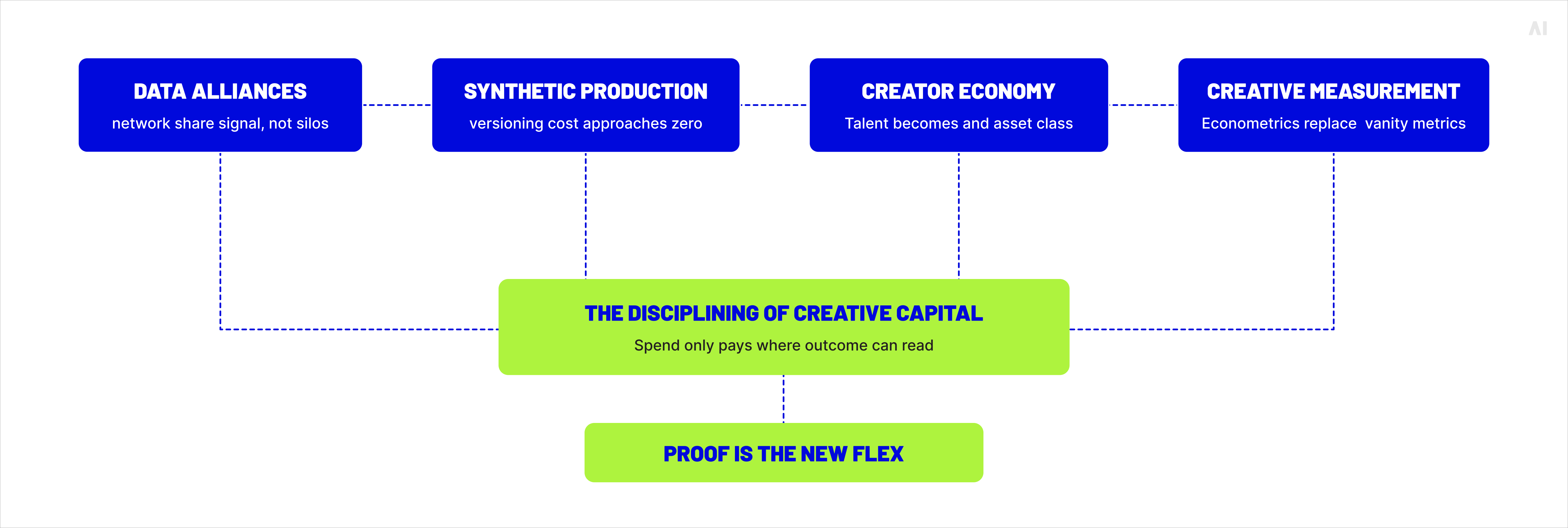
What connects every thread at Cannes this year is the disciplining of creative capital. Data alliances cut the waste of fragmentation, synthetic production collapses the cost of scale, and the creator economy matures into a governable asset—and all three reward only the buyers who can read the relationship between creativity and commercial outcome. That measurement layer, sitting across channels and joining strategy to result, is where the advantage now lives. It is the work AI Digital was built to do, and a conversation we would welcome on the Croisette and after it.