Introducing AI Creative Studio: where human taste meets AI-powered production

Marketing automated the parts that were easiest to measure and left alone the part that drives most of the performance. Creative production is the last manual process in programmatic advertising, and the brands solving it first are finding out what that is worth.
A campaign that shipped six assets a few years ago now needs sixty. Sometimes six hundred. The budget, the team, and the deadline have not moved with it. AI Creative Studio is AI Digital's in-house creative unit, built to close that gap rather than absorb it through overtime.
TL;DR: key takeaways
- AI Creative Studio combines human creative expertise with AI-powered production, helping brands create, adapt, and optimize advertising assets at greater speed and volume than manual workflows support.
- AI accelerates execution. Humans direct it. Strategy, concept development, art direction, brand discipline, and final quality control stay with creative professionals.
- Four capabilities define the offering: AI creative production, adaptation at scale, interactive creatives, and AI creative intelligence.
- Output spans every major format—static and HTML5 banners, rich media, CTV video and overlays, social creative, AI-generated video and UGC, digital audio, motion graphics, and product mockups.
- Creative gets tested before launch, not just after, through synthetic audience testing and predictive scoring.
- Production is one layer of a larger system. Smart Supply determines where creative runs; Elevate measures independently what it achieved.
AI scale, human taste describes how. Experienced designers, strategists, and production specialists direct AI-native workflows, so one approved idea reaches every format, audience, and placement a campaign requires at a cost that no longer rises in step with the output.
This article covers what AI-powered creative production involves in practice, how the studio is built, what it produces, and where it sits inside AI Digital's marketing intelligence ecosystem.
It also answers the question most marketing leaders raise first—whether faster creative and better creative can be the same thing. They can, though the answer depends almost entirely on what a brand refuses to hand to a model.
Why AI-powered creative production matters
Automation has moved through digital advertising unevenly. It reached buying first, then targeting, then measurement. Creative production is where it arrived last—and where the pressure has been building longest.
The creative production bottleneck
Consider what a single campaign now requires.
- Each audience segment wants its own message.
- Each channel imposes its own specifications.
- Each placement has a format, an aspect ratio, a duration limit, a file-weight ceiling.
Multiply segments by channels by placements by the variants meaningful testing requires, and the asset count climbs into the hundreds before anyone has stopped to ask whether it should.
The buying side absorbed that complexity through automation. The production side absorbed it through overtime.
Duke University's Fuqua School of Business, in its spring 2026 CMO Survey with Deloitte and the American Marketing Association, found AI usage in marketing has more than doubled in two years, with companies expecting AI to power more than half of all marketing activities within three years. Underneath that headline sits a less comfortable number: the capability shortfall marketing leaders cite most often is not a missing skill but insufficient people, time, and budget to make existing capabilities effective. Ambition has outrun capacity.
Manual production compounds the problem in three specific ways:
- Limited capacity. Traditional creative workflows were never designed for the volume modern campaigns demand. They were designed for a handful of hero assets and a long lead time.
- Slow execution. High-quality production takes weeks. Launches slip, refreshes get skipped, and optimization cycles stretch until the insight that prompted them has gone stale.
- Rising costs. Every additional format, version, and update adds time, coordination, and expense. Cost scales with output almost linearly, which is precisely what makes scale unaffordable.
Teams stop testing, because testing requires variants and variants require budget. They run the same creative until performance decays. They accept whatever dynamic creative optimization can assemble from a thin asset library, when DCO rewards a deep one. Media efficiency improves while creative effectiveness flattens, and the campaign underperforms for reasons no media report will surface.
What is AI-powered creative production?
AI-powered creative production is the use of generative AI—for image, video, audio, and copy—combined with human creative direction to produce, adapt, version, and test advertising assets at a speed and volume manual workflows cannot reach.
- Generative models handle the labor: rendering, resizing, versioning, voicing, iterating.
- People handle the decisions: what the idea is, who it speaks to, whether the execution earns attention, and whether it is fit to carry a brand's name.
Remove the human layer and you have content generation. Keep it and you have production.
Adoption has moved quickly enough that the debate is now about method rather than merit. According to the IAB's 2026 Digital Video Ad Spend & Strategy Full Report, produced with Advertiser Perceptions and Guideline, nearly two in three buyers now use generative AI for digital video creative, up from half in 2025, and one-third of their ad assets will use it this year—a share projected to reach 43% by 2027.
The harder question for most teams is how to automate ad creative production with AI without surrendering control of the brand, and speed alone does not answer it. Iteration does more of the work. When producing a variant costs hours instead of weeks, testing stops being a luxury reserved for flagship campaigns. Concepts can be explored before they are committed to. Underperforming assets can be replaced mid-flight rather than endured. Creative becomes a variable the team can act on, which is what AI in digital marketing has already done for bidding and targeting, and what AI-driven performance marketing depends on to close the loop.
What generative tools do not supply is taste, strategic intent, or accountability for the result. Those remain human responsibilities, and the studios that treat them as such are the ones producing work worth scaling.
What is AI Creative Studio
AI Creative Studio is AI Digital's in-house creative unit, set up to multiply creative output without diluting it. AI scale, human taste describes a division of labor. AI compresses the production timeline; human creative judgment determines what gets produced, how it looks, and whether it ships.
That makes an AI-powered creative studio a hybrid model rather than a conventional agency or a self-serve generation tool. A traditional creative shop brings craft and concept but hits a ceiling on volume. A generative platform delivers volume with no view on whether the output is any good. AI Creative Studio is structured to supply both, and to do so with an understanding of the media environment each asset will land in—placement, format, audience behavior, and the performance expectations attached to all three.
Most creative studios understand art. Comparatively few understand media. An asset built without knowledge of where it will run is a design exercise; an asset built with it is an advertising decision.
The human + AI creative team
The team is built from AI-native designers, creative strategists, and production specialists—people fluent in generative tooling and in the channel-specific standards that govern display, CTV, social, video, and audio advertising. The tool stack is deliberately broad rather than loyal to a single vendor:
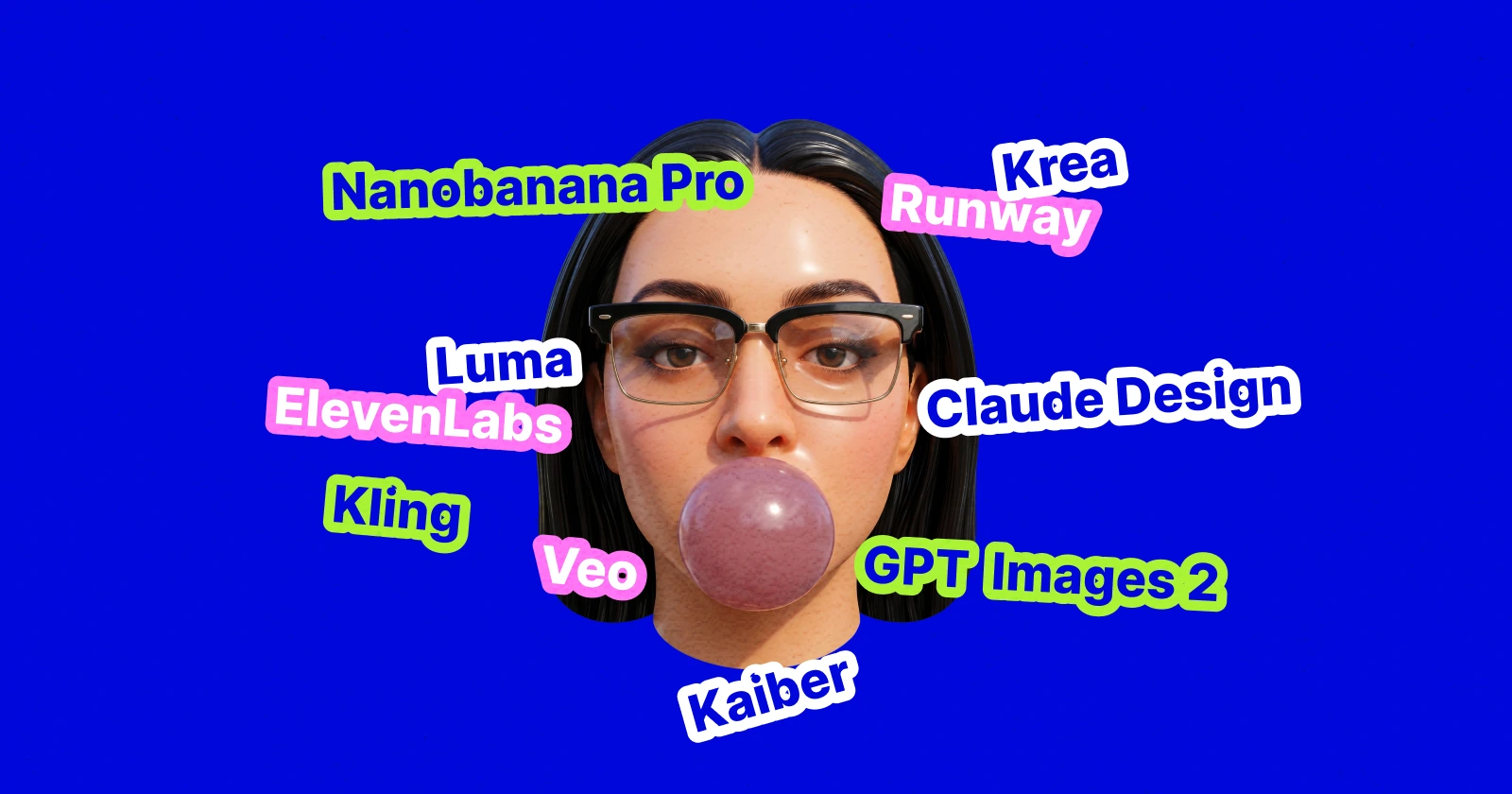
- Runway, Veo, Kling, Luma, and Pika Labs for video;
- ElevenLabs for voice and audio;
- Krea, Kaiber, and Nano Banana Pro for image generation;
- BannerBear and comparable systems for templated production at volume.
Tools change constantly, so building a practice around any single vendor is a mistake. The human layer persists. Art direction, visual intelligence, typography, composition, concept development, and creative strategy sit with people, as does the decision to reject an output and start again—the least glamorous and most consequential part of the process.
Buyers want it that way. IAB research found 96% of buyers agree agentic AI has a role in programmatic, yet 40% want humans kept in the loop—rising to half among small and medium spenders—while 36% want an audit trail for AI decisions and 31% want explicit guardrails on what agents can do. Enthusiasm for automation and insistence on oversight are not in tension. They are the same instinct.
Gartner's 2026 CMO Spend Survey, fielded among 401 marketing leaders, found that labor's share of marketing budgets rose to 24.5% in 2026, up from 21.9% in 2025. AI was expected to reduce the cost of people. Instead it raised the value of the people who can direct it. Direction has become the scarce input, and it is one of the broader challenges of AI in marketing that adoption alone does not solve.
Alongside the AI-native work, AI Creative Studio delivers traditional design services:
- art direction,
- static banners,
- rich media,
- HTML5,
- CTV overlays, and
- social creative, built to spec and on brand.
Not every brief calls for generative production, and treating AI as the answer to every question is its own kind of inefficiency.
⚡ AI changed the cost of making an asset. It did not change the cost of making a bad one.
AI creative production
AI creative production covers original assets built through AI-native workflows under human oversight. Three areas carry most of the volume.
- Cinematic video and motion graphics. Video sequences produced without a shoot, a location, or a crew—usable for CTV, online video, and social placements where production budgets have historically restricted what brands could attempt.
- AI-generated UGC and platform-native video. Creator-style content built to match the visual grammar of social feeds, where polish often performs worse than authenticity. Synthetic presenters and AI avatars extend this into formats that would otherwise require talent contracts and scheduling.
- Voiceover and audio production. AI and human voices, produced in multiple languages, with the audio finishing that digital audio and CTV placements require.
The distinction from generic content generation is intent. Every asset is produced against a placement, an audience, and a KPI—not generated speculatively and assigned a home afterward. A thirty-second CTV spot and a six-second bumper are not the same film trimmed to different lengths; they open differently, brand at different moments, and hold attention through different means. Production that begins from the placement produces work that fits it.
Adaptation at scale
Adaptation is where the volume problem is usually won or lost. A campaign rarely needs six hundred ideas; it needs one strong idea expressed six hundred ways.
AI Creative Studio takes a single approved concept and extends it into channel-ready creative across formats, placements, and audiences. That covers multi-platform versioning and format adaptation, resizing, localization, and creative variations, plus high-volume updates when a price, an offer, or a legal line changes across an entire asset library at once.
Cheap adaptation buys more than savings. Brands can support more audience segments without diluting the central idea, enter new markets without rebuilding from scratch, and refresh creative before fatigue sets in rather than after performance reports confirm it. When adaptation is expensive, all three get deferred.
Interactive creatives
Interactive formats ask the audience to do something, and the engagement data that follows is richer than an impression count.
AI Creative Studio builds HTML5 banners and rich media experiences, interactive CTV overlays and QR-enabled formats that bridge the living room to the phone, and dynamic creative constructed for engagement and conversion rather than reach alone. Playable, shoppable, and expandable units fall into the same category: creative that converts attention into an action inside the ad unit itself.
These formats have historically been expensive to produce and therefore reserved for flagship campaigns. Production economics are what changed, and the formats are now available to campaigns that could never previously justify them. A regional advertiser can run a QR-enabled CTV overlay on the same terms as a national one, which alters who gets to use the most engaging inventory in the market.
AI creative intelligence
AI creative intelligence is the layer that improves creative decisions rather than accelerating creative labor. It spans rapid prototyping and concept development, AI-powered testing and audience feedback, and asset tagging, optimization, and content repurposing.
Several of the underlying tools come from AI Digital Labs, the company's AI transformation and innovation practice:
- Synthetic Focus Group, which identifies the creative most likely to perform before it reaches the market;
- Bulk Creative Tagging, which tags and organizes hundreds of assets in a single upload; and
- Dynamic Resizing, which converts one asset into multiple platform-ready formats in seconds. Labs builds the tooling.
AI Creative Studio applies it with creative direction attached.
AI-generated mood boards, storyboards, and style explorations let a team see three campaign directions rather than describe them—before anyone commits budget to production. Concepts that would once have died in a deck can be evaluated on the strength of the work, which changes what gets made and by extension what runs. The same principle underpins advertising intelligence more broadly: better decisions upstream cost less than corrections downstream.
What can AI Creative Studio produce?
The format range is deliberately wide, because fragmented media planning makes narrow production capability a liability. A brand running display, CTV, social, and audio in the same quarter should not be coordinating four separate suppliers with four different lead times.
Current output spans:
- Display and rich media—static banners, HTML5 banners, rich media units, native and interactive formats
- Video—TV-grade AI video, CTV video production, static-to-video generation, motion graphics, logo animation
- Connected TV—interactive CTV overlays and QR-enabled experiences
- Social—platform-native creative for stories, reels, and feeds, plus AI-generated UGC and synthetic presenters
- Audio—AI and human voiceover, digital audio assets in multiple languages
- Commerce and product—dynamic ads with AI product versioning, product and packaging mockups, product review video
- Concepting—mood boards, storyboards, ad copy variations, campaign style explorations
Set against traditional production, the differences are structural rather than incremental.
Human involvement does not disappear in the AI-assisted column—it concentrates. Time previously spent on resizing and reformatting returns to concept, direction, and judgment, which is where creative professionals add value that no model replicates.
How AI Creative Studio works
Engagement follows a defined sequence, and human checkpoints are built into it rather than bolted on at the end.
- Campaign briefing. The studio works from campaign objectives, audience definitions, channel mix, and brand guidelines. Where a brand is already working with AI Digital on media, planning intelligence informs the brief—the creative team knows which placements and audiences the assets need to serve before design begins.
- Concept development. Creative strategists and art directors develop the central idea. AI-generated mood boards and style explorations accelerate visualization, but direction is set by people. Concepts are reviewed and approved before production starts.
- AI-assisted production. Approved concepts move into AI-native production workflows. Designers direct the generative tooling, curate outputs, and refine results—closer to art direction on a shoot than to prompt entry.
- Adaptation across formats and channels. The approved concept extends into every required format, placement, and audience variant, with localization handled inside the same workflow.
- Human review and quality control. Every asset is checked for brand consistency, technical compliance, and creative quality before delivery. Nothing ships on the strength of a model's confidence.
- Delivery and iteration. Assets are delivered campaign-ready. Performance feedback informs refreshes, new variants, and the next production cycle.
AI never holds a decision that carries brand risk.
How AI Creative Studio optimizes creative performance
Most creative optimization happens too late. A campaign launches, data accumulates, and by the time a winner emerges a meaningful share of the budget has already been spent proving which asset was weaker. Pre-launch validation attacks that sequence directly.
- Before launch, synthetic audience testing simulates how a target segment is likely to respond to competing executions, generating predicted performance scores that let teams identify probable winners before media budget is committed. AI-powered ideation widens the pool of concepts worth testing, and rapid prototyping makes evaluating them affordable. The purpose is not to replace real-world results but to stop obviously weaker work from consuming spend on its way to being disproven.
- After launch, asset tagging turns a creative library into an analyzable dataset. When every asset is tagged by format, message, visual treatment, and audience, patterns emerge that impressions and clicks alone will not show—which openings hold attention on CTV, which color treatments underperform in social feeds, which messages work for one segment and fail for another. Those findings feed the next production cycle, and the loop tightens with each round.
Validation is one component of AI creative intelligence rather than a standalone product. Prediction that never reaches the people making creative decisions is a report. Prediction embedded in a production workflow changes what gets made.
Buyers are already asking for precisely this. IAB's video research found that among smaller buyers, 96% are dissatisfied with their current level of generative AI use for creative ad production, with more than four in ten wanting stronger proof of performance and easier integration with platforms and DSPs. Access to generative tools is no longer the constraint. Confidence in the output is.
⚡ Access to generative tools stopped being a competitive advantage some time ago. Knowing which output deserves media budget has not.
Why brands need AI Creative Studio
Campaign complexity has grown faster than creative capacity, and the gap is now wide enough to affect performance rather than merely workflow.
The benefits compound:
- Faster production cycles, so launches hold their dates and refreshes happen before fatigue sets in
- More creative variation, making genuine testing viable rather than aspirational
- Easier localization across markets, languages, and channels within one workflow
- Lower production costs per asset, particularly on versioning and adaptation
- Stronger creative testing, with prediction before launch and analysis after it
- Better campaign performance, because creative quality remains among the largest controllable variables in advertising outcomes
Testing stops being reserved for flagship campaigns. Creative gets refreshed on a schedule rather than after a performance report confirms decay. Audience segments receive creative built for them instead of a shared generic asset. New markets become a localization task inside an existing workflow rather than a separate project with its own budget line. Channel mix starts being dictated by media strategy rather than by whichever formats a production supplier can handle.
Volume without judgment produces more assets and worse advertising, and the market is alert to the difference. Gartner's Ewan McIntyre put the constraint plainly in the firm's 2026 survey commentary: "AI is not a shortcut around marketing capability." Scale and standards have to be engineered together, which is the entire argument for keeping creative professionals at the center of an AI-powered process.
AI Creative Studio within AI Digital's ecosystem
Creative production is one layer of a larger system. Excellent assets delivered into poor inventory underperform. Excellent assets measured through platform-reported metrics look successful whether or not they were. Production, delivery, and measurement are interdependent, which is why AI Digital treats them as connected layers rather than separate services—an approach that distinguishes a genuine AI marketing platform from a traditional martech stack assembled from disconnected tools.
Delivering creative through premium inventory
An asset can only perform as well as the environment it lands in. Fraudulent impressions, invalid traffic, and low-quality placements degrade results regardless of creative quality, and the industry knows how exposed it is. IAB's 2026 video report found that 43% of buyers report somewhat to no confidence in the quality of inventory they purchase even through the most trusted CTV methods, rising to 55% for private marketplaces and 67% for open exchange and RTB.
Smart Supply addresses that exposure.
- It delivers premium, outcome-based supply through curated, AI-powered deal IDs built against each campaign's KPIs, with direct SSP partnerships providing 99.9% coverage of top-tier supply.
- AI-driven filtering removes fraud, invalid traffic, and inefficient placements before they reach an advertiser, while in-flight adjustments refine bidding and targeting as campaigns run.
- Execution stays DSP-agnostic, so supply decisions are made on performance rather than platform preference.
Creative quality and media quality multiply each other rather than substituting for one another, which is why production and supply belong in the same conversation.
Measuring what actually works
Production and delivery still leave the central question open: what did the creative achieve?
Platform-reported metrics are an unreliable answer, since each platform grades its own performance. Elevate, AI Digital's intelligence platform, measures independently across the ecosystem—connecting fragmented data into a single view spanning research, planning, optimization, and reporting across 12+ integrated DSPs, drawing on 150 billion monthly data points and 8,000 analyzed campaigns.
For creative specifically, Elevate's marketing mix modeling and path-to-conversion analysis show which touchpoints influenced conversions across channels, rather than assigning credit to whichever platform recorded the last click.
Elevate does not produce or assemble creative; it establishes what the creative accomplished once activated, which is the only basis on which the next production cycle can be planned intelligently.
That independence is what separates a true marketing intelligence platform from platform dashboards, and it reflects where buyers are heading—the IAB's 2026 Outlook Study recorded cross-platform measurement rising to a 72% priority among advertisers, up from 64% year over year.
Getting marketing measurement right is what converts creative output into creative learning.
Connecting creative, media, and measurement
Holding the layers together is the Open Garden Framework, AI Digital's vendor-neutral operating model. Its premise is that brands should orchestrate their own strategy, data, and outcomes rather than accept the terms of closed platforms—and its four pillars run from vendor-neutral architecture and a curated supply strategy through AI-powered intelligence to unified cross-channel measurement.
For creative, that means assets are not built to one platform's specifications and stranded there. Supply decisions are made on merit rather than platform allegiance. Measurement is consistent across channels, so creative performance can be compared rather than merely reported. AI Creative Studio produces, Smart Supply delivers, Elevate measures, and the same brand-first logic governs all three.
Human + AI: the next era of creative production
The advantage in advertising is passing to organizations that can move at machine speed while retaining human judgment about what deserves to be made. Neither half works alone. AI without direction produces volume that no one wants to watch. Human craft without AI produces work of real quality at a pace the market has outgrown.
AI Creative Studio is built for the combination. Production timelines compress, variation becomes affordable, formats stop dictating strategy, and creative professionals spend their time on the decisions that determine whether advertising works—the idea, the execution, the standard. Set within an ecosystem that also governs where creative runs and measures independently what it achieved, creative production stops being a bottleneck and starts functioning as a competitive advantage.
Most studios understand art. AI Digital understands media—and creative built with that understanding performs before the first impression is ever served.
⚡ Automation reached buying, then targeting, then measurement. Creative was always going to be next. The organizations that fare best are the ones that decided in advance what they were not willing to automate.
Explore the AI Creative Studio, discover our high-impact creative solutions, or get in touch to discuss scaling creative production.