Marketing Measurement Is Broken — Here’s Why Most Data Can’t Be Trusted


Marketing measurement is no longer failing because marketers lack dashboards. It is failing because most dashboards are built on partial, platform-controlled, and disconnected data. A paid social platform may report strong conversions. Search may claim high return on ad spend. A retail media network may show sales lift inside its own environment.
But when senior marketers try to measure marketing performance across the full customer journey, those numbers often do not connect into one reliable business view. Each platform measures what happens inside its own walls, using its own attribution logic, reporting window, identity signals, and performance definitions.
That creates a serious problem for modern marketing measurements. The numbers look precise, but the picture is incomplete. A conversion may be credited to the last clickable ad, while the earlier brand exposure, CTV impression, creator recommendation, retail media touchpoint, or offline influence disappears from the analysis. The result is not just imperfect attribution. It is a distorted version of customer behavior.
This is why confidence in marketing measurement can be misleading. Nielsen’s 2025 Annual Marketing Report found that 84% of global marketers were confident in their martech’s ability to measure ROI, yet only 38% measured traditional and digital marketing together. The gap matters: marketers may feel confident in the tools they use, while still measuring channels in isolation rather than understanding total business impact.
The problem is structural. Today’s digital ecosystem is fragmented across walled gardens, retail media networks, CTV platforms, programmatic environments, mobile apps, creator platforms, and offline touchpoints. IAB Europe’s 2025 addressability and measurement research shows how deep this fragmentation has become: 68% of respondents cited lack of cross-platform data access and transparency as a key addressability challenge, while 53% cited attribution without cookies and 53% cited lack of standardization as major privacy-first measurement challenges.
💡Fixing marketing measurement therefore requires more than choosing between attribution, MMM, or incrementality testing. Those models are useful, but they depend on the quality, coverage, and consistency of the data feeding them. A modern measurement approach needs a marketing intelligence platform that can unify data across channels, normalize performance signals, connect media activity to business outcomes, and help teams move from fragmented reporting to decision-ready insight.
This article explains why marketing measurement breaks in today’s digital ecosystem and how marketers can rebuild it around unified data, cross-channel visibility, and business-driven decision-making.
Marketing measurement worked — until the ecosystem changed
Marketing measurement used to follow a cleaner operating logic: track the user, assign credit to the channel that influenced the conversion, and move budget toward the campaigns with the strongest reported performance. This model was useful when digital media was concentrated across fewer platforms, tracking signals were more stable, and customer journeys were easier to observe.

In that environment, marketers could measure marketing performance through attribution models, platform-reported data, and channel-level KPIs. Search, paid social, display, and email gave teams fast feedback through metrics such as ROAS, CPA, CTR, CPM, conversion rate, and revenue per campaign. If paid search reported a lower cost per acquisition than display, budget could shift to search. If a retargeting campaign generated purchases, it could be scaled. The system was not perfect, but it gave performance teams a practical way to compare channels and justify spend.
The problem is that this model confused what was measurable with what was valuable. Channels that produced clicks and direct conversions looked stronger because they were easier to track. Channels that shaped demand earlier, such as CTV, video, audio, retail media, influencer content, and brand campaigns, were harder to connect to revenue and were often undervalued.
That weakness became more damaging as the media ecosystem fragmented. A customer may discover a product through a creator, see a CTV ad days later, compare options through search, read reviews, receive an email, and finally convert through a branded search ad. Traditional attribution may give most credit to the final interaction, even though the decision was created across several earlier touchpoints.
The scale of this fragmentation is now too large for channel-level reporting to solve alone. WPP Media estimated that digital advertising would account for 73.2% of global ad revenue in 2025, showing how much marketing investment now flows through digital environments that are highly platform-specific and difficult to reconcile into one view.
This is why traditional marketing measurement no longer gives marketers a complete picture. Attribution, dashboards, and platform metrics still matter, but they were designed for a more trackable ecosystem. Modern marketing measurement must connect fragmented signals across channels and explain how marketing activity contributes to revenue, growth, and real customer behavior.
Why marketing measurement breaks in today’s digital ecosystem
Marketing measurement breaks because today’s digital ecosystem is not one connected environment. It is a set of separate platforms, each with its own reporting rules, attribution windows, identity signals, and performance definitions. A conversion reported by Google, Meta, Amazon, TikTok, or a retail media network may look like the same business outcome, but it is often calculated through different logic.

The problem is not that attribution, MMM, or incrementality are useless. The problem is that each method depends on reliable inputs. Attribution needs visible touchpoints. MMM needs consistent historical data. Incrementality testing needs clean test and control conditions. When those inputs are split across walled gardens, CTV platforms, retail media networks, programmatic systems, CRM tools, and offline sales channels, the models produce less reliable answers.
This is why platform-reported data can be risky. A platform may claim credit for a sale because a user clicked, viewed, or interacted with an ad inside its environment. But that same customer may have also seen a CTV ad, searched for reviews, received an email, or compared products through another channel before buying.
⚡️For a deeper read, The Problem with Platform-Reported Data: Why You Can’t Trust the Numbers explains why platform dashboards often overstate their own role and make cross-channel performance harder to evaluate.
The scale of the issue is visible in recent industry research. DoubleVerify’s 2025 Global Insights report, based on 22,000 consumers and 1,970 marketing and advertising decision-makers, describes a market where consumer attention is concentrated inside walled gardens, while data is “locked behind walls” and the path from media investment to outcome is harder to see. The report also notes that Facebook and Instagram alone were expected to command $192 billion in global ad spend in 2025, showing how much budget now sits inside platform-controlled environments.
Structural limits
The first problem is structural. Walled gardens restrict how much data marketers can access, export, compare, and connect. Google, Meta, Amazon, TikTok, retail media networks, CTV platforms, and programmatic environments may all report performance, but they do not automatically combine into one neutral view of the customer journey.
This creates duplicated credit and inconsistent measurement. One platform’s “conversion” may be based on a click. Another may include view-through attribution. Another may use a different reporting window. The result is that marketers are not comparing like with like.
💡Fragmented martech stacks make the problem worse. CRM data, web analytics, media reporting, offline sales, and campaign planning often sit in separate tools.
⚡️For a deeper read, Why Fragmented Martech Stacks Kill Marketing Performance explains how disconnected systems create reporting gaps, slow optimization, and weaken budget decisions.
Measurement fails to capture real behavior

Real customer behavior does not follow a neat funnel. A buyer may first discover a brand through a creator video, later see a CTV ad, search for reviews, compare prices on a retail platform, receive an email, and finally convert through branded search.
Traditional measurement often gives the most credit to the final visible action. That makes paid search, retargeting, and affiliate campaigns look stronger because they sit close to conversion. Meanwhile, brand, video, CTV, creator marketing, and upper-funnel programmatic activity can appear weaker because their influence happens earlier and is harder to isolate.
This distorts decision-making. Marketers may shift budget toward channels that are easiest to measure, not necessarily the channels that create demand, improve consideration, or contribute to long-term revenue.
Missing and underrepresented channels
Measurement also breaks when important channels are poorly measured or excluded from the analysis. CTV, retail media, gaming, creator platforms, audio, and in-store media often influence customer decisions, but their data is harder to connect with search, social, CRM, and sales systems.
This creates a skewed view of performance. For example, CTV may build awareness and consideration before a customer searches for the brand, but the final search click often receives more credit. Retail media may influence purchase decisions close to the point of sale, but its metrics are not always comparable across networks. IAB Europe’s 2025 Retail Media report found that network fragmentation remains a barrier for 51% of respondents, while lack of standardization is a barrier for 53%. That means retail media is growing, but measurement consistency is still not mature enough for clean cross-network comparison.
⚡️This is why programmatic environments need to be evaluated as part of a connected media system, not as isolated inventory sources. For more context, see Programmatic Advertising Platforms, which explains how programmatic platforms organize buying across channels, audiences, and inventory sources.
Why models break in this environment
Attribution, MMM, and incrementality are not broken by themselves. They break when they are forced to work with incomplete or inconsistent data. Attribution becomes biased when key touchpoints are missing. MMM becomes less precise when historical inputs are inconsistent across channels. Incrementality testing becomes harder when audiences overlap, platform exposure is hidden, or control groups are difficult to isolate.
💡This matters because modern measurement models are only as strong as the signals they receive. If CTV exposure, retail media activity, creator influence, offline sales, and CRM data are not connected, the model cannot fully explain how marketing creates demand or drives revenue.
For a deeper read, Marketing Measurement vs Attribution vs MMM: What’s the Difference clarifies how these methods differ and where each one fits. For deeper context on modeling, see Mixed Media Modeling, which explains how MMM connects channel investment with business outcomes over time.
The cost of broken marketing measurement
Broken marketing measurement is not only a reporting problem. It changes business decisions. When marketers rely on incomplete data, they may allocate budget incorrectly, overvalue short-term performance channels, undervalue demand creation, and struggle to prove ROI to leadership.
💡The cost appears in three places: where budget goes, which channels receive credit, and how confidently teams can connect marketing activity to revenue. Once the measurement system is distorted, optimization also becomes distorted.
Misaligned budget allocation
Incomplete measurement pushes budgets toward channels that are easier to track, not necessarily channels that create the most value. Paid search, retargeting, and affiliate activity often look efficient because they sit close to conversion. But they may be capturing demand that was created earlier by video, CTV, creator content, retail media, or brand campaigns.
This creates a false sense of efficiency. A channel may show strong ROAS because it receives credit at the final stage of the journey, while upper-funnel channels appear weaker because their impact is harder to isolate. Over time, this can lead marketers to cut the very activity that creates future demand.
⚡️For a deeper read, Media Mix Optimization: How to Use MMM for Budget Allocation explains how modeling helps marketers compare channel contribution beyond last-click performance and make budget decisions based on business impact, not just trackable conversions.
Overinvestment in trackable channels
Broken measurement often makes performance channels look stronger than they really are. Paid search, retargeting, and affiliate campaigns usually sit close to conversion, so they capture demand at the moment a customer is already ready to act. In reporting, this can make them appear more efficient than channels that created the original interest.
The problem is not that performance marketing lacks value. It is that trackable channels often receive too much credit because their impact is easier to document. Brand-building activity, video, CTV, creator content, and upper-funnel programmatic media may influence awareness, trust, and consideration, but their effect is harder to connect to a single click or sale.
This creates a budget trap. Marketers may keep increasing spend on channels that harvest existing demand while reducing investment in channels that create future demand. Over time, growth becomes harder because the business is optimizing for short-term conversions, not the full demand cycle.
Weak ROI visibility
Broken measurement also makes it harder to prove marketing’s value to leadership. When data is fragmented, ROI reporting becomes a negotiation between different dashboards instead of a clear explanation of business impact. One platform may report strong ROAS, another may claim assisted conversions, while finance may see a different revenue picture.
This is especially risky when budgets are under pressure. Gartner’s 2025 CMO Spend Survey found that marketing budgets remained flat at 7.7% of company revenue, while 59% of CMOs said their budgets were insufficient to execute their strategy. In that environment, weak ROI visibility makes marketing more vulnerable: if leaders cannot clearly see which activities drive revenue, they are more likely to challenge spend or cut investment.
Marketing intelligence platforms: a new measurement model
Fixing marketing measurement requires more than replacing one model with another. A business cannot solve fragmented measurement simply by switching from last-click attribution to MMM, or by adding occasional incrementality tests. Those methods are useful, but they still need connected, consistent, and business-relevant data.
A marketing intelligence platform creates the operating layer that traditional measurement is missing. It brings media, audience, campaign, sales, CRM, and revenue data into one system, so marketers can evaluate performance across channels instead of interpreting separate reports in isolation.
⚡️For a deeper read, Marketing Intelligence Platforms: From Data to Decisions to Performance explains the core components of this type of system.
The value is not only technical. It changes how marketing teams make decisions. Deloitte’s 2025 Marketing Investment Trends report found that organizations investing more in martech than working media saw 18% greater sales lift from marketing and 7% greater overall revenue growth than organizations that invested more in working media than martech. The point is not that media spend matters less. It is that media spend works harder when teams have the infrastructure to connect data, interpret performance, and act on insights faster.
⚡️For a related read, Marketing Analytics vs Marketing Intelligence: Why the Difference Matters for Growth explains why intelligence goes beyond reporting by connecting analysis to planning, optimization, and business decisions.
Unified data across channels
A marketing intelligence platform consolidates data from paid search, paid social, programmatic, CTV, retail media, CRM, web analytics, offline sales, and revenue systems into a single view.
This does not mean every channel becomes perfectly measurable. It means data is cleaned, normalized, and organized so marketers can compare performance using consistent definitions.
💡Instead of reviewing separate dashboards with different attribution rules, teams can see how channels contribute together. This reduces duplicated credit, exposes gaps in coverage, and gives marketers a more reliable base for attribution, MMM, and incrementality analysis.
Cross-channel decision-making
Once data is unified, teams can make budget decisions across the full media mix, not just inside individual platforms. A search campaign may look efficient on its own, but a connected system can show whether that efficiency depends on demand created by video, CTV, creator content, or retail media.
This matters because optimization should not only ask, “Which campaign has the lowest CPA?”
It should ask, “Which combination of channels creates the strongest business outcome?” A marketing intelligence platform helps teams move budget based on total contribution, not isolated platform performance.
From metrics to business outcomes
Modern measurement needs to connect marketing activity to revenue, growth, customer acquisition, retention, margin, and ROI. Platform metrics still matter, but they are not the final objective. Clicks, impressions, reach, and conversions only become useful when they explain business impact.
A marketing intelligence platform helps translate fragmented marketing measurements into decisions leadership can trust.
⚡️For a deeper read, Unified Marketing Measurement: What It Is and Why It Matters explains how connected data turns channel-level reporting into a clearer view of marketing’s role in business growth.
Turning fragmented measurement into growth with AI Digital
AI Digital shows how fragmented measurement can be turned into a connected decision system. Instead of treating measurement as a final reporting task, AI Digital positions intelligence as part of the full marketing workflow: planning, supply selection, optimization, reporting, and performance analysis.
This matters because broken measurement is rarely caused by one missing dashboard. It usually comes from disconnected data, unclear supply paths, inconsistent platform reporting, and slow decision-making. AI Digital’s approach connects these layers through AI-driven analysis, transparent media infrastructure, and interoperable workflows.
💡This is where AI becomes practical. In modern measurement, AI is not just used to automate reports. It helps process large volumes of campaign, audience, supply, and performance data faster than manual teams can.
⚡️AI Digital’s article on AI in Digital Marketing explains this wider role of AI in campaign optimization, predictive analytics, real-time adjustments, and performance improvement.
Unified intelligence with Elevate
Elevate acts as the intelligence layer of AI Digital’s model. The platform is positioned around connecting fragmented data into control, strategy, and measurable business results. AI Digital states that Elevate analyzes 150 billion monthly data points, works across 12+ DSP integrations, and supports the marketing lifecycle from research and intelligence to planning, optimization, reporting, and AI agents.
For measurement, the value is clear: marketers need fewer isolated dashboards and more connected intelligence. Elevate helps teams move from manual interpretation toward faster budget, audience, and performance decisions based on cross-channel signals.
Cleaner data through Smart Supply
Smart Supply supports measurement from the supply side. This is important because poor inventory quality creates poor data quality. If campaigns run through inefficient paths, hidden markups, low-quality placements, or biased supply routes, the resulting performance data becomes noisy.
Smart Supply is positioned around outcome-based supply, direct SSP access, AI-powered optimization, transparent placements, and DSP-agnostic execution. AI Digital also states that it uses real-time filtering and in-flight deal adjustments to improve traffic quality and reduce waste.
This strengthens measurement because cleaner supply paths make campaign results easier to interpret. Marketers are not only asking which channel performed better; they are also asking whether the media quality behind that performance was reliable.
Interoperability with Open Garden Framework
The Open Garden Framework addresses the structural problem behind broken measurement: closed ecosystems. AI Digital frames walled gardens as environments with siloed data, restricted signals, limited cross-channel optimization, and platform-controlled measurement. Its alternative is a tech-agnostic, vendor-neutral model that connects data, inventory, and outcomes across the digital ecosystem.
⚡️This is especially relevant for brands that need consistent tracking across DSPs, SSPs, retail media, CTV, and other programmatic environments. The related article What Is the Open Garden Framework reinforces this point by arguing that the future is not a simpler stack, but a more interoperable one.
💡In measurement terms, AI Digital’s model gives marketers a clearer path from fragmented data to business growth: unify intelligence with Elevate, improve signal quality through Smart Supply, and connect the ecosystem through Open Garden.
AI-powered measurement at scale
AI-powered measurement gives marketing teams a way to move beyond static reporting. Instead of waiting for weekly or monthly performance reviews, AI can process campaign, audience, supply, and revenue signals continuously, then identify patterns while campaigns are still active.
⚡️This matters because modern marketing produces more data than teams can manually interpret at speed. AI Digital’s article on AI in Marketing Automation explains this shift clearly: AI-driven automation helps teams analyze historical and real-time marketing data, predict outcomes, optimize campaigns, and reallocate budgets across channels. The article also connects AI automation to measurable performance metrics such as CAC, LTV, ROAS, conversion rate, pipeline velocity, and churn.
For measurement, the value is practical. AI can detect when performance changes across channels, when supply quality affects outcomes, or when one audience segment is becoming more efficient than another. This turns measurement into an active optimization system rather than a post-campaign report. Instead of only explaining what happened, AI-powered measurement helps marketers decide what to change next.
How to move to modern marketing measurement
Moving to modern marketing measurement starts with an audit of what the current system cannot see. Marketers need to identify where data is missing, duplicated, delayed, or defined differently across platforms. That includes checking whether CRM data, media spend, web analytics, offline sales, retail media, CTV, creator activity, and revenue data are connected or still reviewed separately.
The next step is improving data coverage. This does not mean every customer interaction must be tracked at the user level. In a privacy-first environment, that is no longer realistic. Instead, teams need consistent channel inputs, clean naming conventions, reliable conversion definitions, and enough historical data to compare performance over time.
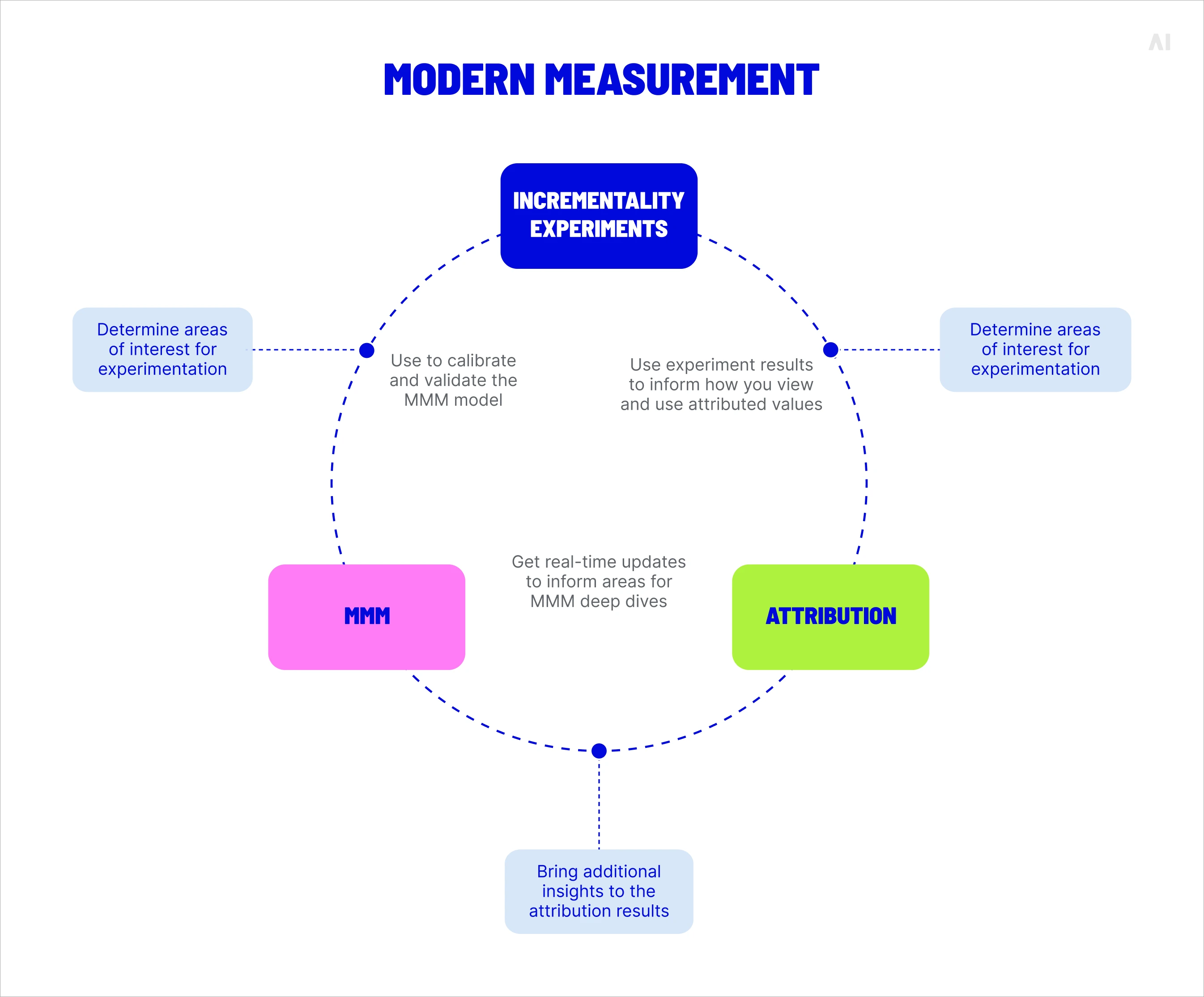
Modern measurement also requires using different methods together. Attribution can help explain short-term digital interactions. MMM can show how channel investment affects business outcomes over time. Incrementality testing can validate whether a campaign caused additional results or simply captured existing demand. Used separately, each method has limits. Used together, they give marketers a more balanced view of performance.
The final step is aligning measurement with business outcomes. Marketing teams should not optimize only toward clicks, impressions, platform ROAS, or last-touch conversions. They should connect measurement to revenue, margin, acquisition efficiency, retention, customer lifetime value, and growth.
⚡️For a deeper read, Marketing Planning Software: How to Connect Planning, Optimization, and Reporting in One System explains how marketers can bring these workflows together instead of treating measurement as a separate reporting function. The goal is to make measurement part of daily decision-making: what to fund, what to reduce, what to test, and where growth is actually coming from.
From fragmented measurement to real business growth
The goal of modern marketing measurement is not better reporting for its own sake. It is better business decision-making. When marketers adopt a marketing intelligence platform, they gain a clearer view of how channels work together, where budget is being wasted, and which activities are actually contributing to revenue, growth, and ROI.
This is the shift AI Digital emphasizes: campaign success should move beyond media metrics and connect to real brand and business outcomes. Its Get in Touch page positions Elevate as a proprietary insights, optimization, and measurement platform designed to provide greater accountability for media spend and shift success from media metrics to business results.
That matters because fragmented measurement often keeps teams reactive. They compare disconnected dashboards, defend channel-level performance, and make budget decisions with incomplete evidence. A unified intelligence layer changes the workflow. It connects planning, optimization, reporting, and measurement so marketers can act on cross-channel performance rather than isolated platform claims.
⚡️With AI Digital’s model, the growth path is clearer: Elevate turns fragmented data into strategy and measurable results, Smart Supply improves the quality of the media signals being measured, and the Open Garden Framework helps reduce platform silos by supporting a more connected and interoperable ecosystem.
Key takeaways
- Fragmented measurement creates fragmented decisions. When each platform reports performance through its own logic, marketers cannot see the full customer journey clearly.
- A marketing intelligence platform connects the system. Unified data helps teams compare channels, reduce duplicated credit, and understand total business impact.
- AI Digital’s model supports outcome-driven measurement. Elevate provides intelligence and measurement, Smart Supply improves signal quality, and Open Garden Framework supports interoperability across the media ecosystem.
- Growth depends on connected decision-making. Better measurement should help marketers decide where to invest, where to reduce waste, and how to connect marketing activity to revenue and ROI.
⚡️To move from fragmented measurement to measurable growth, get in touch with AI Digital and explore how unified intelligence can support stronger budget decisions, reduced waste, and scalable performance optimization.