Fragmented Martech Stacks Are Killing Marketing Performance — Here’s Why
Marketing teams do not have a technology shortage. They have a connection problem. Over the last decade, companies have added CRM systems, CDPs, analytics platforms, automation tools, DSPs, attribution tools, dashboards, and reporting layers to improve performance. But when these tools operate separately, they create the opposite effect: disconnected data, inconsistent reporting, slower decisions, and weaker ROI visibility.
This is the core problem behind fragmented martech stacks. Each tool may solve a specific workflow, but the full system often fails to show how marketing activity contributes to revenue, customer growth, or media efficiency. A campaign can look successful in one platform, underperforming in another, and unclear in the finance view. That makes martech stack optimization a business priority, not just an operational cleanup task.
McKinsey’s 2025 martech research shows the scale of the issue: 47% of martech decision-makers cite stack complexity, system complexity, and data integration challenges as key blockers to getting value from martech tools. McKinsey also found that many organizations lack core enablers such as cross-channel integration, data governance, and the ability to measure business impact from martech investments.
⚡️AI Digital’s guide to marketing technology frames martech as practical infrastructure: it should unify first-party data, coordinate journeys across touchpoints, enforce governance, and connect marketing effort to business results.
This article explains why martech stacks fragment, where performance breaks, and how a connected marketing intelligence approach can turn scattered tools into a system for better measurement, faster decisions, and scalable growth.
What is a fragmented martech stack?
A fragmented martech stack is a collection of marketing tools that operate without enough integration, shared data structure, or common measurement logic. The issue is not simply having many tools. A large stack can work if the systems are connected, governed, and designed around clear business outcomes. Fragmentation happens when those tools become independent islands.
In practice, this means customer data sits in one system, campaign data in another, media performance in several platform dashboards, sales data in a CRM, and reporting in a separate analytics tool. Each platform may use different naming conventions, attribution windows, campaign taxonomies, and conversion definitions. The result is not one reliable performance view, but several partial versions of reality.
That creates a serious problem for martech strategy. If paid media, CRM, web analytics, retail media, and sales data cannot be connected, marketers cannot clearly see which activities are creating demand, converting customers, or improving ROI. Teams may spend more time reconciling reports than making decisions.
💡This is why fragmented stacks directly affect performance. They slow optimization, create duplicated work, weaken measurement confidence, and make budget allocation less accurate.
Gartner’s 2025 CMO Spend Survey found that marketing budgets remained flat at 7.7% of company revenue, while 59% of CMOs said they did not have enough budget to execute their strategy. In that environment, disconnected technology is costly because teams cannot afford wasted spend, duplicated tools, or unclear ROI.
⚡️A guide by AI Digital, AI Marketing Platform vs Traditional Martech Stack, explains how AI-powered platforms differ from disconnected collections of tools.
⚡️Another AI Digital guide, Why Fragmented Data Is Breaking Cross-Platform Performance, goes deeper into the data layer, showing how disconnected datasets weaken measurement, attribution, and optimization across channels.
The real causes of martech stack fragmentation
Martech stack fragmentation rarely happens because a company makes one bad technology decision. It usually happens gradually. A team adds one tool to fix reporting, another to automate email, another to manage paid media, another to improve attribution, and another to support a new channel. Each decision may be reasonable in isolation. The problem appears later, when those tools do not share the same data structure, measurement logic, or business goal.
💡That is why fragmentation is not only a technology issue. It is a misalignment between technology, data, and decision-making. A stack can include strong platforms and still fail if customer data, media data, sales data, and performance reporting cannot move through the system cleanly.
⚡️AI Digital’s article on open web programmatic makes this point in the media context: as advertising expands across open web environments, programmatic systems, data partners, and optimization layers, performance depends on transparency, interoperability, and the ability to connect signals across the ecosystem.
Tool-first decisions
One of the most common causes of fragmentation is tool-first decision-making. A marketing team faces a specific problem, such as slow reporting, poor lead scoring, weak campaign automation, or limited audience segmentation. To solve it quickly, the team buys a tool. The tool solves the immediate workflow, but it is not always evaluated against the wider system architecture.
Over time, this creates a patchwork stack. The CRM holds one version of the customer. The analytics platform holds another. Paid media platforms report their own conversions. Email and automation tools use their own audience rules. Finance may still evaluate revenue separately. The company has more technology, but not necessarily more clarity.
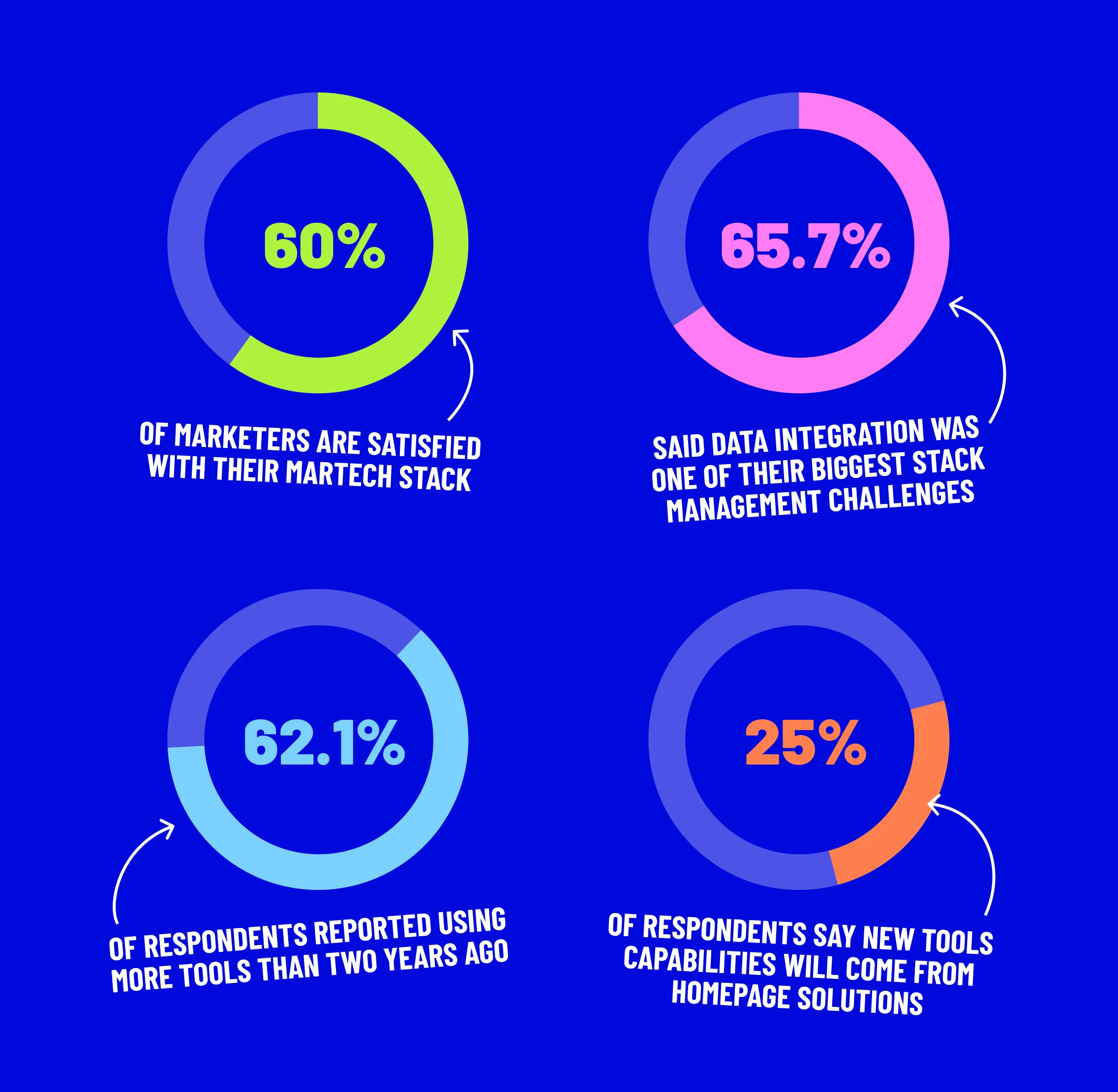
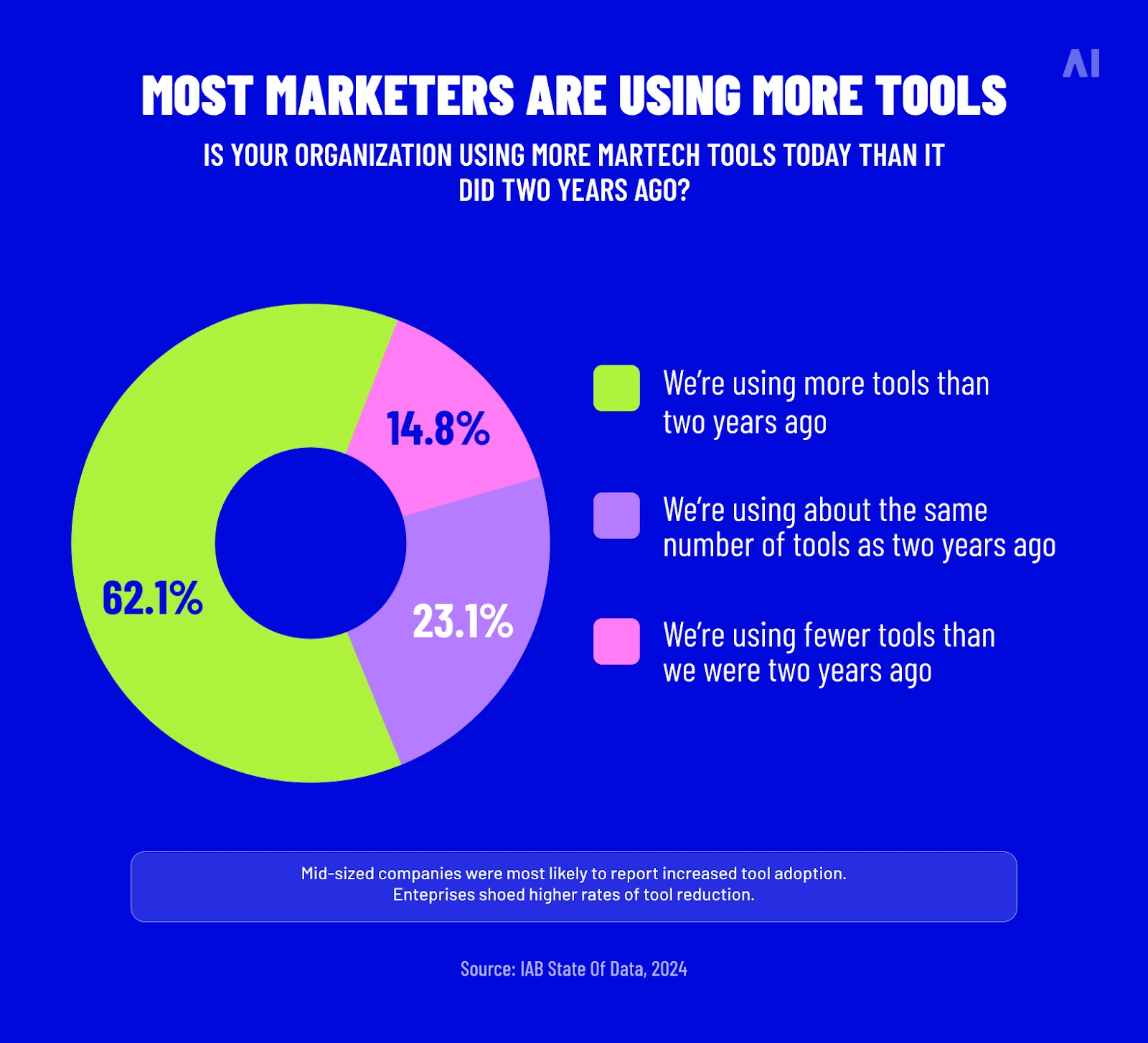
This pattern is visible across the wider martech market. The 2025 State of Your Stack Survey found that 62.1% of respondents use more martech tools than they did two years ago, while 65.7% said data integration is one of their biggest stack-management challenges. The interpretation is clear: teams are adding tools faster than they are connecting them.
Point-to-point integrations that don’t scale
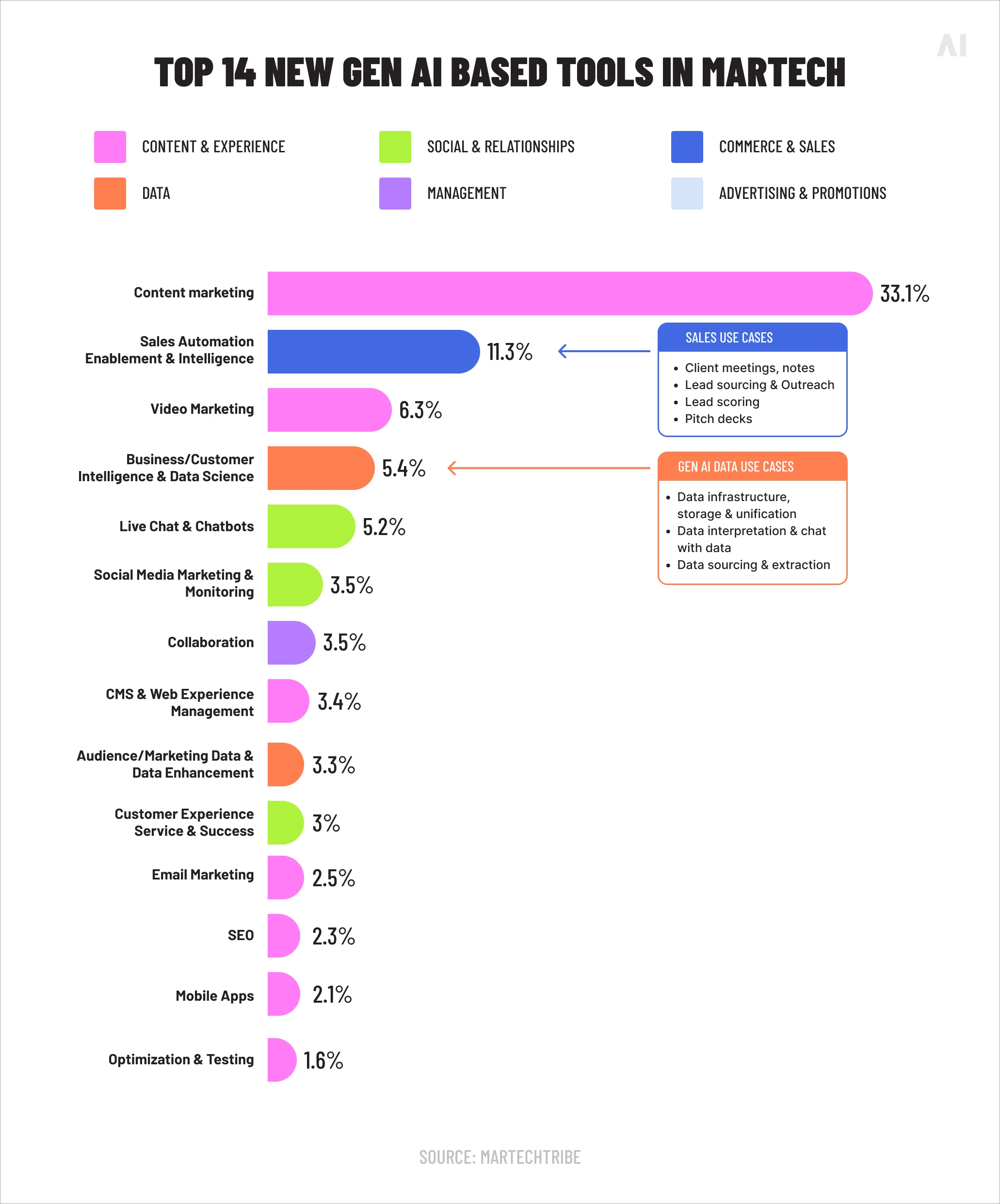
Many companies try to fix fragmentation through quick point-to-point integrations. One tool is connected to another through a native connector, custom API, spreadsheet export, or manual workflow. At first, this feels efficient because it solves a local problem. A CRM can send data to an email platform. A campaign platform can export spend data into a dashboard. A sales report can be joined manually with media performance.
But point-to-point integration does not scale well. As more tools are added, the number of connections multiplies. Each connection has its own data fields, sync rules, naming conventions, update frequency, and failure points. When one platform changes its API, attribution logic, or data structure, the downstream reports can break.
The result is fragile infrastructure. Marketing teams may spend more time checking whether the data is correct than using it to optimize campaigns. This is where martech stack optimization becomes strategic: the goal is not simply to connect tools, but to build a data foundation that can support growth without adding operational complexity every time the stack changes.
Rapid expansion of channels and platforms
Fragmentation also accelerates when marketing expands into more channels. Search, social, display, email, and web analytics were already difficult to connect. Now marketing teams also need to account for CTV, retail media, mobile apps, creator platforms, digital audio, gaming, and programmatic environments.
Each new channel adds another layer of data complexity. CTV may use household-level signals. Retail media networks may report sales inside their own commerce environments. Social platforms may apply different attribution windows. Programmatic platforms may depend on DSP, SSP, inventory, identity, and verification data. These signals are valuable, but they do not naturally align.
⚡️This is why future planning needs more than a list of tools. An article by AI Digital, 7 Best Performance Marketing Platforms in 2026: Features, Pricing, and Fit, can help compare platform capabilities, while Cross-Channel Marketing Measurement: Challenges and Solutions Model explains how to evaluate performance when channels work together instead of operating separately.
Lack of data governance and ownership
The final cause is weak data governance. Without clear ownership, every team can define campaigns, conversions, audiences, and performance differently. Paid media may use one naming convention. CRM may use another. Sales may define qualified leads differently from marketing. Analytics may track conversions that do not match platform reports.
⚡️This creates inconsistency at the source. Once inconsistent data enters the stack, every dashboard, model, and report becomes harder to trust. AI Digital’s article on advertising governance explains why governance matters in fragmented ecosystems: brands need rules for how data is defined, validated, reported, and used across partners and platforms.
⚡️The same principle applies to measurement. AI Digital’s cross-platform measurement governance article argues that platform-by-platform reporting is no longer enough because consumer behavior crosses devices, channels, and environments. Governance creates the standards needed to compare performance consistently instead of stacking incompatible numbers together.
⚡️For a deeper read, The Problem with Platform-Reported Data: Why You Can’t Trust the Numbers can explain why self-reported metrics from closed ecosystems often conflict with independent measurement.
The core point is that fragmentation grows when no one owns the rules of the system. Without governance, the stack becomes a collection of tools. With governance, it can become a connected performance infrastructure.
Martech stack audit: where marketing performance breaks
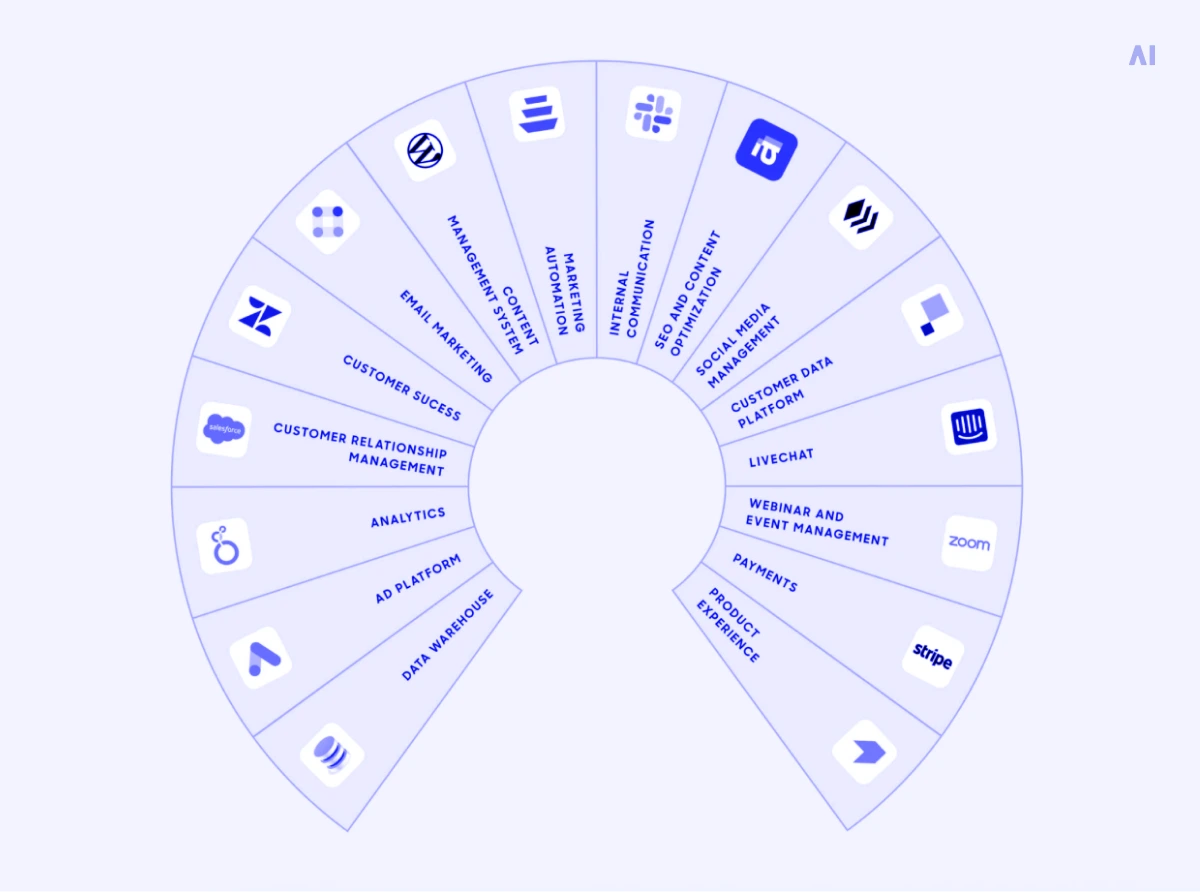
A martech stack audit is not just a list of tools. It is a diagnostic process that shows where marketing execution, measurement, and decision-making start to break. Most teams already know which platforms they use. The harder question is whether those platforms work together well enough to support performance.
Fragmentation usually becomes visible when teams try to answer basic business questions:
- Which channels are driving qualified demand?
- Which campaigns are creating revenue, not just clicks?
- Where is budget being wasted? Which reports should leadership trust?
- If every system gives a different answer, the problem is not the dashboard.
The problem is the lack of a unified data foundation.
⚡️This is why future analysis on Why Marketing Dashboards Don’t Drive Real Decisions is important. Dashboards can visualize data, but they cannot fix disconnected systems, inconsistent definitions, or unreliable inputs.
⚡️AI Digital’s article on advertising intelligence makes the stronger point: advertising performance now depends on turning fragmented signals into intelligence that supports targeting, optimization, budget allocation, and measurable business outcomes. In other words, performance improves when data, measurement, and decisions are connected, not when teams simply add another reporting layer.
No single source of truth
The first audit finding is often the absence of a single source of truth. Customer data may sit in the CRM. Campaign data may sit inside paid media platforms. Website behavior may sit in analytics. Revenue may sit with sales or finance. Retail media, programmatic, CTV, and email platforms may each report performance in their own way.
This creates conflicting insights. A campaign can look efficient in one platform, underperforming in another, and unclear in the revenue report. When teams cannot agree on which numbers are correct, strategy slows down. Marketing, sales, analytics, and finance begin defending their own data sources instead of working from a shared performance view.
A proper audit should identify where data lives, how often it updates, who owns it, and whether it connects to business outcomes. Without that foundation, martech stack optimization becomes cosmetic. The stack may look sophisticated, but the organization still cannot make confident decisions.
Inconsistent and unreliable measurement
The second issue is inconsistent measurement. Different platforms often define the same metric differently. One platform may count a conversion after a click. Another may include view-through attribution. A third may use a longer attribution window. A CRM may define a lead differently from the automation platform. Finance may only recognize closed revenue.
This creates reports that do not match. It also makes ROI difficult to evaluate because marketers are not comparing like with like. CaliberMind’s 2025 State of Marketing Attribution Report argues that attribution often fails not because the model is wrong, but because it is built on messy data, misaligned systems, weak process definitions, and unrealistic expectations. The report also cites data integration as the top measurement barrier, with 65.7% identifying it as a leading challenge, and notes that the average martech environment now contains 17 to 20 platforms.
⚡️This is why these articles such as Marketing Measurement Strategy: How to Measure and Optimize Performance Across Channels and Marketing Attribution Challenges: Why Traditional Attribution Models Don’t Work Anymore should focus not only on models, but also on the data quality and governance required to make those models useful.
Slow and inefficient decision-making
Fragmented stacks also slow decisions. When data has to be exported, cleaned, reconciled, and manually checked before teams can act, optimization becomes delayed. By the time the report is ready, campaign conditions may have already changed.
This matters in paid media, where performance can shift quickly because of auction dynamics, audience fatigue, creative performance, inventory quality, and budget pacing. If marketers need several days to understand what happened, they lose the ability to adjust spend while it still matters.
A martech stack audit should therefore look at reporting speed, not just reporting accuracy. How long does it take to move from campaign activity to usable insight? Which reports still depend on manual spreadsheets? Where do teams lose time validating data instead of improving performance? These are operational questions, but they have direct financial consequences.
Inability to optimize across channels
A fragmented stack also prevents cross-channel optimization. Teams may optimize search, social, email, CTV, programmatic, and retail media separately, but still lack a clear view of how those channels work together. This leads to poor budget allocation because each channel is judged inside its own reporting environment.
For example, paid search may appear highly efficient because it captures existing demand. CTV or programmatic video may appear less efficient because their influence happens earlier in the journey. If the stack cannot connect these signals, marketers may overfund the channel that receives the final conversion and underfund the channels that created demand.
⚡️This is where Media Mix Optimization: How to Use MMM for Budget Allocation becomes relevant. MMM can help evaluate the contribution of channels over time, but only when the business has reliable historical data and consistent inputs.
⚡️AI Digital’s guide to mixed media modeling explains MMM as a way to connect marketing investment with business outcomes by analyzing how different channels contribute to performance across time, rather than relying only on platform-level attribution.
Over-reliance on platform-reported data
Another common audit issue is over-reliance on platform-reported metrics. Closed ecosystems often measure performance through their own attribution logic. That does not make the data useless, but it does make it incomplete. A platform can show what happened inside its own environment, but it cannot always explain how other channels contributed to the same conversion.
💡This creates inflated confidence. If multiple platforms claim credit for the same sale, total reported performance may exceed actual business results. Marketers then face a familiar problem: every dashboard looks positive, but revenue growth does not match the reported efficiency.
A stack audit should separate platform-reported metrics from business-validated outcomes. Platform data can support optimization, but budget decisions need a broader measurement layer that connects spend, exposure, customer behavior, and revenue.
Organizational and data silos
Finally, fragmented stacks create organizational silos. Paid media, CRM, analytics, sales, finance, and ecommerce teams often work from different systems and different definitions. That separation affects collaboration. Teams may optimize their own KPIs while missing the broader business objective.
This is where fragmentation becomes a management problem, not just a technology problem. If no one owns shared data standards, reporting logic, and measurement governance, each team creates its own version of performance. The result is slower alignment, weaker accountability, and less effective marketing.
A martech stack audit should therefore end with a clear question: does the current system help the business make better decisions, or does it simply produce more reports? If the answer is more reports, the next step is not another dashboard. It is a connected marketing system that aligns data, measurement, and decisions around growth.
What a connected marketing system looks like
A connected marketing system is not defined by how many tools a company owns. It is defined by how well data, measurement, and decision-making work together. In a high-performing system, customer data, media data, campaign data, sales data, and revenue data do not sit in separate reporting environments. They flow into a shared structure where teams can compare performance, identify waste, and make decisions with a consistent view of the business.
⚡️This matters because modern marketing is no longer contained inside a few predictable channels. CTV, retail media, programmatic, paid social, search, email, CRM, and offline sales all create different signals. AI Digital’s guide to CTV media buying shows how complex this has become in one channel alone: CTV buying involves supply sources, deal structures, DSP capabilities, frequency management, cross-device attribution, and fragmented inventory paths. The article notes that each buying decision affects reach quality, cost efficiency, and measurement reliability.
💡A connected marketing system gives teams the infrastructure to manage that complexity without turning every new channel into another isolated reporting problem.
Unified data and decision layer
The foundation is a unified data and decision layer. This is where a marketing intelligence platform becomes important. It aggregates, cleans, and standardizes data from paid media, CRM, analytics, sales, ecommerce, retail media, CTV, and other channel systems. The goal is not to erase channel differences. The goal is to create a reliable base for analysis and decision-making.
Without this layer, teams keep comparing disconnected dashboards. With it, they can see how channels contribute together, where performance is duplicated, and where budget decisions need to change.
⚡️An article by AI Digital, Unified Marketing Measurement: What It Is and Why It Matters, explains how unified measurement connects channel-level activity with business outcomes.
⚡️Another article, From Data to Decisions: How Marketing Intelligence Transforms Performance Strategy, shows how intelligence turns raw data into planning, optimization, and growth decisions.
Standardized metrics and taxonomy
A connected system also needs standardized metrics and taxonomy. This means teams agree on how campaigns are named, how channels are classified, how conversions are defined, and how performance is measured. Without common definitions, even strong platforms produce confusion.
For example, one team may define a conversion as a form fill, another as a qualified lead, and another as closed revenue. One platform may count view-through conversions, while another only counts clicks. These differences make reporting difficult because teams are not comparing the same thing.
💡Standardized taxonomy reduces this friction. It allows marketing, analytics, sales, and finance to evaluate performance using shared rules.
⚡️Deeper reads such as How AI Improves Marketing ROI and What Metrics Actually Change and CTR vs CPC vs CPM vs CPA vs CPV: Understanding Ad Metrics and Pricing Models can help clarify how different metrics should be interpreted and connected to business outcomes.
Scalable, API-first integrations
Connected systems also require scalable integrations. Point-to-point fixes may work in the short term, but they become fragile as the stack grows. A stronger system uses API-first integrations that allow platforms to exchange data consistently without relying on manual exports or custom workarounds for every new tool.
This makes the stack more adaptable. When a company adds a new channel, partner, platform, or reporting requirement, the system can absorb that data without rebuilding the entire workflow. Integration becomes part of the architecture, not a series of emergency fixes.
Timely data flow
Finally, connected marketing systems need timely data flow. If performance data arrives too late, teams cannot optimize while campaigns are still active. They can only explain what happened after the opportunity to act has passed.
Up-to-date data helps teams adjust budget pacing, creative, audiences, supply paths, and channel mix faster. It also improves confidence because marketers are not making decisions from stale reports or manually reconciled spreadsheets.
The result is a marketing system that supports performance in real time: unified data, consistent measurement, scalable integration, and decisions that connect directly to growth.
What businesses gain by fixing fragmentation
Fixing martech fragmentation is not only about cleaning up tools. It restores the connection between data, measurement, and decision-making. When these three layers work together, marketing teams can stop reacting to disconnected reports and start making clearer decisions about budget, channels, campaigns, and growth.
A marketing intelligence approach turns fragmented data into a usable performance system. Instead of asking each platform what happened inside its own environment, teams can evaluate how marketing activity contributes to business outcomes across the full customer journey. This improves ROI visibility, reduces wasted spend, and gives leadership a more reliable view of marketing’s role in revenue growth.
⚡️For a deeper read, Marketing Planning Software: How to Connect Planning, Optimization, and Reporting in One System explains how connected workflows help teams move from analysis to action.
⚡️Another article, Creating a Data-Driven Marketing Strategy, shows how unified data supports stronger planning, forecasting, and long-term performance management.
{{mso-1}}
💡The main value of fixing fragmentation is not having a cleaner stack on paper. It is the ability to make outcome-driven decisions faster and with more confidence. When data is unified, measurement becomes more trustworthy. When measurement is trustworthy, teams can allocate budget more intelligently. And when budget decisions improve, marketing becomes a stronger engine for scalable growth.
How to fix fragmented martech stacks (AI Digital approach)
Fixing a fragmented martech stack does not start with buying another platform. It starts with understanding where the current system breaks. Marketing teams need to identify what is duplicated, disconnected, unreliable, or no longer useful across tools, data flows, integrations, reporting processes, and ownership structures.
A practical approach includes:
- Start with a martech stack audit.
Map every major system in the stack, including CRM, CDP, analytics, automation, DSPs, reporting tools, retail media platforms, CTV systems, attribution tools, and sales or revenue platforms. The goal is to see where data enters, where it changes, where it gets delayed, and where it fails to connect with business outcomes.
- Simplify the stack before adding new tools.
Fragmented stacks often contain overlapping tools, duplicated workflows, and unnecessary reporting layers. Removing redundancy matters because more technology does not automatically improve performance. In many cases, too many disconnected tools make it harder to understand what is actually working.
- Define a unified data strategy.
Teams need shared rules for campaign naming, audience structure, conversion definitions, attribution logic, reporting cadence, and data ownership. Without these standards, even integrated tools can produce inconsistent insights. An article by AI Digital, Integrated Marketing Systems: How to Connect Data, Channels, and Performance, explains how these standards help teams build a connected operating model instead of a patchwork of tools.
- Move from a tool-based stack to a marketing intelligence layer.
The key shift is not simply connecting more platforms. It is creating a layer that connects data, measurement, and decision-making. This allows marketers to evaluate performance across channels, understand which activities create demand, identify which channels convert that demand, and decide where budget should move next.
- Use AI Digital’s approach to turn fragmented data into intelligence.
The goal is not just to centralize reports. It is to transform fragmented marketing data into intelligence that supports budget allocation, campaign optimization, supply quality, and measurable growth. An article by AI Digital, Marketing Intelligence Platforms: From Data to Decisions to Performance, can go deeper into how this layer functions.
- Connect measurement to business outcomes.
In practice, fixing fragmentation means building a system where data is cleaner, measurement is more consistent, and decisions are tied to revenue, ROI, and growth. That is the foundation for stronger ROI visibility, faster optimization, and scalable marketing performance.
1. Turn fragmented data into marketing intelligence
The first step is turning disconnected data into usable marketing intelligence. A platform like AI Digital’s Elevate is built for this role: it connects fragmented data across the digital landscape and turns it into control, strategy, and measurable business results. AI Digital describes Elevate as an AI-powered intelligence platform that supports the full marketing lifecycle, from research and intelligence to planning, optimization, reporting, and AI agents.
For fragmented martech stacks, this matters because the problem is not only data access. It is data usability. Teams need customer, campaign, audience, media, and performance data to be cleaned, validated, and organized into a consistent foundation. Elevate supports that shift by analyzing large-scale data signals, including 150 billion monthly data points, 10,000 audience attributes, and integrations across 12+ DSPs.
The outcome is a move from disconnected reporting to actionable intelligence. Instead of asking each tool what happened separately, teams can use a unified layer to identify performance patterns, compare channels, and make faster decisions about budget, audiences, and optimization.
2. Improve supply efficiency and data quality
Better marketing decisions depend on better inputs. If the media supply path is inefficient, biased, or low quality, the performance data coming from that media will also be unreliable. This is why fixing a fragmented martech stack cannot focus only on dashboards or reporting. It also needs to improve the quality of the inventory, traffic, and supply signals feeding the system.
Smart Supply addresses this from the media-buying side. AI Digital positions it as AI-powered supply for programmatic buying, with outcome-based deal IDs, direct SSP access, AI-powered optimization, full transparency, and DSP-agnostic execution. The service is designed to reduce DSP and SSP bias, improve traffic quality, remove unnecessary intermediaries, and give advertisers visibility into placements, traffic sources, and performance.
For measurement, this is critical. Cleaner supply paths reduce noise in campaign data. If low-quality inventory, hidden markups, invalid traffic, or inefficient placements distort campaign results, marketers cannot confidently evaluate ROI. Smart Supply improves the reliability of the inputs, which makes downstream measurement and budget allocation more accurate.
3. Connect ecosystems without fragmentation
Fragmentation also happens when brands become too dependent on closed ecosystems. Walled gardens often restrict signals, control measurement, limit transparency, and make it difficult to compare performance across channels. AI Digital’s Open Garden Framework is positioned as an alternative operating model: one that connects data, inventory, and outcomes across the digital ecosystem instead of locking them inside separate platforms.
This is especially important for teams operating across programmatic, CTV, retail media, DSPs, SSPs, and data partners. The Open Garden Framework emphasizes vendor-neutral architecture, DSP-agnostic execution, KPI-led orchestration, unified identity and audience strategy, and AI-optimized cross-channel performance. It is designed to reduce platform bias and make the system more adaptable as channels, privacy rules, and measurement standards continue to evolve.
⚡️AI Digital’s article on what the Open Garden Framework is reinforces this point: the future is not a return to a simpler stack, but a more interoperable one. The article argues that unified measurement gives marketers a practical way to interpret reach, frequency, outcomes, attribution, and incrementality more consistently across platforms.
4. Align technology with business outcomes
The final step is aligning the stack with business outcomes. The goal is not better reporting for its own sake, and it is not simply reducing the number of tools. The goal is to build a marketing system that helps teams make stronger decisions about growth, budget allocation, customer acquisition, and ROI.
💡This is where the AI Digital approach connects the pieces. Elevate creates the intelligence layer. Smart Supply improves the quality of the media inputs. Open Garden Framework connects the ecosystem so brands are not trapped inside closed, platform-first measurement. Together, these components support a more outcome-driven model: cleaner data, more reliable measurement, faster decisions, and stronger performance accountability.
⚡️For a deeper read, From Fragmented to Sustainable: Rethinking the Programmatic Supply Path explains why sustainable performance depends on supply quality, transparency, and measurement discipline working together. The broader point is simple: fragmented martech stacks are fixed when technology stops operating as a set of disconnected tools and starts functioning as a connected system for business growth.
From fragmented stacks to connected marketing performance
Improving marketing performance starts with eliminating fragmentation. When tools, data, measurement, and decisions operate separately, marketing teams lose visibility into what is actually driving growth. Reports become harder to trust, budget decisions become slower, and performance optimization becomes reactive instead of strategic.
A connected marketing system changes that. It gives teams a clearer view of how campaigns, channels, audiences, and media investments work together. Instead of comparing disconnected dashboards, marketers can evaluate performance through a unified data foundation, consistent measurement logic, and business-focused reporting.
This is the shift AI Digital supports: moving from fragmented martech stacks to connected marketing performance. With a marketing intelligence layer, cleaner supply paths, and interoperable systems, businesses can identify waste faster, allocate budget more accurately, and connect marketing activity to revenue, ROI, and scalable growth.
The result is not just better reporting. It is better decision-making. Teams can see where performance is breaking, understand which channels contribute to outcomes, and act with more confidence across planning, optimization, and measurement.
⚡️To explore how AI Digital can help connect fragmented data, improve measurement, and turn marketing technology into a performance system, get in touch with AI Digital. This closing section aligns with the article’s required final CTA direction.