Unified Marketing Measurement: Why Attribution Alone No Longer Works


Marketing organizations have a curious relationship with their measurement infrastructure. The volume of available data has expanded continuously for a decade; the credibility of what it claims to prove has eroded in roughly inverse proportion. The result is a marketing function with more dashboards than it knows what to do with, and a CFO who has stopped finding them persuasive.
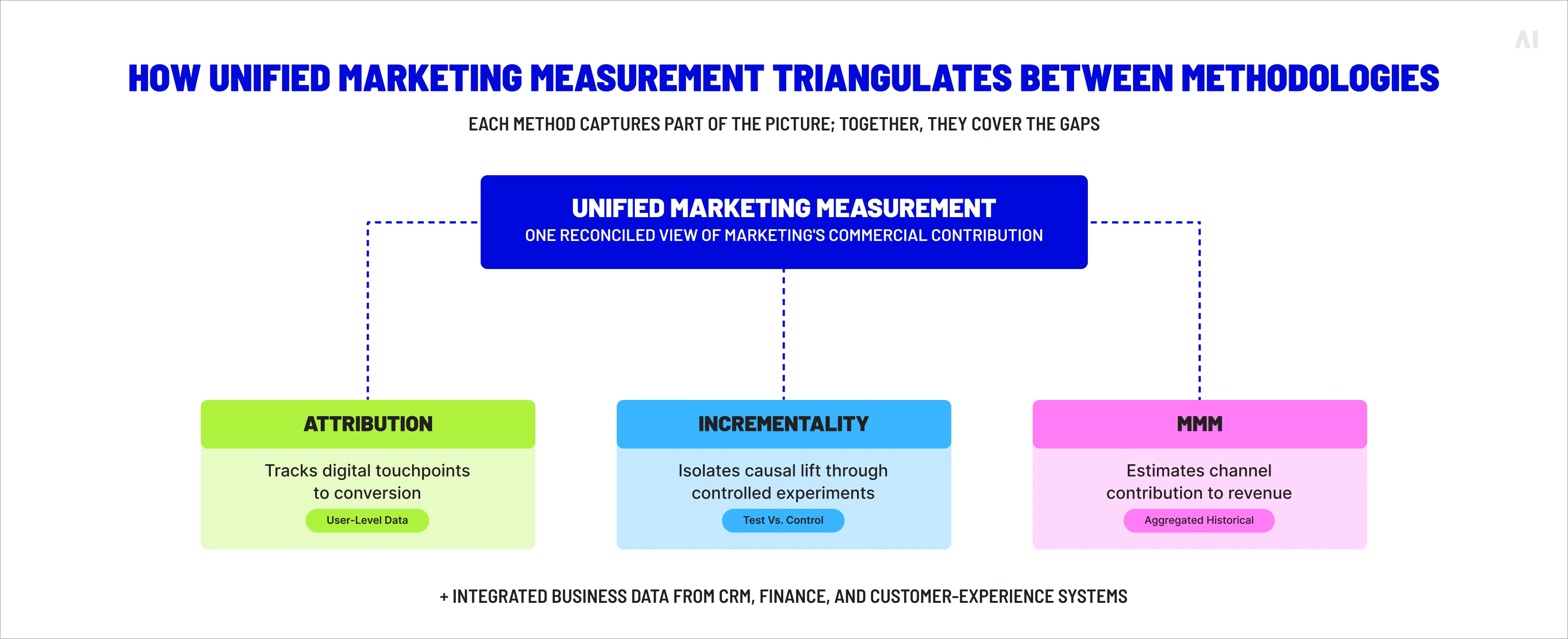
Unified marketing measurement has emerged as the response. It accepts what previous generations of measurement tooling tried to deny: that no single methodology — not attribution, not marketing mix modeling, not incrementality testing—can answer the question of marketing's commercial contribution on its own. Each captures part of the picture. Each misses what the others see. Unified marketing measurement combines them with integrated business data drawn from CRM, finance, and customer-experience systems into one decision-making framework designed to triangulate rather than choose between methods.
According to NielsenIQ's 2026 CMO Outlook, 84% of CMOs now treat return on investment as the primary metric for budget allocation, while 54% report that connecting data from different sources is a major barrier to insight generation. The two findings sit at odds. CMOs are being asked to defend every dollar of media spend, and most do not have the data infrastructure to defend it credibly. Unified measurement is the operating model increasingly being built to close that gap — less an analytics technique than a business framework that connects media performance, customer behavior, revenue outcomes, and the financial reporting structures that finance, sales, and operations already use.

What unified marketing measurement really is
Unified marketing measurement is easier to describe by what it does than by which analytics category it belongs to. It is a structural decision: rather than trusting any single measurement methodology to answer the question of marketing's commercial contribution, organizations run multiple methodologies against the same set of business outcomes and reconcile their conclusions.
Within that framework, three methodologies do most of the analytical heavy lifting.
- Attribution tracks the digital touchpoints a customer interacts with on the way to conversion.
- Incrementality testing runs controlled experiments to identify which of those touchpoints actually caused a conversion that would not otherwise have happened.
- Marketing mix modeling uses aggregated historical data to estimate the long-term contribution of each channel — paid and unpaid, digital and offline — to revenue. Each method has known weaknesses.
Attribution overweights digital and last-click moments. Incrementality answers narrow, expensive questions. MMM is strategic but slow to refresh. Used together, they describe the marketing system from three different angles, none of which the others can replicate.
The unified approach also brings in non-marketing data that traditional measurement programs tend to ignore: CRM signals, retail point-of-sale outputs, contact-center logs, finance-controlled revenue data, and customer lifetime value calculations sourced from the post-purchase journey. The unified marketing measurement framework treats those inputs as first-class measurement signals rather than supplementary context.
Attribution measures interactions
Attribution is the methodology most marketing teams started with, and it remains the easiest to operate. It tracks the digital touchpoints a customer encounters before converting — clicks, ad views, email opens — and distributes credit among them according to a chosen model: last-click, first-click, linear, position-based, time-decay, or a custom rules-based or algorithmic approach.
Attribution is good at answering questions about within-channel optimization: which keyword, creative, or placement performed best within a defined window. It is less effective with bigger questions:
- Customers interact with brands offline as well as online; attribution sees only the digital portion.
- Customers use multiple devices and platforms that fragment identity; attribution sees only the touchpoints it can stitch together.
- And customers are exposed to brand activity that drives demand without ever producing a click; attribution does not register those exposures at all.
The growing limitation is causality. Attribution can show that a conversion happened after a sequence of clicks. It cannot show that the clicks caused the conversion. Most platform-reported numbers exist in that ambiguous territory, and unifying them with other measurement signals is how organizations move from correlation to a defensible claim about what their marketing actually produced.
💡 Related reads: Marketing attribution challenges: why traditional attribution models don't work anymore.
Incrementality measures real impact
Incrementality testing addresses what attribution cannot. By comparing outcomes in a group exposed to a campaign with outcomes in a comparable group that was not, it isolates the additional conversions that would not have occurred without the marketing intervention. The output is a causal estimate of lift rather than an attributed share of credit. Geo-holdouts, conversion lift tests, ghost ads, and matched-market experiments all sit within this category.
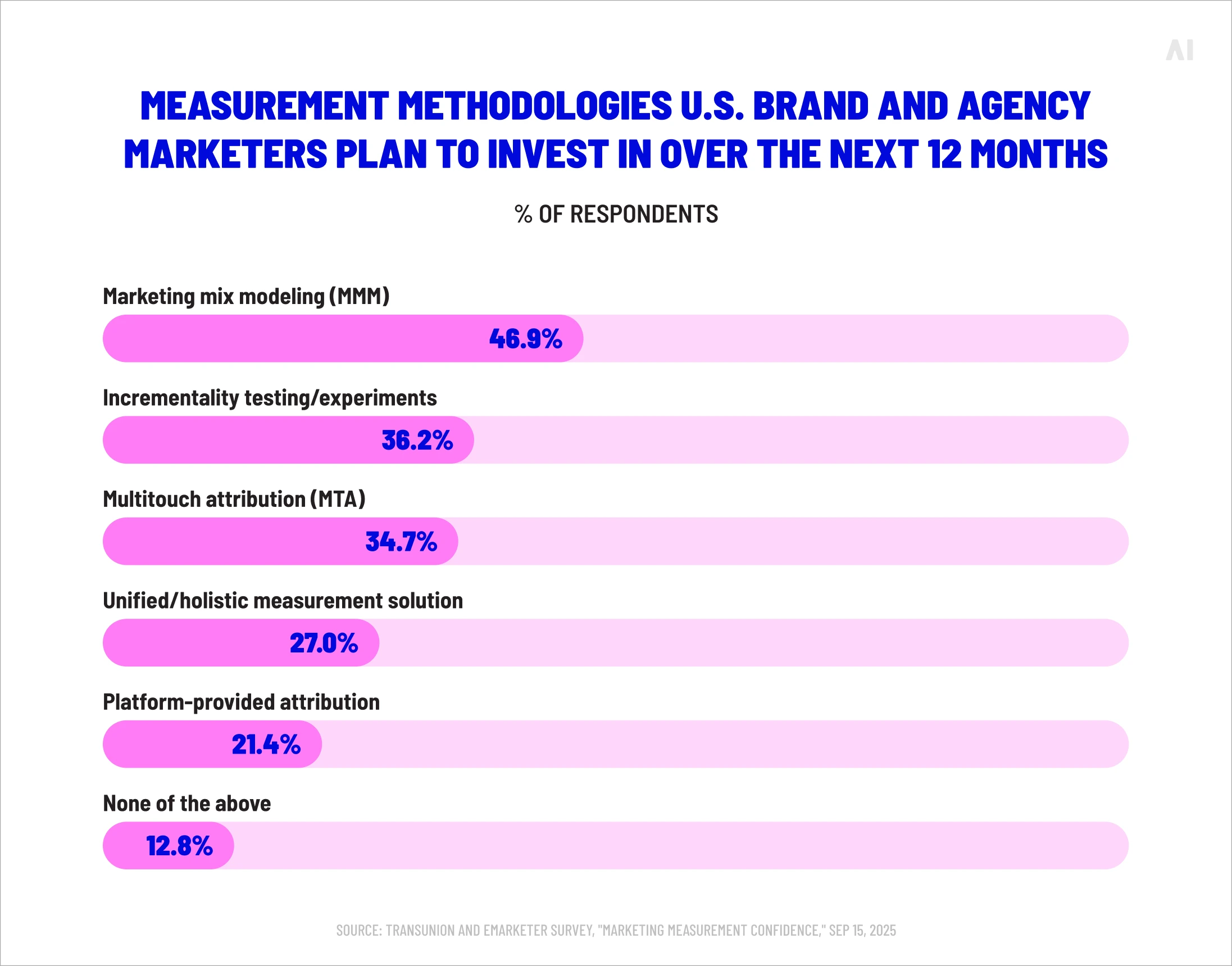
The methodology has moved from niche to mainstream over the past two years. According to EMARKETER and TransUnion's July 2025 survey, 52% of US brand and agency marketers now use incrementality testing to measure campaigns, and a further 36.2% plan to invest more in the methodology over the next year. Platform thresholds have helped — Google reduced its minimum incrementality experiment budget from approximately $100,000 to $5,000 in late 2025, putting controlled testing within reach of mid-market brands that previously could not afford it.
The constraint with incrementality is what it does not measure. Tests are run on specific campaigns, in specific markets, over specific periods. They produce sharp causal evidence about narrow questions, not portfolio-wide answers about strategic budget allocation. That is the gap MMM is meant to fill.
💡 Related reads: Incrementality vs attribution: what's the difference and why the shift is happening | Media Mix Optimization: How to Use MMM for Budget Allocation
MMM measures strategic contribution
Marketing mix modeling sits at the strategic end of the measurement stack. Where attribution operates at the impression level and incrementality at the campaign level, MMM operates at the channel and quarter level — using aggregated historical data, including spend, impressions, pricing, seasonality, competitive activity, and macroeconomic context, to estimate how each marketing channel contributes to overall business outcomes.
The strengths of MMM are exactly the weaknesses of attribution:
- Because it works on aggregated data, MMM is unaffected by cookie deprecation and identity loss.
- Because it ingests offline media, brand activity, and macroeconomic variables, it captures contribution that digital-only models miss.
- And because it produces a single coherent allocation across all channels, finance teams accept its outputs as legitimate inputs into budgeting decisions.
In the EMARKETER and TransUnion data cited above, MMM was named as the single most reliable measurement methodology of 2025 by 27.6% of US brand and agency marketers, the top-ranked response.
MMM has its own limitations. Quarterly refresh cycles, dependency on years of consistent historical data, and difficulty isolating short-term tactical levers are all real constraints. Modern MMM tools — including those evaluated in Gartner's 2025 Magic Quadrant for Marketing Mix Modeling Solutions — address those constraints with Bayesian methods, automated calibration, and integration with incrementality test data. The point of unifying these models is to let each one feed the others: incrementality tests validate MMM estimates, MMM provides priors for attribution, and attribution generates near-real-time signals that MMM cannot. For more on how MMM works as a stand-alone discipline, see our analysis of mixed media modeling.
{{umm-1}}
Why businesses need UMM now
Three changes in the underlying environment suggest that the conditions which made siloed attribution viable have run out.
- Customer journeys have fragmented to the point that single-touch attribution is functionally a guess.
- Privacy regulation has restricted the visibility that user-level tracking once delivered.
- And C-suite expectations of marketing have escalated in ways that make the old reporting habits — impressions, click-throughs, platform-reported ROAS — actively dangerous to defend.
According to the EMARKETER and TransUnion data referenced earlier, seven out of eight US marketers will invest more in at least one measurement methodology over the next year, which suggests the discipline collectively understands that the status quo cannot hold.

Customer journeys became fragmented
A typical purchase journey today involves multiple devices, several channels, and a non-linear sequence of brand exposures that traditional attribution models were never designed to handle. Impact.com's 2025 modern customer journey research, drawing on a survey of 1,000 US adults, found that consumers engage with brands across three or more digital touchpoints before purchase, with high-income consumers ($250K+ household income) exceeding five.
Industry-level benchmarks run higher still — Focus Digital's analysis of cross-channel data put the average across industries at 28.87 touchpoints per sale, with high-trust verticals (industrial equipment, pharmaceuticals) running well above that. The structural implications for cross-platform measurement are significant.
The consequence for measurement is methodological. Single-touch attribution models — last-click in particular — assign 100% of credit to one moment in a sequence that may have included a dozen earlier ones across multiple devices and channels. Even multi-touch attribution, which distributes credit more thoughtfully, still operates only within the touchpoints it can observe. When the journey includes a podcast mention, an in-store visit, a word-of-mouth recommendation, or a CTV exposure that did not produce a click, none of those events enter the model. Unified marketing measurement is designed to absorb them by triangulating between modeled channels (MMM), tested channels (incrementality), and tracked channels (attribution).
💡 Related reads: Why fragmented data is breaking cross-platform performance.
Privacy changes reduced visibility
The data layer underneath attribution has thinned considerably. Third-party cookies are restricted in Safari and Firefox, iOS App Tracking Transparency has cut mobile signal in half for many advertisers, and consumer behavior has caught up to platform restrictions. Per a May 2025 Usercentrics and Sapio Research report cited in EMARKETER's measurement trends analysis, 38% of US consumers report accepting cookies less often than they did three years ago, with consent rates declining most sharply among the younger demographics that advertisers most want to reach.
The response has been a pivot toward first-party data. Forty-three percent of B2C marketers worldwide cite improved targeting accuracy as the most important benefit of building first-party datasets, per a July 2025 PGM Solutions and Ascend2 survey covered in the same EMARKETER piece. First-party data alone, however, cannot resolve the measurement gap. It improves what an organization knows about its own customers; it does not improve what it knows about non-customers, prospects, or the broader market in which performance is being measured. That is why aggregated methods — MMM in particular — have regained importance. They are unaffected by consent loss because they do not require user-level identity in the first place.
Executives demand financial accountability
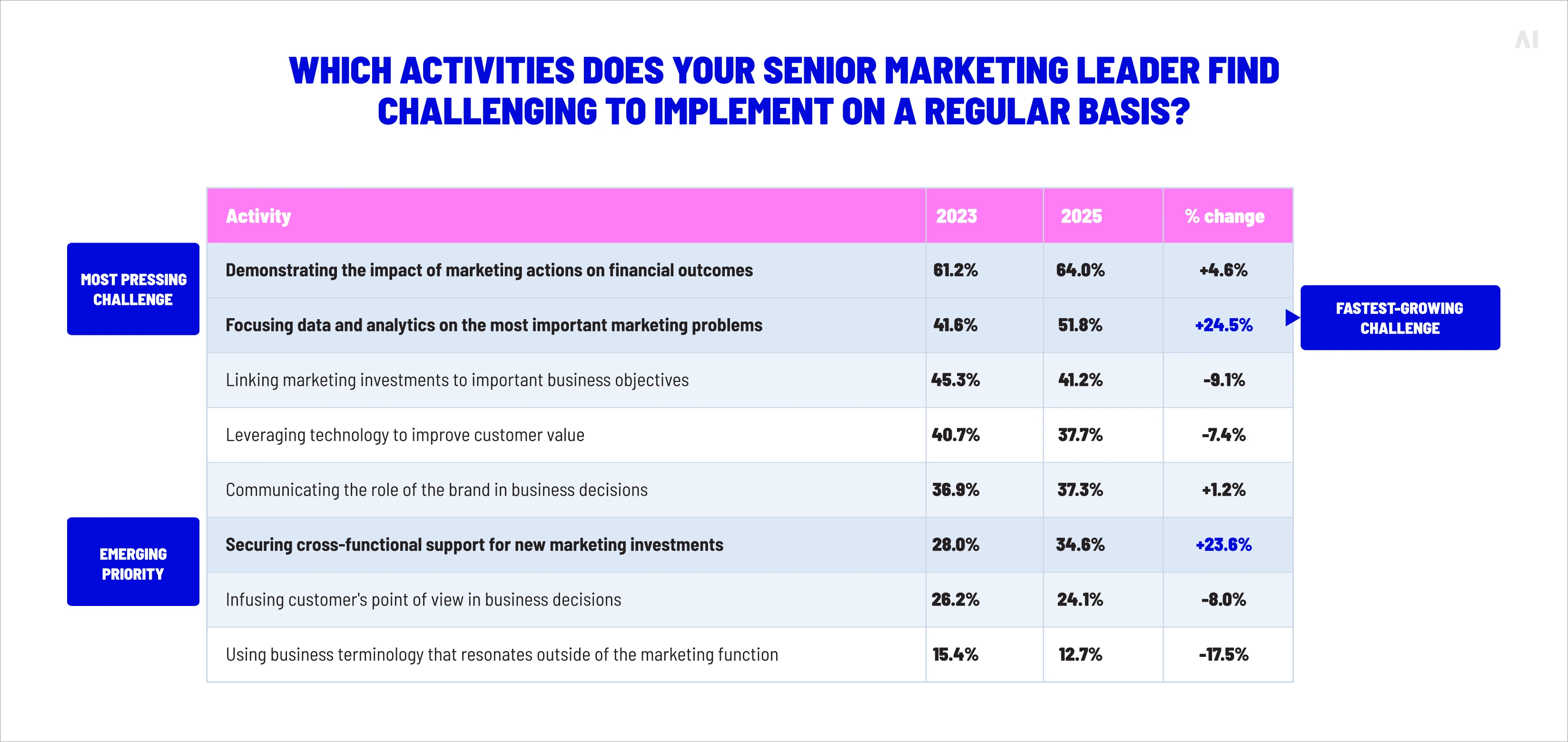
The pressure on marketing to demonstrate financial impact is no longer ambient. It is direct, metric-led, and increasingly tied to job security. According to The CMO Survey, conducted by Duke University's Fuqua School of Business and supported by Deloitte and the American Marketing Association, demonstrating the impact of marketing actions on financial outcomes remains the single largest challenge cited by senior marketing leaders, identified by 64% of respondents. Pressure to prove marketing value has risen sharply at every level of the C-suite between 2023 and 2025 — by 52% from the board, 21% from the CFO, and 20% from the CEO.
This is the operational reason unified marketing measurement is being adopted. A CMO defending a media plan to a CFO can no longer rely on impressions and platform-reported ROAS. Per a Gartner analysis covered by CX Today in February 2026, more than 40% of CMOs who push for larger budgets without demonstrating clear ROI are expected to lose influence with their C-suite peers. The discipline is being asked to produce financial-grade answers to financial-grade questions. Unified measurement is the framework that produces them.
"Every marketing dollar is now under the microscope. With organizations prioritizing cost reductions, CMOs are being challenged not just to spend wisely, but to prove how marketing directly drives awareness, growth, and loyalty." — Marta Cyhan-Bowles, Chief Communications Officer & Head of Global Marketing COE, NielsenIQ
How unified measurement improves budget and growth decisions
The most direct payoff of unified marketing measurement shows up in budget decisions rather than dashboards. When a CMO can show how each channel performs against a consistent definition of business outcome — and where the diminishing returns sit — the conversation with finance moves from defending last year's plan to designing this year's investment thesis.
Scale media efficiently
Unified insights make it possible to scale spend without losing efficiency. Attribution and platform reporting tend to flatter the channels that took credit for the last touch; MMM and incrementality reveal which channels are creating genuine lift versus which are harvesting demand that would have converted anyway.
The difference is consequential. Forrester's 2026 marketing operations research found that teams operating with five or fewer core marketing tools generate roughly 23% more marketing-attributed pipeline per headcount than those managing 25 or more — partly a function of integration, partly a function of being able to see the system whole rather than piece by piece.
For media buying specifically, that visibility translates into more confidence about where the next dollar should go.
- Customer acquisition cost is held in check because saturation points are visible before they are crossed.
- Channels with declining marginal returns are flagged before they consume budget that would perform better elsewhere.
- The signal-to-noise ratio improves because the measurement system is no longer arguing with itself.
Balance efficiency and long-term growth
The trickier conversation is between short-term performance and long-term brand equity. Performance teams optimize for ROAS within the quarter; brand teams measure share of voice over multi-year horizons; the two rarely speak the same language. Unified measurement provides one. Per NielsenIQ's 2026 outlook, only 69% of CMOs now report that their CEO and CFO support long-term brand investment — down from 80% the previous year — which means the brand-versus-performance argument is increasingly being decided by finance.
The framework's contribution here is methodological rather than ideological. MMM is the only major measurement approach that captures brand-driven and awareness-driven demand at the channel level. Used alongside attribution and lifetime-value modeling, it allows organizations to demonstrate how brand activity contributes to acquired customer value rather than presenting brand investment as an article of faith.
Connect online and offline performance
A surprising amount of commercial activity still happens offline. Impact.com's 2025 customer journey research found that 83.8% of retail dollars in the United States are still spent in physical stores. Most attribution systems treat that revenue as invisible. Unified measurement, by contrast, ingests retail point-of-sale data, CRM signals, and offline conversion data alongside digital touchpoints, producing a complete picture of how media activity translates into outcomes — whether those outcomes occur on a checkout page or at a physical till.
The methodological mechanic varies. Some organizations connect via deterministic identifiers (loyalty IDs, hashed emails); others rely on data clean rooms; others run MMM across both channels simultaneously. The common thread is that no single measurement model is asked to do the entire job.
Improve forecasting and planning
Unified measurement is forward-looking as well as backward-looking. Because the framework integrates historical performance data, seasonal patterns, competitive activity, and ongoing experimental results, it produces forecasts that finance teams will accept as inputs to budgeting cycles. Scenario modeling becomes possible: what happens to revenue if 15% of search budget moves to CTV, or if retail media absorbs an additional 10% of total spend? Those questions used to be debated; with unified data, they can be modeled.
The cadence of this kind of planning has accelerated. Automated MMM tools refresh weekly or monthly rather than quarterly. AI-driven scenario engines run sensitivity analyses on inputs that would have taken consultants weeks to produce.
For organizations dealing with retail seasonality or category-specific demand cycles, the speed gain is the difference between in-flight optimization and post-mortem reporting.
💡 Related reads: Retail forecasting.
Identify inefficient investments
The most uncomfortable use of unified measurement is finding the channels that should not have survived previous budget reviews. Per NielsenIQ's 2026 CMO Outlook, one in three CMOs uses between 5 and 15 separate tools to measure ROI — in some cases more than 15 — while only 37% report having a centralized data repository accessible to all stakeholders. With that level of fragmentation, "top-performing" channels often survive on attribution generosity and executive wishful thinking rather than evidence of incremental contribution.

Unified measurement makes those channels visible.
- Incrementality testing exposes acquisition channels that look healthy on platform dashboards but produce little additional revenue.
- Cross-channel deduplication removes the inflated conversions that occur when multiple platforms claim credit for the same outcome.
- MMM produces aggregate channel-contribution figures that finance can reconcile against general-ledger revenue.
The combination tends to surface a portion of media spend — typically in the 10–30% range, depending on the maturity of the existing measurement program — that can be reallocated to better-performing inventory.
Unified measurement as part of a marketing intelligence platform
Unified marketing measurement is increasingly being absorbed into a broader category of software: the marketing intelligence platform. Rather than running attribution in one tool, MMM in another, and incrementality testing in a third, organizations are consolidating these methodologies inside connected environments that share data, models, and outputs.
The integration is what makes the framework operational. Without it, unified measurement reverts to a set of separate analytical exercises that finance teams have neither the time nor the inclination to reconcile.
💡 Related reads:How AI platforms improve cross-channel marketing performance || Marketing measurement vs attribution vs MMM: what's the difference | Marketing intelligence vs marketing analytics: what's the difference?
Measurement frameworks
The methodological layer of a marketing intelligence platform combines attribution, MMM, incrementality, and analytics modeling so that each technique informs the others. In practice, this means MMM coefficients are calibrated against incrementality test results; attribution outputs are deduplicated against MMM-derived channel contributions; and analytics dashboards present the combined picture rather than three competing versions of it.
The Gartner Magic Quadrant for MMM and corresponding Forrester evaluations both reflect this consolidation — the vendors named as leaders are those that integrate test-and-learn capability and cross-channel measurement rather than offering econometric modeling alone.
💡 Related reads: Marketing measurement framework: how to build a scalable system
Connected data ecosystems
Measurement only works if the data feeding it is reliable, consistent, and accessible. That requirement reaches far beyond marketing's own technology stack. CRM systems, retail point-of-sale, customer data platforms, analytics tools, DSPs, finance systems, and data warehouses all need to communicate within a shared governance framework.
Most marketing organizations are not there yet — as noted earlier, only 37% of CMOs report having a centralized data repository accessible to all stakeholders, which is one reason measurement debates often devolve into arguments about whose numbers are correct.
Interoperable infrastructure like AI Digital's Open Garden Framework is designed for this layer of the problem. By providing DSP-agnostic infrastructure that operates across walled-garden boundaries — and by making consistent measurement signals available across 15+ DSPs and 9+ SSPs — Open Garden gives organizations the cross-platform visibility that unified measurement requires.
Without that visibility, even sophisticated MMM and incrementality programs operate on incomplete inputs and produce conclusions that finance cannot fully trust. For more on the underlying philosophy, see our piece on what the Open Garden framework is.
⚡ Measurement is only as reliable as the data infrastructure feeding it. Most measurement debates, on closer inspection, are really data governance debates in disguise.
💡 Related reads: Marketing Planning Software: How to Connect Planning, Optimization, and Reporting in One System.
Media efficiency and transparency
Measurement quality depends on supply quality. A media plan that buys low-viewability impressions through opaque intermediaries produces measurement signals that no amount of modeling can clean up. Programmatic supply paths in particular have a long history of bid-stream recycling, redundant fee layers, and inflated CPMs that obscure the real cost of effective inventory. The cleaner the supply path, the cleaner the measurement signal — and the more confident the conclusions a unified framework can draw.
AI Digital's Smart Supply addresses this directly by applying AI-driven and human-curated supply path optimization to remove low-quality, fraudulent, or non-brand-safe traffic before it reaches the buyer. The output is a higher-quality input layer for the entire measurement system: cleaner impressions, more accurate viewability data, and direct supply paths that strip out the cost inflation introduced by mid-stream bid hops. For more on how transparency at the supply layer affects measurement integrity, see our analysis of transparency in advertising.
AI-driven optimization
The volume and velocity of marketing data have moved past the threshold at which human analysis can keep up. AI is now structurally required to identify patterns across millions of touchpoints, forecast performance as conditions change, and recalibrate budget allocations in something resembling real time. Per the State of Martech 2026, more than 90% of marketing organizations now use AI agents in some capacity, although only a fraction have moved them into full production environments — the gap between adoption and operationalization is wide.
AI Digital's Elevate platform is designed to operationalize unified measurement at this layer. It ingests 150 billion data points monthly across 12+ DSPs, applies AI to over one million audiences and 10,000+ audience attributes, and produces media plans, scenario forecasts, and post-campaign analyses inside a single environment. The AI-Assisted Media Planner draws on more than 8,000 prior campaigns to generate plans that human strategists then verify — a structure designed to combine analytical speed with strategic judgment rather than replace one with the other.
For organizations whose measurement question is "how do we turn unified insight into faster decisions?", the combination is the operational answer.
💡 Related reads: AI in programmatic advertising: how it improves targeting, bidding, and optimization
Business intelligence and decision-making
Unified measurement is increasingly used as input for decisions that have nothing to do with marketing reporting. Demand forecasts inform inventory and supply chain planning. Channel-contribution models inform pricing and product strategy. Customer-lifetime-value calibrations feed acquisition budgeting and finance forecasting. Modern businesses now collect enough marketing data to simulate omniscience, yet still struggle to decide which numbers deserve trust. Unified measurement frameworks are how organizations build the methodological discipline that lets them treat marketing data as a reliable strategic input rather than a quarterly self-report.
The implication is organizational as well as analytical. When marketing measurement produces outputs that finance, operations, and customer-experience teams use, the discipline starts to be valued accordingly. The CMOs gaining ground in 2026 are increasingly those who have built their measurement function to serve enterprise decision-making rather than internal marketing dashboards.
💡 Related reads: What we do | Integrated Marketing Systems: Why Connected Operations Drive Better Performance
UMM metrics that influence business decisions
The output of unified marketing measurement is only as useful as the metrics organizations choose to track. Most measurement programs report too many metrics and too few of the right ones — campaign-level KPIs that flatter performance while obscuring the business question underneath.
A more useful set divides into three families: revenue efficiency, incremental growth, and customer quality. Each family answers a different question, and unified frameworks make them consistent across channels.
Revenue efficiency metrics
These describe whether marketing is acquiring customers profitably and at a sustainable cost. The core measures are CAC (customer acquisition cost), MER (marketing efficiency ratio), ROAS (return on ad spend), contribution margin, and the LTV:CAC ratio.
Used together, they answer questions like: are we paying too much for the customers we acquire? Are we acquiring customers whose lifetime value justifies the spend? Is our efficiency improving or eroding as we scale?
Unified measurement makes these numbers honest by reconciling platform-reported figures against finance-grade revenue data.
Incremental growth metrics
Attributed conversions are not the same as additional conversions. Incremental growth metrics — incremental ROAS (iROAS), incremental conversions, lift, and matched-market test results — describe what marketing produced that would not have happened otherwise.
Including them in a measurement framework is how organizations move from claiming credit to proving causation.
Customer quality metrics
Acquisition is only half of the picture. Repeat purchase rates, retention, churn risk, and customer lifetime value describe whether the customers marketing acquired are the right customers — and they reveal which channels are over-indexing on one-time buyers who churn within months.
Unified measurement integrates these post-purchase signals into channel-contribution models, producing a more complete picture of marketing's commercial impact.
{{umm-2}}
Common UMM mistakes
Most unified measurement programs fail for non-technical reasons. The methodology is the easier part; the harder part is organizational. Five mistakes recur often enough across industries to be considered structural rather than incidental.
- The first is treating UMM as an analytics project rather than an operating model. Teams stand up a measurement stack, deliver a dashboard, and stop there. Without the executive sponsorship that makes the outputs actionable — and the financial alignment that makes them consequential — the measurement system runs in parallel to decision-making rather than informing it.
- The second is chasing perfect attribution at the expense of useful answers. Unified measurement is built on the assumption that no single method produces perfect attribution, and that triangulating between several imperfect methods produces more reliable conclusions than perfecting any one of them. Teams that resist this trade-off tend to spend years building elaborate multi-touch attribution systems that finance still cannot trust.
- The third is building measurement against legacy KPIs. Click-through rate, cost per click, and platform-reported ROAS describe campaign mechanics. Measurement programs designed around them will produce campaign-mechanic answers — useful for media buyers, less useful for CFOs.
- The fourth is fragmented martech compounding rather than reducing complexity. The Forrester research cited earlier found that teams running five or fewer marketing tools generate 23% more marketing-attributed pipeline per headcount than enterprises managing 25 or more, and clean-attribution rates fall from 92% in consolidated stacks to 67% in sprawling ones. More tools rarely produce more clarity.
- The fifth is disconnected ownership across departments. When marketing owns attribution, finance owns LTV, customer success owns retention, and no one owns the integration between them, the measurement system inherits the silos. Unified measurement requires unified governance — or at least an explicit framework for how the outputs of one team become the inputs of another.
{{umm-3}}
What Unified Marketing Measurement cannot solve
It is worth being honest about the limits. Unified marketing measurement improves visibility and decision-making, but it does not produce certainty in environments that are structurally uncertain. Three constraints persist regardless of how sophisticated the framework becomes.
- The first is data quality. Models trained on inconsistent, mislabeled, or incomplete inputs produce inconsistent outputs. No amount of methodological triangulation compensates for tagging errors, mismatched conversion definitions, or gaps in CRM data. Investment in measurement should be paired with investment in the data infrastructure underneath it.
- The second is strategic judgment. Unified measurement is a tool for evaluating decisions, not making them. The decision to enter a new market, launch a new product line, or rebalance the brand-performance portfolio still belongs to human leaders. Where teams have outsourced strategic judgment to optimization algorithms, the result tends to be local efficiency and global drift.
- The third is uncertainty itself. Marketing operates inside competitive, macroeconomic, and consumer-behavior systems that change continuously. Even a perfectly calibrated measurement framework produces probability distributions rather than precise answers, and the wisest measurement programs treat their outputs as ranges rather than points.
⚡ The methodology is the easier part. The operating model is what most teams take longest to build.
💡 Related reads: Why AI alone can't fix marketing performance (and what actually works).
Conclusion: Unified marketing measurement matters more than ever
Unified marketing measurement replaces fragmented reporting and contradictory attribution with a more connected, reliable basis for commercial decision-making. Organizations that combine integrated data systems, AI-driven optimization, incrementality testing, and cross-channel measurement are better positioned to forecast accurately, reduce wasted spend, and grow sustainably. Adoption is rising because the alternatives have stopped working.
Companies further along this path tend to share three habits.
- They treat measurement as enterprise infrastructure rather than a marketing reporting line.
- They invest in the data quality that makes their models trustworthy.
- And they accept that no single method produces the answer — that the answer comes from running several methodologies against the same business outcomes and reconciling the differences honestly.
If your organization is rebuilding its measurement function for 2026, AI Digital helps brands and agencies design unified marketing measurement programs that fit how their business actually operates.
- Our managed service delivers end-to-end programmatic execution across 15+ DSPs with full transparency on supply and inventory.
- Our Open Garden Framework provides the DSP-agnostic infrastructure required for cross-platform visibility.
- Our Smart Supply curation removes the bid-stream inefficiencies that distort measurement upstream.
- And our Elevate platform brings AI-driven planning, optimization, and reporting into one intelligence layer designed for the unified measurement era.