Incrementality vs Attribution: What’s the Difference and Why the Shift Is Happening


Marketing once promised a precise account of how every impression, click, search, and site visit contributed to a sale. The reality proved less orderly. Consumers move between devices, platforms protect their own data, browsers restrict tracking, and several channels may claim the same conversion. A dashboard can still produce an exact number, but precision in the interface does not guarantee certainty in the conclusion.
Confidence in advanced measurement is weakening even as the methods become more sophisticated. The IAB State of Data 2026 report found that 60% to 75% of buy-side users believed advanced measurement fell short on rigor, timeliness, trust, or efficiency. That dissatisfaction reaches beyond technical teams. CMOs and finance leaders want to know which spending generated additional revenue, not merely which platform recorded an interaction before a customer bought.
Attribution and incrementality approach that problem from different directions.
- Attribution assigns conversion credit across observable marketing touchpoints. It can reveal which ads, channels, or sequences appeared along a customer journey and support fast campaign decisions.
- Incrementality estimates what marketing caused. It compares an observed result with a credible version of what would probably have happened without the campaign, channel, or tactic.
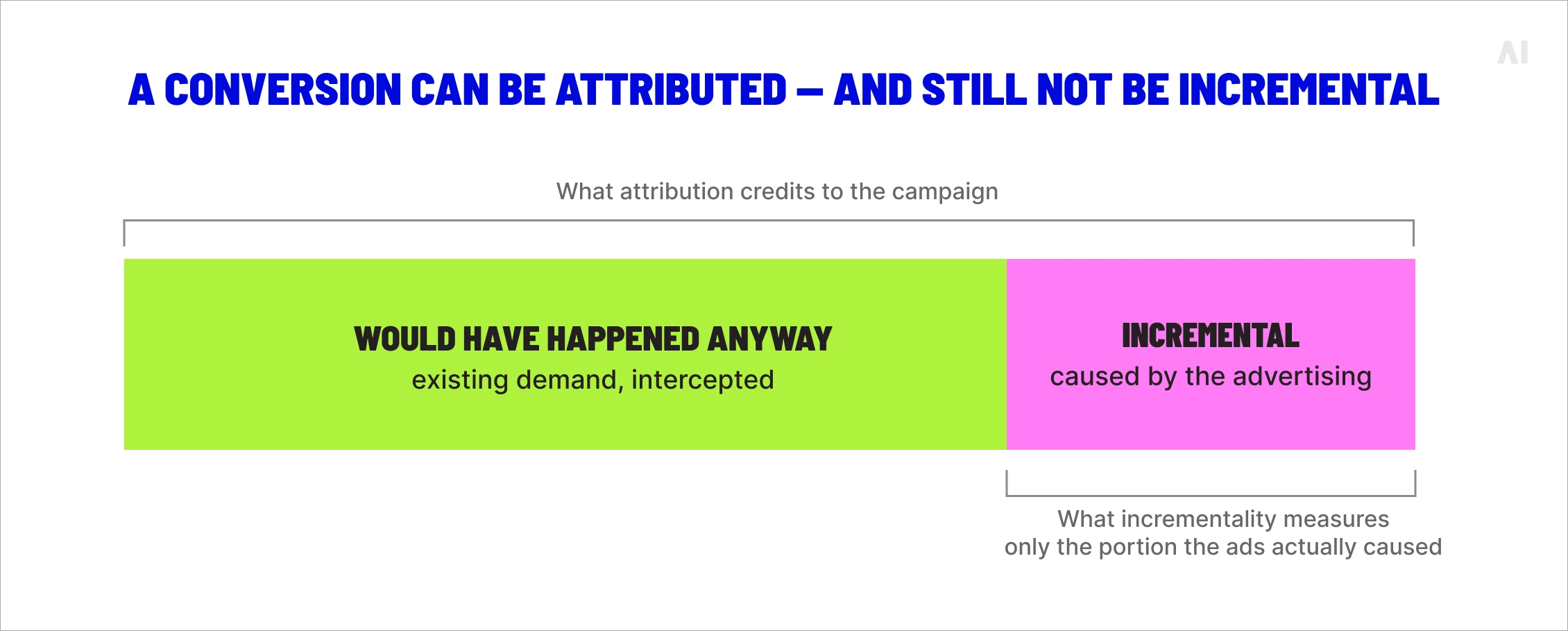
The distinction affects everything from reported return on ad spend to annual budget planning. A conversion can be legitimately attributed to an ad and still not be incremental. The customer may already have intended to buy, may have reached the brand through another channel, or may have converted without any paid media at all.
Leading marketing organizations increasingly combine attribution, incrementality, and marketing mix modeling rather than asking one methodology to do every job. Attribution offers tactical visibility. Incrementality provides causal validation. Marketing mix modeling supplies an aggregate view of channel contribution, external influences, and future allocation.
⚡ Attribution records the route to a conversion. Incrementality tests whether marketing changed the destination.
Why marketing measurement is broken
Attribution became dominant because digital advertising made activity visible at a level traditional media rarely could. Marketers could connect ad clicks with site visits, purchases, downloads, and leads. Platform dashboards returned results quickly, allowing teams to alter bids, audiences, creative, and budgets while a campaign was still running.
That immediacy improved media management. It also encouraged the industry to equate observable activity with marketing effectiveness.
Three conditions made attribution particularly attractive:
- Digital touchpoints produced event-level data. Impressions, clicks, page views, and conversions could be recorded and ordered.
- Advertising platforms supplied ready-made reports. Marketers did not have to build a causal model to obtain a performance figure.
- Conversion metrics suited performance marketing. Revenue, leads, purchases, and return on ad spend appeared easier to defend than reach, awareness, or brand preference.
The resulting measurement culture rewarded channels that were easiest to track. A channel capable of recording a click close to a purchase often appeared more productive than one whose influence developed earlier, operated offline, or produced an effect that could not be tied to a user identifier.
Nielsen’s 2025 Marketing ROI Blueprint captures the contradiction. Although 85% of surveyed marketers expressed confidence in tracking holistic performance, only 32% said they actually measured traditional and digital media holistically.
The problem is not a complete absence of data. Most organizations have more marketing data than they can use. The difficulty lies in reconciling data generated under different rules:
- One platform may use a seven-day click window.
- Another may include view-through conversions.
- Analytics software may credit the final session.
- A CRM may record the lead source reported at form submission.
- Retail media networks may use their own identity and transaction data.
- Offline sales may appear days or weeks later.
- Several platforms may claim the same purchaser independently.
Each report may be internally consistent while the combined account remains inflated, incomplete, or impossible to reconcile.
Conversion-based reporting creates another weakness. It concentrates attention on people who bought, signed up, or completed another measurable action. It says much less about the many people exposed to advertising who did nothing, or about customers who would have converted without paid media. Without that comparison, marketing can appear to generate demand when it has mainly intercepted it.
Measurement is therefore broken less by a single failed model than by a mismatch between the questions organizations ask and the evidence their reporting can provide. Attribution is routinely asked to prove causality, platform reports are treated as neutral audits of their own performance, and short-term conversion data is used to judge investments whose effects unfold over months.
💡 Related reading: The Problem with Platform-Reported Data: Why You Can’t Trust the Numbers
What attribution really measures
Attribution measures the relationship between recorded touchpoints and recorded conversions. Its practical purpose is to distribute credit: which interaction, campaign, channel, or sequence should receive recognition for an outcome?
That is a useful task. Media teams need to understand how prospects enter a funnel, which campaigns produce qualified traffic, which creative prompts action, and where customers return before converting. Attribution can expose patterns that disappear when marketing is reviewed only through aggregate revenue.
Attribution can help answer questions such as:
- Which campaign was the final recorded interaction before purchase?
- Which channels appeared most often in converting journeys?
- How long did recorded conversion paths take?
- Which creative or keyword generated the most attributed actions?
- Did assisted touchpoints appear earlier in the funnel?
- Where are users dropping out before completing an action?
These are questions about observed paths and assigned credit. Problems begin when the answers are restated as causal claims.
An attributed conversion does not automatically mean the credited touchpoint created the sale. A branded search ad, for example, may appear highly efficient because it captures people already looking for the company. Retargeting may collect conversions from recent site visitors who were already close to buying. Affiliate, paid social, search, and email systems may each claim involvement in the same purchase.
Attribution can still guide campaign management, but its output should be read as evidence of association within the observable journey.
How attribution models assign credit
Every attributon model contains an opinion about which interactions deserve recognition. Rules-based models express that opinion directly. Data-driven models estimate it from patterns within the data available to the system.
Google’s own description of attribution models is explicit: the model determines how much credit each ad interaction receives. Changing the model can therefore change reported channel or campaign performance without changing the underlying number of customers who bought.
{{iva-1}}
Data-driven attribution is more adaptive than a fixed rule, but “data-driven” does not mean universal. Google Ads, for example, analyzes eligible interactions within its own advertising environment and the conversion data available to the advertiser. Other platforms use their own events, identity systems, engagement definitions, and attribution windows.
A model can therefore become more sophisticated while remaining incomplete. It may distribute credit intelligently across the part of the journey it can observe, yet remain unable to see a podcast exposure, an in-store visit, an organic recommendation, a competitor’s promotion, or an ad served in another closed platform.
💡 Related reading: Best Attribution Models for B2B and Long Sales Cycles.
Attribution’s blind spots
Attribution lacks a direct counterfactual. It observes that a conversion followed one or more marketing contacts, then assigns credit according to a rule or model. It does not independently observe the same customer under identical conditions without those contacts.
That creates several blind spots.
- Existing demand can look like marketing-created demand. Branded search, retargeting, loyalty email, and affiliate activity often reach customers with high purchase intent. Attribution may correctly record those interactions while overstating how much additional demand they produced.
- Unobserved touchpoints disappear from the account. A customer may see television, hear a recommendation, research on another device, visit a store, and later click a paid search ad. The click is visible; the rest may not be.
- Credit can be duplicated across platforms. Self-attributing platforms often evaluate conversions within their own reporting systems. When media runs across several platforms, each may count the same outcome according to its eligibility rules.
- View-through attribution can widen the claim. A conversion may be credited after an impression even when the user did not click. View-through reporting can capture genuine influence, but it also raises the risk of claiming people who happened to see an ad before buying.
- Optimization can reinforce the bias. Platforms learn from attributed conversions. When the reporting system favors audiences already likely to convert, the delivery system may pursue more of them, producing stronger attributed results without a corresponding increase in causal lift.
- The model cannot recover data it never received. More advanced algorithms cannot infer every missing offline, cross-device, or cross-platform contact with equal reliability.
For these reasons, attribution is strongest when used to understand observable customer journeys and manage tactical performance. It becomes less dependable when used as the sole proof that marketing generated incremental business growth.
⚡ A conversion may be correctly attributed and still not be incremental.
💡 Related reading: Marketing Attribution Challenges: Why Traditional Attribution Models Don’t Work Anymore.
What incrementality really measures
Incrementality measures the additional outcome caused by a marketing action compared with what would probably have happened without it.
The IAB’s 2025 Guidelines for Incremental Measurement define incrementality through causal impact: additional business outcomes directly driven by a campaign or tactic, measured against an estimate of the outcome in the absence of that activity.
This changes the measurement question.
- Attribution asks: Which touchpoint should receive credit for this conversion?
- Incrementality asks: How many conversions occurred because the marketing ran?
The difference depends on the counterfactual. Since marketers cannot expose and withhold the same campaign from the same person at the same time, they construct a comparison using randomized control groups, audience holdouts, matched geographic areas, synthetic controls, or other causal methods.
Suppose an exposed audience generates 5,000 purchases while an equivalent unexposed group would be expected to generate 3,000. The campaign’s estimated incremental contribution is 2,000 purchases, subject to the design and statistical uncertainty of the test.
The remaining 3,000 purchases are not unimportant. They may reflect brand demand, organic activity, store distribution, existing customers, competitor conditions, seasonality, or other marketing. They simply cannot be claimed as additional outcomes caused by the tested campaign.
Incrementality can be evaluated against several business results:
- Purchases or subscriptions;
- Revenue;
- Profit or contribution margin;
- Qualified leads;
- Store visits;
- Customer acquisition;
- New-to-brand buyers;
- Product adoption;
- Brand or consideration outcomes.
The outcome should be selected before the test begins. An experiment designed around clicks cannot later be presented as proof of incremental profit unless the necessary business data and design support that conclusion.
💡 Related reading: How to Measure Incrementality in Marketing Campaigns | Incrementality Testing Framework: Step-by-Step
Control groups and incremental lift
A control group represents the best available estimate of what would have happened without the marketing treatment.
In a randomized audience experiment, eligible users are assigned to treatment and control groups. The treatment group can receive the campaign; the control group is withheld from it. Randomization is intended to distribute pre-existing differences between the groups so that the main systematic difference is the marketing exposure.
In a geographic test, selected markets receive the treatment while comparable markets do not. Matching may account for historical sales, population, media behavior, seasonality, and other relevant factors. Synthetic control methods can construct a modeled comparison from several untreated regions or units when a direct match is unavailable.
Incremental lift can be expressed in absolute or relative terms:
Absolute incremental lift
Observed treatment outcome – estimated control outcome
If the treatment produces 12,000 sales and the counterfactual estimate is 10,000, the absolute lift is 2,000 sales.
Relative incremental lift
(Observed treatment outcome – estimated control outcome) ÷ estimated control outcome
Using the same example, the relative lift is 20%.

A credible result requires more than a visible difference between two totals. The test must address three requirements emphasized by the IAB:
- A credible counterfactual: the comparison should resemble what would have happened without the intervention.
- Control of bias: pricing, promotions, seasonality, competitor activity, audience composition, and concurrent campaigns must not explain the result.
- Separation of signal from random variation: the test needs sufficient scale, duration, and statistical evaluation to distinguish a persistent effect from chance.
Control contamination is a frequent problem. A person assigned to the holdout group may still encounter the brand through another platform, organic social, television, retail media, or an offline promotion. Geographic markets can also influence one another through travel, news coverage, shared media, or ecommerce.
Incrementality is therefore a family of methods with different levels of causal strength. Randomized experiments generally provide stronger evidence than simple exposed-versus-unexposed comparisons, where the exposed audience may have differed before the campaign began.
Incremental ROAS vs. reported ROAS
Platform-reported return on ad spend usually divides attributed revenue by advertising cost:
Attributed revenue ÷ ad spend
Incremental ROAS divides estimated additional revenue caused by the advertising by the same cost:
Incremental revenue ÷ ad spend
Consider a campaign that costs $100,000 and receives credit for $600,000 in sales.
Its reported ROAS is:
$600,000 ÷ $100,000 = 6.0
An incrementality test, however, estimates that $180,000 of those sales would not have happened without the campaign.
Its incremental ROAS is:
$180,000 ÷ $100,000 = 1.8
Both calculations can be technically correct. They describe different things.
The reported ROAS says that six dollars of credited revenue appeared for every dollar spent. Incremental ROAS says that the campaign generated an estimated $1.80 in additional revenue for every dollar spent.
The gap may be particularly large for:
- Brand search;
- Retargeting;
- Existing-customer campaigns;
- Loyalty or promotional email;
- Affiliate activity close to checkout;
- High-intent retail media;
- Channels with generous view-through windows.
Incremental ROAS should also be interpreted against margin. A campaign producing $1.80 in incremental revenue per dollar may still lose money when cost of goods, discounts, returns, agency fees, and other variable costs are considered. For that reason, some teams move from incremental revenue toward incremental profit on ad spend or marginal contribution.
Attribution remains useful within the campaign. It may identify which keyword, creative, audience, or placement collected the most conversions. Incrementality evaluates the larger investment claim: did the campaign produce enough additional business to justify its cost?
💡 Related reading: Profit on Ad Spend: A Better Measure of Marketing Performance
Why incrementality reveals what attribution cannot
Causation requires a comparison between the observed outcome and a credible alternative. Attribution has the observed journey but usually lacks the alternative. Incrementality is designed around it.
Imagine a customer who regularly buys coffee capsules from the same brand every month. A retargeting ad appears two days before the next order. Last-touch attribution awards the sale to the ad. The timeline is accurate: the customer saw or clicked the ad and then purchased.
Yet the relevant business question is not whether the interaction preceded the sale. It is whether the order would have happened without the ad.
A holdout test might find that 92% of similar customers bought again without retargeting, compared with 94% among customers eligible to receive ads. The campaign produced a two-point lift, not the entire 94% purchase rate.
The same distinction applies at channel level. Paid search may receive thousands of conversions from users searching for a brand by name. Attribution identifies the final contact. Incrementality testing estimates how many users would have reached the website organically, through direct navigation, or through another listing if the paid ad had not appeared.
Correlation still has operational value. A campaign strongly associated with conversions may be worth investigating or optimizing. It simply should not be promoted into a causal conclusion without additional evidence.
Attribution vs. incrementality: strengths and limitations
Attribution and incrementality are not interchangeable because they operate against different evidence, time horizons, and business questions.
Attribution offers speed, granularity, and continuous reporting. Incrementality offers stronger causal evidence, but testing can require scale, planning, holdouts, and tolerance for uncertainty. Attribution is often available every morning. A credible incrementality result may take weeks and may not support placement-level detail.
The choice should therefore begin with the decision, not with the method already installed in the analytics stack.
💡 Related reading: Marketing Measurement vs Attribution vs MMM: What’s the Difference? | Unified Marketing Measurement: Why Attribution Alone No Longer Works
Credit vs. causality
Attribution distributes credit among observed interactions. Incrementality estimates causal contribution.
That difference changes the wording of the conclusions each method can support.
An attribution report can reasonably say:
- Paid social received credit for 3,000 conversions.
- Search appeared in 40% of recorded conversion paths.
- Video assisted more conversions than display.
- A particular creative generated the lowest attributed cost per acquisition.
It cannot establish, on its own, that:
- Paid social caused all 3,000 conversions.
- Removing search would reduce conversions by 40%.
- Video generated more additional revenue than display.
- The cheapest attributed creative produced the greatest causal lift.
An incrementality study can support causal claims if the counterfactual, bias controls, and statistical evidence are credible. Its conclusions are generally narrower:
- The tested campaign produced an estimated lift during a defined period.
- The channel generated additional purchases among the eligible population.
- Increasing spend beyond a certain level produced diminishing marginal return.
- The treatment did not generate a detectable effect at the scale tested.
The last result deserves attention. A statistically inconclusive test does not always prove that the campaign had zero impact. The study may have been too small, the effect may have been modest, or the outcome may have varied too widely. Good incrementality reporting includes uncertainty rather than forcing every test into a positive or negative verdict.
📌 The term incremental attribution is sometimes used to describe assigning value according to causal contribution, but it should not be confused with conventional attribution models that redistribute credit across observed touchpoints.
Data and privacy requirements
Traditional multi-touch attribution depends heavily on connecting user-level interactions across time, devices, websites, and platforms. That task becomes harder as identifiers disappear, consent varies, and platforms restrict external access to event data.
Incrementality can also use user-level exposure and conversion information, but it does not always require a complete journey for every individual. Geographic experiments, conversion lift studies, synthetic controls, and aggregate time-series methods can evaluate changes without reconstructing each customer’s path.
This gives incrementality a degree of privacy resilience, though not immunity from privacy obligations. A user-level randomized test still requires lawful data collection, appropriate consent, secure matching, governance, and controls over who can access the information. Aggregate methods reduce dependence on personal identifiers, but poor geographic or sales data can still undermine the result.
The long-term distinction is therefore one of dependency:
- Multi-touch attribution often needs persistent identity across many touchpoints.
- Incrementality needs a credible treatment and counterfactual.
- MMM generally works with aggregated historical data rather than person-level paths.
A company with strong first-party transaction data but limited cross-site identity may struggle to build a complete attribution graph while still being able to run matched-market tests or aggregate modeling.
Speed vs. depth
Attribution is usually faster. Its reports can update daily or within hours, making it suited to pacing, bidding, audience review, creative rotation, and campaign troubleshooting.
Incrementality is slower because causal evaluation requires a deliberate design, a suitable comparison, and enough observations to detect an effect. Tests may also require a pre-period, a campaign period, and time for conversions to mature.
The trade-off is not simply fast versus slow. It is frequent directional feedback versus deeper validation.
Use attribution when a team needs to know:
- Which campaign is spending too quickly;
- Which creative receives more qualified visits;
- Which keywords collect lower-funnel actions;
- How recorded journeys differ by audience;
- Where conversion tracking may have failed.
Use incrementality when leaders need to know:
- Whether a channel creates additional sales;
- Whether retargeting is capturing existing demand;
- Whether a new media investment deserves expansion;
- How much revenue would be lost if spending stopped;
- Which channels retain marginal value as budgets rise.
Fast feedback and causal depth can support one another. Attribution may identify a campaign worth testing. Incrementality can then determine whether its apparent success survives controlled evaluation.
⚡ Fast reporting supports campaign management; causal evidence supports investment decisions.
Which measurement method is more accurate?
Accuracy depends on the claim being made.
- Attribution is more suitable for describing recorded interactions. If the question is which eligible ad click occurred last, a properly implemented last-touch report may answer accurately. If the question is how the recorded customer journey unfolded inside a particular data environment, attribution can provide valuable detail.
- Incrementality is generally more reliable for determining causal business impact because it explicitly estimates what would have happened without the marketing. The strength of that conclusion, however, depends on the test design.
A badly matched geographic test may be less informative than a well-implemented attribution analysis for a tactical question. A small holdout may lack enough statistical power. A platform-run lift study may provide strong evidence within that platform but limited insight into cross-channel effects. A modeled counterfactual may be sensitive to omitted variables.
The most defensible hierarchy is therefore:
- Use attribution as directional evidence about recorded journeys and campaign activity.
- Use well-designed incrementality testing as causal evidence for defined interventions.
- Use MMM as aggregate evidence for cross-channel contribution, external effects, and allocation.
- Compare the methods rather than forcing them to agree.
When attribution and incrementality produce different answers, the discrepancy is useful. It can reveal demand capture, audience selection effects, duplicated credit, an unsuitable attribution window, or a channel whose influence extends beyond trackable interactions.
From attribution to incrementality: Why the shift is happening
Marketers are giving incrementality a larger role because the assumptions that supported user-level attribution have weakened. Cross-device tracking is less complete, consumer consent has greater influence over data availability, browsers block or restrict identifiers, and closed platforms reveal only selected parts of the journey.
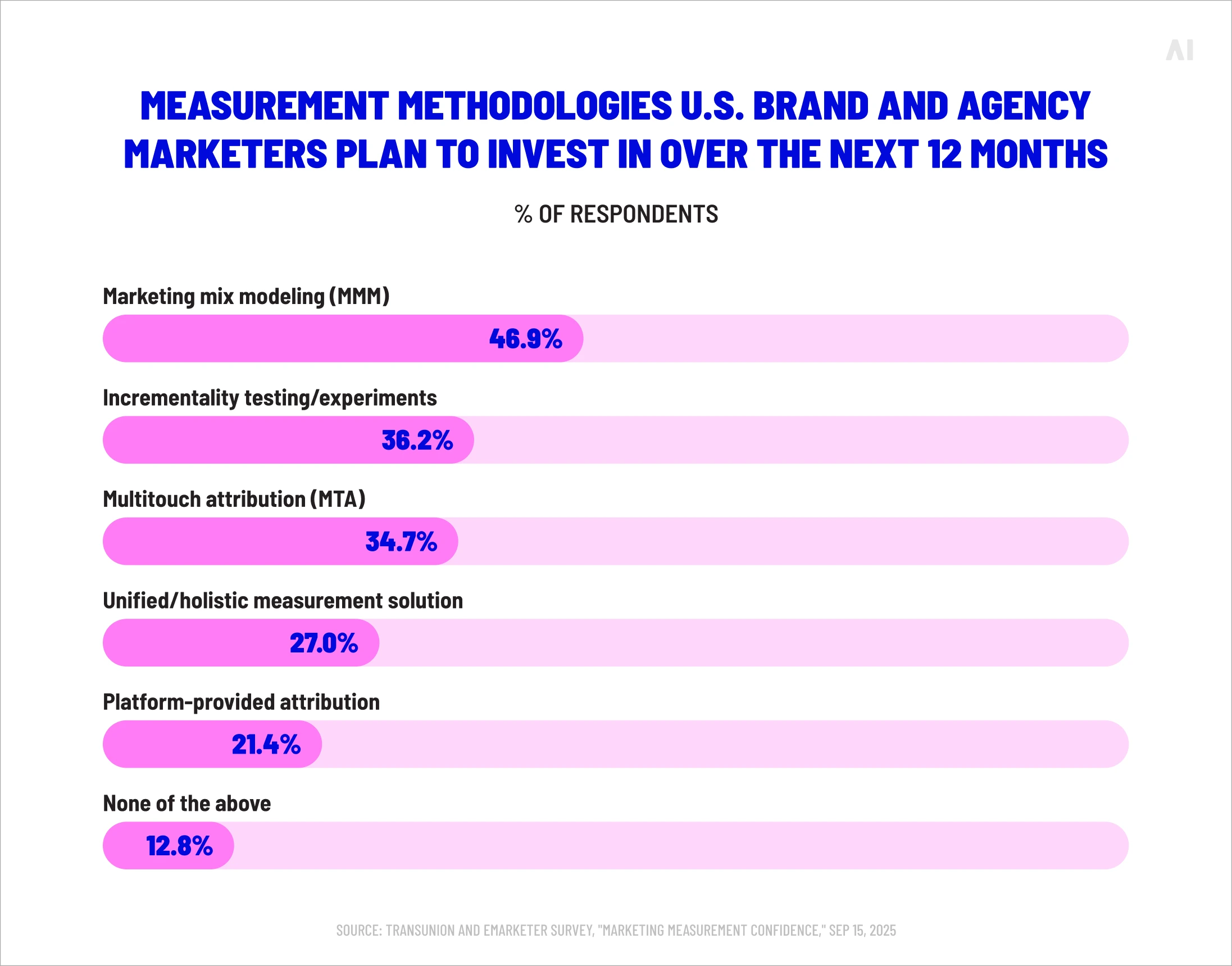
Economic pressure has accelerated the demand for stronger evidence. In the IAB’s September 2025 outlook, 36% of surveyed US media buyers named cross-channel measurement as a leading investment challenge, and the same proportion cited demonstrating media incrementality.
Attribution has not disappeared. It remains embedded in bidding, analytics, campaign reporting, and channel operations. Its authority as a complete account of business impact is what has declined.

The collapse of cross-channel tracking
Cross-channel attribution assumes that interactions can be connected with enough consistency to reconstruct a meaningful journey. Several technical and regulatory developments have weakened that assumption.
- Apple’s App Tracking Transparency framework requires apps to request permission before tracking users across apps and websites owned by other companies. Without authorization, access to the advertising identifier is restricted.
- Safari’s Intelligent Tracking Prevention blocks third-party cookies by default and applies additional restrictions intended to limit cross-site tracking.
- GDPR and related European privacy rules impose conditions on personal-data processing, with the European Commission stating that valid consent must be freely given, specific, informed, and unambiguous when consent is the legal basis.
- Chrome requires a more current qualification. Google did not complete the blanket third-party-cookie removal once expected. In April 2025, it said Chrome would retain its existing user-choice approach rather than introduce a separate prompt, while continuing stronger protections in Incognito mode.
The broader attribution problem remains: cookie availability varies by browser, user setting, consent state, device, and environment.
Server-side tracking, clean rooms, first-party identifiers, conversion APIs, and probabilistic models can recover part of the lost visibility. They cannot create a universally observable customer journey. They also introduce their own questions about matching accuracy, governance, interoperability, and unequal platform access.
Incrementality can operate with less dependence on continuous identity. A geo-test can compare sales across markets. A platform lift test can randomize eligible users. A synthetic control can estimate an untreated baseline from aggregate data. These approaches do not remove every data problem, but they redirect measurement toward differences in outcomes rather than complete path reconstruction.
💡 Related reading: Data Fragmentation in Advertising | Transparency in Advertising
The walled garden problem
Major advertising platforms provide valuable measurement because they can connect media exposure with activity inside their own systems. They also define the eligible interactions, attribution windows, modeled conversions, identity rules, and optimization signals used in their reports.
Those rules are not identical.
Google explains that its data-driven attribution analyzes eligible Google ad interactions and advertiser conversion data. Meta allows advertisers to select attribution settings based on qualifying views, clicks, or engagements. Other platforms apply their own windows and event definitions.
The result is a set of internally generated performance accounts rather than one neutral cross-platform ledger.
This creates three problems:
- Each platform sees itself more clearly than it sees competitors.
- The same conversion may satisfy several platforms’ attribution rules.
- The organization selling the media also reports how well that media performed.
None of this proves that platform reporting is deliberately inaccurate. It means that platform attribution has a bounded perspective and an institutional incentive. Marketers should understand what the metric includes before using it for cross-channel allocation.
Independent incrementality testing can provide a check. A brand can compare platform-attributed conversions with user-level lift, geo-lift, matched-market results, or aggregate sales effects. Large differences may reveal that a platform excels at finding likely buyers but contributes less additional demand than its attributed totals suggest.
Platform lift studies remain useful, particularly when they use genuine randomized holdouts. Their scope should still be stated clearly. A test may establish incremental impact within one platform without resolving overlap with search, television, email, retail media, or competitor activity.
💡 Related reading: Walled Gardens in Digital Advertising
Why CFOs prefer incrementality
Finance teams examine marketing through revenue, margin, cash flow, opportunity cost, and marginal return. Attributed conversions can support the discussion, but they do not settle it.
The finance question is usually counterfactual: What additional financial result did the company receive for this investment, and what would happen if the budget changed?
That language aligns naturally with incrementality.
Budget pressure has made the distinction more urgent. Gartner’s 2025 CMO Spend Survey found that marketing budgets remained at 7.7% of company revenue, while 59% of CMOs said they lacked sufficient budget to execute their strategy. In that setting, a report that allocates conversion credit is less persuasive than evidence that spending produced additional profitable growth.
Incrementality helps finance and marketing discuss:
- Incremental revenue;
- Incremental gross profit;
- Customer acquisition beyond the existing baseline;
- Marginal return from the next dollar invested;
- Diminishing returns at higher spend levels;
- The financial risk of reducing or removing a channel;
- Payback periods and long-term customer value.
It also exposes investments that look efficient because they reach customers who would probably buy anyway. A retargeting campaign with a high reported ROAS may prove less valuable after the organic purchase baseline is removed. An upper-funnel channel with weaker direct attribution may show stronger incremental impact than its click data suggests.
Finance leaders do not necessarily prefer experiments in every circumstance. They prefer evidence linked to financial causality. Incrementality, calibrated MMM, and marginal-response analysis are often better suited to that requirement than platform credit alone.
Attribution vs incrementality comparison table
The following framework summarizes the practical differences.
{{iva-2}}
The table does not identify a universal winner. It shows why each methodology should be tied to a suitable decision. Attribution is often the practical choice for daily campaign operations. Incrementality becomes more valuable as the financial importance and causal burden of the question rise.
The role of MMM in modern measurement
Marketing mix modeling examines the relationship between marketing investment, business outcomes, and external factors using aggregated data over time. It can include digital and offline media alongside pricing, promotions, seasonality, distribution, economic conditions, competitor activity, and other demand drivers.
MMM answers broader questions than most attribution or campaign-level lift studies:
- How much did each channel contribute across the measured period?
- How did non-media factors affect sales?
- Where are channels approaching saturation?
- How might revenue respond to a different budget allocation?
- What mix is likely to produce a stronger marginal return?
Modern MMM can be updated more frequently than older annual models, though it remains dependent on data quality, variation in spend, model design, and transparent assumptions. Google’s open-source Meridian framework and Meta’s Robyn project reflect the renewed investment in privacy-durable, aggregate modeling.
MMM complements attribution and incrementality because each method supplies a different view.
- Attribution observes journeys and supports tactical action.
- Incrementality testing isolates the effect of a defined campaign, channel, audience, or tactic.
- MMM estimates broad channel and non-channel contribution across time and supports scenario planning.
Experiments can also calibrate MMM. If a controlled test produces a credible channel-lift estimate, modelers can compare or incorporate that evidence when evaluating the broader media mix. MMM, in return, can identify areas where experimental validation would be most valuable.
Relying on MMM alone creates its own blind spots. Highly correlated channel spending can be difficult to separate. New channels may lack sufficient history. National campaigns with little geographic or temporal variation can leave the model with weak identification. Aggregate results may not explain which creative or audience performed best.
The strongest modern measurement framework uses triangulation. When attribution, experiments, and MMM point in a similar direction, confidence rises. When they disagree, the organization investigates the assumptions rather than selecting the most flattering number.
⚡ No single measurement method can answer every question a marketing organization asks.

💡 Related reading: Media Mix Optimization: How to Use MMM for Budget Allocation
When to use attribution vs. incrementality
The right method depends on what the organization plans to do with the answer.
A campaign manager deciding which creative to pause has a different evidence requirement from a CMO deciding how to allocate $20 million across channels. The first decision values speed and granularity. The second needs broader and more causal evidence because the financial consequence is greater.
A useful selection process begins with four questions:
- Is the decision tactical or strategic?
- Does the answer require causal proof or directional evidence?
- What data, scale, and comparison groups are available?
- How costly would a wrong conclusion be?
Higher-stakes decisions justify stronger causal rigor. Lighter evidence may be sufficient for reversible, low-cost operational choices, provided its limitations remain visible.
Attribution: funnel visibility and tactical optimization
Attribution remains valuable when marketers need an ongoing account of observable campaign behavior.
Use it to:
- Monitor conversions and revenue during a campaign;
- Compare recorded paths across audience groups;
- Identify high-performing creative, keywords, or placements;
- Diagnose funnel drop-off;
- Review assisted interactions;
- Detect tracking or landing-page problems;
- Support bid and budget pacing;
- Understand time to conversion;
- Compare attribution models for sensitivity.
Its value rises when the decision is frequent, reversible, and close to campaign execution. A team may not need a randomized test to pause an ad with broken creative, correct an event-tagging failure, or move spend away from a placement generating invalid traffic.
Attribution can also generate hypotheses for stronger testing. If one audience appears to outperform another, an experiment can evaluate whether that difference persists when exposure is randomized. If brand search receives unusually high credit, a geo-test can estimate how many conversions continue when paid brand coverage is reduced.
The discipline lies in using attribution language accurately. Say that a campaign received credit for conversions or appeared in customer paths. Reserve “caused,” “generated,” and “produced incremental growth” for evidence capable of supporting those claims.
💡 Related reading: How to Gain Full Visibility Across Your Marketing Ecosystem
Incrementality: budget allocation and channel investment
Incrementality is most useful when the organization must decide whether an investment deserves to continue, expand, contract, or move elsewhere.
Common scenarios include:
- Evaluating a new channel. A company launching CTV, retail media, podcasts, or digital out-of-home may have limited attribution visibility. A geographic or matched-market design can test whether business outcomes improve where the media runs.
- Testing retargeting value. Holdouts can reveal how many high-intent users would have converted without additional ads.
- Validating branded search. Market-level or campaign experiments can estimate the proportion of paid clicks that replace organic or direct visits.
- Comparing prospecting strategies. Randomized audience tests can evaluate incremental customer acquisition rather than attributed purchase volume.
- Assessing promotional media. Tests can separate the effect of advertising from the effect of the discount itself.
- Setting investment levels. Repeated tests at different spend levels can reveal diminishing returns and support marginal allocation.
- Checking platform claims. Independent tests can compare causal lift with platform-reported conversions.
Incrementality should be connected to an action before the study begins. A test is less valuable when no one has agreed what result would justify a budget increase, hold, redesign, or reduction.
Are you ready for incrementality?
Effective incrementality programs require more than a testing tool. They need organizational agreement, reliable data, sufficient scale, and the willingness to withhold marketing from part of an eligible audience.
Teams should assess readiness across five areas.
- A defined business decision
The organization should know what will change after the result. “Measure incrementality” is too broad. “Determine whether to increase connected TV investment next quarter” is actionable.
- A measurable business outcome
Clicks and impressions are rarely enough. The test should connect to sales, profit, qualified leads, subscriptions, store visits, customer acquisition, or another meaningful result.
- Adequate scale and variation
Small budgets can support incrementality testing when conversion volume is high, the expected effect is large, or the treatment can be concentrated across suitable markets. Low-volume businesses may need longer tests, broader outcomes, pooled regions, or modeled counterfactuals.
- A defensible control
The team needs a credible untreated comparison. That may be a randomized user holdout, matched geography, store group, product group, time-based intervention, or synthetic control.
- Governance and patience
Tests need stable definitions, documented exclusions, pre-agreed success criteria, and honest reporting of uncertainty. Teams must also accept that withholding media can feel uncomfortable, particularly when an existing campaign appears successful in platform reports.
Organizations that lack scale can begin with alternatives:
- Consolidate several small markets into test cells;
- Test a major budget change rather than a minor adjustment;
- Use higher-frequency intermediate outcomes with a proven relationship to revenue;
- Run matched-market studies across stores or regions;
- Use synthetic controls where randomization is unavailable;
- Apply MMM for broader allocation and use smaller experiments for calibration;
- Treat platform lift estimates as directional until independently validated.
The aim is proportional rigor. A small company does not need an enterprise experimentation department to ask causal questions, but it should avoid claiming more certainty than its design can provide.
💡 Related reading: Creating a Data-Driven Marketing Strategy.
Attribution or incrementality? A decision framework
The following matrix connects common business questions with the method best placed to answer them.
{{iva-3}}
For many organizations, the final column is the real answer. Measurement methods work best as a system. Attribution supplies detail, incrementality tests decisive assumptions, and MMM connects the findings to the wider budget.

Beyond attribution and incrementality: AI Digital’s measurement ecosystem
Modern measurement is becoming a connected operating discipline rather than a contest between individual models. Marketing teams need to collect evidence, compare it across platforms, interpret uncertainty, and convert the result into an investment decision.
AI Digital’s approach brings attribution, path analysis, marketing mix modeling, planning, forecasting, reporting, and optimization into a broader marketing intelligence framework. The purpose is not to make every methodology produce the same number. It is to help teams understand why the numbers differ and decide which evidence is appropriate for the decision at hand.
That distinction is important in fragmented media programs. An organization may receive platform attribution reports every day, an incrementality study each quarter, and an MMM update several times a year. Without a common decision process, the results sit in separate decks and influence different teams.
A connected measurement ecosystem should establish:
- Shared business outcomes;
- Consistent channel and campaign taxonomies;
- Transparent source definitions;
- A record of attribution windows and model assumptions;
- Experiment results that can inform planning;
- Aggregate models calibrated against causal evidence;
- Clear rules for turning findings into budget action.
💡 Related reading: Integrated Marketing Systems: Why Connected Operations Drive Better Performance
Turning measurement into action
Measurement has limited value when it ends with a report. Teams must connect the finding with planning, budgeting, forecasting, audience strategy, and campaign execution.
Elevate, AI Digital’s marketing intelligence platform, is designed to support that connection across the marketing cycle. Its capabilities include research and audience intelligence, media planning, reporting, path-to-conversion analysis, marketing mix modeling, forecasting, and optimization.
Within an attribution and incrementality framework, this creates several useful workflows:
- Attribution and path analysis can identify customer-journey patterns worth testing.
- Experiment findings can challenge or validate reported channel efficiency.
- MMM can place those findings within the broader media mix.
- Planning tools can model alternative budget allocations.
- Reporting can compare actual performance with forecasts and benchmarks.
- Optimization decisions can reflect business KPIs rather than one platform’s preferred metric.
Elevate should not be treated as a reason to collapse distinct methods into one blended score. Attribution, experiments, and MMM retain different assumptions and levels of causal strength. The advantage comes from making those differences visible within a shared decision environment.
Independent measurement across platforms
Cross-platform measurement becomes difficult when each environment supplies its own data, definitions, and claims. A campaign may span search, social, CTV, display, streaming audio, commerce media, and offline activity, yet no single platform can provide a neutral view of the entire program.
AI Digital’s Open Garden Framework is a vendor-neutral, DSP-agnostic operating model intended to connect data, inventory, activation, and measurement around the advertiser’s business outcomes.
For measurement, independence requires more than exporting dashboard data into one interface. It requires governance:
- Define comparable business outcomes across platforms.
- Document attribution windows and conversion rules.
- Deduplicate where the available data permits it.
- Separate platform-reported performance from independently validated lift.
- Compare results using a shared commercial metric, such as incremental profit.
- Retain the original methodology and uncertainty behind every figure.
An open framework does not eliminate walled gardens. It reduces the risk that one closed environment becomes the sole judge of its own value.
From measurement to media optimization
Measurement becomes commercially useful when it changes a decision.
Attribution can improve campaign operations by revealing creative, audience, placement, and journey patterns. Incrementality can identify which investments are producing additional outcomes. MMM can estimate cross-channel response and support allocation. Audience research and supply analysis can then apply those findings to the next plan.
AI Digital uses measurement intelligence across media planning, budget allocation, audience strategy, campaign management, and optimization. That may involve:
- Reducing investment in channels that collect existing demand without sufficient lift;
- Expanding channels with credible incremental returns;
- Adjusting frequency where added exposure produces little additional value;
- Testing new audiences against holdouts;
- Rebalancing spend as saturation increases;
- Selecting supply according to business performance rather than volume alone;
- Revising forecasts when observed results diverge from modeled expectations.
No measurement result should be transferred mechanically into optimization. A test conducted during a promotion may not generalize to a normal sales period. A strong regional result may not reproduce nationally. A channel can produce positive incremental lift while already operating beyond its most profitable marginal level.
Human judgment remains necessary: to examine the context, decide how far the evidence can travel, and specify the next test.
Attribution vs. incrementality: what marketers need to know
The incrementality vs attribution debate is useful only when it leads to better measurement choices.
Attribution answers questions about recorded touchpoints, conversion paths, and assigned credit. It remains valuable for campaign monitoring, funnel analysis, creative evaluation, and day-to-day media operations.
Incrementality estimates additional business outcomes caused by marketing. It is better suited to channel validation, budget allocation, investment approval, and questions about true revenue or profit contribution.
MMM widens the view further. It evaluates aggregate channel performance alongside seasonality, promotions, pricing, distribution, and other business factors, helping leaders plan the wider marketing mix.
These methods should not be forced into artificial agreement. They should challenge and calibrate one another.
A channel with strong attribution but weak incrementality may be capturing demand. A channel with weak direct attribution but positive lift may influence buyers in ways user-level tracking misses. An MMM result that conflicts with experiments may require revised variables, stronger calibration, or a closer examination of the test period.
The practical hierarchy is clear:
- Use attribution to observe and optimize.
- Use incrementality to validate causal impact.
- Use MMM to allocate and forecast across the wider business.
- Use all three to reduce dependence on any single model.
AI Digital helps organizations connect marketing intelligence, cross-platform measurement, planning, MMM, reporting, audience strategy, and media optimization. To discuss how these methods can support your measurement and investment decisions, get in touch with AI Digital.