POAS Meaning: What It Is and Why It Matters for Marketing Profitability


The shift from revenue-led to profit-led marketing is not just a tactical adjustment—it is a structural transformation in how modern organizations evaluate growth.
In traditional digital marketing frameworks, success has been defined by metrics like clicks, conversions, and revenue. However, as customer acquisition costs (CAC) continue to rise across platforms such as paid search, social, and retail media, these indicators have become increasingly insufficient. According to Statista, global digital advertising spend surpassed $600 billion, intensifying competition and inflating costs across nearly every channel.
Within this context, understanding what is POAS and how profit on ad spend works is becoming critical for marketing leaders who are accountable not just for growth, but for sustainable and scalable profitability.
At its core, POAS marketing introduces a more financially aligned metric, one that integrates marketing performance with business economics. Rather than optimizing campaigns purely for revenue generation, it enables teams to:
- Identify which campaigns truly drive profit
- Allocate budgets based on margin efficiency
- Scale growth without sacrificing financial sustainability
From an operational perspective, POAS bridges the long-standing gap between marketing and finance, aligning media investment decisions with actual business outcomes.
💡As AI Digital emphasizes in its performance frameworks, the future of digital marketing is not about generating more revenue—it is about generating better revenue, where each euro of ad spend contributes meaningfully to profit.
This article will unpack the POAS meaning, explain how it differs from traditional metrics like ROAS, and demonstrate why profit-based measurement is rapidly becoming essential in modern e-commerce and omnichannel marketing environments.
What is Profit on Ad Spend (POAS)?
Profit on Ad Spend (POAS) is a performance metric that measures how much profit a business generates for every unit of advertising investment. Unlike traditional revenue-based metrics, POAS focuses on net value creation, making it a more accurate indicator of true marketing effectiveness.
Core Formula
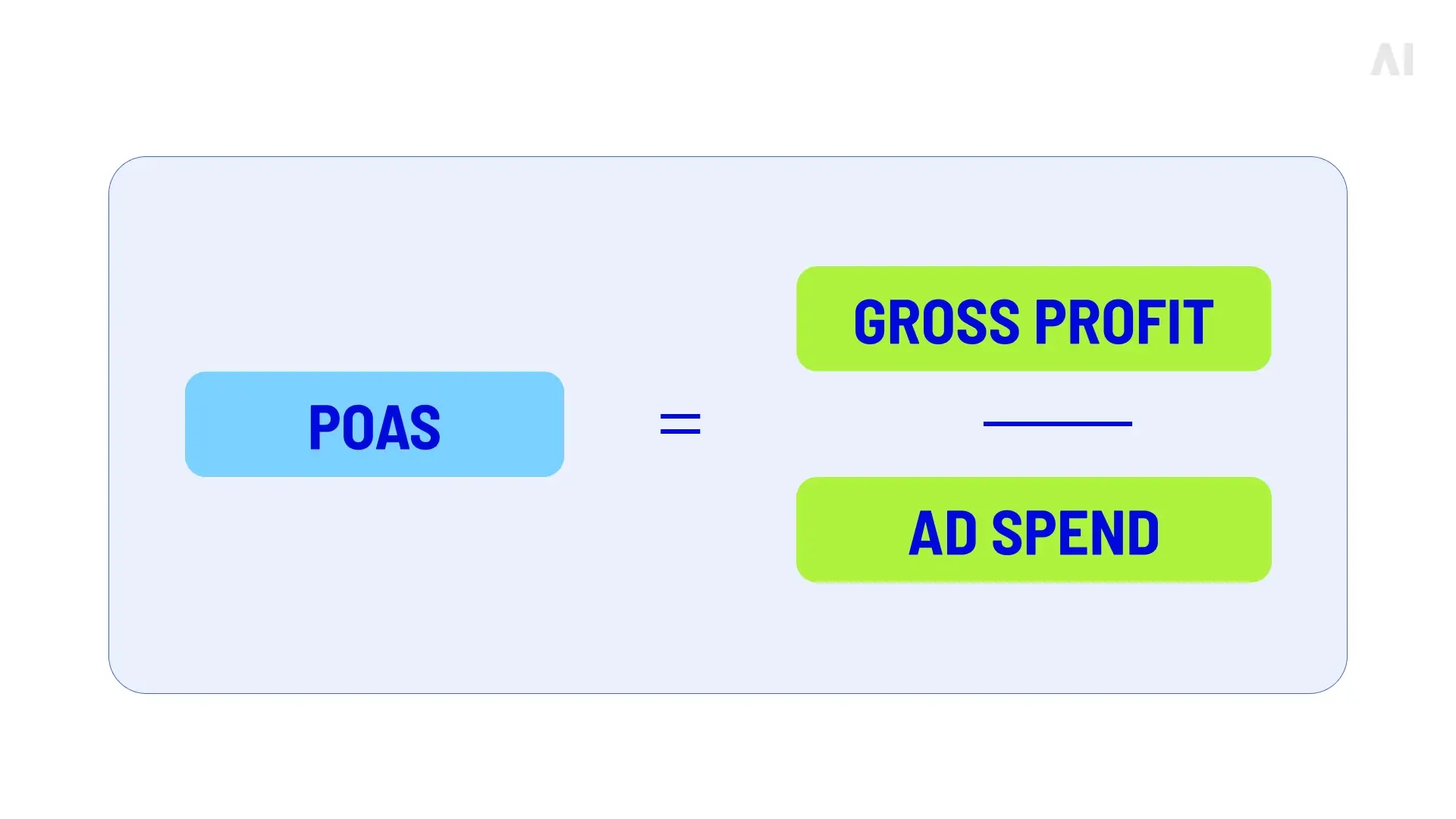
At a surface level, this formula appears straightforward. However, the definition of “profit” is not fixed and can vary depending on how a business structures its financial model and reporting logic.
What Counts as “Profit” in POAS?
The key complexity—and strategic value—of understanding what is POAS lies in how profit is calculated. Depending on the level of sophistication, businesses may include:
- Cost of goods sold (COGS)
- Discounts and promotional reductions
- Shipping and fulfillment costs
- Payment processing and platform fees
- Returns and refunds
- Operational and logistics expenses
More advanced organizations may also factor in customer acquisition costs across channels, warehousing, or even partial overhead allocation.
This variability matters because POAS is only as accurate as the cost inputs behind it. Two companies reporting the same POAS could have entirely different underlying economics depending on what is included in their profit calculation.
Why POAS Matters in E-commerce
The poas meaning becomes particularly critical in e-commerce environments, where profitability is highly sensitive to operational complexity.
Unlike simpler business models, e-commerce profitability is influenced by multiple fluctuating cost drivers:
- Margins vary significantly across products and categories
- Return rates can materially impact net profit
- Fulfillment and shipping costs differ by region and channel
- Discounts and promotions directly reduce realized revenue
- Marketplaces and retail media platforms introduce additional fees
In this context, relying solely on revenue-based metrics like ROAS can produce misleading signals, as they fail to account for these underlying cost dynamics.
For example, a campaign may generate high revenue but primarily drive low-margin or heavily discounted products—resulting in strong ROAS but weak or negative profit contribution.
Why Revenue-Only Measurement Falls Short
This is why profit on ad spend is becoming a foundational metric in modern digital marketing. It shifts evaluation from:
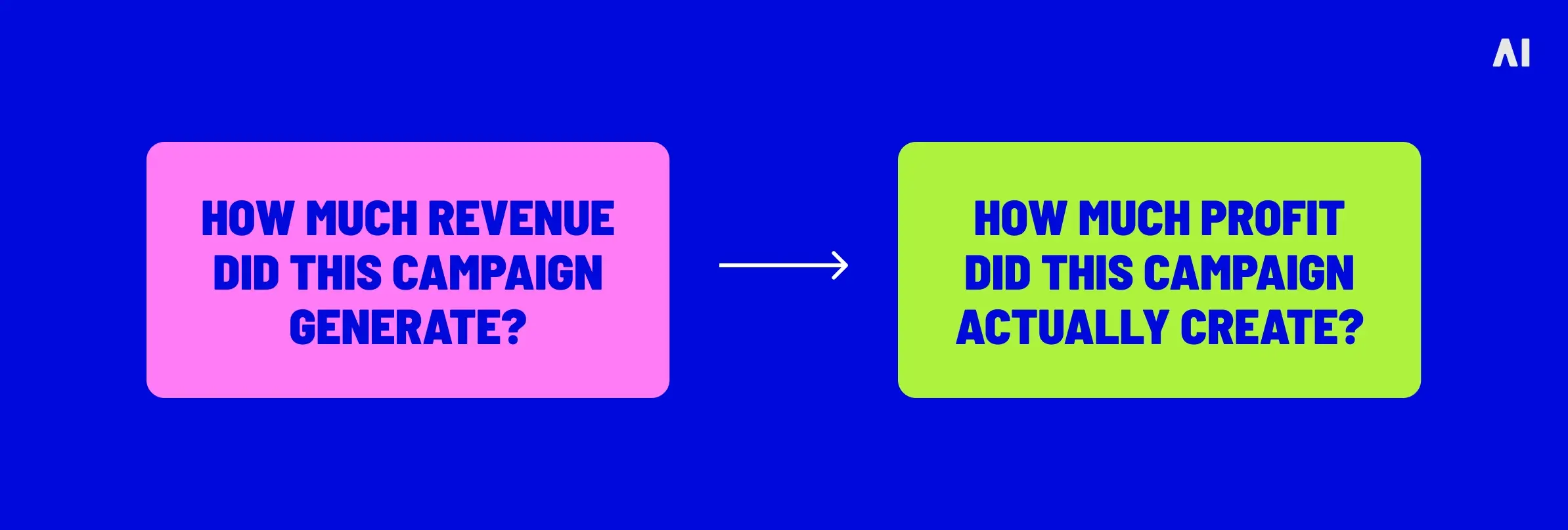
⚡️This shift is especially relevant in increasingly complex advertising ecosystems, where multiple intermediaries, platforms, and cost layers affect final outcomes. For a deeper understanding of how these systems operate, see this analysis of the AI Digital perspective on AdTech infrastructure.
%2520.webp)
POAS vs ROAS: What’s the real difference?
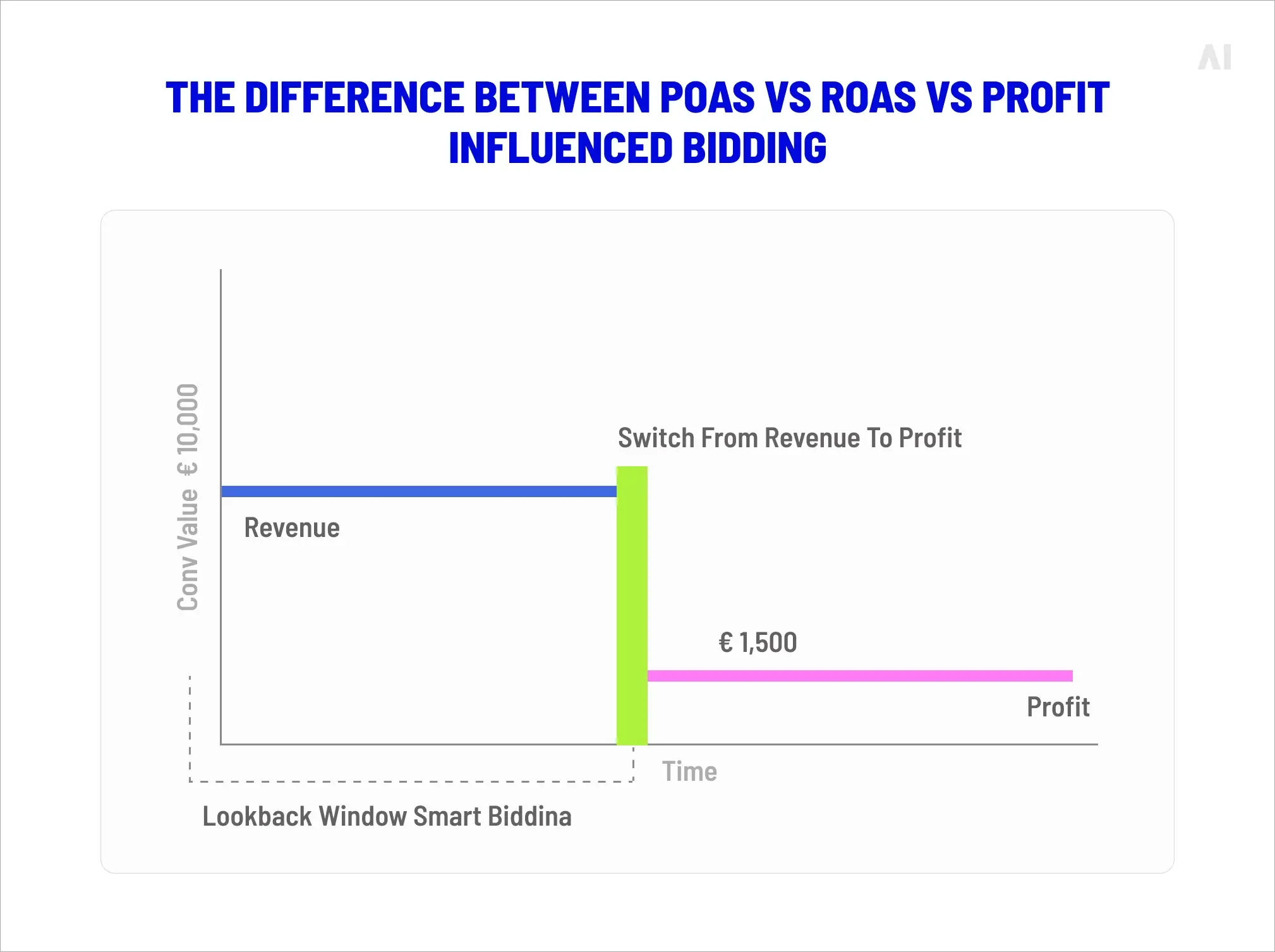
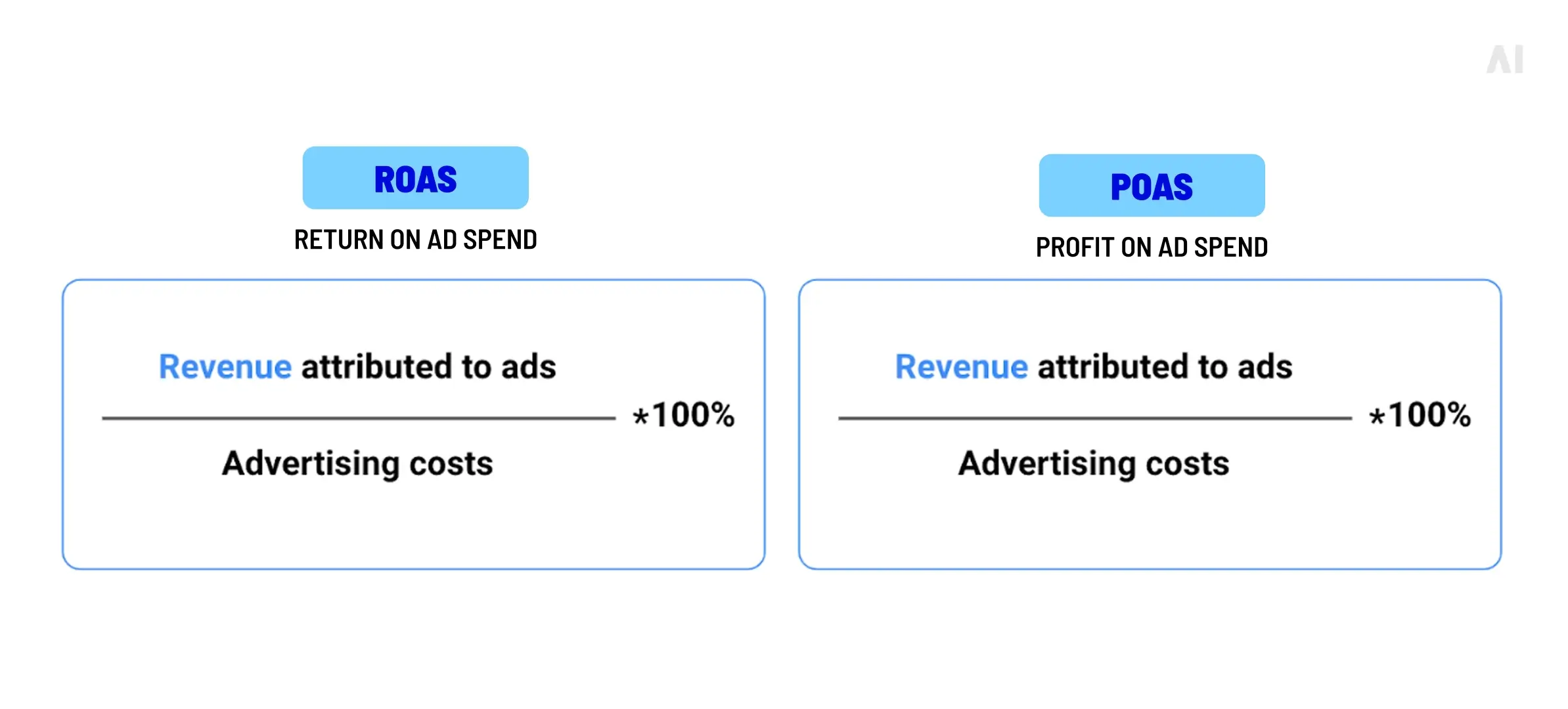
ROAS (Return on Ad Spend) measures how much revenue is generated for every unit of ad spend, while POAS (Profit on Ad Spend) measures how much profit remains after all relevant business costs are taken into account. This distinction is critical: ROAS reflects top-line performance, whereas POAS reflects bottom-line impact.
In practice, ROAS is still a useful metric for understanding media efficiency and revenue generation at the campaign level. It helps marketers compare channels, evaluate audience performance, and optimize delivery based on revenue outcomes. However, it does not account for factors such as margins, fulfillment costs, discounts, or returns—meaning a campaign can show strong ROAS while contributing little or no actual profit.
💡This is where the poas meaning becomes strategically important. By incorporating cost structures into performance measurement, profit on ad spend provides a more decision-useful view of marketing effectiveness, especially in e-commerce and complex digital environments where profitability varies significantly across products and channels.
⚡️For organizations focused on profitable growth rather than revenue expansion alone, POAS offers a more reliable foundation for budget allocation, scaling decisions, and cross-channel optimization. A more detailed breakdown of how performance metrics evolve in modern digital marketing can be found in this resource from AI Digital.
How to calculate and track POAS
Calculating POAS (Profit on Ad Spend) is not just a mathematical exercise—it is an operational measurement framework that requires aligned definitions, integrated data, and consistent reporting across the organization. While the core formula for profit on ad spend is simple, accurately tracking it depends on combining inputs from marketing platforms, commerce systems, and financial reporting. Unlike ROAS, which can be read directly from ad dashboards, POAS marketing requires cross-functional coordination to ensure that profitability reflects real business conditions rather than isolated platform metrics.
Align with finance
Before POAS can be tracked reliably, the business must establish a shared definition of profit. This requires close alignment between marketing and finance teams to determine which costs are included—such as COGS, discounts, fulfillment, returns, and fees—and how they are allocated across products and channels. Without this agreement, POAS loses credibility as a decision-making metric, since different teams may interpret profitability differently. A standardized definition ensures that what is POAS in practice is consistent, comparable, and actionable across the organization.
Collect and clean data
Accurate poas marketing depends on integrating data from multiple sources, including ad platforms, analytics tools, e-commerce systems, and financial databases. This introduces complexity: platform-reported revenue must be reconciled with actual realized revenue and costs, while product-level margins and operational expenses must be consistently mapped. Clean, standardized data inputs are essential, because fragmented or inconsistent data can distort profit calculations and lead to incorrect optimization decisions. In practice, this often requires building pipelines that unify campaign, product, and cost data into a single reporting layer.
Model profit contribution
Once data is aligned, the next step is to determine how profit is attributed to marketing activity. Basic reporting may assign profit based on last-click revenue, but this approach often oversimplifies the role of different channels. More advanced models assess incremental contribution, evaluating how much profit marketing actually influenced rather than merely capturing demand that would have occurred anyway. This distinction is critical for understanding true campaign impact, especially in omnichannel environments where multiple touchpoints contribute to conversion.
Build actionable dashboards
Effective POAS tracking requires dashboards that go beyond surface-level metrics and present profit and ad spend in a decision-ready format. In practice, this means enabling teams to compare POAS across campaigns, products, audiences, and channels, while also identifying where profit is being created—or eroded. The most useful dashboards allow marketers to quickly answer questions such as:
- Which campaigns are driving the highest profit, not just revenue?
- Which products or categories are underperforming due to margin pressure?
- Where should budget be increased, reduced, or reallocated?
By structuring reporting around profit-based insights, organizations can move from reactive optimization to proactive, financially aligned decision-making, making POAS a central metric for scalable and sustainable growth.
How POAS changes marketing strategy
Once a business adopts POAS (Profit on Ad Spend) as a core metric, marketing strategy shifts from volume-driven execution to profit-oriented decision-making. Instead of optimizing for revenue growth or platform-reported success, teams begin prioritizing financial efficiency, margin protection, and sustainable scaling.
⚡️This transition introduces greater discipline into how budgets are allocated, how campaigns are evaluated, and how performance is interpreted across channels. A deeper strategic perspective on this evolution is outlined by AI Digital, Performance Marketing Strategy.
Budget allocation
With poas marketing, budget allocation becomes directly tied to profit generation rather than revenue volume. Campaigns or products that deliver strong ROAS but low margins are deprioritized, while those generating higher profit per euro spent receive increased investment. This leads to more efficient capital deployment, where every increment of ad spend is evaluated based on its contribution to the bottom line, not just its ability to scale revenue.
Pricing and discount optimization
The poas meaning becomes particularly visible in pricing and promotion strategies. Discounts that appear to drive conversions and revenue can significantly erode margins once costs are accounted for. By measuring profit on ad spend, teams can identify when promotions are genuinely incremental versus when they simply reduce profitability. This enables more precise control over discount depth, timing, and product selection, ensuring that promotional activity supports profit rather than undermines it.
Channel portfolio rebalancing
POAS enables a more meaningful comparison across channels because it evaluates performance based on profit contribution rather than output volume. Channels that appear efficient from a revenue perspective may underperform once costs are included, while others with lower apparent scale may deliver stronger margins. This allows organizations to move beyond simplistic channel rankings and instead build a balanced portfolio strategy, where investment is distributed according to true economic impact across the entire marketing mix.
Avoiding vanity metrics
One of the most important strategic effects of adopting POAS is the reduction of vanity metrics—indicators that look strong in dashboards but do not translate into real business value. Metrics such as high ROAS, low CPA, or large conversion volumes can create a false sense of success if they are not connected to profitability. By focusing on what is POAS and how much profit campaigns actually generate, teams gain a clearer, more grounded view of performance.
⚡️For a broader perspective on how performance metrics differ from brand-oriented evaluation frameworks, see this analysis: Performance Marketing vs Brand Marketing: Key Differences and Strategic Implications.
Common POAS mistakes that distort profitability
While POAS (Profit on Ad Spend) provides a more accurate lens on marketing performance than revenue-based metrics, it is not inherently reliable on its own. POAS is only as useful as the business logic, cost structure, and data quality behind it.
In practice, many organizations implement poas marketing with incomplete inputs or inconsistent assumptions, which can create a false sense of precision. Instead of clarifying profitability, poorly constructed POAS models may overstate performance, misguide budget allocation, and distort strategic decisions.
{{26-POAS-Marketing-Profitability-1="/tables"}}
The key implication is clear: understanding the poas meaning is not enough—its implementation must be rigorously structured. When built correctly, profit on ad spend becomes a powerful decision-making metric; when built poorly, it risks becoming just another misleading KPI in the marketing stack.
Beyond POAS: Building a broader profit-focused marketing model
POAS (Profit on Ad Spend) is a critical step toward more accurate and financially aligned measurement, but it is not a complete framework on its own. Mature marketing organizations do not rely on a single metric—even one as robust as profit on ad spend. Instead, they combine short-term profitability indicators with longer-term measures of customer value, retention, and growth potential. This broader approach ensures that marketing decisions are not only efficient in the present, but also strategically sound for future revenue and profit generation.
When POAS alone isn’t enough
While poas marketing is highly effective for evaluating immediate campaign efficiency, it can underrepresent the value of customer acquisition and upper-funnel investment. Campaigns that bring in new customers may initially show lower POAS due to acquisition costs, even if those customers generate significant revenue over time. Relying exclusively on POAS in such cases can lead to underinvestment in growth-driving activities, particularly in categories where repeat purchases and customer loyalty are strong drivers of profitability.
Combining POAS with Customer Lifetime Value (LTV)
To address this limitation, many organizations pair POAS with Customer Lifetime Value (LTV). While POAS captures short-term profit per campaign, LTV estimates the total profit a customer is expected to generate over time. This combination allows businesses to evaluate whether a lower initial POAS is acceptable when long-term customer value justifies the upfront investment. In e-commerce and subscription-driven models, this perspective is essential for balancing acquisition efficiency with retention-driven profitability.
Using POAS data for future optimization
Beyond real-time decision-making, POAS data becomes a powerful input for forecasting and strategic planning. Historical profitability trends can inform:
- Budget allocation across channels and campaigns
- Product-level investment strategies based on margin performance
- Seasonal planning and demand forecasting
- Scenario modeling for different growth strategies
⚡️When integrated with broader business context, POAS enables more accurate predictions of how marketing investments will translate into profit over time. For a deeper look at how profitability data supports forward-looking decision-making, see this guide: Retail Forecasting: A Guide to Smarter Planning, Media, and Growth.
💡Ultimately, understanding what is POAS is just the starting point. The real advantage comes from embedding it within a wider measurement ecosystem that connects short-term performance with long-term business value.
When should you start tracking POAS?
Businesses should start tracking POAS (Profit on Ad Spend) when marketing complexity begins to outgrow simple revenue-based measurement. In early stages, ROAS may be sufficient to validate demand and channel performance. However, as operations scale, the limitations of revenue-only metrics become more visible.
POAS becomes especially important when:
- Ad spend is increasing and inefficiencies become more costly
- Channel mix is expanding across search, social, retail media, and programmatic
- Profitability pressure is rising, particularly in e-commerce environments with variable margins
- Product portfolios are diversifying, with different cost structures and margin profiles
- Leadership requires tighter financial accountability from marketing investments
At this stage, relying on ROAS alone introduces risk. POAS marketing provides the necessary visibility to ensure that growth is not only scalable, but financially sustainable. In practical terms, if marketing decisions start impacting overall profitability in a measurable way, it is time to move beyond revenue metrics and implement profit-based evaluation.
Why Profit on Ad Spend matters more than revenue metrics
Revenue metrics like ROAS indicate how much activity advertising generates, but they do not reveal the quality of that growth. High revenue can coexist with declining margins, inefficient spend, and unprofitable scaling—especially in competitive digital marketing environments where acquisition costs continue to rise.
This is why understanding the poas meaning is critical. Profit on ad spend connects marketing performance directly to business outcomes, showing not just what campaigns generate, but what they actually contribute to the bottom line.
By adopting POAS, organizations gain:
- Clearer accountability, linking marketing investment to real financial results
- Better decision-making, grounded in profit rather than surface-level performance
- Stronger budget discipline, prioritizing efficiency over volume
- More sustainable growth, where scaling is aligned with margin health
From a structural perspective, this shift also aligns with AI Digital’s Open Garden approach—a model that moves beyond closed platform reporting and fragmented metrics toward a more transparent, interoperable, and profit-aware marketing ecosystem. By integrating data across channels and prioritizing real business outcomes over platform-specific performance signals, the Open Garden framework enables organizations to operationalize POAS at scale and make cross-channel decisions grounded in profitability, not just reported revenue.
Ultimately, what is POAS if not a shift in perspective—from measuring activity to measuring value. As marketing ecosystems become more complex and cost pressures intensify, this shift is no longer optional. It is foundational to building a performance strategy that is both scalable and economically sound.
⚡️For organizations looking to implement more advanced, profit-driven measurement frameworks, insights from AI Digital can support this transition, Get in Touch.