Cross-Platform Measurement Governance in Digital Advertising


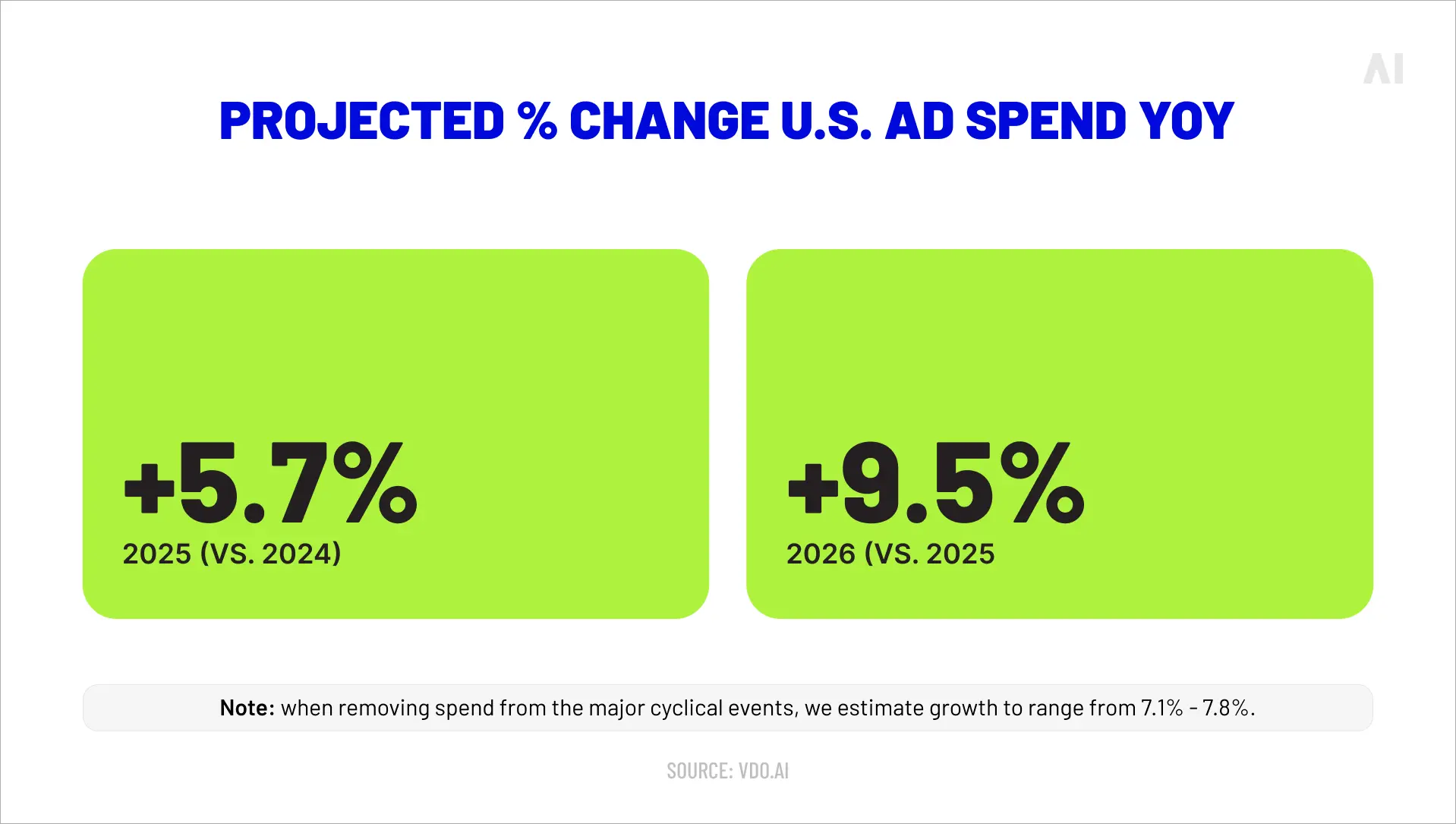
U.S. ad spend is projected to grow 9.5% in 2026, with double-digit gains across social media, connected TV, and commerce media. Brands are spending more, across more platforms, than at any point in the history of digital advertising. Yet a persistent contradiction sits at the centre of this expansion: the more money flows into cross-platform media campaigns, the less confident marketers become in understanding what that investment actually delivers.
Cross-platform measurement exists. The tools are available, the data is abundant, and the dashboards are plentiful. But results remain fragmented. Performance reports from one platform contradict those from another. Reach figures overlap in ways nobody can fully quantify. Attribution models disagree on which touchpoint mattered and which was noise. The problem is not that brands cannot measure. The problem is that nothing governs how measurement happens—no shared definitions, no consistent logic, no neutral validation. What the industry treats as a tooling gap is, in reality, a governance failure.
This article examines why cross-media measurement continues to produce inconsistent results, what measurement governance actually means, and how structured frameworks can turn contradictory data into controlled, comparable performance insight.
💡 Related reading: What is cross-platform advertising? Strategy, challenges, and measurement.
What is cross-platform measurement governance?
Cross-platform measurement is the practice of tracking and evaluating advertising performance across multiple devices, environments, and media formats—from mobile and desktop to CTV, digital out-of-home, streaming audio, and linear broadcast. Its purpose is to give advertisers a unified view of how audiences encounter, engage with, and respond to campaigns regardless of where those campaigns appear.
Platform boundaries mean nothing to audience behavior, and that is what makes this significant. A consumer might see a display ad on a news site, encounter the same brand on a streaming service that evening, and convert through a search ad the following morning. Without cross-platform measurement, each of those interactions gets reported in isolation—overstating reach, misattributing conversions, and distorting the true cost of acquisition.
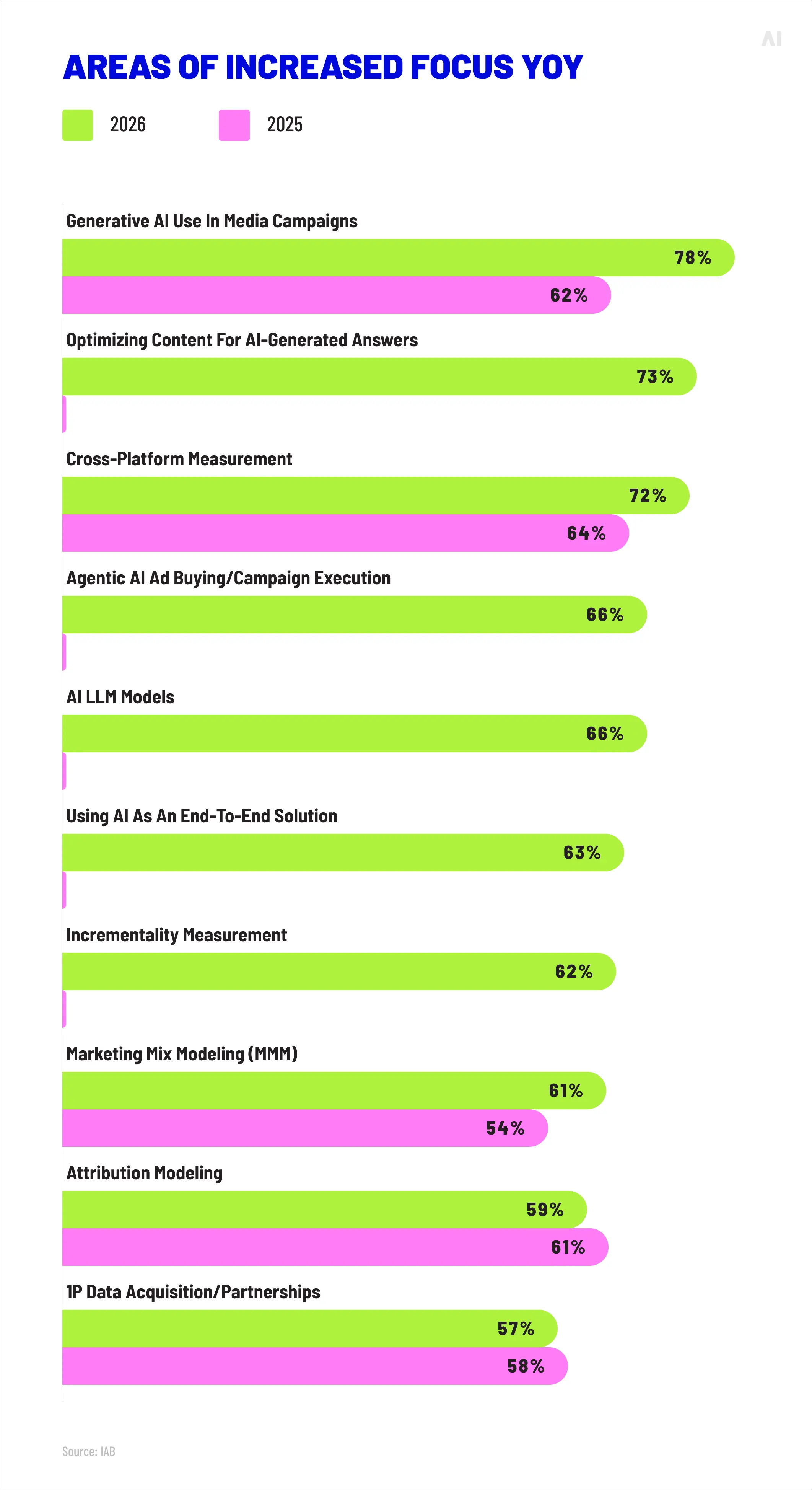
The IAB's 2026 Outlook Study found that 72% of U.S. advertisers now prioritize cross-platform measurement, up from 64% the previous year. That increase reflects more than a trend. It signals a market-wide acknowledgement that platform-by-platform reporting has stopped being sufficient.
Cross-platform vs. cross-channel measurement
The terms are often used interchangeably, but they describe different things.
- Cross-channel measurement tracks performance across media types and tactics—paid search versus social versus display versus email, for example. The focus is on comparing how different channels contribute to a campaign's outcomes.
- Cross-platform measurement operates at a different level. It tracks performance across devices, operating systems, and media environments—a smartphone versus a smart TV versus a desktop browser versus an in-app experience. The distinction matters because a single channel (say, video) can span multiple platforms (YouTube on mobile, a CTV app, an in-stream placement on the open web), each reporting in its own way, using its own definitions.
When an advertiser asks whether their video campaign reached the right audience at the right frequency, the answer depends on resolving both cross-channel and cross-platform data. One without the other produces an incomplete picture.
{{26-Cross-Platform-Measurement-Governance-1="/tables"}}
💡 Related reading: How fragmentation is accelerating
Measurement governance explained
Governance, in this context, is the system of rules, standards, and validation logic that ensures measurement produces consistent, comparable, and trustworthy results regardless of which platform generated the data. It is not another tool. It is not a dashboard. It is the structural layer that determines how data is defined, collected, deduplicated, and reported across every platform and partner in a media plan.
Think of it this way: if cross-platform measurement is the act of collecting data from multiple sources, governance is the framework that decides whether those sources are speaking the same language—and what to do when they are not.
Governance aligns data rather than simply aggregating it. Aggregation without governance means stacking incompatible numbers on top of each other and hoping the total makes sense. Governance means establishing, in advance, what counts as an impression, how a unique user is identified, what constitutes a completed view, and who has the authority to validate results independently.
💡 Related reading: What is advertising governance in a fragmented ecosystem?
Why cross-platform measurement remains inconsistent
Despite widespread adoption of multi-platform media strategies, measurement is still unreliable. The inconsistencies are structural. They stem from how the advertising ecosystem is built, not from a shortage of effort or technology.
💡 Related reading: Why cross-platform measurement is still broken in a walled garden world.
Fragmented data and identity signals
A single consumer typically uses multiple devices throughout the day—a phone during a commute, a laptop at work, a tablet in the evening, a connected TV before bed. Each device generates its own identifiers. Mobile advertising IDs, browser cookies, IP addresses, CTV device tokens, and logged-in user IDs all describe the same person in different, often incompatible ways.
The result is that one person looks like four or five different users across platforms. Reach gets inflated because the same individual is counted multiple times. Frequency appears lower than it actually is because exposures are split across unlinked profiles. Without a governed approach to identity resolution—one that defines how signals are matched, what confidence thresholds apply, and how privacy constraints are respected—measurement produces a distorted view of audience behavior.
Inconsistent metrics across platforms
Not every platform means the same thing when it uses the same word. A "video view" on one platform might require two seconds of playback. On another, it might require 50% of the video to be watched. On a third, the ad simply needs to render in a viewable area for a qualifying duration. "Engagement" can mean a click, a hover, a swipe, a share, or a comment depending on who is defining it.
These differences are not bugs. They are by-product of platforms optimizing their reporting frameworks to make their own inventory look as effective as possible. For advertisers comparing performance across platforms, however, the effect is that direct comparison becomes unreliable. A campaign that looks like it delivered strong completion rates on one platform and weak results on another may simply be reflecting different counting rules, not different performance.
{{26-Cross-Platform-Measurement-Governance-2="/tables"}}
Walled gardens and limited data access
Magna (IPG's intelligence arm) reported in December 2024 that Google, Meta, and Amazon now account for 51% of total advertising sales globally, and 61% of ad sales outside China. These platforms operate as closed ecosystems—commonly known as walled gardens—where data stays inside the platform, measurement is conducted on the platform's own terms, and independent verification is limited.
For advertisers, this means that a significant share of their media budget operates in environments where they cannot fully validate reach, deduplicate audiences across platforms, or apply their own attribution logic. The platform acts as both the media seller and the measurement provider—a structural conflict of interest that governance is specifically designed to address.
Privacy and signal loss
Privacy regulation has added another layer of complexity. State-level privacy laws continue to expand across the U.S.—Indiana, Kentucky, and Rhode Island enacted new comprehensive privacy statutes on January 1, 2026, with additional state-level changes scheduled throughout the year. At the browser level, Safari and Firefox have restricted third-party cookies for years, and even Chrome's shifting cookie policies have pushed the industry toward alternative identity solutions.
The practical effect is that the signals advertisers once relied on for cross-platform tracking—third-party cookies, device graphs, deterministic matching across environments—are diminishing. This does not make cross-platform measurement impossible, but it makes ungoverned measurement far less reliable. Without governance that specifies which identity signals are acceptable, how probabilistic matching is validated, and what consent requirements apply, measurement accuracy degrades quietly—and the advertiser may not even realise it.
💡 Related reading: In a cookieless world: new challenges and opportunities
The hidden problem: why more data doesn’t fix measurement
There is a widespread assumption in the industry that the solution to fragmented measurement is more data—more platforms reporting, more pixels firing, and more attribution vendors feeding more models. The logic seems intuitive: if the problem is incomplete visibility, then more information should fill the gaps.
In practice, the opposite often happens. Adding more data sources without a governing framework introduces duplication, conflicting signals, and noise. Two platforms both claim credit for the same conversion. Three attribution models produce three different answers about which channel drove a sale. Reach figures across five platforms sum to a number that exceeds the total addressable audience.
The ANA's Q2 2025 Programmatic Transparency Benchmark estimated that approximately $26.8 billion in global programmatic media value is still lost each year due to redundant supply paths, measurement gaps, and low-quality inventory. That figure reflects what happens when scale operates without structure. More data, without governance, doesn't solve measurement—it makes contradictions harder to detect and waste harder to eliminate.
The market is all about apples-to-apples comparisons. If I do more of this and less of that, how do I move the needle? — David Cohen, CEO, IAB (The Drum)
This is the turning point in any measurement maturity conversation. The problem is not insufficient data. The problem is that data from different sources is collected, defined, and reported under different rules. Until those rules are aligned, adding more inputs only increases the volume of conflicting insights.
From fragmented measurement to governed systems
The shift from fragmented measurement to governed measurement is not a technology upgrade. It is a structural change in how organizations think about performance data.
In a fragmented model, each platform, vendor, and partner reports using its own standards. The advertiser is left to reconcile contradictions manually—or, more commonly, to accept whichever number best supports the narrative they need for the next budget cycle. This is how intelligent organizations end up making significant investment decisions on unreliable data.
In a governed model, the framework exists before the data arrives. Standardized definitions, agreed deduplication logic, and independent validation are already in place. When platform data enters the system, every source is processed under identical rules, producing outputs that bear comparison, support combination, and earn trust.
The WFA has been instrumental in pushing this transition through its Halo cross-media measurement framework—an open-source, privacy-preserving system for measuring deduplicated reach and frequency across platforms. In the U.S., the ANA's Project Aquila and, separately, the IAB's Project Eidos both represent efforts to address different dimensions of this same challenge. These are not competing tools. They are structural responses to a measurement ecosystem that has outgrown ad-hoc reporting.
{{26-Cross-Platform-Measurement-Governance-3="/tables"}}
“Innovation without standards and interoperability creates friction, and friction, as we know, slows growth” — David Cohen, CEO, IAB (Measure)

The core components of cross-platform measurement governance
Governance is not a single solution. It is a framework built from several interdependent components, each addressing a specific source of measurement inconsistency.
Standardized KPI definitions
The most fundamental requirement—and the one most frequently overlooked—is agreement on what success means across every platform in a media plan. If one platform defines a "completed view" as 100% of a video watched and another counts any playback exceeding three seconds, comparing performance between them produces meaningless results.
Governance starts here: with a documented, organisation-wide set of KPI definitions that apply regardless of platform. These definitions should cover impressions, views, engagement, reach, frequency, and conversions—and they should specify how each metric is calculated, not just what it is called.
This is particularly important as marketing budgets remain under pressure. The Gartner 2025 CMO Spend Survey found that marketing budgets have flatlined at 7.7% of overall company revenue, with 59% of CMOs reporting insufficient budget to execute their strategy. When budgets are tight, reporting that inflates or misrepresents performance doesn't just waste money—it misallocates it. Standardised KPIs ensure that the metrics informing budget decisions are measuring the same thing across every platform.

Unified measurement logic
Beyond defining what to measure, governance establishes how to measure it. Reach, frequency, and engagement should be calculated using consistent methodology across all platforms, including rules for viewability thresholds, attribution windows, and exposure counting.
This does not mean forcing every platform to report in exactly the same way. Platforms have different data capabilities and different delivery environments. What governance requires is a common measurement layer that sits above platform-specific reporting and translates raw data into standardised, comparable outputs. The logic is applied centrally, not delegated to each platform.
Deduplication and identity resolution
Perhaps the most technically demanding component of governance is deduplication—the process of identifying when two or more data points describe the same person, and counting them once rather than multiple times.
Without deduplication, a campaign reaching 500,000 unique individuals across three platforms might report 1.2 million unique users. That inflation distorts every downstream metric: cost per unique reach, effective frequency, return on ad spend. Governance defines the rules for how identity resolution works—which signals are used, what match confidence is required, and how privacy constraints limit the scope of matching.
The WFA's Halo framework approaches this through a Virtual Persons methodology, which assigns campaign impressions to virtual proxies of a population, enabling richer deduplication without compromising privacy. This kind of approach illustrates how governance and privacy can work together rather than in tension.
Data validation and neutral reporting
The final component addresses a straightforward question: who validates the numbers? If the platform that sold the media is also the platform that measures its performance, there is a structural incentive to present results favourably. Governance requires independent, neutral measurement—either through third-party verification, through industry-aligned standards (such as those developed by the MRC), or through centralised reporting systems that the advertiser controls.
The ANA's Programmatic Transparency Benchmark underscored this point: advertisers enforcing quality governance converted 56.7% of programmatic spend into benchmark-qualified impressions, compared with just 37.5% for lower-performing advertisers. That gap—nearly twenty percentage points—illustrates the difference that structured oversight makes.
{{26-Cross-Platform-Measurement-Governance-4="/tables"}}
Why attribution fails without measurement governance
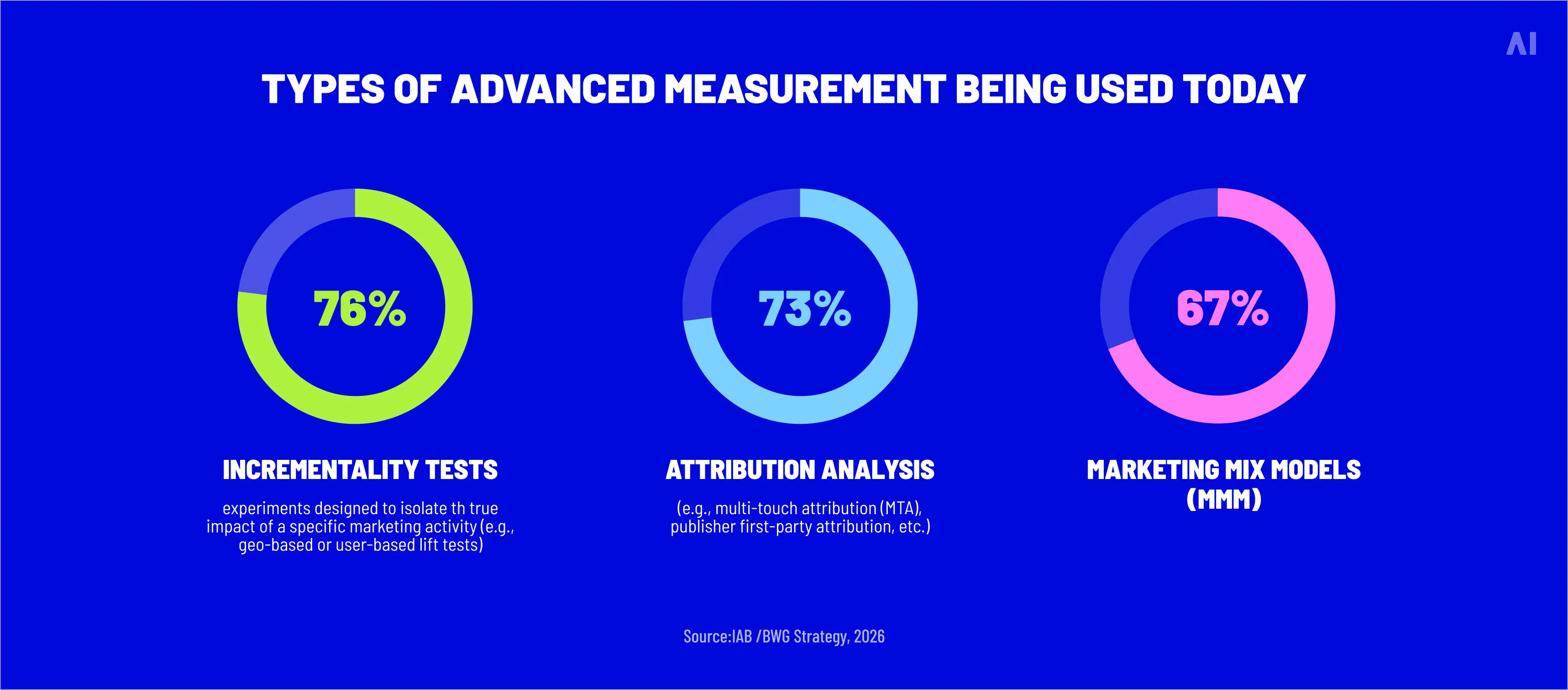
Attribution models attempt to answer the most commercially important question in advertising: which touchpoints influenced a conversion, and how should credit be distributed among them? Multi-touch attribution, marketing mix modelling, and incrementality testing all approach this question from different angles.
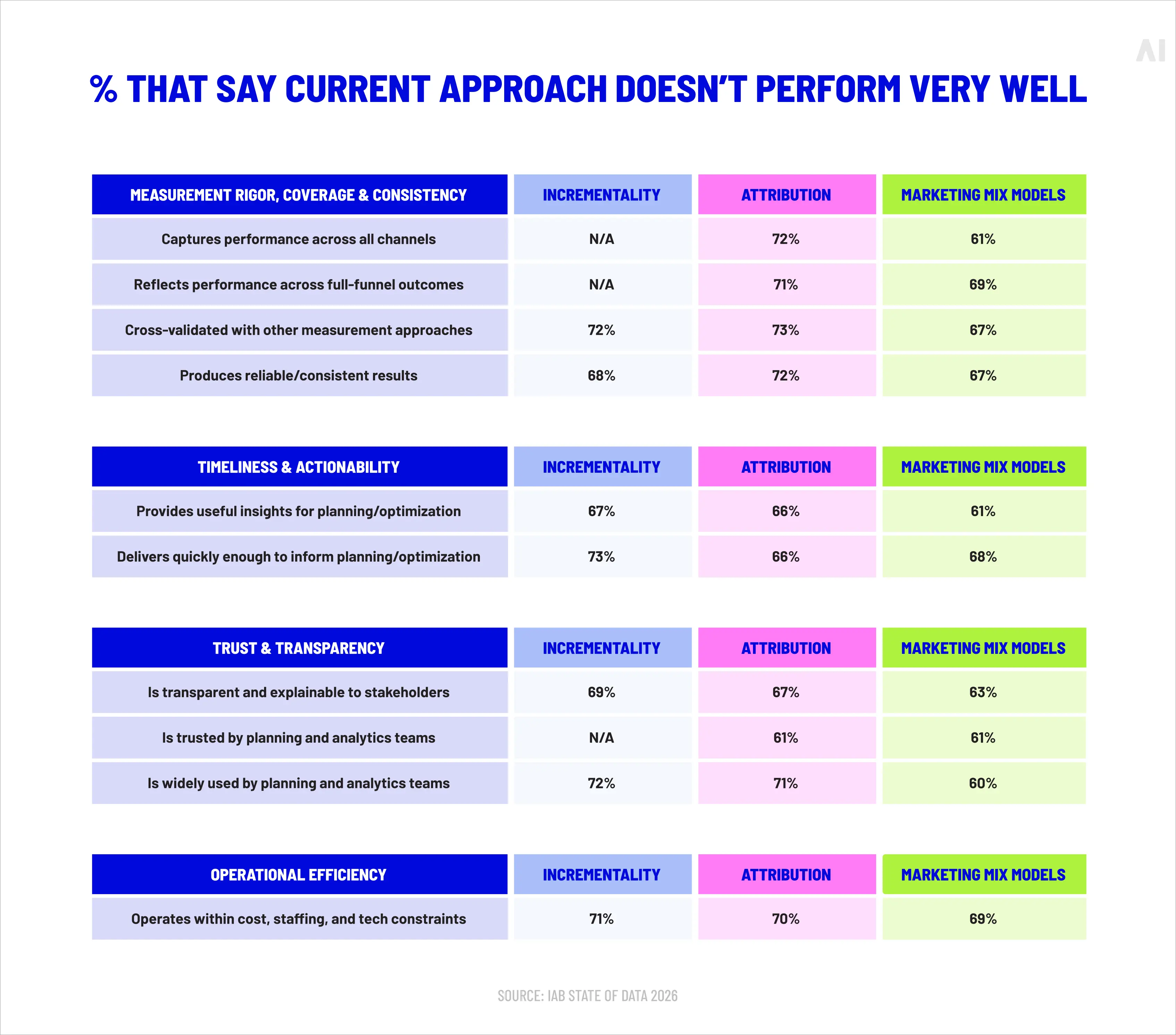
But every attribution model depends on consistent, deduplicated input data. If the same user is counted as two separate people, the model assigns credit to interactions that didn't happen. If platforms define conversions differently, the model compares events that aren't equivalent. If reach is inflated, the model underestimates frequency effects. Attribution does not fail because the models are flawed. It fails because the data feeding those models was never governed.
A Gartner study found that 84% of companies are stuck in a measurement "doom loop"—a cycle where underfunded measurement leads to unclear impact, rising C-suite scepticism, and tighter budgets. Attribution governance is the mechanism that breaks that cycle. When data inputs are standardised, deduplicated, and validated, attribution models produce outputs that the C-suite can act on, not outputs that provoke more questions than they answer.
Underfunded measurement breeds C-suite skepticism, which deprives brand of the investment it needs to drive growth. — Sharon Cantor Ceurvorst, VP Research, Gartner Marketing Practice (Gartner Newsroom)
💡 Related reading: Multi-touch attribution
How brands implement measurement governance
Governance sounds compelling in theory. The challenge is operationalizing it across teams, platforms, and external partners—each with their own priorities, reporting preferences, and technical constraints.
Aligning teams around a single measurement framework
In many organizations, marketing, analytics, media buying, and finance teams each maintain their own performance dashboards and their own definitions of success. Marketing might report on brand lift. Media might report on CPM efficiency. Analytics might report on attribution-modelled conversions. Finance wants to see revenue impact.
Governance begins with cross-functional alignment: a single measurement framework, documented and enforced, that defines how performance is assessed across every team. This requires executive sponsorship—not just buy-in from the media team—because the framework must have authority over reporting practices that are often deeply entrenched.
Creating a unified source of truth
A measurement framework is only as useful as its reporting layer. Governance requires a centralised reporting environment where data from all platforms is ingested, standardised, deduplicated, and presented using consistent definitions. This is the organization's single source of truth—the place where contradictions are resolved, not buried.
This does not necessarily require a proprietary platform. It requires a deliberate architectural decision: that no platform's self-reported data will be accepted at face value, and that all data must pass through a common validation layer before it informs business decisions.
Enforcing standards across partners and platforms
Governance cannot stop at the organisation's boundary. Media agencies, technology vendors, DSPs, SSPs, and publishers all contribute data to the measurement ecosystem. If any partner reports using definitions that don't align with the governance framework, the integrity of the entire system is compromised.
Enforcement means writing governance requirements into contracts and partnership agreements. It means specifying data formats, delivery cadences, metric definitions, and validation rights. It means auditing partner-reported data against independently verified benchmarks. This is uncomfortable work—but it is the work that separates governed measurement from wishful thinking.
What measurement governance actually enables
The case for governance is not abstract. It produces specific, measurable improvements in how advertising budgets are deployed and evaluated.
{{26-Cross-Platform-Measurement-Governance-5="/tables"}}
Accurate reach and frequency control
When audiences are deduplicated across platforms, advertisers gain an honest view of how many unique individuals their campaign actually reached—and how many times each person was exposed. This clarity eliminates two of the most expensive problems in media planning: underestimating frequency (and failing to drive impact) and overestimating reach (and believing the campaign was broader than it was).
The WFA's research among some of the world's largest brands—collectively spending over $50 billion annually on marketing—found that the lack of understanding of where frequency has exceeded requirements creates an opportunity cost in the billions. Governed measurement makes that waste visible and recoverable.
Better budget allocation
When performance data is consistent and comparable across platforms, budget allocation decisions shift from guesswork to evidence. An advertiser can see, with confidence, that a particular platform delivers higher incremental reach at lower cost per unique user—and shift spend accordingly. Without governance, the same analysis is contaminated by incompatible metrics, and the "winning" platform may simply be the one with the most generous counting rules.
Reliable ROI and performance insights
Governance transforms reporting from a post-campaign formality into a strategic input. When the C-suite receives performance data that has been standardised, deduplicated, and independently validated, confidence in those numbers increases. Budgets get defended with evidence rather than narrative. Investment cases are built on comparable data rather than platform-specific claims.
As mentioned previously, Gartner's research found that companies trapped in the measurement doom loop are half as likely to exceed growth targets as those that can demonstrate clear measurement-backed ROI. Governance is how organizations escape that loop.
The future of measurement is governance-led
The advertising ecosystem is not going to become less fragmented. New platforms, new formats, new retail media networks, and new privacy requirements will continue to multiply the complexity of cross-media campaign measurement. The IAB's Project Eidos, the ANA's Project Aquila, and the WFA's Halo framework all represent institutional acknowledgement that the industry needs structural solutions—not more tools.
The organizations that treat measurement governance as a strategic priority will make better decisions, waste less budget, and build stronger relationships between marketing and the C-suite. The organizations that continue to rely on platform-by-platform reporting will find themselves spending more, understanding less, and falling further behind competitors who have already made the shift.
Cross-platform advertising measurement will only become more important as ad spend continues to grow. The question is whether brands will govern that measurement—or continue to let each platform define the rules.
From measurement to control: introducing Open Garden
AI Digital's Open Garden framework was designed to operationalize the principles outlined in this article. Built on a DSP-agnostic, transparent model, Open Garden enables advertisers to measure performance across platforms without relying on any single platform's self-reported data. It provides neutral, cross-platform visibility—the kind of independent measurement layer that governance demands.
For brands and agencies looking to move from fragmented, platform-dependent reporting to a governed, advertiser-controlled measurement environment, Open Garden offers a practical starting point. To explore how AI Digital can help your organization build a governed measurement framework, reach out to our team—we provide managed media services, supply curation, and cross-platform intelligence designed around transparency and performance accountability.
⚡ The real competitive advantage in advertising is not spending more. It is understanding more, and governance is what makes understanding possible.