

The modern customer journey is not so much a funnel as a web. A single buyer may hop between search, social, email, connected TV, a mobile app, a review site and three browser tabs before completing a purchase—and that is on a quiet week. Salesforce's 2026 marketing research puts the average number of customer engagement channels at ten, which is an impressive figure until you consider how few teams can see all ten at once.
Against that backdrop, digital experience analytics has quietly become one of the most consequential disciplines in marketing and product. It is no longer a dashboard exercise or a UX side-project. Powered by AI, cross-channel measurement and real-time data capture, digital customer experience analytics now sits alongside forecasting and financial planning as a senior leadership concern. Done well, it turns observed behavior—every click, hesitation and abandoned basket—into concrete decisions about revenue, retention and growth.
This guide sets out how.
💡 Related reads: Digital Advertising Ecosystem: How It Actually Works in a Fragmented, Platform-Driven World
Why digital experience analytics matters
Digital experience analytics is the discipline of capturing and interpreting how users actually behave across a brand's digital footprint and using that understanding to improve the outcomes the business cares about. It is, put plainly, the difference between knowing what happened and knowing why.
Traditional web analytics tends to report. It tells you that 42,000 people visited the pricing page, that bounce sat at 38%, and that the mobile conversion rate dipped three points quarter on quarter. These are useful facts, but they explain nothing.
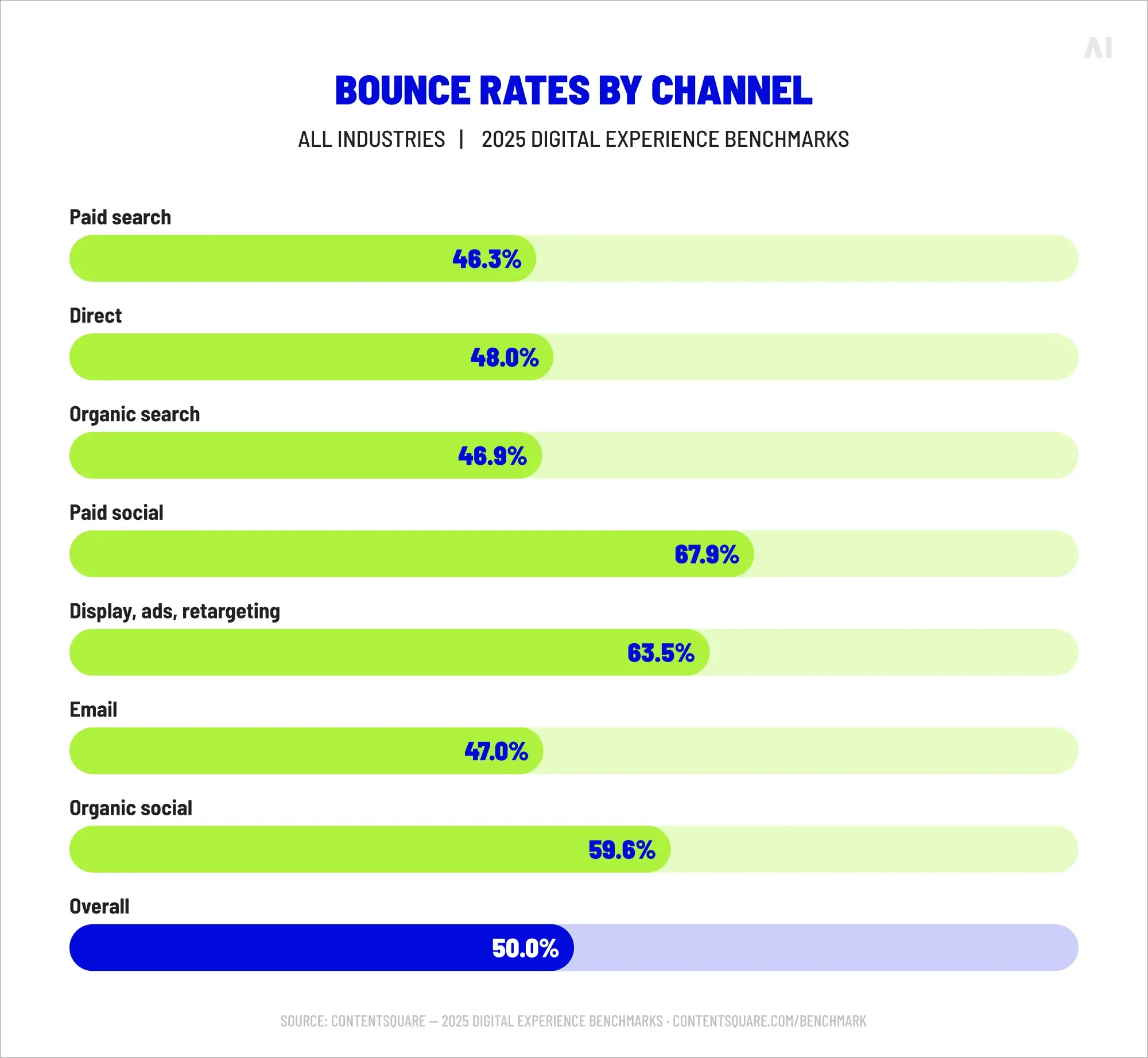
Experience analytics supplies the missing layer: where in the page someone hesitated, which field in the sign-up form caused them to leave, which paths the highest-value customers take before they convert. It treats the user journey as evidence rather than as a spreadsheet.
{{26-Full-Guide-to-Digital-Experience-Analytics-1="/tables"}}
The commercial stakes are considerable. Forrester's 2025 Customer Experience Index found that 25% of US brands saw their CX rankings decline, against only 7% that improved — the second consecutive year of widespread regression. The same research body's work on customer obsession makes the commercial case plain: customer-obsessed organizations report 41% faster revenue growth, 49% faster profit growth, and 51% better customer retention than their non-customer-obsessed peers. The gap between leaders and everyone else is not narrowing.
⚡ The advantage, increasingly, does not belong to the companies with the most data. It belongs to the ones asking the most useful questions of data they have had all along.
How digital experience analytics works and reveals insights
Experience analytics operates in three movements: it captures behavioral signals across touchpoints, combines them with quantitative performance data, and applies pattern recognition to turn the resulting picture into decisions. None of the three is especially glamorous on its own. Together, they produce the journey-level intelligence senior teams now depend on.
💡 Related reads: Advertising intelligence
Behavioral data vs quantitative data
The simplest way to separate the two is by what each can answer:
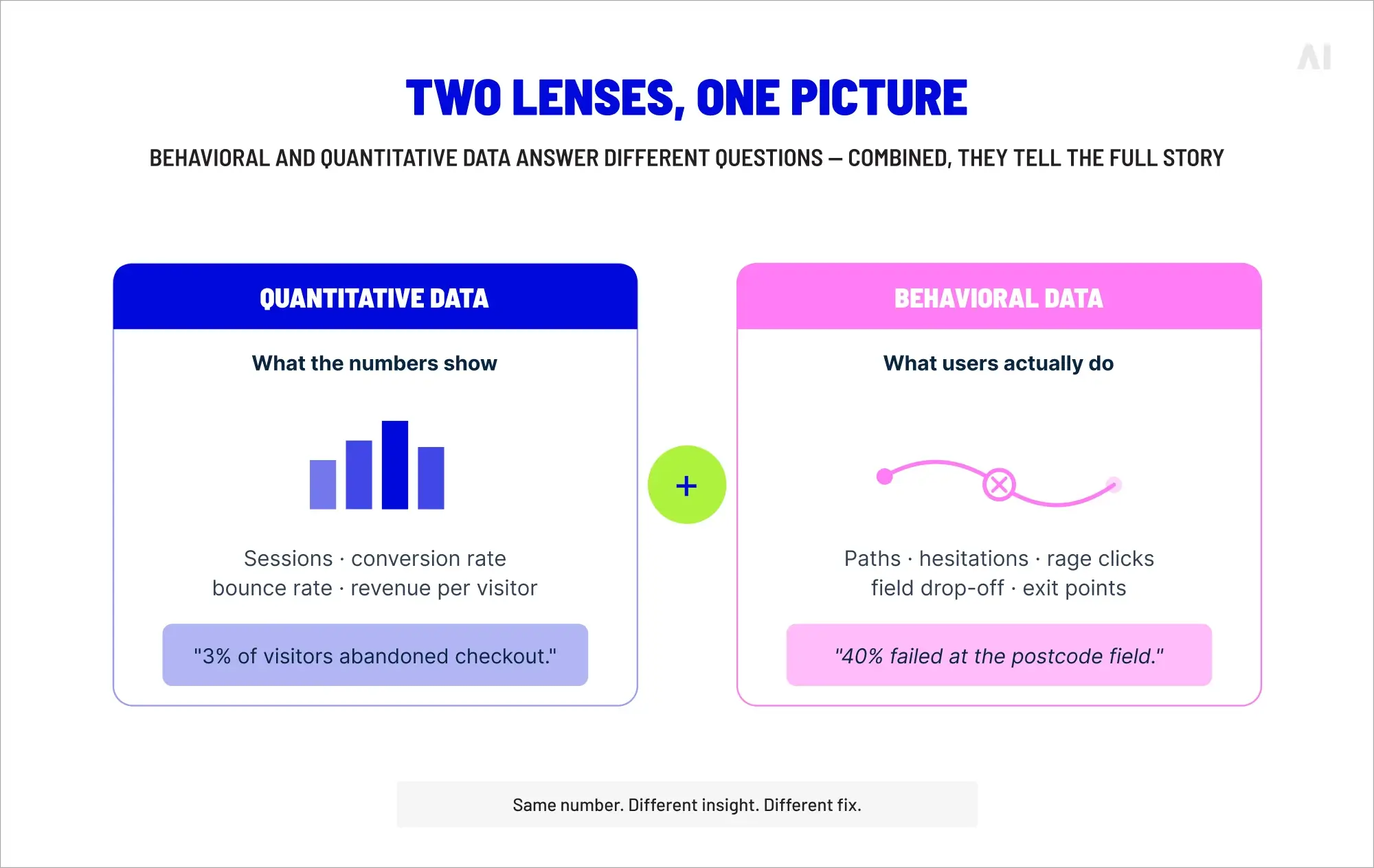
- Quantitative data aggregates — sessions, conversion rates, bounce rates, revenue per visitor — and is excellent at showing directional trends.
- Behavioral data is granular and contextual: the specific path a user took, the point at which they hesitated, the element they rage-clicked, the form field they abandoned.
Each on its own yields a partial picture:
- Quantitative reporting might tell you that 3% of visitors abandoned the checkout, which looks tolerable on a dashboard.
- Behavioral data might reveal that 40% of those abandoners did so at the same payment field because the postcode validator was rejecting a common input format.
The number is the same. The insight — and the fix — is entirely different.
💡 Related reads: Digital marketing KPIs · Contextual advertising
Key data sources and signals
A mature experience analytics setup captures signals across several families. Grouped by what they tell you, the most valuable are:
- Interaction signals—clicks, scrolls, hovers, rage clicks and dead clicks, which reveal engagement and frustration at the element level
- Session signals—visit duration, depth, paths, repeat patterns and exit points, which trace the shape of the journey
- Conversion signals—funnel progression, cart behavior, form completion and drop-off at each step
- Contextual signals—device, referrer, campaign source, geography and time of day, which explain the conditions around the behavior
The point is not to collect all of them for their own sake. The point is to connect them. A rage click on a landing page is interesting; a rage click on a landing page that correlates with a specific paid campaign source is actionable.
Turning data into actionable insights
The analytical bottleneck today is no longer data scarcity but data overload. Salesforce's 2026 research found that 98% of marketing teams using AI reported at least one data-related barrier to personalization — data silos, sheer volume, and poor quality being the three most common complaints. Even teams with well-instrumented stacks struggle to separate signal from noise.
AI-led analytics systems address this by doing the triage manual analysis cannot scale to: clustering behavioral patterns, detecting anomalies, flagging friction hotspots, and—crucially—ranking what matters. The value is not that the system finds every issue. It is that it tells you which issue, fixed this quarter, is worth the most.
💡 Related reads: Data management platform | AI in digital marketing
Digital experience analytics platform and how to use it
A digital experience analytics platform is the unified system that captures, processes and surfaces user behavior across a brand's digital estate—web, mobile, app, connected channels—and makes that information usable for decision-making.
Under the hood, such a platform performs four jobs:
- Data capture through tags, SDKs and event streams
- Processing and stitching, connecting anonymous and known identities across devices and sessions
- Visualization and alerting, exposing behavior through dashboards, replay tools and anomaly flags
- Experimentation and activation, enabling the testing of hypotheses and the deployment of fixes
In practice, different teams use the same platform differently:
- Product teams use it diagnostically: why did this feature's activation rate fall?
- Marketing teams use it to optimize: which landing page variant is converting which audience segment?
- CX and operations teams use it for reporting: what changed, why, and what do we do next?
The platform's value is less in its technical capabilities than in its ability to give several teams a shared, trustworthy view of what customers are actually doing.
Core digital experience analytics metrics
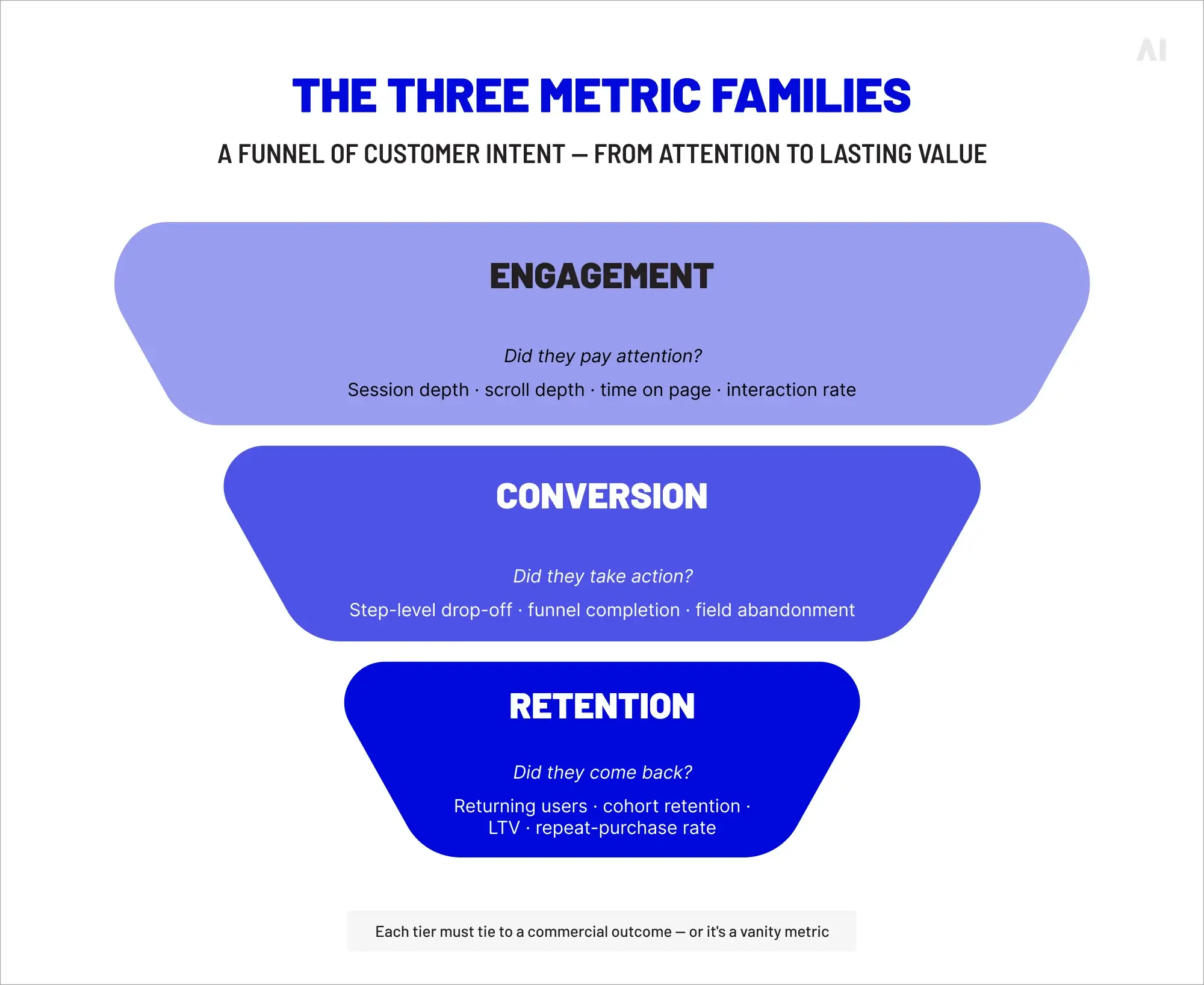
Metrics are not in short supply. The ones worth paying attention to tend to cluster into three families — engagement, conversion, and retention — each corresponding to a different stage of intent. Choosing between them is not really the point. The point is whether any of them, in practice, is tied to an outcome that matters.
Engagement metrics
Engagement metrics describe the quality of a user's attention. The most useful are session depth, scroll depth, time on page, interaction rate and return-session rate. The least useful, if taken in isolation, is time on page—which can mean a user is deeply absorbed or hopelessly confused. All engagement metrics benefit from being read in context: alongside the journey, the segment and the intent.
Conversion and drop-off metrics
Conversion rate is the number most often reported. It is also the number most often misread. A single funnel rate obscures the reality that different user segments, devices and traffic sources convert at wildly different rates—and that the drop-off between specific steps is where actionable insight lives.
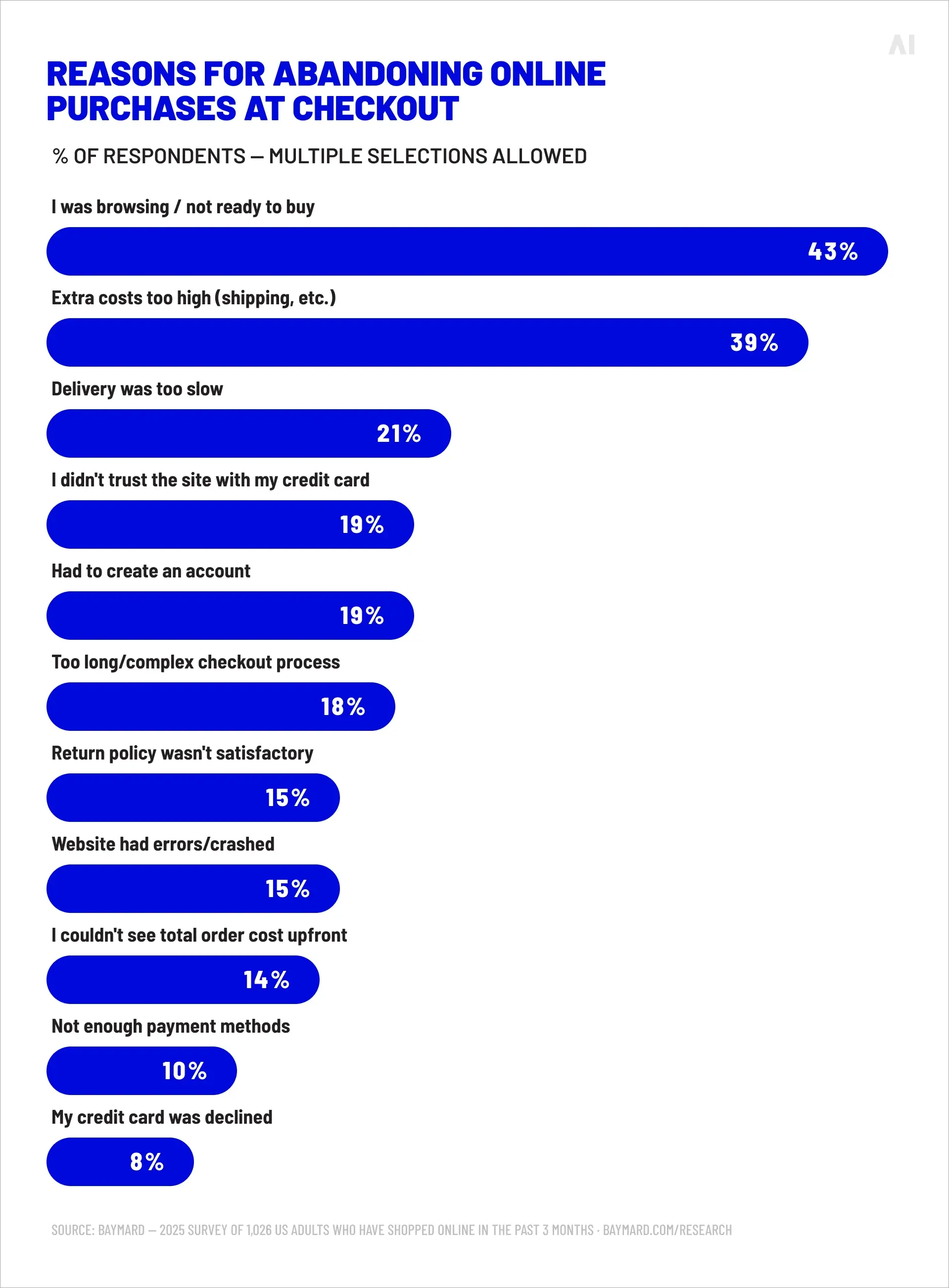
Teams that optimize well track step-level drop-off, segment-specific conversion, funnel completion rate and abandonment by field or action. The headline number is the output; the step-level view is the diagnosis. Research from Baymard Institute puts the global cart abandonment rate at 70.19%—and calculates that better checkout design alone could lift conversion by 35.26%, worth an estimated $260 billion in recoverable orders across the US and EU.
Retention and customer quality metrics
Acquisition gets attention; retention compounds. The most useful retention-facing metrics are returning user rate, cohort retention curves, customer lifetime value and repeat-purchase rate. Read together, they answer a question that single-session analytics cannot: which users are worth earning back, and what did we do that earned them?
💡 Related reads: CTR vs CPC vs CPM vs CPA vs CPV: Understanding Ad Metrics and Pricing Models | CTR for display ads
How digital experience analytics tools and methods drive insights
The methods below are not a shopping list so much as a set of complementary lenses. The strongest teams triangulate across several at once—behavioral signals with qualitative feedback, replay with segmentation, heatmaps with experimentation. No single method produces a complete picture.
Session replay and journey analysis
Session replay reconstructs individual user sessions as viewable recordings. Journey analysis aggregates those sessions into path maps, showing the routes users take, where they cluster, and where they leak. Replay is the diagnostic tool—it tells you what a single user experienced. Journey analysis is the strategic view—it tells you whether that experience is typical.
Used together, they answer questions that dashboards cannot: where in the flow people are hesitating, which paths the highest-value customers take, and which detours quietly cost the most revenue.
💡 Related reads: Cross-device targeting
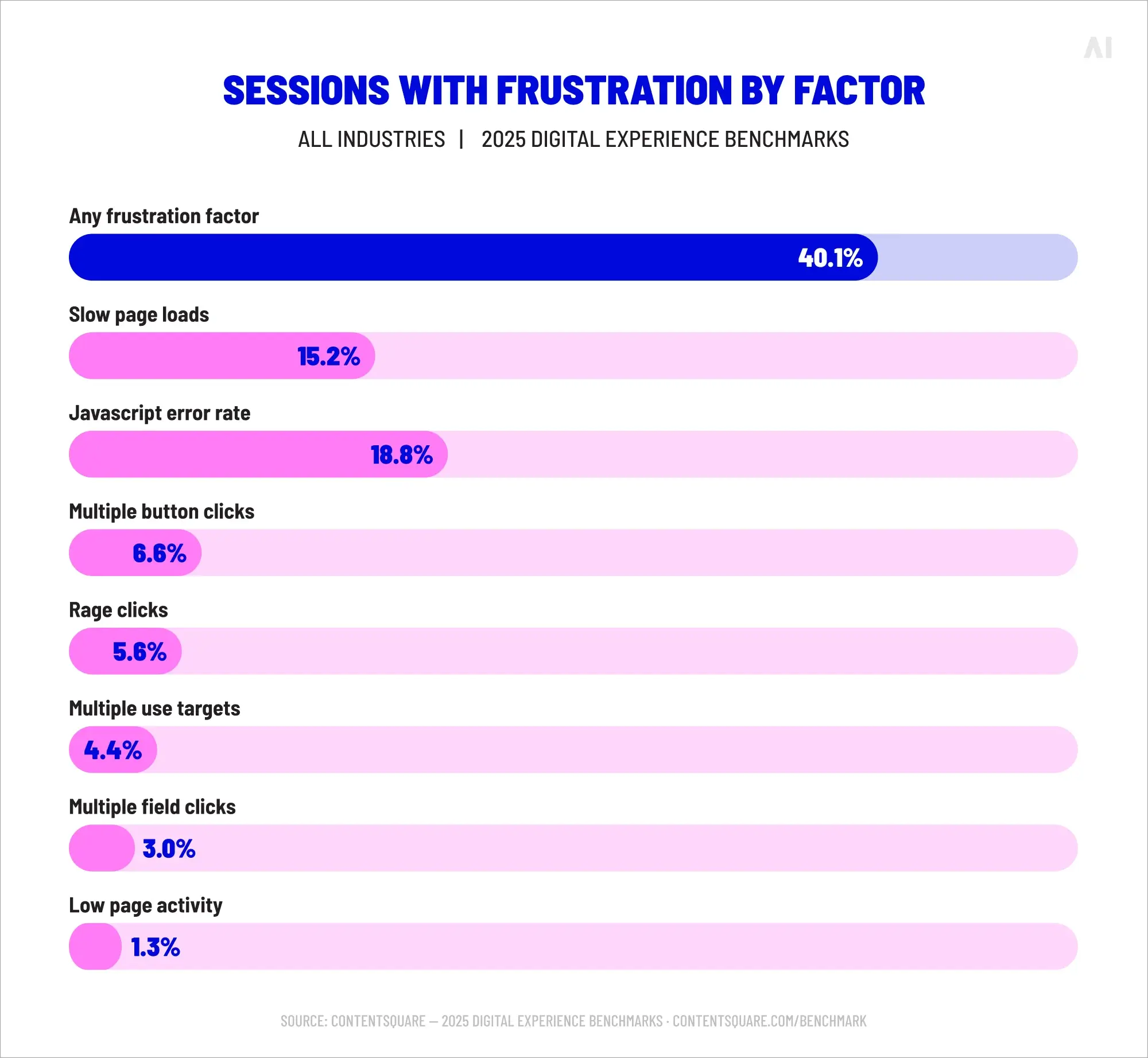
Heatmaps and interaction tracking
Heatmaps visualize aggregated interaction—click density, scroll depth, hover concentration—overlaid on the page itself. They are genuinely useful for landing page design, above-the-fold decisions and content prioritization. They are genuinely misleading for complex app UIs where interaction is task-specific rather than attention-driven. A heatmap that shows clicks scattered across a product listing page tells you how users are browsing; the same density on a checkout page usually means something has gone wrong.
Form analytics and conversion optimization
Forms are where experience analytics most reliably pays for itself. Field-level analytics reveals time-per-field, error rates, skip patterns and the precise field at which users abandon. The insights are usually immediate and actionable: a failing validator, a poorly explained field, a required input that should be optional.
Baymard's research, cited above, underscores why this matters. Checkout UX is a conversion lever of the first order, and the gap between the current global average and what is achievable is measured in hundreds of billions of dollars. Form analytics is how that gap gets closed.
Segmentation and behavioral analysis
Demographic segmentation is easy and mostly wrong. Two 35-year-old urban professionals on the same income can behave entirely differently online.
Behavioral segmentation — grouping users by what they actually do, not by what a database says they are—tends to be more predictive and more useful.
The groupings that consistently earn their keep are first-time vs returning, high-intent vs exploratory, and high-engagement vs low-engagement. Layered onto campaign data, they transform both the precision of targeting and the quality of experience design.
⚡ Behavior is the most honest data you can collect about a customer. It's what they do when no one is asking them what they think.
💡 Related reads: Programmatic Ad Targeting: Best Strategies, Tools, and Tactics in 2026 | AI-targeted advertising
Experimentation and testing methods
A/B and multivariate testing are the formal mechanisms by which hypothesis becomes decision. Usability testing complements them with qualitative depth. The discipline that separates good experimentation from theater is hypothesis-first thinking: knowing why you expect a change to move a metric before you run it, and resisting the temptation to ship anything that shows a two-day bump without statistical rigor. Significance is necessary; business significance is what counts.
User feedback and qualitative insights
Behavioral data tells you what users did. It rarely tells you why. That is what intercept surveys, NPS, exit-intent questions and open feedback loops are for. Neither channel is sufficient alone—qualitative without behavioral data is selection-biased anecdote; behavioral without qualitative is inference without context. The best teams pair the two.
{{26-Full-Guide-to-Digital-Experience-Analytics-2="/tables"}}
Best practices for implementing digital experience analytics
There is no great mystery to doing this well. The teams that extract real value from experience analytics do a few things consistently that their peers do inconsistently.
1. Align analytics with business outcomes
Every dashboard should answer a commercial question. If a report does not tie, even loosely, to revenue, retention, acquisition cost or margin, it is information for its own sake. Analytics leaders who win internal budget battles tend to start from the outcome and work backwards to the signal, not the other way around.
2. Focus on high-impact touchpoints
Pareto applies ruthlessly here. A handful of pages and flows—checkout, key landing pages, high-intent search results, the primary activation journey—account for most of the conversion value. Instrumenting those deeply is nearly always more valuable than instrumenting everything shallowly.
💡 Related reads: CPCV
3. Ensure data accuracy and consistency
Insight built on bad data is worse than no insight at all, because it is trusted. A standardized event taxonomy, shared metric definitions across teams, proper consent management, and regular data QA are not glamorous work. They are the foundation that makes everything above them possible.
4. Avoid vanity metrics
Pageviews, impressions, total sessions and raw traffic flatter reports and rarely move decisions. McKinsey's research on relevance offers a useful corrective: over 75% of consumers are turned off by content that doesn't feel relevant. A metric that cannot distinguish the 25% who might still engage is a metric that will flatter you into irrelevance. The KPIs that matter are the ones tied to outcomes—and owned by someone with the authority to act on them.
💡 Related reads: Cross-Platform Measurement Governance in Digital Advertising | Why Cross-Platform Measurement Is Still Broken in a Walled Garden World.
How to build a scalable analytics strategy with AI Digital
Experience analytics only pays back when insight can flow all the way through to action—and at scale, that is an infrastructure problem as much as an analytical one. Fragmented data, slow decision-making, and inefficient media execution are the three costs most commonly left on the table. AI Digital's approach addresses each in turn.
Unify fragmented data and improve measurement
The scale of the fragmentation problem is routinely underappreciated. Salesforce's 2025 research found that the average enterprise uses 897 applications, and only 29% of them are connected. The same study estimates that 19% of organizational data is siloed, inaccessible or otherwise unusable—and 70% of data leaders believe their most valuable business insights reside within that inaccessible portion.
Walled gardens compound the problem by locking cross-platform visibility behind proprietary dashboards. AI Digital's Open Garden framework is built specifically to counter this: a DSP-agnostic, cross-platform approach that unifies performance data across 15+ DSPs and 9+ SSPs, so teams can see the whole journey—not just the portion any single platform is willing to show them.
💡 Related reads: The Open Garden Framework: A New Operating Model for Programmatic Advertising.
Reduce analysis paralysis with AI-driven insights
Unified data is necessary but not sufficient. The next constraint is cognitive: there is simply too much of it to analyze manually in the time commercial decisions allow. 84% of data and analytics leaders say their data strategies need a complete overhaul before their AI ambitions can succeed, and 65% of senior executives now identify AI and predictive analytics as primary contributors to growth.
AI Digital's Elevate platform is built for exactly this constraint. Positioned as a marketing intelligence platform covering the full digital landscape—not just programmatic—Elevate unifies research, planning, optimization and reporting in a single intelligence layer. It draws on 150 billion data points monthly and 10,000+ audience attributes to surface AI-ranked insight: audience segmentation, competitive analysis, cookieless targeting, marketing mix modeling, and path-to-conversion attribution among them.
⚡ Generating more data is not the goal. Cutting the time it takes to make a decision, and raising the quality of the decisions that cannot wait, is.
Improve media efficiency and eliminate wasted spend
Behavioral insight only pays back if the media execution on the other side is efficient enough to respect it. That is where supply-side waste—fraudulent inventory, low-quality placements, bloated ad tech chains—quietly erodes value.
AI Digital's Smart Supply is the efficiency layer: direct SSP relationships, AI-powered supply path optimization, and curation that filters low-value impressions before they reach the buy side.
The result is less wasted spend, cleaner measurement and higher-quality engagement—which, crucially, feeds back into cleaner experience analytics.
💡 Related reads: What Is Supply Path Optimization (SPO) in Programmatic Advertising?
Build a continuous optimization system
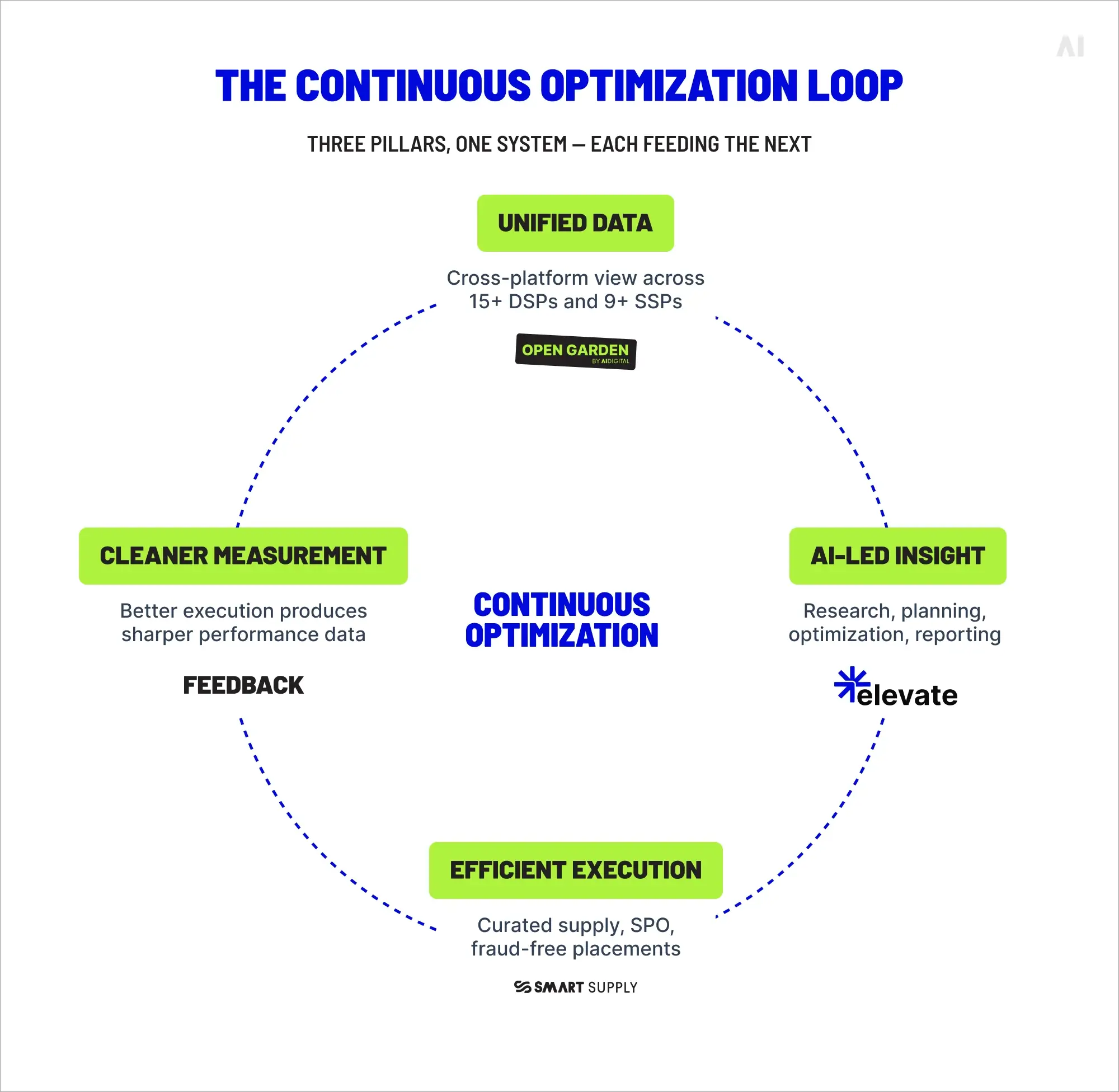
Read as a loop, the three pillars become more than the sum of their parts. Unified data (Open Garden) feeds AI-driven insight (Elevate); insight informs efficient media execution (Smart Supply); cleaner execution produces better measurement; better measurement feeds the next round of insight. This is the system the best-performing teams are quietly building—and the reason one-off optimization projects so consistently underperform ongoing ones.
⚡ It is worth being precise about this: continuous optimization is not a better project. It is a different discipline—one that demands different habits, different rhythms, and a different relationship with the data.
💡 Related reads: Media planning and buying
Conclusion: Turn user behavior insights into measurable growth
Fragmentation is the condition of modern marketing. Digital experience analytics is the response. Continuous optimization, built on unified data and AI-driven insight, is the discipline that makes the whole thing pay off.
Four takeaways worth holding on to:
- Behavioral data matters only when it leads to action. Observation without decision is cost.
- Unified measurement is essential for understanding the full customer journey. Without it, every channel looks like it is working, and none of them are talking.
- AI-driven insight changes the tempo. When the system prioritizes, human judgment gets applied where it counts.
- Continuous optimization compounds. One-time wins don't.
If your own organization's analytics stack looks closer to the pre-agentic era than it ought to, that is usually the starting point of a worthwhile conversation. AI Digital works with senior marketing, product and CX teams to build the three pieces that turn digital experience analytics into durable commercial outcomes — Open Garden for unified cross-platform measurement, Elevate for AI-driven insight and planning, and Smart Supply for efficient, transparent media execution. If any of that sounds useful, get in touch.
💡 Related reads: Multi-touch attribution | Creating a Data-Driven Marketing Strategy