What Is CPCV (Cost Per Completed View) — and Why It Matters for Video Advertising

%2520%25E2%2580%2594%2520and%2520Why%2520It%2520Matters%2520for%2520Video%2520Advertising.webp)
CPCV has become more important for one big reason: video delivery has fragmented, while measurement expectations have not. Marketers still need to prove message delivery, manage waste, and compare performance across placements that behave very differently.
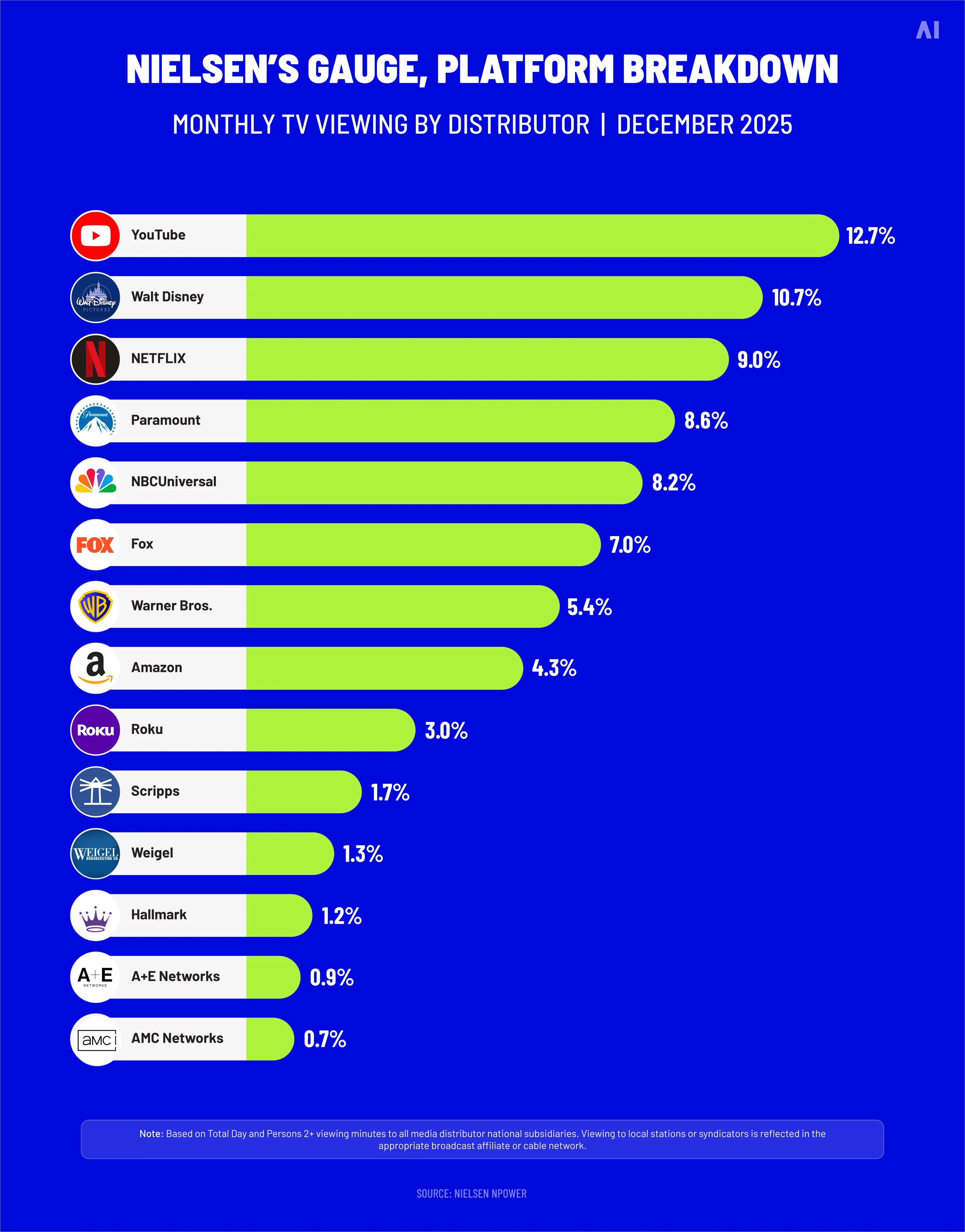
In the U.S., streaming has been taking a larger share of total TV time, and ad-supported streaming remains a major part of the experience. At the same time, the streaming universe keeps expanding in household reach and total hours, which widens the opportunity—and the room for inconsistency.
That’s why CPCV sits comfortably inside a broader KPI toolkit.
💡 If you want a refresher on how it fits alongside CPM, CPV, CPA, and reach/frequency metrics, AI Digital’s digital marketing KPI guide is a useful reference point.
⚡ CPCV is less about “cheap video” and more about paid attention you can audit.
What is CPCV?
CPCV (Cost per completed view) is the amount you pay, on average, for a video ad that reaches whatever your platform defines as a completed view.
At its simplest:
- Completed view = a view that hits the completion threshold (often 100% of the video, but not always)
- CPCV = the cost you paid to generate those completions
Why it’s valuable: CPCV focuses on message delivery, not just delivery of an impression or a partial view. That matters when you’re running awareness and consideration creative where the ending carries the brand, offer, or call-to-action.
Two practical notes before you use it in anger:
- “Completed” is not universally standard. Some platforms define completion as 100% watched; others use thresholds (e.g., “viewed for X seconds” or “to the end, whichever comes first”).
- Your reporting must always state the completion definition (and the platform/source of truth), or CPCV comparisons become misleading.
💡 If you’re planning to use CPCV in streaming-heavy plans, it helps to align it with your broader CTV measurement approach. AI Digital’s overview of CTV measurement is a helpful companion.
💡 For open-web and auction-based execution, AI Digital’s programmatic video advertising explainer gives relevant context.
How CPCV works across video channels
CPCV behaves differently depending on where the video runs, because completion is shaped by format rules, user behavior, and measurement visibility. One more factor is growing in importance: as identity and user-level tracking become harder, teams lean more on signals that indicate real exposure and real attention.
{{26-What-Is-CPCV-Cost Per Completed View-SEO-1="/tables"}}
Below is how CPCV typically “means” something slightly different in each major video channel.
CPCV in CTV & OTT
On CTV/OTT, many ad formats are closer to traditional TV: full-screen, sound-on by default (often), and frequently non-skippable. That environment can make completion a strong proxy for “the message had a fair chance to land.”
But the catch is measurement quality and transparency. DoubleVerify’s 2025 streaming insights highlight issues that directly affect how trustworthy a “completed view” is, including partial app transparency and waste scenarios like ads continuing after a TV is turned off (“TV Off”). Those aren’t abstract problems—DV also points to bot-driven fraud and large-scale invalid traffic risks in CTV.

So in CTV/OTT, CPCV is most meaningful when you pair it with:
- app-level transparency (where the ad ran),
- fraud controls,
- viewability/quality measurement where available,
- and frequency management (because high completion can still mean “the same people watched it too often”).
💡 If you want the channel-level strategy view, AI Digital’s connected TV advertising and OTT advertising primers are good jump-off points.
CPCV in programmatic video
In open-web programmatic video, completion is heavily influenced by player behavior and placement quality:
- autoplay vs click-to-play,
- in-article vs in-banner vs outstream,
- viewability (was the video actually on screen?),
- and supply quality (was it a real human opportunity?).
This is where CPCV can become a “false friend” if you chase cheap completions in low-quality environments.
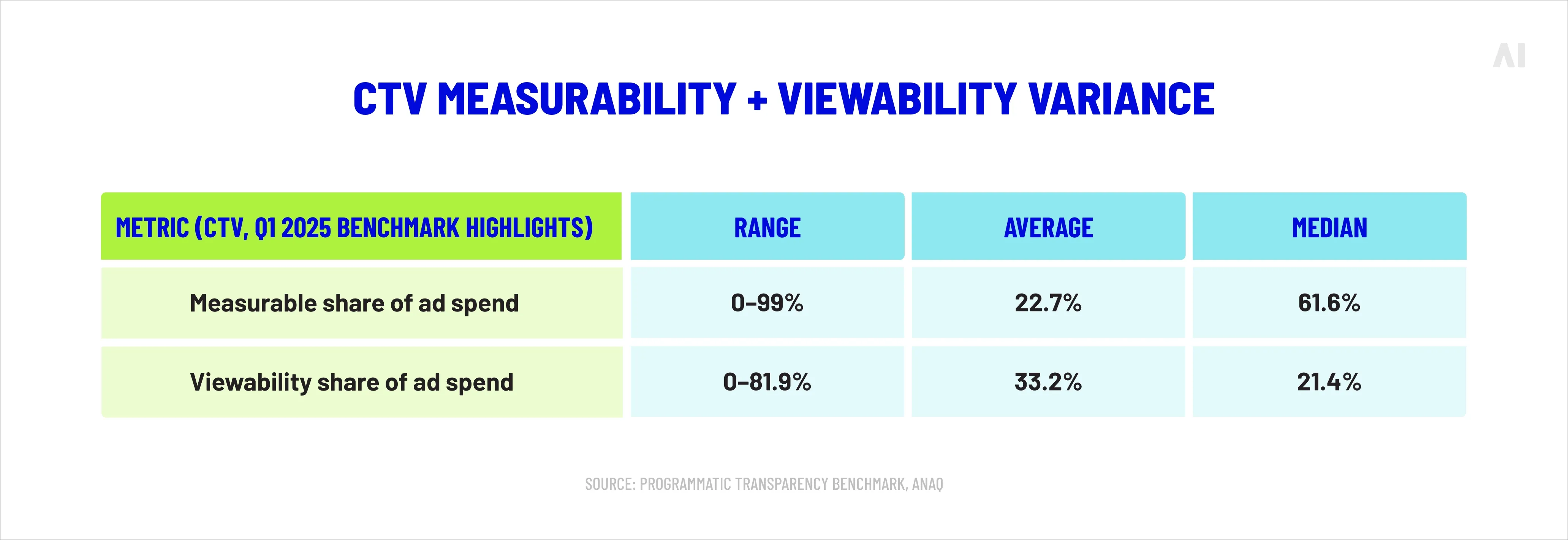
The ANA’s Q1 2025 Programmatic Transparency Benchmark is a strong reminder of how much waste still exists in open-web buying. It reports that benchmark participants directed 41% of programmatic budgets to “effective” impressions meeting core quality requirements, while also estimating a sizeable optimization opportunity remains. In other words: a lot of spend can still land on impressions that don’t meet basic measurability/viewability expectations, which will drag down your true completed-view efficiency.
In this channel, CPCV improves when you improve:
- supply path and publisher selection (avoid long-tail junk),
- viewability and measurement rates,
- contextual alignment (the video is actually welcome there),
- and creative fit for the placement (shorter isn’t always better, but mismatched length is expensive).
💡 AI Digital’s programmatic video advertising article and OLV advertising explainer are relevant reads here.
⚡ In programatic video, CPCV is often a quality metric in disguise.
CPCV in social video platforms
On social platforms, CPCV is shaped by feed behavior:
- fast scrolling,
- sound-off viewing,
- heavy competition for attention,
- and short-form formats that reward immediate clarity.
Also, social platforms may optimize toward proprietary events that behave like “completion,” but aren’t always 100% watched. That’s not bad—it just means your reporting must define the event precisely.
A practical way to think about CPCV in social:
- It’s as much a creative diagnostic as a buying KPI.
- If completion improves after a creative change, you likely made the opening seconds clearer, the pacing tighter, or the message more relevant.
For YouTube-style environments, Pixability’s 2026 benchmarks outline how completion rates can vary significantly by format (for example, skippable vs non-skippable), which is exactly why CPCV should be interpreted alongside format selection.
💡 If your plan includes YouTube on TV screens and living-room viewing behavior, AI Digital’s YouTube TV ads piece is a useful internal reference.
CPCV in DOOH
DOOH is the hardest place to treat CPCV literally, because the environment is physical:
- people move,
- screens compete with the real world,
- and “viewed to completion” is rarely measured in a one-to-one way the way it is online.
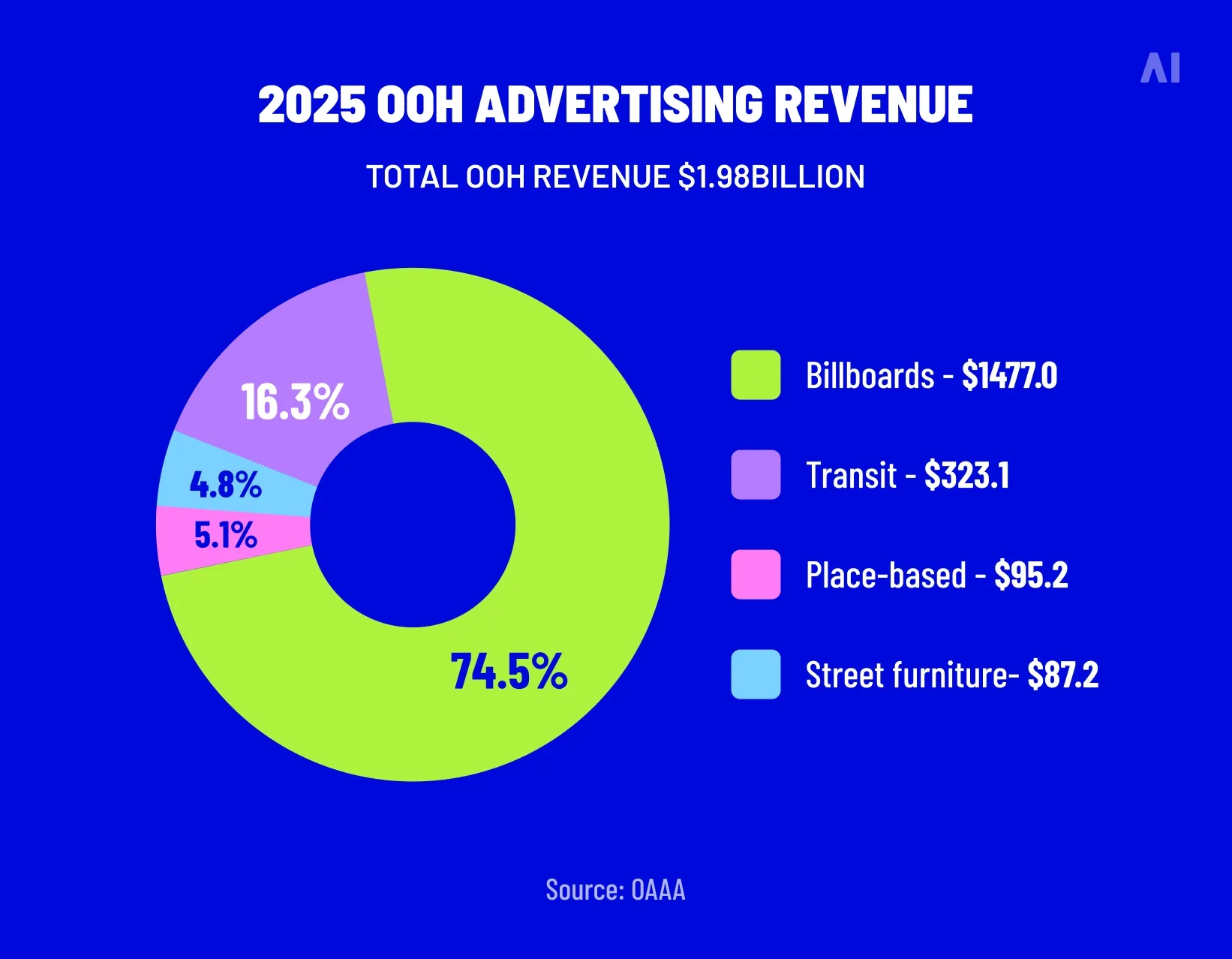
That doesn’t mean CPCV is useless in DOOH. It means you typically interpret it through proxies, such as:
- confirmed play-out (the creative ran for its full duration),
- impression models based on location/time/traffic,
- and (where available) attention or verification layers.
From a market standpoint, IAB projected U.S. DOOH ad revenue to reach $3B in 2025, which underlines why more teams are trying to standardize performance expectations in the channel.
💡 For channel context, AI Digital’s DOOH advertising overview and Why DOOH inventory quality drives campaign performance are the natural internal resources.
How to calculate cost per completed view
The core formula is straightforward:
CPCV = Total spend ÷ Number of completed views
Example:
- Spend: $12,000
- Completed views: 300,000
- CPCV: $12,000 ÷ 300,000 = $0.04 per completed view
There’s also a helpful way to connect CPCV to CPM and completion rate:
CPCV ≈ (CPM ÷ 1000) ÷ Completion rate
So if your CPM is $20 and your completion rate is 50% (0.5), then:
- CPCV ≈ (20/1000) / 0.5 = 0.02 / 0.5 = $0.04
This is useful for planning because it shows why CPCV is not just a “creative metric.” It’s also a pricing-and-quality metric.
The ANA benchmark includes CPM breakdowns across buying types (open market vs PMPs, etc.), which can help you build realistic planning scenarios before you ever launch.
⚡ If you know CPM and completion rate, you can usually predict CPCV before you spend the first dollar.
{{26-What-Is-CPCV-Cost Per Completed View-SEO-2="/tables"}}
💡 Related reading: Key performance marketing strategies 2026.
CPCV in the video performance KPI ecosystem
CPCV is most useful when you treat it as a message-delivery efficiency metric. It tells you what you paid to get viewers to the end of the ad. That’s valuable, but it doesn’t tell you everything.
A practical way to use CPCV is as a “second lens” next to the KPI you’re already optimizing toward (reach, views, conversions). It helps you answer: are we paying for real consumption, or just delivery?
{{26-What-Is-CPCV-Cost Per Completed View-SEO-3="/tables"}}
Below is how CPCV relates to the metrics it’s most often confused with, plus how to use each without tripping over definitions.
💡 Related reading: How to measure TV advertising ROI
CPCV vs CPV (Cost Per View)
CPV usually charges when someone meets a minimum viewing threshold. That threshold varies by platform, but it’s typically seconds watched or a short view event, not necessarily the full ad. CPV is designed for scale. It’s a good way to buy lots of “initial attention” efficiently.
CPCV is stricter. It optimizes for the viewer finishing the message, which makes it better when the ending matters.
Here’s the simplest mental model:
- CPV buys starts (or meaningful partial views)
- CPCV buys finishes
And they’re mathematically connected:
- CPCV = CPV ÷ completion rate (among counted views)
Example:
- CPV = $0.05
- 40% of counted views complete the ad
- CPCV ≈ $0.05 ÷ 0.40 = $0.125
So when CPCV is “too high,” it’s usually one of two problems:
- CPV is expensive (you’re paying a lot for starts), or
- completion rate is weak (the ad or placement loses people before the end).
Use CPV when:
- You want efficient top-of-funnel reach with light exposure.
- The creative is long and you’re comfortable paying for partial attention.
- The platform’s “view” threshold is a meaningful engagement signal for your goal (for example, you care about initial message pickup, not full story completion).
Use CPCV when:
- The end of the ad matters (brand reveal, offer, CTA, story payoff).
- You’re running sequential messaging and need completion as a gating signal (“only show ad #2 to people who finished ad #1”).
- You’re comparing placements where view thresholds vary and you want a more consistent definition of “delivered message.”
A good guardrail approach: optimize to CPV for scale, but monitor CPCV to ensure you’re not buying cheap “views” that never reach the point of the ad.
{{26-What-Is-CPCV-Cost Per Completed View-SEO-4="/tables"}}
CPCV vs CPM
CPM tells you what it costs to deliver 1,000 impressions, regardless of whether the video was watched or finished. It’s a delivery metric.
CPCV answers a different question: what did it cost to get the full message consumed?
They connect through completion rate:
- CPCV ≈ (CPM ÷ 1000) ÷ completion rate
Example:
- CPM = $20
- completion rate = 50% (0.50)
- CPCV ≈ ($20 ÷ 1000) ÷ 0.50 = $0.02 ÷ 0.50 = $0.04
This is why CPCV is such a useful “truth test” for CPM. You can have a decent CPM and still end up with an ugly CPCV if completion is weak.
CPM is still essential for:
- Reach and frequency planning.
- Cross-channel media mix modeling.
- Forecasting and budget allocation.
CPCV helps you sanity-check whether CPM is buying:
- Actual message delivery (high completion, stable CPCV), or
- Theoretical opportunity (impressions that don’t translate into finishes).
💡 Related reading: How CPM influences TV ad performance
CPCV vs CPA (Cost Per Acquisition)
CPA is lower-funnel. It measures what you paid for a desired action: purchase, signup, lead, install.
CPCV is upper/mid-funnel by nature, but it can still support performance goals when you use it correctly. Think of CPCV as a way to improve the inputs to performance, not as a replacement for performance itself.
CPCV can support CPA by:
- Improving exposure quality before retargeting. If your retargeting pool is built from people who actually finished the ad, you often get a cleaner signal than “someone had an impression.”
- Acting as a pre-qualification signal in sequential messaging. You can reserve deeper, more direct-response creative for people who demonstrated attention.
- Identifying which creative versions actually land. If Creative A has a meaningfully better CPCV (and completion rate), it’s often the better candidate to scale into performance testing.
The common mistake: Treating CPCV as the goal when the business goal is acquisition.
CPCV tells you you paid for attention. It does not tell you that attention converted. The smart way to pair them is:
- Use CPCV (and completion rate) to keep your video layer honest.
- Use CPA/ROAS to confirm whether that attention translates into outcomes.
What is a good or bad CPCV?
A “good” CPCV is not a single universal number. It depends on:
- what “completed” means in your platform,
- your video length,
- the format (skippable vs non-skippable),
- the audience and targeting tightness,
- and the inventory quality.
A practical benchmark method that works across brands:
- Define completion precisely (100%, 15 seconds, etc.).
- Benchmark within channel first, then compare across channels only after normalizing definitions.
- Segment CPCV by creative length (6s, 15s, 30s) and format.
- Evaluate CPCV alongside waste indicators, not in isolation.
Why the “waste indicators” point matters: both the ANA programmatic benchmark and DV’s streaming research highlight how measurability gaps, transparency limitations, and invalid traffic can inflate the apparent efficiency of delivery metrics.
“Good” CPCV tends to look like this:
- CPCV improves without a collapse in reach (you didn’t just buy tiny scale).
- Completion improves and brand/site lift signals hold steady or rise.
- The placements driving low CPCV also show acceptable transparency and quality.
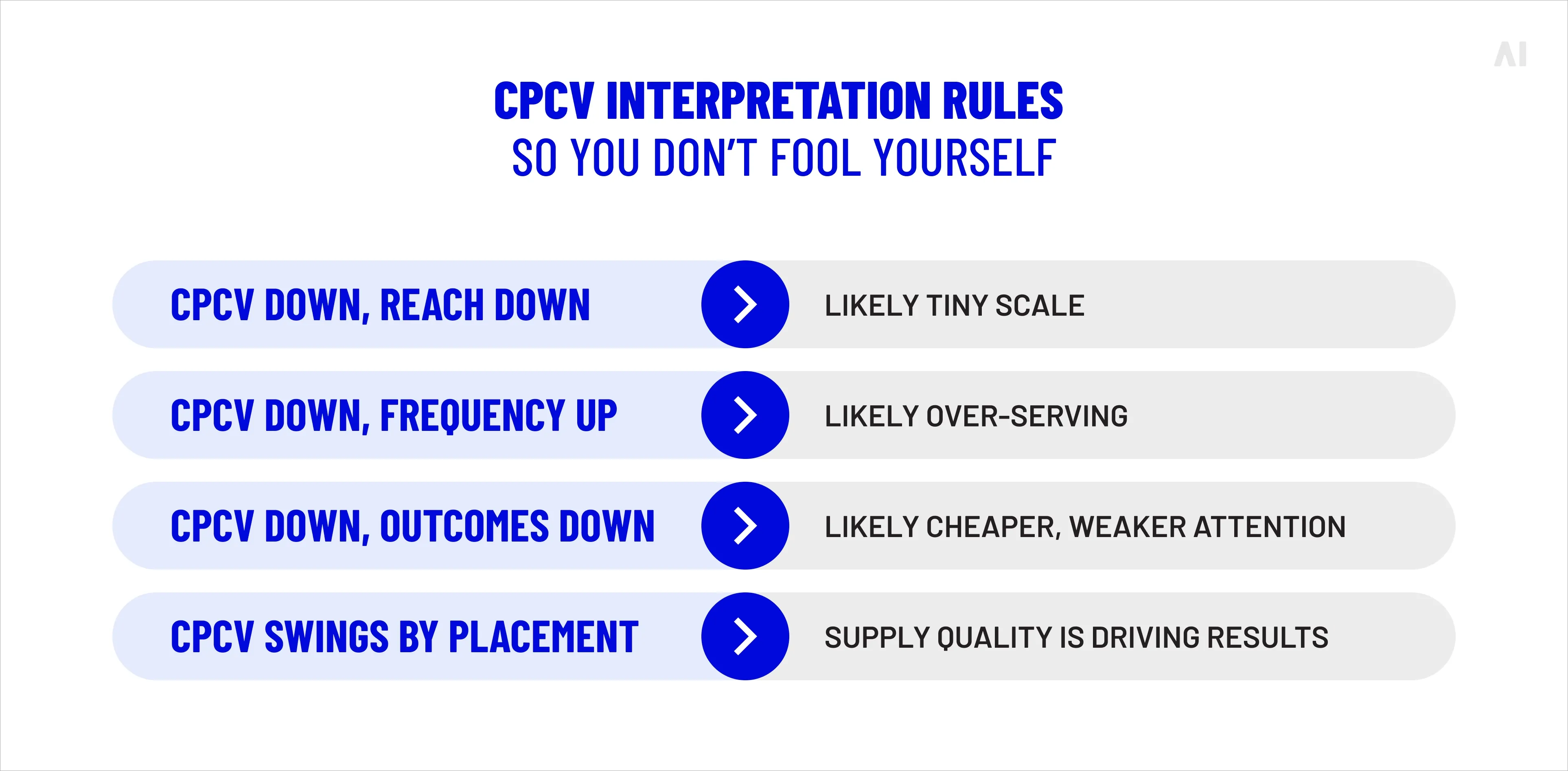
“Bad” CPCV tends to look like this:
- CPCV drops, but frequency spikes (you’re grinding the same audience).
- CPCV drops, but downstream KPIs weaken (you bought cheap completion, not meaningful attention).
- CPCV drops mainly due to questionable supply (poor transparency or low-quality inventory signals).
Who Benefits from CPCV — and Why
CPCV is one of the few video metrics that both brand and performance teams can use without talking past each other.
CPCV benefits for brands
For brand-led campaigns, CPCV helps you:
- validate that storytelling creative is actually being consumed,
- compare message delivery across premium CTV, social, and open-web video,
- and diagnose when “reach” is being bought at the cost of real attention.
It’s also useful when you’re running multiple creatives and need a quick, comparable signal for which versions keep viewers watching.
CPCV benefits for agencies
For agencies and planners, CPCV helps you:
- standardize reporting across fragmented video buys,
- justify budget shifts with a metric clients immediately understand,
- and build clearer optimization narratives (creative changes, supply changes, targeting changes).
It also plays well in cross-channel planning workflows where you need a single metric that reflects delivery quality, not just delivery volume.
When should you optimize for CPCV?
Optimizing toward CPCV makes the most sense when your goal depends on viewers consuming a complete message, not just being exposed to it.
Common scenarios:
- Product launches and brand storytelling: This is where the payoff is late in the creative (the reveal, the proof point, the offer). If your strongest moment is in the last third of the ad, CPCV protects you from paying for “almost watched.”
- Consideration campaigns: If the message needs a full explanation (how it works, why it’s different, what to do next), completions matter more than raw impressions. CPCV helps you prioritize placements and audiences that actually stick with the story.
- Sequential messaging: CPCV becomes especially practical when completion is a gating rule. YouTube’s video ad sequencing, for example, explicitly lets you move viewers through steps based on impressions, views, or skips, so “watched vs didn’t watch” can be used as a progression signal.
- CTV video built to support performance: If you’re using CTV to feed retargeting pools or lift studies, CPCV is a clean way to pressure-test whether you’re buying real message delivery (not just “served” ads). It’s not a replacement for CPA, but it can improve the quality of the upstream exposure that performance work depends on.
Best practices to improve your CPCV
Before you start tweaking bids or swapping platforms, it’s worth remembering what CPCV really reflects: the cost of holding attention long enough to finish the ad. That means improvements usually come from the basics—how the creative is built, where it runs, who sees it, and how often they’re exposed. Start with the levers that change completion behavior, then use buying tactics to scale what’s already working.
{{26-What-Is-CPCV-Cost Per Completed View-SEO-5="/tables"}}
Creative optimization
Most CPCV gains come from creative fundamentals. In practice, CPCV gets better when completion rate improves for the same (or similar) media cost.
What reliably helps:
- Put the premise in the first seconds (don’t “warm up” too long). A lot of the battle is simply keeping someone past the opening. In creator-style environments, WARC reported that only 14% of creator ads were watched past the first three seconds. That’s why the first beat matters so much.
- Make the brand readable early, then reinforce later. WARC also noted that when creator ads include a brand in the first three seconds, it’s associated with a +16% impact on video view completion and 13% lower CPV. It’s a helpful reminder that “authentic” and “clear branding” don’t need to be opposites.
- Design for sound-off where relevant (captions, clear supers). Don’t assume audio carries the message, especially in scrollable placements.
- Cut versions by length and context. A 15s and a 30s are different products. They drop off differently, they pace differently, and they often win in different inventory.
- Test openings more aggressively than endings. Openings drive completion. Endings polish the message for the people who already stayed.
Targeting and inventory quality
In many cases, CPCV improves because you stopped buying “completion” in places where people never had a real chance to watch, or where measurement is too weak to trust the metric.
Concrete steps:
- Use allowlists for high-performing publishers/apps. This is the simplest way to reduce long-tail waste and stabilize completion rates.
- Prefer PMPs or curated supply when it improves transparency and control. You’re not just buying media, you’re buying conditions: viewability, clean reporting, consistent playback, fewer surprises.
- Audit long-tail placements regularly. The ANA’s Q1 2025 Programmatic Transparency Benchmark found that participants directed 41% of programmatic budgets to “effective ad impressions,” and the report’s TrueCPM Index indicated a 37.8% optimization gap tied to quality basics like non-IVT, measurability, and viewability. That’s exactly the kind of leakage that can distort CPCV if left unmanaged.
- Treat measurability and viewability as prerequisites for “completed” meaning anything. If you can’t reliably measure viewability, a completion event is a weak signal. The IAB/MRC attention guidance is blunt here: attention-style metrics should meet minimum viewability standards, and anything reported before viewability should be flagged as diagnostic.
- In CTV, apply safeguards for transparency and fraud. DV’s 2025 streaming research highlights that only 50% of CTV impressions offered full app transparency in 2024, and it calls out issues like “TV Off” waste and bot-driven fraud that can inflate delivery metrics if you don’t filter aggressively.
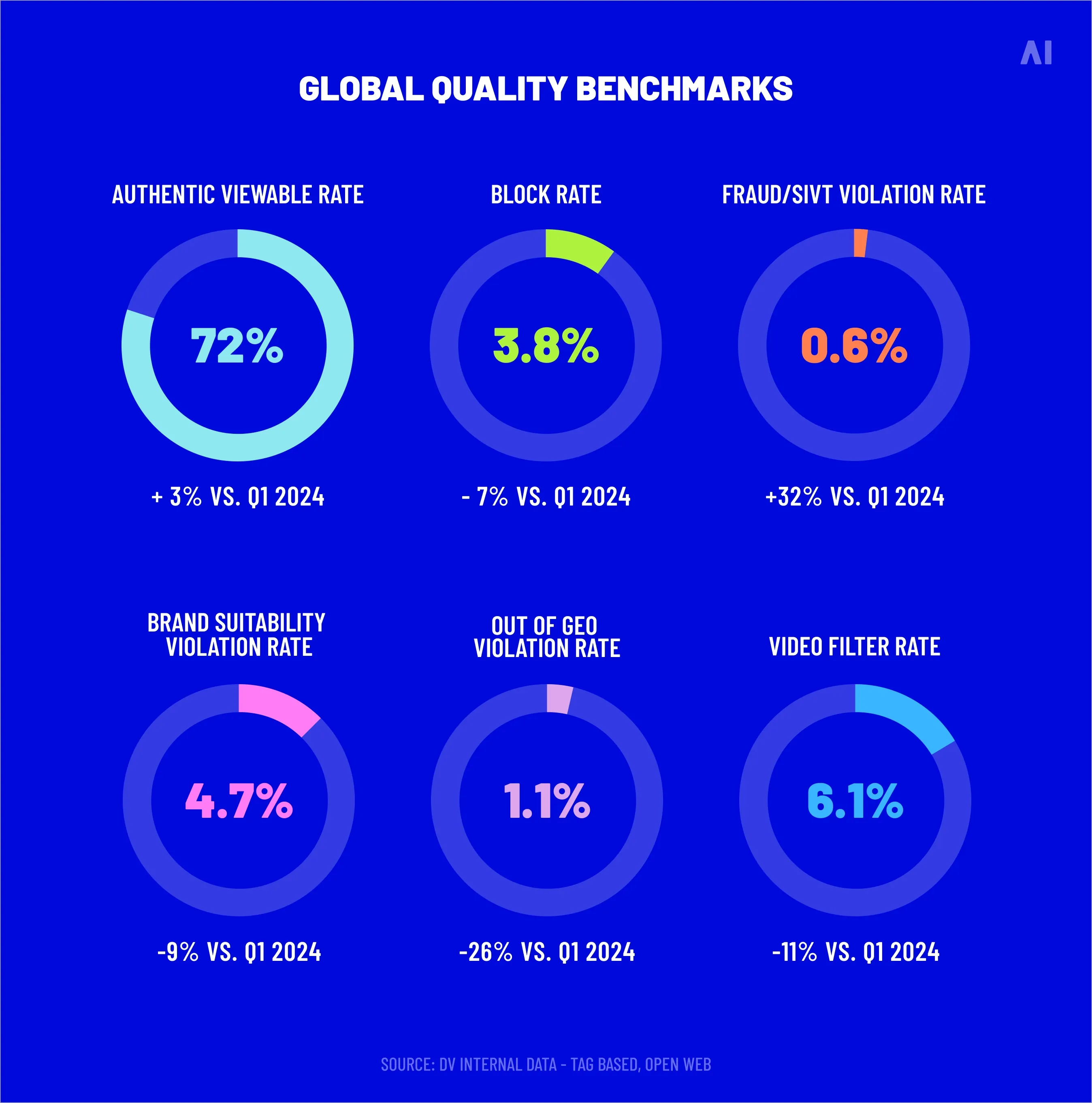
⚡ In DV’s Q1 2025 benchmarks for North America (open web, tag-based), the video viewable rate is 85% and the fraud/SIVT violation rate is 0.7%. Benchmarks like this give you a reality check for what “good” can look like—then your job is to avoid buying below it.


💡 Related reading: What is AI targeted advertising and why it’s changing everything
Frequency and sequencing strategy
High completion can still be wasteful if it’s driven by repetition. CPCV can look “healthy” while the campaign is quietly overserving the same households.
To protect CPCV from frequency inflation:
- Set frequency caps appropriate to the channel. Innovid’s 2025 CTV benchmarks are a good reality check: the average CTV campaign reached 19.64% of households with an average frequency of 7.09, and higher-investment campaigns pushed frequency into 10+. That’s where completion can remain high but efficiency can quietly degrade.
- Rotate creatives before fatigue sets in. If completion starts to slip at higher frequencies, creative fatigue is often the culprit, not the bid.
- Use sequencing to reward completion with the next message. This is where completion becomes functional. YouTube sequencing also has a built-in default cap (one sequence per person per 7 days), which is a decent starting point for “don’t spam the same storyline.”
- Review CPCV by frequency bucket. 1–2 exposures vs 6–8 exposures usually tells the real story.
Platform and format selection
Some formats are structurally more completion-friendly than others. The trick is to choose formats where “completion” aligns with the real viewing experience (full-screen, intentional viewing, fewer accidental plays).
A practical way to frame this is: how easy is it for someone to leave mid-ad? That single question often predicts completion behavior.
For YouTube specifically, Pixability’s 2026 benchmarks illustrate how much completion varies by format: skippable in-stream typically lands at 60%+ VCR, while non-skippable in-stream is 90%+, and bumpers tend to be 90–95%+. That kind of spread is why CPCV comparisons across formats only make sense when you control for “what completion even looks like here.”
💡 Related reading: The best programmatic advertising platforms
How to analyze and report on CPCV
CPCV reporting gets much easier when you standardize the way you present it and pair it with the metrics that explain why CPCV moved.
A clean reporting structure:
- Define the completion event clearly. “100% watched” sounds obvious, but confirm the platform’s event definition and whether it’s based on quartiles, player signals, or other criteria.
- Report CPCV with companion metrics:
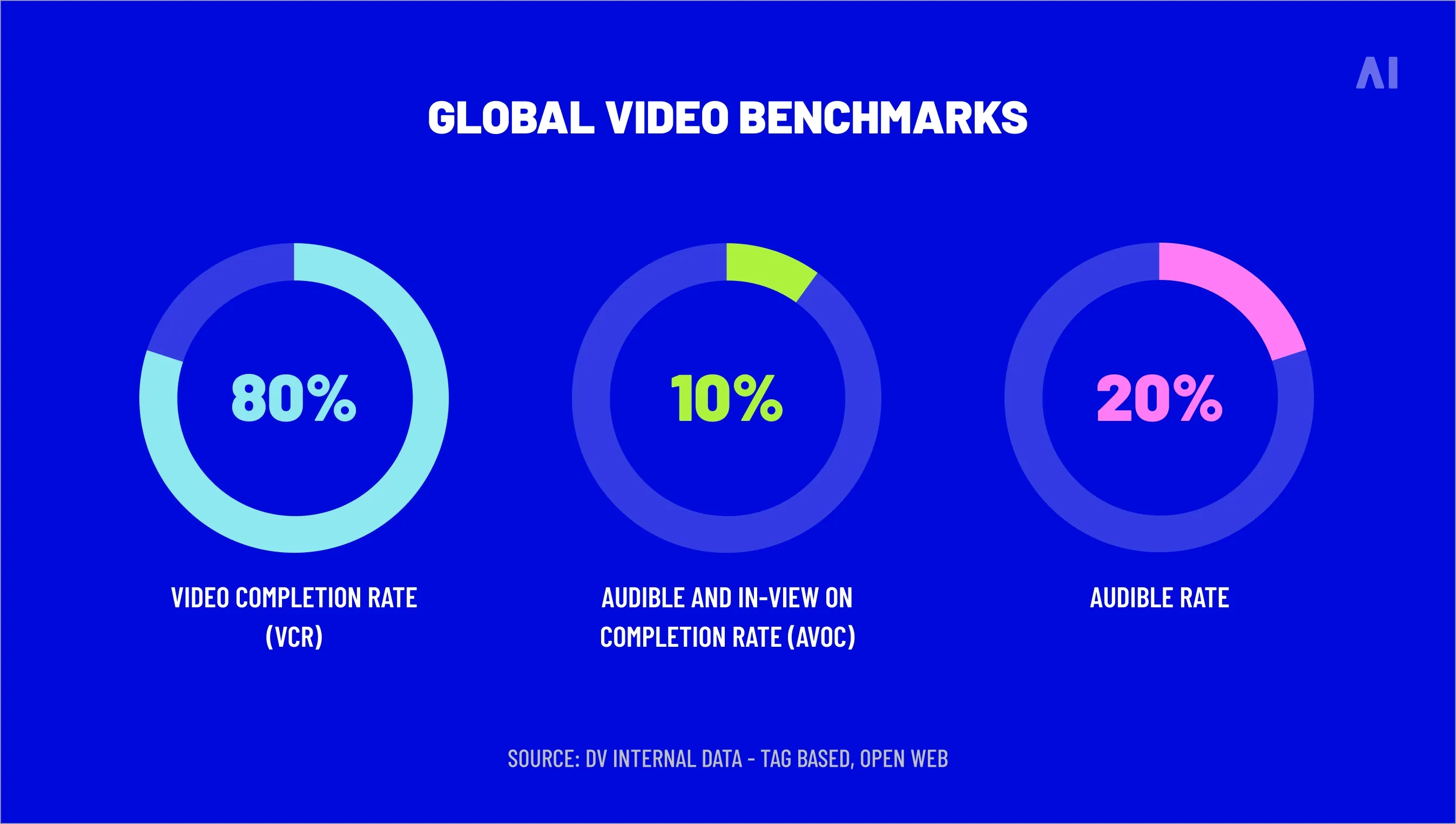
- Completion rate / VCR. DV defines VCR as the percentage of video ads that play through their entire duration to completion.
- Viewability and measurability. DV also restates the IAB/MRC viewability baseline (50% pixels in view for 2 seconds for video) which helps keep “completed view” grounded in viewable reality.
- Audible/in-view context where available. DV’s glossary includes “audible rate” and “audible and in-view on completion” style metrics, which can be useful for explaining why completion is high (or suspiciously high).
- Downstream KPIs: site visits, CPA, lift, etc., so CPCV doesn’t become the goal by accident.
- Break down CPCV by:
- Creative (and length)
- Audience segment
- Placement/app/site
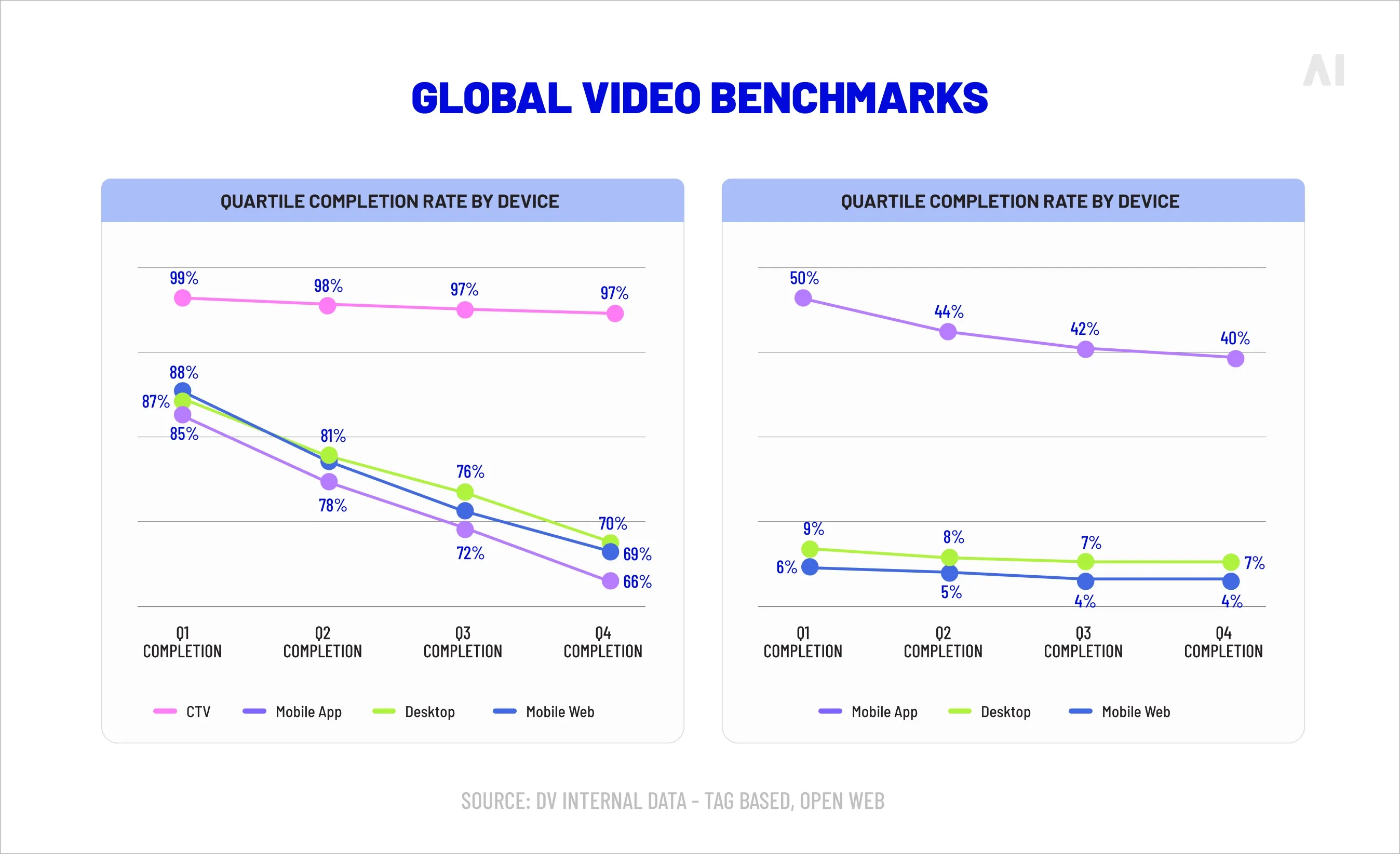
- Device environment (CTV vs mobile vs desktop)
- Call out quality risks explicitly. This is where you reference the same issues mentioned previously: long-tail waste, measurability gaps, and (in CTV) transparency and invalid traffic risks that can distort delivery metrics.
- Translate CPCV into an outcome narrative. Aim for: “We reduced CPCV by increasing completion at the same reach,” not “we reduced CPCV by buying cheaper inventory.” The first implies better delivery. The second might just be lower-quality supply.
Conclusion: Driving better video performance with CPCV
CPCV works because it forces a more honest question than most video dashboards do: did people stay long enough to receive the full message? When you track (and optimize toward) completed views, you stop rewarding “almost watched” delivery and start rewarding placements, audiences, and creative that earn attention all the way through.
Used properly, CPCV also makes cross-channel video easier to manage. CTV and OTT may deliver strong completion by default, but you still need to validate quality and avoid waste. Programmatic video can swing from excellent to awful depending on supply and player context. Social can deliver huge volume, but completion depends heavily on the opening seconds and format fit. DOOH adds reach and presence, but “completion” must be defined carefully so you don’t compare apples to billboards.
AI-driven optimization is what ties this together. The practical role of AI here isn’t magic. It’s discipline at scale:
- Finding the inventory and contexts where completion is real and repeatable (not accidental or low-quality).
- Shifting spend toward creatives and segments that hold attention based on live performance signals.
- Managing frequency and sequencing so high completion doesn’t turn into repetitive waste.
- Making reporting cleaner by standardizing definitions and surfacing the drivers behind CPCV movement (creative, placement, audience, device).
If you want CPCV to translate into better media efficiency and ROI, treat it as a working system, not a single number. Define completion clearly, pair CPCV with completion rate and quality indicators, and use it to guide decisions that actually change outcomes: creative structure, supply selection, and exposure strategy.
- To go deeper on how AI is changing optimization and measurement across channels, see AI in digital marketing
- And for broader planning context, including how budgets and channels are evolving, the 2026 media trends report is a strong companion read
If you’d like help applying CPCV across CTV, programmatic video, social, and DOOH—setting benchmarks, cleaning up reporting, or building an optimization playbook—get in touch with AI Digital. We can pressure-test your measurement approach and help you turn completed views into more efficient video performance.
.webp)