
As TV advertising shifts from traditional linear TV to an increasingly data-driven world of connected TV platforms, understanding how TV CPM, CTV CPM, and connected TV CPM function is now a cornerstone of smarter media planning. With CPM in television serving as a universal benchmark across channels, it helps teams compare costs, forecast reach, and allocate dollars with far greater precision than legacy rating systems could ever offer. This evolution matters because the way audiences consume content—streaming on demand versus scheduled broadcast—reshapes both audience behavior and the advertising cost landscape. The shift is part of the broader transformation in tv advertising from a broad-reach broadcast playbook to a performance-oriented strategy that emphasizes targeting and measurable outcomes.
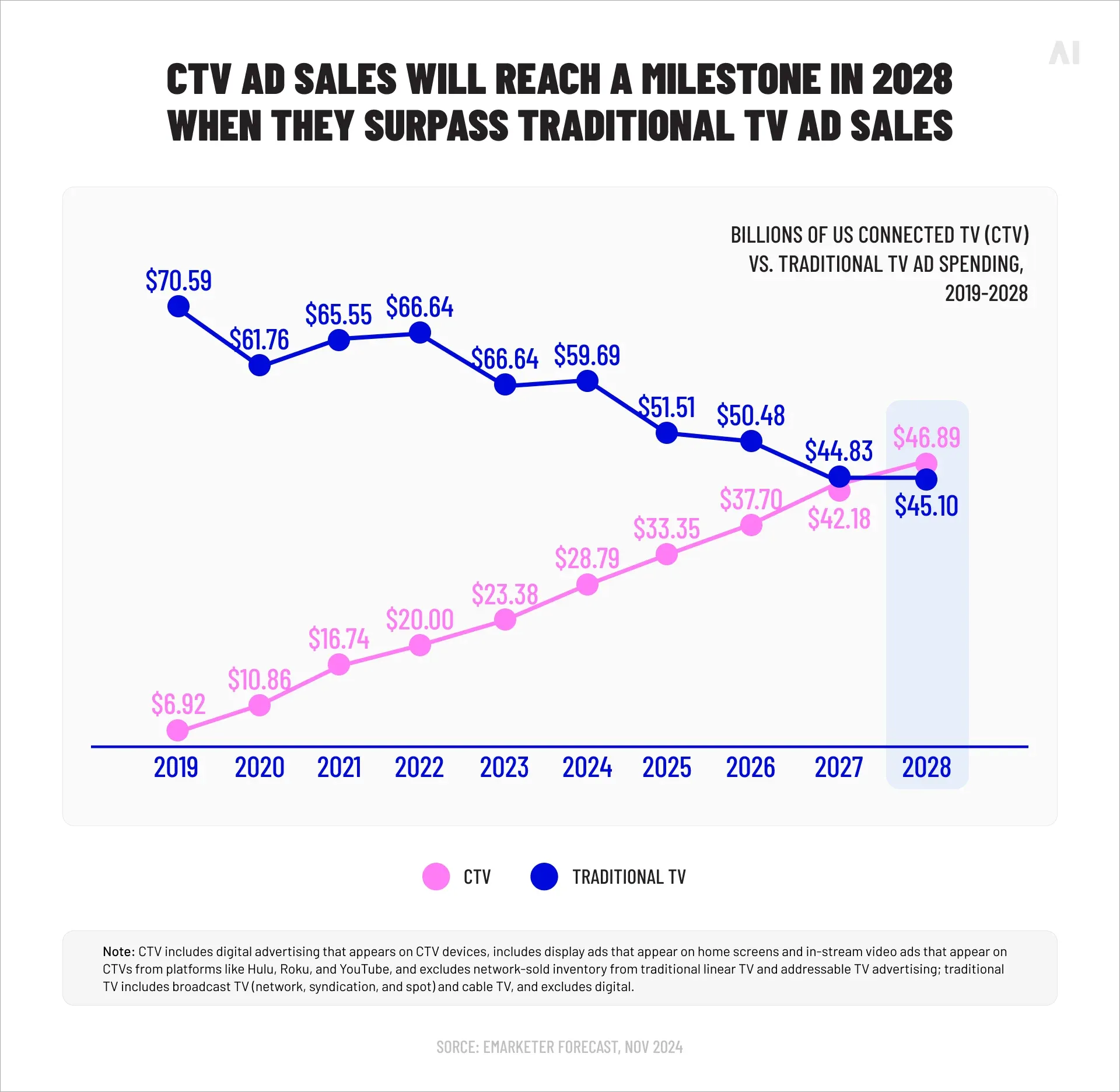
⚡️The rise of CTV advertising isn’t just hype: global CTV ad spend is projected to climb into the tens of billions of dollars in 2025, reflecting double-digit year-over-year growth as advertisers pivot more budget toward streaming screens and away from conventional television channels.
In practice, CTV CPM often ranges from roughly $20–$65 depending on platform, targeting precision, and inventory premium, which is higher than many linear TV benchmarks but comes with richer data and performance insights that traditional buys can’t match. These figures underscore how cost and value now intersect in new ways across digital-measured and big-screen environments.
Although CPM has been part of TV planning for decades, its role today carries far more strategic weight. With advertisers navigating fragmented publishers, new measurement standards, and fluctuating inventory prices, CPM acts as a common denominator that helps compare platforms, evaluate the real cost of reaching audiences, and determine whether a particular CTV CPM aligns with expected outcomes. The goal of this article is to explore why CPM remains so influential—especially in cpm tv advertising—and how marketers can interpret it correctly to improve decision-making without giving up scale or performance.
What is CPM in TV advertising?

CPM — cost per thousand impressions — is one of the core pricing models in tv advertising, including both linear and CTV environments. In practical terms, TV CPM or CTV CPM represents the amount an advertiser pays for every 1,000 ad impressions delivered on a television screen. The “per thousand” standard comes from the Latin mille, a convention that has shaped impression-based buying for decades across television and digital media.
⚡️You can see how CPM connects to broader performance evaluation—alongside metrics like CPA, ROAS, and attribution models—in our guide on digital marketing KPIs, which outlines how impression-based metrics fit into a full measurement ecosystem.
In linear TV, an impression is counted when an ad airs during a scheduled program and is attributed to the estimated audience watching at that time. These impressions rely on panel-based projections. In connected TV, however, an impression is recorded only when an ad fully renders on a device—an important evolution because impressions are now verified rather than estimated. This shift is one of the main reasons modern connected tv CPM values are typically higher than those in traditional broadcast.
Recent market analyses reveal that CTV CPMs often fall between $20 and $65, depending on audience specificity, targeting sophistication, and publisher inventory, while broad linear TV placements commonly range from $10 to $30. The difference reflects growing audience fragmentation, premium streaming environments, and the higher precision that CTV platforms provide.
What makes CPM tv advertising especially valuable today is that CPM acts as a financial and performance anchor. It allows marketers to compare inventory quality across platforms, understand whether they are overpaying for certain audiences, and evaluate how campaign structure influences final outcomes. As performance expectations rise, CPM provides a stable, comparable metric that bridges the old world of rating-based buying and the new world of impression-level measurement.
💡Across both linear and connected TV, CPM remains essential for planning, budgeting, and determining whether your advertising cost aligns with expected reach and effectiveness—a crucial foundation for any modern TV or CTV strategy.
How to calculate CPM: formula and quick example
CPM is calculated using a simple formula that helps advertisers understand how much they pay to reach 1,000 viewers across linear TV or connected TV platforms. Whether you’re evaluating tv cpm, connected tv cpm, or comparing costs across multiple publishers, the math stays the same.
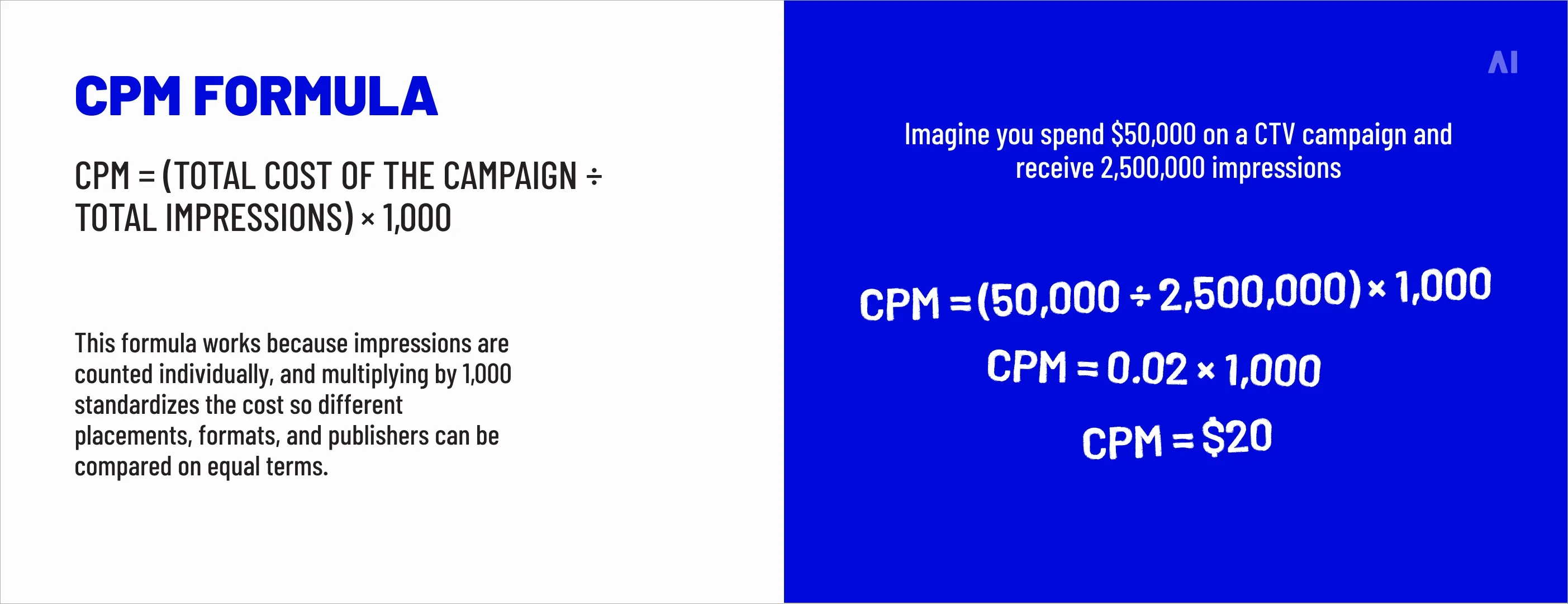
In this case, your CTV CPM is $20, meaning you pay $20 for every 1,000 impressions delivered. This type of calculation helps benchmark pricing, forecast reach, and compare performance across various television and CTV inventory sources.
Why CPM is a core KPI in TV and CTV media planning
Brands rely on CPM because it creates a unified way to compare cost and reach across different TV environments, from linear broadcast to data-driven CTV platforms. As audiences scatter across devices and publishers, CPM offers a stable reference point that helps marketers navigate fragmentation while keeping budgets aligned with expected outcomes.
Below is a structured view of why CPM remains essential in modern TV and CTV planning:
{{26-how-cpm-influences-1="/tables"}}
💡Beyond these four pillars, CPM serves as the connective tissue between cost, audience reach, and performance expectations. It helps unify planning across fragmented television ecosystems, ensuring that campaigns stay financially grounded while still maximizing impact.
⚡️For a deeper breakdown of how these metrics work together and how TV and CTV advertisers quantify financial return, you can explore our guide on TV advertising ROI, which explains attribution models, sales impact measurement, and methods for linking impression delivery to revenue outcomes.
What influences CPM in TV and CTV advertising?

CPM in both tv advertising and CTV advertising fluctuates based on several interconnected factors, from the channel where the ad appears to the targeting depth and competitive pressures surrounding specific audiences. Understanding these drivers helps advertisers judge whether a TV CPM, connected TV CPM, or CTV CPM aligns with the value they expect from a campaign. Below are the core influences that shape CPM across the television ecosystem.
Channel type: Linear vs CTV
The type of television channel plays one of the most significant roles in determining cost. Linear TV CPMs tend to be lower because they are built on broad reach and estimated impressions. In contrast, CTV CPMs are generally higher due to verified delivery, premium streaming environments, and richer audience data.
{{26-how-cpm-influences-2="/tables"}}
⚡️For a deeper comparison of how these environments differ in pricing, measurement, and audience behavior, explore our guide on CTV vs. Linear TV.
Audience targeting depth
The more granular the targeting, the higher the CPM. Broad audiences usually come with lower costs, while precise segments such as household income, interest categories, retargeting pools, or custom data overlays, command a premium. Advertisers pay more when they want to reach fewer people with higher relevance, which is why connected TV CPMs often rise when demographic, behavioral, or geographic filters become more specific.
💡Targeting depth influences not only cost but also the quality of impressions, which can significantly impact downstream performance.
Competition and seasonality
CPM fluctuates with market demand. Periods of high advertiser competition—holidays, political cycles, product launches, or major cultural events—push CPM upward across both linear and connected TV. When more brands compete for limited premium inventory, auction-based and fixed-price environments both experience cost inflation.
Conversely, softer advertising periods often bring more accessible TV CPMs and better negotiation leverage for buyers.
Creative quality and placement
Higher-quality creative often earns access to better placements or premium inventory categories, which can increase CPM but improve performance. Placement also matters: prime-time linear slots, high-engagement CTV apps, or exclusive publisher environments typically command higher CPMs because they offer greater visibility and stronger audience concentration.
On the flip side, remnant inventory, off-peak timing, or recycled creative assets may cost less but deliver weaker impact. In this way, creative strength and placement strategy directly influence the value of each impression.
How to reduce CPM without hurting reach
Lowering CPM in TV advertising and CTV advertising is a balancing act: you want to improve cost efficiency without shrinking your audience or weakening performance. The strategies below help advertisers bring down TV CPM, connected TV CPM, and CTV CPM while maintaining healthy impression volume and campaign impact.
Define your target audience properly
When segments are overly narrow or poorly defined, supply becomes limited and CPM rises as a result. Broader, relevant audiences typically drive lower CPM and more total impressions without diluting campaign impact.
In fact, CTV campaigns with well-structured audience definitions deliver higher engagement and better downstream outcomes compared to broad, undifferentiated buys—CTV ads can have completion rates as high as 90–98%, which correlates with more efficient cost distribution across impressions.
⚡️To explore how different types of targeting affect scale and brand awareness, see our guide: Which Targeting Option Is Best for Achieving Brand Awareness: Reviewing Programmatic & Google Ads.
Use look-alike audiences for scale
Look-alike modeling extends reach to viewers who resemble your core audience but haven’t yet been exposed to your ads. Because these segments are larger yet still relevant, buyers often see CPM improve while maintaining performance. A growing body of data shows that as CTV expenditure increases—projected ad spending is expected to reach over $32 billion in the U.S. by 2025—marketers who combine audience expansion with precision targeting tend to capture more efficient reach than those relying solely on narrow buys.
⚡️For more on how advanced audience models and personalization are shaping cost efficiency, check out our article: AI-driven Personalization — What It Is, How It Works, and Why It Matters in 2026.
Optimize frequency caps
Too much repetition drives wasted impressions and inflates CPM without meaningful incremental reach. Industry research shows the average CTV campaign frequency can exceed optimal levels (frequencies above 7 exposures) even while effective household reach remains under 20%. This imbalance signals inefficiency: users see the same ad repeatedly while the campaign fails to reach new viewers.
💡That’s why by tightening frequency caps—setting sensible limits on how often an individual viewer sees an ad—you spread impressions across more unique users, which lowers effective CPM and improves overall campaign efficiency.
Leverage data-first platforms
Platforms built around first-party and deterministic data deliver more accurate audience matches and fewer wasted impressions than less sophisticated inventory.
💡In CTV, viewers are increasingly shifting away from traditional linear consumption, with nearly nine out of ten U.S. households now owning at least one CTV device. This deep penetration means data-driven platforms have enormous potential to scale reach at competitive CPMs because they can better match ads to engaged viewers and reduce wasted spend.
Choosing these platforms typically supports more efficient budgeting and superior reach compared with legacy buys that treat all impressions as equal.
At AI Digital, this data-first philosophy is foundational. Our platform is built on high-quality, privacy-compliant first-party signals and deterministic audience intelligence, enabling advertisers to target with precision and measure outcomes more reliably. By prioritizing clean, transparent data pipelines over opaque inventory, AI Digital helps brands reduce waste, control CPM volatility, and deliver campaigns that actually reach the audiences they’re paying for.
CPM benchmarks: What’s considered “Good” in 2026?
CPM benchmarks in tv advertising and CTV advertising have become increasingly fluid as audience behavior shifts, streaming inventory grows, and media buying becomes more data-driven. By 2026, it’s no longer useful to think of a single “ideal CPM.” Instead, advertisers evaluate CPM based on channel type, vertical, audience quality, and campaign objectives. Benchmarks are directional, not absolute, and should be interpreted within the broader context of cost efficiency and downstream performance.
⚡️You can explore more adoption insights in our Connected TV statistics, which highlight viewer behavior trends, device penetration, and how shifting consumption patterns shape CPM expectations across streaming environments.
💡In general terms, linear TV remains more cost-efficient for broad-reach campaigns, offering lower CPMs but less precision. CTV, on the other hand, typically carries higher CPMs but delivers verified impressions, better targeting, and higher engagement rates—factors that justify the premium for many advertisers.
A “good” CPM in 2026 depends on what the campaign is trying to achieve:
- For brand awareness, a higher CPM may still be optimal if it reaches high-value audiences with strong completion rates.
- For performance-focused campaigns, efficiency matters more, and buyers look at CPM alongside metrics like ROI, frequency, and incremental reach.
- For verticals such as finance, health, or B2B, CPMs are naturally higher due to limited audience availability and higher competition.
- For mass-market retail or entertainment, CPMs trend lower, but quality and placement still shape the true value of those impressions.
The key is to use CPM as a directional benchmark rather than a rigid target, combining it with engagement metrics, conversion data, and platform-level insights to understand whether a particular cost aligns with your campaign’s expected impact.
CPM vs other TV advertising metrics (CPV, CPA, ROAS)
CPM is foundational in tv advertising and CTV advertising because it measures the cost of delivering impressions, but marketers rarely evaluate it in isolation. To understand whether a tv cpm, connected tv cpm, or ctv cpm is performing well, advertisers compare it against metrics that reflect engagement, action, or financial return. Each metric answers a different question—CPM tells you what it cost to deliver the audience, while CPV, CPA, and ROAS reveal what that audience actually did.
Below is a structured view of how CPM relates to other key performance metrics in TV and CTV campaigns:
{{26-how-cpm-influences-3="/tables"}}
Conclusion: How to make CPM work for your TV advertising strategy
CPM remains the backbone of effective tv advertising and CTV advertising because it anchors planning, budgeting, and performance evaluation. But CPM becomes truly powerful when it’s used as a decision-making tool, not just a cost metric. The goal isn’t simply to chase the lowest number; it’s to reach valuable new audiences efficiently and consistently, supported by transparent data and optimized delivery paths.
💡This is where the right technology stack matters.AI Digital’s Elevate platform and Smart Supply system transform CPM from a static cost metric into a strategic tool that drives efficiency, transparency, and business impact. They do this through several concrete capabilities:
- Unified planning and forecasting
AI Digital marketing platform gives marketers predictive planning and KPI-driven optimization across channels, including CTV. This means you can model how different CPM scenarios affect reach, frequency, and results before launching campaigns. The platform delivers high-confidence forecasts to help anticipate outcomes and align budget decisions with strategic goals rather than gut feel.
- Transparent, glass-box optimization
Unlike opaque vendor-specific automation, Elevate’s AI intelligence engine reveals the “how” and “why” behind every recommendation. That transparency helps you understand which impressions are truly valuable, and why some placements or segments drive better performance—so your CPM decisions are grounded in insight, not guesswork.
- Real-time performance tuning
AI isn’t just predictive — it’s adaptive. Elevate continuously ingests live performance data, so optimization happens on the fly. This means campaigns self-adjust toward placements and audience segments that deliver stronger results, which often lowers effective CPM by reducing spend on inefficient impressions.
- AI-powered supply-side optimization (Smart Supply)
AI Digital’s Smart Supply uses machine learning to refine how ad inventory is sourced and activated across programmatic channels. Instead of buying through layers of intermediaries that inflate cost, Smart Supply identifies the most efficient paths to premium inventory, eliminates low-performing placements, and prioritizes high-engagement sources—improving cost efficiency without sacrificing reach.
- High-quality, fraud-filtered inventory access
Smart Supply’s AI filters out low-value or non-viewable impressions (including indirect traffic and weak placements), ensuring the impressions you buy are real and impactful. This inventory curation directly supports healthier CPM metrics and better campaign ROI.
- Platform-agnostic “Open Garden” approach
Rather than locking advertisers into one DSP or walled garden, AI Digital’s systems operate across multiple demand sources. This reduces dependency on a single vendor’s pricing tactics and gives you direct visibility into where your money goes, enabling better CPM control across a diverse set of supply partners.
In sum, Elevate doesn’t treat CPM as an isolated number; it turns it into a strategic lever that’s dynamically tied to performance, audience quality, and inventory efficiency. This combination of predictive AI planning, real-time optimization, clean supply paths, and transparent decisioning helps advertisers lower effective CPM without sacrificing reach—or the quality of the audiences they serve.