AI-driven Personalization — What It Is, How It Works, and Why It Matters in 2026


Marketers in the US are dealing with three converging pressures:
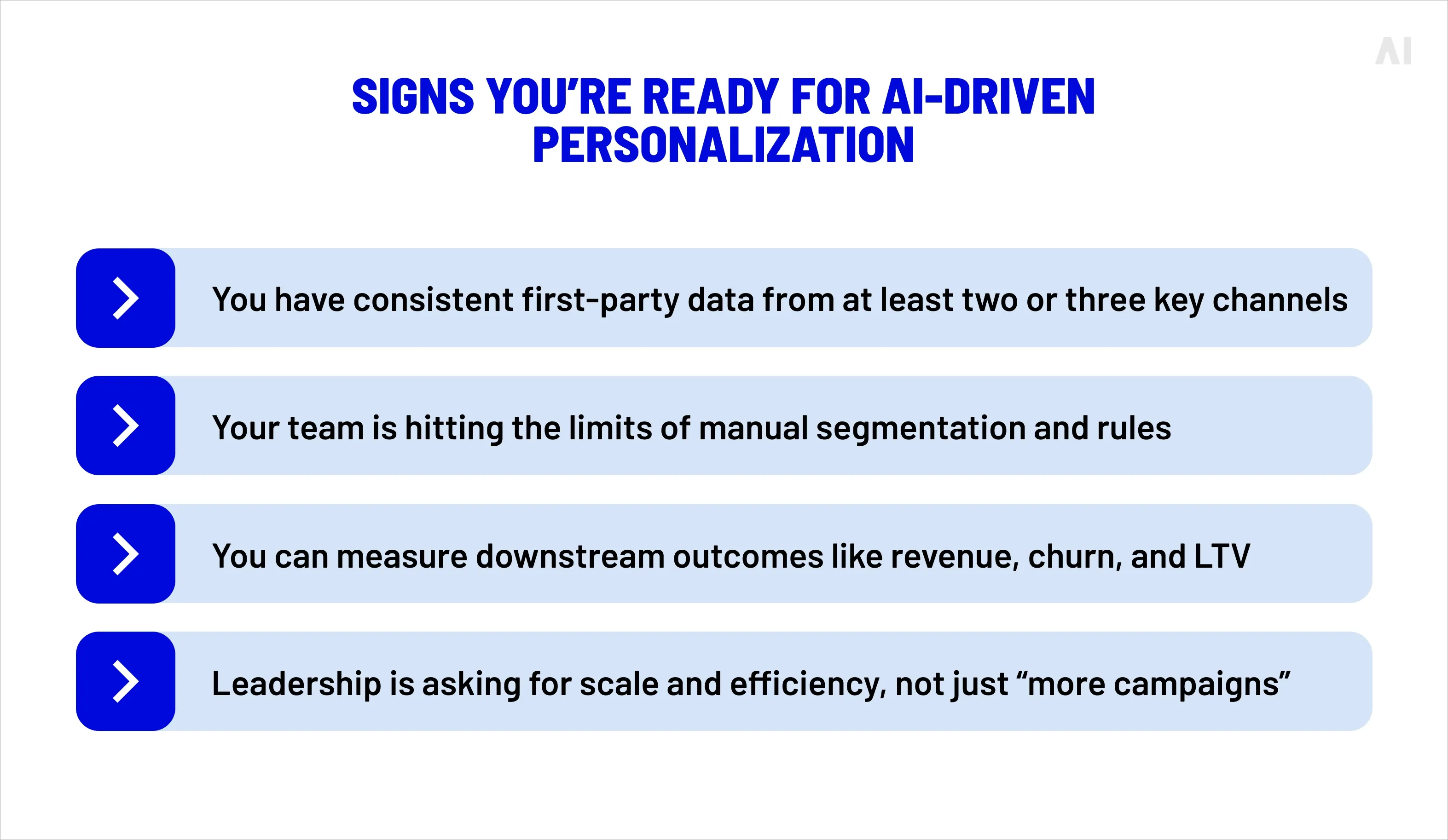
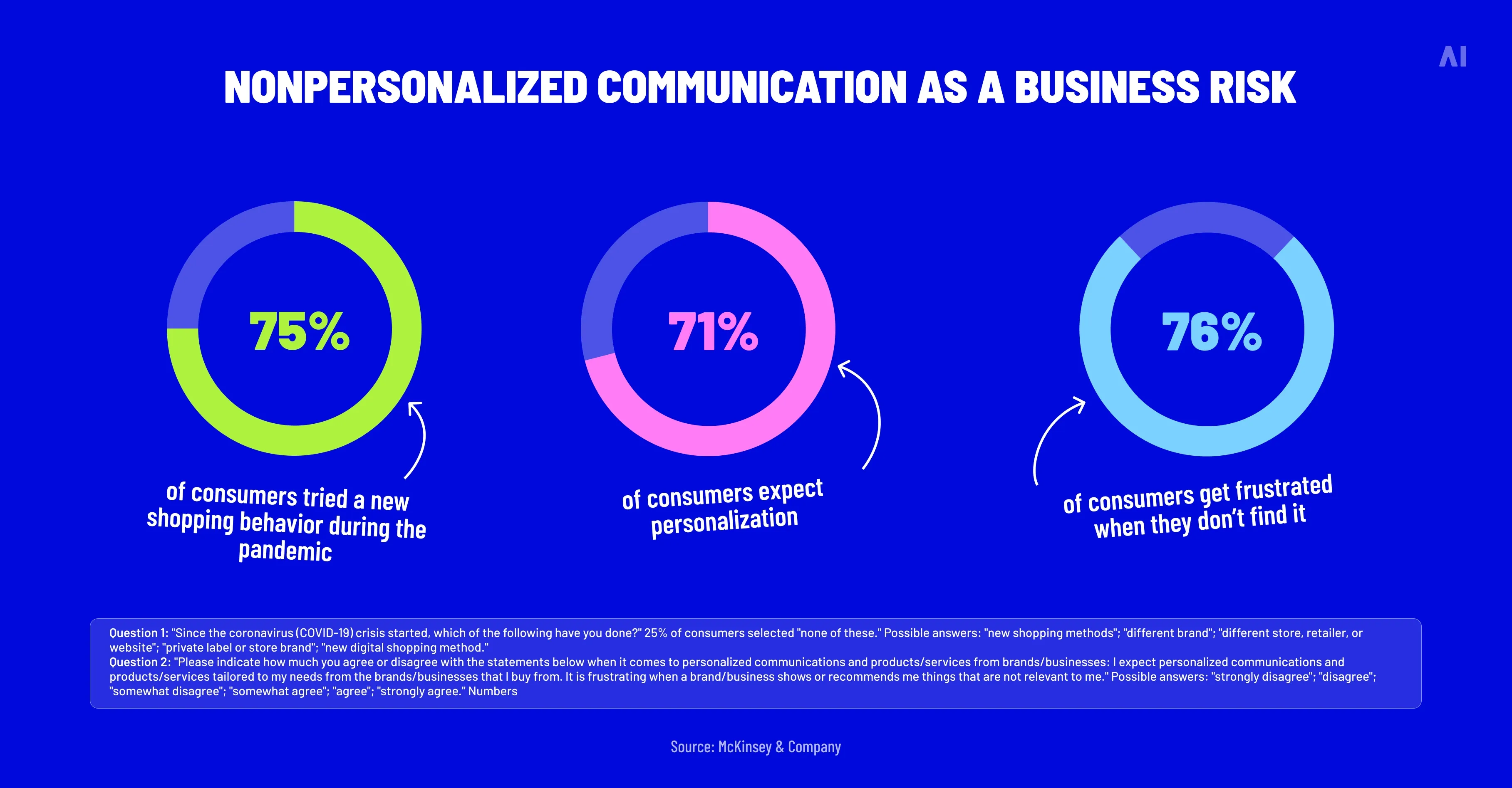
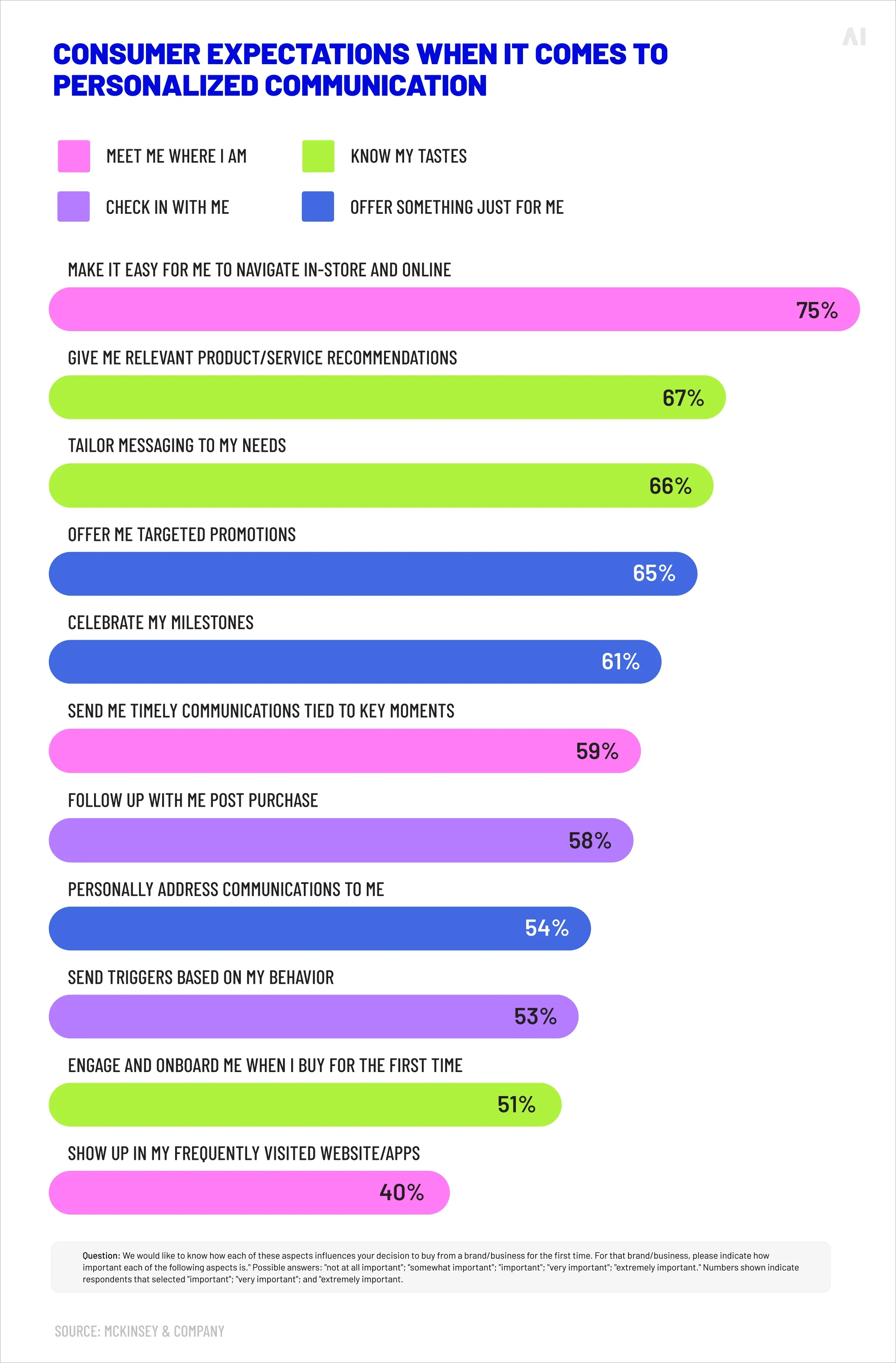
- Customers expect brands to “know” them. Surveys show that around 81% of consumers prefer companies that offer personalized experiences.
- Journeys are fragmented and multi-device. The same buyer can start on TikTok, research on Google, read reviews on a laptop, then purchase through an app or CTV shoppable ad.
- Data is messy and scattered. CRM, web analytics, app events, ad platforms, call centers, and in-store systems rarely line up neatly.
Traditional rule-based personalization can’t keep up. Manually building hundreds of segments and journeys is slow, brittle, and limited to broad assumptions.
AI-driven personalization solves this by using machine learning, predictive models, and real-time decisioning to adapt messages, offers, and experiences for each person continuously. Instead of “segment A sees message B,” the system asks, “Given everything we know about this specific individual right now, what should we show next?”
In the sections that follow, we’ll:
- Define AI-driven personalization and how it differs from legacy tactics
- Walk through the technical workflow, from data inputs to feedback loops
- Break down key features and tools (CDPs, recommendation engines, journey orchestrators, AI-powered advertising platforms)
- Show how different industries—from eCommerce and fintech to telecom, travel, healthcare, media, and B2B SaaS—are using AI-driven personalization today
- Cover the main pitfalls (privacy, bias, over-personalization, tech complexity) and how to avoid them
- Look ahead to 2026+ trends like generative hyper-personalization, autonomous journeys, and CTV/audio personalization
⚡ AI-driven personalization isn’t about guessing what people want; it’s about using real behavior to make every interaction feel more intentional.
What is AI-driven personalization?
AI-driven personalization is the use of machine learning, predictive analytics, and automation to deliver individualized experiences across marketing, product, and service channels. Instead of relying on static rules, AI models continuously learn from behavioral, contextual, and transactional data to decide:
- Who to engage
- What content or offer to show
- Where to show it (channel, device, placement)
- When to deliver it (timing, frequency)
⚡ Think of it as a constantly updated model of each customer, not just a segment label in a CRM.
💡 To see how this connects to broader marketing applications (creative optimization, media buying, search, etc.), it’s worth reading AI Digital’s overview of AI in digital marketing, which describes how machine learning underpins targeting, bidding, content testing, and measurement across the funnel.
How it differs from traditional personalization
Traditional personalization typically means:
- Static segments (e.g., “women 25–34,” “loyalty members,” “cart abandoners”)
- Manually defined rules (e.g., “IF segment = ‘high value’ THEN send VIP email”)
- Periodic updates (monthly/quarterly)
- Limited data sources (email behavior, basic demographics)
AI-driven personalization, by contrast:
- Uses dynamic, behavior-based profiles that update with each event
- Relies on statistical models and algorithms rather than hand-crafted rules
- Operates in or near real time
- Connects many data sources: web/app events, CRM, offline sales, call-center logs, ad exposure, CTV viewing, etc.
- Continuously optimizes through feedback loops instead of one-off campaigns
{{26-AI-driven-Personalization-SEO-1="/tables"}}
⚡ The shift isn’t just from manual to automated. It’s from fixed rules to living systems that adjust to every click, swipe, and purchase.
How AI-driven personalization works
At a high level, AI-driven personalization follows a repeatable pipeline:
- Data collection & unification
- Identity resolution
- Feature engineering & model training
- Real-time prediction & decisioning
- Content assembly & delivery
- Feedback loops & optimization
💡 For paid media, this same logic also runs inside DSPs and ad servers. AI Digital’s article on AI in DSPs explains how machine learning scores impressions, predicts outcomes, and bids accordingly. For a broader look at AI in media planning and optimization, see The future is now: how AI Digital embraces AI technologies to change the programmatic game
Let’s break this pipeline down.
Data inputs for AI models
AI personalization lives or dies on data quality. Typical inputs include:
- First-party behavioral data – This captures how people actually interact with your owned properties in real time:
- Page views, clicks, scroll depth, dwell time
- App events (feature usage, in-app purchases)
- Search queries on-site or in-app
- Transactional data – This reflects the concrete commercial outcomes of those behaviors:
- Orders, returns, subscriptions, renewals
- Basket composition, purchase frequency, average order value
- Zero-party data – This is information customers choose to share directly with you about their preferences:
- Preference centers (size, style, interests)
- Survey responses, quizzes, onboarding flows
- Contextual & device data – This adds situational context around each interaction, so models understand the “where” and “how”:
- Location (at a region or DMA level)
- Time of day, day of week, seasonality
- Device type, OS, browser
- Marketing & media signals – These signals show how a user arrived and which campaigns or creatives influenced them:
- Campaign source, channel, creative ID
- Impression and click data from DSPs/ad servers
- Exposure to CTV/OTT, audio, display, paid social
- Customer support and product data – This reveals satisfaction, friction points, and how deeply customers use your product or service:
- Support tickets, chatbot logs, NPS scores
- Product usage metrics in SaaS (logins, feature adoption)
{{26-AI-driven-Personalization-SEO-2="/tables"}}
In a mature stack, this flows into a Customer Data Platform (CDP) that unifies it into a single profile per person or account.
Real-time decisioning
Once data is in place, models score the likelihood of specific outcomes, such as:
- Conversion or purchase
- Churn or downgrade
- Upsell/expansion
- Engagement with specific content types
- Response to discounts vs non-discounted offers
A decision engine then chooses the best action from a set of options—like “show social proof banner,” “offer free shipping,” “promote higher-tier plan,” or “hold out as a control.”
In programmatic advertising, similar logic decides which impression to bid on, at what price, and with which creative.
💡 AI Digital’s guide to programmatic video advertising shows how real-time bidding and audience signals are evaluated in under 100 milliseconds for each impression.
Feedback loops & model optimization
The secret to AI-powered personalization is the closed-loop learning cycle. Instead of running one-off campaigns, the system is constantly learning from how real people behave:
- Model predicts the best experience: Based on current data and past outcomes, the model scores different options (creative, offer, message, channel, timing) and selects the one with the highest expected impact for that individual.
- System delivers it: The chosen experience is pushed to the user in real time — on-site, in-app, via email, through an ad impression, or inside the product.
- User responds: The user’s behavior becomes the “vote” on that decision: they click, scroll, buy, ignore, bounce, upgrade, or churn. All of these signals count, not just conversions.
- Response is logged as outcome data: The platform records what was shown, to whom, under which conditions, and what happened next. This creates a rich training dataset of context→decision→outcome.
- Models retrain or update with the new results: The model adjusts its parameters — sometimes continuously, sometimes in scheduled retraining cycles—so future decisions reflect what’s working now, not just historical averages.
⚡ The real advantage of AI is the feedback loop: every click, view, and purchase teaches the system how to do better next time.
Over time, this loop:
- Identifies what works for whom: It becomes clear which creative variants, offers, and sequences resonate with specific types of users (e.g., deal seekers vs brand loyalists, heavy users vs light users).
- Discovers micro-segments no human would have created manually: Patterns emerge around behaviors, contexts, and combinations of traits that would be too subtle or complex for manual segmentation—like a small but highly valuable cohort that responds best to a particular message only on mobile, in the evening.
- Helps algorithmic bidding and pacing get smarter: Media and channel algorithms learn where spend truly drives incremental outcomes, not just clicks, and shift budgets toward the most productive audiences, times, and environments while pulling back from low-value impressions.
💡 Platforms like AI Digital’s Elevate unify these signals across channels, using historical data from thousands of campaigns to forecast performance and continuously adjust budget and bids to hit client KPIs — not just clicks.
Key features of AI-driven personalization
Now let’s look at the core capabilities you’ll find in modern AI personalization systems.
Dynamic customer profiles
Instead of static database records, AI-driven personalization uses dynamic profiles that update continuously with:
- Latest behaviors (sessions, events, purchases)
- New predictions (propensity scores, churn risk, next best product)
- Membership in micro-segments that may exist only for hours or days
A dynamic profile might include:
- Lifetime value band
- Current life-cycle stage (prospect, first-time buyer, active, at-risk, dormant)
- Likelihood to buy a category (e.g., “high propensity: running shoes”)
- Sensitivity to discounts
- Preferred channels and devices
These profiles are often maintained inside a CDP or dedicated personalization engine and synced out to email, ad platforms, on-site personalization tools, and product analytics.
Predictive analytics and intent modeling
Here, machine learning personalization models predict what a user is likely to do next, so you can intervene earlier:
- Will this visitor buy in the next 7 days?
- Is this subscriber at high risk of churn?
- What category are they most likely to browse next?
- Are they more likely to respond to a discount, a bundle, or social proof?
Retail-specific research suggests that tailoring experiences based on these kinds of insights can drive 10–15% revenue uplift, especially for companies that excel at real-time personalization.
Recommendation engines
Recommendation engines are probably the most visible AI personalization example:
- “Customers also bought…”
- “Because you watched…”
- “You might like…”
Under the hood, they use techniques like:
- Collaborative filtering (users who liked X also liked Y)
- Content-based filtering (this product is similar to others you liked)
- Hybrid models that combine user behavior, product content, and context
For eCommerce, this might mean dynamic product carousels on the homepage, PDP, cart, and post-purchase pages. For media, it’s the “Up next” queue. For B2B SaaS, it could be a recommended learning path or set of features to adopt.
Automated journey orchestration
Journey orchestration tools use AI to:
- Decide when to trigger communications (abandoned cart, inactivity, repeat purchase windows)
- Adjust frequency based on engagement and fatigue signals
- Move users between journeys (e.g., from onboarding to cross-sell to win-back)
- Sync journeys across channels: email, push, in-app, SMS, paid media
Rather than one static journey per segment, AI can orchestrate millions of micro-journeys that adapt to each person’s real behavior.
Omnichannel personalization
Finally, AI-driven personalization aims to keep experiences consistent as people move between:
- Website & mobile web
- Mobile apps
- Email & SMS
- Social and display ads
- CTV/OTT and digital audio
- Offline touchpoints (in-store, call centers, sales reps)
Research from Salesforce and others suggests that around 73–78% of customers expect companies to understand their needs and provide consistent experiences across departments and channels.
⚡ Dynamic profiles, predictions, and recommendations only matter if they show up where customers actually are—on your site, in your product, in their inbox, and in their media feeds.
{{26-AI-driven-Personalization-SEO-3="/tables"}}
💡 AI Digital’s articles on CTV and addressable media—for example, connected TV advertising and OTT advertising — show how these same personalization principles are expanding from web and apps to the biggest screen in the house.
Benefits of AI-driven personalization
Done well, AI-powered personalization produces a distinct performance step-change rather than a marginal tweak.
Higher engagement and relevance
When messages reflect what people are actually doing—and what they might do next—engagement lifts:
- Higher open and click-through rates
- Longer session times
- More content consumed per visit
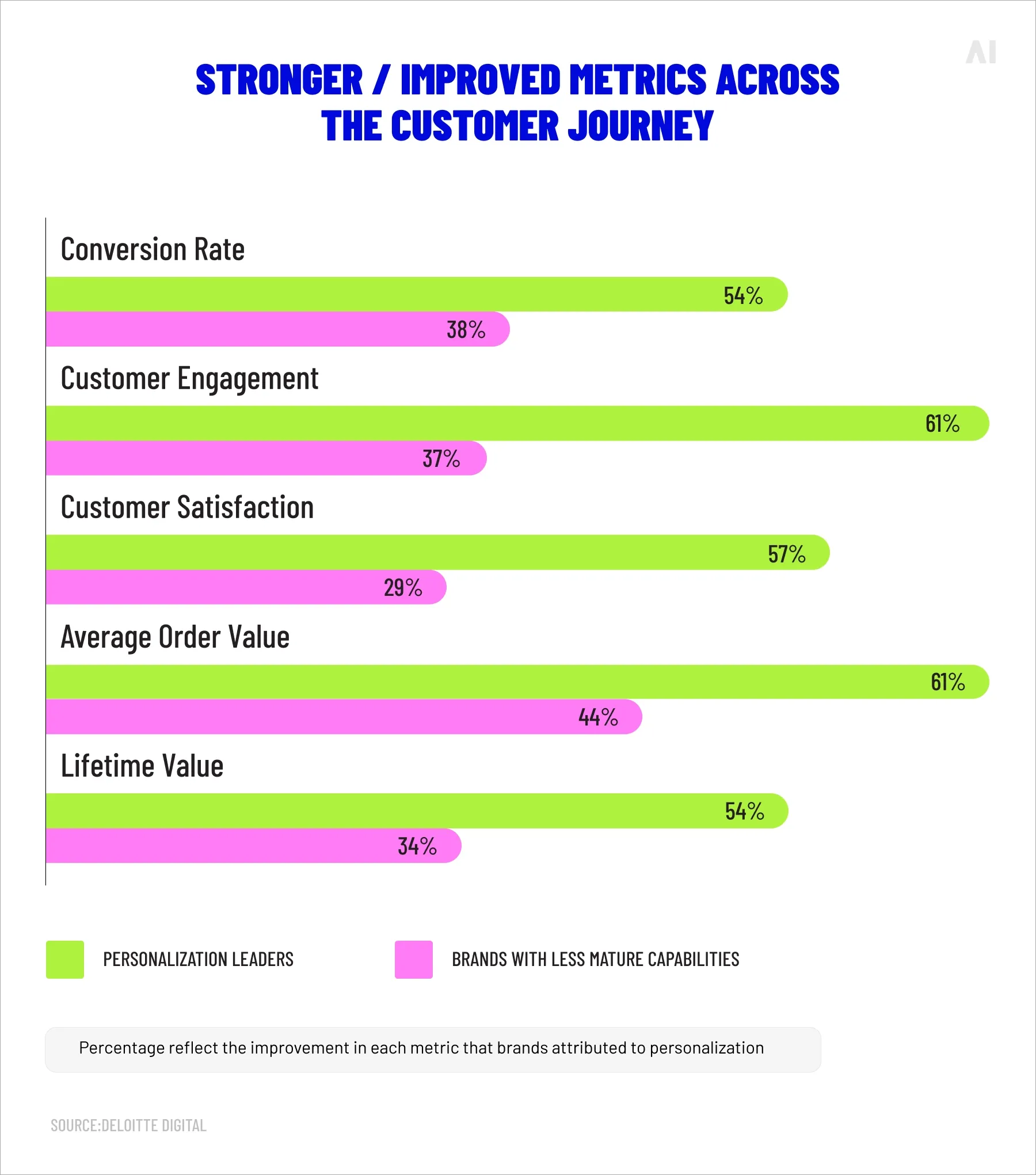
Research from ON24’s Digital Engagement Benchmarks shows that B2B programs using personalization see roughly 2× higher conversion rates for meetings booked, and CTA engagement jumps to 68% vs 8% in non-personalized webinars.
Put simply, AI-driven personalization turns broad outreach into interactions people actually want to spend time with.
💡 If you’re deep in paid media, AI Digital’s article on AI targeted advertising explains how model-driven targeting, bidding, and dynamic creative combine to improve relevance at impression level.
Increased conversions and revenue
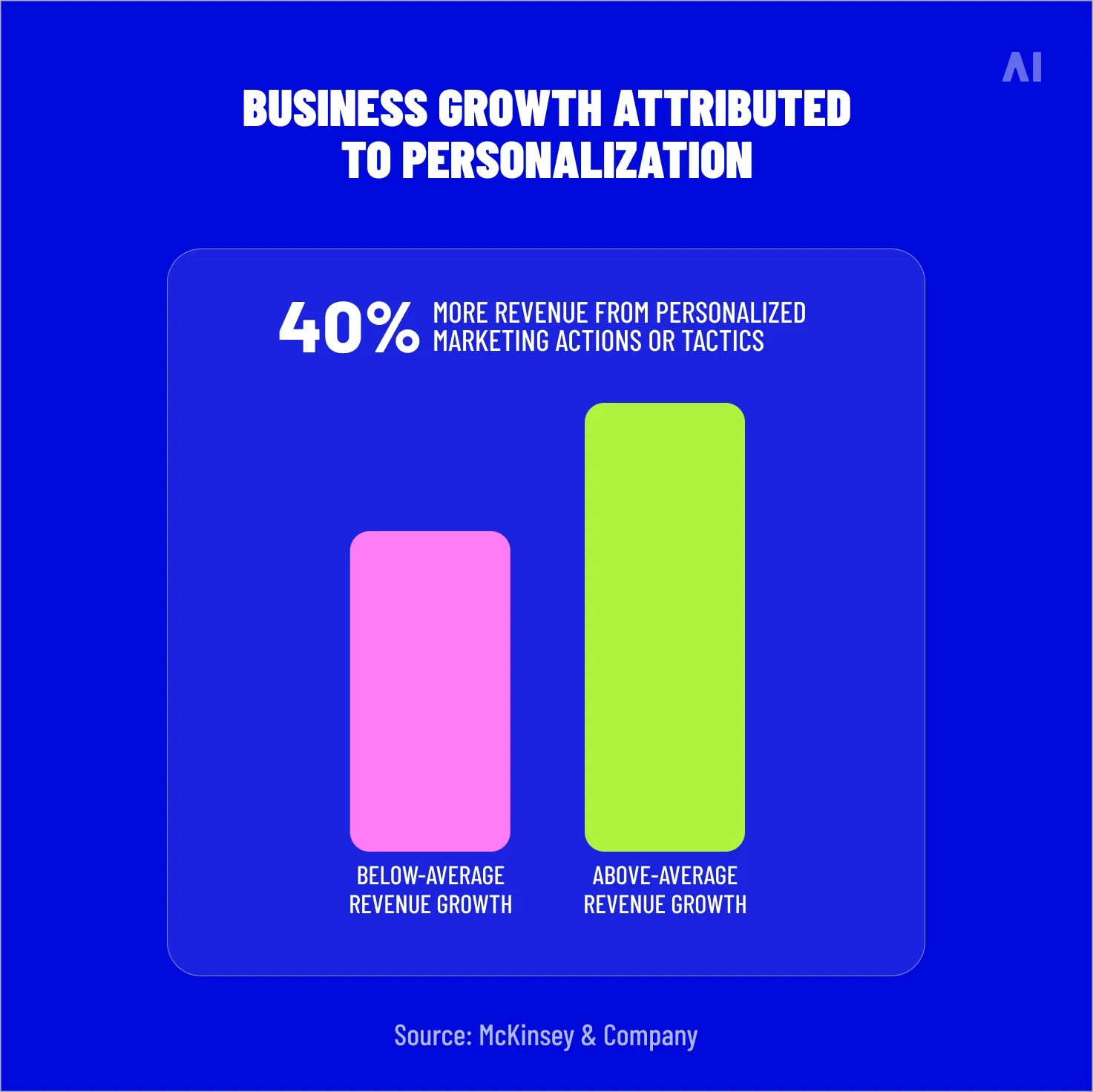
Multiple independent studies conclude that advanced personalization can:
- Increase revenue by 5–15%
- Reduce customer acquisition costs by up to 50%
- Boost marketing ROI by 10–30%
For eCommerce specifically, a range of large-scale studies links AI-driven personalization to measurable revenue and conversion gains:
- Twilio Segment’s State of Personalization data shows that nearly 80% of business leaders see customers spend more when experiences are tailored, with spend rising by up to 34% on average.
- A Boston Consulting Group study, cited by Forbes, reports that retailers using advanced personalization capture 6–10% revenue growth—two to three times faster than competitors.
- And on the ground, Salesforce’s Evergage research and Statista data indicate that roughly 63% of marketers attribute increased conversion rates to personalization, with almost a quarter seeing lifts above 20%.
The result is a compounding lift in both top-line revenue and marketing efficiency that traditional one-size-fits-all tactics rarely achieve.
Better customer satisfaction & retention
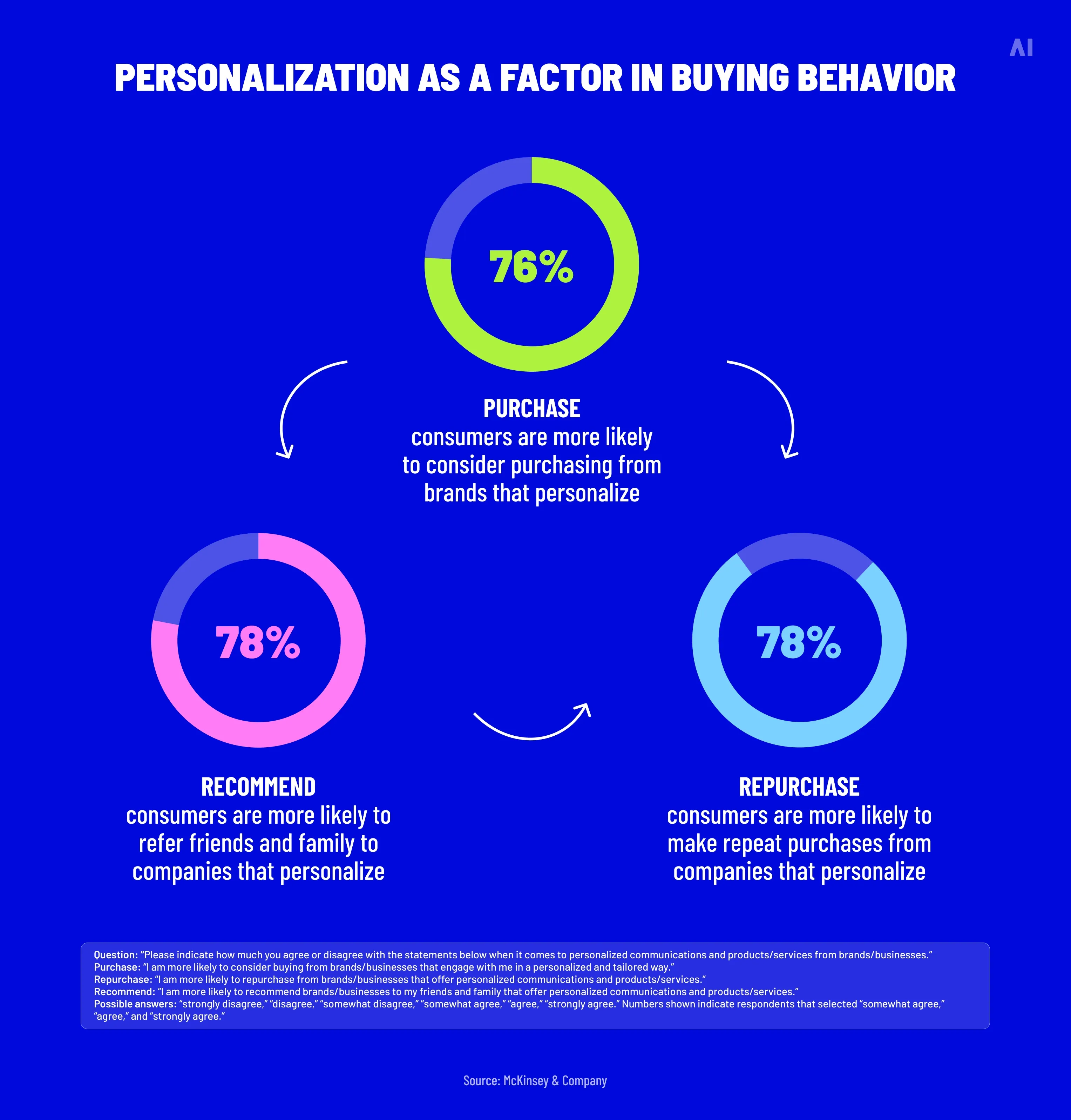
Personalization is no longer just a “nice touch.” It’s often a prerequisite for loyalty:
- Deloitte finds that 80% of consumers prefer brands that offer personalized experiences and say they spend 50% more with those brands;
- Twilio Segment data, summarized by Contentful, shows that 52% of consumers report higher satisfaction as experiences become more personalized.
When personalization is done thoughtfully, customers pay it back in deeper trust, stronger loyalty, and higher lifetime value.
Efficient use of data and automation
AI-driven personalization also frees human teams from manual grunt work:
- Less time building one-off segments and journeys
- Fewer static test matrices to maintain
- More leverage from each data point collected
SAP Emarsys finds that automation saves marketers about 2.3 hours per campaign, while aggregated studies summarized by Firework show teams reclaim more than six hours a week on routine execution and that 74% of marketers say automation helps them save time on repetitive tasks. Gartner also observes that most organizations are in an early “AI as a tool” phase, using AI primarily to reduce manual work and improve internal efficiency.
In practice, AI-driven personalization engines turn that wasted effort into value: less time hand-building one-off segments and journeys, fewer static test matrices to maintain, and more opportunities to squeeze insight out of every data point collected.
💡 AI Digital’s Elevate platform automates both planning and optimization: its AI planning assistant turns historical campaign data into cross-channel plans in about 30 seconds, while the Impact score engine refreshes optimization opportunities every 15 minutes and a custom KPI algorithm continuously reallocates budget toward client-specific goals. That lets marketers focus on strategy, positioning, and creative, while the system handles the heavy lifting on pacing and in-flight tweaks.
Scalability
Because the heavy lifting is algorithmic, personalization scales without linear headcount growth:
- Add new SKUs, content, or offers → models learn and incorporate them
- Launch new markets or channels → core models and pipelines can be reused
- Grow from thousands to millions of profiles → infrastructure, not manual labor, is the main constraint
This is critical for US marketers trying to manage national campaigns with regional nuance, state-level privacy requirements, and diverse audiences across channels like CTV, OTT, and programmatic audio.
⚡ AI doesn’t replace marketers; it multiplies what a small team can achieve with the same budget and time.
{{26-AI-driven-Personalization-SEO-4="/tables"}}
AI personalization tools
There’s no single “AI personalization tool.” Instead, personalization capabilities live across a stack of products that handle data, decisioning, and delivery. The art is choosing a small number of tools that work well together, rather than assembling a bloated collection of overlapping platforms. Here are the main categories and how they fit into an AI-driven personalization strategy.
Customer data platforms (CDPs)
CDPs ingest, unify, and activate customer data so you’re not personalizing on top of fragmented, inconsistent profiles.
They typically:
- Connect online and offline sources
- Resolve identities across devices and channels
- Maintain unified customer profiles
- Expose data to downstream tools via APIs and real-time streams
A mature CDP becomes the source of truth for your audience data. It tells your email platform, your ad stack, your on-site personalization tools, and your analytics tools who a person is and what they’ve done so far.
Modern CDPs are increasingly adding embedded machine learning for propensity scoring, clustering, and audience building, which makes them a logical hub for AI personalization marketing. In many organizations, this is where data teams and marketing teams meet: data engineers set up the pipes, and marketers use the resulting profiles and scores to power campaigns.
Recommendation engines
Recommendation engines are often the most visible part of AI-driven personalization, because customers see them every time they’re told “you might also like” or “because you watched…”.
These can be standalone products (e.g., for retail or content) or modules inside broader platforms. They typically:
- Analyze user behavior across sessions
- Map products or content into relevant clusters
- Serve recommendations via APIs/widgets for web, app, email, and in-ad placements
In CTV, recommendations determine which shows or channels a viewer sees next. In commerce, recommendation systems drive personalized product carousels, bundles, and post-purchase cross-sells. In content and B2B SaaS, they might surface the next guide, webinar, or feature to explore.
The key decision for marketers is where to let recommendations run fully automatically and where to apply guardrails (for example, pinning strategic products or content in key placements while allowing the algorithm to fill in the rest).
Journey orchestration tools
Journey orchestrators focus on sequencing and coordination—what happens first, what happens next, and how that changes when a customer behaves differently than expected.
Typical capabilities include:
- Visual journey builders for marketers
- Event-based triggers and conditions
- AI-powered send-time optimization and channel selection
- Testing support (holdouts, multi-armed bandits)
They’re especially powerful when combined with a CDP, so journeys can react to data from across the ecosystem, not just one channel. For example, a journey could pause email when someone becomes highly engaged in-app, or trigger a CTV retargeting sequence after a key behavior on the website.
As AI models become more capable, these tools shift from static flowcharts to adaptive flows that automatically move people between journeys based on predicted intent and value.
Dynamic creative and content personalization
Dynamic content engines and dynamic creative optimization (DCO) tools sit closer to execution. They focus on which creative combination each person sees.
They typically:
- Store modular creative components (headlines, images, CTAs, offers)
- Use AI rules or models to assemble the best combination for each impression or user
- Learn from performance data to favor top-performing variations
AI Digital’s article on dynamic content personalization explains how marketers can deploy this across web, email, and ads to build individualized experiences without hard-coding every variant. The practical win is that you can keep your brand system intact, but let the machine decide which approved elements to mix and match for each audience or situation.
Over time, the system learns not only which creatives win overall, but which combinations work for specific segments, contexts, or devices—insight that can feed back into your creative strategy.
💡 For a primer on DCP, explore Dynamic content personalization: how brands create smarter customer experiences in 2026
Marketing automation with embedded AI
Most modern marketing automation platforms now include AI features on top of their core orchestration and messaging capabilities. They typically:
- Score leads or users
- Suggest segments or audiences
- Recommend send times and subject lines
- Provide predictive metrics (likelihood to purchase, churn risk, etc.)
For many teams, this is where AI-driven personalization first shows up in daily work—inside tools they already use for email, SMS, and in-app messaging.
The key questions are how explainable and configurable those models are, and whether you can connect them to first-party data rather than relying only on platform-native signals. You want to know why someone is considered “high intent,” not just that a score appeared in a column.
💡 If you want a deeper primer on programmatic advertising, refer to the dedicated piece: Programmatic advertising: What it is, how it works, and why it matters in 2026
AI-powered advertising platforms
On the paid media side, AI-driven personalization shows up throughout the ad stack, especially in programmatic and biddable channels.
Typical capabilities include:
- DSP bidding algorithms and lookalike models
- Contextual and semantic targeting
- Creative optimization in ad servers
- Cross-channel budgeting and pacing
Here, AI is constantly deciding which impressions to bid on, at what price, and with which creative variation. It’s also reallocating budget between audiences, channels, and formats as performance data flows back.
💡 For a deeper dive into evaluating the platforms themselves, AI Digital’s piece on best programmatic advertising platforms is designed as a practical buyer’s guide for 2026 stacks, focusing on how to compare AI capabilities, transparency, and control across vendors.
Taken together, these tool categories form the building blocks of an AI personalization stack. You don’t need every category on day one, but you do need a clear view of which layer handles data, which layer makes decisions, and which layer delivers the experience so the whole system works as one.
⚡ You don’t need the “perfect” stack on day one—you need a few tools that speak the same data language and optimize toward the same KPIs.
Summary: AI personalization tools & examples
To make this more concrete, it helps to break the ecosystem down into a few core categories. Most AI-driven personalization stacks combine several of these tool types, with each one handling a different piece of the data, decisioning, or delivery puzzle.
{{26-AI-driven-Personalization-SEO-5="/tables"}}
In practice, your goal isn’t to buy one of everything, but to choose a small set of tools that work well together and can share data, models, and KPIs so personalization feels consistent to customers rather than stitched together behind the scenes.
Industries leveraging AI personalization in 2026
AI-powered personalization isn’t limited to retail banners or Netflix rows. Let’s look at how different sectors are using it.
⚡ The most effective AI personalization programs borrow ideas across industries: what works in streaming or eCommerce often adapts surprisingly well to SaaS and fintech.
eCommerce and retail
Retail is still the front line of AI ecommerce personalization:
- Product recommendations on home, category, and checkout pages
- Dynamic pricing and promotions based on elasticity and inventory
- Personalized search and merchandising (re-ranking results per user)
- AI-powered chat and virtual stylists
Studies focused on retail report 5–10% average revenue lifts for retailers implementing AI-driven personalization, mainly via higher conversion and basket size.
During Cyber Week 2025, Salesforce data showed that AI agents were responsible for about 17% of online orders across participating retailers, generating roughly $13.5 billion in sales, while Adobe Analytics found shoppers using AI chat services were 38% more likely to purchase than those who didn’t.
Banking and fintech
In US banking and fintech, AI-driven personalization focuses on trust, risk, and financial health:
- Proactive alerts (e.g., Capital One’s Eno) that warn customers about duplicate charges or unusually high bills, delivered via conversational interfaces
- Personalized product recommendations for cards, savings, loans, and investment products based on behavior and goals
- Adaptive security that tightens controls in risky scenarios while keeping normal interactions smooth
Leaders like JPMorgan Chase and Capital One feature prominently in AI banking indexes for pairing modern data infrastructure with personalization, using AI not just for trading and risk but for customer-facing experiences.
Telecom and subscription services
Telecoms and subscription-based utilities use AI personalization to:
- Predict churn and trigger targeted retention offers
- Personalize bundles of services (mobile, broadband, streaming)
- Tailor usage insights dashboards for customers
McKinsey finds that telecom operators using advanced analytics and AI-powered next-best-experience engines can reduce churn significantly—its research cites up to 15% churn reduction from analytics-driven base management and up to 30% lower early-life churn when AI is used to orchestrate proactive, personalized service and marketing interventions.
Travel and hospitality
Travel brands leverage personalization to handle complex, high-consideration journeys:
- Destination and fare recommendations based on past trips, search history, and budget signals
- Dynamic packaging (flight + hotel + experiences) tailored to likely intent
- In-trip personalization, such as upsells for seat upgrades, late checkout, or add-on excursions based on real-time behavior
AI-powered chatbots and concierges help travelers rebook or adjust plans quickly, while models predict who is likely to upgrade or extend their stay, and when.
Recent data shows how much personalization already shapes travel decisions. Skyscanner’s Traveler Insights Survey found that 66% of travelers expect tailored recommendations based on their habits and preferences, a figure highlighted in TravelOperations’ Q1 2025 industry review.
Healthcare and digital health
In regulated sectors like US healthcare and pharma, AI personalization must operate under strict privacy and compliance rules, but use cases are expanding:
- Personalized adherence messaging based on patient behavior
- Next-best-action nudges for chronic disease management apps
- Content personalization to provide condition-specific education
Here, data minimization, anonymization, and explicit consent are crucial; marketers typically work closely with compliance and legal teams to ensure HIPAA and other regulations are respected. Many organizations focus on cohort-level personalization (e.g., by condition or program) to reduce risk.
Large-scale work from McKinsey on digital therapeutics shows that digital disease management programs can reduce major adverse cardiovascular events by around 45% and cut 30-day readmission rates after acute myocardial infarction by roughly 50%, underscoring how targeted, data-driven interventions change outcomes when they’re embedded in the care journey.
Media, streaming, CTV, and audio
Streaming media is almost defined by AI personalization:
- Recommendation engines drive watch-next queues and home rows
- Thumbnail and promo selection varies by viewer
- CTV and OTT campaigns use AI to target households based on viewing habits, demographics, and purchase intent
💡 On the audio side, programmatic platforms and streaming services are starting to deploy AI to personalize podcast and music ad experiences, which we explore further in AI Digital’s dedicated guide to programmatic audio advertising and how it works in 2026.
Analyses of Netflix’s recommendation engine routinely cite that around 80% of viewing time on the platform is driven by personalized recommendations, which also help cut churn and have been estimated to save the company over $1 billion a year in prevented cancellations.
B2B SaaS and enterprise software
B2B SaaS teams use AI-powered personalization to bridge marketing, sales, and product:
- In-product personalization (feature recommendations, onboarding flows, tooltips) based on user behavior and account profile
- Account-based marketing journeys that coordinate ads, email, and sales outreach around buying groups, not just individuals
- Usage-based upsell prompts (e.g., when usage exceeds plan thresholds)
Userlens’ 2025 retention benchmarks show how this plays out in numbers: data-driven onboarding programs can lift first-year retention by about 25%, and products where 70%+ of users regularly adopt key features roughly double their retention likelihood compared with lower-adoption peers.
💡 Leading B2B marketers are layering AI-driven personalization into ABM programs so each target account sees coherent, account-specific narratives across ads, emails, landing pages, and in-product experiences—an approach we describe as “programmatic ABM” in our account-based marketing playbook.
Challenges of AI-driven personalization and how to overcome them
AI-driven personalization is powerful, but it’s not magic. It sits right at the intersection of data, regulation, ethics, and technology, so there are real risks and constraints that marketers have to manage deliberately rather than treat as an afterthought.
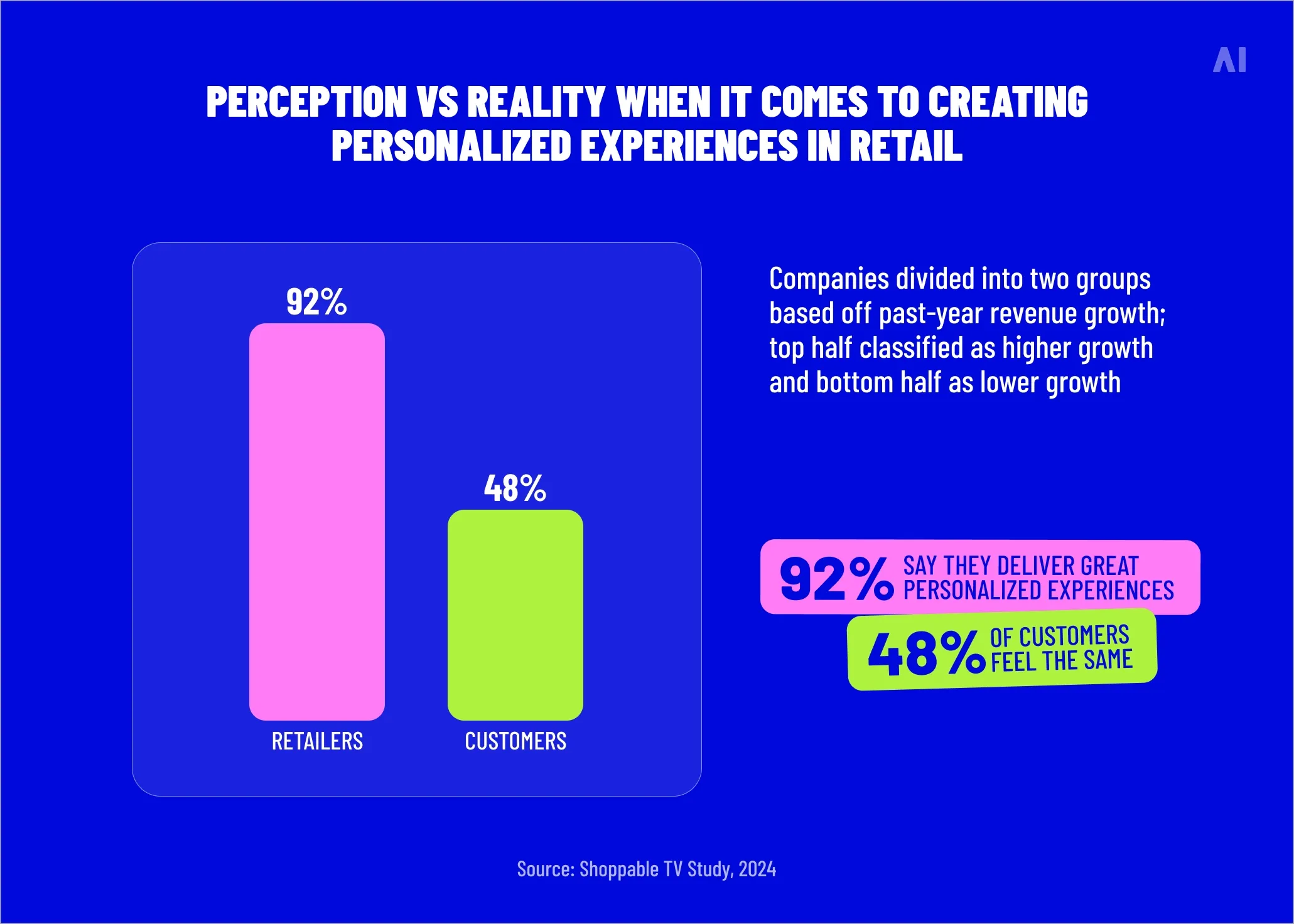
Data privacy & compliance (GDPR, CCPA, CPRA)
Marketers in the US have to balance personalization with evolving privacy laws and rising consumer expectations. The more data you use to tailor experiences, the more scrutiny you invite.
- CCPA/CPRA give California residents the right to know, delete, and opt out of the sale and sharing of personal information, including for cross-context behavioral advertising. This affects everything from retargeting to audience building.
- GDPR (for EU/EEA users) requires a lawful basis (often consent or legitimate interest) and strict controls around purpose limitation, data minimization, and data subject rights. If you have visitors or customers in Europe, your personalization logic is in scope.
Best practices include:
- Prioritizing first-party data strategies, where customers explicitly share information with you through sign-ups, interactions, and preference centers rather than relying heavily on third-party data.
- Providing granular consent options, letting users separately opt in or out of analytics, personalization, and marketing so they can choose what they are genuinely comfortable with.
- Making opt-out and preference management as easy as opt-in, with clear links, simple language, and real-time enforcement so people feel in control rather than trapped.
Handled well, privacy and personalization can reinforce each other: you earn more data because people trust you with it.
Data quality issues
AI personalization is only as good as the data feeding it. Even sophisticated models will deliver poor results if the underlying data is broken.
Common problems include:
- Duplicated profiles that fragment a single person across multiple IDs
- Missing or incorrect events that distort behavior patterns
- Channel silos that never sync, so email, web, app, and ads each see a different version of the truth
- Latency that makes “real-time” personalization feel like it’s reacting to yesterday’s actions
Mitigation tactics:
- Invest in data governance and ownership: define a clear data model, maintain a source-of-truth schema, and agree contracts between teams about how data is created and maintained.
- Use CDP features like identity resolution and deduplication to collapse multiple identifiers into a single customer profile that all channels can trust.
- Monitor data freshness and coverage as seriously as you monitor campaign metrics; build alerts for broken event streams, missing fields, or major shifts in volume.
The goal is not perfect data, but reliable, well-understood data that models and marketers can depend on.
Model bias and fairness
Models trained on historical data can easily encode unwanted patterns. If your past campaigns underserved certain groups or regions, your AI may quietly continue that behavior.
Typical failure modes:
- Over-targeting specific demographic groups with certain offers or creative, which can reinforce stereotypes or create regulatory risk.
- Under-representing segments who historically haven’t converted, even if they might respond to different messaging, channels, or experiences.
Marketers should:
- Work with data science and compliance to define acceptable uses, guardrails, and “red lines” where models are not allowed to make decisions.
- Use fairness audits and scenario testing for sensitive use cases (credit, employment, housing, healthcare, education, and other regulated categories) to check how different groups are treated.
- Maintain human review for high-impact decisions, especially where AI recommendations may affect access to essential services or have long-term consequences.
Performance gains are valuable, but they need to sit within a clearly defined ethical and legal framework.
Over-personalization (“creepy factor”)
Not every signal needs to be used just because it exists. Personalization crosses into “creepy” territory when it feels like surveillance rather than service.
Customers can feel uncomfortable if:
- Messaging reveals more about what you know than they realized (for example, referencing a very specific behavior or sensitive topic)
- Retargeting follows them too aggressively across channels, especially for high-intent or sensitive purchases
- Sensitive inferences are made explicit, such as health status, financial distress, or political leanings
Gartner has warned that nearly half of personalized communications are perceived as irrelevant or intrusive, which means more personalization does not automatically equal better experiences.
Practical steps:
- Personalize based on observable behavior, not inferred sensitive traits, and avoid targeting on categories that could feel discriminatory or invasive.
- Use frequency caps and cool-downs so people are not overwhelmed by repeated messages and ads.
- Frame personalization as helpful, not invasive: “We saved your cart” or “Here are similar items to what you browsed” feels useful; “We saw you looking at debt relief” does not.
If customers feel respected, they are far more likely to stay opted in and keep sharing the data that powers your models.
⚡ If you ignore privacy, data quality, and fairness, AI will happily optimize its way into trouble on your behalf.
Tech stack complexity
Finally, tech sprawl can quietly kill even the best personalization strategy. When too many tools overlap or don’t talk to each other properly, teams end up spending more time wrestling the stack than improving the experience.
Typical problems:
- Multiple overlapping tools (CDP, ESP, analytics, ad tech, on-site personalization, testing platforms) with unclear roles
- Custom integrations that break whenever any vendor updates their API or data format
- Inconsistent IDs and business logic across platforms, which leads to conflicting numbers and mistrust of the data
Here, the goal is an integrated personalization architecture, not just more tools. You want a clear view of which layer owns identity, which layer runs models and decisions, and which layer delivers experiences.
AI Digital’s Elevate platform, for example, is built as a central intelligence layer that sits above DSPs and channels, bringing data together, standardizing KPIs and optimization logic, and reducing the number of places where teams have to manually reconcile performance. That kind of consolidation makes AI-powered personalization more reliable and much easier to operate at scale.
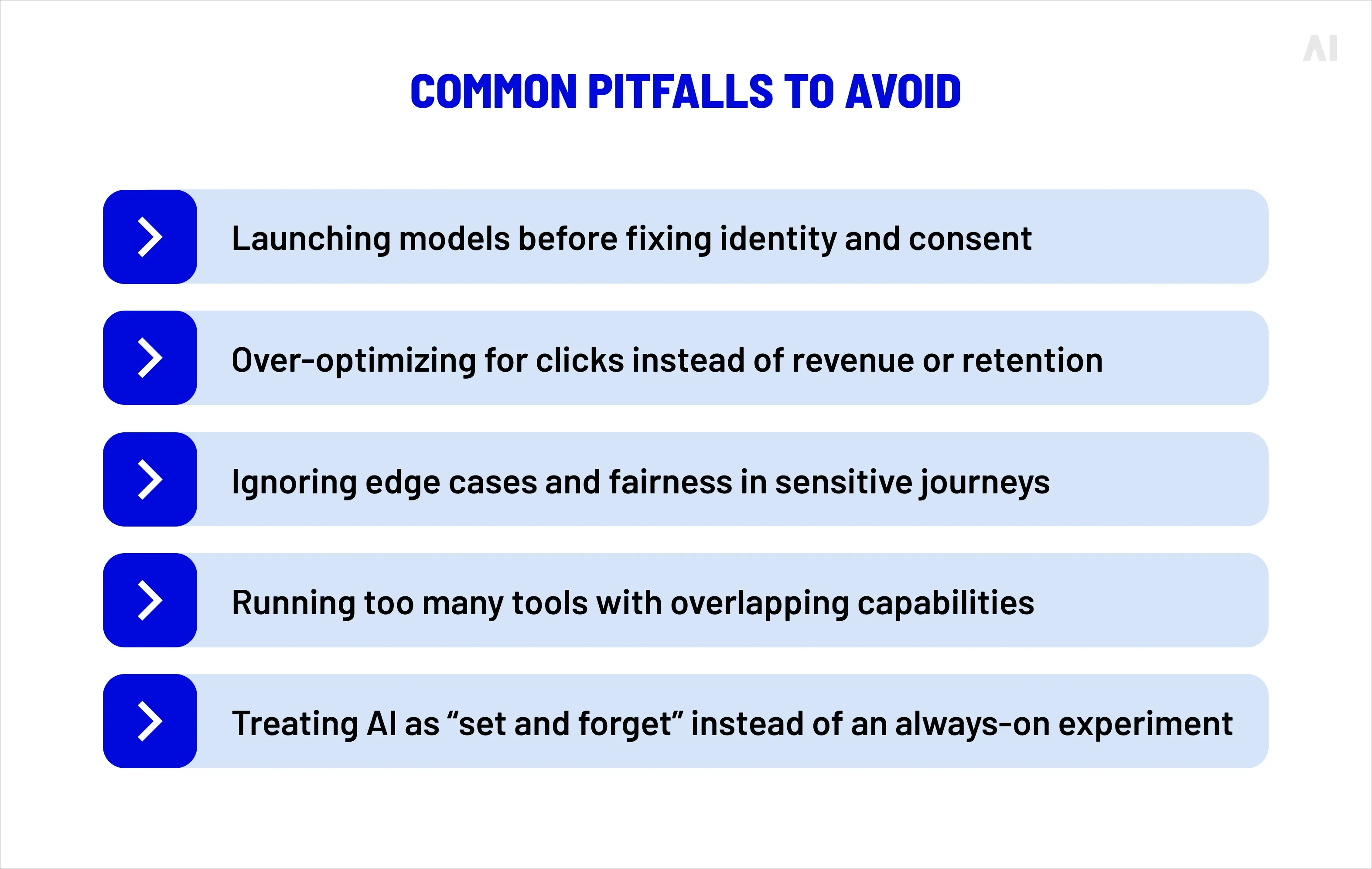
Taken together, these challenges aren’t reasons to avoid AI-driven personalization; they are the checklist for doing it responsibly. Teams that confront them head-on tend to move faster and unlock more value because they’re not constantly fighting fires in the background.
Best practices for implementing AI personalization
How do you move from theory to practice without getting lost in complexity? The teams that succeed treat AI personalization as a structured program, not a one-off feature. These principles help keep efforts focused and sustainable.
Start with unified customer data (CDP)
Avoid jumping straight into complex models. If the underlying data is fragmented, even the best algorithms will struggle.
Start by:
- Consolidating key data sources into a CDP or equivalent: Bring together CRM, web and app analytics, transaction data, support systems, and media platforms so you can see a coherent picture of each customer or account.
- Defining a golden customer profile: Decide which fields really matter (for example, lifecycle stage, last purchase date, key behaviors, consent status) and make sure they are consistently populated and well documented.
- Getting reliable identity resolution and consent management in place: Make sure identities are stitched correctly across devices and channels, and that you can respect user choices about tracking and personalization in every downstream system.
This foundation makes every downstream AI personalization tool more effective. It also creates a shared language between marketing, product, and data teams, which matters just as much as the technology.
Define the right KPIs (engagement, retention, revenue)
You get what you optimize for. If you only optimize for clicks, you will get clickbait. If you optimize for long-term value, your AI will learn to favor experiences that build durable relationships.
Define tiered KPIs so models and teams both know what “good” looks like:
- Primary outcomes: revenue, margin, lifetime value, churn, subscription renewals
- Leading indicators: add-to-cart rate, trial activation, feature adoption, repeat visits
- Experience metrics: satisfaction scores, NPS, complaint rates, support contact volume
This structure lets you experiment with aggressive personalization in some areas while making sure it does not hurt satisfaction or retention elsewhere.
💡 AI Digital’s content on digital marketing KPIs is designed to help teams map AI personalization tactics directly to business outcomes rather than proxy metrics, so AI is pushing in the same direction as finance and leadership, not working off its own scoreboard.
Test, iterate, and run A/B experiments
AI personalization is not “set and forget.” Models will drift, audiences will change, and channels will evolve. You still need a disciplined experimentation culture on top.
Key ingredients:
- Control groups to measure incremental lift: Always keep a slice of traffic or audience on a simpler experience so you can see what the AI is adding.
- A/B or multivariate tests to evaluate new models and strategies: Treat changes to bidding logic, scoring algorithms, or journey rules as experiments to be tested, not toggles to flip and hope for the best.
- Holdouts where personalization is intentionally suppressed: Use long-running holdouts to validate that your personalization strategy continues to outperform more generic approaches over time.
⚡ The most powerful personalization systems are the ones that treat every campaign as an ongoing experiment, not a finished product.
This approach keeps you learning continuously and prevents “black box” models from drifting away from what the business actually needs.
Balance automation with human oversight
AI should propose; humans should dispose. Automation is there to scale decisions, not to replace judgment.
Keep people:
- Setting strategy and constraints: Humans decide budgets, target customers, brand safety rules, and what is off-limits for models.
- Curating creative and messaging frameworks: AI can mix and match elements, but brand voice, positioning, and core narratives still need human ownership.
- Interpreting ambiguous results and identifying outliers: When performance moves in unexpected ways, humans investigate, dig into context, and adjust course.
AI Digital’s Open Garden philosophy is built around this balance: AI handles the volume and speed of decisions across platforms, while human teams stay in control of where and why spend moves, and how personalization aligns with brand and business strategy.
Ensure transparency and ethical use of AI
Finally, even the most effective AI-driven personalization can create risk if it feels opaque or manipulative. Transparency and ethics are not “nice to have” extras; they are part of the product.
Make sure you:
- Are transparent in your privacy notices about how personalization works, which data you use, and why it benefits users. Plain language beats legalese here.
- Offer easy controls such as preference centers, email and ad opt-outs, and simple ways to turn recommendations up or down.
- Document model use cases, limitations, and monitoring processes so you can explain how decisions are made and respond quickly if something goes wrong.
Regulators like the FTC have been explicit about their interest in AI, dark patterns, and manipulative design, and enforcement is increasing. Clear, user-first personalization strategies are both an ethical and legal necessity—and they tend to perform better over time because customers trust them.
If you treat these best practices as a checklist rather than theory, you get a roadmap: unify data, align on KPIs, run structured experiments, keep humans in the loop, and build trust through transparency. The technology can then do what it does best—scale the pieces that are already working.
Future trends in AI-driven personalization (2026 and beyond)
Looking ahead, several trends are reshaping how AI personalization will work over the next few years—not just in what gets personalized, but in how automated systems decide, test, and learn.
Hyper-personalization powered by generative AI
Generative AI is moving from experimentation to production use:
- Auto-generating copy, images, and layouts tailored to an individual’s context
- Personalizing entire landing pages or app views on the fly
- Synthesizing personalized video or audio content for key segments
We’re already seeing the investment ramp up. A 2024 market study valued the global hyper-personalization market at about $21.2 billion, with projections to reach nearly $68 billion by 2031 at an estimated 18%+ CAGR, driven largely by AI and real-time analytics adoption across industries such as retail, banking, and healthcare.
As mentioned previously, McKinsey (as cited by IBM) links advanced personalization to higher revenue and marketing ROI, which explains why brands are now pushing toward one-to-one, generative experiences rather than just segment-level targeting.
Taken together, these signals suggest that by 2026, hyper-personalization will be less of an experiment and more of a default expectation in mature CX programs, especially where the business case has already been proven.
Predictive journeys that redesign themselves
Instead of fixed flows, we’ll see agentic AI systems that:
- Monitor user behavior in real time
- Re-sequence touchpoints for each person (for example, education before a discount)
- Shift channel mix automatically based on response (for example, from email to paid social to CTV)
These systems treat a journey like a living strategy, not a static diagram. Academic work on predictive customer journey intelligence shows how combining LLMs, semantic retrieval, and zero-trust governance can move from simple probability estimates to adaptive journey models that optimize click-through and conversion rates in live A/B tests.
On the commercial side, BCG estimates that retailers who fully apply data-driven personalization across journeys can unlock hundreds of billions in incremental growth, underlining why predictive, self-adjusting journeys are a core part of next-generation personalization roadmaps rather than a nice-to-have experiment.
💡 AI Digital’s Elevate already hints at this in media planning: its AI planning assistant and predictive planning engine use historical data from over a hundred campaign datasets to recommend cross-channel plans in seconds, while Elevate Optimization’s Impact score and custom KPI algorithm continuously refine live campaigns based on real-time performance. Predictive journeys simply extend that logic beyond media to every touchpoint in the customer experience.
Conversational personalization via chatbots
Conversational interfaces—text and voice—are becoming personalization hubs:
- AI assistants embedded in apps, websites, and messaging
- Dynamic FAQs and troubleshooting flows based on user history
- Proactive outreach (“We noticed you might be interested in…”)
The user appetite is already there. Zendesk reports that 51% of consumers prefer interacting with bots when they want immediate service, and 56% of customers believe bots will soon be able to have natural conversations.
Broader chatbot research finds that around 82% of respondents would talk to a chatbot rather than wait for a human agent, and roughly 60% say chatbots already influence their purchase decisions, which shows how conversational touchpoints are shifting from pure support to sales and guidance roles.
As capabilities combine with richer first-party data, expect chat-based journeys to become some of the most personalized experiences customers have with a brand.
Cross-channel orchestration with autonomous agents
Agentic AI systems will increasingly:
- Manage budget allocation in real time across channels
- Spin up micro-campaigns for emerging cohorts or signals
- Coordinate creative testing and message sequencing end-to-end
Demand for this kind of orchestration is visible in customer expectations. Salesforce’s State of Service research (summarized by Kayako) reports that 73% of customers expect to start on one channel and finish on another without repeating themselves, yet only about one-third of companies offer fully integrated omnichannel support.
At the same time, cross-channel fragmentation is one of marketers’ top frustrations. Mediaocean’s 2025 H2 CTV Market Report notes that more than half of marketers cite limited cross-channel visibility and fragmented measurement as major pain points, especially in CTV.
💡 AI Digital’s Open Garden approach and the Elevate platform are early examples of how to solve this—with a neutral intelligence layer that sits above DSPs, SSPs, and walled gardens, harmonizing KPIs and optimization logic while agents handle much of the tactical decision-making.
Real-time personalization in CTV & audio ads
Finally, expect more real-time personalization in CTV and audio:
- Dynamic creative that adapts based on household context, viewing behavior, or inferred interests
- Frequency and sequencing controlled at person or household level across devices
- Audio ads that adjust scripts and offers based on known preferences and real-time behavior
CTV investment is moving in this direction. In Mediaocean’s 2025 H2 report, 58% of marketers expect to increase CTV spend, more than any other channel surveyed, and the same research finds that dynamic ad personalization is the top-cited driver of CTV’s full-funnel performance potential.
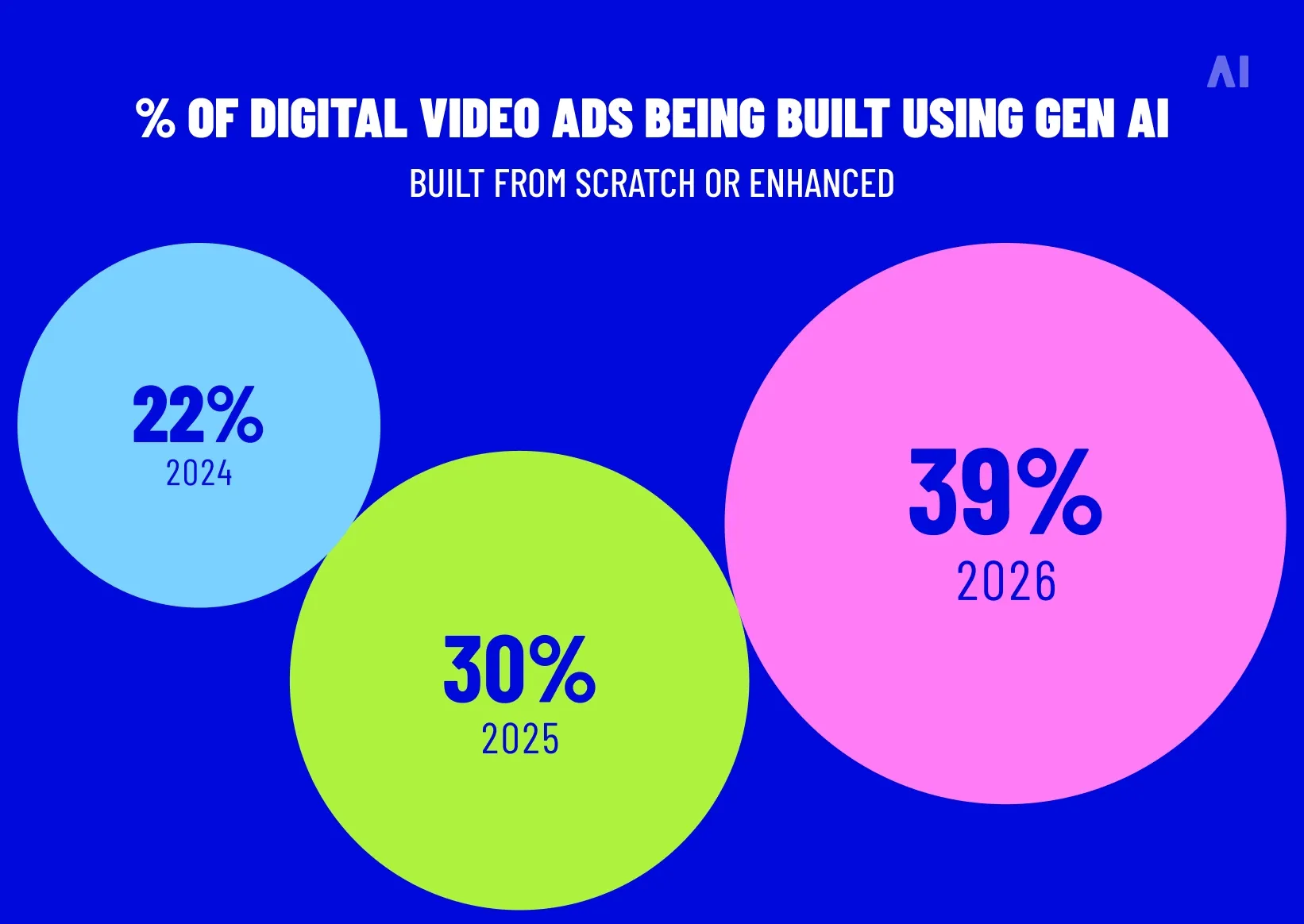
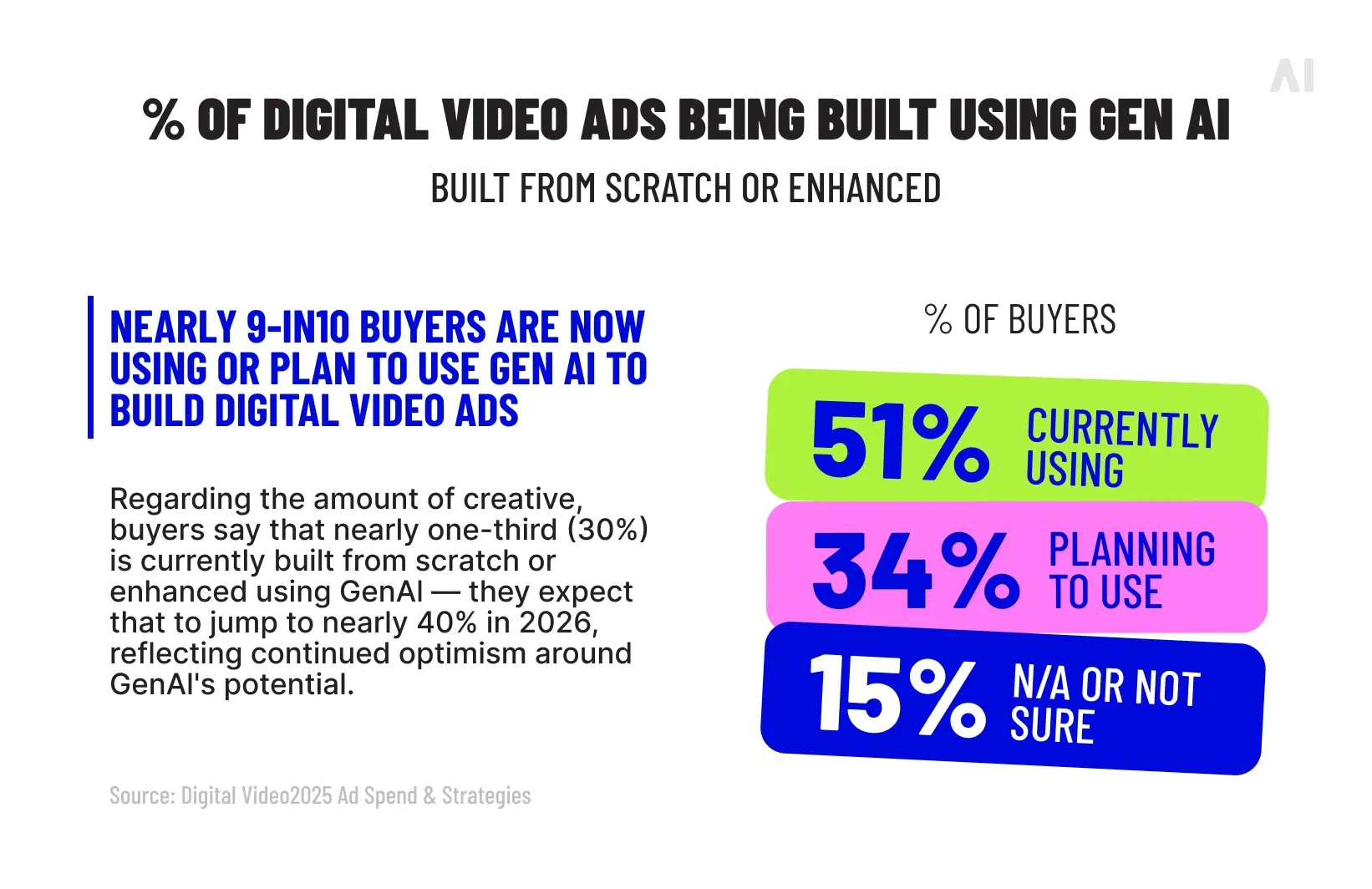
On the creative side, IAB’s 2025 Digital Video Ad Spend & Strategy work shows that 51% of ad buyers are already using generative AI for digital video ad creation, and about 30% of digital video ads are being built with genAI today, with buyers expecting that figure to approach 40% by 2026; over 40% of those buyers say they use genAI specifically to create different versions of video ads for different audiences.
In audio, AdsWizz’s State of Audio Adtech 2025 report notes that contextual targeting now accounts for around 60% of targeting dimensions on its platform, and brands adopting personalization have increased budgets for these tactics by nearly 30% year over year as they see stronger resonance and recall from contextually and behaviorally tailored ads.
💡 AI Digital’s guide to programmatic audio advertising and how it works in 2026, together with the CTV and OTT resources mentioned previously, digs into how these tools are being used in practice—from localized, time-of-day targeting to mood- and genre-based personalization that evolves with each impression.
⚡ In 2026, the real differentiator won’t be whether you use AI—it will be how clearly you can explain what it’s doing and what business problem it solves.
Conclusion: Why AI-driven personalization is now a competitive necessity
AI-powered personalization has shifted from a nice differentiator to table stakes for modern marketers:
- Customers expect brands to recognize them and respond to their context, not blast the same message to everyone.
- The number of channels and touchpoints keeps expanding, from web and apps to CTV, audio, and in-product experiences.
- Privacy rules demand thoughtful, first-party data strategies and make “spray and pray” targeting increasingly risky and expensive.
If you’re building an artificial intelligence personalization roadmap for 2026, a few principles matter more than any single tool:
- Start with unified, privacy-compliant first-party data. A solid CDP or equivalent foundation makes every AI initiative more effective and easier to govern.
- Use predictive models to surface intent early. Churn risk, purchase propensity, and product interest scores should steer your journeys, not just last-click behavior.
- Automate key journeys and creative decisions. Let AI personalize content, offers, and timing at scale while your team focuses on strategy, narrative, and creative big ideas.
- Test continuously. Run A/B tests, keep control groups, and monitor long-term metrics so you can prove incremental impact rather than relying on model promises.
- Keep ethics and transparency central. Respect consent, avoid dark patterns, and explain how personalization works and why it benefits customers. That’s how you keep trust while you scale automation.
For teams who want AI-powered personalization with transparent, KPI-led decisioning, AI Digital’s Elevate platform acts as an intelligence layer across planning, optimization, and measurement—helping marketers design personalization strategies that are measurable, accountable, and aligned to real business outcomes.
If you’re exploring how to upgrade your personalization engine, send us a message—whether that’s to pressure-test your roadmap, see Elevate in action, or map how AI-driven personalization could plug into your existing stack.