AI is moving marketing forward quickly, but it also comes with higher expectations for accuracy, efficiency, automation, and results. As this space evolves, it’s important to know exactly where the compliance boundaries lie.
That’s why we partnered with GetGenAI — a platform that automatically reviews marketing content against regulatory, platform, and brand rules before it goes live, helping companies catch issues early and avoid last-minute rewrites or legal blocks. In this post, we break down the dos and don'ts of AI marketing content: what you can confidently say, what requires qualifications, and where brands often unintentionally cross regulatory lines.
DOs — responsible content about AI
Communicating AI's potential doesn't mean exaggerating its capabilities. The most effective messaging combines impact with precision. Teams can showcase AI's value by describing how the technology functions rather than making sweeping guarantees. Here are the core principles for responsible AI communication that keeps you compliant:
- Lead with specificity over absolutes: Describe what your tool is built to do rather than promising guaranteed outcomes.
- Ground performance claims in evidence: Back up results with clear methodology, identified data sources, defined timeframes, or industry benchmarks.
- Acknowledge that results vary: Include context like "outcomes depend on use case, industry vertical, data quality, or implementation approach."
- Focus on the 'how' not just the 'what': Explain the mechanisms at work ("our predictive models identify patterns in X to inform Y…") instead of vague promises.
- Keep humans in the picture: Position AI as a tool that augments human decision-making, not one that eliminates the need for human judgment.
- Embrace transparency: Share both strengths and constraints, including what inputs are required and what dependencies exist.
- Choose measured, verifiable language: Opt for phrases like "built to enhance," "informed by data," or "supports better decisions when used alongside…"
- Set realistic customer expectations: Clarify whether your AI provides recommendations for human review or executes actions autonomously.
DON'Ts — risky content about AI
Understanding what to avoid is equally critical. Many AI marketing missteps happen unintentionally—teams don't realize their language has crossed into territory that raises red flags. These guidelines help you spot and avoid the most common compliance pitfalls:
- Steer clear of ROI guarantees: Linking AI directly to business results without solid evidence creates regulatory exposure.
- Resist overstating capability — language suggesting your AI never makes errors or operates with complete autonomy can breach advertising standards.
- Don't position AI as a replacement for oversight — claims that your solution removes the need for legal, regulatory, or human review are rejected by regulators.
- Avoid blanket applicability statements — phrases like "effective for any business," "works across all sectors," or "succeeds in every campaign" are high-risk territory.
- Drop the hyperbole — terms like "instantaneous perfection," "superhuman performance," or "100% accuracy" can violate truth-in-advertising requirements.
- Be upfront about dependencies — if your AI's effectiveness relies on data quality, user expertise, proper configuration, or specific conditions, state that clearly.
- Maintain accountability in your messaging — avoid implying that AI adoption means teams can skip due diligence, compliance checks, or strategic oversight.
Putting it into practice: testing our own content
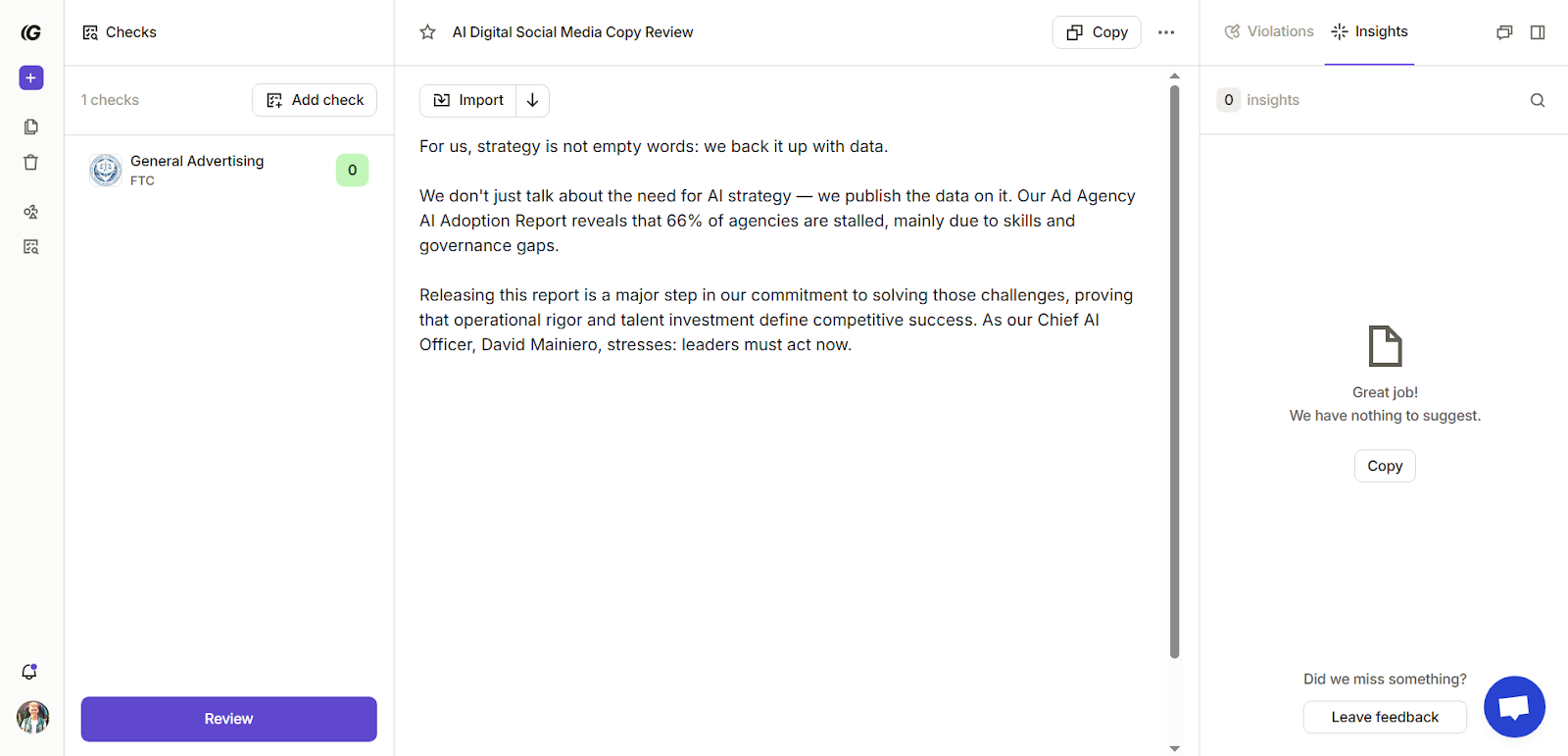
We ran one of our recent posts through GetGenAI to see how our messaging held up against FTC standards for truthfulness, substantiation, and transparency. Here's what we tested:
Our original copy
For us, strategy is not empty words: we back it up with data.
We don't just talk about the need for AI strategy — we publish the data on it. Our Ad Agency AI Adoption Report reveals that 66% of agencies are stalled, mainly due to skills and governance gaps.
Releasing this report is a major step in our commitment to solving those challenges, proving that operational rigor and talent investment define competitive success. As our Chief AI Officer, David Mainiero, stresses: leaders must act now.
GetGenAI's verdict
Great job! We have nothing to suggest.
GetGenAI flagged zero issues in the copy. Why? Because we followed the principles above: we cited specific data from our own research, made clear claims about what the data shows, and avoided overpromising what AI can do.
💭 Compliance isn't about weakening your message—it's about making it credible.
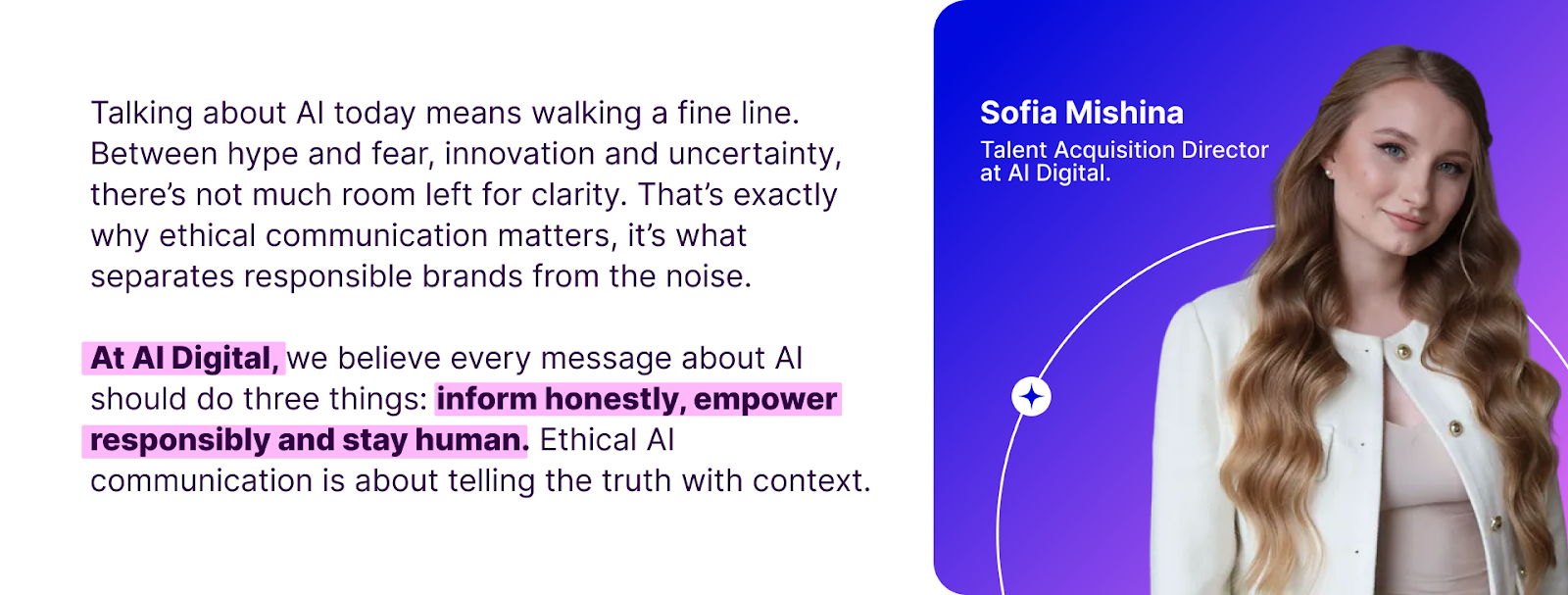
“Talking about AI today means walking a fine line. Between hype and fear, innovation and uncertainty, there’s not much room left for clarity. That’s exactly why ethical communication matters, it’s what separates responsible brands from the noise.
At AI Digital, we believe every message about AI should do three things: inform honestly, empower responsibly and stay human. Ethical AI communication is about telling the truth with context.” – Sofia Mishina, Talent Acquisition Director at AI Digital.
Why ethical AI communication matters
"We've entered a moment where every company feels compelled to tell an AI story. That's natural — the technology is transformative, and teams want to show progress. But with this momentum comes a responsibility to describe AI in a way that's honest, nuanced, and aligned with regulatory expectations.
Today, AI messaging is scrutinized not only for what it promises but for what it implies. Even well-intentioned claims can create risk when they sound absolute or oversimplified. Clear qualifiers and transparent context are no longer 'nice to have' — they're essential.
Hype may grab attention, but compliance builds trust. And the companies that earn trust will ultimately shape how AI is adopted across industries."
— Anastasia Sartan, CEO and Co-Founder of GetGenAI
What this partnership means for agencies
Our collaboration with GetGenAI gives us—and our clients—an additional layer of confidence when communicating about AI capabilities. In an industry where overpromising is tempting but costly, having tools that help verify compliance before content goes live is invaluable.
The reality is simple: the agencies and brands that will thrive in the AI era aren't the ones making the biggest claims. They're the ones making the most credible ones.
💡 Want to test your AI content for compliance? Learn more about GetGenAI at getgen.ai