What Is Programmatic Audio Advertising and How It Works in 2026

.webp)
Programmatic audio advertising applies the rigor of modern ad tech to sound. Instead of manual buys and broad estimates, you plan and activate through demand-side platforms, access premium streaming and podcast inventory, and make real-time decisions about who to reach, when to deliver, and what creative to play. Dynamic ad insertion handles delivery at playback, while first-party and contextual signals guide targeting that respects privacy and relevance.
For marketers, the payoff is practical: de-duplicated reach across devices, frequency you can actually control, and reporting that ties listens to outcomes. Audio is also an efficient companion to video and CTV—filling screenless moments during commutes, workouts, and chores—so it earns a stable place in an omnichannel plan.
This article breaks down how programmatic audio works, which formats to use, how to measure success, and where AI-driven optimization and dynamic creative add the most value. You’ll also find a candid review of challenges (measurement, visuals, privacy) with concrete fixes, plus a step-by-step playbook to run campaigns that deliver in 2026.
💡 For a deeper primer on programmatic advertising, see our article: Programmatic advertising: What it is, how it works, and why it matters in 2026.
What is programmatic audio advertising?
Programmatic audio is the automated buying and selling of audio ad inventory—across streaming music services, digital radio, and podcasts—using software platforms that make real-time decisions about which impression to buy and what creative to serve. Instead of manual insertion orders, brands use demand-side platforms (DSPs) to bid on impressions via auctions or curated deals, targeting audiences by context, device, time, and first-party or privacy-safe third-party signals. In practice, that means you can buy Spotify music streams, SiriusXM/Pandora streams, iHeart’s digital inventory, and large podcast marketplaces, while applying the same rigor you use for display, video, and CTV—frequency control, audience segmentation, and outcome measurement.
Two important details underpin the “audio” part of programmatic:
- First, the IAB’s VAST standard powers audio ad delivery much like video; DV360, for example, supports audio creatives via VAST 2.0–4.0, with companion display units when supported.
- Second, “dynamic ad insertion” (DAI) is a core capability for podcasts and streams, letting sellers swap in the right ad at the moment of download or play. Adoption is now industry-standard (see measurement section for more detail).
How programmatic audio advertising work
Before we dig into the components, here’s what this section will cover. We’ll map the full supply chain for programmatic audio, explain how an individual impression gets bought and served, and show where data, AI, and dynamic creative make a difference. You’ll also see how measurement fits together so results are comparable with video and CTV, plus the controls you’ll use day to day to keep delivery on target.
The programmatic audio ecosystem
At a high level, programmatic audio uses the same moving parts you know from display and video: a demand side (buyers and DSPs), a supply side (publishers, SSPs/exchanges), and shared standards that let everyone transact consistently. What’s different is the audio context—streams and podcasts are delivered in sessions, often with dynamic ad insertion at play. That shapes how an impression is described, auctioned, served, and measured:
- Buy side (advertisers, agencies, and DSPs): Media teams plan, target, bid, and optimize in DSPs such as Google Display & Video 360 (DV360) and The Trade Desk (TTD). DV360 documents audio support through VAST (the same container used for video), so buyers can traffic audio creatives and companion units where supported. TTD positions audio as a core channel in an omnichannel plan and provides workflow features to build audio creatives and sequence messages alongside CTV and online video.
💡 For a deeper primer on DSP, see Demand-side platform (DSP): how it works, benefits, and examples
- Sell side and exchanges (publishers, SSPs, and marketplaces): Streaming services and podcast networks expose inventory via programmatic pipes. Spotify enables buying through the Spotify Ad Exchange and invite-only private marketplaces (PMPs) that buyers can access from major DSPs. Traditional radio groups’ digital inventory (e.g., iHeart, SiriusXM/Pandora) and podcast aggregators connect through SSPs and exchanges, so the same bid request can reach multiple buyers.
- Standards and pipes (how an impression is described): Programmatic plumbing relies on OpenRTB. For audio, the bid request includes an imp.audio object that declares formats, mime types, duration, and optional companion banners—so the DSP knows exactly what’s on offer. OpenRTB 2.6 and related guidance keep adding quality-of-life features for streaming media (e.g., clearer podding rules and pricing controls), while DV360’s OpenRTB spec clarifies which audio fields are supported in Google’s marketplace.
- Verification, suitability, and measurement rails: On mobile apps and the open web, the IAB Tech Lab Open Measurement SDK (OM SDK) gives verification providers a standard way to collect measurement signals. Recent OM SDK updates explicitly added audio ad support and device-level protections, which helps unify verification across formats. For podcasts, the IAB Tech Lab Podcast Measurement Guidelines v2.2 define what counts as a download, a delivered ad, and an audible play—critical for apples-to-apples reporting.
How a single programmatic audio impression happens (step by step):
- A listener hits an ad break (in a music stream or a dynamically inserted podcast slot).
- The publisher/SSP generates an OpenRTB bid request with an audio object plus app/site, device, content category, and any PMP deal details.
- DSPs evaluate the request, apply audience/context rules, and submit bids.
- The exchange selects a winner, and the publisher ad server returns a VAST audio creative (or the assets needed for DAI to stitch the ad at play).
- Measurement and verification tags fire; companion units render if supported.
- If enabled, attribution pixels listen for post-exposure actions (site visit, app event) to connect the listen with an outcome.
Why omnichannel buyers care: Because audio runs in the same DSPs as CTV and online video, planners can retarget exposed audiences across channels and cap frequency across devices. TTD’s materials underscore audio as a natural complement to CTV, supported by cross-device sequencing and reporting.
Role of AI and data in targeting
Most of the “AI” you’ll touch is embedded in pacing and bid optimization. Models estimate win rates, predict incremental reach, and adjust bids by time, device, and context to hit KPI targets with fewer manual toggles. You’ll see this surfaced in DSP features (e.g., outcome-driven bidding, automated audience expansion) rather than as a separate product.
- Audio-native context signals: Audio offers context clues that matter: genre, mood, playlist type, daypart, device (headphones, smart speaker, in-car), and content category. Spotify highlights the ability to align messaging to listener “mindsets” and daily activities using its first-party context; that lets buyers tune creative and bidding to commutes, workouts, or focus sessions.
⚡ In audio, context signals—genre, mood, device, daypart—often predict receptivity better than broad age/gender targets. Start with context, then layer audience where it adds clear value.
- Episode-level suitability and context: Podcast content is now machine-readable at scale. Vendors such as Barometer and Sounder transcribe episodes, classify content to GARM/IAB standards, and expose pre-bid suitability signals so you can avoid off-tone topics before you ever bid. SiriusXM Media publicly recommends using Barometer for episode-level pre-bid controls—this is a major unlock for programmatic podcasting.
- Dynamic audio creative and interactivity: Dynamic audio swaps voiceover, offer, location, and SFX elements in real time—similar to dynamic creative optimization for display. On mobile, interactive formats like AdsWizz ShakeMe™ turn a passive listen into an action (shake/tap to open a map, download an app, or call). Case studies report strong engagement; for example, a multi-campaign ShakeMe program for the Yuh finance app achieved a 92% listen-through rate and a 2.48% interaction rate, out-performing non-interactive audio.
💡 For a comprehensive take on AI's role in DSP, see the guide: AI in DSPs: How demand-side platforms use artificial intelligence to optimize advertising
Measurement and attribution
Here’s a quick roadmap for how audio gets counted and credited. First, you need a consistent way to log delivery and listens so reports line up across publishers. Then layer brand lift and content suitability to confirm quality, followed by outcome signals and cross-media deduplication so audio’s impact shows up next to TV, CTV, and video.
- Delivery and play counting (the baseline): As mentioned, for podcasts, the IAB Tech Lab Podcast Measurement Guidelines v2.2 set the rules for counting downloads and ad plays, including the requirement that 100% of the ad bytes be downloaded when inserted dynamically. For streaming audio, delivery and completion are handled through VAST events (start and quartiles), just as in video, which keeps reporting familiar for omnichannel teams.
- Brand lift and suitability checks: Most large publishers offer built-in brand-lift studies. Spotify Brand Lift uses on-platform surveys with a test/control design to quantify awareness, consideration, and intent shifts from your audio (and other Spotify) placements. Pair that with the episode-level suitability tools mentioned earlier to keep content alignment tight while you optimize toward lift.
- Attribution and outcomes: Podcast and streaming buys can be tied to on-site and in-app actions. Spotify Ad Analytics (formerly Podsights) models cross-device attribution using a household IP graph and configurable lookback windows, while audio-first adtech such as AdsWizz provides pixels and dashboards (e.g., AudioPixel) to connect listens with visits, downloads, and purchases in real time. These tools don’t replace incrementality testing, but they give you actionable feedback loops for weekly optimization.
- Cross-media deduplication (seeing audio next to TV/CTV): To value audio accurately in an omnichannel plan, you need deduplicated reach and frequency across screens and speakers. Nielsen ONE and related cross-media frameworks exist to provide that common yardstick, so the incremental contribution of audio is visible next to TV, CTV, and online video.
{{What-Is-Programmatic-Audio-Advertising-1="/tables"}}
📌 A note on programmatic maturity in podcasts: As the buying and measurement rails standardized, dynamic ad insertion (DAI) became the default. The IAB U.S. Podcast Advertising Revenue Study shows DAI’s share nearly doubled in three years to 92% in 2022, and subsequent IAB/PwC reporting through 2024 continued to cite programmatic delivery and measurement as key growth drivers. In short, the pipes are in place for scaled, measurable podcast buying.
- Verification keeps improving: Finally, industry standards continue to harden the pipes. The OM SDK has added explicit audio support and new anti-spoofing features, which means more consistent verification across app, web, and connected environments—useful when your plan mixes audio with CTV and video.
Top benefits of programmatic audio advertising for brands
Programmatic audio gives marketers four practical advantages worth prioritizing. It lets you aim messages with precision and tailor them to the moment, earns attention in screen-free listening, and delivers efficient costs with reporting you can act on. Below, we unpack each benefit and the tactics that make it work.
Precision targeting and personalization
Unlike broadcast radio's broad reach, programmatic audio enables advertisers to define audiences with specificity. Targeting parameters include demographic filters (age, gender, location), behavioral signals (workout playlist listeners, commute times), and contextual alignment (fitness podcasts, morning news shows).
This precision allows brands to ensure ads reach relevant listeners with appropriate messages. A running shoe brand can target people listening to fitness playlists during typical workout hours. A financial services company can reach business podcast audiences during weekday mornings.
Personalization extends beyond audience selection to message customization. Dynamic creative insertion allows different ad variations to serve based on listener characteristics. An automotive ad might mention the listener's city or reference local dealerships. A retail promotion could adjust messaging based on the time of day or current weather conditions.
Studies show that combining programmatic audio with other channels like video yields up to 18% higher short-term return on ad spend due to better audience alignment across touchpoints.

The targeting precision in audio helps ensure that each dollar reaches listeners most likely to care about the message.
The perceived authenticity of targeted audio ads matters. Podcast endorsements from trusted hosts are nine times more trusted than traditional TV ads.
When targeting aligns a relevant message with engaged listeners in appropriate content contexts, the combination drives higher receptivity than interruptive advertising in other channels.
Cross-device reach and frequency control
Audio consumption spans smartphones, smart speakers, desktop computers, tablets, and connected cars. Programmatic platforms manage campaigns across these touchpoints, providing coordinated reach while controlling exposure frequency.
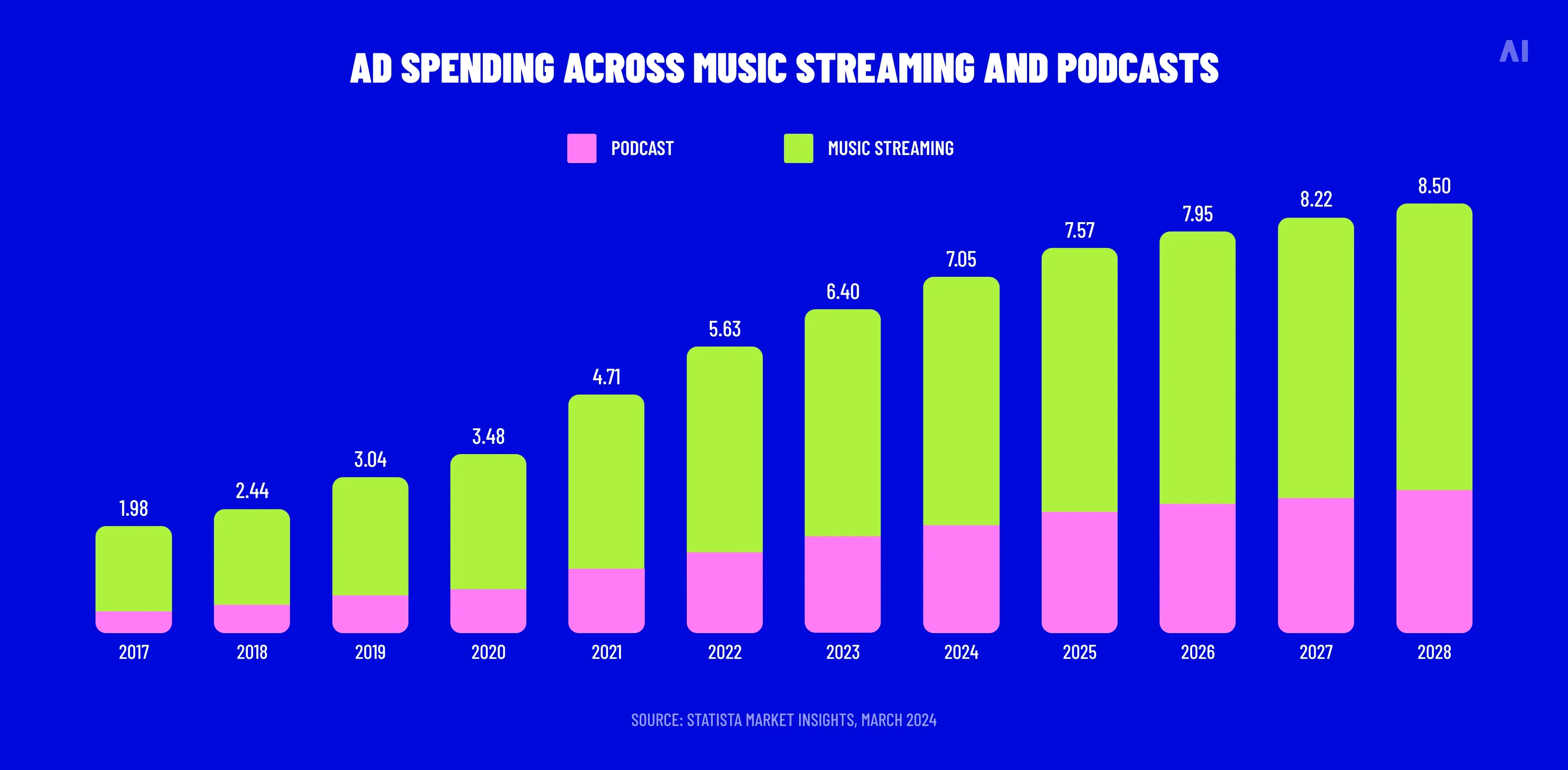
By 2028, mobile is projected to account for roughly 79% of digital audio ad spend in the Americas, reflecting how people listen throughout their day. The same listener might stream music on their phone during a commute, continue on a desktop at work, and finish the evening with a podcast on a smart speaker at home.
Frequency capping across devices prevents overexposure. Rather than bombarding the same person with identical ads on every device, programmatic buying recognizes the listener and maintains appropriate message frequency. This creates better user experiences and prevents wasted impressions.
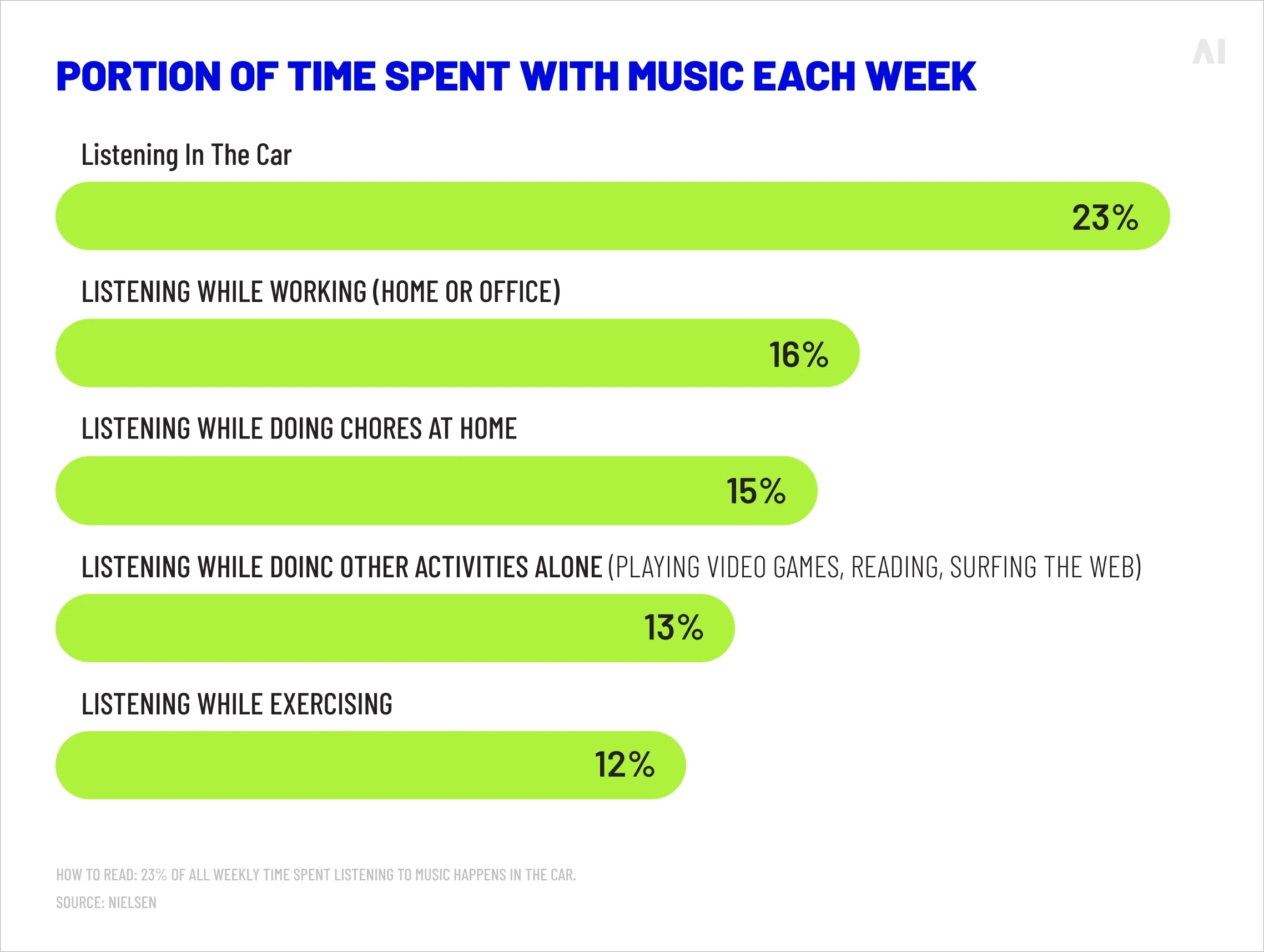
The ability to reach people during screen-free moments represents a significant advantage.
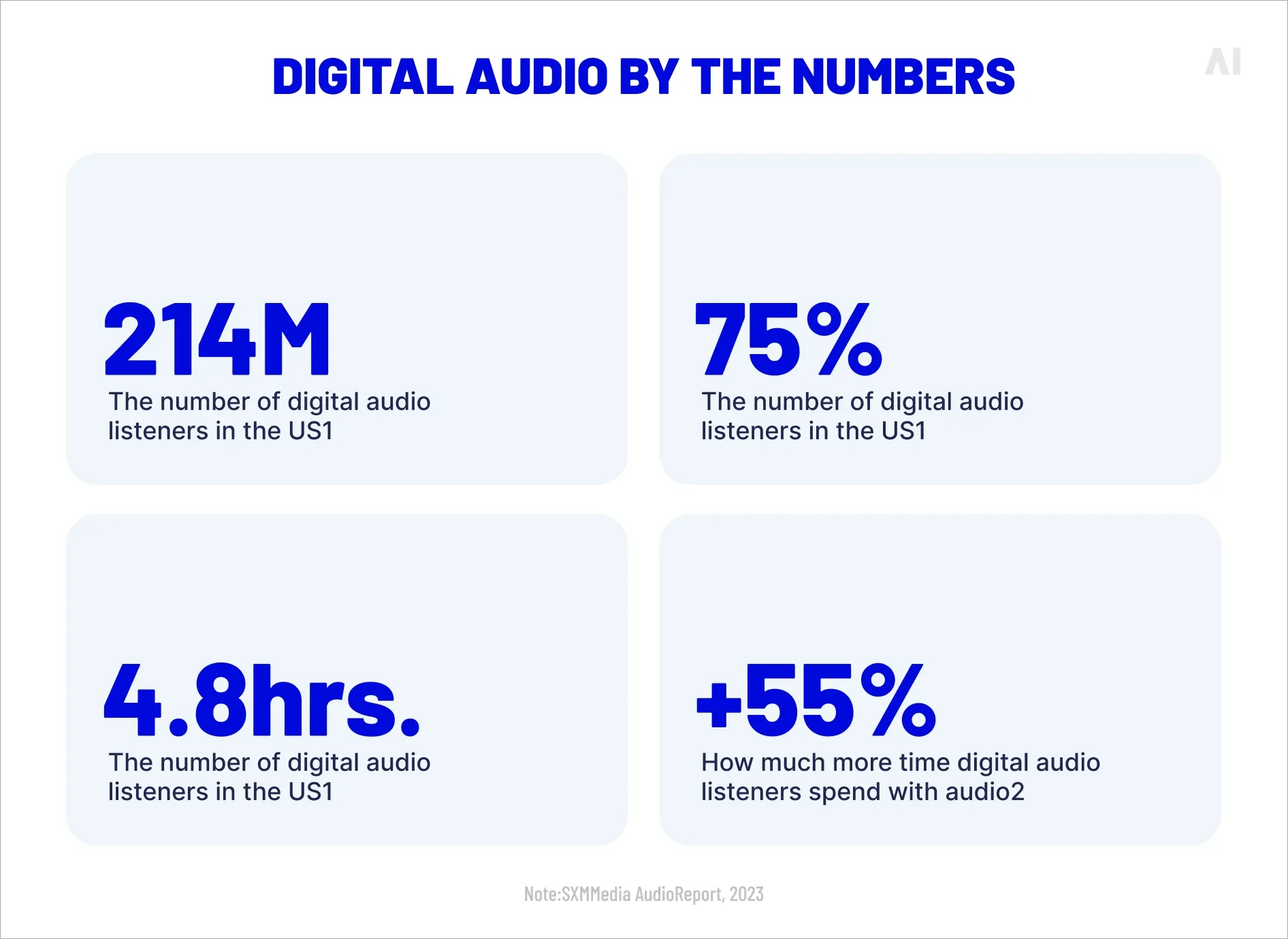
63% of listeners say Spotify is important to their everyday routines. Separately, Nielsen estimates ~79% of audio consumption occurs when visual media can’t reach people.
Commuting, exercising, and household chores all represent opportunities where audio advertising faces less competition for attention than visual channels.
💡 For a primer on programmatic video, see the dedicated piece: Programmatic video advertising explained: Smarter campaigns for the streaming era
High engagement and emotional impact
Audio creates an intimate connection with listeners. The medium engages through voice, music, and sound design, triggering emotional responses and mental imagery that visual formats approach differently.
Research shows audio ads generate approximately 50% more attentive seconds per impression than TV, video, or social ads.
People actively choose their audio content, creating a receptive environment for messages that respect that choice with relevant, well-crafted creative.
Studies have found 74% aided recall for host-read podcast ads and 72% for announcer-read spots.

These recall rates exceed typical benchmarks for display advertising, where banner blindness and ad fatigue reduce message retention.
The completion rates for audio ads contribute to this effectiveness. Most streaming audio ads are unskippable, ensuring brands receive full message delivery rather than partial exposure. When people stream ad-supported content, they accept ads as part of the value exchange, creating less resistance than pre-roll video ads that viewers seek to skip.
Emotional resonance plays a role. Voices convey personality and authenticity. Music triggers memories and moods. Sound effects create mental theater that engages imagination. These elements combine to make audio advertising memorable and persuasive when executed well.
Consumers rate audio advertising as significantly more authentic than social media ads, with podcasts seen as 6 to 23 times more trustworthy than content on social platforms.
This trust transfers to advertisers who sponsor or place ads within respected audio content.
⚡ Audio advertising excels at building emotional connections because listeners choose to engage with content they love, creating a receptive environment where well-crafted brand messages can genuinely resonate.
Cost-efficiency and measurable ROI
Audio advertising often delivers strong returns relative to investment.
Analysis by Acast found that podcast advertising can yield up to 4.9 times higher return on investment than other digital formats.
The combination of high engagement, completion rates, and growing but not oversaturated inventory creates favorable economics.
Production costs for audio creative remain lower than video. A professional 30-second audio spot requires voice talent and sound design but avoids the expenses of video production, location shoots, or complex post-production. This allows brands to test multiple creative variations or produce localized versions without significant budget implications.
CPMs in programmatic audio tend to run lower than premium video inventory while delivering comparable or better attention metrics. Audio currently accounts for roughly 9% of ad spend despite capturing significant listener attention, suggesting less competition and more efficient pricing than more saturated channels.
.webp)
The efficiency extends to campaign management. Programmatic buying reduces the operational overhead of traditional insertion orders and manual trafficking. Real-time optimization shifts budget toward better-performing inventory automatically, improving cost-per-action metrics throughout campaign flights.
Measurement improvements enable clearer ROI calculation. Advertisers can track impressions, listen-through rates, post-ad website visits, and conversion attribution, providing data to calculate actual returns rather than relying on estimated reach and frequency.
For marketers seeking to maximize budget efficiency while maintaining quality reach, programmatic audio presents a compelling case. The channel delivers measurable performance at competitive rates, particularly for brands willing to invest in strong creative that leverages audio's unique strengths.
💡 For a complete set of metrics to track and improve in digital marketing, see: 15 essential digital marketing KPIs to track in 2026
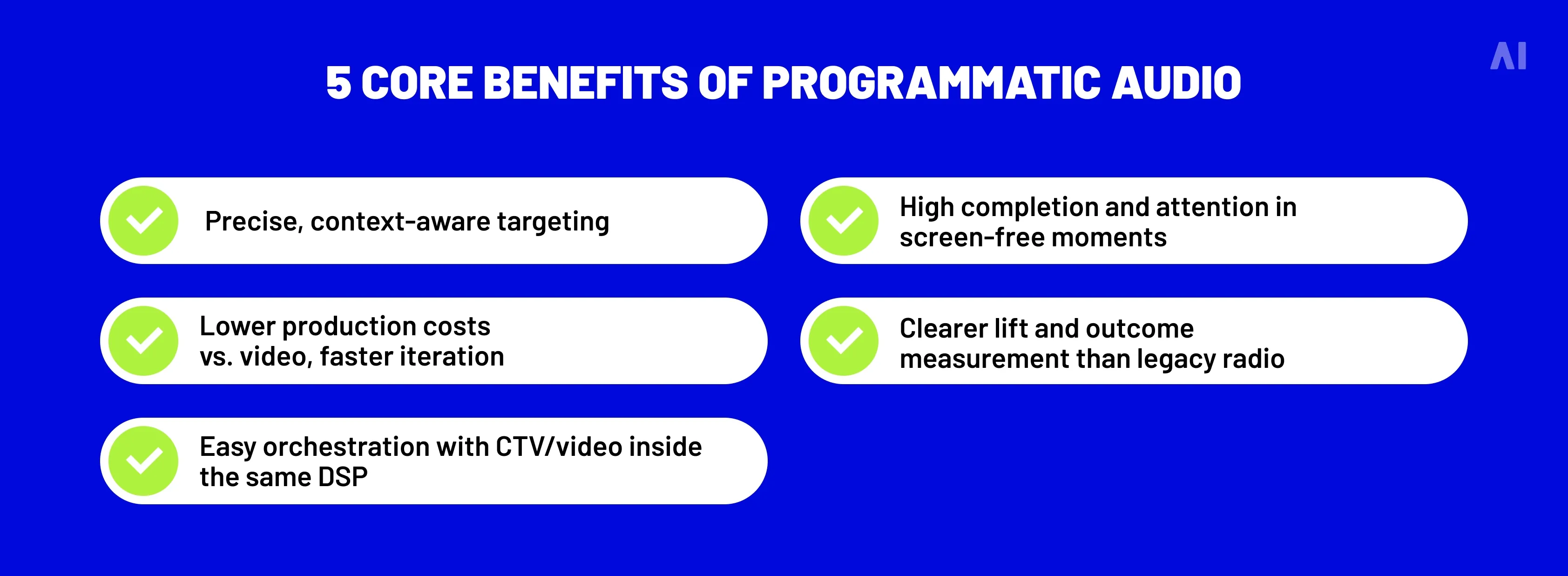
Is programmatic audio right for you?
Programmatic audio performs particularly well for specific marketing objectives and audience segments. Understanding these ideal use cases helps determine when to allocate budget to this channel.
- Brand awareness campaigns benefit from audio's high completion rates and attentive listening environments. Brands seeking to build recognition or introduce new products can reach engaged audiences during receptive moments. The intimacy of audio helps new brands establish personality and voice in ways that banner ads struggle to achieve.
- Omnichannel strategies gain from adding audio as a complementary reach extension. When combined with video, display, or connected TV campaigns, audio fills frequency gaps and reaches consumers during times when visual media consumption drops. The coordinated exposure across multiple touchpoints reinforces messaging and improves overall campaign lift.
- Local and regional advertisers find value in audio's geographic targeting capabilities. A restaurant chain can run different promotions in different markets. An automotive dealer can target listeners within a specific radius of their location. Radio streaming apps and podcast networks offer extensive local inventory that programmatic buying makes accessible without requiring individual station negotiations.
- Industries with strong affinity audiences see particularly good results. Financial services in business podcasts. Fitness brands in workout playlists. Automotive in drive-time content. When audience interests align closely with available content categories, targeting precision improves and message relevance increases.
- Direct response campaigns work in audio when creative includes clear calls-to-action. Promo codes, vanity URLs, and voice commands (on smart speakers) provide trackable response mechanisms. Research indicates that 46% of podcast listeners have learned about new brands through ads, and 23% have made purchases based on podcast sponsorships, demonstrating audio's ability to drive action beyond awareness.
- Mobile-first brands align naturally with audio consumption patterns. Apps, digital services, and e-commerce businesses benefit from reaching audiences on the devices where conversions happen. A listener hearing an ad on their smartphone can immediately open an app or visit a website without device switching.
Certain categories may find audio less suitable. Highly visual products that require demonstration (fashion, home decor) face challenges in audio-only environments, though companion display units can mitigate this limitation. Brands requiring complex explanations might struggle within 30-second audio spots, though podcast sponsorships allow for longer-form storytelling.
Budget considerations matter less than execution quality. While audio inventory remains cost-efficient, success depends on strong creative that leverages audio's strengths rather than treating it as radio repurposed for digital. Brands willing to invest in audio-specific creative strategy typically see better returns than those running generic or uninspired spots.
Programmatic audio ad formats
Programmatic audio breaks down into four practical buckets. Below is a clear-eyed view of what each format is, when to use it, how to build creative that fits the moment, and what you can expect on delivery and measurement.
In-stream ads
Standard 15s/30s/60s audio ads inserted into music streams on services like Spotify, Pandora/SiriusXM, and iHeart’s digital apps. Many placements support a clickable companion banner inside the app, which gives you a visual surface for visits while the audio spot does the heavy lifting.
- Where it performs best: Use in-stream for broad reach and reliable delivery. Completion rates are typically high because there’s nothing to watch or dismiss during a music stream. Spotify’s own benchmark pegs average audio completion around 91%, which makes this format a steady vehicle for awareness and message reinforcement.
- Targeting and context tips: Plan by activity and context, not just age and gender. Commuting, working, studying, and workouts create distinct listening “modes.” Align scripts and offers to genre or mood, then layer device filters (mobile, connected car, smart speaker) to match intent. Spotify’s programmatic marketplace exposes first-party contextual signals and private marketplaces (PMPs) you can tap from major DSPs.
- Creative and UX: Keep the opening three seconds clean and branded. Use one clear benefit, one proof, and a plain-English CTA. If the app supports it, add a companion display unit or post-exposure card to provide a low-friction next step. DV360 and Campaign Manager 360 document companion support and specs.
- Measurement to expect: You’ll track starts and quartile completions via VAST, plus clicks on companions where available. For outcome measurement, layer platform analytics (e.g., Spotify Ad Analytics) for site/app actions and run brand lift on at least one publisher line to quantify awareness/consideration shift.
- Common pitfalls: Over-frequency can shorten sessions and raise irritation. As a rule, cap tightly and rotate copy. When in doubt, prioritize reach and pacing over maxing out impressions in a single daypart.
Podcast ads
Host-read or announcer-read ads delivered through dynamic ad insertion (DAI) into podcast episodes across networks and marketplaces. DAI lets sellers insert the right ad at playback, which is why podcast buying now behaves more like the rest of programmatic. As mentioned, DAI reached 84% of podcast ad revenue in 2021, reflecting the rapid operational shift; subsequent IAB reporting continues to cite automated delivery and measurement as growth drivers.
- Where it performs best: Use podcasts for trust, depth, and mid- to lower-funnel outcomes. Audiences opt into specific shows and hosts, which transfers credibility when the message fits the content and tone.
- Scale and maturity: The IAB/PwC U.S. Podcast Advertising Revenue Study (2024) reported $1.925B in 2023 revenue and projects the market to approach $2.6B by 2026—useful signal that accountability and scale are improving together.
- Targeting and suitability: Go beyond show-level targeting. Use episode-level transcription and pre-bid suitability to steer away from content that’s off-tone for your brand, and to positively select episodes that match the message. This keeps podcast buys precise without sacrificing scale.
- Creative and UX: When possible, commission host-read integrations with a clear brief: one claim, one proof, one specific action (URL or code that’s easy to remember). For announcer-read, keep pacing natural and resist over-stuffing copy; people are wearing headphones.
- Measurement to expect: Plan for IAB-compliant delivery counts, brand-lift studies with a test/control design, and pixel-based attribution where the platform supports it. Add vanity URLs or codes to catch direct response that won’t fire a pixel (common in podcasting).
- Example outcome: Contextual data plus programmatic reach can move cost metrics. A widely cited example: Orangetheory Fitness used Acast content signals via a programmatic buy to reduce cost per booking—illustrating how content alignment and automation can work together.
- Common pitfalls: Buying only against “top shows” and ignoring episode context; running the same script everywhere; expecting last-click ROAS from a channel that’s often heard on-the-go. Solve this with content controls, rotating creative, and blended attribution (lift + site/app events).
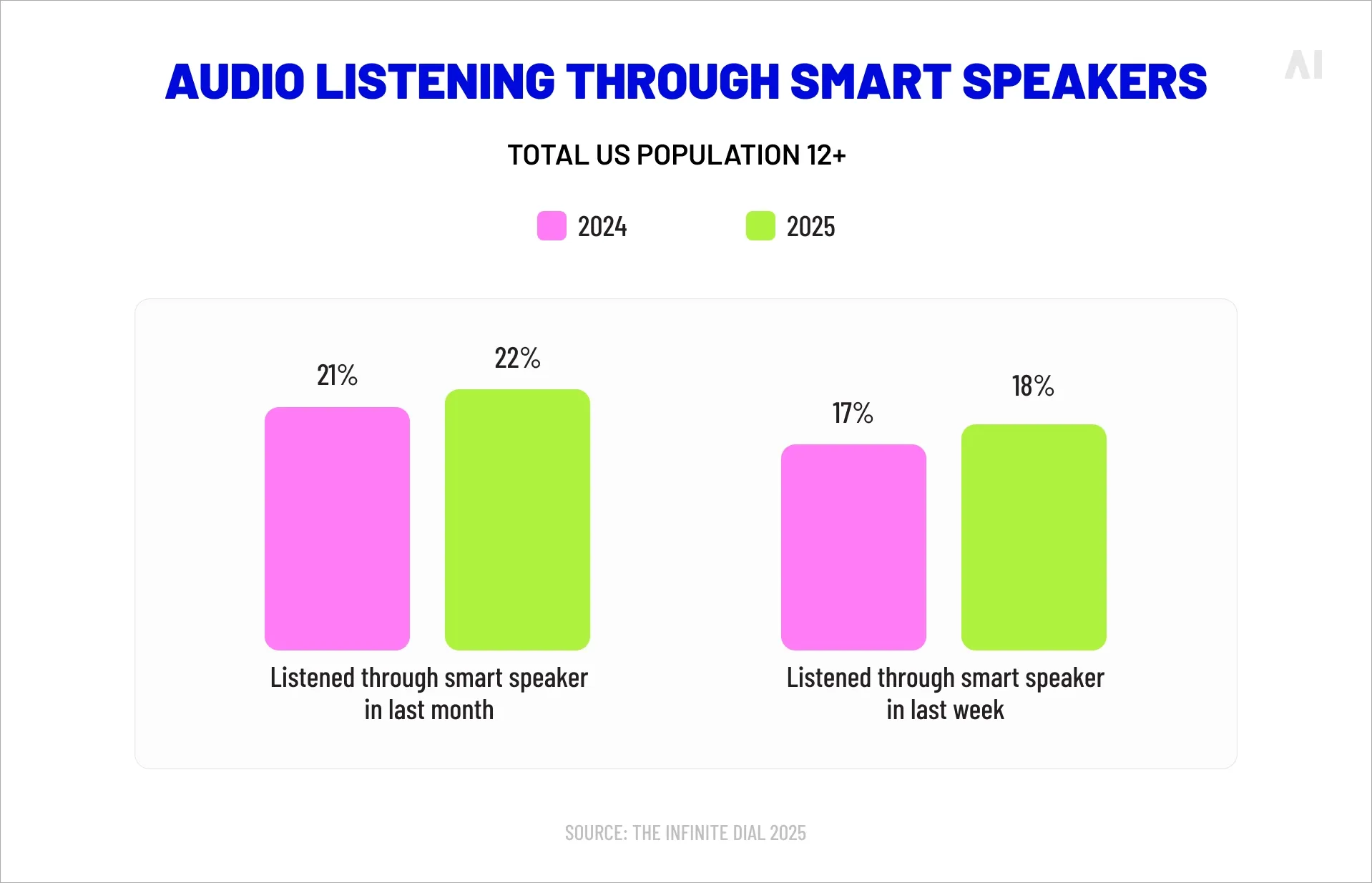
Smart speaker ads
Audio ads that reach households through devices like Amazon Echo and Google Home. Some executions are voice-activated, allowing a listener to respond (“send details,” “set a reminder,” “add to cart”).
- Where it performs best: Use it for upper- to mid-funnel messaging that invites a simple next step. Smart speakers sit in low-distraction contexts (kitchens, living rooms), which helps recall.
National Public Media’s Smart Audio Report finds 53% of owners who have heard an ad say they are likely to respond to a smart-speaker ad—evidence that, when invited, many people will act.
- Interactivity in practice: On mobile, interactive audio formats such as AdsWizz ShakeMe™ let people respond without looking at the screen (shake or tap to open a map, download, or call). As mentioned—a multi-campaign program for the Yuh finance app saw a 92% listen-through rate and a 2.48% interaction rate, with engagement 60% higher than non-interactive audio benchmarks. These are strong signals that reducing friction during the spot increases action.
- Creative and UX: Write to a single action that’s feasible hands-free. Use a short “if you want X, say ‘send me a link’” line, then pause briefly. Keep the voice tone conversational and the audio bed uncluttered.
- Measurement to expect: Depending on the platform, you can capture interactions (e.g., “send me info”) as events. Mirror this with site or app attribution and run brand-lift to understand mindset shifts among households using voice frequently.
- Common pitfalls: Packing in multiple CTAs; using URLs that aren’t speakable; ignoring household context (shared devices). Solve with one action, one benefit, and a memorable phrase.
In-app radio ads
Ads within digital radio streams—think iHeart’s live radio streams in its app or Pandora’s lean-back listening. Inventory includes live/linear streams in addition to on-demand, and is accessible via exchanges or direct DSP integrations (including newly announced access through Amazon DSP for iHeart’s streaming inventory).
- Where it performs best:Use in-app radio for scale and daypart control. Live news, talk, and sports programming can add context, while the lean-back experience helps with consistent message delivery over time.
- Why ad-load discipline matters: A randomized long-run experiment on Pandora with ~35 million listeners over 21 months quantified how people respond to different ad loads. The study found meaningful ad-load sensitivity—total ads per hour mattered most—and a slight preference for more frequent but shorter breaks. Translation: protect experience with tight frequency caps and reasonable break lengths if you want sustained outcomes.
- Creative and UX: Write for the ear. Use clear branding early, a single benefit, and a short CTA. If you’re aligning to live content (game night, traffic, weather), update copy more often and localize where it helps.
- Measurement to expect: Track VAST completions for delivery quality, layer platform attribution for site/app actions, and consider footfall studies for retail if the partner supports it.
- Common pitfalls: Cramming too many impressions into the same hour; running the same script for weeks; missing obvious moments (e.g., traffic reports, morning news) where a context-tuned message could lift response.
{{What-Is-Programmatic-Audio-Advertising-2="/tables"}}
💡 For a comprehensive tale on online video, see: OLV advertising: a complete guide to boosting engagement & ROI in 2026 — AI Digital
⚡ Tip: choose one primary format to meet your main objective (e.g., reach via in-stream), then layer a second format to deepen impact (e.g., podcasts for trust or smart speaker for action).
Why programmatic audio is growing in 2026
Programmatic audio is accelerating for three simple reasons: listeners are spending more time with streamed audio and podcasts, buying tools now make audio as easy to plan as display or CTV, and measurement has matured enough to prove impact.
Digital audio consumption keeps rising
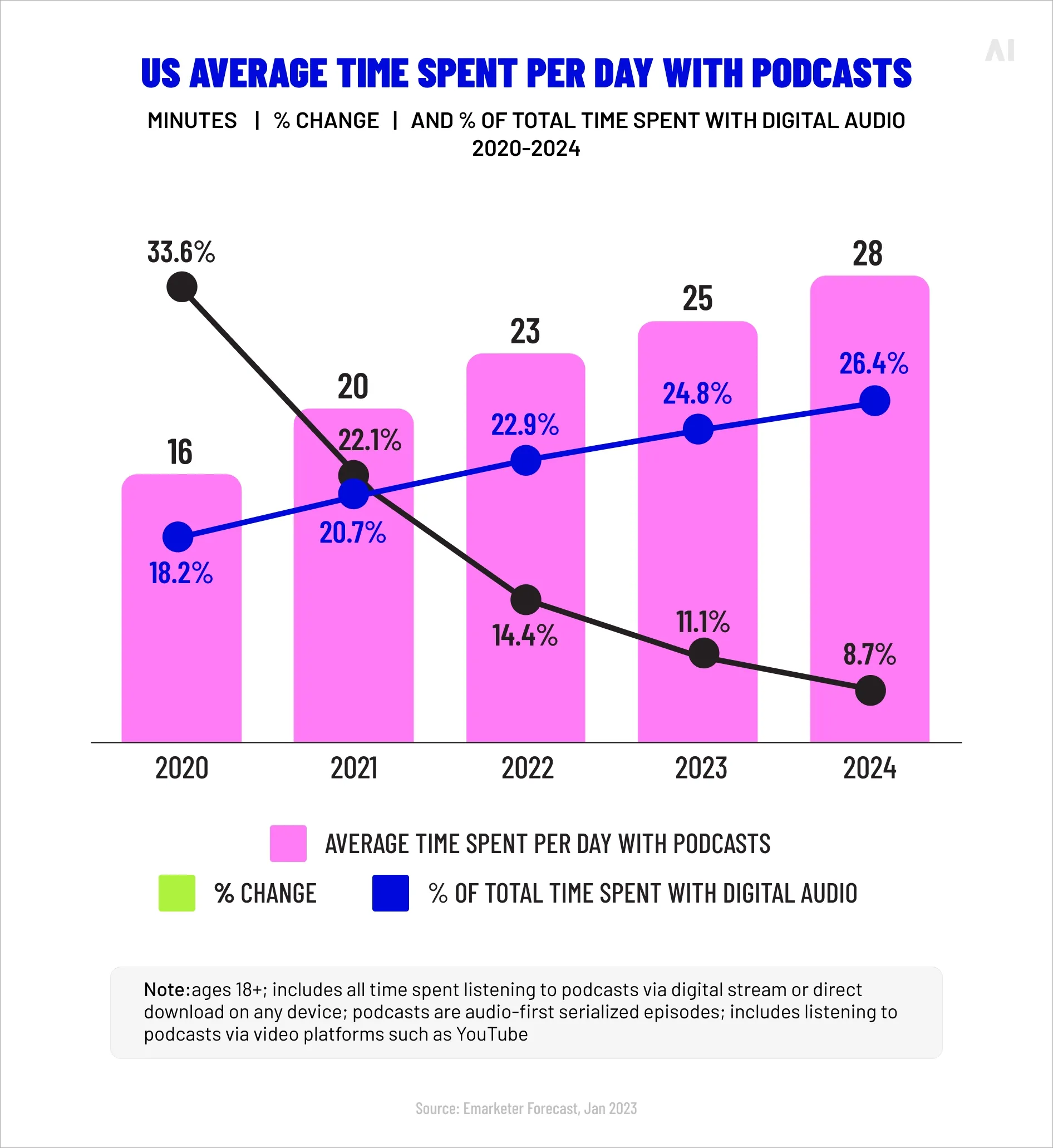
Listening has outpaced the hype. The Infinite Dial 2025 shows that 48% of Americans 12+ have both listened to and watched a podcast, and YouTube is now the service used most often by U.S. weekly podcast listeners—evidence that audio is spilling onto screens and drawing larger, hybrid audiences. Edison’s full deck and write-up also confirm record podcast reach and continued growth in monthly listening, which expands the addressable pool for programmatic buying.
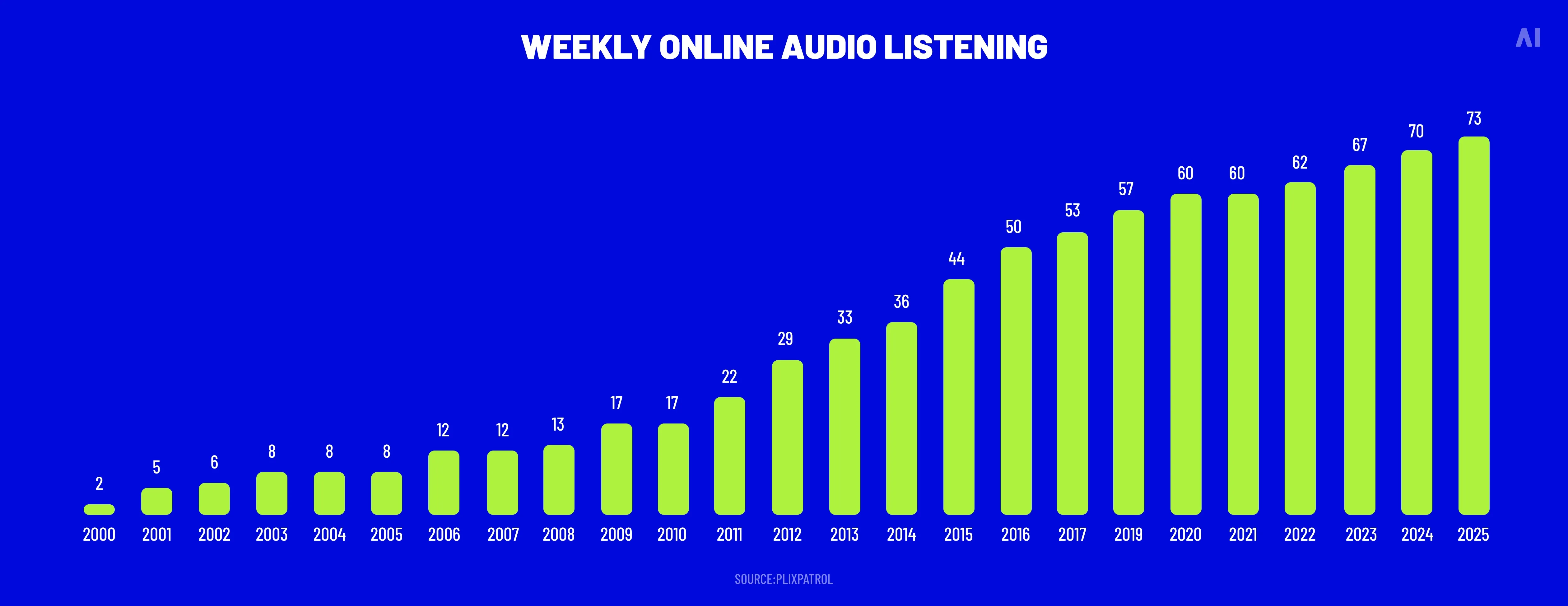
What matters for planners is not just volume, but where that volume sits. If a third of weekly podcast listeners use YouTube most often, you can expect more inventory packaged with video surfaces and more opportunities to run audio across environments that your DSP already supports. That creates practical paths to unify frequency and attribution for audio alongside CTV and online video, rather than managing it as an island.
Audio is mobile-first and “on the go”
Audio fits into active parts of the day. In IAB’s 2024 planning guide, a Publicis/Edison study found 70% of respondents consumed audio while on the go during peak purchase hours (8 a.m.–5 p.m.), and 53% of streaming audio listeners reported taking an action after hearing an ad while out shopping or dining. Said plainly: listeners are hearing ads at the exact moments when intent can turn into action.
Those contexts are mostly mobile—phones, earbuds, and in-car streaming—so programmatic controls like dayparting, device targeting, and proximity messaging have real leverage. The combination of habitual daytime listening and action-oriented environments is a key reason brands are adding audio to performance plans, not just brand campaigns.
Advertisers are embracing omnichannel integration
Buying tools have caught up to the opportunity. Insider Intelligence (eMarketer) forecasts that programmatic will account for roughly 30% of digital audio services ad spending in 2025, with a further push toward “nearly a third” by 2026. That shift is being enabled by supply that plugs directly into omnichannel DSPs: Spotify’s Ad Exchange lists access through 30+ DSPs (including The Trade Desk and DV360), and Amazon DSP now offers programmatic access to iHeartMedia’s streaming inventory as well as Spotify—making it easier to plan audio next to display, video, and CTV with shared identity and measurement.
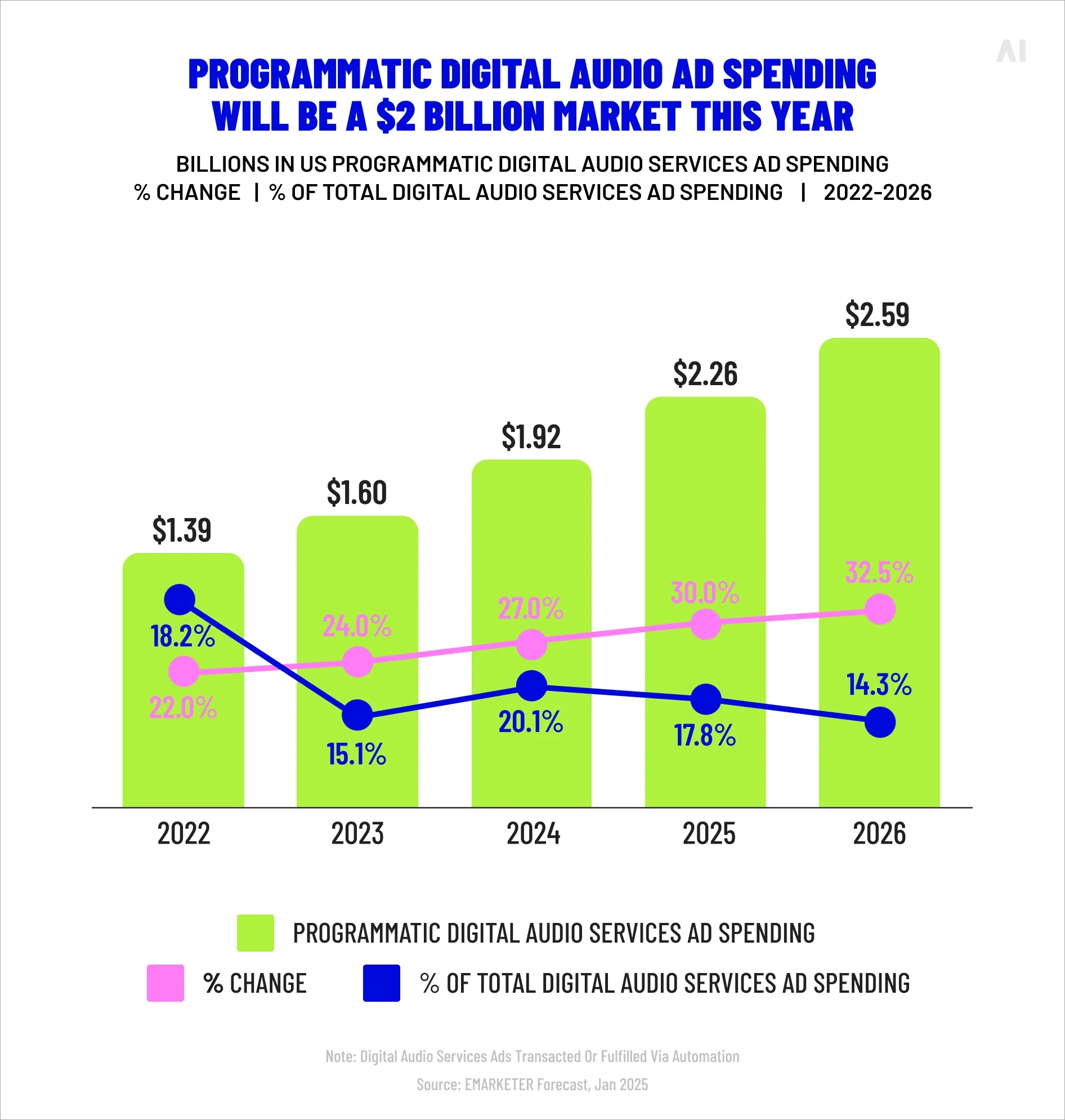
For teams, this means audio can live in the same plan as CTV and online video, with unified pacing, cross-device sequencing, and deduplicated reporting. As more premium audio supply becomes accessible through the platforms you already use, the operational cost of including audio falls, and the case for allocating incremental budget rises.
Challenges of programmatic audio (and How to solve them)
Here’s the reality check before you scale. Programmatic audio is mature enough to plan alongside CTV and online video, but three friction points still trip up campaigns: inconsistent counting across podcasts and streams, the lack of a built-in visual surface for clicks, and evolving privacy rules and IDs. Below, you’ll see each challenge framed plainly—and the specific standards, formats, and workflows that resolve it in practice.
Lack of standardized measurement
Podcast and streaming audio have historically used different counting methods. Podcasts are often downloaded and played later, which complicates what “delivered” and “heard” mean; streaming reports use VAST quartiles more like video. Without a common yardstick, it’s hard to compare partners or place audio next to CTV and online video in the same report.
What “good” looks like:
- Adopt IAB Tech Lab podcast v2.2 as your baseline for podcasts. The 2024 update tightens definitions for downloads, ad delivery, and “audible” plays in dynamic ad insertion (DAI) environments and comes with a compliance program you can require of partners.
- Anchor streaming audio in MRC standards. The Media Rating Council’s Digital Audio Measurement Standards outline how to qualify an audio ad impression (e.g., an actual opportunity to hear), giving you a consistent way to evaluate streaming delivery quality.
How to fix it in your plan:
- Make IAB v2.2 compliance table stakes for podcast partners; log which vendors are certified.
- For streaming, confirm partners are MRC standards–aligned and that VAST events are captured correctly.
- Layer brand lift and outcome attribution (site/app visits, conversions) so you can evaluate creative and supply decisions beyond delivery. IAB’s 2024 podcast creative best practices is useful for setting lift study expectations and creative guardrails that improve recall.
Limited visual engagement
Audio is heard, not seen. That limits “instant click” moments and can make action measurement feel harder than with display or social placements that live on a screen.
What “good” looks like:
- Clickable companions and CTA cards. Spotify supports companion images for audio ads and call-to-action cards that appear during and after exposure in the app, giving listeners a simple way to act when it’s convenient. Specs and availability vary by workflow (Ads Manager, Ad Exchange, or direct IO), but the principle is the same: pair the spot with a visual surface.
⚡ If there’s a screen, give listeners a surface to act on. Companion images and CTA cards convert attention into action without forcing immediate clicks during the spot.
- Interactive mobile audio. As mentioned, formats like AdsWizz ShakeMe™ let people respond without looking at the screen (e.g., shake or tap to open a map or download an app).
How to fix it in your plan:
- Where the publisher supports it, traffic a companion or CTA card with every audio line.
- Test one interactive unit in mobile-heavy ad sets; compare interaction and downstream events to standard audio.
- Use speakable CTAs and vanity URLs/codes for podcasts and smart speakers to capture actions that won’t fire pixels.
- Attribute thoughtfully: treat companions and CTA cards as a pathway to action, not the only success metric.
Privacy and compliance
Signal quality and consent rules are evolving. Audio spans apps, web, and walled platforms, and U.S. state privacy laws continue to add requirements for disclosures, consent signaling, and automated decision-making. Teams need a consistent way to pass consent through the ad chain and an identity approach that doesn’t rely on third-party cookies.
What “good” looks like:
- Use the IAB Tech Lab Global Privacy Platform (GPP). GPP standardizes how consent and privacy strings are transmitted across sites, apps, and vendors. In 2025 the Tech Lab issued new GPP updates and implementation guidance, adding more U.S. state sections and a re-architected string to future-proof deployments; bi-annual releases start in 2026.
- Adopt modern IDs where appropriate. Large audio sellers are integrating Unified ID 2.0 (UID2) to enable addressable, privacy-compliant buying without third-party cookies. iHeartMedia announced UID2 adoption in December 2024 to strengthen targeting, measurement, and attribution across streaming and podcasts.
How to fix it in your plan:
- Pass GPP strings end-to-end in your DSP and tag setup; confirm partners can ingest and honor them.
- Where available, activate UID2 or similar consent-based IDs for logged-in audio, and fall back to contextual and first-party data when identity isn’t present.
- Track CPPA/CCPA updates: California finalized new regulations in 2025 covering cybersecurity audits, risk assessments, and automated decision-making; ensure your contracts, consent flows, and data maps reflect the new obligations and timelines.
Bottom line: Standardize how you count, give people a simple way to act, and make consent portable. With v2.2 measurement, companions or interactive formats, and GPP-aligned consent plus modern IDs, programmatic audio can be evaluated and optimized with the same confidence you bring to CTV and online video.
💡 For more info on marketing and advertising technologies, refer to guidance: Adtech and martech: what’s the difference and why they’re converging.
How to run programmatic audio campaigns effectively
Below is a practical playbook you can lift straight into a media plan. It moves in the order you’d actually work: objective → inventory → audiences → creative → measurement → delivery controls → QA → reporting.
1. Start with a reach + reinforcement objective
Decide the job of audio before you touch budgets. Is it (a) incremental, unduplicated reach; (b) frequency shaping around CTV/online video; or (c) mid-funnel consideration with podcasts? Write that goal at the top of the brief and map KPIs accordingly.
- If the job is incremental reach: prioritize in-stream music/digital radio for scale; set a hard cap for per-person weekly impressions to avoid fatigue. Use your DSP’s reach planner to estimate de-duplicated reach against your CTV/video plan and set a target (e.g., +6–10 points incremental).
- If the job is frequency shaping: model how many additional exposures you want across the campaign and where audio should appear in sequence (e.g., 1 CTV exposure → 2 audio exposures within 72 hours).
- If the job is consideration in podcasts: set brand-lift or site-visit lift as primary metrics, with a backup DR proxy (vanity URL/code usage).
⚡ Tip: Use cross-media guidance to set de-duplication targets and agree on the reporting unit of truth (household vs person) so your evaluation is apples-to-apples.
2. Choose inventory for the job
Match formats to objectives, then layer a secondary format to deepen impact.
- Need scale and consistency? In-stream music and digital radio (Spotify, iHeart, SiriusXM/Pandora) for high completion and predictable delivery.
- Need trust and niche context? Programmatic podcast marketplaces using dynamic ad insertion (DAI), filtered by genre and episode-level context.
- Need in-home presence or a simple action? Smart speakers and interactive audio where “send info / set reminder” type responses make sense.
- Buying paths: use PMPs or programmatic guaranteed for premium shows/streams; keep an open-auction line for efficient backfill; avoid over-concentrating spend in a single marketplace.
⚡ A simple starter split (adjust to your goals): 50–60% in-stream for reach, 30–40% podcasts for depth, 10% smart speaker/interactive for action testing.
3. Lean into first-party and contextual signals
Build a privacy-sound audience spine, then let context do the heavy lifting.
- First-party: onboard CRM segments (loyal customers, lapsed, high-value lookalikes) where allowed. Use retailer segments if you have a commerce goal and the partner supports it.
- Contextual: layer genre, mood, playlist type, daypart, and device (mobile, in-car, smart speaker). Context is highly predictive in audio and travels well as third-party signals recede.
- Publisher first-party: take advantage of Spotify and SiriusXM contextual/mindset targeting; use show/episode taxonomies from podcast networks.
- Orchestration: use your DSP (e.g., DV360/TTD) to unify frequency across audio + CTV/video and to set sequence rules (e.g., show audio only after a video view).
4. Use dynamic audio creative (and test it)
Write modular scripts and let the platform swap elements.
- Build blocks: opening hook (3–5s), benefit, proof, localized offer, CTA, SFX bed.
- Personalize by trigger: time of day (“morning coffee?”), weather (“rainy-day delivery”), location (“near 5th Street store”), or show/genre (“game-day deal”).
- Interactive where it fits: test one AdsWizz-style interactive unit in mobile-heavy ad sets to capture response without a screen.
- Test design: always pit at least two variants (voice, offer, CTA wording) against each other; set a clear winner rule (e.g., +10% lift in site-visit rate or brand-lift delta).
- Sonic hygiene: clean VO, intelligible brand name twice, avoid over-mixing music/SFX, and keep files normalized per publisher specs.
⚡ Plan your creative tests before launch and lock a decision rule. Weekly swaps with a clear winner criterion beat ad-hoc changes every time.
5. Instrument measurement up front
Decide how each line item will be judged before launch.
- Delivery/playback: require IAB podcast measurement v2.2 compliance for podcast partners; confirm VAST quartile events for streaming lines.
- Brand lift: schedule a standardized lift study on at least one large publisher (awareness, consideration, intent).
- Outcomes: enable site-visit and app-event attribution where supported; assign vanity URLs/codes for podcasts and smart-speaker lines to catch off-pixel actions; consider geo-lift or footfall for retail.
- Cross-media: ensure your measurement stack can deduplicate reach and frequency across TV/CTV/digital so audio’s incremental contribution is visible next to video.
A measurement map example:
- In-stream line (PMP): delivery quality (start/complete), companion CTR, site-visit lift
- Podcast DAI line: IAB v2.2 delivery, brand lift, vanity URL/code hits, site-visit lift
- Smart speaker line: interaction events, brand lift, follow-up site visits within lookback
6. Control frequency and ad-load
Protect listener experience and your KPIs:
- Frequency caps: start with 1–2 impressions per person per day and 3–4 per week per format; tighten if you hear fatigue or see session length drop.
- Sequence variety: rotate at least two scripts per audience to avoid ad wear; introduce a fresh variant every 2–4 weeks on long flights.
- Ad-load discipline: in radio-like streams, shorter, more frequent breaks tend to be tolerated better than long blocks (as mentioned previously); plan with partners to avoid stacking multiple long ads in one pod.
- Pacing: prefer even pacing with daypart multipliers over “as fast as possible,” so you’re present in habitual listening windows without over-concentrating delivery.
{{What-Is-Programmatic-Audio-Advertising-3="/tables"}}
7. Plan companion visuals where possible
Give people a screen to act on when one is available:
- Companions/CTA cards: traffic a static/HTML5 companion or a CTA card wherever the app supports it; align the headline and CTA with the spoken line.
- Specs & QA: confirm file formats, size, and click-through tracking in the DSP or publisher portal; verify that companions render on both iOS and Android app versions.
8. Treat podcast like TV: buy against content, not just “listeners”
Context is the control knob:
- Suitability: use transcript-based, episode-level suitability to avoid off-tone topics and to positively select episodes that match your message.
- Deals: combine show-level PMPs for priority titles with network-level DAI for scale; manage frequency across both.
9. Report like a grown-up channel
Make audio live next to CTV and online video in your wrap.
- Core delivery: reach, frequency, completion rate, and cost per completed listen.
- Quality & action: brand-lift deltas, site/app visit lift, vanity URL/code usage, interaction rates (for interactive units).
- Cross-media: deduplicated reach/frequency against TV/CTV/video lines; show the incremental lift where audio was present.
- Optimization log: document supply path changes (PMP vs open), bid and frequency adjustments, and creative learnings so the next flight starts smarter.
{{What-Is-Programmatic-Audio-Advertising-4="/tables"}}
💡 Looking for guidance on real-time bidding? Check our our comprehensive guide: What is real-time bidding (RTB)? Definition and importance
Programmatic audio vs. other digital channels
Before you choose budget splits, it helps to see how audio stacks up against your usual suspects. Each channel excels in different moments—audio in screen-free routines, video when the screen has attention, display for cheap clickable reach, and CTV for big-screen storytelling. Use this table to decide when to lean on audio, when to lean on the other channel, and how to make them work together.
{{What-Is-Programmatic-Audio-Advertising-5="/tables"}}
⚡ Sequence CTV for the big story, then audio to reinforce in daily routines. You’ll lift effective frequency without burning screen time.
The future of programmatic audio advertising
Here’s what’s next for the channel. Interactions will move from passive listening to simple, spoken responses. Creative will assemble itself in real time from data you already own. Audio will plug more neatly into cars and connected TVs so sequencing and frequency feel unified. And under the hood, smarter optimization, standardized verification, and cleaner privacy signals will make the whole system easier to plan and prove.
Voice-activated and conversational ads
Interactivity is moving from gimmick to workflow. Beyond simple “send me a link” prompts, assistants are starting to blend organic answers with sponsored results inside the conversation itself. Amazon’s Alexa+ is testing product discovery that automatically folds Sponsored Products into shopping chats, which points to native ad opportunities with measurable downstream actions. Expect more publishers to expose “spoken response” events (e.g., send-to-phone, add-to-list, set-reminder) so planners can optimize to an interaction, not just a listen.
On the demand side, willingness to engage is real. Voicebot reports that a majority of smart-speaker owners who have heard ads say they would respond to them—evidence that conversational CTAs have an addressable audience when the request is simple and contextually relevant. Edison’s broader “Sound Data” also shows that nearly two-thirds (63%) of smart-speaker owners stream more audio after buying a device, which expands the inventory where those CTAs can appear.
Real-time dynamic audio creative
Dynamic audio is maturing from “swap a line” to rules-based, data-driven orchestration. A Million Ads shows how first-party triggers (inventory, prices, store proximity) and contextual cues (time, weather, local events) render thousands of variants without production bloat; their 2025 guidance for retailers details practical data hooks to make messages feel live to each listener. Independent white-paper work from the company explains how campaigns generated tens of thousands of on-the-fly variants and then verified brand lift against a control—useful proof that dynamic can be both personalized and measurable.
AI-assisted creative is also showing outcomes beyond novelty. Veritonic’s 2025 analysis of thousands of audio ads underscores that creative quality—voice, music, and structure—drives lift as much as placement, and Instreamatic’s case work with Dentsu found personalized, AI-generated audio increased brand favorability by 22 points versus generic spots for a major electronics brand. The takeaway: automation should optimize what you say as much as who you reach.
Integration with connected cars and CTV
Two shifts are making in-car audio more addressable for programmatic buyers. First, phone projection platforms are mainstream among those who have them—Edison reports 83% of Americans with Apple CarPlay or Android Auto use these systems—so streamed audio follows the driver and creates targetable, session-based supply. Second, in-car listening itself is getting more digital; The Infinite Dial coverage shows online audio now accounts for more than half of in-car listening (55%), with CarPlay alone at 22% usage—clear signals that the car is no longer a broadcast-only environment.
⚡ As projection systems and streaming grow in the car, session-based targeting will improve. Use daypart and geo to align offers with errands and game-day traffic.
As CTV and audio increasingly sit in the same DSPs, packaged sequencing becomes practical: big-screen exposure first, then audio reinforcement during drives and errands. Measurement vendors are keeping pace; Comscore Campaign Ratings now supports deduplicated reach at the local level across programmatic environments, which makes it easier to quantify the incremental reach audio adds to TV/CTV plans in-market, not just after the fact.
💡 Learn more on CTV in our guide: Connected TV advertising in 2025: The ultimate guide for marketers.
The next evolution of AI and automation in audio
Artificial intelligence will increasingly handle campaign management tasks currently requiring human intervention. Predictive models will identify high-value impressions before bidding, shift budgets toward better-performing inventory automatically, and adjust frequency caps based on engagement patterns.
Creative production will become faster and more accessible. AI voice synthesis already generates realistic voiceovers, enabling small businesses to produce professional audio ads without expensive voice talent. Translation and localization will happen instantly, expanding campaign reach into multilingual markets effortlessly.
At AI Digital, we see AI's role as enhancing rather than replacing human strategic thinking. Platforms like Elevate demonstrate how AI can process vast data sets and execute optimizations at machine speed while human experts guide strategy, interpret results, and ensure campaigns align with business objectives beyond algorithmic metrics. This partnership between artificial and human intelligence will define the most effective audio campaigns—using AI for pattern recognition, bidding optimization, and creative variation while maintaining strategic oversight that understands brand nuances and market context.
Attribution modeling will improve through AI-powered probabilistic matching and media mix modeling. As individual identifiers become scarcer, algorithmic approaches will better estimate audio's contribution to conversions across the customer journey.
Unified measurement solutions bridging podcasts, streaming, radio apps, and other audio formats will emerge. Rather than fragmented platform reports, advertisers will gain holistic views of audio performance across their entire investment.
💡 For a deeper take on AI in marketing, see AI in digital marketing: how artificial intelligence is transforming strategies in 2026
Conclusion: how to make programmatic audio ads part of your omnichannel strategy
Programmatic audio has moved into the core stack. Supply is broad across streaming, podcasts, and live digital radio. Counting and verification are standardized enough to compare results alongside CTV and online video. Creative can now adapt in real time, respond to context, and even invite interaction. Put simply, audio gives you reliable completion, reach in screen-free moments, and the ability to prove outcomes—not just impressions.
Audio also complements video and CTV in practical ways. Video builds the story when the screen has attention. Audio keeps that story present during commutes, chores, workouts, and in the car. Planning both in the same DSP lets you control cross-channel frequency, sequence exposures sensibly, and show deduplicated reach in one report. The result is a campaign that works across the day, not just when someone is looking at a screen.
What to do next:
- Set audio’s job. Decide whether you want incremental reach, frequency shaping around CTV/video, or mid-funnel lift in podcasts. Choose KPIs that match the job, then size the budget to hit them.
- Pick formats with intent. Use in-stream audio for scale and dependable completion, podcasts for trust and depth, and a small smart-speaker or interactive test for hands-free action. Start with a simple 60/30/10 split and adjust to results.
- Wire measurement before launch. Require IAB-compliant podcast counting, confirm VAST events for streaming, book one brand-lift study, and enable site or app attribution. Plan how you’ll report cross-media reach next to CTV.
- Design for the ear and iterate. Build modular scripts with a clear opening, one benefit, one proof point, and a speakable CTA. Test at least two variants and rotate copy to manage wear.
If you want a plan that puts this into action—inventory strategy, creative templates, measurement, and a clean reporting framework—reach out to AI Digital. We’ll help you slot programmatic audio into your omnichannel plan and align it with CTV and video. If you just want to explore and see what’s on offer, then check out What We Do, Smart Supply, and Elevate.