The Digital Advertising Supply Chain Explained: How Ads Really Reach Audiences


Marketers, media buyers and ad-tech professionals face a pressing challenge: how to get real value from every euro spent — rather than pay for inefficiency, opaque algorithms, or hidden inventory.
💡The digital advertising supply chain, and in particular the programmatic supply chain, is the backbone of this process: it connects your ad spend to real audience impressions.
⚡️But many modern campaigns are executed inside so-called “walled gardens” — closed ecosystems operated by large platforms — where data, targeting, measurement and reporting live behind locked doors, limiting visibility into what really happens behind the scenes.
In an era where nearly 90% of all digital display advertising is bought programmatically, the digital advertising supply chain has become the backbone of modern marketing and yet also one of its biggest blind spots.

For media buyers, marketing leaders and ad-tech professionals, understanding how the programmatic supply chain (or “advertising supply chain”) works is no longer optional — it’s strategic. Without clarity on the journey from ad budget to audience impressions, brands risk paying for inefficiency, wasted inventory, and even invalid or low-quality placements.
Recent industry data paints a stark picture. According to the Association of National Advertisers (ANA) Q2 2025 Programmatic Transparency Benchmark, roughly US$ 26.8 billion of global programmatic media spend remains unrealized — money lost to inefficiencies, poor ad-quality, or mismatched supply paths. A separate study estimated that about 25% of programmatic ad dollars are wasted, meaning as much as US$ 22 billion annually is not delivering value.
Given the scale and the risk of this inefficiency, the need for supply chain transparency, supply path optimization, and rigorous scrutiny of intermediaries has never been greater. In this article, we’ll unpack how ads actually travel through the programmatic ecosystem, where value leaks occur, and what marketers can do to reclaim control and maximize return on their ad budgets.
What is the digital advertising supply chain?
The digital advertising supply chain — sometimes referred to as the advertising supply chain or programmatic supply chain — is the interconnected system of platforms, technologies, and data processes that deliver an ad from an advertiser to a real user across web, mobile, apps, and connected TV (CTV). It is the operational backbone of the digital advertising ecosystem, enabling automated buying, real-time bidding, precise audience targeting, and large-scale delivery of programmatic ads.
At its core, the supply chain links three critical sides:
- Advertisers and media buyers, who set goals and budgets.
- Demand-side platforms (DSPs) and data layers that decide how programmatic ads work in real time.
- Supply-side platforms (SSPs) and publishers, who make inventory available across websites, apps, and CTV environments.
When functioning well, the programmatic supply chain provides end-to-end automation: an impression becomes available, bid requests travel through the programmatic supply, algorithms evaluate audiences, and the winning ad is shown in milliseconds. This system is what enables data-driven advertising at scale — along with the need for supply chain transparency, strong data-privacy safeguards, and practices like supply path optimization to remove unnecessary intermediaries and improve efficiency.
⚡️Understanding this structure is also essential when evaluating modern marketing technology. As outlined in this overview of marketing-technology fundamentals, today’s martech stack is deeply interconnected with the ad-tech ecosystem: customer data platforms, analytics suites, DSPs, and SSPs collectively shape how ads are bought, optimized, measured, and delivered.
💡In short, the digital advertising supply chain is the engine powering programmatic advertising — the system that determines how effectively brands reach audiences and how transparently their budgets flow through the marketplace.
The core components of the advertising supply chain
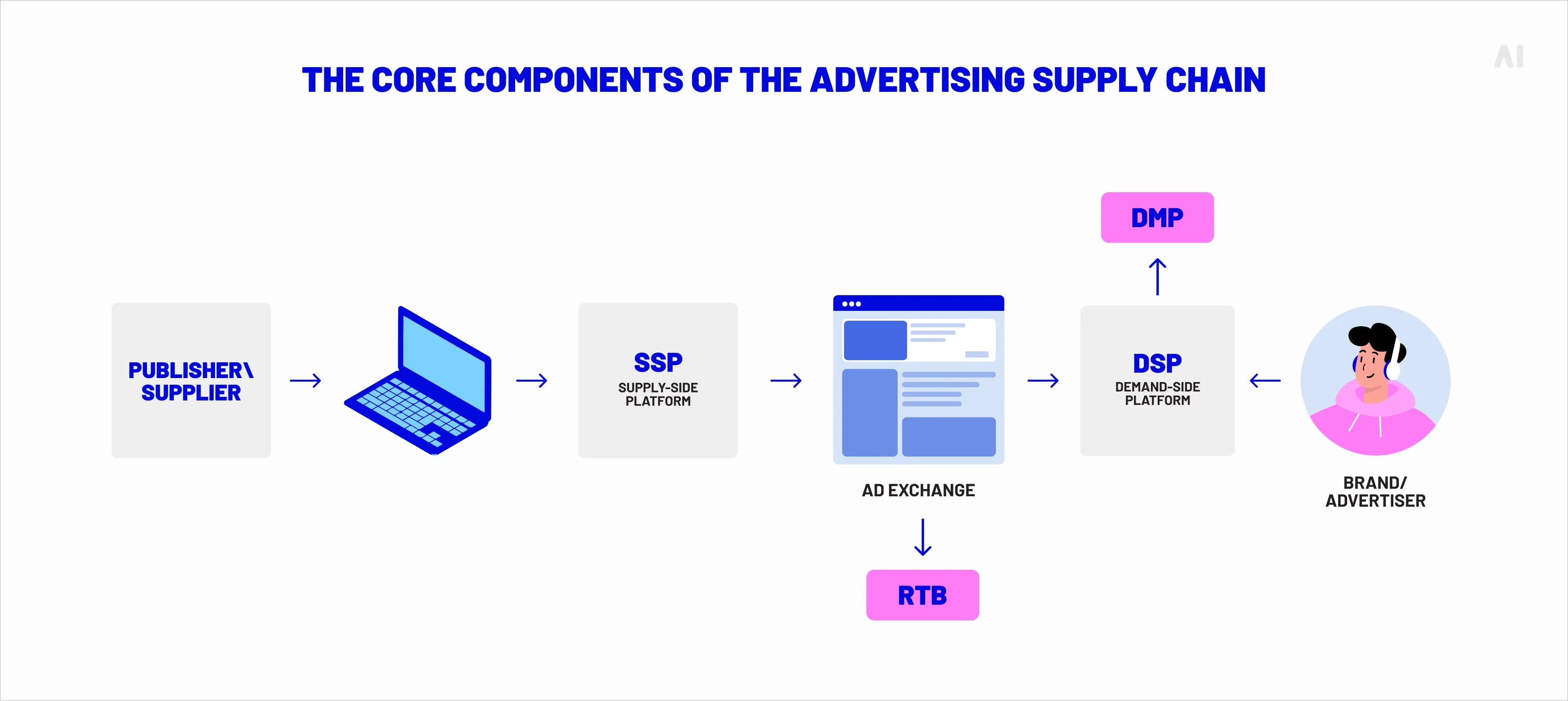
The digital advertising supply chain is built on three foundational pillars — the demand side, the supply side, and the intermediary infrastructure that connects them. Together, these components form the machinery that moves an impression from ad request to delivery, powering how programmatic advertising works at scale.
Demand side

On the “buy side,” Demand-Side Platform (DSP) solutions serve as the control center for advertisers, agencies, and media buyers. DSPs allow advertisers to automatically purchase ad impressions across a broad range of publishers — web, mobile, apps, and even connected TV — through a single interface.
When a user visits a site or app, the DSP receives a bid request (often via real-time bidding (RTB), evaluates parameters like audience targeting, budget, and desired creative, and submits a bid if the criteria match. If the bid wins, the ad is served. DSPs manage many campaign parameters — from targeting and bid strategy to frequency caps and performance tracking — making them crucial to how programmatic ads work.
💡Because DSPs link advertisers with a wide range of supply sources — across devices and formats — they play a central role in the broader digital advertising ecosystem, helping brands scale while targeting efficiently.
⚡️For more detail on this component, see our exploration of DSPs — a deep dive into how demand-side platforms actually operate, the algorithms that drive bidding decisions, and the role DSPs play in unifying targeting, frequency management, and optimization across channels.
Intermediaries and infrastructure
Between advertisers (via DSPs) and publishers lies a web of intermediaries and infrastructure such as ad exchanges, ad networks, data platforms, and other technologies, which collectively form the plumbing of the supply chain. These elements enable the flow of bid requests, audience data, auctions, and inventory access at scale.
- Ad exchanges operate like marketplaces where ad inventory is bought and sold in real time; they match supply from publishers with demand from DSPs.
- Ad networks (and older legacy networks) can also act as intermediaries, aggregating inventory from multiple smaller publishers — though modern ad-tech often brings them into the programmatic loop through exchanges or SSPs.
- Data layers/data-management platforms (DMPs or segments providers) supply targeting data (like demographics, behavior, device type), enabling DSPs to bid more precisely. This data infrastructure fuels the “data-driven” aspect of programmatic advertising.
- This infrastructure also supports the verification, measurement, and reporting of ad performance — tracking which impressions were served, viewability, clicks or conversions, and enabling feedback loops that help media buyers optimize campaigns in real time.
⚡️Because of this intermediary web, the supply chain becomes complex — but also powerful: it enables reach at scale, cross-device delivery, and granular targeting across web, mobile, apps, and CTV.
Supply side
On the “sell side,” Supply-Side Platform (SSP) is the counterpart to DSP: SSPs enable publishers, mobile-app developers, connected TV (CTV) providers, and other media owners to make their inventory available to many potential buyers simultaneously.
SSPs connect publisher inventory to ad exchanges and demand-side platforms. When a user visits a publisher's site/app, SSPs generate bid requests for available ad slots and send them to ad exchanges, where DSPs can bid. This opens each ad slot to a large pool of demand (many advertisers), helping publishers maximise yield per impression.
By handling ad auctions, floor pricing, inventory segmentation, and integration with exchanges or networks, SSPs help publishers monetize their digital real estate efficiently — while integrating into the same programmatic supply chain that advertisers use to buy ad impressions.
⚡️For a deeper dive into the role and evolution of SSPs, especially in context of supply intelligence and modern programmatic innovations — check our analysis on How Supply Intelligence Navigates Programmatic's AI Evolution.
Why the supply chain includes so many players
The digital advertising supply chain contains far more participants than a simple “buyer meets seller” model because each layer performs a specialized function that makes large-scale, data-driven advertising possible. Programmatic advertising depends on rapid decisioning, identity resolution, inventory access, verification, and safety controls — tasks no single platform can execute alone.
- Specialization of roles such as DSPs handle bidding and optimization, SSPs manage publisher inventory and yield, Exchanges coordinate auctions at scale.
- Multiple platforms help match users across devices, browsers, and environments — essential for frequency management, targeting, and measurement in the programmatic supply chain.
- Different intermediaries connect media buyers to millions of ad slots across web, mobile, apps, and CTV, increasing reach and competition.
- Multiple exchanges and pathways prevent monopolies, introduce competition, and help ensure fair market pricing.
- Data providers enrich bid requests with behavioral, contextual, or demographic insights, enabling programmatic ads to work with precision.
- Verification vendors check for viewability, invalid traffic, brand safety, and regulatory compliance (including data privacy obligations), ensuring impressions are legitimate and safe.
💡Put simply: the advertising supply chain has many players because each one contributes a crucial layer of intelligence, transparency, or protection that allows programmatic advertising to operate reliably and at scale.
How ads actually reach audiences
To understand the digital advertising supply chain, it helps to trace a single programmatic impression from the moment a user loads a page to the moment an advertiser records a measurable outcome. This is where the full machinery of the programmatic supply chain comes to life — identity resolution, inventory access, auction fairness, data activation, and safety controls all operating within milliseconds.
User visits a site or opens an app
The process begins when a user loads a webpage or mobile app. The publisher’s ad slots become available, and the system gathers contextual information (device type, placement, page URL, app bundle, consent status). This triggers the start of the programmatic ad request.
SSP processes the ad request
A Supply-Side Platform (SSP) receives the request from the publisher.
The SSP evaluates the available inventory, applies floor prices, runs fraud and quality checks, and prepares a bid request. It then sends that request to connected ad exchanges and demand-side platforms. This step ensures publishers maximize yield while maintaining quality and safety requirements.
DSP receives the bid request
The bid request reaches one or more Demand-Side Platforms (DSPs), where advanced algorithms determine whether the impression fits the advertiser’s goals. DSPs analyze audience data, historical performance, contextual signals, and campaign parameters — all in real time.
By using AI-based audience profiling and prediction, the DSP improves the chances of showing ads only to users likely to engage. This reduces wasted impressions and increases return on ad spend.
⚡️For deeper context on how AI shapes targeting and decisioning at this stage, see our analysis on AI-targeted Advertising to understand how AI-driven targeting and bidding integrate into the programmatic supply chain is key if you want to manage campaigns smartly, efficiently, and ethically.
Real-time bidding
Real-Time Bidding (RTB) remains a central pillar of the programmatic supply chain, enabling per-impression auctions that determine which ad will be shown — and at what price — in a matter of milliseconds.
- In 2024, RTB accounted for roughly 42% of the global programmatic advertising market share — underlining its dominance as a method for ad inventory buying and selling.
- According to a recent market-analysis forecast, the global RTB market was valued at around USD 14.37 billion in 2023 and is projected to grow to USD 39.61 billion by 2030, with a compound annual growth rate (CAGR) of about 16%.
- As of 2024, programmatic buying (of which RTB is a large component) was estimated to constitute over 85% of global digital display ad transactions, showing how deeply RTB and automated auctions underpin display advertising.
💡On the channel front, adoption is shifting strongly toward mobile and video: with mobile devices dominating programmatic ad delivery, RTB enables reach across device types and formats — making it especially effective where scale and flexibility are needed.
Impression delivered and measured
Once the auction is won, the ad doesn’t simply “appear” and call it a day. The final stage of the digital advertising supply chain activates a series of verification, safety, and measurement processes designed to ensure the impression is legitimate, viewable, brand-safe, and accurately recorded. This is where transparency becomes essential: each system plays a role in validating the quality of the impression and feeding performance signals back into the programmatic supply chain so future bidding becomes smarter and more efficient. The table below outlines what happens in the milliseconds after an ad is served — and why each step matters.
{{26-The-Digital-Advertising-Supply-Chain-1="/tables"}}
💡This means:
- An impression is only the starting point. After the ad loads, multiple verification layers activate to ensure the impression is real, viewable, and safe.
- Viewability matters as much as delivery. Using MRC standards, advertisers confirm that the ad was actually seen, not just served.
- Invalid traffic checks protect budgets. Fraud-detection systems filter bots, spoofed devices, and manipulated environments before impressions are billed.
The role of transparency: why standards matter
Transparency is the foundation of a healthy digital advertising supply chain. Without shared standards, advertisers can’t see where their budgets go, publishers can’t accurately value their inventory, and media buyers can’t verify whether programmatic paths are efficient or wasteful.
Transparent systems reduce hidden fees, expose fraudulent or low-quality supply, and give all parties a clearer picture of how impressions move through the programmatic supply chain. In a marketplace powered by automation and auctions, transparency isn’t optional — it’s what enables trust, accountability, and long-term performance.
Supply-side transparency standards
On the sell side, transparency ensures that advertisers understand where inventory originates, how it’s sold, and which intermediaries touch each impression. Key mechanisms include:
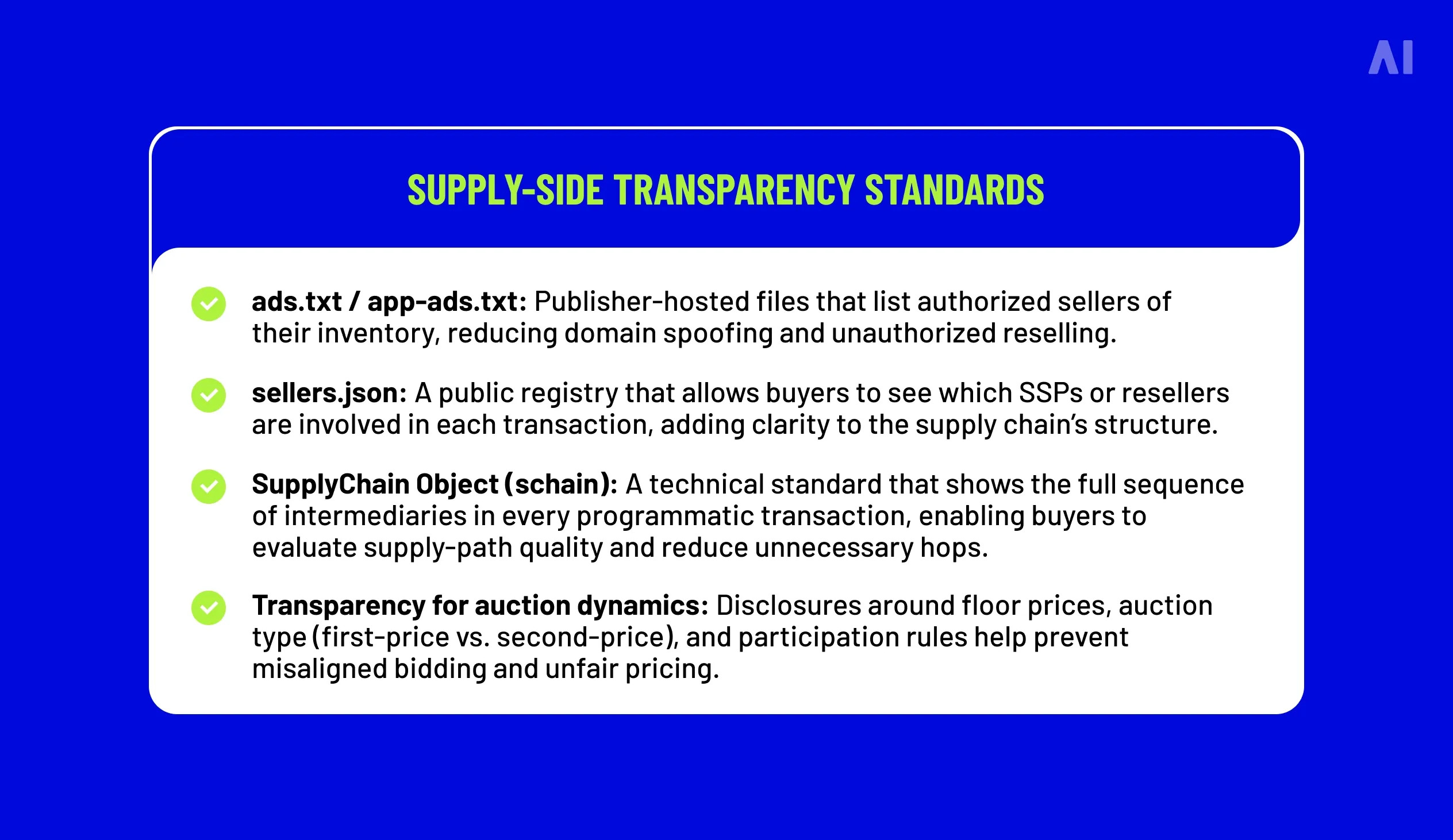
These standards help buyers enforce supply path optimization, avoid inflated tech fees, and prioritize direct, high-quality supply — strengthening both trust and efficiency.
Demand-side transparency standards
On the buy side, transparency gives publishers and advertisers visibility into how decisions are made, how data is used, and how budgets are allocated. Important areas include:
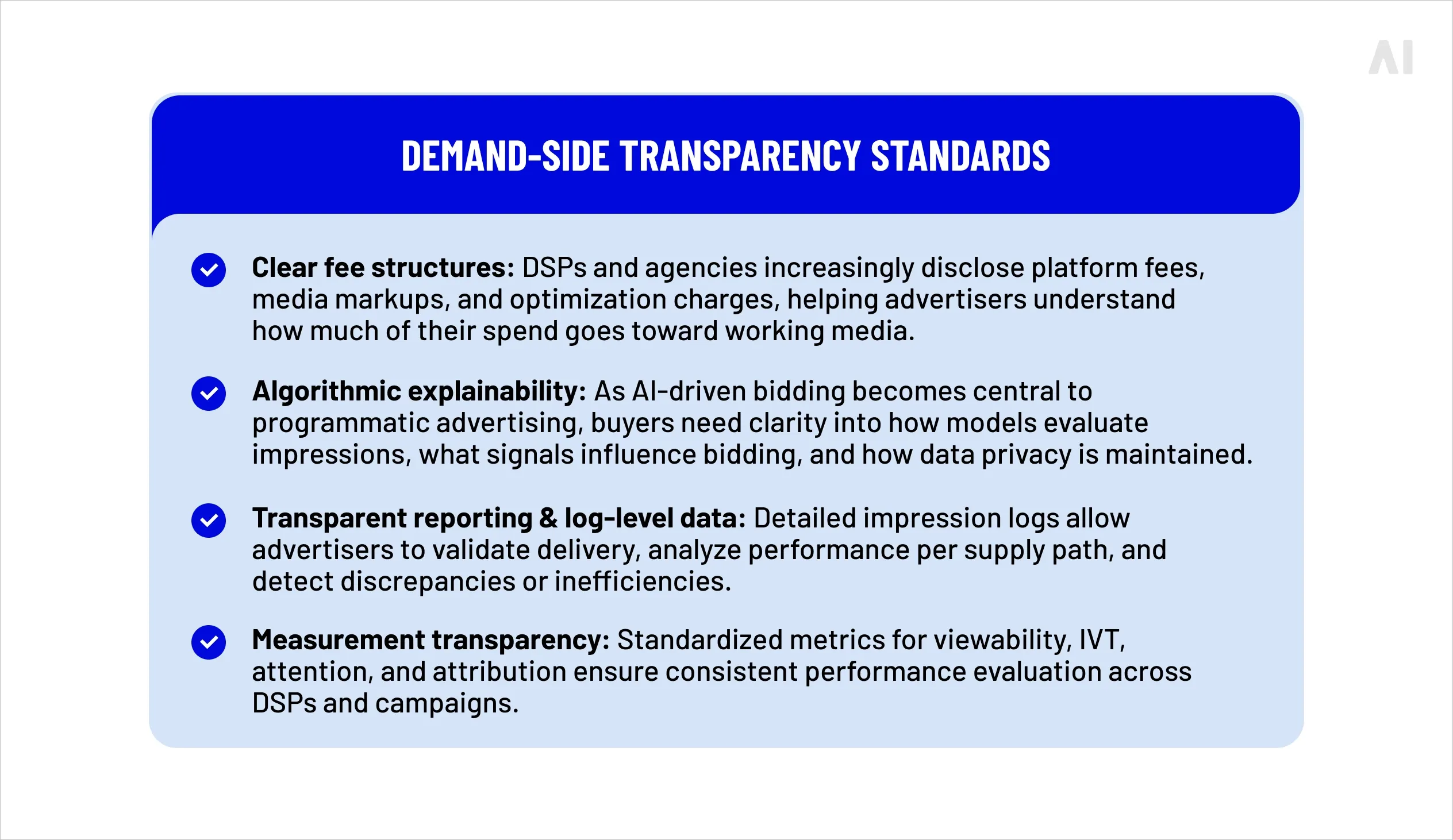
Demand-side transparency ultimately ensures that the programmatic advertising ecosystem operates fairly — reducing the risk of overspending, improving campaign performance, and fostering accountable partnerships between advertisers and their technology providers.
The hidden challenges in today’s digital supply chain
Even with all its automation and intelligence, the digital advertising supply chain carries structural challenges that affect cost efficiency, audience reach, and transparency.
Ad fraud and invalid traffic
Ad fraud remains one of the most persistent threats in programmatic advertising. Bots, spoofed domains, faked app environments, and manipulated devices can generate impressions that look real but deliver no value. Invalid traffic drains budgets, distorts performance metrics, and weakens trust across the ecosystem. Verification partners and strict supply-chain transparency standards help mitigate this risk — but fraud evolves continuously, making vigilance critical for media buyers.
Opaque fees and lack of transparency
One of the biggest cost drivers in the advertising supply chain is opacity. DSPs, SSPs, exchanges, and intermediaries may charge fees that aren’t always visible to advertisers. Without granular insight into tech fees, media markups, or auction mechanics, brands struggle to understand how much of their budget becomes working media. Transparent reporting, log-level data access, and standardized disclosure frameworks help reduce uncertainty — but achieving full clarity still requires proactive supply-path evaluation.
Supply path duplication
Because publishers often work with multiple SSPs, the same impression may reach a DSP through several parallel paths.
💡This supply-path duplication leads to inefficiency: buyers may bid against themselves, drive up auction prices, or pay unnecessary intermediary fees.
Supply path optimization is designed to identify these redundant routes and focus spend on the cleanest, most direct paths — improving cost efficiency and reducing noise in auctions.
Frequency inflation across channels
As users move across devices, browsers, apps, and connected-TV environments, the lack of unified identity resolution can cause advertisers to serve the same user far more impressions than intended. This frequency inflation results in wasted spend, poor user experience, and suboptimal performance. Managing it requires transparent identity signals, tighter control within DSPs, and clear visibility into how impressions are counted and capped across platforms.
Fragmented measurement
Measurement has become increasingly complex in a privacy-first world. Different platforms, walled gardens, and open-web environments use their own methodologies, making unified performance analysis difficult. Viewability scores, attention metrics, conversions, and attribution often live in disconnected systems.
💡Fragmentation weakens optimization: without a consistent view of performance, advertisers can’t accurately determine which supply paths deliver real value. Consolidated reporting and standardized measurement frameworks are essential to solving this issue.
How AI and automation are reshaping the digital ad supply chain
AI is transforming every layer of the digital advertising supply chain, enabling faster decisioning, leaner supply paths, stronger fraud prevention, and deeper transparency across the programmatic ecosystem. What once relied on static rules and manual optimization is now powered by models that evaluate millions of signals per second.
As the programmatic supply chain grows more complex, AI and automation provide the intelligence needed to make bidding more efficient, improve audience accuracy, and streamline how media buyers access high-quality supply.
For media buyers navigating an ecosystem filled with intermediaries, auction variables, and privacy constraints, AI delivers the strategic visibility and real-time decisioning needed to access cleaner, smarter, and more efficient supply paths.
AI-driven bid optimization
By analyzing vast pools of data — user behavior, device signals, contextual awareness, past performance — AI transforms bidding from reactive to predictive. This means each impression is evaluated in real time for its likelihood to deliver value, rather than being treated equally.
Studies of AI-based “smart bidding” strategies report meaningful gains: one recent analysis showed campaign sales increased by 23% while maintaining or improving conversion rates and margins under AI-driven bidding systems.
Especially for smaller advertisers, AI bid optimization can increase auction win-rates substantially — providing a competitive edge even with modest budgets.
💡The result: more efficient budget allocation, fewer wasted impressions, better cost-per-acquisition (CPA) or cost-per-click (CPC) — and a higher return on ad spend overall.
Predictive audience modeling
Machine-learning models can analyze browsing history, device behavior, demographic signals, contextual data, and campaign performance. This lets them infer user intent, preferences, and propensity to convert — even when explicit identifiers are unavailable.
Empirical research shows AI-powered personalization significantly improves ad relevance, engagement, and conversion rates compared with traditional broad-based targeting.
As privacy standards tighten and third-party identifiers fade, predictive modeling allows advertisers to rely on aggregated patterns and context rather than cookies — sustaining effective targeting while respecting user privacy.
Over time, as models ingest more data and feedback, audience segments become more refined and accurate — improving click-through rates, lowering wasted spend, and enhancing overall campaign ROI.
Predictive audience modeling effectively turns the digital advertising ecosystem from a scatter-shot medium into a precision instrument — displaying the right ads to the right people at the right time.
Automated supply selection (Smart Supply)
In a world where the programmatic supply chain is more fragmented than ever — with multiple SSPs, DSPs, exchanges, resellers, and varying inventory quality — Smart Supply aims to simplify and elevate the ad buying process. Rather than accepting the usual inefficiencies, biases, hidden fees, or quality risks, Smart Supply offers a streamlined, AI-driven path from advertiser demand to high-quality inventory.
Smart Supply is an AI-powered supply-side optimization & activation solution that:
- Delivers premium, outcome-based supply: Every deal ID (i.e. packaged supply offer) is built against your campaign KPIs.
- Provides direct SSP access: It connects you to top-tier supply sources (0.1% latency loss from the full pool), avoiding unnecessary resellers or intermediaries — a key factor to preserve quality and transparency.
- Uses real-time AI-powered optimization: Smart Supply filters traffic quality, adjusts deals mid-flight, and constantly refines inventory selection based on performance data.
- Maintains full transparency: Advertisers get visibility into placements, traffic sources, pricing and performance — no black-box opacity.
- Operates DSP-agnostically: That means it doesn’t matter which DSP the media buyer uses — Smart Supply works across platforms to deliver optimized supply.
This approach helps resolve many of the structural inefficiencies of traditional programmatic buying — particularly for organizations focused on cost-efficiency, brand safety, and measurable ROI.
⚡️Smart Supply streamlines the supply chain in three phases: Supply Selection, Traffic Filtering & Optimization, and Real-Time Deal Adjustment.
{{26-The-Digital-Advertising-Supply-Chain-2="/tables"}}
⚡️For advertisers, media buyers, and ad-tech professionals, this integration marks a clear shift away from fragmented, opaque programmatic processes toward a unified, data-driven supply-chain framework. By combining Smart Supply with AI Digital’s intelligence layer, the buying process becomes more transparent, more efficient, and far easier to control. The integrated solution delivers:
- Cleaner supply paths with fewer intermediaries, helping reduce unnecessary fees and eliminate redundant resellers.
- Real-time supply-path intelligence, ensuring that optimization focuses not only on bidding strategy but also on selecting the highest-quality, most cost-effective inventory routes.
- Higher-quality, brand-safe inventory, supported by continuous AI-powered filtering and verification.
- Transparent sourcing and performance visibility, giving teams the clarity needed for audits, reporting, optimization, and long-term supply-path strategy.
Real-time fraud prevention
AI strengthens fraud prevention by analyzing impression-level data the moment it appears in the bidstream. Machine-learning models evaluate behavioral patterns, device fingerprints, geographic anomalies, page integrity, and historical fraud markers to determine whether an impression is legitimate — all within milliseconds.
This real-time approach is essential for protecting programmatic budgets. Invalid traffic not only wastes spend, it makes optimization impossible: when bots act like “engaged users,” algorithms are trained on false signals.
{{26-The-Digital-Advertising-Supply-Chain-3="/tables"}}
By filtering fraudulent impressions before the bid is placed — or before the ad is served — AI ensures budgets flow only into high-quality, human, brand-safe inventory. In practice, this improves supply trust, strengthens campaign performance, and preserves the integrity of reporting and attribution across the digital advertising ecosystem.
How brands can optimize their supply chain strategy
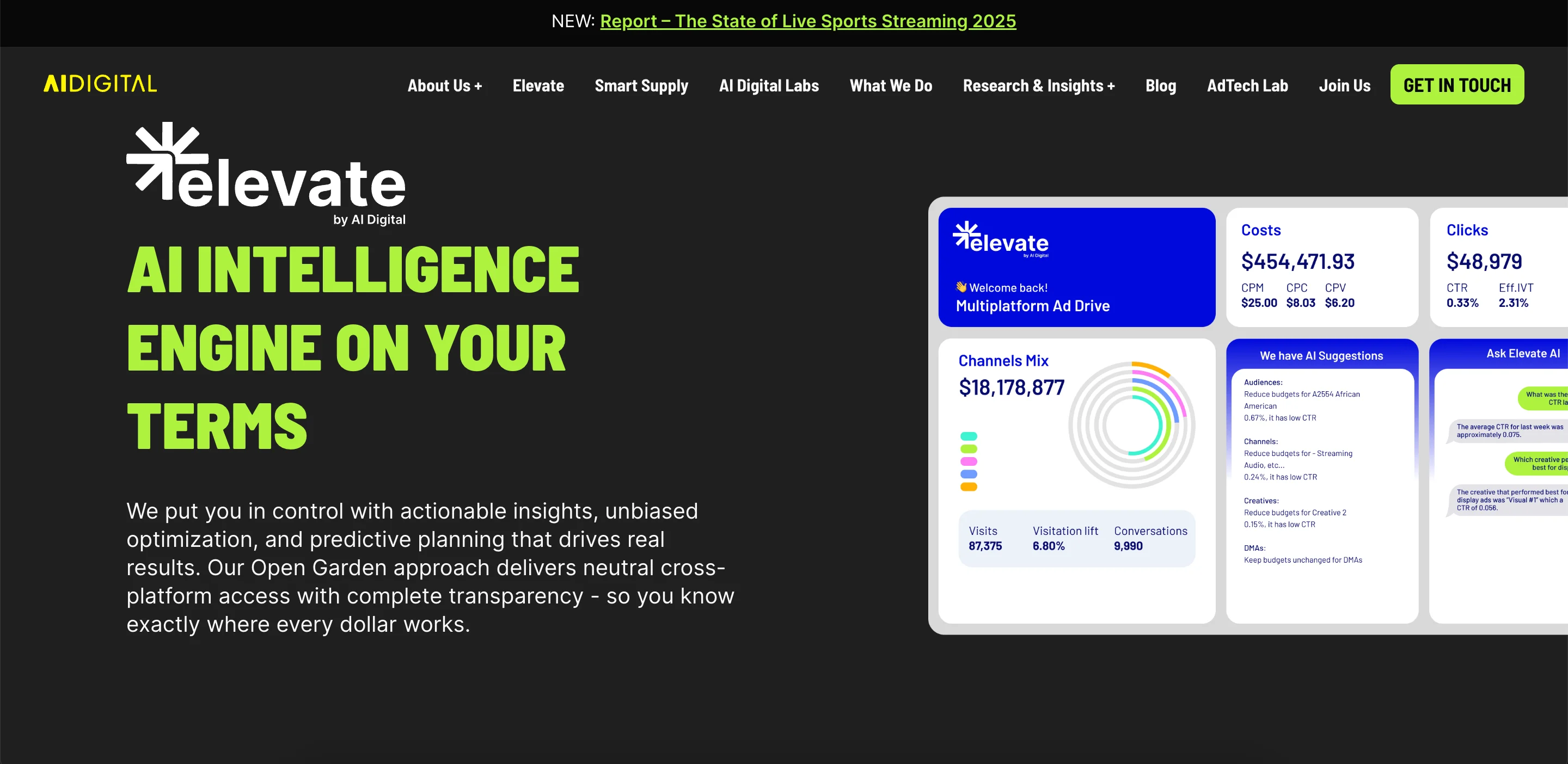
To navigate today’s complex programmatic landscape, filled with intermediaries, varied inventory quality, and fragmented data, advertisers need a clear, proactive supply-chain strategy. The right approach boosts transparency, drives efficiency, and maximizes performance.
Below are actionable steps, along with a real-world example from Elevate — an AI-powered media intelligence platform, illustrating how brands can put supply-chain optimization into practice.
⚡️Elevate is a “glass-box” AI media intelligence platform that unifies planning, optimization, and analytics under full transparency. It was built to counter the typical problems in programmatic buying — fragmented data, opaque AI decisions, and misaligned incentives across DSPs and SSPs.
Key features:
- Predictive planning & forecasting — Elevate’s planner can forecast campaign success with high confidence in seconds.
- KPI-aligned optimization, not just impressions or clicks — The optimization engine aligns spending with real business goals (e.g. conversions, revenue) instead of optimizing for superficial metrics.
- Full transparency and accountability — Every AI-powered decision or recommendation is traceable and auditable: you see “how” and “why” each action is taken.
- DSP-agnostic & cross-platform — Elevate works across multiple DSPs and supply channels, helping avoid bias or lock-in toward a specific platform’s inventory.
💡Because of these capabilities, Elevate offers a practical example of how brands today can move toward a transparent, efficient, and outcome-oriented supply-chain model.
Conclusion: A more transparent, efficient, AI-driven ad ecosystem
The modern digital advertising supply chain is no longer something marketers can afford to ignore. As budgets move deeper into programmatic channels, understanding how impressions flow — and where value is gained or lost — becomes a strategic advantage.
Transparency, clean supply paths, and accurate measurement are the foundations of smarter buying decisions. When advertisers know which intermediaries add value, which paths introduce waste, and how auction dynamics shape cost, they gain the control needed to reduce inefficiency, improve performance, and safeguard brand integrity.
💡AI accelerates this shift. With models capable of analyzing millions of signals in real time, the programmatic supply chain becomes more intelligent, more accountable, and more aligned with business outcomes.
AI elevates every stage — from bid optimization and fraud detection to supply-path intelligence and audience modeling — enabling brands to focus on strategic decisions rather than operational complexity. The next era of programmatic advertising will be shaped by platforms that combine transparent data, clean supply, and AI-powered intelligence into one unified system.
- Adopt transparent, “glass-box” intelligence platforms like Elevate to unify planning, optimization, and measurement with full visibility into how AI makes decisions.
- Leverage supply-path intelligence solutions such as Smart Supply to prioritize high-quality, direct inventory and reduce hidden tech fees.
- Align campaigns to real KPIs, moving beyond impressions and clicks toward outcomes such as conversions, revenue, and lifetime value.
- Build long-term partnerships with transparent ad-tech providers that support open standards, data integrity, and accountability.
A transparent, efficient, AI-powered ecosystem is no longer a future vision — it’s the competitive baseline. The brands that thrive will be the ones that treat the supply chain as a strategic asset, harness the power of AI responsibly, and insist on clarity at every step of the programmatic journey.