What is Real-Time Bidding (RTB): Definition, Benefits, and How It Works in 2026
_%2520Definition%252C%2520Benefits%252C%2520and%2520How%2520It%2520Works%2520in%25202026.webp)
Real-time bidding (RTB) has evolved from a niche auction mechanism into the central nervous system of modern programmatic advertising. By 2026, analysts project that 90 % of global display-ad budgets will flow through programmatic channels. Within Europe alone, the programmatic advertising market hit US$177.8 billion in 2023 and is on track for a compound annual growth rate of 23.1 % through 2030, with RTB already identified as the largest sub-segment in that region.
But what is RTB in essence? It’s the automated, impression-by-impression auction mechanism that underpins programmatic buying, allowing brands to bid for ad inventory in real time, and publishers to monetise each ad slot dynamically.
The term “real-time bidding” doesn’t just mean “fast”—it means leveraging data, algorithms and inventory optimisation to decide within milliseconds both who sees the ad and what they see. This article breaks down what real-time bidding is, how the RTB advertising ecosystem works, and why AI-driven programmatic buying has become essential for performance in 2026. It also explains how real-time bidding platforms, algorithms, and automation drive more efficient targeting, higher-quality impressions, and stronger results for both advertisers and publishers—setting the stage for the next era of real-time advertising.
What is real-time bidding (RTB)?
Real-time bidding (RTB) is an automated auction system that allows advertisers to buy digital ad impressions one at a time, in real time, as a user loads a webpage, opens an app, or streams content. Instead of purchasing ad inventory in bulk, RTB lets brands decide within 40–120 milliseconds how much each impression is worth based on data such as context, device, user behavior, predicted engagement, and campaign goals.
RTB sits at the center of programmatic advertising. According to industry projections, over 90% of global digital display spend in 2026 will occur through programmatic channels, with RTB remaining the fastest-growing buying method, particularly across mobile, CTV, and in-app inventory. This shift is driven by the increasing precision of machine-learning models, which now evaluate thousands of signals per auction to determine the optimal bid in real time.
In practice, the real-time bidding process involves three core components:
- Real-time bidding platforms (DSPs) where advertisers set budgets, targeting, and bidding strategies.
- Supply-side platforms that connect publisher inventory to RTB ad exchanges.
- The RTB auction itself, where bids compete and the highest bid wins the impression—at the best achievable price.
RTB in advertising has become central to performance-driven marketing because it improves both efficiency and relevance. Advertisers gain more control over cost and audience quality, while publishers benefit from stronger competition, higher yield, and better monetization of premium inventory.
⚡️For a deeper comparison of RTB vs. other programmatic buying methods, see the full overview, which includes detailed breakdowns of open-auction RTB, private marketplaces (PMPs), programmatic guaranteed deals, and more.
💡Advanced real-time bidding algorithms now predict user value, optimize creative variations, and adapt bids dynamically. This evolution is why RTB ads consistently outperform traditional placements in both ROAS and cost efficiency, and why RTB remains the backbone of modern programmatic marketing.
How real-time bidding works (step-by-step)

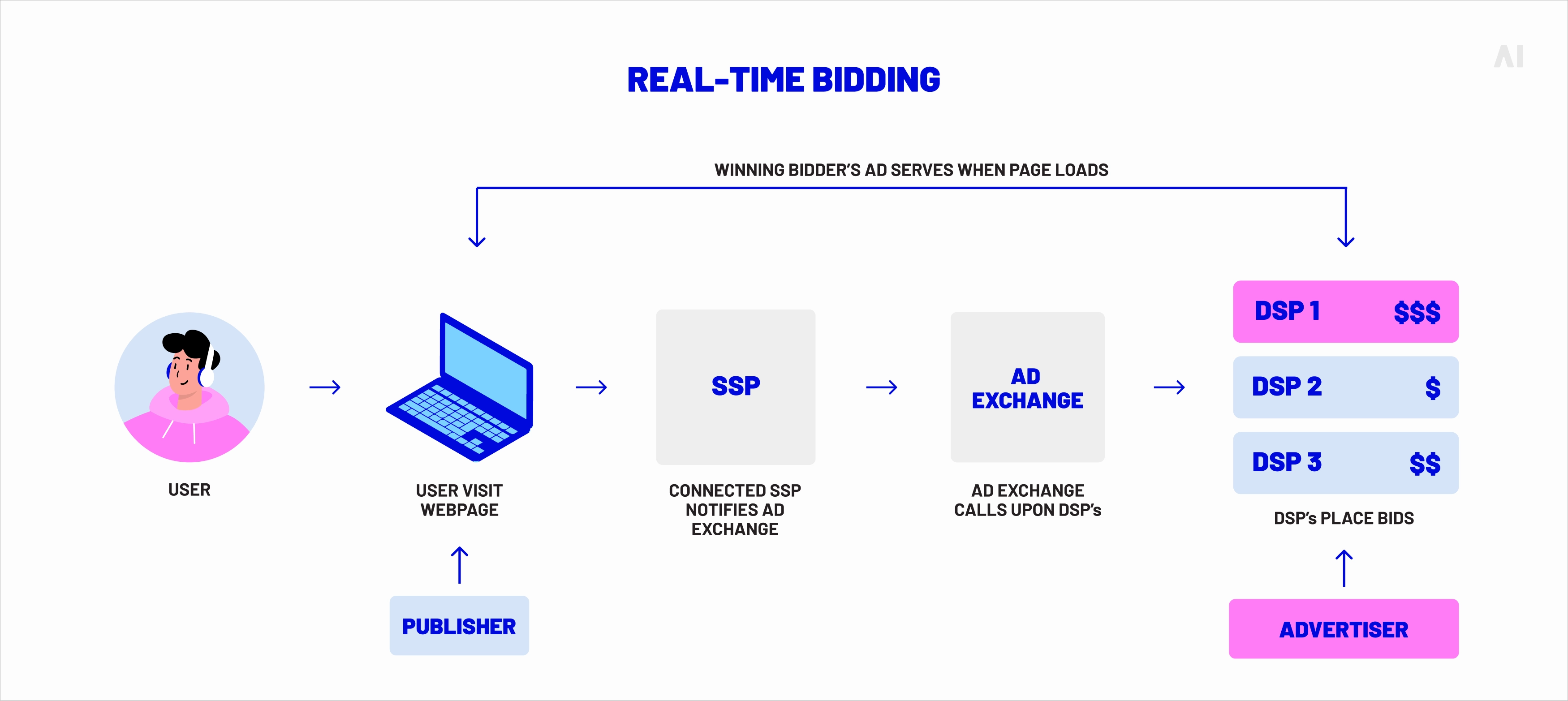
RTB (real-time bidding) works like a lightning-fast marketplace that opens and closes every time a user lands on a page, scrolls a feed, or loads an app. In the split second it takes the content to appear, a full real-time bidding auction unfolds behind the scenes—data signals are gathered, the impression is evaluated, DSPs decide whether to compete, and bids are placed across multiple real-time bidding platforms.
1. A user visits a website or app
When a user loads a webpage, enters an app, or starts a video stream, an available ad slot becomes eligible for a real-time bidding auction. At this moment, the publisher’s site or app sends contextual information, such as page category, device type, screen size, and privacy-compliant user signals, into the RTB system. This is when bidding in digital marketing begins at the impression level.
2. Publisher sends an ad request via an SSP
The publisher’s supply-side platform (SSP) packages the impression and forwards it to multiple RTB ad exchanges. The SSP ensures the inventory is visible to demand sources and enforces rules such as floor prices, creative restrictions, brand-safety filters, and fraud checks. This step drives RTB demand by making each impression available to programmatic buyers in real time.
3. DSP evaluates available impressions and bids
Advertisers access inventory through demand-side platforms (DSPs), which use real-time bidding algorithms to decide whether to bid on the impression and at what price. Factors include audience targeting, contextual relevance, expected engagement, campaign pacing, and predicted conversion value.
💡Advanced DSPs now also use AI to forecast impression quality, adjust bidding time dynamically, and optimize for cross-channel placements, including mobile RTB and CTV.
4. The highest bidder wins the auction
Once the RTB auction closes—typically in under a tenth of a second—the highest bid that meets the publisher’s requirements wins. Most RTB advertising platforms now run first-price auctions, meaning the winning advertiser pays exactly what they bid. The shift from second-price to first-price auctions has pushed DSPs to rely more heavily on bid-shading and predictive RTB software to avoid overpaying.
5. The winning ad is served instantly
The SSP delivers the winning creative back to the publisher, and the ad appears on the user’s screen in real time. From the user’s perspective, this process is invisible—yet behind the scenes, multiple real-time bidding platforms, RTB software systems, and programmatic partners have evaluated the impression, placed bids, and selected the most relevant ad within milliseconds.
💡 This entire chain defines what RTB is in marketing: a fast, automated, data-driven ecosystem where each individual impression is priced and purchased in the moment. It’s the backbone of real-time advertising and remains the most efficient method for scalable, precise programmatic RTB buying.
RTB vs. programmatic buying
Real-time bidding (RTB) is a subset of programmatic buying—not the whole system. Programmatic advertising includes every method of automated media buying: preferred deals, private marketplaces, programmatic guaranteed, and fixed-price agreements. RTB, by contrast, refers specifically to auction-based buying, where each impression is evaluated and priced in real time.
In simple terms:
- Programmatic = the entire automated ecosystem
(DSPs, SSPs, data, algorithms, multiple deal types)
- RTB = the auction rail inside that ecosystem
(millisecond-level bidding, impression-by-impression pricing)
Programmatic buying can therefore involve RTB auctions, but it can also use non-auction contracts with fixed CPMs or guaranteed volumes. Most advertisers blend both—using programmatic guaranteed for premium inventory, and RTB in marketing for scalable reach and real-time optimization.
{{what-is-RTB-1="/tables"}}
⚡️ For a full breakdown of how real-time bidding compares to the broader programmatic ecosystem, including deal types, pricing structures, transparency levels, and when advertisers should choose one approach over the other—you can explore our complete guide on Programmatic vs. RTB.
Types of real-time bidding
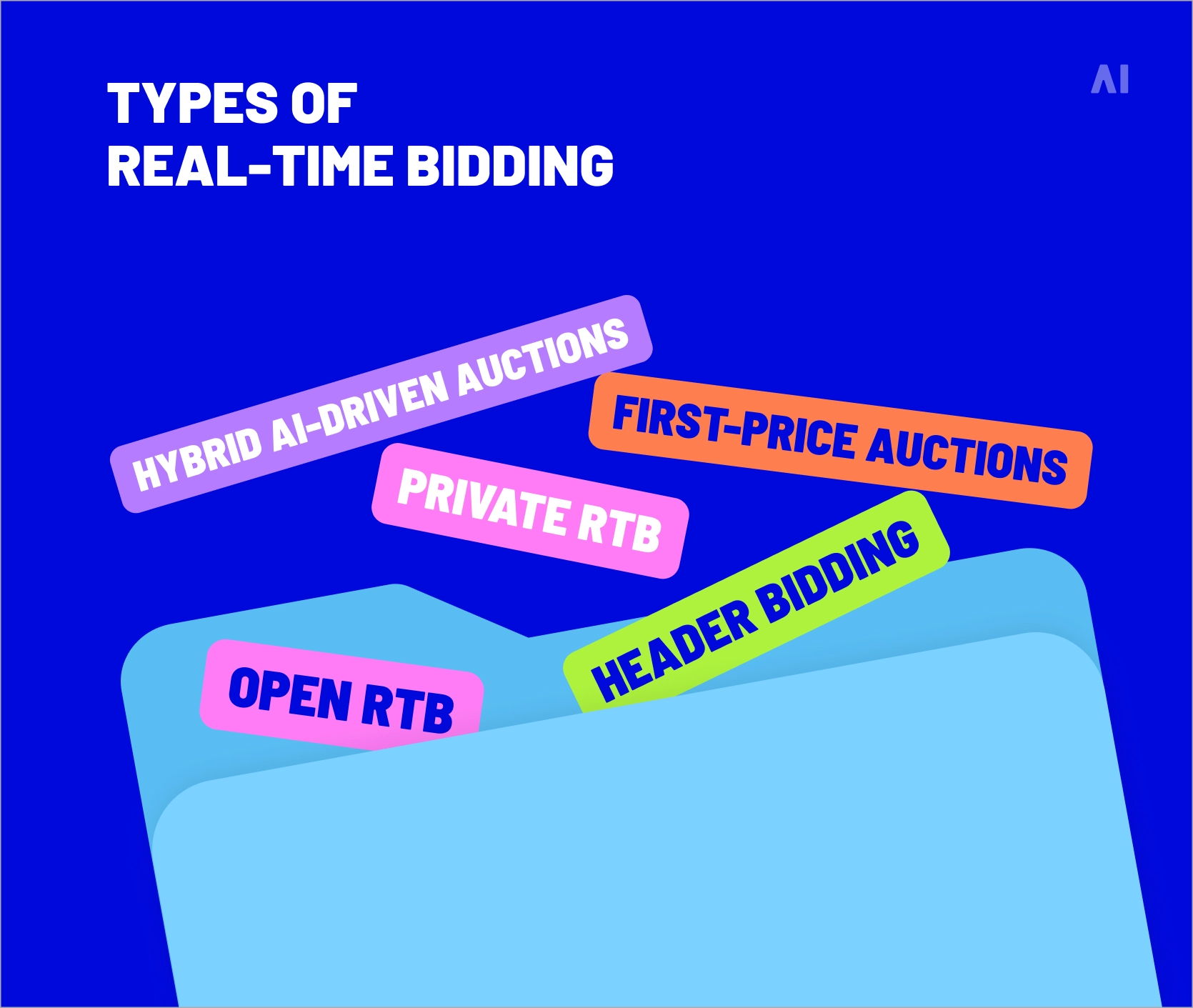
Real-time bidding now operates across several auction models, each designed to balance scale, control, and price efficiency. In 2026, advertisers often use a mix of these RTB formats depending on campaign goals, audience quality, and inventory availability.
Open RTB
Open RTB takes place on public real-time bidding exchanges where any qualified buyer (via a DSP) can bid on available impressions. It offers maximum scale, competitive CPMs, and access to a wide range of inventory across display, video, mobile apps, and CTV. This model is ideal for performance-driven RTB buying, retargeting, and broad reach.
Private RTB (PMP)
Private marketplaces operate on an invite-only basis. Publishers allow select advertisers to access premium inventory before it reaches the open market. PMP deals provide more transparency, stronger brand safety, and higher viewability — making Private RTB popular for brand campaigns, premium publishers, and controlled supply paths.
Header bidding
Header bidding sends each impression to multiple SSPs and exchanges simultaneously, rather than relying on a traditional waterfall sequence. This creates more competition, increases publisher revenue, and gives advertisers fairer access to top-tier placements. Header bidding is now standard across major news sites, video platforms, and CTV apps.
First-price vs. second-price auctions
Most RTB ad exchanges have fully transitioned to first-price auctions, where the winning advertiser pays exactly what they bid. Second-price auctions—where the winner paid slightly above the second-highest bid—were once common, but they now exist mostly in legacy systems.
First-price auctions require DSPs to use smarter bidding algorithms and bid shading to avoid overspending, making RTB strategies more reliant on machine learning.
{{what-is-RTB-2="/tables"}}
Hybrid auctions (emerging model)
Hybrid RTB auctions blend first-price mechanics with adaptive, AI-driven rules. These systems evaluate competition level, impression quality, and predicted ROI, then adjust pricing dynamically. Hybrid auctions are becoming more common in CTV and in-app environments where impression value fluctuates significantly.
Key components of RTB ecosystem
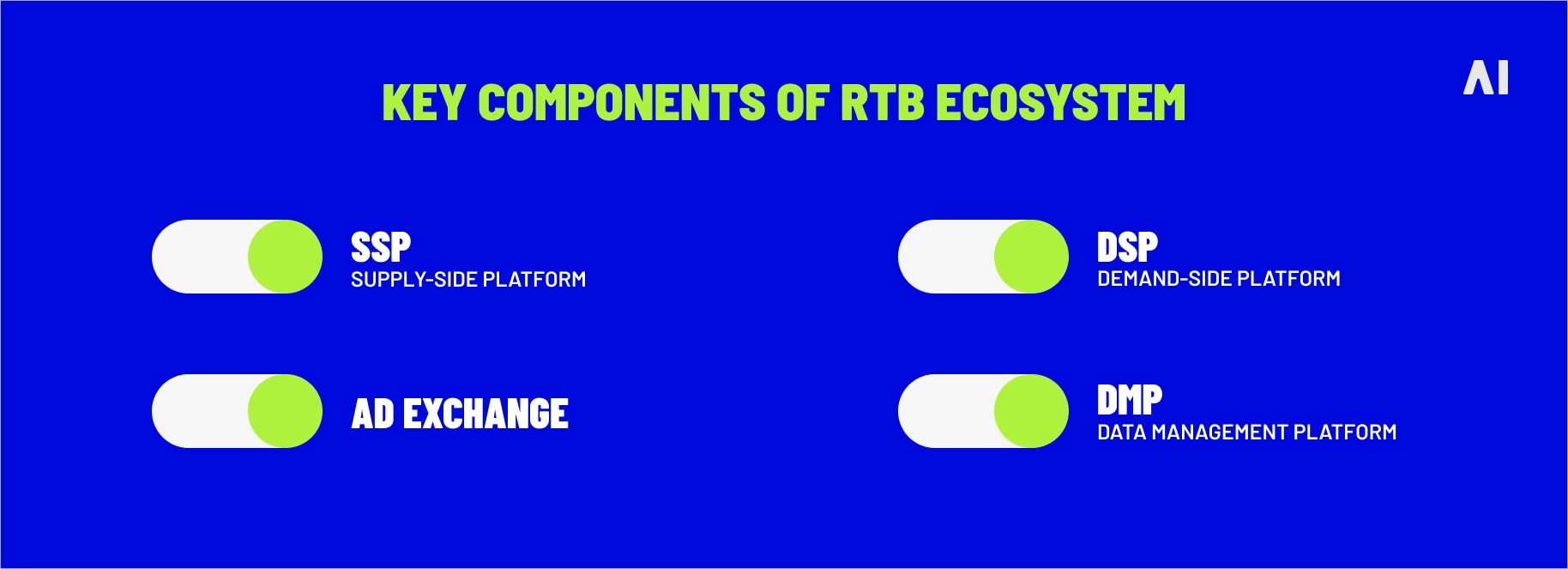
RTB works because several platforms connect advertisers, publishers, and data signals in real time. Each component plays a specific role in the real-time bidding process.
Supply-Side Platform (SSP)
SSPs manage publisher inventory and make impressions available for auction. They enforce floor prices, apply brand-safety filters, run fraud checks, and route impressions to RTB ad exchanges. SSPs ensure that each ad opportunity reaches the right buyers at the right moment.
Demand-Side Platform (DSP)
DSPs are where advertisers set campaign goals, budgets, targeting, and bidding strategies. The DSP evaluates each impression and uses real-time bidding algorithms to decide whether to bid—and at what price—based on contextual signals, audience fit, predicted conversion value, and pacing constraints.
💡Modern DSPs rely heavily on machine learning to process millions of bid requests per second, score impression quality, apply bid shading, and optimize spending across channels such as mobile, display, video, and CTV.
⚡️For a deeper look at how AI improves DSP accuracy and efficiency—including predictive bidding, creative optimization, automated pacing, and impression-level value scoring—you can explore the full breakdown here on AI in DSPs.
Ad exchange
The ad exchange is the central marketplace where SSPs and DSPs interact. It hosts the real-time bidding auctions, receives bids from multiple demand sources, evaluates them against publisher rules, and selects the winning advertiser in milliseconds. Ad exchanges sit at the heart of RTB, enabling the rapid matching of supply and demand across millions of impressions per second while maintaining auction logic, transparency rules, and fraud filtering between both sides of the ecosystem.
⚡️ For a deeper explanation of how ad exchanges differ from DSPs and SSPs, including their roles, data flows, and how each platform contributes to the RTB supply path, you can explore our full guide here on DSP vs. SSP vs. Ad Exchange.
Data Management Platform (DMP)
The DMP stores and organizes audience data—first-party, second-party, and third-party—used in RTB targeting. It helps advertisers build audience segments, enrich user profiles, and activate data across real-time bidding platforms. Although privacy regulations have changed how DMPs operate, they still play a major role in contextual, interest-based, and predictive audience modeling.
Top real-time bidding platforms
The table below highlights the major real-time bidding platforms shaping the programmatic ecosystem in 2026, outlining how each DSP or exchange contributes to scale, data quality, AI optimization, and cross-channel performance. These platforms, ranging from enterprise solutions like DV360 and The Trade Desk to powerful supply-side players such as Magnite and PubMatic, form the backbone of modern RTB buying across display, mobile, CTV, video, and commerce-driven environments.
{{what-is-RTB-3="/tables"}}
⚡️For a deeper look at the broader ecosystem and the technologies shaping it, you can also explore our article Best Programmatic Advertising Platforms 2025.
Why RTB matters for advertisers in 2026
Real-time bidding (RTB) has become a core part of programmatic advertising, shaping how brands buy media across web, in-app, CTV, and mobile RTB environments. With the rise of real-time bidding platforms and advanced RTB algorithms, advertisers rely on the RTB system to automate buying, refine targeting, reduce costs, and maintain transparency across every impression.
Automation and efficiency
RTB buying automates the entire real-time advertising workflow, allowing advertisers to evaluate and bid on individual impressions within milliseconds. This level of automation has scaled massively: by 2026, over 90% of global digital display spend is projected to run through programmatic channels, with RTB powering the majority of these transactions. With millions of bid requests processed per second, RTB software reduces manual work, speeds up optimization, and improves overall campaign performance.
Targeting precision
RTB in marketing stands out for its ability to match impressions with detailed audience data in real time. User behaviour, device type, context, and location all inform the bid decision during each real-time bidding auction. Research shows that synchronized data-sharing can raise impression value by 19%, highlighting how crucial high-quality data is in RTB advertising. As cookies fade, programmatic RTB and contextual models make targeting sharper—improving engagement and reducing wasted impressions.
Cost-effectiveness and ROI
Real-time ad bidding offers cost control because advertisers only bid when an impression meets their criteria. Programmatic and RTB channels—now representing 80–90% of all global display spending—are designed to optimize prices dynamically, helping brands avoid overspending. When paired with strong creative, first-party data, and proper KPI tracking, RTB ads consistently deliver higher ROI through lower CPA, better ROAS, and more efficient budget allocation.
⚡️For deeper performance insights and to see which indicators actually move revenue and efficiency—explore our full guide: 15 Essential Digital Marketing KPIs to Track (and Improve) in 2026.
Transparency and control
As RTB demand rises, so does the need for supply-chain clarity. Modern RTB advertising platforms offer domain-level reporting, supply-path optimization, real-time metrics, and fraud-prevention tools. The European programmatic market—forecast to reach USD 203.18 billion by 2032—is shifting toward stricter transparency standards. This gives advertisers more control over where RTB ads appear, how much they pay, and which RTB ad exchanges or SSPs deliver the best performance.
Disadvantages and challenges of RTB
Real-time bidding (RTB) brings huge advantages in automation and efficiency, but it also introduces structural challenges that advertisers must manage carefully. As the RTB ecosystem becomes more complex—with more intermediaries, more data signals, stricter regulation, and higher competition—the risks increase. Understanding these challenges early helps advertisers build strategies, tools, and processes that stabilize performance and protect budgets.
Privacy and compliance (GDPR, CCPA, cookie deprecation)
Privacy regulations deeply affect how the RTB system works. Under GDPR and CCPA, every data point passed during real-time bidding auctions—device IDs, location data, audience segments—must be collected and shared legally. The challenge is that RTB in marketing involves multiple intermediaries. When a bid request is sent to an RTB ad exchange or SSP, the advertiser becomes responsible for ensuring that every partner handles data correctly. As cookies disappear and browsers block cross-site tracking, the traditional RTB definition of audience targeting becomes harder to execute. This weakens signal quality, increases acquisition costs, and affects how RTB algorithms evaluate users in milliseconds of bidding time.
Brand safety and ad fraud
Because RTB buying moves at extreme speed, the RTB system does not always filter out unsafe or fraudulent inventory in time. Real time bidding advertising can unintentionally place RTB ads on low-quality sites, misinformation pages, or environments that don’t align with a brand’s values. Ad fraud — bots, spoofed domains, invalid traffic—remains a major challenge for every RTB advertising platform and RTB software provider. Fraud distorts bidding time signals and makes advertisers pay for impressions that never reach real humans.
The solution is to build multi-layer protection: pre-bid brand-safety filters, supply-path optimization, fraud-prevention partners, and allowlists for trusted inventory. Examining log-level data helps detect anomalies like unusual click-through rates or suspicious bidding patterns. Choosing transparent real-time bidding platforms and reliable RTB ad exchange partners greatly reduces fraud exposure. While no RTB product can eliminate all risk, a strong verification framework keeps budget focused on high-quality impressions and protects your RTB in advertising strategy.
Latency and performance issues
The real time bidding process relies on ultra-fast response times. Every RTB ad exchange sends bid requests that must be evaluated in milliseconds; if the RTB algorithm responds late, the bid is ignored. High latency caused by slow servers, long supply paths, or overloaded DSPs—reduces win rates and raises CPMs. In periods of heavy RTB demand, performance issues disrupt pacing and reduce campaign reach, especially in mobile RTB environments where milliseconds matter most.
Improving performance requires strong infrastructure: server-side bidding, edge computing, geographically distributed data centers, and fewer intermediaries. Supply-path optimization shortens the route between SSPs and DSPs, lowering delays and improving real time advertising accuracy. Evaluating RTB software based on bid-response speed and reliability helps advertisers scale smoothly across formats. A robust, low-latency RTB system ensures that RTB buying remains efficient, competitive, and stable even during high-volume real-time bidding auctions.
No guaranteed placements
One structural challenge in real time bidding advertising is the absence of guaranteed impressions. RTB programmatic buying is fully auction-based: advertisers compete impression by impression, and nothing ensures they will win. When RTB demand spikes—during holidays or major events—premium inventory becomes more expensive, and smaller budgets may fail to win auctions. This unpredictability makes planning reach, frequency, and delivery more complicated for brands relying heavily on RTB in marketing.
How AI and automation enhance RTB
As real-time bidding (RTB) evolves, artificial intelligence has become the driving force behind modern programmatic RTB optimisation. The shift from manual bidding to AI-powered automation has transformed how advertisers evaluate impressions, model audiences, detect fraud, and manage overall campaign efficiency. Today’s RTB system no longer relies on human intuition—AI algorithms process billions of data points per day, making faster and more accurate decisions than any manual team ever could.
.webp)
⚡️This evolution is part of a broader rethink happening across the programmatic ecosystem. AI Digital, a leader in programmatic strategy and real-time bidding innovation, explores this transformation in depth in its dedicated industry guide, Rethinking the Value Proposition of DSPs in Today’s Programmatic Landscape.
A core part of this transformation is Smart Supply, an AI-powered programmatic media buying and supply-path solution from AI Digital that delivers premium, outcome-based supply through transparent, high-quality inventory.
- Outcome-based deal IDs: Every supply deal is optimised for your campaign KPIs.
- Direct SSP access: 99.9% coverage from top-tier supply sources to ensure quality.
- Real-time AI optimisation: Live traffic filtering, in-flight deal adjustments and full transparency.
- DSP-agnostic execution: Works across platforms, eliminating bias and hidden mark-ups.
💡 Smart Supply matters because it solves some of the biggest inefficiencies in today’s fragmented programmatic ecosystem. When supply paths are cluttered with unnecessary intermediaries, hidden resellers, and low-quality inventory, media budgets are wasted on inflated bid streams and impressions that never deliver real value. Smart Supply eliminates these issues by providing unbiased, fully transparent supply routes that cut out redundant hops, lower CPMs, and redirect spend toward high-performance inventory.
Smart bidding algorithms
AI-powered bidding algorithms evaluate every impression in milliseconds, analysing user intent, contextual signals, device data, and historical performance to decide the optimal bid. Smart Supply strengthens this process by feeding the algorithm cleaner, higher-quality supply paths. When the system only receives verified, transparent, and fraud-free inventory, the bidding engine can make far more accurate decisions. Because Smart Supply removes inefficient hops, hidden-fee resellers, and low-quality SSPs, the bidding algorithm gets a clearer understanding of real impression value. This improves bid forecasting, reduces wasted spend, and increases the probability of winning premium placements at competitive prices. The result is an RTB environment where AI can operate with sharper signals, stronger data integrity, and higher bidding efficiency.
Predictive analytics and audience modeling
Predictive analytics and audience modeling rely on the quality of the underlying supply. AI models can only forecast engagement or conversion likelihood accurately when the impressions themselves come from clean, consistent, and transparent sources.
Smart Supply enhances this by prioritising inventory from SSPs and exchanges with strong user-quality and performance histories. With its filtering the supply chain, predictive systems work with more reliable data—cleaner user behaviour patterns, higher match rates, and more authentic engagement signals. This allows AI to model audiences with greater precision and forecast conversions more accurately. Smart Supply essentially removes “noise” from the dataset, giving predictive algorithms the clarity needed to target high-value impressions and build stronger, AI-driven RTB audiences.
Fraud detection and brand safety
AI-based fraud detection protects advertisers by identifying bots, spoofed domains, and invalid traffic before a bid is placed. Smart Supply amplifies these protections by cleaning the supply chain upstream, eliminating low-credibility sources before they even enter the auction. While AI guards the signal layer, Smart Supply reinforces the inventory layer—blocking unsafe or suspicious supply paths entirely.
This two-layer approach significantly reduces exposure to fraudulent impressions. By working only with vetted SSPs and exchanges, Smart Supply ensures that AI risk-scoring models evaluate impressions that already meet a higher baseline of authenticity. It also improves brand safety by removing inventory associated with harmful, sensitive, or unreliable environments, ensuring that RTB ads appear only in contexts that align with brand standards. Combined, AI and Smart Supply deliver a safer, more transparent, and more trustworthy RTB experience.
{{what-is-RTB-4="/tables"}}
RTB pricing and CPM ranges
RTB pricing is determined by a mix of factors, including audience targeting depth, market competition, placement quality, supply-path efficiency, and the type of creative being used. CPMs can vary significantly across formats—display generally remains the most affordable, video commands higher prices due to stronger engagement, and CTV sits at the premium end of the spectrum because of its high-impact inventory and limited supply. Below is an approximate view of typical CPM ranges across RTB channels.
{{what-is-RTB-5="/tables"}}
Conclusion: how RTB fits into the modern programmatic ecosystem
Real-time bidding has become the backbone of today’s programmatic ecosystem — fast, transparent, and increasingly shaped by AI-driven optimisation. RTB gives advertisers instant access to billions of impressions across display, mobile, video, audio, and CTV, while intelligent bidding algorithms assess each opportunity in milliseconds. But success in RTB doesn’t come from speed alone. It relies on aligning DSP capabilities, high-quality data, supply-path transparency, and consistently optimised creative. That’s where solutions like Smart Supply and Elevate play a transformative role: Smart Supply secures clean, premium, outcome-driven inventory across the supply chain, while Elevate enhances performance with AI-powered optimisation, audience intelligence, and cross-channel insights. Together, they streamline the entire programmatic workflow, giving advertisers a clearer path to stronger ROI across every channel.
For brands ready to strengthen their RTB strategy, here are four practical takeaways:
- Prioritize supply quality, not just scale. Cleaner inventory and transparent supply paths improve bid efficiency, engagement, and overall performance.
- Feed your DSP with high-quality data. First-party data, contextual insights, and privacy-safe identifiers give AI models the accuracy they need to optimise bids.
- Optimise creative for real-time environments. Strong, adaptive creative drives better results when bidding algorithms can instantly match message to audience intent.
- Combine automation with strategic oversight. AI handles bidding, pacing, and modelling, but human direction ensures alignment with brand goals, KPIs, and market conditions.
RTB is an intelligent engine at the centre of modern programmatic advertising. When supported by the right tools and supply infrastructure, it becomes one of the most powerful levers for scalable, sustainable growth in digital marketing.