Best Programmatic Advertising Platforms: How to Choose the Right Stack

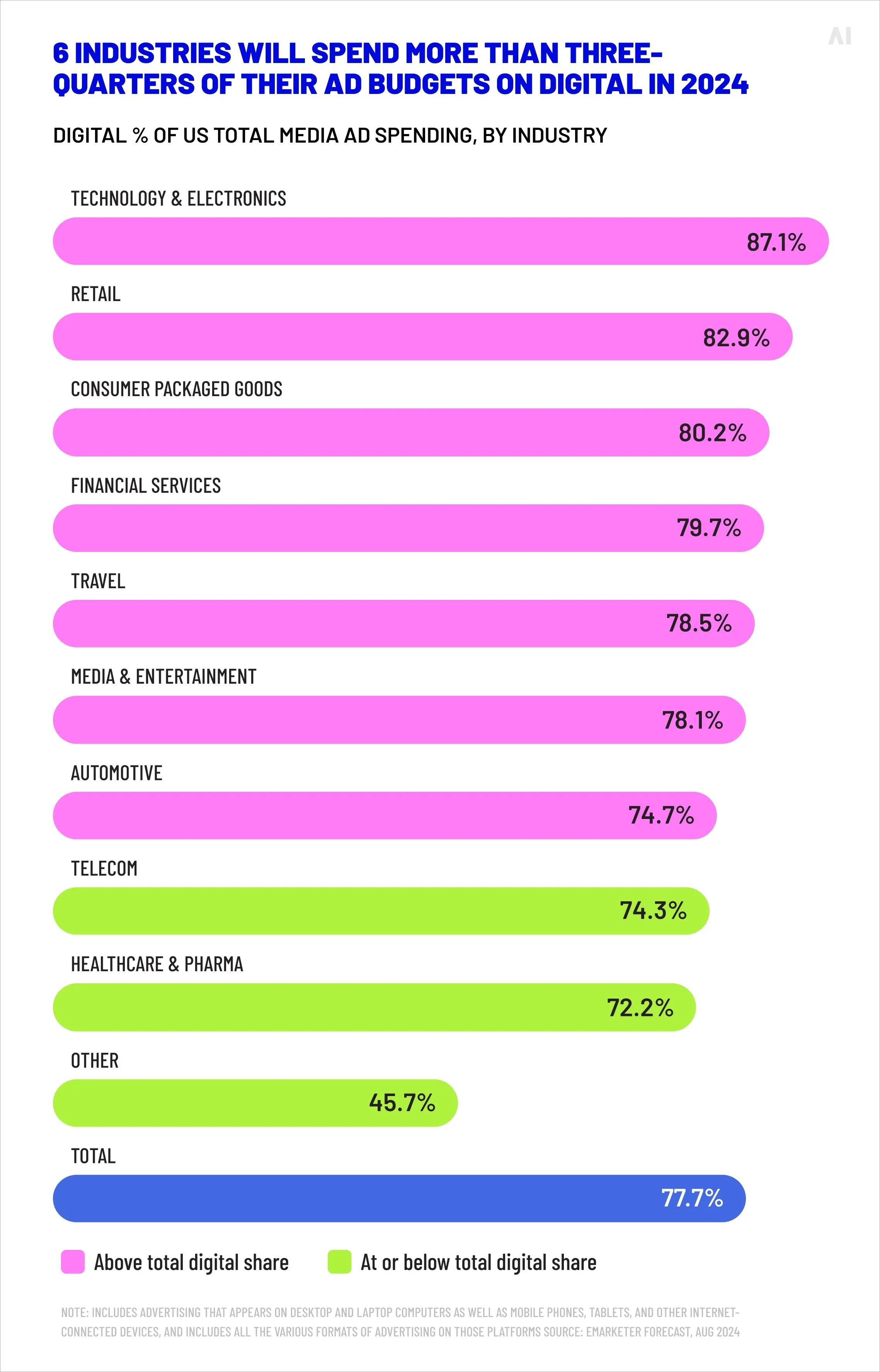
Audience attention is fragmented across mobile, CTV, social, retail media, and the open web. Programmatic advertising platforms stepped in first as simple real-time bidding tools and have since become the central nervous system of digital advertising. They now control most of how digital display budgets move: programmatic accountув for more than 90% of US digital display ad spend in 2024.
That sheer scale is why the stakes are high. The best programmatic advertising platforms don’t just place ads; they decide which impressions are worth paying for, which audiences you can reach, and how much of your budget survives the supply chain to become real, viewable media.
This guide is for marketers, digital strategists, media buyers, and brand leaders who want a clearer view of:
- What a programmatic advertising platform actually does
- How different platform types (DSPs, SSPs, DMPs, CDPs, ad exchanges, ad networks, and full-stack tools) fit together
- How to evaluate the best programmatic advertising platforms for your stack
- How AI is reshaping programmatic planning, bidding, creative, and fraud prevention
💡 If you want a broader primer before we get technical, you can also read AI Digital’s overview of programmatic advertising and then come back to this deeper dive.
⚡ A strong programmatic stack is less about having every tool, and more about choosing the tools that work well together.
What is a programmatic advertising platform?
A programmatic advertising platform is software that automates the buying and selling of digital ad inventory using real-time data and AI models instead of manual negotiations and insertion orders. Programmatic ad platforms:
- Evaluate billions of impressions in milliseconds
- Decide whether to bid, how much to bid, and which creative to show
- Deliver the ad and send performance data back into the system
⚡ If you only remember one thing, remember this: a programmatic platform is decisioning software. Its real power lies in how it chooses each impression, not just in how many impressions it can buy.
Different programmatic platforms are built for different roles in the ecosystem:
- Demand-side platforms (DSPs) for buyers
- Supply-side platforms (SSPs) for publishers
- Ad exchanges as neutral marketplaces
- Data platforms (DMPs, CDPs) to manage and activate audience data
- Ad networks and full-stack platforms that bundle multiple functions
{{Best-Programmatic-Advertising-Platforms-1="/tables"}}
Collectively, these programmatic buying platforms give marketers precision, scale, and control across display, video, audio, CTV, DOOH, and more.
Key benefits of programmatic advertising platforms
Done right, programmatic advertising platforms turn fragmented media buying into a measurable, optimizable system. Below are the core benefits, with a focus on practical outcomes you can take to your CFO or CMO.
Streamlines media buying
Programmatic media buying platforms drastically reduce the operational load of running campaigns. Instead of multiple insertion orders, emails, and spreadsheets, your team configures campaigns in a single UI and lets the platform execute buys across hundreds of publishers.
A programmatic advertising platform can:
- Centralize campaign setup, pacing, and frequency caps
- Remove manual trafficking and reconciliation work
- Automate budget shifts between line items and audiences
💡 If you want to go deeper into the mechanics of planning vs. buying, check out AI Digital’s guide, What are media buying and planning, and how do they work?
⚡ If your team is still managing media in spreadsheets, your competitors’ algorithms are already a few steps ahead.
Delivers ads to target audiences
Programmatic ad platforms excel at matching messages to people, not just pages. Instead of buying a generic placement on a single site, you can build audience segments and reach them wherever they happen to be.
Typical use cases include:
- Retargeting site visitors with product ads
- Prospecting with lookalike audiences derived from converters
- Layering contextual, demographic, and behavioral data to create intent segments
⚡ The real test of a targeting strategy isn’t how many people you reach—it’s how many of the right people you reach at a cost that still makes sense for your business.
Leading programmatic marketing platforms combine first-party data, publisher signals, and third-party data to construct detailed audiences while still respecting privacy controls.
💡 For a deep dive into this, see AI Digital’s piece, Addressable advertising in 2026: Precision, privacy, and the power of AI.
Optimizes bids and creatives in real time
Historically, bid strategies changed weekly or monthly. Programmatic advertising tools update bids and creative selections in milliseconds, impression by impression.
A modern programmatic advertising software stack can:
- Increase bids when a user’s predicted likelihood to convert is high
- Decrease bids on low-quality or low-viewability placements
- Auto-rotate creatives and favor those with better engagement or conversion rates
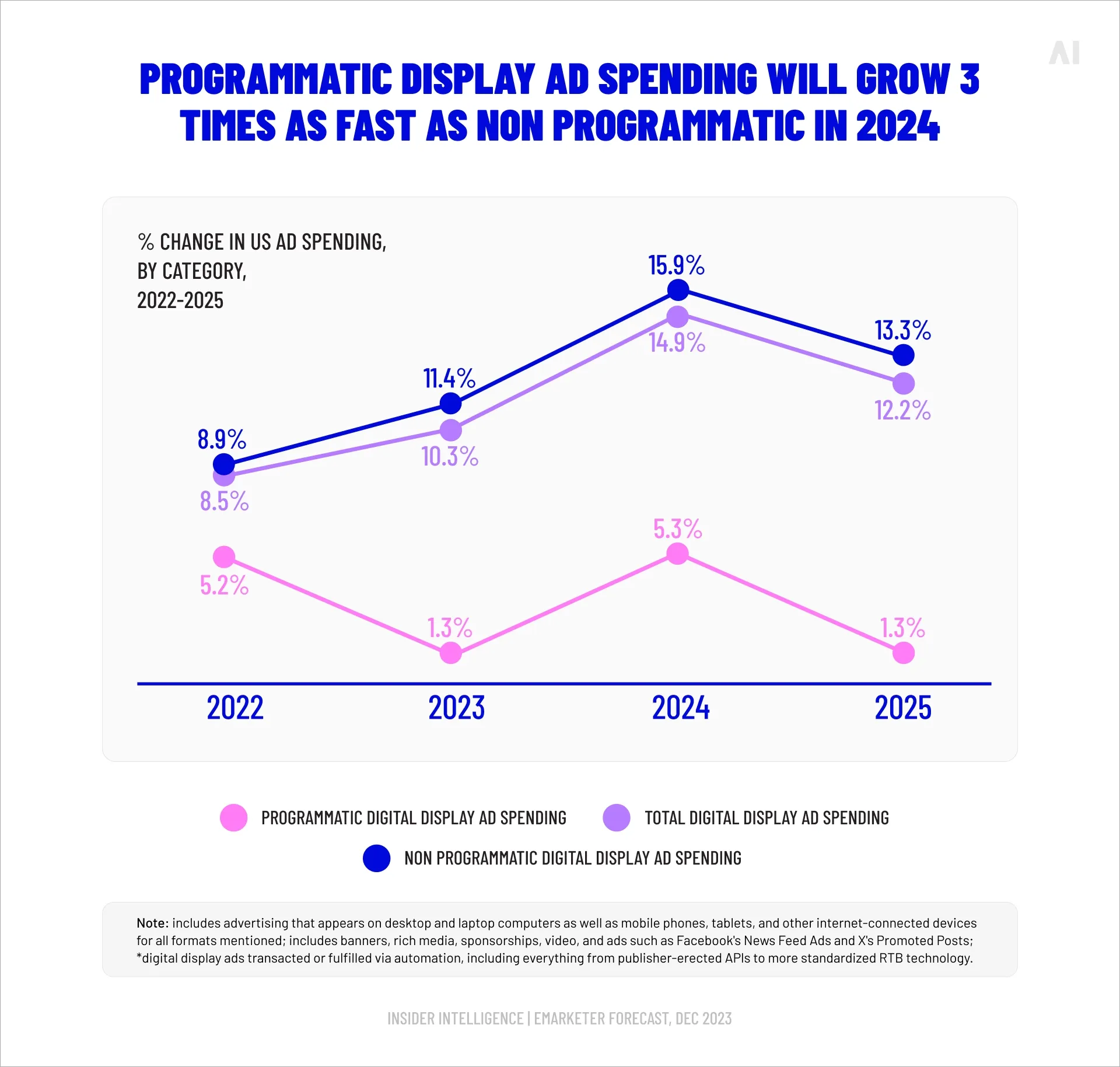
This kind of real-time optimization is exactly why US programmatic digital display ad spend has been growing almost three times as fast as non-programmatic display spend.
⚡ The net effect: you spend more of your budget on impressions that are likely to drive outcomes and less on generic reach.
Provides full transparency and control
One of the hottest debates around programmatic platforms is transparency. Early programmatic was often a black box; today, the best programmatic ad platforms are expected to provide granular visibility.
Strong platforms offer:
- Site/app-level reporting and log-level data exports
- Detailed fee breakdowns and supply path insights
- Controls for blocklists, allowlists, and content categories
The Association of National Advertisers’ Programmatic Transparency Benchmark found that in Q1 2025, advertisers directed 41% of programmatic budgets to “effective” impressions that meet quality standards, up from 36% in 2023. That improvement is directly tied to tighter controls and better data from programmatic software.
Drives stronger ROI
Programmatic media buying platforms make more of your budget work as “working media” rather than disappearing into fees and low-quality inventory.
A 2024 ANA and TAG TrustNet report found a 7.9-percentage-point improvement in ad spend efficiency compared with prior years, although less than half of spend still reaches consumers. Even with that caveat, advertisers are recovering meaningful value as they refine their platforms and supply paths.
For marketers, that translates into:
- Lower effective CPMs for viewable, brand-safe impressions
- Better cost per acquisition (CPA) as waste is removed
- Clearer attribution paths from impression to conversion
This is why many brands now push a majority of their digital display budget through programmatic buying platforms instead of direct, one-off buys.
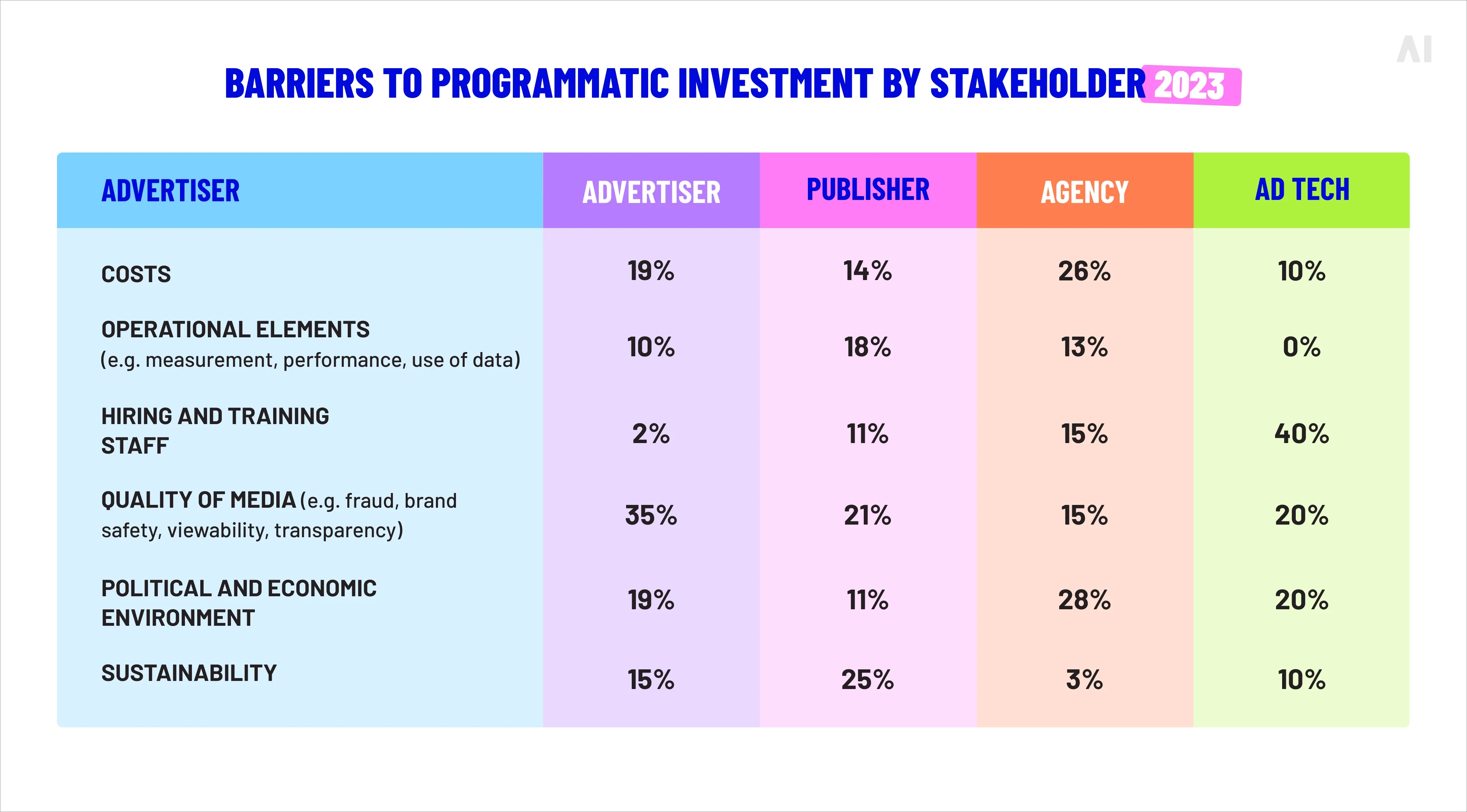
Maintains data compliance
Programmatic ad buying platforms also help you stay on the right side of privacy and compliance. With GDPR, CCPA, and emerging state laws, simply uploading any data you can find into a DSP is no longer an option.
The better programmatic advertising platforms:
- Integrate with consent management platforms (CMPs)
- Respect user opt-outs and consent strings
- Offer contextual and cohort-based targeting as alternatives to third-party cookies
This is where CDPs and clean rooms come into play, and we’ll revisit that when we talk about data platforms and AI later.
⚡ Treat privacy as a hard design constraint, not an afterthought. The more your stack is built around consented data and clear controls, the easier it is to scale without regulatory headaches later.

7 core types of programmatic advertising platforms
Programmatic media buying is not a single tool; it’s an ecosystem. Each programmatic advertising platform type plays a distinct role, and together they form the stack that delivers your campaigns.
💡 For a focused comparison of three core pillars, you can also read AI Digital’s article on DSP vs SSP vs ad exchange.
Below are the seven main categories of programmatic ad platforms, what they do, and examples of each.
{{Best-Programmatic-Advertising-Platforms-2="/tables"}}
1. Demand-Side Platforms (DSPs)
A demand-side platform (DSP) is the primary interface advertisers and agencies use to run programmatic campaigns. DSP programmatic platforms connect to multiple exchanges and SSPs, evaluate each impression in real time, and decide whether to bid, how much to bid, and which creative to serve based on your rules and optimisation goals.
In a DSP, a buyer can typically:
- Upload or create audiences (first-party segments, lookalikes, contextual, etc.)
- Set budgets, bids, pacing, and frequency caps
- Choose inventory types (display, video, CTV, audio, DOOH)
- Integrate tracking and conversion pixels, or server-side events
- Optimise toward KPIs such as CPA, ROAS, CTR, viewability, or completed views
.webp)
Well-designed DSPs also include forecasting, private marketplace (PMP) deals, programmatic guaranteed, and experimentation tools so traders can test strategies without losing control of spend.
💡 If you want a deeper breakdown, AI Digital’s guide Demand-side platform (DSP): how it works, benefits, and examples covers the mechanics in more detail.
Popular programmatic DSP platforms include:
- The Trade Desk – An independent, omnichannel DSP with strong reach across the open internet and a particular focus on CTV, identity and data-driven planning. It offers advanced tools for audience building, cross-channel measurement, and its Unified ID 2.0 identity framework, appealing to brands that want an alternative to walled gardens.
- Google Display & Video 360 (DV360) – Google’s enterprise DSP within the Google Marketing Platform. DV360 centralises planning, buying, and measurement for display, video, TV, audio, and more in one interface, organised around modules for Campaigns, Audiences, Creatives, Inventory, and Insights. It integrates closely with Google Analytics, Campaign Manager 360, and YouTube.
- Amazon DSP – A DSP that lets you use Amazon’s rich first-party shopping, streaming, and browsing data to reach both new and existing audiences on Amazon-owned properties and third-party sites and apps. Available in self-service or managed-service modes, it is often used for retail-focused and upper-funnel CTV campaigns tied to commerce outcomes.
- Simpli.fi – A DSP and workflow platform often favoured by agencies and mid-market advertisers, especially for local and addressable campaigns. It supports CTV, geofencing, mobile, display, native, audio, and social, with a strong emphasis on unstructured data, localised targeting, and flexible buying options (self-serve, API-based, or managed service).
- MediaMath – Historically one of the pioneering independent DSPs, focused on omnichannel programmatic, configurable bidding, and transparency. MediaMath filed for bankruptcy in 2023, but its technology has since resurfaced under “MediaMath by Infillion,” which is positioned as a composable DSP that lets advertisers plug in their preferred identity, data, and optimisation components.
💡 For a strategic view of where DSPs are heading and how their value is changing, see AI Digital’s article Rethinking the value proposition of DSPs in today’s programmatic landscape.
⚡ Your DSP is the cockpit for programmatic media buying; everything else in the stack feeds into, or out of, that control centre.
2. Supply-Side Platforms (SSPs)
A supply-side platform (SSP) serves the publisher side of programmatic. Where a DSP helps buyers bid on impressions, an SSP helps publishers package their inventory, connect to demand, and maximise yield from every ad slot.
With an SSP, publishers can:
- Connect their ad server to multiple ad exchanges and DSPs
- Set floor prices, deal priorities, and preferred trading relationships
- Control which advertisers, creatives, and categories can appear
- Manage open auctions, private marketplaces, and programmatic guaranteed deals
- Optimise yield across direct-sold and programmatic inventory
For advertisers, SSPs matter because they influence the quality, pricing, and transparency of the impressions that appear in your DSP.
Examples of SSPs and publisher-side platforms include:
- Magnite – Marketed as the world’s largest independent sell-side advertising platform, with particular strength in CTV and premium video. Magnite provides a unified SSP and ad serving infrastructure that helps publishers monetise across CTV, web, mobile, and audio, and gives advertisers access to brand-safe, high-quality inventory at scale.
- Microsoft Monetize SSP (Xandr) – Microsoft’s SSP (formerly Xandr Monetize) offers access to scaled programmatic demand and provides tools for holistic inventory management across formats and transaction types. It sits within Microsoft’s broader ad tech offering, which historically included both DSP and SSP components, and is used by publishers to unlock demand from Microsoft’s ecosystem and third-party buyers.
- Index Exchange – A global supply-side platform whose ad exchange enables media owners to maximise the value of their content on any screen and in any format. Index emphasises transparent auction mechanics and provides detailed data and analytics to help publishers and buyers understand performance and supply paths.
SSPs influence how often your bids win, which inventory you can see, and the degree of transparency around fees and auction logic, so they are very much part of the buyer conversation too.
💡 Learn more in dedicated pieces:
- Microsoft Folds Xandr: What marketers should know and why it matters
- Programmatic I/O 2025: the case for real supply intelligence
- Smart Supply | Programmatic Media Buying & Planning Software by AI Digital
3. Ad exchanges
An ad exchange is the marketplace where programmatic trading actually happens. DSPs connect on the demand side, SSPs on the supply side, and the exchange runs high-speed auctions whenever an impression becomes available.
Key functions of an ad exchange include:
- Receiving bid requests from SSPs or publisher ad servers when a page or app is loaded
- Sending those bid requests to connected DSPs and buyers
- Collecting bids within a strict time window (often 100 milliseconds or less)
- Selecting the winning bid based on auction rules (first-price, second-price, or hybrid)
- Returning the winning creative to be served by the publisher’s ad server
Examples of ad exchanges:
- Google Ad Manager / Google AdX (Authorized Buyers) – Google AdX (now often surfaced through Google Ad Manager and the Authorized Buyers programme) is a major global ad exchange that connects publishers and buyers in real-time auctions. It offers premium inventory, tight integration with Google’s ad server, and is widely considered one of the most important liquidity sources in programmatic.
- Index Exchange – In addition to its role as an SSP, Index operates a large ad exchange that lets buyers reach consumers across screens and formats. It positions itself as a transparent, global marketplace for premium publishers, with strong reporting on transactions, deals, and performance.
- Microsoft Advertising / Xandr exchange – Historically, Xandr operated a major exchange alongside its SSP and DSP. Today, Microsoft continues to provide programmatic access to inventory via its Microsoft Advertising stack, even as it shifts focus away from its third-party Xandr DSP business. Buyers can still access Microsoft supply through approved routes and APIs.
Many modern platforms blur the lines between SSPs and exchanges, bundling them into a single product, but conceptually the exchange is the neutral marketplace where buyer bids meet publisher supply.
4. Data Management Platforms (DMPs)
A data management platform (DMP) aggregates, organises, and segments audience data—traditionally focused on anonymous identifiers such as cookies, mobile IDs, and device IDs. It is designed to help marketers and publishers build audience segments that can be activated in DSPs, SSPs, ad exchanges, or networks.
DMPs typically work with:
- Anonymous IDs (cookies, mobile device IDs, CTV IDs)
- Third-party data (demographic, interest, intent data from external providers)
- Publisher first-party data (log-ins, registrations, content consumption)
Core DMP tasks:
- Ingest data from multiple sources and normalise it into a unified schema
- Create segments (e.g. “auto intenders”, “frequent travellers”, “sports fans”)
- Evaluate segment performance and reach
- Push those segments into downstream activation tools (DSPs/SSPs/ad networks)
As third-party cookies are deprecated, many DMP functions are evolving toward CDPs and data collaboration platforms, but DMPs still play a role in anonymous audience targeting and enrichment.
Classic DMP examples include:
- Lotame – A global data and identity provider whose DMP historically helped marketers and publishers collect, organise, and activate first-, second-, and third-party audience data across online and offline sources. Lotame now positions its Spherical platform as a data collaboration and addressable audiences solution, reflecting the shift toward privacy-conscious identity and data collaboration.
- Adobe Audience Manager – Adobe’s DMP, built to unify audience data from multiple sources and activate high-value segments across channels. It focuses on experience-oriented use cases and can send first-party audiences into people-based platforms at scale, bridging media data with experience tools in the wider Adobe Experience Cloud.
DMPs handle mostly anonymous IDs for ad targeting, while CDPs (next section) focus on known, customer-level records.
5. Customer Data Platforms (CDPs)
A customer data platform (CDP) focuses on known, first-party customer data rather than anonymous cookies. It is designed to collect, unify, and activate customer data across channels, producing a persistent, people-based profile for each user.
CDPs are built to:
- Ingest data from CRM systems, websites, mobile apps, offline transactions, email platforms, call centres, and more
- Resolve those records into unified customer profiles
- Continuously update those profiles as new events arrive
- Make segments and profiles available to marketing channels, including DSPs, email, mobile, and on-site personalisation
In a programmatic context, CDPs are invaluable for:
- Building high-value audiences (e.g. “churn-risk customers”, “high-LTV repeat buyers”)
- Activating those audiences as custom segments in DSPs or retail media platforms
- Measuring results back against customer-level metrics and lifetime value
Well-known CDP providers include:
- Twilio Segment – A popular CDP that helps teams capture data from every customer interaction, combine it with warehouse data, build unified profiles, and send that data to marketing and analytics tools. It supports real-time collection, governance, and audience building that can feed into programmatic buying platforms.
- Tealium – A CDP built around real-time data collection and vendor-neutral activation. Tealium’s AudienceStream CDP is designed to unify data from websites, apps, offline interactions, and IoT devices into 1:1 profiles, then connect those profiles to a wide range of martech and ad tech integrations, including programmatic platforms.
- Salesforce Data 360 (Salesforce CDP) – Salesforce’s CDP offering, positioned as the “world’s #1 CDP for marketers.” It unifies data across sales, service, commerce, and marketing into a single customer view and supports real-time segmentation and activation, including into advertising destinations.
As marketers shift budgets into privacy-centric strategies and away from third-party cookies, CDPs increasingly sit at the heart of programmatic marketing platforms by providing clean, consented data for targeting and measurement.
6. Ad networks
Ad networks are one of the earliest digital advertising models and still matter in a programmatic world, especially for smaller teams or those who prefer more guided buying.
An ad network will typically:
- Aggregate inventory from multiple publishers
- Package that inventory into themed or audience-based bundles (e.g. “home décor enthusiasts,” “tech news readers”)
- Sell those packages to advertisers, often with managed service and a simpler buying experience than a full enterprise DSP
Many modern networks have added programmatic pipes and self-serve dashboards so advertisers can plug into their inventory using programmatic workflows while still benefiting from packaged audiences and hands-on support.
Examples include:
- Criteo – Best known for dynamic retargeting, Criteo now describes itself as a commerce media platform connecting brands, retailers, and publishers using commerce data. Its demand-side products (such as Commerce Max) let advertisers run campaigns across retailer sites and the open internet, making it a key player for commerce-driven display and video.
- AdRoll – A marketing and advertising platform widely used by ecommerce brands and SMBs. AdRoll offers full-funnel, cross-channel programmatic campaigns (web, social, email) built around retargeting, prospecting, and ABM for B2B. It positions itself as a way to manage multi-channel campaigns from a single interface without needing deep in-house programmatic expertise.
- Outbrain – An independent native advertising platform that places content-style ad units across a large network of premium publishers. Outbrain helps advertisers reach users via native placements that match the look and feel of the host site and has been expanding its performance and AI-driven optimisation capabilities.
For advertisers with smaller budgets or limited in-house programmatic capacity, these programmatic ad platforms can provide a “lighter weight” entry point into programmatic, combining automation with guidance and pre-built inventory packages.
7. Hybrid or Full-Stack platforms
Hybrid or full-stack platforms combine multiple functions—demand, supply, data, and analytics—into a single environment. Instead of piecing together separate DSP, SSP, DMP/CDP, and reporting tools, a full-stack platform aims to offer an end-to-end solution.
Benefits they pitch include:
- Shorter, more efficient supply paths
- Integrated planning, activation, and measurement
- Closer alignment between media buying and analytics
- Fewer vendors to manage and fewer data hand-offs
At the same time, marketers need to keep a close eye on transparency, fees, and interoperability so they don’t become overly dependent on a single vendor.
Examples include:
- Adobe Advertising (Adobe Advertising DSP) – Adobe’s advertising solution includes a demand-side platform that centralises buying across display, video, audio, and CTV and integrates directly with Adobe Analytics and Real-Time CDP. It is designed for brands that want tight alignment between media buying, first-party data, and broader customer experience tools.
- StackAdapt – An integrated, AI-driven marketing platform built around programmatic buying across channels such as CTV, digital out-of-home, in-game, native, and display. StackAdapt emphasises machine-learning optimisation, creative insights, and educational resources for media buyers who want a single, self-serve environment to manage omnichannel campaigns.
- Amobee (now part of Nexxen) – Amobee has historically been known as an omnichannel buy-side platform with strengths in TV and CTV, combining linear TV and digital media buying in one system. It was acquired by Tremor International (now rebranded as Nexxen) to create one of the larger video and CTV-focused end-to-end stacks, combining DSP (Amobee), SSP (Unruly), and ad serving capabilities.
These programmatic advertising companies appeal to marketers who want a tightly integrated, video-heavy stack. The trade-off is that you need to make sure you still have the transparency, independence, and flexibility you’d expect from a more modular toolkit.
Comparison of programmatic advertising platforms
To make this more concrete, the table below gives a quick snapshot of well-known platforms across each category. It isn’t a definitive buyer’s guide, but it will help you map familiar brand names to the roles we’ve just covered and start to see how a practical programmatic stack comes together.
{{Best-Programmatic-Advertising-Platforms-3="/tables"}}
Use this as a starting point, not a shopping list. Two organisations with similar budgets can still need very different stacks based on channels, data maturity, and in-house skills. Shortlist a handful of platforms that match your priorities, ask hard questions about transparency and integration, then run controlled tests before you commit serious spend. That’s where the real differences between “good enough” and “best fit” programmatic platforms become obvious.
Criteria for choosing the right programmatic advertising platform
Selecting the right programmatic advertising platform is not just about features; it’s about fit. Your goals, budget, internal skills, and data maturity all influence what “best” looks like.
{{Best-Programmatic-Advertising-Platforms-4="/tables"}}
Here are five criteria to weigh carefully when evaluating programmatic advertising platforms for your stack.
Budget alignment and scalability
Programmatic software comes with several cost components:
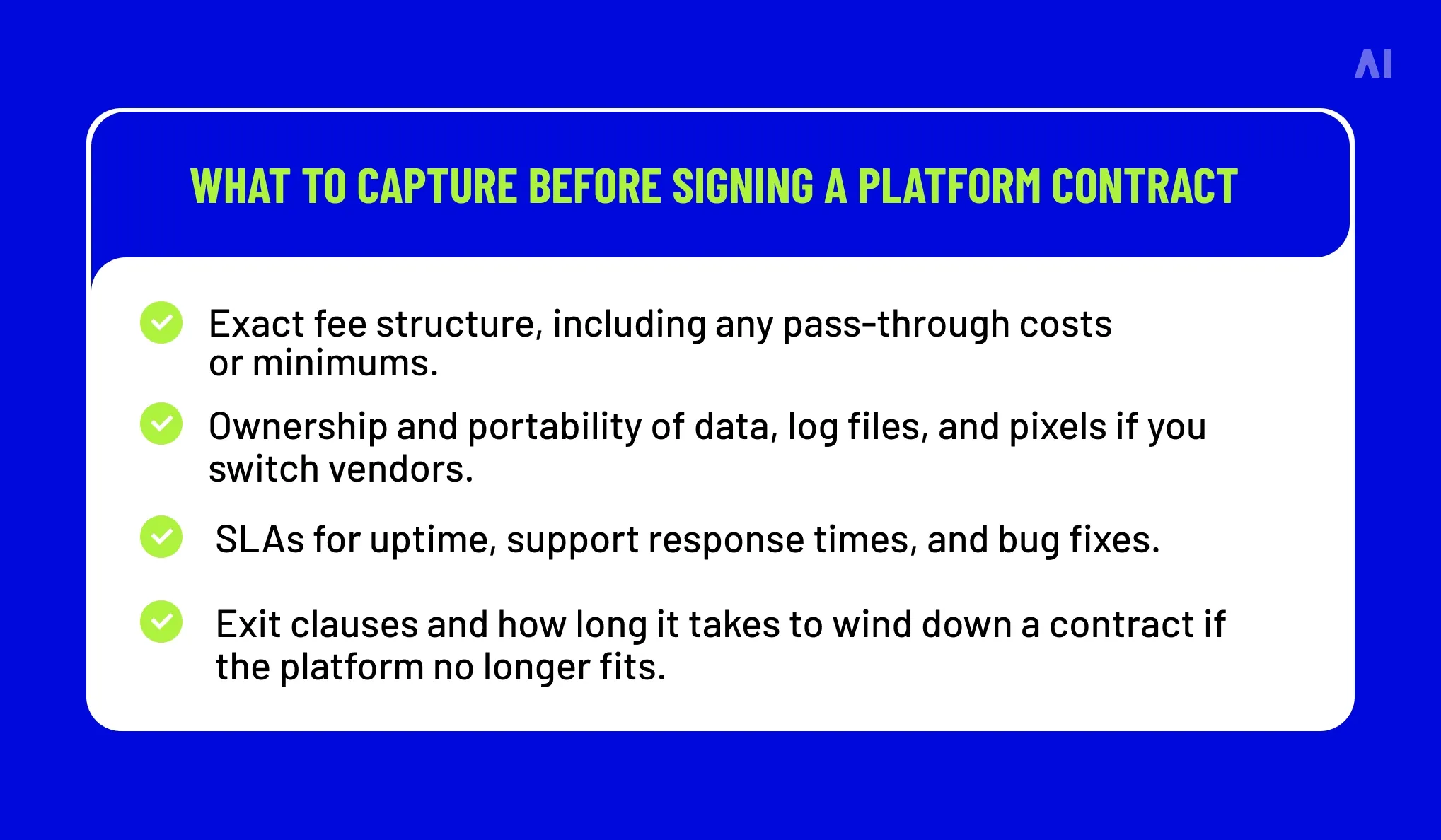
- Platform or technology fees (flat monthly fees or minimums)
- Percentage of media spend (e.g. 10–20% of ad spend)
- Additional data or measurement costs
Some DSPs are geared toward enterprise-level spend, while others cater to mid-market and smaller advertisers. When comparing programmatic ad buying platforms, consider:
- Minimums and commitments – Can you start small, or do you need to commit to a certain monthly spend?
- Pricing transparency – Are fees clearly documented, or hidden inside the CPM?
- Scalability – Will this platform comfortably support a 2–3x increase in spend over the next few years?
A practical approach: model your expected annual spend across two or three platforms, including tech and data fees, to see where the economics look sustainable.
Data integration and reporting capabilities
Programmatic media buying platforms are only as smart as the data you can feed them and the reporting they give back.
Key questions to ask vendors:
- Can the system ingest first-party data from your CDP or CRM securely?
- Does it support server-side tracking or clean room integrations?
- Can you access log-level data or connect reports to BI tools like Looker, Tableau, or Power BI?
- Is there a unified view of performance across display, video, CTV, and other channels?
eMarketer expects US programmatic digital display spend to reach nearly $180 billion by 2025. At that scale, small inefficiencies add up quickly. Strong, granular reporting lets you spot where budget underperforms and adjust in days, not months.
Brand safety and transparency
With the volume of impressions flowing through programmatic marketing platforms, brand safety and fraud protection are non-negotiable.
Consider:
- Quality controls – Does the platform integrate with verification partners (e.g. DoubleVerify, IAS, MOAT)?
- Brand suitability tools – Can you specify the types of content and environments that are acceptable for your brand?
- Fraud detection – Does it have built-in tools for invalid traffic and sophisticated fraud schemes?
- Supply path transparency – Can you see which intermediaries are involved and how much each is taking in fees?
Global ad fraud losses reached around $84 billion in 2023, equivalent to roughly 22% of digital ad spen. That alone is a strong argument for choosing programmatic media buying platforms with rigorous anti-fraud strategies.
Cross-channel automation
Most brands no longer run display in isolation. A typical mid-market or enterprise plan might include:
- Open web display and video
- CTV and OTT
- Audio and podcasts
- Digital out-of-home
- Retail media networks
The best programmatic advertising platforms help you run these channels with a single strategy and common set of controls. When you evaluate programmatic ad platforms, ask:
- Which channels are truly supported, and which are bolted on via third parties?
- Can you cap frequency across channels and devices?
- Are cross-channel attribution and path-to-conversion reports available?
Remember that programmatic will account for the vast majority of new display ad dollars globally in the mid-2020s. Cross-channel capability is not a nice-to-have; it’s how you stop over-serving ads to the same people and wasting budget.
Privacy compliance
Finally, your programmatic advertising software must keep you on firm legal ground and protect customer trust.
Look for:
- Support for IAB Transparency and Consent Framework (TCF) where relevant
- Audience building based on consented data and privacy-safe IDs
- Strong controls for data retention, erasure, and access rights
- Clear documentation on where data is stored and processed
As third-party cookies deprecate, more of your strategy will depend on identity solutions, publisher first-party data, and contextual signals. Choose programmatic advertising platforms that have a credible roadmap for privacy-first targeting and measurement, not just a short-term workaround.
⚡ When you compare platforms, pick two or three criteria that matter most this year and turn them into concrete questions. Abstract feature lists rarely survive first contact with real campaigns.
Where an AI-native advertising consultancy fits into the programmatic stack
So far, we’ve talked about programmatic advertising platforms as individual building blocks: DSPs to buy media, SSPs and exchanges to sell it, DMPs and CDPs to manage data, and various hybrid stacks that bundle those functions together. In practice, most brands do not have the time, internal expertise, or tooling to stitch those components into a genuinely high-performing, transparent system on their own.
That’s where an AI-native advertising consultancy like AI Digital fits in.
Rather than being “one more platform,” AI Digital sits above and across your stack as an orchestrator. The role is to design, run, and continually improve a programmatic setup that is:
- DSP-agnostic (not locked into a single buying platform)
- Supply-aware (using curated, premium inventory rather than default open exchange paths)
- AI-enhanced but human-directed (automation plus strategic oversight)
- Open and neutral (no bias toward owned media or walled gardens)
⚡ In other words, AI Digital is the connective tissue between your chosen tools and the business outcomes you actually care about.
Open Garden: a neutral layer across DSPs and channels
Most stacks start with a single DSP and maybe a couple of preferred SSPs or ad networks. That’s workable, but it tends to create silos: each platform has its own reporting, its own optimisation rules, and sometimes its own commercial interests.
AI Digital’s Open Garden framework is designed to break that pattern. Instead of pushing all spend through one programmatic advertising platform, Open Garden:
- Connects to 15+ DSPs and multiple top-tier SSPs
- Lets campaigns flow to whichever path offers the best performance and quality
- Normalises reporting so you get a single view across channels and platforms
- Keeps optimisation rules focused on your KPIs, not on a particular vendor’s inventory
This positions AI Digital as an independent operator in the middle of the ecosystem: we work with (and across) the tools you choose, but we are not trying to pull all media into a proprietary buying platform or walled garden.
💡 Learn more about Open vs Walled gardens in our dedicated piece: Walled gardens: The hidden cost for digital advertisers
Managed service: AI-powered buying without giving up control
For many brands and agencies, the biggest practical challenge is not choosing a DSP; it’s running that DSP day in, day out across CTV, display, social, native, audio, and search without losing oversight or burning out a small team.
AI Digital’s Managed Service is built for that reality. It combines:
- Media planning and strategy – Translating business KPIs (revenue, ROAS, CAC, brand outcomes) into channel plans and platform choices.
- Campaign execution and optimisation – Handling the hands-on work of setting up line items, audiences, deals, and measurement across your chosen programmatic ad platforms.
- Cross-channel buying – Coordinating buys across CTV/OTT, open web display and video, social, search, native, and audio so they work as one system rather than a set of disconnected campaigns.
The key difference from a traditional managed service or agency trading desk is the DSP-agnostic, client-first stance. Because AI Digital is not tied to a single buying platform, recommendations can be genuinely neutral: if a particular DSP, SSP, or exchange stops delivering, spend can move elsewhere without friction.
Internally, AI models help with forecasting, pacing, and optimisation, but every campaign is still stewarded by human strategists who keep it aligned with your commercial goals, not just media metrics.
Smart Supply: curation and optimisation on the supply side
On the supply side, most advertisers see only a fraction of what’s going on. They might block obviously low-quality domains or turn on a brand safety integration, but the supply path itself is rarely examined in depth.
AI Digital’s Smart Supply service is meant to solve that. It acts as a curated, AI-enhanced supply layer that sits between your DSPs and the open web:
- Direct SSP relationships – Access to a focused set of 9+ top-tier SSPs, rather than an unfiltered mix of every exchange on the market.
- AI-powered filtering – Algorithms that pre-screen inventory to remove low-value, non-viewable, or fraudulent traffic before it ever hits your campaigns.
- Supply path optimisation – Systematically favouring shorter, more efficient routes to the same inventory to reduce hidden fees and improve working media.
- Full placement transparency – Reporting that shows exactly where ads ran and how each source performed, so you can make informed decisions about future inclusion or exclusion.
In the context of the stack, Smart Supply effectively becomes your quality gate for inventory, working alongside your DSPs and verification partners to make sure every impression has genuinely earned its place in the media plan.
Elevate: intelligence layer across platforms
Even when you have the “right” programmatic advertising platforms and a curated supply setup, you still face another issue: each platform has its own interface and analytics. Stitching it all together into one clear picture is hard work.
Elevate, AI Digital marketing solution, is designed as a cross-platform brain for programmatic:
- AI-powered campaign planning – Using historical performance, audience data, and predictive models to suggest budget splits, channel mixes, and inventory combinations before spend goes live.
- Real-time optimisation across tools – Monitoring performance across multiple DSPs and supply sources and suggesting (or executing) changes every few minutes, not once a quarter.
- Custom KPI optimisation – Optimising toward the business metrics you specify (ROAS, CAC, revenue, lead quality), instead of just high-level media metrics like CPM or CTR.
- Unified insights – Aggregating data from all connected platforms into one view, including forecasted outcomes, impact scores for different campaign components, and multi-touch attribution.
- Conversational analysis – Through features like “Ask Elevate,” users can query performance in plain language (“Which CTV partner drove the most incremental conversions last week?”) and get prompt, data-backed answers.
Elevate doesn’t replace your DSPs or CDP; it sits above them, making them more effective and more accountable. For many clients, this is what finally turns a collection of programmatic tools into a coherent programmatic advertising platform stack.
How AI Digital complements your existing tools
Putting it all together:
- Your DSPs are still where bids are placed and creatives are served.
- Your SSPs and exchanges still handle auctions and connect you to publisher inventory.
- Your DMP/CDP still owns audience data and identity resolution.
AI Digital, as an AI-native advertising consultancy, sits across that stack to:
- Design the right combination of platforms for your goals, budget, and data maturity, using the Open Garden framework instead of a single-vendor lock-in.
- Operate and optimize campaigns on your behalf through a transparent managed service, while keeping you in control of strategy and KPIs.
- Curate and refine supply with Smart Supply so that more of your spend reaches high-quality, brand-safe impressions.
- Add an intelligence layer with Elevate so decisions are based on cross-platform data and predictive analytics, not just channel-by-channel reports.
If you think of programmatic as an intricate machine, the individual platforms are the parts; AI Digital’s role is to assemble those parts into a reliable engine, tune it, and keep it running at peak efficiency over time.
How AI shapes the modern programmatic stack
AI is now the engine room of programmatic, not an add-on. As budgets shift into always-on, omnichannel buying and privacy rules tighten, marketers need tools that can make thousands of micro-decisions every second: which bid to place, which audience to prioritise, which creative to show, which impressions to avoid. That is why around 69% of marketers reported incorporating AI into their marketing strategies in 2024, up from 61% the year before.
In programmatic, AI shows up in four main ways:
- Turning manual bid rules into predictive, impression-level optimisation
- Building and refining audiences in real time
- Powering creative decisioning and measurement
- Defending budgets against fraud and unsafe environments
We’ve already talked about how tools like Smart Supply and Elevate slot into your stack. Before we come back to that, it’s worth looking at the broader AI forces that shape how programmatic advertising platforms work today.
{{Best-Programmatic-Advertising-Platforms-5="/tables"}}
From manual bidding to predictive optimization
Early programmatic campaigns relied on simple if/then rules: bid a fixed CPM on a handful of sites, tweak it weekly, and hope performance improves. AI has replaced much of that manual tinkering with predictive modelling.
Inside modern DSPs and programmatic buying platforms, AI models:
- Score each impression on its likelihood to drive a chosen outcome (viewable impression, click, conversion, or revenue event)
- Adjust bids on the fly, increasing spend where predicted value is high and throttling it where value is low
- Rebalance budgets between line items, audiences, and channels as new performance data comes in
This is part of a wider automation trend. Across marketing as a whole, around 76% of companies already use some form of marketing automation, and 91% of marketers say it helps them achieve their objectives. Programmatic is simply the most automation-intensive piece of that puzzle, with algorithms handling millions of auctions a second.
For your team, the impact is practical: instead of spending hours on bid spreadsheets, you set guardrails (targets, caps, exclusions) and let the system optimise within them. Human attention shifts to strategy, testing, and creative, while AI handles the repetitive, high-volume decision-making.
⚡ AI is excellent at tuning thousands of tiny levers at speed; humans are still better at deciding which direction to point the machine. You need both in the loop to stay competitive
Smarter audience targeting and personalization
AI is also reshaping how audiences are created, not just how bids are set. Rather than static “personas” built once a quarter, programmatic advertising platforms now rely on continuously updated models.
Typical AI-driven capabilities include:
- Audience discovery and segmentation – Clustering users into micro-segments based on behaviour, context, and engagement patterns that humans would struggle to spot.
- Lookalike modelling – Finding new users who resemble your best customers, using both observed behaviour and inferred traits.
- Propensity scoring – Ranking impressions by the likelihood that a user will convert, churn, or respond to a particular offer.
This is reflected in how marketers work: recent research from Insider Intelligence found that about 41% of marketers rely on AI to help identify and segment audiences for improved targeting.
On the personalisation side, AI can decide:
- Which product set to feature (based on browsing or purchase history)
- Which value proposition to emphasise (price, speed, quality, sustainability)
- Which format to use (short video vs. static, carousel vs. single image)
Instead of a single “best” creative for everyone, programmatic ad platforms can assemble or select different experiences for different users in real time, all driven by models trained on performance data.
Creative and performance intelligence
Media teams have long had access to granular data; creative teams often had to work more on instinct. AI is closing that gap by turning creative analysis into a more structured, data-driven practice.
Within modern programmatic advertising software, AI can:
- Analyse thousands of ads to detect which visual and textual elements correlate with stronger performance
- Recommend new creative variants (headlines, imagery, layouts) to test
- Power dynamic creative optimisation (DCO), swapping elements based on user, context, and past results
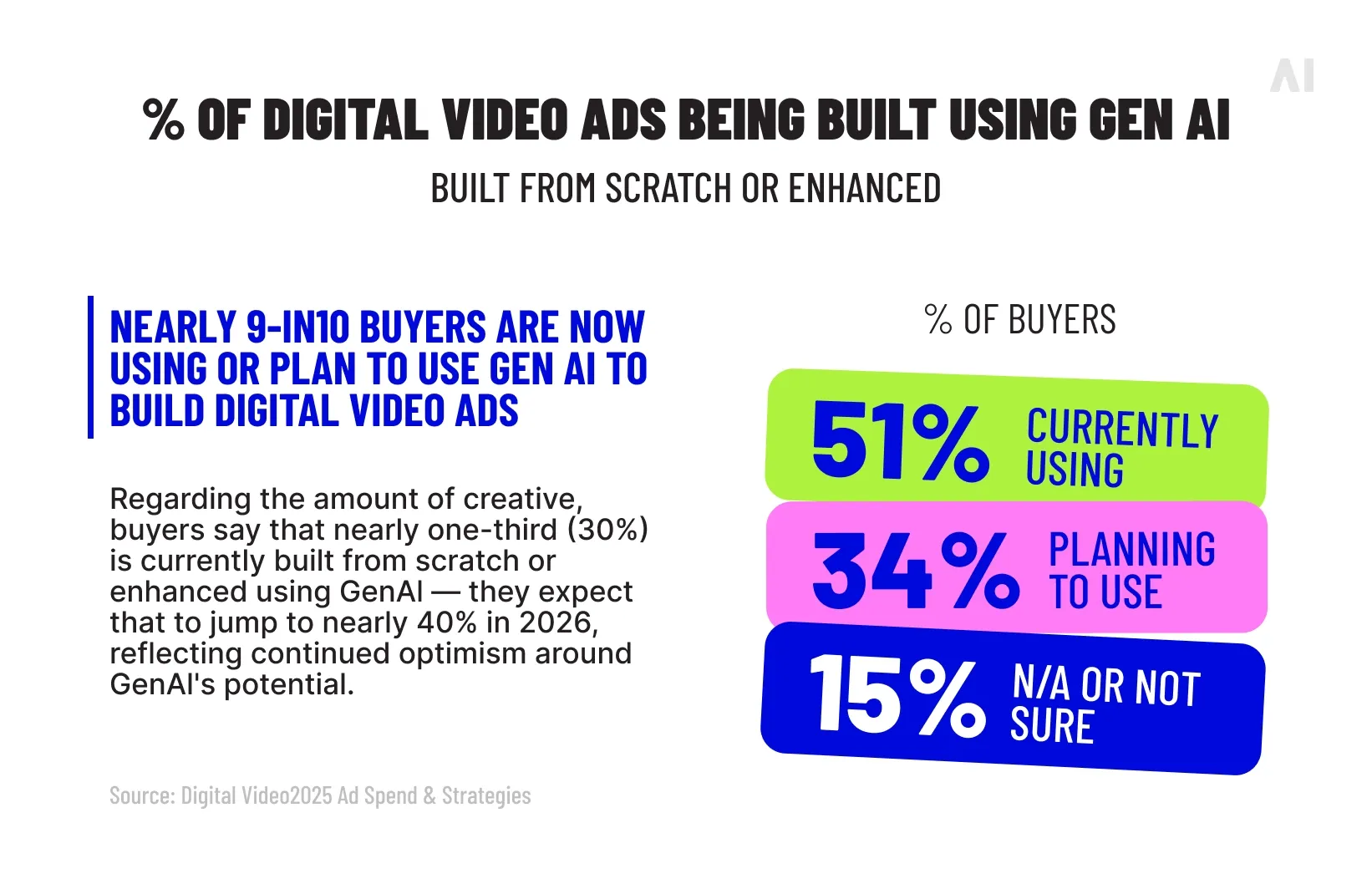
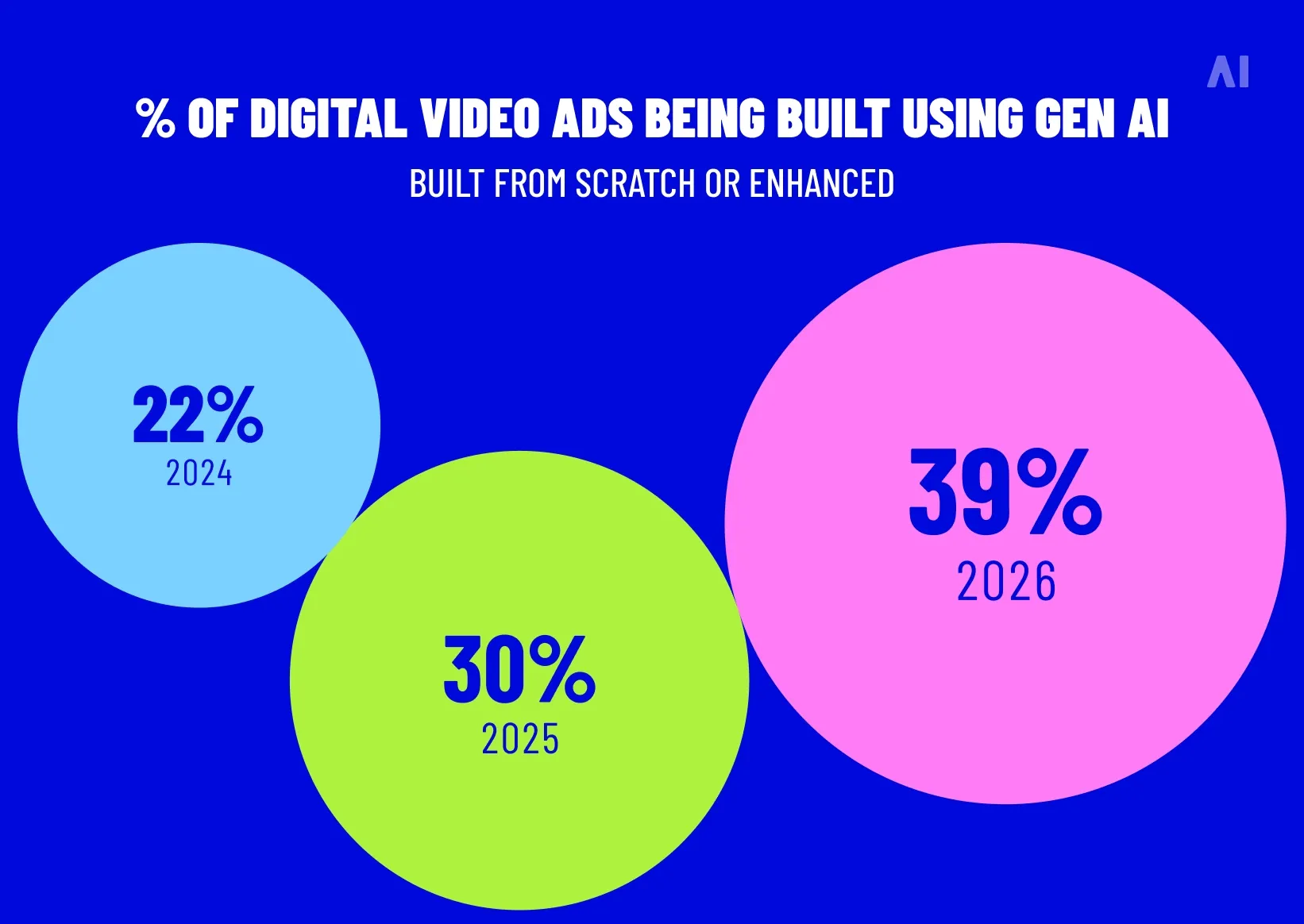
Generative AI takes this further by helping teams produce creative variations at scale. According to the IAB’s 2025 Digital Video Ad Spend & Strategy report, 86% of advertisers are already using or planning to use generative AI to build video ads, and by 2026 it is expected to underpin around 40% of all video ads.
For programmatic marketers, this means:
- Faster testing cycles (you can test 10–20 variations instead of 2–3)
- Better alignment between creative and media (because you can tailor creative to specific audiences and placements)
- Clearer feedback loops (because performance data flows back into both media and creative decisions)
⚡ The crucial point: AI is not “replacing” creative judgement. It is giving you richer feedback on what works, and the capacity to act on that feedback faster.
Fraud detection and brand safety
Programmatic’s scale makes it effective—and also attractive to fraudsters. Fake impressions, bots, spoofed domains, and made-for-advertising sites all compete for your budget. The volumes are too large for manual review, so AI has become essential on the defensive side as well.
As mentioned, research estimates that around 22% of global digital ad spend in 2023—roughly $84 billion—was lost to ad fraud, with losses projected to exceed $170 billion within five years without stronger mitigation.
To combat this, AI systems embedded in exchanges, SSPs, DSPs, and verification tools:
- Flag abnormal traffic patterns that suggest bots or click farms
- Detect domain and app spoofing attempts in real time
- Score impressions and supply paths for fraud risk before a bid is placed
- Analyse page and video content with natural language processing and computer vision to understand context, not just keywords
At the same time, AI introduces new risks of its own. An IAB study in 2025 found that over 70% of marketers had already encountered an AI-related incident in their advertising—such as hallucinated copy, bias, or off-brand content—yet fewer than 35% planned to increase investment in AI governance or brand-integrity oversight.
So the same technology that helps clean up supply and improve suitability also needs guardrails: policies, review workflows, and clear accountability for how models are used in your stack.
Bringing it back to your stack (and to AI Digital)
All of these forces—predictive bidding, smarter audiences, creative intelligence, and AI-driven protection—are now standard expectations for programmatic advertising platforms. The question is less “should AI be involved?” and more “where in the stack does it sit, who controls it, and how transparent is it?”
Earlier in this guide, we already covered how AI Digital’s Smart Supply and Elevate fit into that picture: Smart Supply as an AI-assisted quality and curation layer on the supply side, and Elevate as the intelligence layer that reads signals across platforms and channels. Those are concrete examples of the trends above. They sit alongside the AI capabilities inside your DSPs, SSPs, CDPs, and verification tools, giving you a stack where automation works in your favour—and where you still have the visibility and control to steer it.
💡 Learn more about how we integrate AI into our work: The future is now: how AI Digital embraces AI technologies to change the programmatic game
For programmatic marketers, this means:
- Faster testing cycles (you can test 10–20 variations instead of 2–3)
- Better alignment between creative and media (because you can tailor creative to specific audiences and placements)
- Clearer feedback loops (because performance data flows back into both media and creative decisions)
⚡ The crucial point: AI is not “replacing” creative judgement. It is giving you richer feedback on what works, and the capacity to act on that feedback faster.
Conclusion: Power your campaigns with the smart programmatic platform
Programmatic advertising platforms have become the core infrastructure of digital media. They control how your ads are bought, where they appear, and how effectively your money turns into outcomes.
If you strip it down, a strong stack does three things well:
- Connects the right data – First-party, contextual, and partner data, all activated in privacy-safe ways.
- Automates decisions with guardrails – Bidding, audience selection, and creative rotation guided by clear business rules and AI models.
- Exposes clear, honest reporting – So you can see where every pound or dollar went, and how it performed.
The best programmatic advertising platforms for your brand are the ones that align with those goals, slot neatly into your broader martech stack, and give your team enough control to iterate quickly. With the right combination of DSP, SSP, data tools, and AI-driven optimisation—backed by solutions like Smart Supply and Elevate—you can turn programmatic complexity into scalable, accountable growth. Reach out today, and we’ll discuss how we can help!
⚡ If you can see your media, you can manage it. If you can manage it, you can make it pay for itself many times over.