The Best Native Advertising Platforms to Watch and Choose in 2026

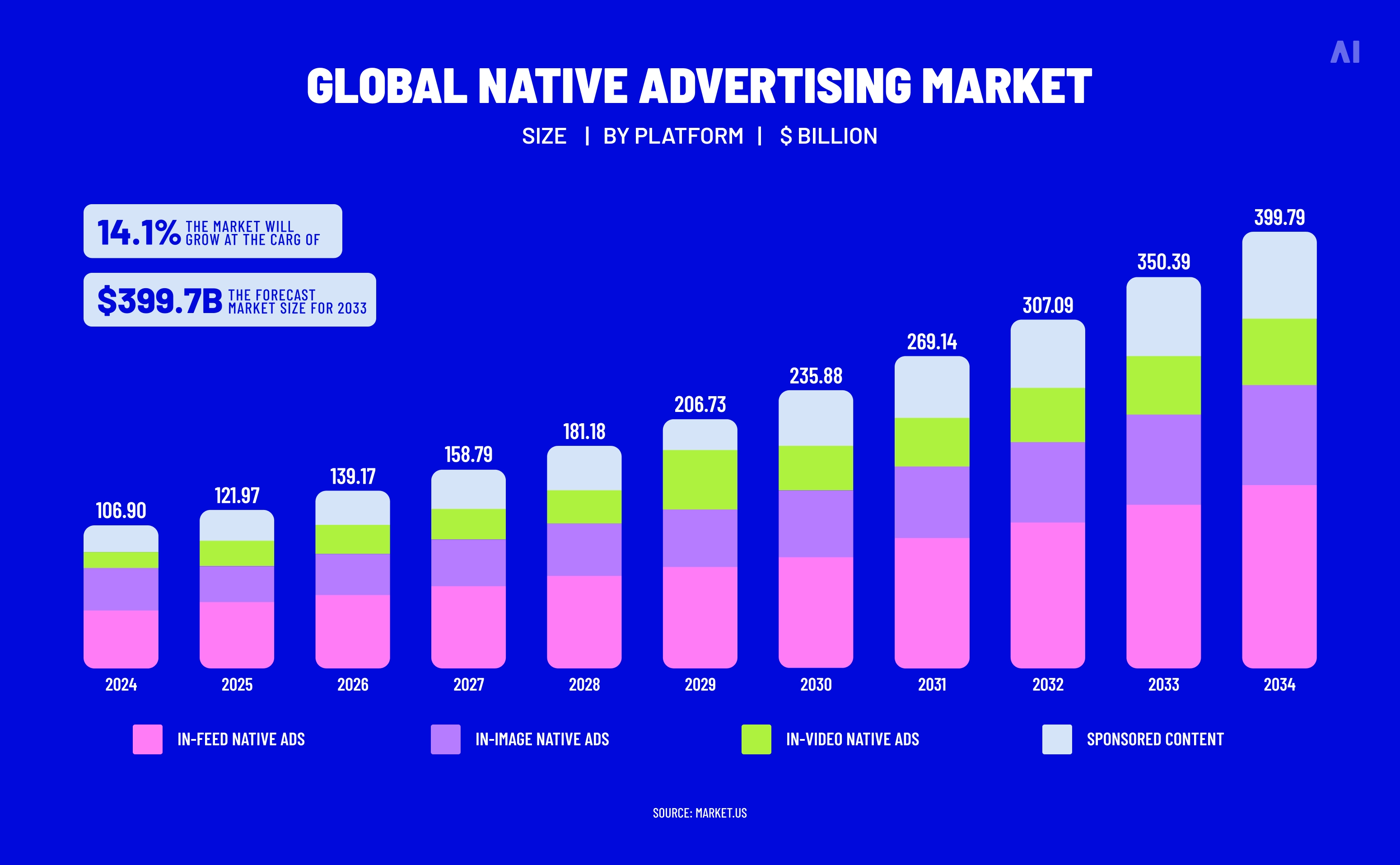
Privacy, user experience, performance: marketers are expected to deliver all three, and the tension between them has become the defining problem of the media plan. Native advertising platforms are where most teams have landed. US native display ad spend will reach $147.98 billion in 2026, up 13.1% year over year.
Key takeaways
- Best all-round reach: Taboola, through its Realize platform—450 billion recommendations a month, and the deepest, most liquid auction on the open web.
- Best for premium open-web scale: Teads, the merged Outbrain–Teads business, now spanning native, outstream video, and CTV in a single platform.
- Best for omnichannel programmatic teams: StackAdapt, where native sits alongside CTV, display, audio, and DOOH in one platform.
- Best for measurement across all of them: an independent intelligence layer such as Elevate, which reads performance across 12+ DSPs rather than inside any one vendor's dashboard.
- What it costs: roughly $0.20–$0.90 per click on discovery networks, $5–$12 CPM programmatically, and a realistic $2,000–$5,000 test budget per offer, per network.
⚡ Think of your native advertising platform as your distribution engine. Content, creative, and offer still decide the outcome.
The pull comes from three directions at once:
- Attention: eye-tracking work from Sharethrough and IPG Media Lab found native formats hold visual attention markedly better than banners do.
- Privacy: with third-party cookies in retreat, contextual and semantic signals now carry the targeting load, and native formats were built to read context.
- Automation: around 91% of US display spend is transacted programmatically, so the quality of a platform's models decides where your money lands.
The market has also moved underneath the category. Outbrain now trades as Teads. Nativo is Life360 Ads. Taboola sells through a platform called Realize. Any comparison written before mid-2025 is describing companies that no longer exist under those names.
This guide covers:
- The 10 best native ad platforms for 2026, with pros and cons for each
- The main types of native advertising platform and what each is good for
- How to choose the right one for your brand
- What native advertising costs, from CPCs to realistic test budgets
- What results you can expect, and how to measure them honestly
What is a native advertising platform?
A native advertising platform buys and delivers ad formats that match the look, feel, and function of the content around them: recommended-article cards, in-feed units, sponsored stories, outstream video, newsletter placements. Rather than interrupting the reader, it places the message inside the reading experience, then uses data and machine learning to decide which creative reaches which person on which page.
How we evaluated native advertising platforms
AI Digital is a media partner, not a native ad network. We don't sell inventory on any platform in this list, which means we have no reason to rank our own product first.
Every platform below was assessed against four criteria:
- Reach and publisher quality—verified against each vendor's current site, press releases, or filings, not against secondhand listicles.
- Format range—what you can actually run, and where it renders.
- Targeting and optimization—first-party data support, contextual depth, conversion-based bidding.
- Measurement—what you can export, and whether it reconciles with independent numbers.
Where a figure comes from a vendor's own marketing, we say so. Where a platform has changed hands or changed names, we say that too—three of the ten have since this guide first published.
The 10 top native ad platforms for 2026
These aren't the only options, but they're the ones most marketing and media teams will encounter and seriously consider.
1. Taboola
Taboola is the largest content discovery platform on the open web, powering the "from around the web" recommendations on thousands of publisher sites.
What changed since last year. Taboola's advertiser-facing product is now Realize, launched in February 2025 to consolidate its performance ad features. In April 2026 the company shipped Realize+, an agentic layer pairing a decision engine and budget allocator with an element generator that creates and refines ads and targeting without manual updates. Taboola also opened the platform to Claude Skills, so campaign setup and optimization can run through a conversational interface. The company is still Taboola; Realize is where you buy.
Scale and reach
- 9,000+ premium publishers, including MSN, NBC News, Daily Mail, The Weather Channel, and Business Insider
- Around 450 billion content recommendations served each month
- Roughly 1.4 billion unique visitors monthly, and close to 600 million daily active users
Formats and features
- Sponsored content tiles clicking through to your article or landing page
- Native video and commerce-focused formats
- Audience and contextual targeting by topic, interest, location, and device
- Headline, image, and placement testing at scale
Taboola is also building DeeperDive, a generative answer engine for the open web that reached 7 million monthly active users by April 2026. Around half of user questions concern the previous 24 hours of news, entertainment, and sport—a new inventory surface worth watching rather than budgeting for yet.
Pros
- The deepest, most liquid native auction—more competitors to learn from, and scale that doesn't run out
- Predictable CPC buying at genuine mass-market reach
- Realize+ automation reduces manual campaign management
Cons
- Publisher quality varies more widely than on premium-only networks
- Higher CPCs than mid-tier networks, particularly on desktop
- Heavy automation means fewer manual levers when a campaign misbehaves
Where Taboola shines: brands that want huge open-web reach with predictable CPC buying, and always-on content programs using native as a steady acquisition channel.
2. Teads (formerly Outbrain)
In February 2025, Outbrain completed its acquisition of Teads; by June 2025 the combined company had renamed itself Teads Holding Co. and moved its listing from OB to TEAD. The Outbrain name has been retired from the advertiser-facing product, though Outbrain branding still dominates the live widget inventory, so you'll see both in the wild for a while yet.
The merger bolted Outbrain's content-recommendation performance engine onto Teads' outstream video and connected TV inventory. What used to be a below-article recommendation network is now a full-funnel open-internet platform.
Scale and reach
- Roughly 10,000 publishers and around 2.2 billion consumers; Teads' own corporate announcement cites more than 10,000 publishers and 20,000 advertisers globally
- Publisher footprint across 36 countries, with particular strength in EMEA inherited from the original Teads business
- Premium editorial placements on major news and lifestyle outlets
Formats and features
- Content recommendation units: image and headline tiles on article pages
- Outstream and in-article video that plays when in view
- Connected TV inventory, a capability that did not exist at Outbrain two years ago
- Conversion optimization toward CPA, not only CPC
Pros
- The only platform in this list that spans native, outstream video, and CTV under one login
- Publisher relationships skew more editorial and more international than Taboola's
- Strong fit for brands in regulated categories where context matters
Cons
- The platform is still consolidating post-merger; onboarding leans managed rather than fully self-serve
- CPCs run higher than mid-tier networks
- Reporting and account structures have shifted, so historical Outbrain benchmarks don't map cleanly
Where Teads shines: brands that want premium publisher association across the funnel, and marketers running native alongside video without standing up a second platform.
3. Life360 Ads (formerly Nativo)
Nativo built its business on publisher-hosted branded content: your story appearing inside a publisher's article template, not in a widget beside it. In November 2025, Life360 agreed to acquire the company for approximately $120 million in cash and stock, with the deal closing in January 2026. The platform now operates as Life360 Ads.
Life360 brings around 91.6 million monthly active users across more than 180 countries, and the deal pairs that family and location data with Nativo's publisher network and direct integrations at outlets including Time and Ziff Davis. Advertisers can reach audiences inside the Life360 app and offsite across mobile, web, and CTV.
Formats and features
- Native article ads clicking into publisher-hosted sponsored content
- In-feed native display cards and editorial-style native video
- Support for longer-form and interactive formats
- Analytics covering engagement depth, not only CTR—scroll depth, time on page, secondary conversions
- Cookie-free ad delivery
Pros
- Best-in-class for content that needs to be read, not just clicked
- Engagement metrics that suit considered purchases and long sales cycles
- Location and household signals now available alongside contextual targeting
Cons
- Integration is early. Roadmap priorities post-acquisition are not yet clear, and buyers should expect some strategic ambiguity through 2026
- Smaller raw reach than the discovery networks
- "Family-safe" positioning is a fit for some categories and a constraint for others
Where Life360 Ads shines: brands investing in storytelling and education, campaigns in B2B, fintech, or healthcare where a single display click can't move someone, and marketers who want a bridge between content marketing and paid media.
4. Dianomi
Dianomi is the specialist in this list: a native marketplace built almost entirely around finance, business, and premium lifestyle audiences. If your buyers read Barron's rather than BuzzFeed, it reaches them in a way the mass-market networks can't.
Scale and reach
- Partnerships with over 320 premium publishers across finance, business, and luxury lifestyle
- Over 500 million devices reachable, and 8 billion+ native ad impressions served each month
- Publisher roster includes Dow Jones titles—Barron's, MarketWatch, and The Wall Street Journal—alongside The Washington Post, Kiplinger, The Times of London, and more recently Fox Business and Euronews
- Dianomi claims its audience skews to incomes above $100,000 and reaches 84% of US C-suite executives
Formats and features
- Contextually placed single and multi-ad units within articles, above or below the fold
- Native display, native video, Apple News video, canvas units, and podcast placements
- Monetization beyond the open web: mobile apps, Apple News, email, and AMP traffic
- Cookieless contextual targeting, charged on a performance basis
Dianomi is publicly listed, unusually for this category, so its numbers are auditable rather than promotional. Its FY2024 results reported 45.5 billion impressions across its publisher base, up 3.9%, from 341 active publishers.
Pros
- The cleanest route to affluent, professional, and financial audiences on the open web
- Contextual by design, so no reliance on third-party identifiers
- Financial reporting is public, so scale claims can be checked against filings
Cons
- Narrow by design. Outside finance, business, tech, and premium lifestyle, it's the wrong tool
- Smaller than the mass-market networks, so it complements rather than replaces them
- Less self-serve control: per-publisher CPC bid adjustments require going through an account representative
- Its own filings flag macro pressure—average spend among its top 100 advertisers declined over the same period
Where Dianomi shines: wealth management, fintech, B2B technology, and corporate campaigns that need context and audience quality more than raw volume—and any brand whose CPCs on the big networks are being wasted on the wrong readers.
5. Revcontent
Revcontent is a performance-oriented native network and recommendation engine, historically positioned as the tighter, stricter alternative to the giants.
Scale and reach
- 250 billion+ content recommendations per month, per the vendor's own site
- A publisher list weighted toward mid-sized and niche sites with deeply engaged audiences
Formats and features
- Content recommendation widgets with image and headline tiles
- Widget styles for sidebars, below-article, and mobile feeds
- Self-serve controls over bids, placements, and device targeting
- Publisher and widget whitelisting and blacklisting
Pros
- Lower CPCs than premium networks, and a thinner auction with fewer competitors
- Granular site-level controls give real optimization levers
- Low entry threshold for testing
Cons
- Live creative volume is a fraction of Taboola's, so campaigns top out sooner and adding budget stops buying scale earlier
- Traffic quality is more variable; expect to spend the CPC savings on blocklisting and creative iteration
- New advertiser accounts are approval-gated
Where Revcontent shines: performance marketers who know how to tune creative and placements, and brands in niches where premium inventory is thin but secondary publishers have strong audiences.
6. MGID
MGID is a global native platform with heavy international coverage across Europe, Asia, and Latin America—the reason it keeps a place in most multi-market plans.
Scale and reach
- 850 million+ monthly unique users, with MGID's homepage now claiming reach approaching a billion
- More than 32,000 direct publishers, delivering over 185 billion impressions per month
- Operations across 200+ countries and 70 languages
Formats and features
- Smart in-content widgets, sidebar recommendations, and mobile placements
- Native display, video, and push formats
- Contextual Intelligence for cookieless targeting, aligned to Seller-Defined Audiences
- Campaign Studio for direct native buys without third-party vendors
MGID markets a "brandformance" position and claims native formats deliver around 60% higher click-through rates than standard display. That is the vendor's own figure, not an independent benchmark.
Pros
- The strongest international and multi-language coverage in this list
- CPCs typically 30–50% below Taboola and Teads
- Cookieless targeting is built out rather than bolted on
Cons
- Traffic quality requires active management and disciplined blocklisting
- Creative mix skews heavily toward entertainment verticals, which thins the comparable-advertiser pool in other categories
- Performance claims come almost entirely from MGID's own data
Where MGID shines: campaigns running across multiple countries and languages, and direct-response advertisers exploiting lower CPCs in less saturated markets.
7. TripleLift
TripleLift has repositioned. It now describes itself as the Creative SSP, powered by TL Spark, its agentic intelligence layer—and it has pushed hard into CTV alongside its native business.
Scale and position
- Reaches 80% of the Comscore 200 ad-supported publishers, with 5,000+ direct publishers across 40 verticals and more than 3 trillion impressions
- CTV inventory more than doubled year over year in 2025, with advanced formats approaching a fifth of CTV revenue
- Launched TL Direct, a self-serve platform for buyers and sellers across web, mobile, and CTV, in June 2026
Formats and features
- Native display units that adapt to a publisher's fonts, colors, and layout
- Native and in-article video
- Creative templating that turns standard display assets into native placements without per-site design
- Programmatic Pause Ads, launched with DIRECTV and expanded to publishers including Xumo and Plex
Pros
- The best creative-quality story in the category; formats are built for you rather than by you
- One route to native, video, and CTV creative through your existing DSP
- Retail media presence growing fast, including through Amazon's DSP Certified Supply Exchange Program
Cons
- You buy through a DSP, so it's not a standalone option for smaller teams
- Less useful if your priority is cheap direct-response clicks
- Pricing depends on your DSP relationship and curation fees, which reduces transparency
Where TripleLift shines: agencies buying via DSPs that want native formats instead of standard banners, and campaigns where visual quality and page fit matter—fashion, automotive, homeware, travel.
8. Criteo
Criteo now positions itself as a commerce intelligence platform, and its native product extends commerce data into product ads across publisher sites.
Scale and reach
- Built on proprietary commerce data from more than $1 trillion in annual sales
- Activated media spend crossed $1 billion in a single quarter for the first time in Q1 2026
- Thousands of retailer and publisher partnerships worldwide
Formats and features
- Dynamic native ads pulling product images, prices, and descriptions from your catalog
- Retargeting users who viewed products, then reaching them across publisher content
- Prospecting via lookalike modeling
- Strong cross-device attribution
Criteo was the first advertising technology partner to integrate with OpenAI's advertising solution. More than a thousand brands are now live on ChatGPT through that integration, and Criteo's data shows users referred from LLM platforms converting at roughly 1.5 times the rate of other referral channels.
Pros
- Unmatched commerce data depth for product-led native
- The clearest early position in AI-assistant commerce surfaces
- Closed-loop measurement back to product-level sales
Cons
- Little use without a product feed
- The retail media business has been volatile: Q2 2026 revenue fell 21% on scope changes with two clients, though the underlying client base grew 20%
- Less flexible than a general-purpose DSP for non-commerce objectives
Where Criteo shines: e-commerce brands wanting native placements to behave like shoppable recommendations, and retailers diversifying retargeting beyond Google and Meta.
9. Paved
Paved is the newsletter marketplace—a buying surface for native placements inside email, which is having a genuine moment.
Scale and reach
- 253 million newsletter subscribers across 3,000+ publishers, including Washington Post, NBC, Bloomberg, Morning Brew, and TechCrunch
- Over 8,000 newsletter creators connected to brands
- Acquired by Redbrick in March 2025
Paved's 2026 Newsletter Ad Performance Report found publisher revenue up 30% year over year, 40% more campaigns run, an 80% larger addressable subscriber pool, unique users across its ad network up 84%, and advertiser rebooking intent up 53%. Some 64% of marketers now use the channel.
Formats and features
- Sponsored placements inside individual newsletters, written in the publisher's voice
- Dedicated sends for larger campaigns
- Programmatic newsletter ads across the network on a CPC basis
- Discovery tools with verified audience data, estimated clicks, and CPC ranges shown before you book
Pros
- No platform fee, no subscription, and no minimum spend for advertisers
- Opt-in, high-attention audiences; a good placement reads as a recommendation from a trusted host
- Unusual pricing transparency—you see estimated performance before committing
Cons
- Paved takes a 30% commission from publishers, which is priced into rate cards
- Measurement is weaker than programmatic: email limits what you can track downstream
- Scale is per-newsletter, so building reach means booking many placements
Where Paved shines: B2B and niche B2C brands that care more about fit than raw scale, and companies with reports, tools, or strong editorial that suit an inbox.
10. StackAdapt
StackAdapt has moved from describing itself as a DSP to an AI advertising and orchestration platform, running native alongside CTV, display, video, audio, DOOH, email, and direct mail.
Scale and position
- Named a Strong Performer in The Forrester Wave: Omnichannel Advertising Platforms, Q1 2026, with top scores for self-serve capabilities, onboarding and support, and pricing flexibility and transparency
- Accesses native inventory through exchanges including TripleLift and Sharethrough
- Launched Ivy Studio in July 2026, an AI-first hub for planning, forecasting, analysis, optimization, and execution, built using OpenAI's models
- Piloting ads within ChatGPT
Formats and features
- Native display and video, in-feed and in-article
- Impression-level optimization based on predicted conversion likelihood
- Complex audience building from first-party data, lookalikes, and contextual segments
- Cross-device and cross-channel attribution
Pros
- The most complete single-platform option if native is one channel among many
- Consistently strong usability and support ratings
- Transparent pricing relative to enterprise DSPs
Cons
- Programmatic expertise required; the learning curve is steeper than a self-serve native network
- Native inventory is sourced through exchanges rather than owned, so publisher relationships are indirect
- Agentic features are new, and the reporting behind them is still maturing
Where StackAdapt shines: media teams that want fine-grained control over native buying with advanced optimization, and brands that need one platform across many channels.
Types of native advertising platforms
The ten above fall into four categories. Knowing which one you're buying from tells you what to expect from pricing, measurement, and effort.
Content discovery and recommendation networks
The classic native ad networks, appearing under labels like "Recommended for you."
- Examples: Taboola, Teads, Revcontent, MGID, plus vertical specialists like Dianomi
- Formats: content cards with image, headline, and brand name
- Pricing: usually CPC
They help publishers monetize with recommendation widgets, give advertisers a way to distribute articles and landing pages at scale, and use AI to personalize which recommendations each user sees. Ideal when you have content to promote and want volume at predictable CPCs.
Two platforms sit awkwardly in this category:
- Teads no longer fits neatly here: since the merger it spans recommendation widgets, outstream video, and CTV, which puts it in the same conversation as the programmatic platforms below.
- And Dianomi runs the same mechanics as the mass-market networks but against a single audience type, which changes what it's good for more than how it works.
Programmatic native DSPs and SSPs
- Examples (DSP-leaning): StackAdapt, plus native capabilities in The Trade Desk and other major DSPs
- Examples (SSP-leaning): TripleLift, Sharethrough
- Formats: in-feed native display, native video, in-article placements, commerce-native units
DSPs aggregate native inventory from many exchanges so you can buy it in one place and set KPIs. SSPs and exchanges help publishers define native placements and auction them programmatically, passing context and layout data so ads render properly.
A programmatic native platform will let you upload multiple headlines, images, and descriptions, assemble native units to fit each publisher's layout, and adjust bids impression by impression toward conversions.
Sponsored content and branded storytelling platforms
- Examples: Life360 Ads (formerly Nativo), plus publisher-direct content studios
- Outputs: sponsored articles, native video pages, custom editorial series
These place full articles or videos inside publisher feeds, match editorial look and feel with clear sponsorship labels, and measure engagement beyond CTR. Use them when your strategy leans on story-driven campaigns and you need to prove branded content did more than look good in a media kit.
Newsletter and email-native platforms
- Example: Paved
- Scale: one marketplace aggregating thousands of independent newsletters
You can sponsor a single newsletter with a placement written in the publisher's voice, run programmatic newsletter ads on a CPC basis, or buy dedicated sends. These behave like native placements because the message sits inside content the subscriber asked for.
How to choose the right native advertising platform
A practical framework, in six steps.
Start with audience and publisher fit
Which platforms already reach the audiences and verticals you care about? Which publishers matter in your category?
- Mass-market US consumer products: Taboola and Teads for reach on mainstream news and lifestyle
- Niche newsletter audiences: Paved is the surgical fit
- Multi-region campaigns: MGID usually beats US-centric networks on coverage
Look for publisher lists by vertical, geographic coverage for your core markets, and the ability to whitelist or blacklist domains.
Match formats to your content and conversion path
- Strong editorial assets—whitepapers, guides, explainer video: Life360 Ads, StackAdapt, Taboola, Teads
- Product feeds and dynamic retargeting: Criteo
- Short, sharp offers or thought-leadership snippets: Paved
Then map formats to funnel stages: sponsored stories and native video for awareness, content hubs and buyer guides for consideration, product listings and retargeting units for conversion.
Evaluate targeting, optimization, and AI capabilities
Given how automated display has become, the quality of a platform's models matters as much as its reach.
- Can it target using first-party data as well as contextual and interest signals?
- Does it offer lookalike modeling?
- Does it support conversion-based bidding—target CPA, target ROAS—rather than CPC only?
Agentic features are now standard across the category rather than a differentiator, so the useful questions are about control. Ask any vendor what the agent decides on your behalf, what it reports back, and what you can still override.
Check brand safety, fraud protection, and traffic quality
Quality varies enormously across native inventory. Made-for-advertising sites—pages built to maximize impressions rather than serve readers—account for 21% of programmatic impressions and 15% of spend among advertisers audited by the ANA.
Key questions:
- Does the platform integrate with IAS, DoubleVerify, or MOAT?
- Can you exclude categories and keywords?
- Does it provide site-level reporting showing exactly where ads ran?
For performance-heavy networks, that transparency is what lets you pause weak placements and concentrate spend where it works.
⚡ Treat placement reports as a diagnostic tool—your best and worst inventory are usually obvious once you look.
Look at reporting depth and ease of integration
- Can you export raw log-level data, or at least detailed placement reports?
- Does the platform integrate with your analytics stack?
- How granular are the metrics—clicks and conversions only, or scroll depth, time on page, creative-level performance, and attention?
Life360 Ads leads on content-centric metrics; StackAdapt and Criteo lead on conversion and ROAS reporting; Dianomi reports on a performance basis within its verticals. If you run several at once, you'll want a layer above them that reconciles the numbers on consistent definitions.
Decide how much support you need
- Self-serve (Revcontent, MGID, StackAdapt, Taboola self-serve) gives flexibility and control but requires internal expertise
- Managed or hybrid (Teads, Life360 Ads, Criteo) brings strategy, creative guidance, and vendor-side optimization
If you're new to native, a managed pilot on one of the larger platforms is a reasonable first move. Once you know what works, bring more in-house.
One more question: disclosure
The FTC requires clear and prominent disclosure when advertising could be mistaken for editorial. Labels must appear before the click-through and again on the destination page, positioned in front of or above the headline. The agency cautions against "Promoted" as ambiguous, and advises against "Presented by" or "Sponsored by" when the advertiser created the content. Background shading alone isn't sufficient visual separation.
New York has gone further. A law enacted in December 2025 requires advertisers to disclose when ads feature AI-generated "synthetic performers"—computer-generated figures intended to appear as real people. It took effect in June 2026 with monetary penalties, and other states are considering similar legislation. If AI-generated people appear in your creative, that requirement is already live.
What native advertising costs
Native usually sits in the middle of the programmatic pricing range: more expensive than a standard banner, cheaper than premium video or CTV. Treat everything below as planning ranges rather than rate cards.
Cost per click
Across the major discovery networks, CPCs run roughly $0.20 to $0.90, varying more by vertical and device than by platform. Mobile is consistently cheaper than desktop. Finance and insurance cost multiples of what lead generation or content arbitrage does, because that's where the competition is.
Cost per thousand impressions
Buying programmatically, standard display banners often sit around $1.50–$4 CPM, while native placements commonly benchmark around $5–$12 CPM. Premium publisher-hosted content is a different market: flat fees run from a few hundred dollars to $200,000+ for a bespoke editorial series.
Minimum spend
Most self-serve platforms open an account for $50 to $100. Taboola and MGID sit around $100; Revcontent's threshold is roughly $50 with advertiser approval gating new accounts; Teads leans toward managed onboarding and a higher commitment.
None of those figures will fund a usable test.
The number that actually matters
Platform algorithms need a minimum volume of conversion events before they optimize properly. Starve them and early CPAs tell you nothing about what the campaign could do at maturity.
- $50/day is the bare minimum to generate any usable signal
- ~$300/day is what it typically takes to exit the learning phase and stabilize optimization
- $2,000–$5,000 total, per offer, per network is a realistic test budget before a keep-or-kill decision means anything
Five hundred dollars spread across four networks teaches you nothing; $500 on one network for ten days starts to. Pick one, fund it properly, expand only once an offer proves out. Read the verdict on CPA: a $0.25 click that never converts costs more than a $0.70 click that does.
⚡ A cheaper click is not a cheaper customer. The cost just moves from the auction to your testing budget.
What results you can expect from native ad platforms
Exact numbers depend on your vertical, creative, and offer. These are reasonable planning benchmarks.
Higher CTR and attention than display
Native's click-through rates sit several times above standard display, and tightly matched editorial or newsletter placements clear that by an order of magnitude. Sharethrough and IPG's eye-tracking work found native ads viewed more often and for longer than banners. Comparative analyses show native delivering roughly 4–8× higher CTR, with better conversion rates alongside.
In practice:
- Six to ten times the click-through rate of a standard display banner on the discovery networks
- Several times higher again on tightly aligned editorial or newsletter placements, where well-crafted copy earns the click
- A clear performance floor to hold campaigns to, per EMARKETER's 2026 benchmark
Native's advantage is reaching people already in a reading frame of mind, which is why the traffic behaves differently once it lands.
Better quality traffic and deeper engagement
Because native platforms are built around content, you typically see longer time on site than from standard display, higher scroll depth, and improved brand recall when the content is useful. Exposure to native content also lifts purchase intent against standard display, according to the Native Advertising Institute.
Competitive CPCs and lower CPA than some social and display
Native inventory is less saturated than the big social feeds, so CPCs can be relatively low. Common patterns:
- Lower CPCs than highly competitive search terms
- Comparable or slightly lower CPCs than social in many verticals
- Better cost-per-acquisition when native pre-qualifies audiences before retargeting
That efficiency depends on content matched to user intent and context, with retargeting set up to use the attention native earns.
Strong ROAS inside a full-funnel strategy
Native performs best as part of a coordinated funnel:
- Use discovery networks (Taboola, Teads, MGID, Revcontent) to drive awareness and content consumption at scale
- Build retargeting pools—on native, social, search, and programmatic display—from people who engaged
- Close with conversion-focused channels
Measured across the whole path, native tends to lower blended cost-per-lead, increase conversion rates from remarketing, and improve lifetime value when the first interaction taught someone something.
Last-click attribution systematically under-credits the channel that started the journey, which is where native is most often mismeasured. An independent measurement layer such as Elevate exists for exactly that problem: it reads campaign data across 12+ DSPs and the wider digital ecosystem, models incrementality and path to conversion, and reports on consistent definitions rather than each vendor's own.
Faster learning cycles
Native platforms increasingly automate creative testing: rotating headlines, images, and descriptions, identifying winners, and shifting budget behind them. StackAdapt describes the shift as programmatic bidding moving from reactive to predictive. The same principle now runs across most of this list.
You spend less time on manual bid tinkering and more on strategy and creative concepts.
Why native advertising will lead the way in 2026
The category is growing for reasons that will outlast any individual platform's roadmap.
The money is moving
The growth has three drivers, according to EMARKETER's December 2025 forecast: engagement rates, AI-powered optimization, and the rising importance of contextual targeting for brand safety.
The wider market is moving the same way. WPP Media's midyear 2026 forecast puts global advertising revenue at $1.3 trillion this year, up from $1.14 trillion in 2025, with AI investment named as the primary countervailing force against wider economic headwinds.
Native's share of total display has slipped even as its absolute spend grows, because connected TV and retail media are expanding faster. Native is a bigger business inside a market growing in several directions at once.
People engage more with native than with banners
People look at native ads more than they look at banners, and the research behind that is unusually consistent.
- Eye-tracking research from Sharethrough and IPG Media Lab found consumers visually engage with native ads 52% more frequently than with traditional banners.
- More recent performance analyses show native delivering 4–8× higher click-through rates.
- Exposure to native content also produces an 18% lift in purchase intent against standard display.
Higher attention and stronger CTR give native an advantage whenever you need to fill the top of the funnel with interested visitors rather than impressions.
Cookieless targeting pushes budget toward context
With third-party cookies in retreat, contextual and semantic targeting have regained importance. Native platforms were built for this: many prioritize page topic, content sentiment, and vertical over user-level IDs, and several—including Life360 Ads and MGID's Contextual Intelligence—now run cookie-free delivery as a headline capability.
Contextual targeting carries three practical advantages:
- it needs no personal data, so compliance is simpler;
- AI-powered contextual analysis assesses tone and subject matter in real time, which beats blunt keyword blocklists for brand safety; and
- because native already matches the form of surrounding content, contextual placement makes it topically relevant too.
⚡ Contextual and semantic signals are quickly becoming as important as audience profiles once were.
AI moved from optimization to orchestration
Last year, AI in native meant better bidding. This year it means agents.
Four of the ten platforms above shipped agentic layers within twelve months: Taboola's Realize+, StackAdapt's Ivy Studio, TripleLift's TL Spark, and Criteo's Model Context Protocol implementation, which serves product and shopper data directly to AI agents. What has changed is how much of the decision-making now sits inside systems you don't control.
Each new layer of automation buys efficiency and costs visibility. Our Open Garden framework exists to keep that trade-off manageable—DSP-agnostic execution across 15+ platforms, with the data and reporting staying yours.
⚡ Algorithms now decide which stories get told, and to whom. Knowing how they decided is the part you have to insist on.
Three trends shaping native in 2026
Native is expanding into three environments it didn’t occupy eighteen months ago: AI assistants, connected TV, and the inbox.
Native is arriving on AI answer surfaces
Criteo, StackAdapt, and Taboola are all building for the same bet: that a meaningful share of product research moves to AI assistants, and that advertising follows it there. Three competitors investing simultaneously in an inventory type with no established benchmarks is a signal about where they expect demand to go, not a channel you can plan against yet.
What to do now: nothing, except read your referral data. If LLM-sourced traffic is already converting differently from your other channels, you'll want that baseline before you're asked to buy against it.
Native is moving onto CTV and into retail media
Native began as a below-article widget. It now appears as a CTV homescreen unit, a pause-screen placement, an in-feed retail media card, and a line in a newsletter. TripleLift's retail media business grew 110% organically in 2025; Teads added CTV to a platform that was purely native two years ago.
What travels is the principle: match the environment instead of interrupting it, now on the screens where interruption is least tolerated. Plan native as a discipline you apply across surfaces, not a box in the display line item.
Newsletters became a real channel
Newsletter placements, first-party publisher audiences, and contextual environments have one thing in common: none of them depend on third-party identifiers, walled-garden algorithms, or search referral traffic. All three of those foundations got less reliable in the past two years. The premium on inventory that sits outside them is rising, and the buyers moving early are paying less for it than they will.
And a caution: made-for-advertising inventory
New surfaces expand where native can run without improving what runs there. Made-for-advertising inventory remains a live tax on every platform in this guide, and the controls that manage it are the ones in the brand safety step above—site-level reporting, blocklisting, verification. New surfaces arrive with the old problems attached.
⚡ Every platform here will sell you scale. None of them will manage quality for you.
What good native looks like: three published results
Three published campaigns, spanning the funnel, with one caveat up front: these are campaigns the platforms chose to publish. They are optimized, well-resourced, and self-selected. Read them as evidence of what native can do, not what it does on average.
Mercedes-Benz: brand lift verified by a third party
For its Defining Class 2.0 campaign, Mercedes-Benz ran Thailand's first connected TV campaign with Teads, combining a CTV native placement on the LG Smart TV homescreen, in-app instream video, and outstream units targeted on income and automotive interest.
In-stream placements returned a 95.46% video completion rate at 100% viewability. Effectiveness was assessed by On Device, which passively tracked exposure and then surveyed panelists 24 to 48 hours later—an independent read on brand perception and favorability rather than a platform-reported number.
Nestlé: one story across formats
Nestlé's "The Perfect Combination" campaign for Coffee Mate and Nescafé in Mexico ran across CTV video, InRead, and interactive shoppable formats on Teads.
Published results: 89% viewability on InRead, 100% on CTV, a 9.05% lift in ad recall from the CTV homescreen placement, and 7.96% across CTV and InRead combined. A single native creative concept traveled across three very different placements and stayed measurable throughout.
Digital Athlete: automated bidding against a CPA target
At the performance end, Tokyo agency Digital Athlete ran a campaign for Loofen, a food-waste-reducing trash can, using Taboola's automated bidding with a target CPA.
The campaign came in 12% below its own CPA target, and 27% below the average CPA the advertiser was seeing across competitor platforms. Spend rose 348% as a result. A CPA that holds while budget grows is a harder test than one that looks good on a small buy.
What to take from all three
Native did different jobs in each case: brand lift, cross-format storytelling, cost-efficient acquisition. Each was measured against something external — a third-party panel, a recall benchmark, a competitor CPA average — rather than against the platform's own definition of success.
Our own programmatic native guide collects further published results, including an Outbrain campaign for dentolo that came in 33% below social on cost per lead and, at peak, 39% below paid search. Every one of these numbers arrived because someone set an external reference point first.
⚡ A result without a comparison isn't a result. It's a number the platform picked.
Conclusion: pick the best native ad platform for your business
Native advertising platforms are no longer side projects. They sit at the center of how brands reach people in environments they trust, respect privacy while still using data intelligently, and turn editorial-style stories into measurable performance.
To recap:
- Content discovery networks—Taboola, Teads, Revcontent, MGID—give you reach and strong CTRs for content-driven campaigns
- Programmatic native platforms—StackAdapt and TripleLift—bring native into the same workflow as display, video, and CTV
- Story-first platforms—Life360 Ads—help you treat branded content as an investment rather than a media-kit line
- Newsletter-native tools—Paved—open up engaged, niche audiences in the inbox
- Commerce-native solutions—Criteo—turn product ads into integrated recommendations
- Vertical specialists—Dianomi—reach finance, business, and professional audiences the mass-market networks dilute
The right choice depends on your audience, formats, internal capabilities, and measurement stack. Aim for:
- Strong publisher and audience fit
- Mature AI-driven optimization and targeting
- Transparent reporting and site-level brand safety controls
- An independent view of performance across whatever mix you end up with
Most teams skip the last point, and it decides whether native gets the credit it earns. Every platform above will tell you it performed. Elevate reads across 12+ DSPs and the wider digital ecosystem to show what actually happened—audience insight, planning, incrementality, path to conversion, and unified reporting on consistent definitions. On the supply side, Smart Supply handles inventory selection and optimization against your KPIs across 9+ top-tier SSPs, which is how you keep MFA exposure off your line items in the first place.
If you want help building and running native across several platforms with that visibility in place, talk to us. That's the point at which native stops being a series of one-off tests and starts working as part of a growth engine.
💡 For a deeper strategic view, pair this article with Native advertising benefits, which explains why brands use native ads and what they gain from them.