10 Reasons Why Native Advertising Has Become the Smartest Investment in 2026


Native advertising is simple at heart: paid messages built to match the look, feel, and context of the surrounding content. Done well, it reads and behaves like what your audience came for—useful first, promotional second. That’s why marketers keep coming back to it when they’re chasing the benefits of native advertising: higher-quality engagement, brand lift that lasts, and accountable performance. This article lays out the native advertising benefits you can bank on in 2026, without the fluff.
U.S. digital ad spend keeps expanding, but the bar for quality is rising with it. The latest IAB/PwC report pegs 2024 U.S. internet advertising revenue at $258.6 billion, up 14.9% year over year, with video and retail media among the fastest growers. Growth is important context, but what matters for planning is how you achieve it—formats that earn attention, prove contribution, and respect user preferences. That is where native has a structural edge.
Native is no longer confined to “in-feed” articles on publisher sites. You’ll find it across open-web recommendation widgets, sponsored listings, branded content, in-app placements, and even CTV interfaces where home-screen tiles and menu units function like native entries people actually choose to explore. Industry bodies have begun standardizing these TV UI formats so buyers can plan and measure them alongside web and mobile, a sign that native is now a cross-screen pattern rather than a single placement.
Privacy expectations and platform policy changes add another reason to prioritize context-rich formats. Google has stepped back from a hard deprecation of third-party cookies in Chrome and moved toward user choice and Privacy Sandbox APIs, but the direction of travel is unchanged: less reliance on third-party identifiers, more emphasis on privacy-safe signals. Native thrives in that world because it uses the page, app, or screen context—and publisher first-party data—to stay relevant without invasive tracking.
What follows is a practical tour of the advantages of native advertising—ten clear, evidence-based reasons it outperforms traditional display for both performance and brand objectives, real-world examples of native in action, and a step-by-step playbook to fold native into your plan for 2026.
Native advertising advantages & 10 reasons to use native advertising
The native advertising benefits stem from how this format fundamentally changes the relationship between brands and audiences. Rather than demanding attention, native ads earn it through relevance and value. Let's examine the specific advantages that make this format indispensable for modern marketing strategies.
10 reasons why native is the smartest strategy:
- Higher-quality engagement and CTR
Native fits the feed and earns intentional clicks, not accidental ones.
- Better user experience and trust
It reads like content people chose, so they’re more open to the message.
- Relevance through context and first-party data
You can target by topic, intent, and publisher signals without chasing third-party IDs.
- Scale without losing fit
Programmatic native delivers wide reach while adapting creative to each placement.
- Stronger brand safety and suitability
Context controls and verification keep ads in the right environments.
- Cost efficiency and durable ROI
More qualified visits and longer attention lower effective CPA and lift ROAS over time.
- Built for cross-channel plans (including CTV)
From premium publishers to smart-TV home screens, native acts as connective tissue across screens.
- Data-driven and testable
Headlines, images, and context can be A/B tested and optimized with transparent reporting.
- A better canvas for storytelling
Articles, video, and interactive formats let brands teach, not just tell—driving recall and consideration.
- Ready for what’s next
Native thrives in a cookieless, AI-optimized, attention-measured world where relevance and quality win.
1. Higher engagement and CTR
Native advertising consistently outperforms traditional display formats on engagement metrics.
The data shows native ads achieve an average click-through rate of 0.30%, compared to just 0.12% for standard display banners—effectively delivering two to three times the response rate.
This isn't a marginal improvement; it's a fundamental difference in how audiences interact with the format.
Beyond clicks, native ads capture more attention overall. Research indicates they receive 53% more views than classic display advertisements, meaning users actually look at them rather than reflexively ignoring them like banner ads. This visibility advantage compounds the click-through benefit. When people see your ad and engage with it, you've achieved the first critical step in any campaign.
👉 Consider what these numbers mean for campaign performance. A native ad campaign with a 0.30% CTR on 1 million impressions generates 3,000 clicks. The same budget allocated to display ads at 0.12% CTR yields only 1,200 clicks. You're getting 150% more traffic for the same spend. For performance marketers focused on driving website visits, lead generation, or immediate conversions, this efficiency matters enormously.
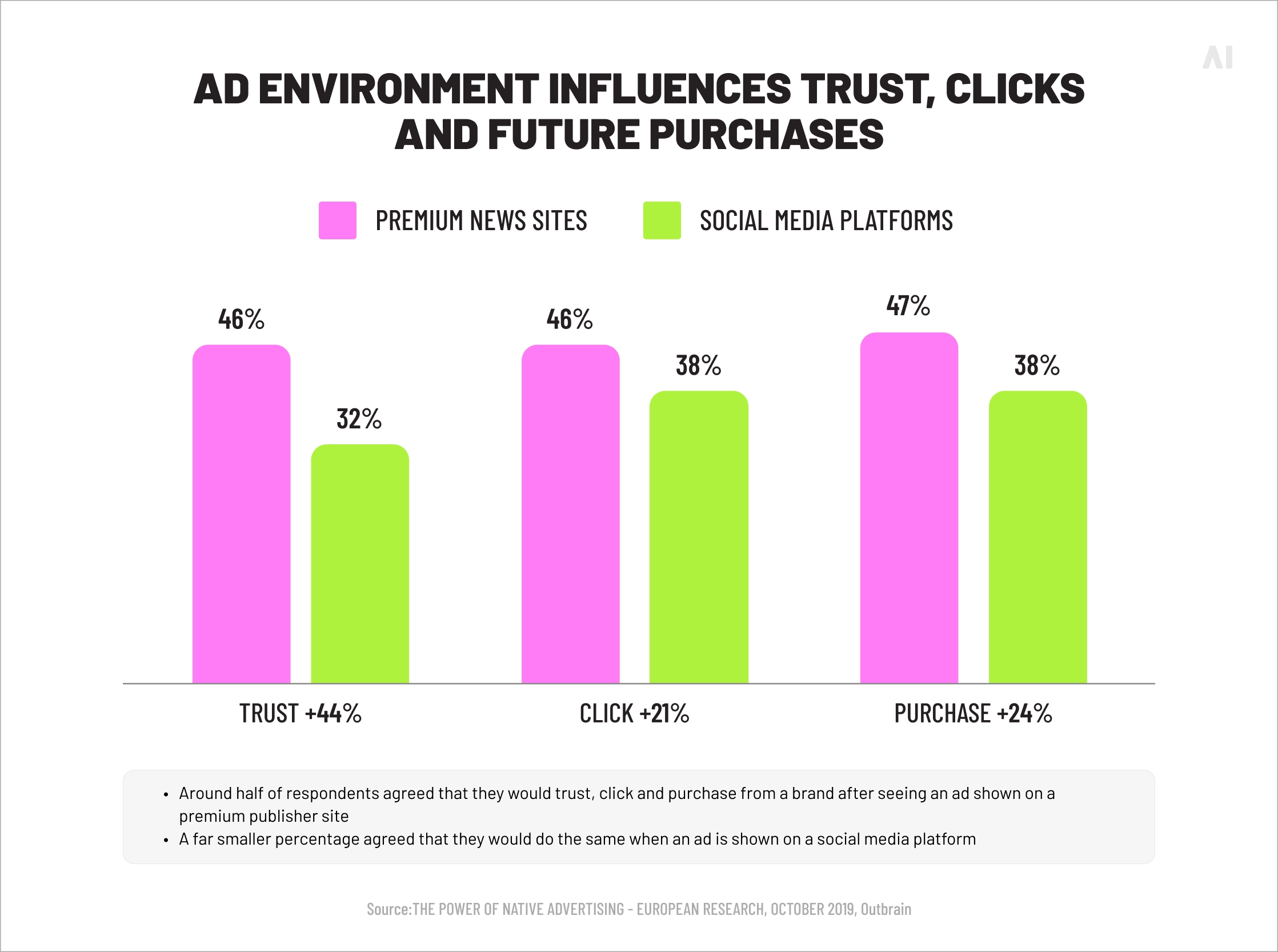
Studies on premium publisher sites have found native ads demonstrate 16% higher click likelihood compared to social media advertisements, with an accompanying 18% lift in purchase intent. The format's ability to drive both immediate action and downstream conversion intent makes it valuable across the entire marketing funnel. Whether you need traffic today or customers next month, native ad formats deliver measurable results.
⚡ Native advertising doesn't compete for attention with content—it becomes part of the content users choose to consume.
2. Better user experience and trust
Traditional display advertising operates on an interruption model. It disrupts what users want to do in hopes of capturing momentary attention. Native advertising works differently: it integrates with what users already want to consume. This distinction creates a fundamentally better user experience that, in turn, builds trust.
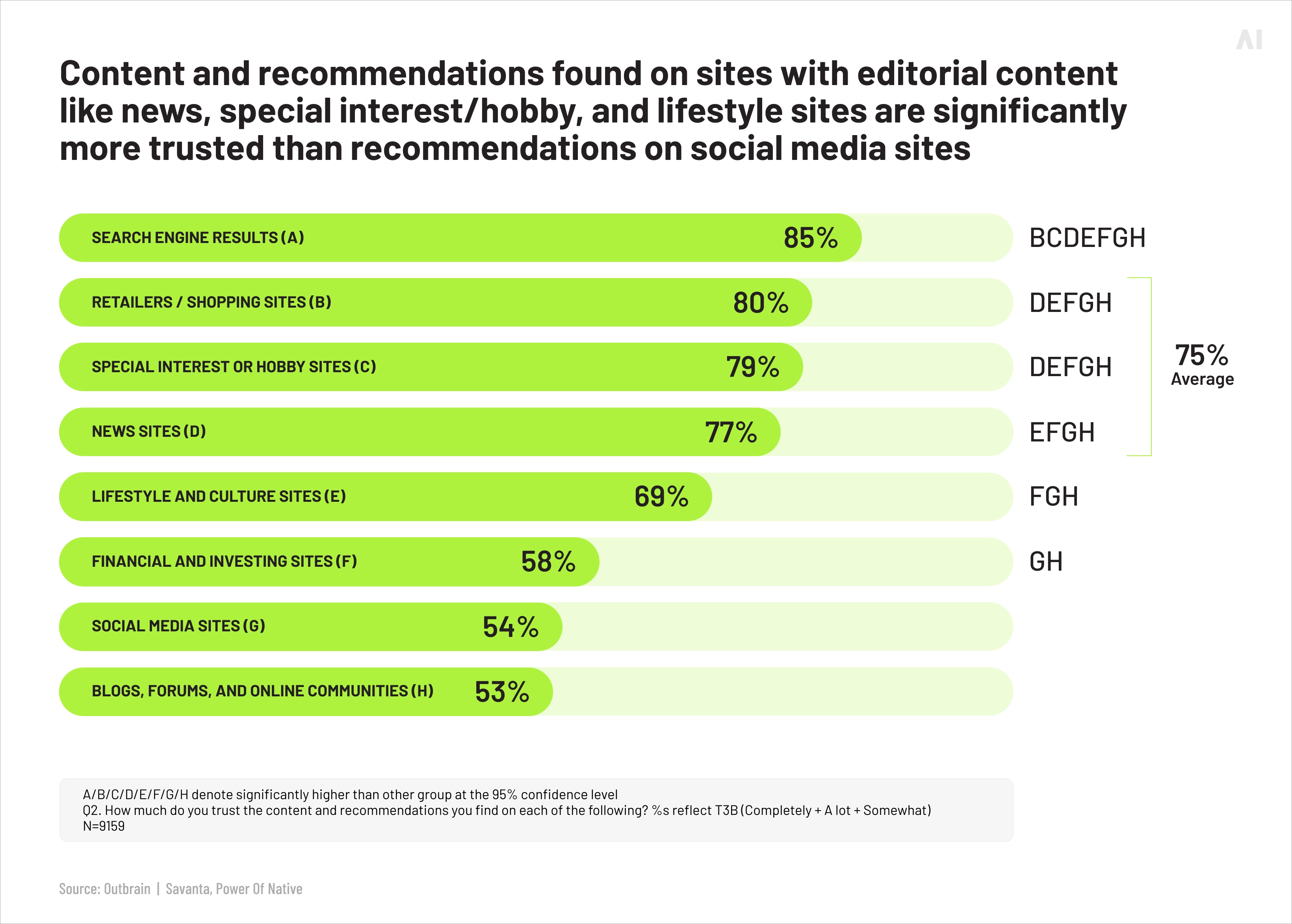
Roughly 75% of consumers trust native ads appearing on reputable editorial sites, compared to just 54% who trust advertisements on social media platforms.
That 21-point trust gap exists because context matters. When your brand message appears alongside trusted editorial content, audiences transfer some of that publisher credibility to your ad. They perceive native content as more informative and credible than obvious promotional material.
The trust advantage extends to format perception. Users rate native ‘sponsored recommendations’ easier to understand—42% vs 32% for social ads and 26% for banners—and they’re seen as the least annoying/intrusive of the three. People understand these placements are sponsored, yet they appreciate the non-disruptive approach. A well-executed native ad provides value first and promotion second, earning audience goodwill rather than irritation.

This goodwill translates directly to campaign outcomes. Native ads on premium news sites are 24% more likely to lead to future purchases than ads on social platforms. You're not just getting better engagement metrics; you're actually improving how people feel about your brand. In an era where brand perception drives long-term customer value, this advantage of native advertising compounds over time.
The format also combats "banner blindness"—the learned behavior where users automatically ignore anything that looks like an ad. Because native ads feel like editorial content, video recommendations, or social posts, users don't reflexively scroll past them.
3. Improved contextual and behavioral targeting
Native advertising excels at reaching the right person with the right message at the right moment. The format leverages both contextual relevance and behavioral data to maximize targeting precision. This dual advantage makes native ads particularly effective in an evolving privacy environment.
Contextual alignment means your ad appears alongside content that matches its topic or your audience's immediate interests. When a running shoe brand's native ad appears in an article about marathon training, that's contextual targeting at work. The placement feels organic because it is organic—the ad genuinely relates to what the reader came to consume.
Research by Nielsen and Seedtag demonstrates contextual targeting increases consumer interest in advertisements by 32% compared to traditional demographic targeting.

That's a significant lift from simply placing your message in the right editorial environment. Context serves as a relevance signal that makes your ad more compelling without any personal data collection.
Native formats also support sophisticated behavioral and programmatic targeting strategies. As of 2025, over 90% of all digital display ad purchases happen programmatically, and native formats have become a leading growth area within that trend. Advertisers can apply audience segments, retargeting lists, lookalike models, and interest-based targeting to native campaigns just as they would with any programmatic buy.

The combination proves powerful: you get behavioral precision (reaching users based on their demonstrated interests and behaviors) plus contextual relevance (showing ads alongside topically related content). This layered approach increases effectiveness while providing a hedge against privacy restrictions. Even as third-party cookies disappear, contextual targeting remains viable and compliant.
AI and machine learning further refine native ad targeting, helping ensure placements appear in relevant, brand-suitable environments while improving engagement. Algorithms analyze page content in real time, going beyond simple keyword matching to understand semantic meaning and tone. This ensures your ad appears in contexts that align with your brand values, not just your product category.
4. Flexible and scalable delivery
Native advertising’s edge over traditional formats is versatility. Programmatic native isn’t tied to one execution or placement. Formats include in-feed units, recommendation widgets, sponsored listings, branded content articles, native video, and more. This flexibility lets marketers match executions to their creative vision and campaign goals.
More importantly, native scales. Programmatic tech runs campaigns across thousands of publishers, apps, and devices while adapting to each placement. Your headline, image, and description dynamically adjust to each publisher’s design language. One buy reaches people on mobile apps, mobile web, and desktop, with the message rendered appropriately in each context.
Platforms like Google’s Display & Video 360 serve native through multiple exchanges and publishers in a single buy. Creative elements adapt automatically to each site’s specs and guidelines—combining the personalization of custom sponsored content with programmatic reach and efficiency.
US programmatic display is on track to reach nearly $180 billion in 2025—and programmatic drives virtually all new display growth, with native and video gaining share. Open standards like IAB Tech Lab’s OpenRTB Native turned bespoke publisher deals into automated, cross-site delivery at scale. SSPs now offer “native-as-a-service” that renders units on the fly, simplifying activation for exchanges and publishers.
Crucially, scale doesn’t cost relevance. A single native campaign can blanket thousands of sites while each placement blends naturally with the surrounding content. Creative adjusts automatically to local format requirements, preserving the native look and feel—delivering broad reach without the jarring, out-of-place feel of many banners.
The result: native delivers integrated brand messages efficiently and broadly. You don’t have to choose between personalization and scale; you get both through smarter tech that makes your creative work harder across more environments.
5. Enhanced brand safety and contextual alignment
Brand safety concerns keep marketing executives awake at night. Programmatic advertising's scale brings efficiency, but it also brings risk—your ad might appear next to inappropriate, controversial, or brand-damaging content. Native advertising offers inherent advantages here because placements integrate tightly with publisher content, providing greater control over context and quality.
Advertisers working with native formats can select specific publishers or content categories to ensure messages appear in brand-suitable environments. Premium publishers often maintain dedicated content studios with strict editorial standards for native content, which protects brand image while delivering quality. When your sponsored article appears on a respected news site or industry publication, you benefit from that publication's reputation and editorial oversight.
Advances in AI have further strengthened this aspect, with industry data indicating AI-driven tools can screen and place native ads in relevant, risk-free contexts while scaling campaigns. These systems analyze page content for brand suitability, sentiment, and contextual relevance in real time, automatically preventing placements next to problematic material. AI makes it feasible to enforce brand safety standards automatically across thousands of publishers without manual review.
Beyond safety, contextual alignment benefits brand perception. When an ad naturally aligns with surrounding content, it feels cohesive rather than jarring. Readers subconsciously associate your brand with the trusted publisher hosting the content.
Compare this to user-generated content platforms where brand safety is harder to guarantee. Social media feeds can contain anything from inspiring stories to inflammatory arguments within seconds. Native advertising on premium publisher sites provides a more controlled, predictable environment that protects brand equity while reaching engaged audiences.
6. Cost efficiency and long-term ROI
Performance marketers care about one thing above all: results per dollar spent. Native advertising delivers compelling cost efficiency alongside strong return on investment, making it attractive for budget-conscious advertisers focused on measurable outcomes.
The superior engagement rates native ads achieve directly impact cost efficiency. Higher click-through rates mean lower costs per result when you're buying on a CPM basis.
👉 When cosmetics brand Avon added native ads to complement its display campaign, the native units drove a 434% higher CTR while achieving an 88% lower cost-per-click compared to standard display advertisements. The native placements weren't just getting more attention—they delivered that attention more cheaply, substantially improving overall campaign ROI.
Similar patterns appear across industries. A travel brand that shifted budget from banners to native content discovery saw a 33% performance boost across campaigns with a slight reduction in bounce rate, indicating more qualified traffic. Better engagement typically means better audience quality, which translates to higher conversion rates downstream. You're not just getting more clicks; you're getting better clicks from users genuinely interested in your message.
Industry experts consistently observe native ads delivering higher return on investment than traditional formats because they generate more engagement and conversions. The cost efficiency stems from multiple factors: better audience targeting, higher engagement rates, improved brand perception, and longer content lifespan.
That last point deserves emphasis. High-quality sponsored content can continue attracting readers long after the initial campaign flight ends, particularly when hosted on a publisher's site. A well-written native article or helpful video maintains value over time, generating ongoing impressions and engagement. Traditional display ads typically have short lifespans—once the campaign stops, the ads disappear. Quality native content can provide sustained returns.
⚡ Cost efficiency in native advertising comes from alignment, not volume. The right message in the right context naturally performs better and costs less.
Native placements also tend to be lightweight and fast-loading, avoiding the heavy scripts that can bog down some display ad formats. This means less user drop-off due to slow page loads and better overall site performance, which indirectly benefits your ROI by keeping audiences engaged through the entire experience.
7. Seamless integration across channels (CTV, OTT, social)
Native advertising has expanded far beyond its origins on publisher websites to encompass virtually every digital channel. This evolution enables truly integrated media strategies that maintain consistent messaging and approach across touchpoints. The format's adaptability makes it valuable for omnichannel campaigns that need to reach audiences wherever they spend time.
Social media platforms have embraced native formats as their primary ad unit. Facebook News Feed ads, Instagram sponsored posts, Twitter promoted tweets, LinkedIn sponsored content—all mimic the organic posts users came to see. This makes social media native advertising feel less intrusive than traditional ads while enabling sophisticated targeting. Your sponsored content can appear in feeds alongside posts from friends and colleagues, earning attention through relevance rather than disruption.
The format has also emerged in connected TV (CTV) and over-the-top (OTT) streaming environments. Streaming platforms and smart TV interfaces increasingly offer sponsored content rows or recommendation-style placements that feel like part of the browsing experience. A "recommended for you" title that's actually a paid placement represents native advertising applied to television. Brands can extend content-driven campaigns into TV viewing in ways that feel organic rather than forced.
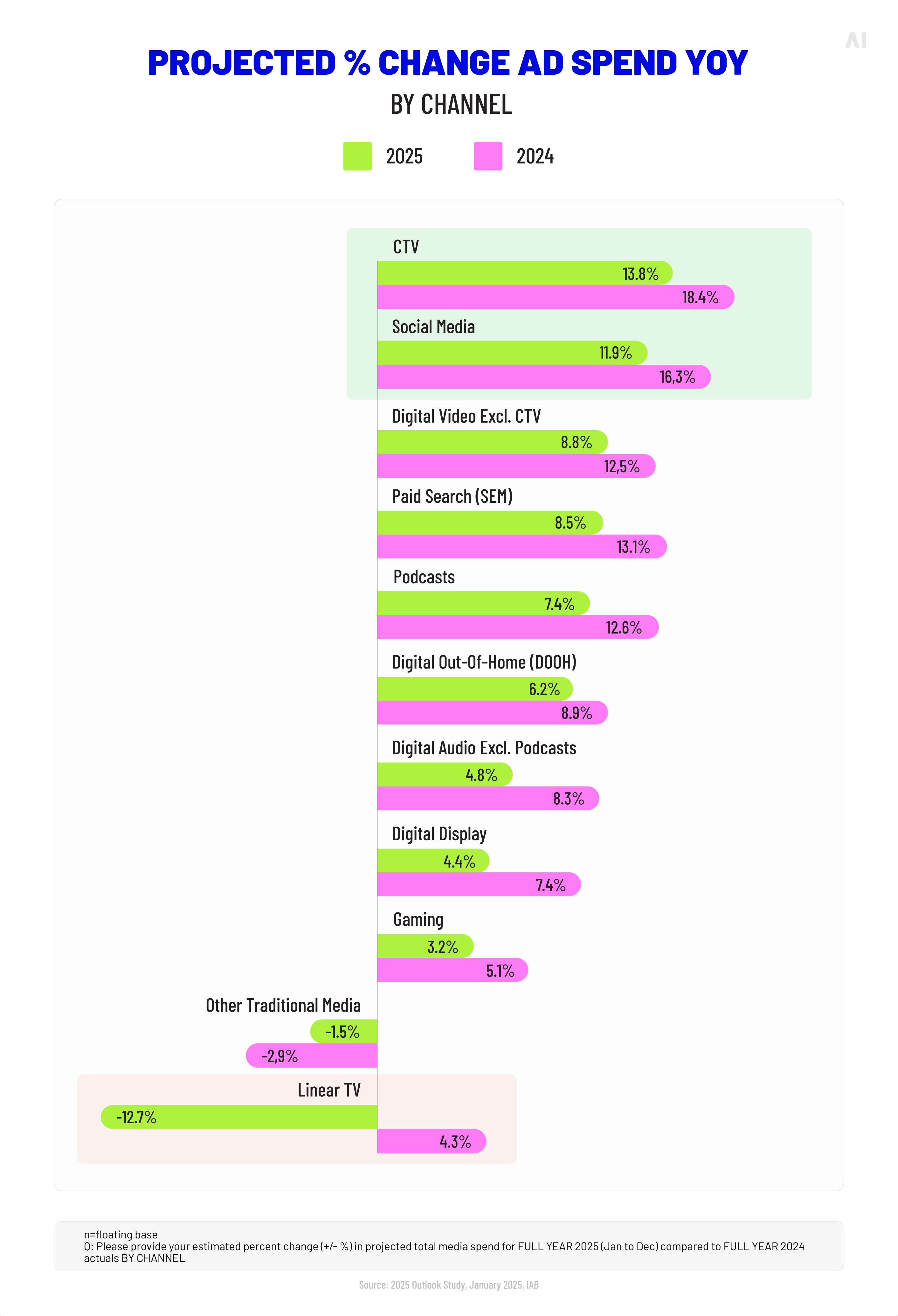
💡 This cross-channel capability matters for modern marketing. Learn more about how these principles apply to connected TV advertising and the opportunities that platform presents for native executions.
Modern programmatic platforms facilitate multi-channel native campaigns efficiently. Many demand-side platforms now support CTV, display, video, audio, and native ad management in unified dashboards. Advertisers can run and optimize across formats and channels simultaneously, maintaining consistent targeting and creative while adapting execution to each environment's norms.
👉 Imagine this in practice: a reader sees your sponsored article on a favorite news site in the morning, a promoted listing in a shopping app at lunch, and a branded mini-documentary on a streaming home screen that evening. Each touchpoint is native to its environment, yet together they form one campaign narrative. This unified approach is increasingly feasible with platforms that manage native alongside other formats.
The ability to integrate native into CTV and emerging channels is relatively new but growing rapidly. Even in streaming video, brands are exploring "storytelling" ads or sponsored content viewers might choose to watch, offering an alternative to forced 30-second commercials. Native advertising serves as connective tissue across channels, ensuring brand messages feel like a natural part of each platform's user experience rather than unwelcome interruptions.
8. Data-driven optimization and transparent performance tracking
Native advertising is now fully digital and data-driven, with robust analytics that guide continuous optimization. Marketers get transparent performance tracking—just like search or social—so every impression, click, engagement and conversion can be captured and analyzed in real time.
This is a big step up from print-era advertorials with little accountability. Modern platforms surface granular dashboards by creative variant, enabling rapid iteration. If a headline underperforms, you’ll see it quickly and test alternatives. Real-time visibility makes on-the-fly, data-driven adjustments standard practice.
A/B testing is especially powerful for native. Best practice is to run multiple headline/image combinations to find what resonates, and dynamic creative optimization goes further by adapting combinations automatically. Studies show AI-based optimization can drive sizable lifts—for example, Outbrain’s Keystone reports an average 30–50% CTR lift, and Yahoo’s native DCO showed a 53.5% conversion-rate lift in online A/B tests.
Transparency has improved, too. You can see which sites or apps ran your ads and how each placement performed, aiding both accountability and brand safety. (Examples: Taboola’s campaign reporting and DV360’s inventory transparency.)
⚡ Put together—granular data, real-time reporting, and optimization—native is a fully accountable channel. You can measure outcomes, attribute results, and keep improving performance over time.
9. Stronger brand storytelling and content integration
Perhaps native advertising's greatest strength lies in enabling authentic brand storytelling at scale. Rather than constraining messages to banner dimensions, brands can use native formats to deliver rich content that engages audiences meaningfully. Articles, videos, infographics, podcasts, interactive experiences—all become viable advertising formats that drive emotional connections and recall.
That storytelling translates into brand impact. In Nielsen case work, native video beat pre-roll on brand lift across five campaigns—one Jarritos campaign posted an 82% lift vs 2.1% for pre-roll.
And, as mentioned, in IPG Media Lab × Sharethrough tests, native drove +18% purchase intent and +9% brand affinity vs banners.
The format also bridges the gap between upper-funnel brand building and lower-funnel performance marketing. Engaging content improves brand sentiment and loyalty over time while also guiding interested readers toward conversion more immediately.
As mentioned, contextual alignment also amplifies storytelling effectiveness. When your brand contributes meaningfully to a topic audiences care about, the native content feels like part of an ongoing conversation rather than a sales pitch.
👉 Consider how Dove tackled beauty standards and self-esteem through native content with Elle Magazine while introducing a new product. The campaign resonated because it addressed genuine concerns and "created a dialogue about body image" beyond mere promotion, yielding meaningful brand-consumer interaction.
Put simply, native advertising lets brands weave messages into content people actually want. It boosts immediate engagement and differentiates through memorable storytelling. When products feel interchangeable, the brand with the better story wins mindshare—and market share.
⚡ The best native advertising makes people forget they're looking at an ad because the content itself delivers genuine value.
10. Future-ready for a cookieless, AI-optimized, and attention-based economy
Native advertising aligns perfectly with emerging realities that will define digital marketing's future: the decline of third-party cookies, the rise of artificial intelligence, and the shift toward attention-based success metrics. These trends will advantage native formats while challenging traditional display approaches.
As browsers and regulations phase out third-party cookies, advertisers are seeking alternatives to behavior-tracked banner ads. Native advertising provides an answer through contextual and first-party data targeting that doesn't rely on cross-site tracking. Because native placements integrate with content, they inherently use context as a relevance signal. Publishers with logged-in audiences can also leverage their first-party data—readership interests, subscription history, on-site behavior—to target native ads in a compliant way. Many analysts predict a renaissance of contextual advertising, and native is leading that movement.
💡 Understanding the challenges and opportunities of adapting to a cookieless world is crucial for marketers planning long-term strategies.
Simultaneously, AI is enabling more sophisticated native advertising at scale. Algorithms can dynamically generate or adjust native ad content for different audience segments, optimize headlines or images for various contexts, and ensure brand safety by automatically screening content.
The advertising industry is also increasingly focused on attention metrics—measuring not just whether an ad was viewable, but whether it truly captured eyeballs and for how long. This "attention economy" approach aligns naturally with native advertising because the format is designed to hold attention through engaging content.
In fact, eye-tracking shows native attracts more attention than standard display (looked at 53% more often).
As advertisers move beyond simple clicks to metrics like dwell time and engagement depth, content-driven approaches shine. Someone spending two minutes reading your sponsored article represents meaningful attentive engagement, far more valuable than a few seconds of banner visibility.
In summary, native ads thrive without third-party cookies, leverage AI for smarter placement and creative execution, and excel at capturing genuine attention in cluttered digital environments. These characteristics make native a forward-looking investment as we advance to 2026 and beyond.
Real-world success stories: native advertising in action
Reviewing real campaigns where native advertising delivered standout results shows how contextual alignment, strong storytelling, and disciplined execution make the format exceptionally effective.

In June 2014, the Times’ T Brand Studio published a long-form, multimedia feature on the realities of women’s incarceration, commissioned by Netflix to support Orange Is the New Black. It used reporting, audio, data visuals, and illustration—presented as a clearly labeled paid post.
Why it worked: The piece matched the editorial tone and audience interest of NYTimes.com. Digiday chronicled how even skeptical journalists praised it, noting that it behaved like real journalism while being transparent about sponsorship. Strategy leads interviewed by Digiday said it succeeded because it attached Netflix to a broader, newsworthy topic rather than pushing a show synopsis.
Evidence it resonated: Internal Chartbeat analysis (shared publicly by the Times’ Michael Zimbalist) found that during the study window the Netflix paid post ranked among the top ~1.47% of all NYTimes.com articles for traffic—i.e., within the site’s top 1,000 out of ~68,000 published pieces—an unusually strong showing for sponsored content.
What to borrow next time:
- Start with a topic your publisher already covers with authority; let the brand play a credible role inside that conversation.
- Build a multimedia reading experience (audio, charts, photos) that earns dwell time, not just clicks.
- Be overt in disclosure; readers accept sponsored work when the value is clear and the label is honest.
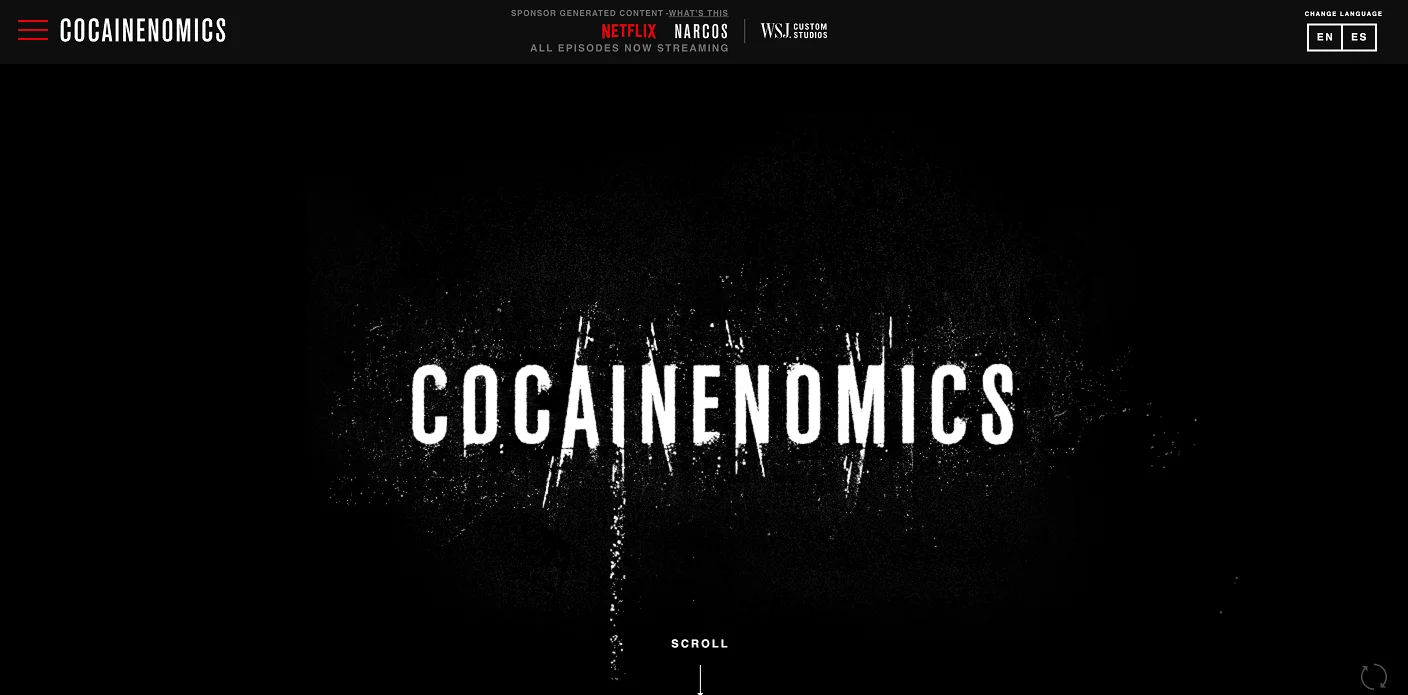
WSJ Custom Studios launched Cocainenomics in 2015, a bilingual, six-part interactive deep-dive into the business of the cocaine trade, aligned to the launch of Narcos. The experience blended maps, timelines, data journalism, video, and a quiz—clearly labeled as an advertisement produced by WSJ’s custom unit (not the newsroom). fastcompany.com+1
Why it worked: The story fit WSJ’s analytical voice and audience expectations—global markets, policy, economics—so readers treated it like a feature they’d read anyway. Fast Company highlighted the editorial depth and craft, which made the brand tie-in feel natural rather than interruptive.
Evidence it resonated: The project went on to win major industry recognition, including a Webby Award for Best Branded Editorial Experience and honors at Cannes Lions, establishing WSJ Custom Studios as a leader in high-caliber branded storytelling.
What to borrow next time:
- Match the publisher’s core beat so the branded feature rides existing reader intent.
- Use interactive structure (chaptered narrative, maps, assessments) to convert curiosity into time spent.
- Explicitly separate custom studio from newsroom for credibility and clarity.
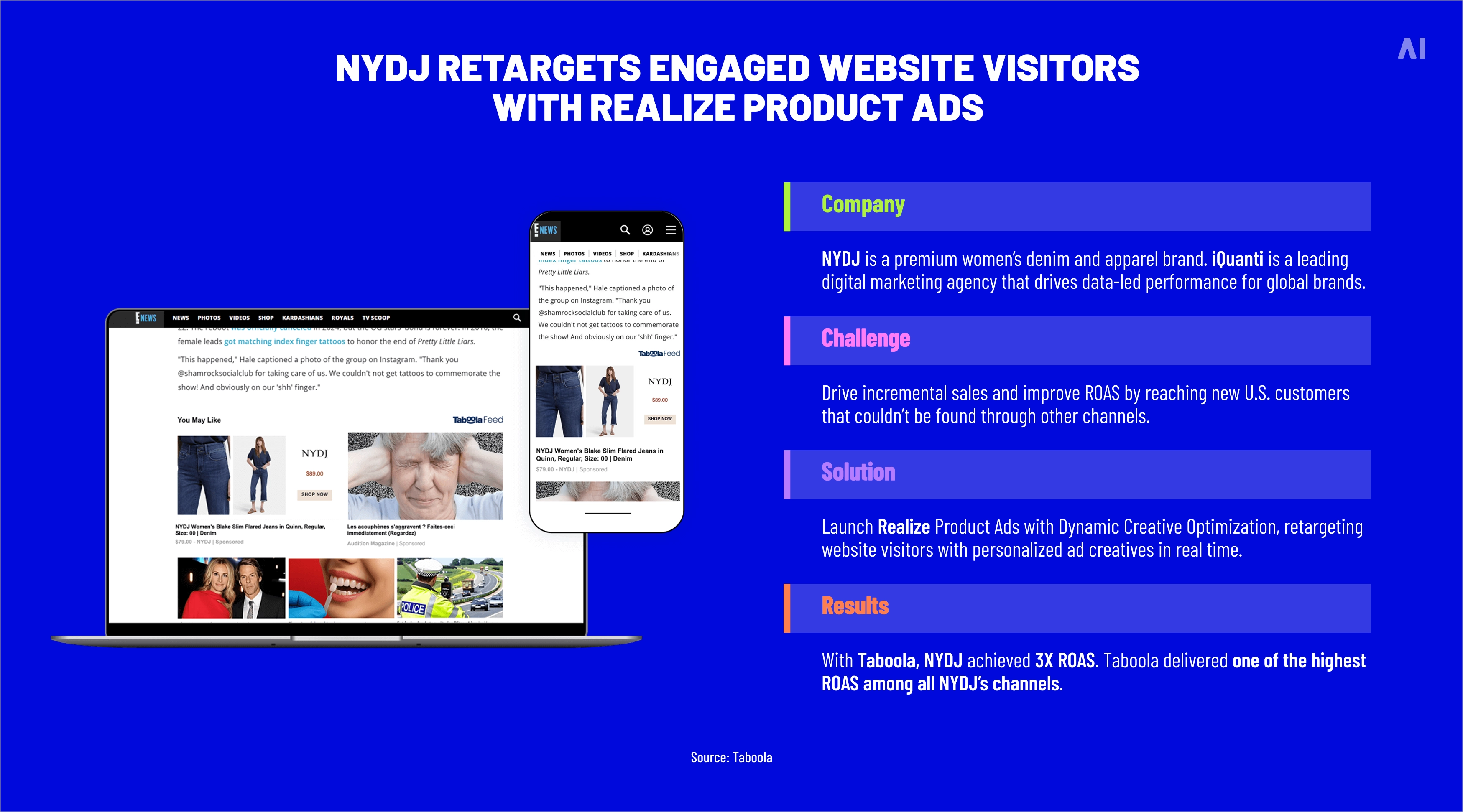
U.S. apparel brand NYDJ and agency iQuanti used Taboola’s Realize Product Ads (feed-based native) with dynamic creative optimization (DCO) to retarget shoppers on premium publisher sites. Creatives pulled live product details from NYDJ’s feed and auto-assembled variations based on each user’s on-site behavior (tracked via the Taboola Pixel).
Why it worked: The unit looked and behaved like the host site’s content modules (native), but the product shown matched each shopper’s intent. That alignment—contextual environment + individualized creative—reduced friction to re-engage carts and product viewers. It also tapped open-web reach to find incremental U.S. customers the brand “couldn’t find elsewhere,” according to the case.
Evidence it resonated: NYDJ achieved 3× ROAS, exceeding the program goal and ranking among the highest ROAS of all NYDJ channels during the test. Results were attributed to DCO’s ability to continuously rotate to top-performing image/headline/product combinations in real time.
What to borrow next time:
- Feed your product catalog into a native platform and enable DCO so ads reflect each user’s last interaction (viewed category, size, color, price point).
- Instrument a pixel and optimize to ROAS/CPA, not just CTR; use placement transparency to exclude under-performing sites.
- Keep creative elements modular (headline, image, price, promo) to support fast testing and auto-optimization without constant manual refresh.
These success stories share common themes: native advertising works best when content truly aligns with audience interests, when it's placed in sensible contexts, and when success is measured meaningfully through engagement and leads, not just impressions. Each brand avoided hard selling; instead, they offered stories or information that pulled consumers in, achieving brand goals while satisfying audience needs.
{{10-reasons-why-1="/tables"}}
How to integrate native advertising into your media strategy
Understanding native advertising’s benefits is one thing; implementing it well is another. Success takes deliberate planning across multiple fronts. Use the following considerations and best practices to make native work within your broader marketing strategy.
Setting clear objectives (awareness vs conversions)
Begin by defining exactly what you want native advertising to accomplish. Are you building brand awareness, shaping perception, and reaching new audiences—or driving actions like product sign-ups, lead generation, or sales? Native can do both, but strategy and metrics differ.
Clear objectives guide content, placements, and measurement. A common mistake is using the wrong KPIs. If your goal is upper-funnel awareness, don’t fixate on immediate conversions; track impressions, click-through rate, time spent with content, social shares, or brand lift surveys to see if the content resonates and spreads.
If you’re focused on conversions or landing-page traffic, monitor sign-ups, add-to-cart events, or cost per acquisition. Align KPIs with goals to avoid misreading results. For example, three minutes of average reading time can be a major engagement win even if direct conversion rate looks low. Define success—say a lift in brand recall or a target number of qualified leads—and use benchmarks appropriate to native.
{{10-reasons-why-2="/tables"}}
Remember, native often excels on engagement quality and depth. Consider attention metrics and lead quality, not just volume. Set the right objectives and KPIs from the start to optimize toward outcomes that matter most to your brand.
Choosing the right placement and creative format
“Native advertising” covers many formats—in-feed ads, sponsored articles, content recommendations, branded video, native social posts, and more. Choose formats and placements that match your audience and objectives.
Map to audience media habits. Which sites do they trust? What do they consume? For awareness and storytelling, partner with premium publishers for sponsored articles or video. For scale and conversions, use content-recommendation networks (e.g., Taboola, Outbrain). If your audience is heavily mobile, prioritize native in-app.
Coordinate cross-channel. Align native on social with native across the open web to reinforce messaging. Match the platform’s style and tone so ads feel like natural extensions of the environment (e.g., thought leadership on news sites; listicles or video on lifestyle blogs).
Relevance and integration are critical. An out-of-place native ad gets ignored—or backfires. Adapt creative to each placement’s norms and leverage publisher guidance to ensure fit.
Pick the right format for the story. Visual narratives suit native video or interactive; informational tips fit sponsored posts. Headlines and thumbnails matter in feeds—promise clear value, spark curiosity, avoid clickbait.
Align format with objectives. For pure awareness, use high-impact units on top-tier media; for performance, favor tighter content and clear calls-to-action. The goal: the right content, in the right format, for the right audience.
💡 If you’re exploring best practices and platforms for native advertising, our blog post on the best native advertising platforms can guide your placement choices.
Measuring success and optimizing creatives
Execution isn’t “set and forget.” To make native a strong part of your mix, measure and optimize continuously—you’ve got abundant data to work with.
Start by establishing baselines against your KPIs. Identify what’s working and what isn’t. If one publisher delivers higher engagement, shift spend. If one headline out of three doubles clicks, iterate in that direction.
A/B test systematically. Pit a benefit-led headline against a question, rotate thumbnail images, and—where dynamic creative optimization is available—feed multiple options. Small wording or image tweaks can drive big gains.
Monitor on-content behavior. For long-form, check scroll depth; for video, watch drop-off. Use insights to sharpen intros or front-load key messages.
Track post-click performance. If traffic bounces, the landing page or promise may be misaligned. (In the Austria Tourism example, lower bounce signaled more engaged visitors.)
Optimize targeting, not just creatives. Certain sites, topics, segments, or dayparts will outperform—keep reallocating toward them.
Compare against other channels. If native beats display on CPA, move budget. If a publisher partnership delivers strong brand lift, deepen it. Apply the same rigor you use for search or social: solid analytics, full-funnel tracking, relentless iteration.
One caution: give campaigns enough time and impressions to mature. With attentive management, you’ll lower costs and lift results—then scale the winning formula of topic, format, placement, and targeting.
💡 Knowing which digital marketing metrics and KPIs matter keeps optimization focused on meaningful gains. Learn more in our dedicated blog post: 15 digital marketing metrics & KPIs to measure performance.
Avoiding common mistakes in execution
While native advertising can deliver big rewards, pitfalls exist. Knowing the common mistakes helps you integrate native smoothly and avoid costly lessons.
- Don’t treat native like banners. Native isn’t a resized display ad. Make it feel like content, not a salesy slogan or generic product shot. Focus on storytelling, education, or entertainment—and avoid bait-and-switch headlines.
- Don’t blur disclosure or ethics. Clear “Sponsored/Partner Content” labels protect trust and meet legal norms. Hiding sponsorship backfires; well-labeled, high-quality content is far more welcome.
- Avoid mis-targeting or ignoring context. Match publication, tone, and audience stage. Early-funnel content should inform or inspire; late-funnel assets (case studies, testimonials) fit warmer audiences.
- Don’t neglect content quality. Native competes with editorial. Invest in strong writing, design, and video. Optimize for mobile; use scannable formatting, visuals, and clear calls-to-action.
- Don’t launch and forget—or rely on one piece. Test multiple creatives, monitor, and iterate. Native often has a longer engagement tail; give campaigns time and adjust based on performance.
By treating native as a content-driven format, aligning with context and funnel, maintaining transparency, and committing to quality and ongoing optimization, you greatly improve your odds of success.
Future of display and native advertising
Looking ahead, native advertising is set to take a larger role as traditional display evolves. Several trends will shape both formats through 2026 and beyond.
Format convergence. The line between native and display is blurring. Traditional placements are adopting native-like traits—more interactive, more context-aware, and redesigned to sit within the flow of content. Native, meanwhile, is borrowing display’s richer media: video, carousels, dynamic units. The upshot: most ads will increasingly mirror the surrounding style rather than sit in isolated boxes. Publishers are adapting, diversifying into video and native to lift revenue—even as banners remain a staple.
Growth of programmatic native and premium partnerships. Programmatic native will keep scaling as advertisers seek efficient reach, while premium publisher collaborations—flagship sponsored articles and brand stories—retain high impact. Expect a two-track ecosystem: AI-driven native flowing through exchanges for scale, alongside bespoke content with top media for depth. Both will flourish. With global native spend rising at double-digit rates, the format has moved from niche to mainstream and is set to command larger budget shares.
Cookieless targeting and privacy. With third-party cookies fading, native’s contextual core becomes more valuable. Contextual targeting is having a renaissance: content-rich ads placed in relevant environments can reach audiences without cross-site tracking, and studies show well-executed context often outperforms behavioral on interest and recall. Regulators and browsers are pushing for less intrusive experiences—native fits that brief by design. Expect privacy-safe identifiers and publisher first-party data to make native targeting even more precise without compromising privacy.
AI and automation. AI’s role in advertising is accelerating. In native, it upgrades buying, targeting, creative, and optimization.
- On the buy/target side, AI can read page content semantically in real time to choose the best placement, match ads to audiences beyond simple keywords, predict which creative will perform for a given context, and enforce brand safety/suitability automatically.
- On the creative side, generative tools can produce multiple headline, image, and layout variations—or full sponsored pieces—tailored to segments, devices, and platforms. Systems can spin light variations of copy for sub-audiences or adapt narratives dynamically as readers engage.
- On the optimization side, algorithms reallocate spend in real time, push budget to winners, and automate testing at scale.
Industry consensus: AI-driven targeting, automation, and analytics will shape what’s next. Native is well placed to lead because it has many parts AI can enhance—content, context matching, creative selection, and bid optimization.
💡 To plan long-term native strategies, marketers need a clear view of how AI in digital marketing is evolving. Read the full piece: AI in digital marketing.
The attention economy and new metrics. Advertisers are moving beyond impressions and clicks to measures of actual attention. Metrics like active viewing time, scroll depth, dwell time, and engagement rate reflect whether an ad truly lands—because a viewable impression doesn’t guarantee impact. In 2025, nearly half of buyers prioritize attention-based KPIs, and adoption is climbing. This shift favors native, which typically holds attention longer than standard display. Expect pricing to evolve too—cost-per-second, minimum-attention guarantees, or cost per engaged visit (e.g., 15+ seconds). The industry is moving past the click toward content people choose to spend time with—exactly where native excels.

Integration with content marketing and influencers. Native will increasingly overlap with content and influencer marketing. Brands will use native channels to amplify content assets, and influencer collaborations will become native units—for example, a publisher running a sponsored piece that embeds an influencer video. Advertising, content, and endorsements are converging, and media companies are building studios to produce brand content and experiences, not just sell native. As a result, “display” will broaden beyond static banners toward interactive, content-rich formats—playable units, AR, and other experiences that share native’s DNA.
Continued decline of low-quality inventory. Ad blockers and stricter browser policies are squeezing out spammy pop-ups, intrusive takeovers, and other heavy units. Advertisers will either improve those experiences or abandon them—many will reinvest in native, which is less blocked and more welcomed. As Gen Z and Millennials demand authenticity, native content becomes one of the few ways to engage them. They spend outsized time in creator-driven spaces like YouTube and TikTok, where ads often appear as sponsored creator content—essentially native. Brands will mirror that style across the open web, making ads feel as genuine and interesting as creator posts.
Put simply: the future of advertising is one where ads don’t feel like ads—and native sits at the center of that shift. Traditional display isn’t vanishing; it still delivers quick reach and retargeting. But earning real attention and trust requires ads that are contextual, relevant, and engaging—which is exactly what native is built for. Expect native and display to keep converging, with smarter targeting and measurement powered by AI and attention metrics.
⚡ In 2026 and beyond, the most effective spend will back story-led, user-first campaigns. Native embodies that approach, which is why it’s primed to lead.
Conclusion: Why native advertising deserves a place in every media strategy
Native advertising has moved from experiment to staple. It solves core challenges for marketers today: rising distrust of traditional ads, falling engagement with interruptive formats, tighter privacy rules that limit behavioural targeting, and the need for content that delivers genuine value alongside brand messaging.
The evidence is strong. Native drives higher engagement, strengthens trust and user experience, improves cost efficiency, and enables real brand storytelling. It works across the funnel—bringing immediate traffic and conversions while building long-term brand equity.
Looking ahead, native becomes even more valuable as the industry shifts to a cookieless reality, attention-based metrics, and AI-powered optimisation. Brands that build native capability now will be positioned to win as these trends accelerate.
Here are the key takeaways for marketing professionals:
- Lead with strategy. Set clear objectives before picking formats or publishers. Whether you’re building awareness or driving conversions, align creative and measurement to those goals. Native is versatile only when intent is precise.
- Prioritize quality and relevance. Invest in well-researched, well-produced content people actually want. One excellent placement on the right publisher beats dozens of mediocre ones. In native, the content is the ad.
- Test, measure, and optimize. Use campaign data to refine headlines, images, formats, and placements. Track depth of engagement—not just clicks—and tighten targeting based on what you learn.
- Think cross-channel. Don’t silo native. Integrate with social, display, video, and CTV to carry a consistent story across touchpoints.
For brands ready to launch native or scale what’s working, Smart Supply gives you outcome-driven supply selection across display, streaming video, CTV, and audio—DSP/SSP-agnostic, brand-safe, and built to remove bias and waste. It levels the playing field across platforms, selects premium inventory through direct SSP paths, filters out low-quality/IVT and bid-stream recycling with AI, and optimizes supply paths so more of your budget reaches working media—all with full placement transparency. With access to top-tier SSPs and broad premium coverage, you can scale efficiently while protecting your brand.
Ready to put native—and the rest of your programmatic supply—on smarter rails? Reach out to AI Digital and map a pilot against your KPIs.