What Is Programmatic Display Advertising? A Complete Guide for Marketers

Programmatic display has gone from clever automation to the dominant way Americans buy digital ads. In 2024, about 91% of U.S. digital display dollars were transacted programmatically—roughly $157B—and growth carried into 2025, according to Insider Intelligence/eMarketer reporting. At the same time, marketers are tightening quality controls, emphasizing measurable outcomes, and preparing for a cookieless reality. The result: programmatic is both bigger and, done right, smarter.
This guide explains what programmatic display really means, how it works, the building blocks of a solid campaign, when it delivers the most value, and where it’s heading.
What programmatic display advertising really means
At its simplest, programmatic is the automated buying and selling of digital ad inventory. Software handles the heavy lifting—matching an impression with a bid, applying data, and selecting creative—so each ad decision happens in milliseconds rather than through manual negotiations.
In practice, “programmatic display” spans banners, rich media, out-stream video, native-style display units on the open web, and increasingly formats beyond the browser (digital audio, DOOH, and CTV when bought through the same DSP rails). The key throughline is automation, not a specific format.
A useful framing: programmatic is impression-level decisioning. Every impression can be valued differently based on context, audience, device, predicted performance, and brand-suitability signals—then won (or skipped) accordingly.
💡 For a comprehensive primer on programmatic, read Programmatic advertising: What it is, how it works, and why it matters in 2026.
How programmatic display advertising works
At a high level, programmatic display is a real-time marketplace. When a page or app calls an ad, the publisher’s stack packages that opportunity and sends it to exchanges; on the buy side, DSPs score the impression against targeting, budgets, and brand-safety rules, then submit a bid. The highest eligible bid wins and the creative returns in roughly 100 milliseconds. Because every impression is priced and decided individually, outcomes hinge on the inputs you control: data, creative, supply paths, and measurement. Let’s start with the raw materials of that decision—the ad inventory itself and the data attached to each request.
Ad inventory and data signals
When a page or app needs an ad, the publisher’s ad server (often working with an SSP) creates a bid request and sends it into the marketplace. Think of this request as a structured snapshot of the opportunity.
It usually includes:
- the placement and size(s) available;
- basic page/app context; device information (desktop, mobile web, in-app);
- approximate location;
- connection type;
- the ad formats allowed (display, video, native); and
- privacy flags indicating what data may be used for this impression.
{{What-Is-Programmatic-Display-Advertising-1="/tables"}}
Modern bid requests follow IAB Tech Lab’s OpenRTB specification so buyers and sellers speak the same language.
The current 2.6 release added CTV-friendly features such as ad pods (so a single TV break can be represented cleanly), new Channel/Network objects to describe the content source, and a Structured User-Agent field that carries browser/device details derived from User-Agent Client Hints.
Alongside the bid request, platforms pass consent and privacy signals so everyone downstream knows what’s permitted. In the U.S., this is handled via IAB Tech Lab’s Global Privacy Platform (GPP), which standardizes how state-level privacy strings and other frameworks move through the ad stack.
⚡ Design your plan so it still performs when IDs go missing. If consent isn’t present, let context and high-quality supply do the work, then validate with lift or MMM.
In the second half of 2025, Tech Lab expanded GPP to add new U.S. state sections and announced a bi-annual release cadence, and it advanced the Data Deletion Request Framework (DDRF) v2 to make deletion requests more interoperable and secure—practical upgrades if you’re buying at scale across many states and partners.
Real-time bidding (RTB)
Most open-web buying happens through real-time bidding. Here’s the flow: the SSP broadcasts the bid request; interested DSPs score that opportunity against your targeting, budget and brand-safety rules; each DSP submits a bid; the highest valid bid wins; and the ad is returned for rendering—typically within a fraction of a second.
⚡ Auctions resolve in milliseconds; governance does not. Build rules once—frequency, suitability, fraud—and reuse them across every line item so speed doesn’t outrun safety.
OpenRTB defines this handshake and, as mentioned, with 2.6, includes constructs tailored for CTV auctions plus standardized objects for content and distribution channel so buyers can apply consistent rules.
💡 Here are two RTB primers for a clear, complete overview: What is real-time bidding (RTB)? definition and importance & Programmatic advertising vs. RTB: understanding the real difference — AI Digital.
Demand- and supply-side platforms (DSP, SSP), exchanges/marketplaces
Think of the programmatic “plumbing” as three connected layers:
- DSPs are the advertiser’s cockpit—the place you plan, target, bid, and optimize.
- SSPs are the publisher’s yield engine—where inventory is packaged, priced, and auctioned.
- In the middle sit exchanges/marketplaces that broker the auction, from open exchange to curated PMPs and programmatic guaranteed.
How you configure these layers—what deals you cut, which supply paths you allow, what controls you switch on—directly affects reach, fees, transparency, and quality. Here’s each of those layers in detail:
DSPs (buy side): This is where you plan and execute. A DSP lets you onboard first-party audiences (directly or via a clean room), build lookalikes, set exclusions and frequency, and choose inventory sources. You can attach bid strategies (e.g., CPA/ROAS, attention, viewability), pace budgets, sequence messaging, and rotate creative or DCO variants. Pre-bid brand-safety, fraud, and MFA filters run before you spend; blocklists/allowlists and supply-path rules (SPO) keep traffic clean. Most DSPs also support server-side conversion tracking, incrementality testing, and integrations with MMM/attribution so optimization aligns with business outcomes.
💡 For a complete DSP walkthrough, see the article Demand-Side Platform (DSP): How It works, benefits, and examples.
SSPs (sell side). Publishers use SSPs to package inventory, set and adjust floor prices, enforce ad quality, and route auctions to demand at scale. On the back end, SSPs manage ads.txt/sellers.json and schain transparency, detect suspicious supply, and apply policies for viewability and brand suitability.
💡 In the meantime, take a look at Smart Supply—premium, outcome-based supply with AI-driven optimization and real-time performance insights for transparent, efficient programmatic.
Exchanges/marketplaces. These connect both sides and host the auctions. Most clearing today is first-price, with exchange-level controls for auction dynamics, fraud screening, and reporting. You’ll encounter three common paths:
- Open exchange for broad reach and price discovery.
- Private marketplaces (PMPs) for curated supply, publisher or retailer data, stricter suitability, and clearer fees.
- Programmatic guaranteed (PG) for reserved inventory with programmatic delivery and predictable placement.
{{What-Is-Programmatic-Display-Advertising-2="/tables"}}
⚡ Supply conditions change; your allowlist should too. Review fee transparency, duplication, and attention every quarter and retire paths that don’t earn their keep.
CTV has moved firmly onto these rails: in 2024, about three-quarters of U.S. CTV buys ran programmatically across open exchange/RTB, PMPs/PG, and network deals. That mix lets buyers unify frequency, creative, and outcome measurement across screens while still accessing premium TV inventory.
💡 To learn more about the differences, please see DSP vs. SSP vs. Ad Exchange: understanding the differences in programmatic advertising.
AI and optimization
Machine learning powers much of the heavy lifting:
- Bid strategy & pacing. Algorithms adjust bids by placement, device, time of day, and audience propensity so you don’t overpay early or under-deliver late.
- Supply path choices. Models can favor cleaner, lower-latency paths that historically deliver better viewability and fewer IVT/MFA issues.
- Audience modeling. Lookalike and probabilistic models expand reach when deterministic signals are thin, while respecting the consent flags passed in the request.
- Creative decisioning. Dynamic creative optimization (DCO) picks the best message, product, or visual for each impression. Many teams now pair DCO with generative-AI workflows to spin up copy and asset variants quickly, then let the optimizer test and learn.
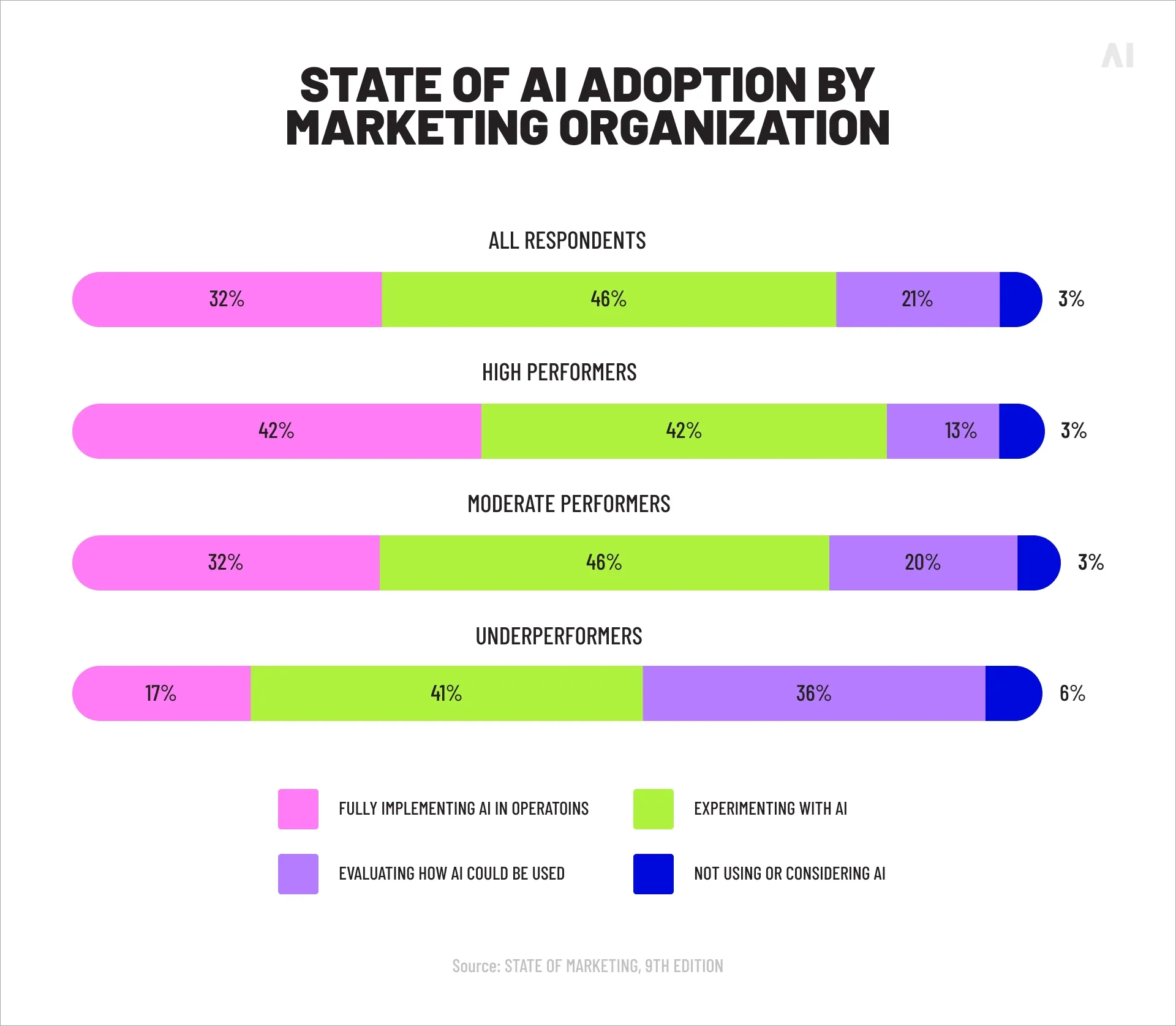
Among organizations that have adopted generative AI, 77% use it for creative development, rising to 84% among high performers, according to Gartner’s 2025 survey.
💡 For more on AI in marketing, see: AI in digital marketing: how artificial intelligence is transforming strategies in 2026
The core components of programmatic display campaign
A strong programmatic plan isn’t one lever—it’s a system. Each impression is decided by a few building blocks working together: the data that defines who you want, the creative that adapts to context, the targeting that balances precision with scale, the safeguards that keep supply clean, and the pipes that carry your message across screens.
Get these right and optimization becomes straightforward because every decision aligns with your outcome.
We’ll start with the foundation—audience data and segmentation—since the quality of your data shapes everything that follows.
Audience data and segmentation
Think of “audience” as four building blocks you can combine per impression: first-party data, clean-room matches, contextual signals, and modeled reach:
- First-party data (site/app behavior, CRM, conversions) becomes your anchor for targeting and measurement. The IAB State of Data 2024 finds marketers reallocating toward first-party data, more contextual strategies, and channels that permit deterministic identity (e.g., CTV and retail media). As third-party identifiers fade, teams are also leaning harder on probabilistic methods and MMM to keep measurement robust.
- Clean rooms let you compare or join your customer lists with publishers/retailers in a privacy-preserving way, then push activation-ready segments back to a DSP without exposing raw PII.
- Context (page/app content, category, sentiment, quality) is addressable even when user IDs are sparse.
- Modeled reach (lookalikes, propensity, or ID-less cohorts) fills gaps where deterministic IDs aren’t available.
Identity signals and match types vary by partner. IAB Tech Lab’s Identity Solutions Guidance maps the ecosystem—how user-level IDs, server-side flows, PETs (privacy-enhancing technologies), and clean-room outputs feed both activation and measurement. If you’re deciding among ID graphs or cohort approaches, this is the reference to keep on hand.
Creative formats
Programmatic display isn’t just banners. You can transact standard IAB display sizes, high-impact rich media, out-stream video, and native-style units through the same pipes. What’s changed is the volume of creative decisioning that happens in real time: dynamic creative optimization (DCO) swaps products, copy, and visuals at the impression level, and agencies report making DCO central to personalization at scale.
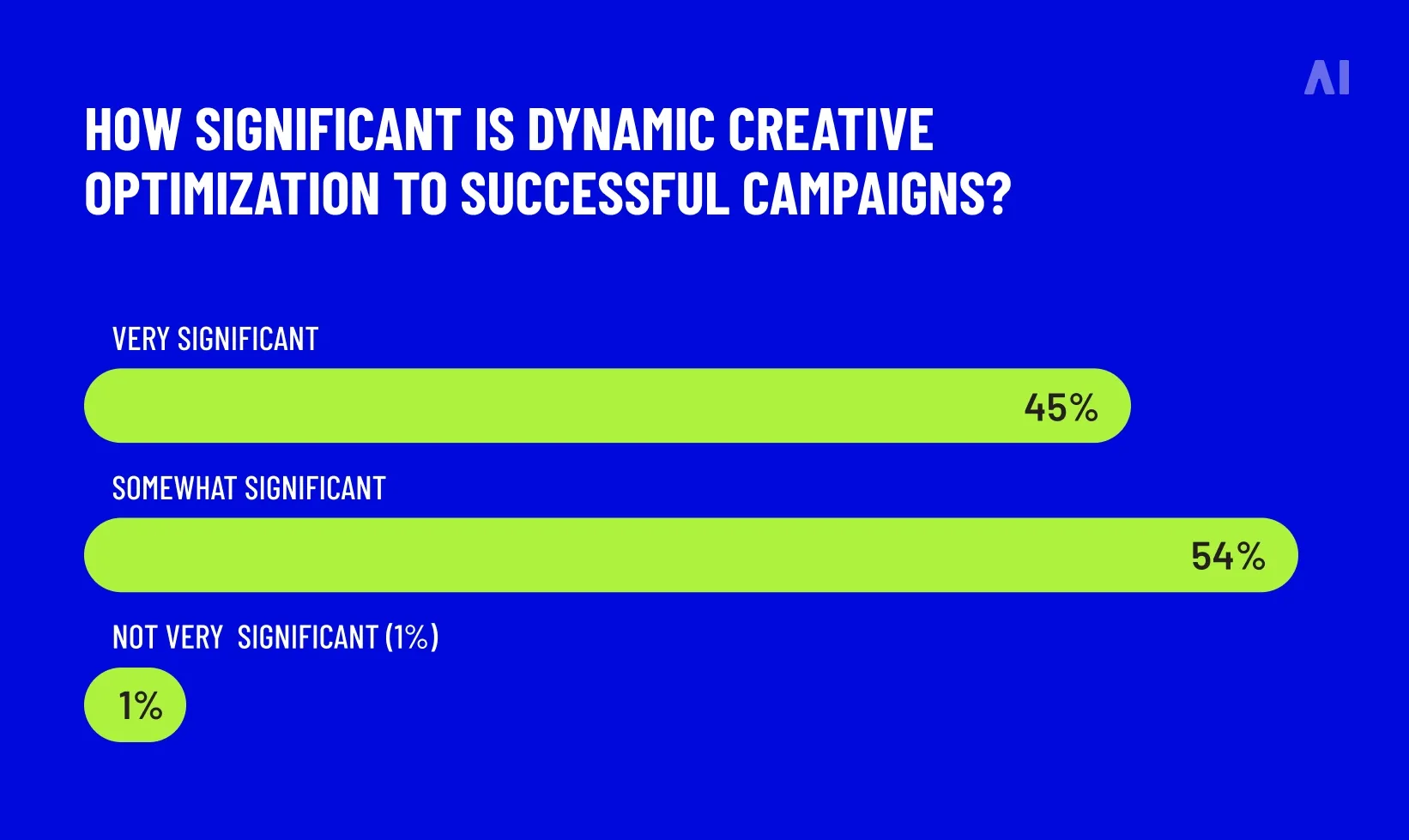
In a Digiday/Clinch survey of 120+ agencies, 99% said DCO is a significant factor in their work (45% “very significant”).
⚡ If frequency is under control but performance slides, look at fatigue. Rotate variants by audience and context before you add spend.
Contextual and behavioral targeting
With third-party cookies receding, contextual targeting has fresh importance, and retail-data powered audiences are becoming a cornerstone for precision. Two truths can coexist:
- Programmatic remains the dominant transacting method for U.S. digital display—over nine in ten dollars in 2024—so you can deploy contextual and retailer segments at scale through DSPs.
- Off-site retail media is accelerating as retailers extend their audiences to the open web, CTV, and video via programmatic pipes. Analysts expect off-site programmatic to capture a fast-growing share of retail media spend in the U.S.

⚡ In ID-sparse traffic, semantic fit and environment quality often beat broad audience guesses. Let context drive message selection and measure impact with attention and lift.
Brand safety and fraud prevention
Quality isn’t a “nice to have”—it’s the difference between money well spent and money wasted. Three realities to plan for:
- The ANA Programmatic Benchmark (2024) found 43.9% of spend entering DSPs reached consumers (a marked improvement vs. prior baselines) and MFA exposure among participants fell to a ~1.1% median—evidence that curation, SPO, and verification move real dollars.
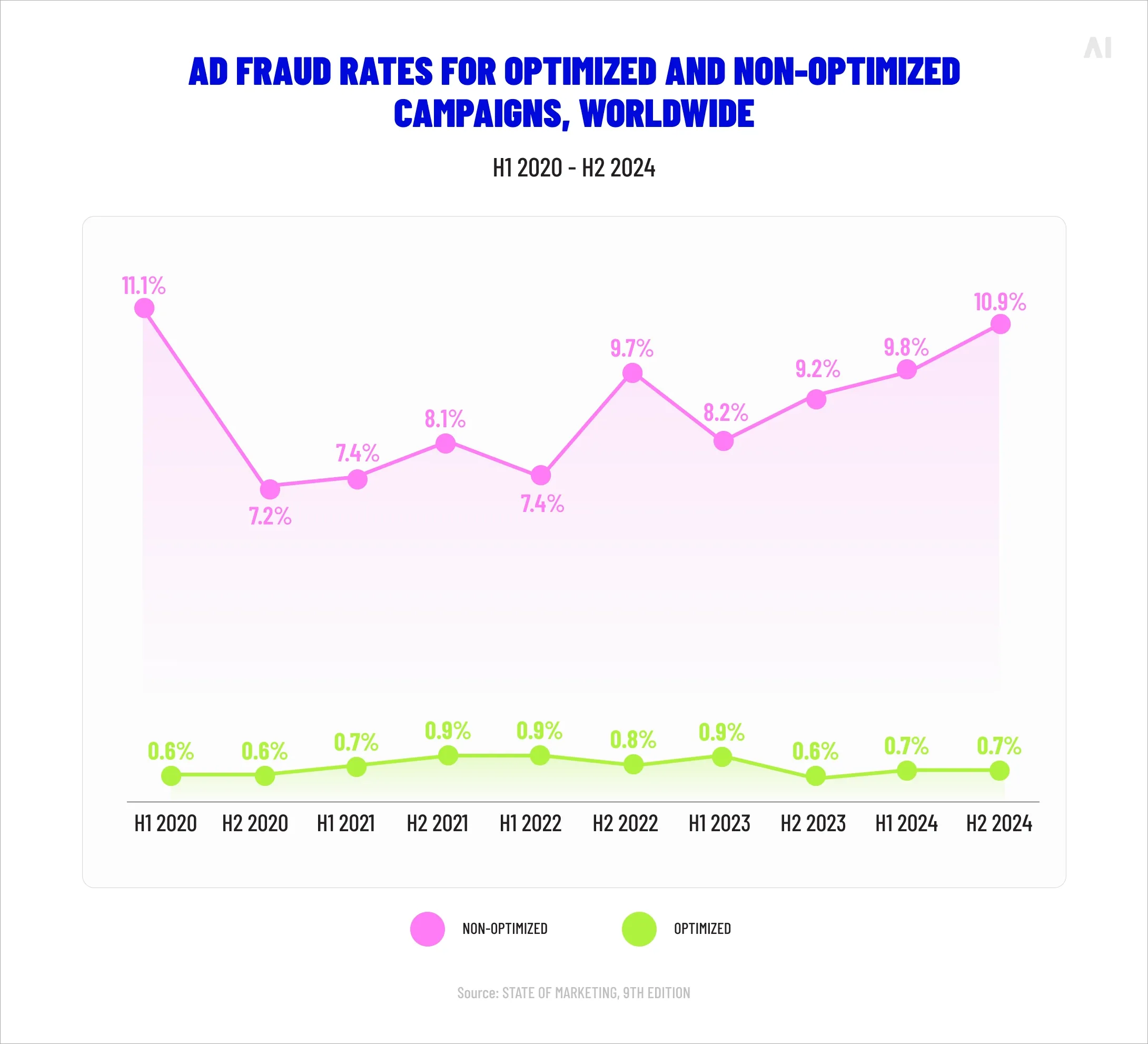
- Fraud risk is asymmetric. IAS reports non-optimized campaigns hit a four-year-high 10.9% fraud rate by end-2024, while protected campaigns averaged ~0.6–0.7%—a 15× gap that justifies pre-bid and post-bid defenses.
Attention and suitability filters are now part of the hygiene toolkit. DoubleVerify’s Global Insights (2024) tracks the rise of attention metrics and documents MFA patterns that degrade performance if left unchecked. doubleverify.com+1
Standards make this enforceable at scale. Buy through ads.txt/app-ads.txt authorized sellers, validate sellers with sellers.json, and inspect the SupplyChain Object to cut unauthorized resellers. These are IAB Tech Lab staples; use them alongside verification vendors and SPO rules in your DSP.
{{What-Is-Programmatic-Display-Advertising-3="/tables"}}
⚡ Use attention metrics to guide creative and supply choices, then confirm value with sales or brand lift. Treat it like a compass, not the destination.
Cross-device and omnichannel delivery
The same programmatic rails now power display, online video, audio/podcast, DOOH, and CTV, so one plan can manage reach, frequency, and outcomes across screens.
On CTV specifically, consumer behavior is doing the heavy lifting: streaming accounted for 44.8% of all U.S. TV usage in May 2025, surpassing the combined share of broadcast and cable for the first time, per Nielsen’s The Gauge.
⚡ CTV reach looks big—make sure it’s new. Run deduped reach or geo holdouts so you know how much of that screen time is incremental to your other video.
At the same time, ad-supported streaming is scaling fast—Comscore reports a 43% year-over-year jump in viewing hours for AVOD/FAST in 2025, and 45% of Netflix U.S. households now watch on its ad tier (up from 34% in 2024).
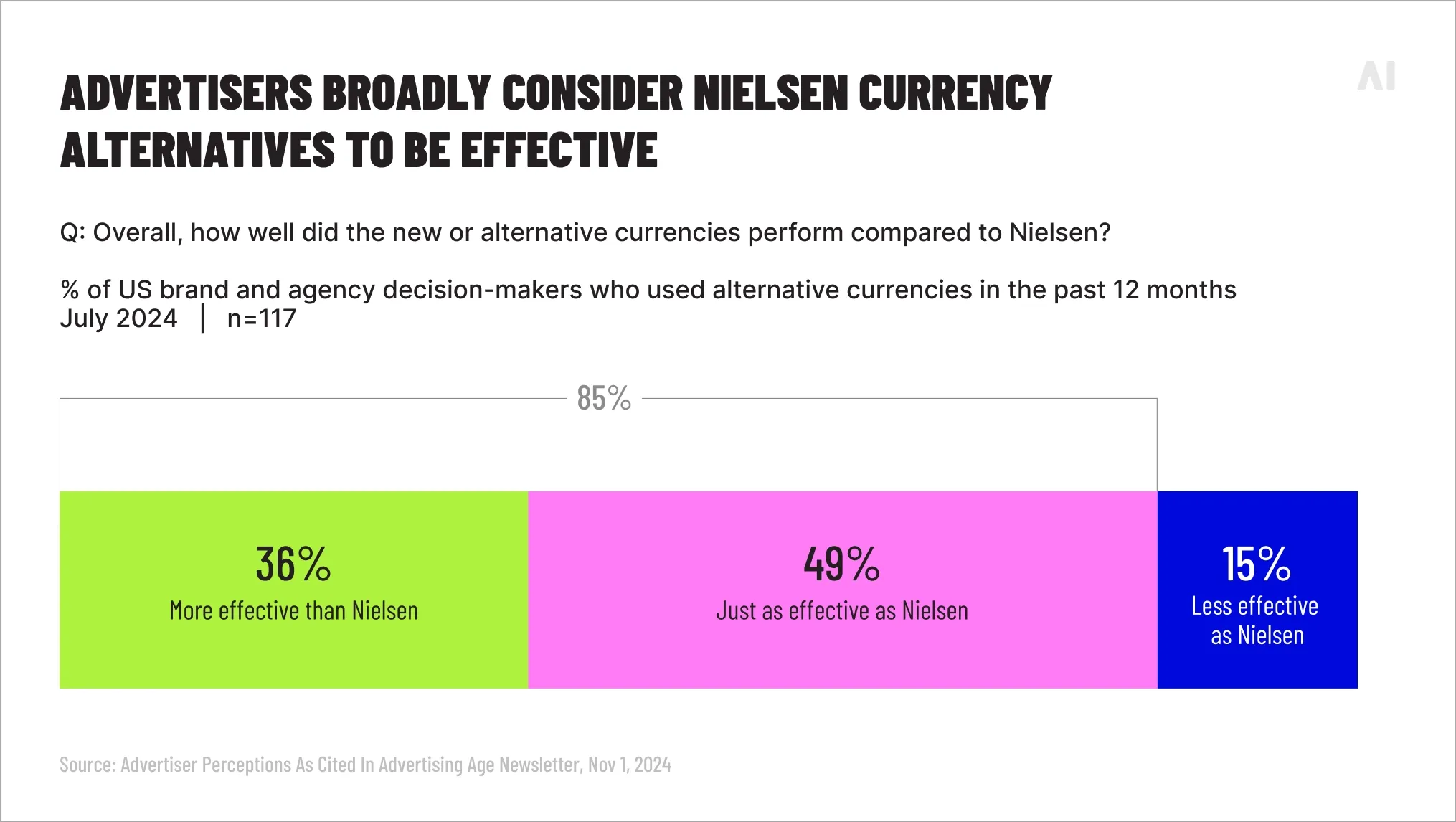
Buyers are also retooling measurement: IAB notes “business outcomes” are the top KPI for digital video, with broad testing of alternative currencies—useful when you’re coordinating budgets across multiple channels.
The benefits of programmatic display advertising
The widespread adoption of programmatic advertising reflects concrete advantages that marketers have discovered through implementation:
- Automated, data-driven decision-making streamlines the entire ad buying process. Transactions that once required lengthy email chains and manual insertion orders now execute in microseconds through software. This efficiency reduces labor costs and allows campaigns to launch or pivot quickly. Marketers can focus on strategy and creative development rather than administrative tasks.
- Smarter targeting and personalization minimize wasted impressions on uninterested viewers. Advertisers can layer multiple targeting criteria to zero in on their ideal audiences. An automotive brand might serve different creative variants showing SUVs to adventure enthusiasts, sedans to families, and electric vehicles to environmentally conscious buyers, each on sites those groups frequent. This precision drives better engagement and click-through rates.
The Economist used programmatic data segmentation to deliver 650,000 new prospects with a 10:1 return on investment, performance possible only through granular targeting.
- Real-time optimization and performance tracking create continuous improvement cycles. Unlike static campaigns that run their course before analysis, programmatic systems adjust constantly based on performance data. Algorithms automatically shift budget toward high-performing placements, audiences, and creatives while reducing spend on underperforming elements.
McDonald's integrated real-time sales data into its programmatic efforts and achieved a 1.3% increase in total sales with nearly 3% more new customers, delivering a $10.92 return on ad spend by quickly optimizing what worked.
- Scalable reach across channels provides the volume brands need for awareness campaigns while maintaining flexibility for performance goals. Through one interface, advertisers can access millions of publisher sites, apps, and multiple channels including display, video, mobile, and connected TV. This reach operates on demand, allowing marketers to scale spending up or down based on performance and business needs.
- Better cost control and measurable ROI stem from auction-based pricing and granular performance tracking. Advertisers pay market value for each impression rather than fixed rates, and competition in exchanges can drive efficiency in long-tail inventory.
UK retailer John Lewis used programmatic deals to secure premium Black Friday placements and beat their ROI target by 346% while optimizing costs. Auto Trader reported a 90% reduction in cost per acquisition after switching to machine learning-optimized programmatic campaigns.
- Stronger privacy compliance and transparency have improved as the industry matured. Modern platforms include consent management features and support privacy-safe targeting methods. Tools like ads.txt and supply path reports help advertisers understand where their money flows, enabling cleanup of inefficient supply chains.
For the full picture on AI-powered targeting, check AI targeted advertising: improving ROI and personalization.
.webp)
When to use programmatic display advertising
Programmatic display ads deliver the most value when you need scale, precision, and the ability to adapt mid-flight. Here are three scenarios—each grounded in recent U.S. results—plus a proven launch example.
Brand awareness campaigns
Use programmatic to build large-screen reach quickly while holding the line on quality and frequency. Two recent U.S. examples show how it performs at the top of the funnel:
- Live sports at national scale: During the Paris 2024 Olympics, NBCU said two top advertisers running programmatic on Peacock achieved 94–96% incremental reach versus other ad-supported streamers—evidence that programmatic can add unduplicated reach fast when audiences surge.
- Programmatic DOOH that moves consideration: In a 2023–2024 U.S. digital out-of-home flight, Nokia saw a +68% lift in purchase intent after activating DOOH programmatically across multiple premium networks—useful when you need broad awareness plus a measurable brand-lift signal.
Performance and retargeting campaigns
When the KPI is a conversion (a lead, an application, a sale), programmatic’s optimization and audience controls shine:
- High-intent recruitment: A U.S. healthcare organization moved its job ads to a programmatic approach and recorded a 131% increase in applications while lowering average CPA—illustrating how algorithmic budget allocation and supply-path controls can outperform fixed job-board buys.
- Attention-optimized bidding for lower-funnel lift: In an Audi programmatic test, a custom algorithm (built on attention signals) delivered a 69% higher conversion rate across open exchange inventory and +60% cumulative conversion rate overall versus standard bidding—showing how optimization beyond basic CPC/CPA can pay off.
Product launches or time-sensitive offers
If you’re racing a deadline (new model, weekend promo, seasonal drop), programmatic’s speed-to-market and creative agility help you scale without sacrificing relevance:
- Personalized launch creative at scale: In an Audi model launch, dynamic creative assembled thousands of ad variants from a modular feed and programmatic buying produced a 4× higher average conversion rate than traditional placements—proof that rapid testing and real-time creative decisioning can accelerate launch performance.
How to decide quickly on type of programmatic ads
Use the matrix below to pick a path in seconds. Match your goal to the scenario in the left column and follow the recommended setup
{{What-Is-Programmatic-Display-Advertising-4="/tables"}}
If your situation spans both (for example, a launch that needs fast awareness and immediate sales), run them in parallel: a curated CTV/DOOH/online video reach layer with strict frequency, plus a conversion-optimized display/retargeting layer that adapts creative and bidding in real time.
⚡ Low CPMs can hide duplication, poor viewability, or MFA. Optimize to cost per outcome and let the algorithm pay more where it truly pays back.
Programmatic display vs. native advertising
Programmatic display and native advertising often get mentioned in the same breath, but they answer different questions:
- Programmatic display describes how inventory is bought and optimized: software evaluates each impression, bids, and serves an ad in real time.
- Native advertising describes what the ad looks like: a format designed to match the surrounding content’s design, location, and behavior (for example, in-feed units, content recommendation widgets, or publisher-hosted branded content).
You can buy native programmatically — via the same DSP/SSP pipes — using the IAB Tech Lab’s OpenRTB Native spec to pass titles, images, and disclosure elements at the impression level.
Where native differs is the creative and compliance layer. Native emphasizes fit and disclosure so people can tell paid messages from editorial.
On spend and usage, native is not a niche format. eMarketer estimates U.S. native digital display ad spend at ~$109B in 2024, with ~$80B on social in-feed and < $30B on non-social native across the open web—evidence that native is a large, distinct slice of display, and that most dollars still flow through social feeds.
How should you choose between them?
- Treat programmatic display as your default for broad, standardized reach and rapid testing across thousands of sites and apps.
- Use native when you need message absorption and editorial adjacency—mid-funnel education, thought leadership, or branded content—while keeping disclosures airtight and measurement tuned to content consumption (e.g., time on content, scroll depth).
{{What-Is-Programmatic-Display-Advertising-5="/tables"}}
💡 For a deeper dive into native, see: Native ads vs. display ads: key differences, examples, and when to use each
Key trends shaping the future of programmatic display
Here’s what’s next for programmatic—and why it matters. The forces shaping the channel aren’t isolated; they reinforce one another. Read each trend with two lenses: what it changes in the pipes (data, identity, auctions) and what it changes in your operating model (planning, creative, measurement).
Cookieless targeting and first-party data
Marketers are rebuilding their playbooks around data they can lawfully use and reliably match. U.S. consumers are pushing in the same direction: 81% want a federal privacy law and 77% prefer consistent rules across jurisdictions, according to Cisco’s 2024 Consumer Privacy Survey.

On the browser side, Privacy Sandbox remains in flux. The UK Competition and Markets Authority’s most recent oversight notes that Google decided in April 2025 not to introduce a standalone cookie prompt and to maintain the current approach to third-party cookies while Sandbox APIs evolve, keeping industry attention squarely on consent signals and privacy-preserving activation.
💡 Read more in detail in our dedicated piece: In a cookie-less world: New challenges and opportunities
Execution is hard: 70% of marketing leaders struggle to identify and reach audiences across touchpoints and two-thirds juggle 16+ martech tools, per Forrester’s Identity Resolution Survey. This complexity is why clean-room workflows and server-to-server integrations are moving from “nice to have” to table stakes.
Cookieless doesn’t mean context-less. Experian reported a U.S. beta where a 15-day, ID-free campaign beat CTR benchmarks by 25% using contextual classification paired with retailer and publisher data pipelines.
Our POV: All signs point to patchy identifier availability across browsers, apps, and states. Our base case: plan as if IDs are scarce. Make consented first-party signals and high-quality contextual data the default, then layer deterministic IDs only where they truly exist. Clean rooms are moving from optional to essential, so center CRM and conversion data there rather than relying on pixels alone. Policy and platform timelines will continue to shift; to stay steady, keep an addressability map for every plan and pair user-level attribution with MMM and incrementality so performance holds when identifiers drop out. Our recommendation: design for resilience, not for a single ID solution.
AI-driven creative optimization
Adoption has broadened beyond asset generation. Salesforce’s latest marketing stats show 63% of marketers now use generative AI, and Forrester’s 2025 CMO Pulse indicates B2C marketers plan to increase AI investments while formalizing how they measure AI’s impact.
Real-world lift is showing up in case work: IBM’s pilot with Adobe Firefly produced 200 base images and 1,000+ variants, driving a 26× engagement rate vs. IBM’s norms—evidence that velocity and variant testing can be an advantage when paired with guardrails.
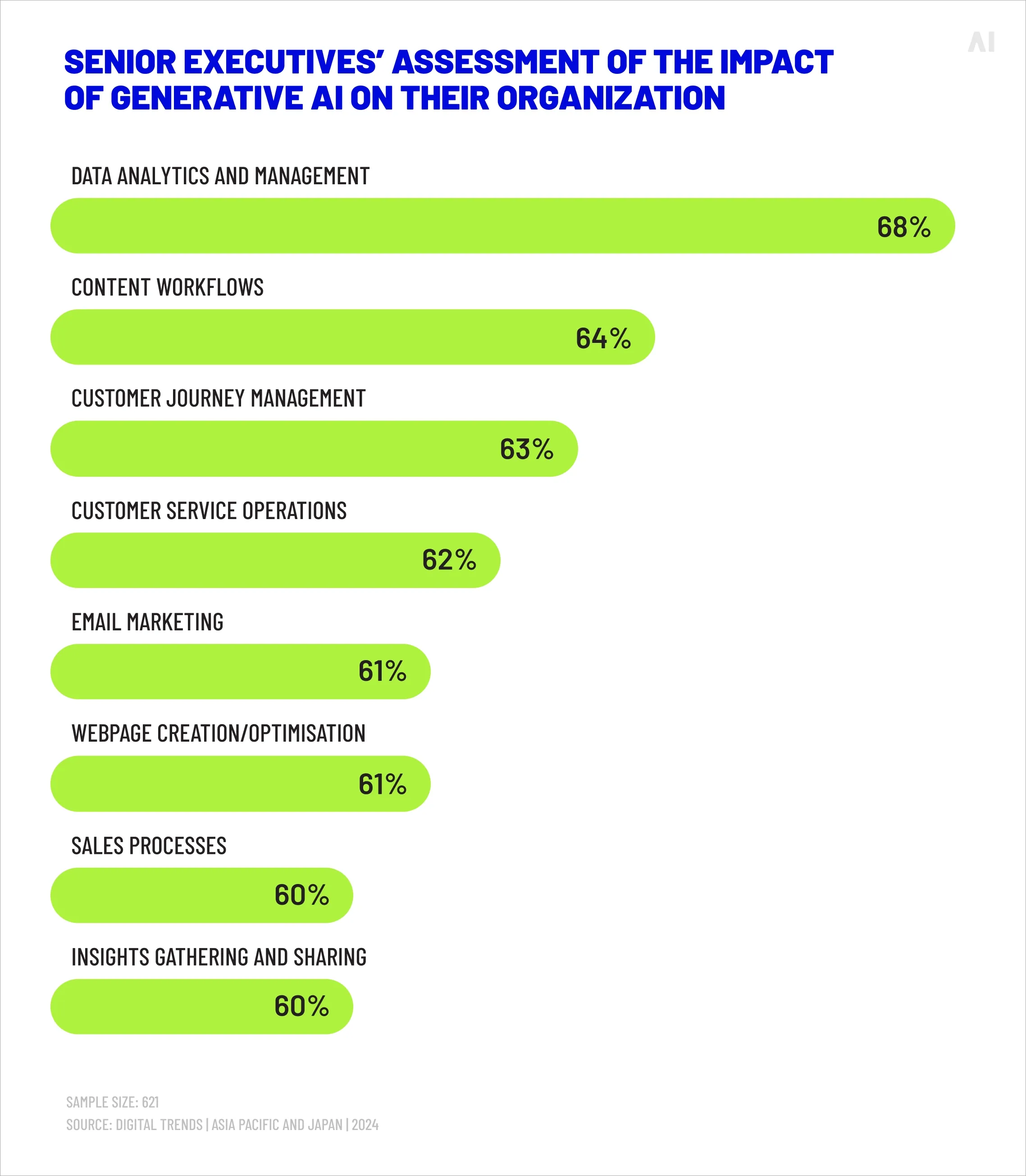
Adobe’s 2024 Digital Trends research also found 64% of senior executives expect gen-AI to reshape content workflows, reinforcing the shift from a few big creative bets to many small, brand-safe experiments each week.
💡 For more on GenAI and its transformative impact on marketing, read: The transformative power of GenAI in creative & media strategy.
Our POV: Momentum favors teams that learn faster, not just produce more. Creative velocity will be a competitive edge, so build a “creative OS”: modular, brand-safe components feeding DCO; guarded generative tools to scale on-brand variants; and human QA to protect tone, claims, and compliance. The industry is moving from proxy metrics to outcomes; meet it there by running many small, controlled experiments each week and letting the buying algorithm steer toward sales, qualified leads, or verified attention. Advice in practice: speed up the testing loop while keeping tight governance so scale never outruns quality.
CTV, Retail Media, and omnichannel expansion
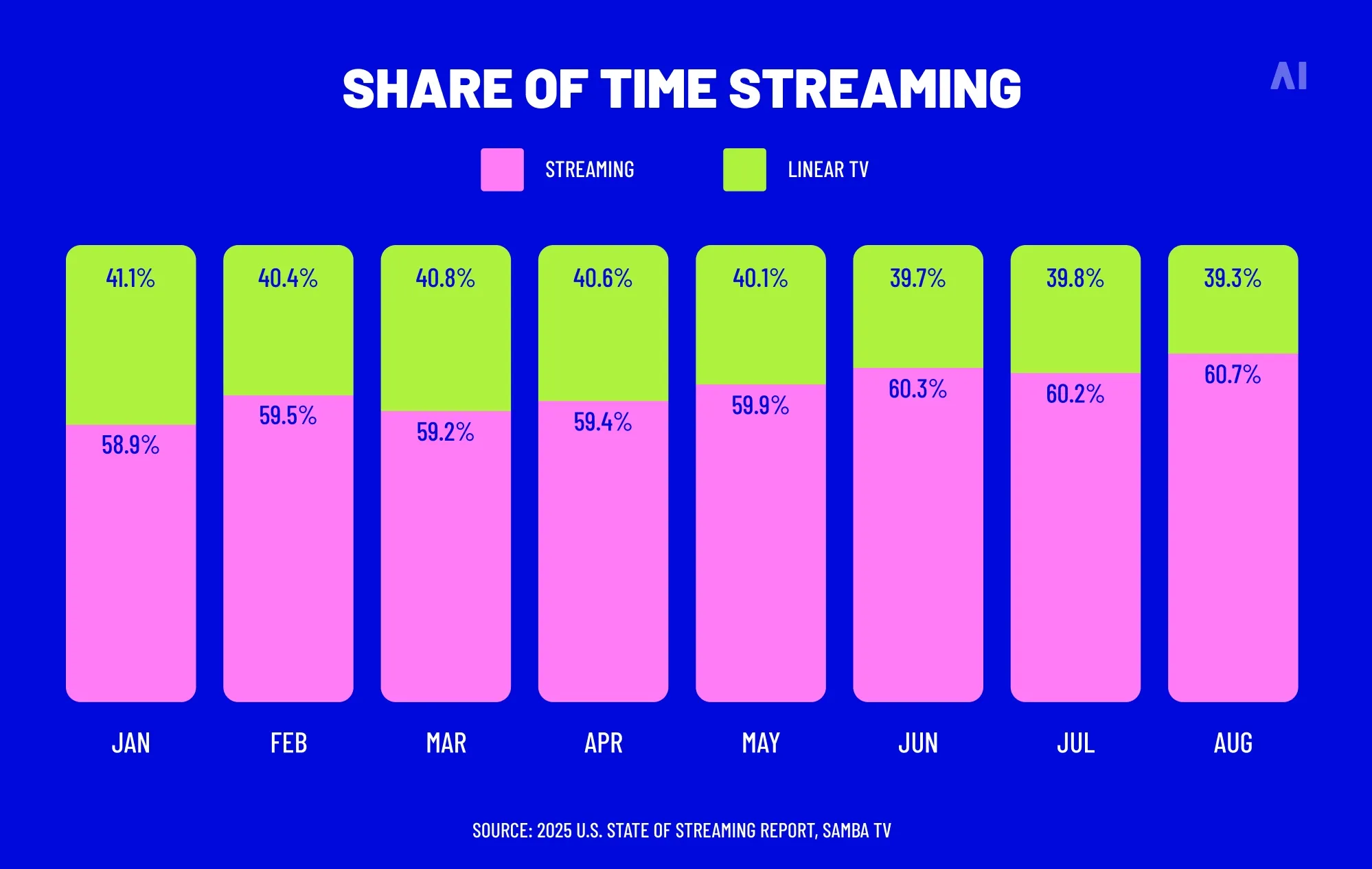
Consumer behavior is doing the heavy lifting for omnichannel planning. As mentioned, streaming now accounts for more than half of U.S. TV viewing time; when shows are available in both places, 67% of viewing happens via streaming. Antenna adds that 46% of U.S. streaming subscriptions are ad-supported, expanding addressable CTV inventory.
Scale on the platform side continues to build: Roku surpassed 90 million streaming households in January 2025 and reported double-digit platform revenue growth tied to advertising later that year.
💡 Learn more in a primer on CTV: Connected TV advertising in 2025
Retail media, meanwhile, is extending off-site through DSP rails. Boston Consulting Group highlights closed-loop sales measurement as a core reason marketers push retail audiences into open web and CTV, and Circana reports up to 6× higher ROI when brands use purchase-based audiences.
💡 Learn more about RMNs in our dedicated piece: Retail media networks: what they are, how they work, and why they matter in 2026.
Our POV: The audience keeps shifting into streaming and retailer ecosystems—and budgets will follow. Treat CTV, retail media, and the open web as one portfolio with shared frequency, suitability, and outcome targets. Premium TV supply will remain fragmented; use curated PMPs or programmatic-guaranteed for predictable quality, and keep a small open-exchange lane for price discovery and incremental reach. Retailer audiences will play a bigger role off-site; extend those segments into display and CTV and verify impact with closed-loop sales studies. Our guidance: one operating plan, one frequency policy, one set of outcomes across every screen.
Outcome-based measurement
The market is formalizing outcomes as currency. Nielsen’s Outcomes Marketplace (July 2025) brings sales, attention, and conversion metrics into Nielsen ONE, and the company has since integrated attention with Adelaide, signaling a shift from delivery metrics to business results within mainstream systems.
Industry groups are also pushing cross-media comparability. The ANA-backed Aquila initiative aims to provide normalized impressions and deduplicated reach/frequency across platforms in the U.S., while WFA’s “North Star/Halo” programdocuments progress toward advertiser-centric cross-media measurement. eMarketer notes that legacy panel-only TV currency is retiring, accelerating the move to big-data currencies.
Attention is maturing from curiosity to lever. IAS/Lumen research found high-attention impressions delivered a +130% conversion lift and a 51% lower CPA versus low-attention impressions, a useful benchmark for planning and optimization. IAB now advises buyers to validate attention-to-outcome correlations via brand/sales lift before hard-wiring it into KPIs.
Our POV: The market is re-centering on business results. Start with the outcome and instrument measurement backwards. Where identity permits, use randomized holdouts or geo tests; where it doesn’t, lean on MMM and calibrated reach models—and reconcile both in a shared dashboard the whole team trusts. Commercial terms are already evolving; be ready to negotiate private deals that bonus on lift or ROAS, and demote supply paths that only look efficient on interim metrics. The north star: outcomes as currency, not just delivery.
Sustainability and transparent supply chains
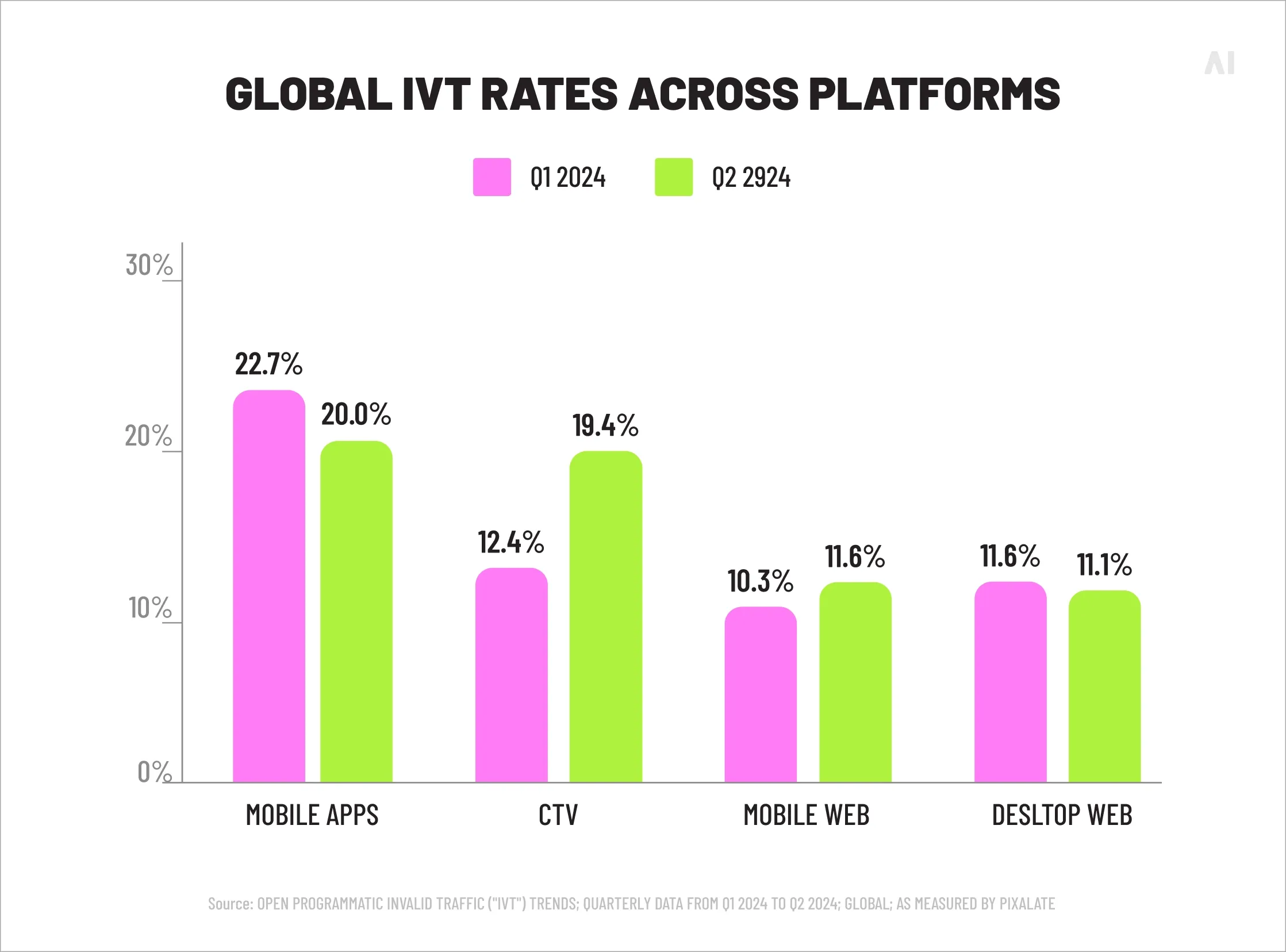
Fraud, waste, and emissions are being confronted together. The Trustworthy Accountability Group estimates the U.S. would have faced ~9.96% IVT and $11.78B in losses in 2023 without anti-fraud programs—underscoring why certified channels matter. Pixalate’s benchmarks show North America carries the highest desktop and mobile-web IVT rates globally, making pre-bid protection and curated supply essential.
Supply-chain clarity is also evolving: Jounce Media’s 2025 analysis flags “rebroadcasting” supply chains as the #1 source of programmatic waste (about 37% of display auctions), shifting focus from last year’s “MFA” shorthand to concrete path cleansing. On CTV, Roku + DoubleVerify reported a marked reduction in spoofed Roku traffic after watermarking and verification work, proving clean pipes are achievable.
Carbon is the other side of the quality coin. Ad Net Zero’s Global Media Sustainability Framework gives planners a common way to measure and reduce emissions; Good-Loop’s modeling pegs ~110 kg CO₂e per 100k impressions as a working estimate and urges buyers to trim high-emission, low-quality paths first.
Our POV: Scrutiny on waste, fraud, and emissions is only going one way—up. Pair supply-path optimization with sustainability metrics: enforce ads.txt, sellers.json, and schain validation; cut resellers that add cost without quality; and track working-media rate, verified attention, and carbon per thousand impressions side by side. Authentication and watermarking will keep reducing spoofing in CTV and apps, so prefer partners who can evidence lower IVT and lower emissions on the same routes. Practical upshot: cleaner paths deliver better media and a smaller footprint.
💡 Learn more about supply-side innovation in our thought leadership piece: Programmatic I/O 2025: the case for real supply intelligence
Use cases: How brands win with programmatic display
Real programs show how the same rails serve very different goals—from fast reach to lower-funnel lift.
Drive store sales and ROAS for a QSR
Dave’s Hot Chicken combined tight geo-fencing around restaurant trade areas with audience segments (recent visitors, nearby intenders) and real-time budget shifts to favor high-response ZIPs. The plan reported a 2× ROAS and a 7.8% average sales lift, tying spend to verifiable in-store outcomes rather than proxy clicks. The lesson: when your KPI lives offline, blend precise location signals with conversion-quality feedback and let pacing algorithms chase what’s working.
Stretch a live event across the open web
To extend NBA Season Tip-Off beyond the TNT broadcast, Turner Sports captured highlight clips as they happened and pushed them programmatically to known NBA fans across YouTube and partner inventory. That near-real-time distribution produced a 17% lift in ad recall and a 7% lift in brand awareness for NBA on TNT—proof that programmatic video pairs naturally with event-based content when speed and audience precision matter.
Improve quality and effectiveness for a CPG portfolio
Kellogg’s re-tooled its buying and measurement around viewability and audience precision—using programmatic controls to choose higher-quality supply and align creative to segments. The shift pushed viewability above 70% and improved targeting 2–3×, showing how better inputs (context, supply, creative fit) compound into stronger sales-oriented performance.
Practical takeaway: if you need measurable sales impact, pair geo/audience precision with clean conversion feedback. For time-sensitive moments, use programmatic video to capture and distribute highlights while interest peaks. And when quality is the issue, let viewability and verified attention guide placements so budget funds impressions that can actually work.
Conclusion: Drive your marketing growth with programmatic display ads
Programmatic display works because it blends three engines into one system: automation that executes decisions at impression speed, intelligence that directs spend toward verifiable outcomes, and creative that adapts to context and audience without slowing down your team. Put together, you get reliable performance today and a plan that can flex with tomorrow’s changes in data, identity, and channels.
If you take one thing forward, make it this operating rhythm: start from the business result, map your addressability and consent, give the optimizer enough creative variation to learn, and keep your supply clean and measurable. Do those four things consistently and programmatic becomes less of a media tactic and more of a growth engine across display, video, audio, DOOH, and CTV.
If you’d like help standing this up—or want a second set of eyes on your current setup—see what we do. We’ll build a plan that pairs outcome-led measurement with the creative and supply choices that make those outcomes repeatable.