What Are Rich Media Ads and How They Help You Turn Viewers into Buyers

.webp)
Every digital strategist knows the pain of underperforming display ads. Static banners — the industry’s oldest workhorse — have an average CTR of 0.05%, according to Google Display Network benchmarks. They’re cheap, scalable, and easy to deploy, but they’re no match for today’s attention-scarce audience. When users scroll at highway speed, a flat image with a tiny CTA simply can’t compete with the immersive richness of modern content.
This is where rich media ads step in with a fundamental shift in how brands communicate.
According to Magna, interactive and video-infused formats can drive up to 3x higher engagement rates compared to basic display ads. Similarly, Google reports that rich media banners often produce six times higher interaction rates and significantly stronger brand recall. These numbers aren’t accidents.
💡They reflect a deeper behavioral truth: humans are wired to respond to movement, novelty, and opportunities for agency. Rich media advertising invites users to participate.
Interaction — whether tapping, expanding, swiping, playing a mini-game, or exploring product images — generates micro-moments of engagement that drastically increase the likelihood of conversion. Each action deepens cognitive involvement, a principle well-documented in advertising psychology: when people interact with content, they remember it. When they remember it, they trust it. When they trust it, they buy. This is why modern marketers increasingly look at what is rich media advertising not as a creative trend but as a performance tool. Rich media content supports adaptive storytelling on mobile, desktop, CTV, and programmatic placements. It allows brands to showcase products from multiple angles, integrate real-time feeds, dynamically personalize based on user behavior, and deliver experiences that feel closer to micro-apps than traditional ads.
⚡️ And as rich media becomes more deeply integrated into programmatic ecosystems, it naturally aligns with broader strategy and budgeting decisions — areas explored in depth in our guide What Is Media Buying and Planning and How Do They Work? Understanding how media buying frameworks operate helps marketers place their rich media formats where they’ll deliver the highest impact.
As we dive deeper into rich media meaning, rich media formats, and best-practice examples, you’ll see how this technology transforms marketing strategies. More importantly, you’ll learn how to deploy these ads strategically to turn casual viewers into high-intent customers.
What are rich media ads?
Rich media ads are interactive, multimedia digital ads that go beyond static images or basic banners by incorporating video, animation, sound, expandable elements, gamified interactions, dynamic content, and real-time personalization. If you’re searching for a simple, accessible way to grasp what are rich media ads, think of them as mini-experiences embedded directly inside an ad space.
Instead of delivering a single image and a CTA, rich media ads allow users to tap, swipe, expand, rotate products, watch videos, browse carousels, play short demos, or even complete actions without leaving the page. This is why the most reliable rich media ads definition often emphasizes engagement-first design: the ad is engineered to invite interaction, not just display a message.
These formats typically rely on HTML5, responsive layouts, real-time data feeds, and programmatic delivery to adapt to users’ screens, behavior, and context. Because rich media ads encourage voluntary engagement, they naturally outperform standard display formats.
⚡️This performance gap becomes especially clear when looking at industry benchmarks for click-through and interaction rates, often discussed in reports like our guide Average CTR for Display Ads (2025–2026): Industry Benchmarks & Optimization Tips.
Rich media advertising is now widely used across mobile apps, web environments, programmatic campaigns, social placements, and even connected TV. From shoppable videos to interactive product lookbooks, the underlying goal remains constant: turn passive viewers into active participants, increasing the likelihood of conversion.
Core features of rich media advertising
Rich media advertising stands out because it blends interaction, motion, and dynamic design into a single ad experience. Instead of relying on passive visuals, these formats use multimedia elements and responsive layouts to capture attention and keep users actively engaged. The features below highlight what makes rich media uniquely powerful in modern digital campaigns.
{{What-Are-Rich-Media-Ads-1="/tables"}}
Rich media vs. standard display ads
Before diving deeper into how rich media advertising works, it helps to understand how it stacks up against traditional formats. Standard display banners were built for a different era — lightweight, inexpensive, and easy to scale across the open web. But in today’s attention-fragmented environment, where users scroll reflexively and judge content in milliseconds, these static units rarely spark meaningful engagement.
Rich media ads, on the other hand, bring motion, interactivity, and dynamic storytelling into the ad space. They capture attention through animation, invite exploration through tactile gestures, and deliver multi-layered experiences that feel far more aligned with modern content consumption. This contrast becomes especially clear when evaluating both formats side by side across engagement, usability, visibility, and measurement — the core criteria that shape campaign performance.
⚡️The table below highlights these differences, offering a clear snapshot of why marketers increasingly shift from standard display to richer, more immersive formats in digital display advertising.
{{What-Are-Rich-Media-Ads-2="/tables"}}
How rich media ads drive engagement
Rich media ads drive engagement because they behave the way modern digital content behaves: interactive, responsive, and dynamic. In a world where users expect movement, gesture-based control, and fluid experiences, rich media advertising mirrors the natural rhythm of mobile and desktop interfaces. Instead of presenting a flat message, rich media content reacts to touch, motion, and curiosity — transforming a simple ad placement into a living experience.
This is the core rich media meaning in performance marketing: engagement is earned through interaction. Rich media ads use movement, micro-animations, and dynamic layouts to attract attention, but they keep users involved by giving them control. When people swipe through a carousel, expand a panel, rotate a product in 3D, or explore embedded video stories, they shift from passive viewing to active exploration. That shift is what elevates engagement, dwell time, and brand recall.
Another advantage is that rich media display ads generate deep behavioral insights. Every gesture — from a quick tap to a long hover — becomes a signal that feeds targeting, sequencing, and optimization. The mechanics below explain why rich media advertising captures and maintains attention far more effectively than standard display formats.
Interaction mechanics
Interaction mechanics are the engine of rich media ads. These ads allow users to act, experiment, and navigate content directly within the creative. Each action — whether a tap, swipe, drag, or hover — strengthens engagement because it requires intention. This is what separates rich media formats from traditional banners, which offer only one possible action: a click.
{{What-Are-Rich-Media-Ads-3="/tables"}}
These interaction mechanics work because they provide agency. The moment a user takes control of an ad, even in a small way, engagement deepens. More importantly, these gestures generate precise, intent-driven signals that help marketers optimize future delivery and creative sequencing.
⚡️These insights are increasingly valuable within AI-powered personalization ecosystems — a direction explored in our article AI Targeted Advertising: How Smart Targeting Is Redefining ROI and Personalization.
💡Rich media advertising drives stronger engagement not because it’s “flashy,” but because it aligns with natural digital behavior and gives users meaningful ways to explore a brand.
Dynamic behavior
Dynamic behavior is another defining characteristic of rich media advertising. Interactivity alone isn’t enough — rich media ads also rely on real-time animations, adaptive layouts, and responsive transitions to keep the experience fluid and alive. This is where rich media formats truly outperform static banners, which remain identical from the moment they load to the moment the user scrolls past.
{{What-Are-Rich-Media-Ads-4="/tables"}}
⚡️These dynamic behaviors give rich media ads an almost app-like quality. The ad becomes something users discover rather than something they ignore. And when combined with personalization frameworks, dynamic elements create tailored experiences that adapt to each viewer in real time. This approach aligns directly with the strategies discussed in the upcoming guide Dynamic Content Personalization: How Brands Create Smarter Customer Experiences.
💡Ultimately, dynamic behavior is what makes rich media advertising feel modern and alive. Instead of being bound to one frame and one message, rich media evolves as the user interacts — increasing dwell time, strengthening brand recall, and elevating campaign performance.
Technology behind rich media advertising
Rich media advertising feels seamless to the user, but behind every interactive gesture is a sophisticated technical ecosystem. What makes rich media ads so compelling isn’t only the creative — it’s the technology powering the animations, transitions, personalization, measurement, and cross-device delivery. Understanding this foundation is essential for marketers who want to scale rich media formats effectively and integrate them into broader digital strategies.
Modern rich media ads rely on a combination of front-end development frameworks, programmatic delivery systems, and real-time data signals. Together, these components create ads that can adapt, respond, and perform consistently across different screens and environments.
⚡️This technical backbone is part of a much wider ad tech infrastructure that governs how digital advertising works — a landscape explored in detail in our guide on The Digital Advertising Supply Chain Explained: How Ads Really Reach Audiences and in the broader overview of AdTech ecosystems on the AI Digital blog.
Below, we break down the core technologies that make rich media advertising possible.
Core technology stack
The core technology stack behind rich media ads is built on HTML5, CSS3, and JavaScript, the same technologies that power modern websites and app-like experiences. These languages allow rich media advertising to achieve the flexibility, interactivity, and smooth rendering that standard banners simply cannot match.
- HTML5 provides the structure for rich media content — from video players and image galleries to canvas animations and 3D product displays. It replaces outdated Flash formats and ensures that rich media ads render consistently across browsers, apps, and operating systems.
- CSS3 controls visual styling and motion. Advanced CSS animations and transitions help guide the user’s attention, create smooth visual effects, and maintain performance without overwhelming memory or processing power. This is essential for mobile rich media, where resource efficiency directly impacts engagement.
- JavaScript is the engine behind interactivity. It detects gestures, triggers events, tracks user behavior, and controls dynamic elements such as carousels, expandable panels, shoppable modules, and conditional content. JavaScript also makes it possible for rich media ads to adapt in real time to device type, orientation, network conditions, and user signals.
Together, this stack creates responsive, fluid, micro-application-like ad experiences that run seamlessly across mobile devices, desktop browsers, and WebViews inside apps. Without these technologies, rich media advertising wouldn’t be able to deliver the level of interactivity and animation that defines the format.
Ad servers, DSPs, and delivery
The delivery of rich media advertising happens through a more complex workflow than standard display banners. While static ads are served as a single image file and tracked with a simple pixel, rich media ads require a specialized ad server and programmatic infrastructure to handle their interactive logic and advanced assets.
Rich media creatives are typically hosted on rich media–enabled ad servers that can:
- Preload assets for fast rendering
- Manage interactive scripts and layered components
- Handle dynamic expansion or animation logic
- Trigger engagement tracking events
- Ensure safe-frame sandboxing for security and compliance
When a user loads a webpage or app with available inventory, the DSP (Demand-Side Platform) evaluates the impression opportunity and bids in real time. Once the bid is won, the DSP retrieves the rich media creative from the appropriate server and instructs the publisher where and how to render it.
⚡️If you're new to how DSPs evaluate inventory, the overview on Demand-Side Platforms provides a clear breakdown, and the more comprehensive comparison in DSP vs. SSP vs. Ad Exchange outlines how these components work together within the ad tech ecosystem.
Delivery differs significantly from standard banners because rich media creatives often contain multiple assets — images, videos, JavaScript modules, style sheets, and conditional components. To maintain speed, these pieces load progressively:
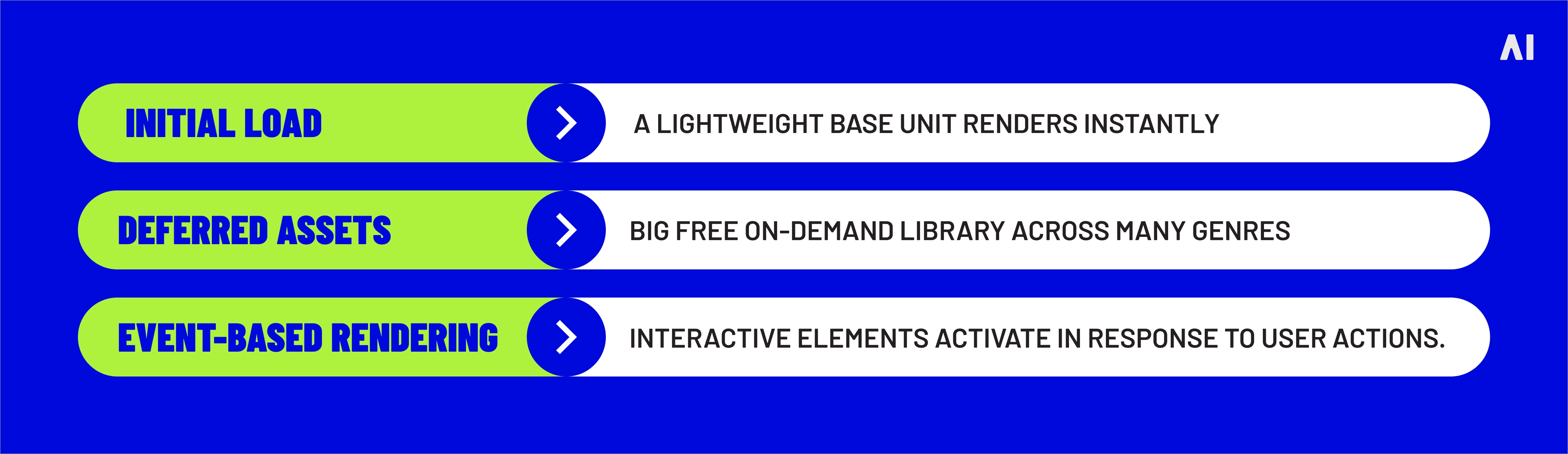
This workflow ensures smooth performance even when the creative is complex. Rich media delivery must also accommodate:
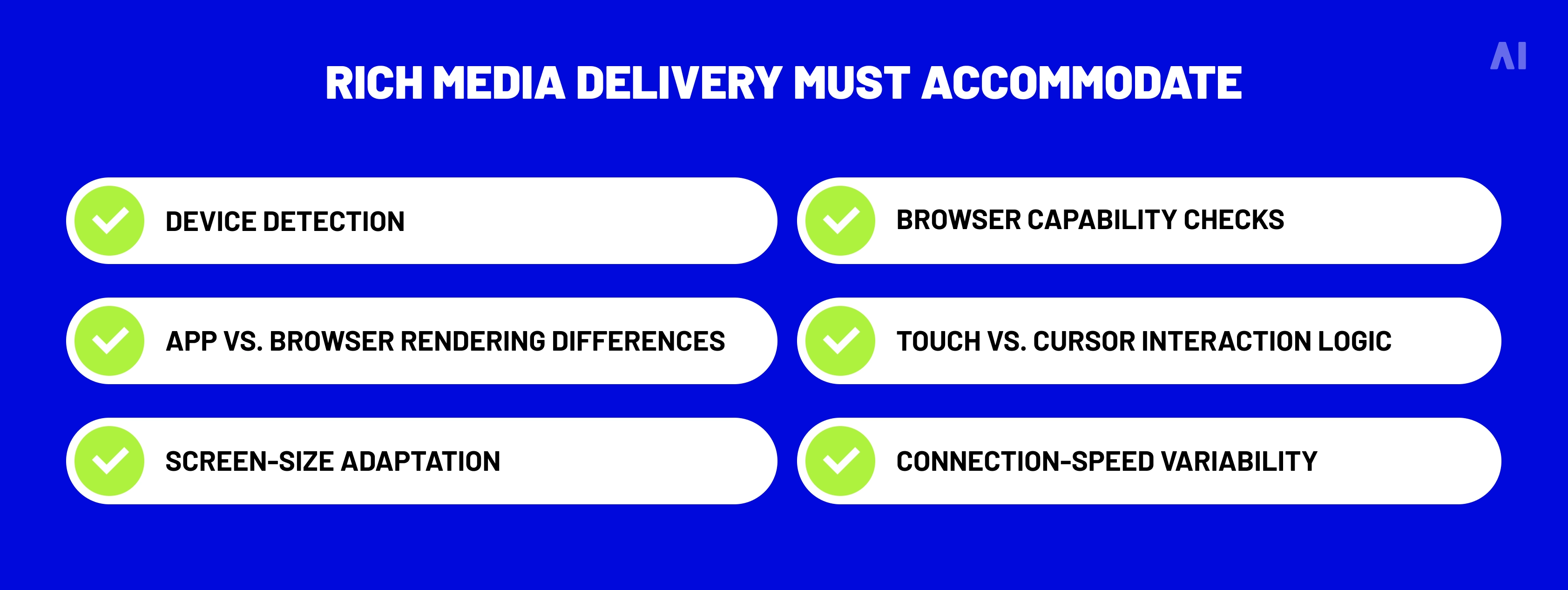
These delivery mechanics are why rich media advertising requires both a capable ad server and full programmatic compatibility.
Dynamic creative optimization (DCO)
Dynamic Creative Optimization (DCO) is where rich media advertising becomes truly powerful. DCO allows a rich media ad to change its content in real time based on data signals — creating a personalized, context-aware experience for every viewer. Instead of delivering one fixed creative, DCO generates multiple variations dynamically, ensuring each user sees the version most likely to drive engagement or conversion.
DCO uses data such as:

⚡️This level of personalization significantly improves performance by increasing relevance, interaction rates, and downstream conversions.
⚡️DCO also connects with privacy-safe audience modeling techniques — including first-party data matching and secure environments like data clean rooms. As brands shift toward privacy-first advertising, understanding what a data clean room is and how it works (explored in the What Is a Data Clean Room? How It Works and Use Cases) becomes crucial for effective DCO deployments.
In short, DCO transforms rich media ads into living, adaptive ad experiences that respond to user behavior and context — driving measurable improvements in engagement and conversions.
Key rich media ad formats
Rich media advertising offers a wide spectrum of formats designed to deliver interaction, movement, and storytelling beyond what standard display banners can achieve. Each format serves a different strategic purpose — some excel at brand awareness, others at mid-funnel engagement, and some drive high-intent performance outcomes.
⚡️Understanding when and how to use these formats helps marketers choose the right creative approach for their goals, audiences, and channels. This overview connects the most widely used rich media ad formats to business objectives, with practical guidance supported by examples featured in Best 10 Rich Media Ads to Elevate Your Next Campaign.
Below are the primary formats shaping today’s rich media landscape.
1. Expandable banners
Expandable banners begin as compact display units and expand into larger canvases when a user taps, clicks, or hovers. This format delivers the perfect blend of subtlety and impact: it respects the surrounding content until the user actively signals interest.
When to use?
- Awareness: visually disruptive without being intrusive
- Engagement: users intentionally open the expanded view
Performance: great for product showcases, galleries, or mini landing pages
Why they work? Expandable rich media banners rely on user-initiated action, which creates stronger intent signals and increases dwell time. They’re especially effective for ecommerce campaigns, new product launches, and interactive feature demonstrations.
2. Interstitial ads
Interstitials are full-screen ads that appear between content transitions — for example, between page loads or app screens. Because they temporarily occupy the entire screen, they offer unmatched visibility.
When to use?
- Brand awareness: total focus, no surrounding clutter
- Mid-funnel engagement: ideal for storytelling or video
- App monetization: widely used in mobile environments
Why they work? Their immersive nature forces a pause, allowing rich media content — video, animations, and interactive elements — to capture attention more effectively than standard display formats.
3. Lightbox ads
Lightbox ads expand into immersive galleries, videos, or multi-panel experiences once the user interacts. They often blur the line between ads and microsites.
When to use?
- Engagement: perfect for collections, product lines, or brand stories
- Upper-to-mid funnel: encourages discovery through exploration
- Retail & travel: rich visual experiences drive curiosity
Why they work? A single Lightbox ad can include image carousels, videos, maps, or store locators, giving users a self-guided browsing experience inside the ad itself.
4. Pushdown & slider ads
Pushdown ads expand downward from the top of the page, gently pushing content aside. Slider ads slide onto the screen from the left or right, offering visibility without covering the entire page.
When to use?
- Awareness: large, eye-catching formats without blocking UX
- Consideration: space for messaging, product cards, or videos
- Publisher partnerships: often reserved for premium inventory
Why they work? Their smooth motion and large canvas create high visibility while preserving a user-friendly experience, which boosts engagement without feeling disruptive.
5. Video rich media units
Video-rich media combines interactive layers with video content — for example, hotspots, product info buttons, overlays, swipeable elements, or branching video paths. They are central to mobile rich media and CTV strategies, and are discussed in detail in Interactive Video Ads: Best CTV Formats for Driving Engagement.
When to use?
- Brand storytelling: high-impact visual narrative
- Engagement: viewers interact with hotspots or explore features
- Performance: shoppable video layers connect awareness to action
Why they work? Video already captures attention; adding interaction multiplies dwell time and offers deeper product education. These formats often outperform standard video ads in completion rates and post-view engagement.
6. Takeover ads
Takeovers temporarily transform an entire webpage or digital environment — including background skins, header areas, side panels, and integrated rich media units. They are one of the most impactful formats available.
When to use?
- High-visibility launches: movies, automotive, tech, luxury
- Brand domination: 24-hour homepage takeovers drive massive reach
- Event-driven campaigns: seasonal sales, premieres, major drops
Why they work? Takeovers immerse the user in a unified visual narrative, often coordinating multiple rich media elements that reinforce brand identity or key messaging. They deliver unmatched visibility at scale.
7. Multi-directional & interactive units
These advanced formats allow multi-way navigation — swiping vertically, horizontally, or diagonally — often functioning like mini web experiences. They may include branching journeys where users choose different paths, explore features, or navigate multi-screen stories.
When to use?
- High-engagement experiences: brand storytelling, gamification
- Product exploration: detailed demos, interactive comparisons
- Immersive campaigns: travel, lifestyle, entertainment, and luxury
Why they work? They give users the freedom to explore content on their own terms, which increases dwell time and builds a deeper emotional connection. These formats are ideal for brands wanting to deliver an app-like experience right inside the ad unit.
How to choose the rich media format for your campaign
Choosing the right rich media format starts with a simple principle: your ad format should match your campaign goal. Rich media advertising gives marketers an entire toolbox of interactive units, but the key is knowing which tool works best for awareness, deeper engagement, conversions, or retargeting. When the format aligns with the objective, rich media ads naturally deliver stronger performance.
{{What-Are-Rich-Media-Ads-5="/tables"}}
Creative ideas to elevate your rich media campaigns
Rich media advertising becomes exponentially more powerful when paired with bold creative ideas. Below are examples of creative ideas that show exactly how each concept can be executed in live campaigns — and why these formats generate deeper engagement or conversion behavior.
{{What-Are-Rich-Media-Ads-6="/tables"}}
Best practices for high-performing rich media ads
Rich media ads deliver exceptional engagement when executed well — but they also demand higher creative, technical, and UX standards. The most effective brands treat rich media advertising like a product experience: lightweight, responsive, intuitive, and designed for real users in real environments. Small optimizations in load speed, design, and interactivity can dramatically improve both engagement and conversion outcomes, especially when aligned with user-first design principles highlighted in Safety in Programmatic Advertising.
- Prioritize fast loading through smart asset management
(Slow-loading rich media kills engagement — use compressed images and video, lazy-loading for nonessential elements, mobile-optimized HTML5 builds, and lightweight animation techniques like CSS before JS.)
- Design mobile-first experiences
(Most interactions happen on mobile — ensure larger touch targets, minimal text, responsive scaling, and smooth tap/swipe/drag gestures.)
- Make interactions intuitive, not instructional
(Users won’t engage if they must think — rely on familiar gestures, subtle animation cues, hover hints, and clear visual hierarchy.)
- Keep UX respectful and non-intrusive
(Protect user experience — include clear close buttons, avoid auto-play audio, and use purposeful animations aligned with brand-safe, user-first principles.)
- Test across devices, browsers, and connectivity levels
(Rich media must work everywhere — test on iOS/Android, across major browsers, in WebViews, on desktop, and under weak or unstable network conditions.)
- Use clear CTAs and personalize when relevant
(Match engagement depth with strong CTAs like “Explore more” or “Shop collection,” and personalize using signals such as weather, location, time of day, product availability, and user behavior.)
How to integrate rich media into programmatic advertising
Rich media advertising becomes significantly more powerful when placed inside a programmatic framework. Programmatic platforms determine who should see an ad, when they should see it, and at what price — while rich media determines what kind of experience that impression delivers. When these two layers work together, campaigns gain both precision and emotional impact.
⚡️At the infrastructure level, programmatic buying automates the decision-making process across DSPs, SSPs, and exchanges — a foundation explained in detail in Programmatic Advertising: A Complete Guide. Rich media creatives are then layered onto this system, adapting to user context, device conditions, and bidding environments in real time. This is especially important in RTB (Real-Time Bidding), where decisions are made in milliseconds, a topic explored more deeply in the upcoming guide What is Real-Time Bidding (RTB): Definition, Benefits, and How It Works in 2026.
💡Because rich media formats can respond dynamically to data signals, programmatic workflows amplify their strengths across targeting strategies, PMPs, creative personalization, and frequency management. The result is a full-funnel experience where the right user meets the right interactive creative at exactly the right moment.
- Use DSPs to deliver rich media at scale
(DSPs handle bidding, targeting, frequency capping, device recognition, and creative decisioning — rich media is hosted on specialized servers but delivered through DSPs just like standard display, only with more complex logic and asset loading.)
- Ensure rich media is optimized for RTB environments
(RTB requires instant load times — base shells must load immediately, heavier assets should load progressively, MRAID must support in-app behavior, and dynamic components should activate only when needed.)
- Apply targeting strategies that enhance adaptation and relevance
(Rich media performs best when reacting to data — use behavioral segments, first-party audiences, contextual keywords, geo/weather triggers, retargeting pools, and content adjacency signals to personalize in-ad elements.)
- Leverage PMPs for high-impact placements
(Private Marketplaces offer premium inventory — homepage takeovers, large-canvas units, interstitials, and exclusive mobile placements where rich media delivers maximum visibility and engagement.)
- Manage frequency to prevent interaction fatigue
(Rich media drives deeper engagement per impression — fewer, higher-quality exposures outperform repeated static impressions and maintain positive UX.)
- Pair rich media with DCO and personalization frameworks
(Dynamic Creative Optimization enhances performance — data signals can trigger product feed updates, location-based offers, dynamic CTAs, sequential storytelling, or time-sensitive messaging inside the rich media unit.)
How to measure rich media performance
Measuring rich media performance requires a different lens than standard display. While static banners rely heavily on impressions and CTR, rich media ads generate layered behavioral signals that reveal how users actually interact with the creative. These deeper metrics offer a more complete picture of user attention, engagement, and intent — and they align closely with the broader measurement frameworks explored in the guide 15 Essential Digital Marketing KPIs to Track (and Improve) in 2026.
Rich media’s strength lies in capturing how users behave, not just whether they clicked. The table below breaks down the key metrics and highlights how they differ from traditional display reporting.
{{What-Are-Rich-Media-Ads-7="/tables"}}
💡Rich media performance is multidimensional. Engagement rate, dwell time, expansions, and micro-interactions reveal genuine user interest, not just click behavior. This gives marketers a far more complete understanding of intent — and offers richer optimization insights compared to static formats.
Where standard display asks “Did the user click?” rich media asks “How did the user explore, react, and move closer to conversion?”
Conclusion: Take your campaigns to the next level with rich media ads
Rich media advertising isn’t just a creative upgrade — it’s a performance engine. When executed well, rich media ads transform a passive impression into an interactive, memorable experience. They capture attention faster, hold it longer, and turn curiosity into measurable engagement. For brands competing in a saturated digital landscape, these formats offer something traditional display simply can’t: movement, exploration, personalization, and emotional resonance at scale.
The value extends across the full funnel. At the top, rich media boosts visibility and brand recall with dynamic storytelling. In the mid-funnel, interactive elements invite users to touch, swipe, compare, explore, and participate. And at the bottom of the funnel, rich media’s shoppable modules, dynamic product feeds, and personalized CTAs push users toward conversion more efficiently than static creatives ever could. These capabilities make rich media a natural fit within modern media-buying strategies — especially as AI-driven planning continues to reshape how budgets are allocated, as explored in How AI Will Transform Media Buying & Planning.
💡For brands ready to elevate their campaigns, rich media provides a competitive edge that compounds over time. It creates richer data, deeper insights, and smarter optimization opportunities. It builds trust, communicates value more clearly, and gives audiences a reason to stay — a rare achievement in today’s attention economy.
⚡️If your team is looking for a partner to build and activate high-impact interactive formats, explore how AI Digital helps brands scale creative innovation and programmatic performance through advanced formats and intelligent delivery. Our end-to-end capabilities from creative development to execution, measurement, optimization, and cross-channel activation give brands a clear roadmap for integrating rich media into your broader growth strategy. With the right combination of smart planning and innovative creative, rich media becomes more than a format; it becomes a long-term differentiator for your brand.
Rich media ads are not the future — they are the present advantage. The brands that embrace them now will own the next wave of digital engagement and performance.