CTV Measurement: The Key Metrics That Will Define Successful Campaigns


CTV advertising budgets have grown fast, and measurement has been forced to grow up with them. EMARKETER forecasts U.S. CTV ad spending will reach $33.35 billion in 2025 and rise to $37.70 billion in 2026 (about 13% year over year).
That growth is great news—until you try to answer basic questions like:
- How many unique households did we reach across all streaming publishers?
- Did frequency spike on one app while another under-delivered?
- Were impressions actually measurable and viewable?
- Did the campaign cause incremental outcomes, or did we just “find” people who were already going to convert?
Those questions are exactly why modern CTV measurement is no longer “nice to have.” It’s the operating system for performance, optimization, and budget confidence.
💡 If you want additional U.S.-focused channel context, Connected TV Advertising in 2025 & Connected TV stats are helpful companion read.
⚡ If you can’t deduplicate reach and control frequency, your CTV ‘scale’ is mostly a guess.”

What is CTV measurement?
CTV measurement is the set of methods used to quantify delivery, quality, audience exposure, and outcomes for ads served on internet-connected TV environments (smart TVs, streaming devices, gaming consoles, and CTV apps).
A useful way to define it is by what it must cover:
- Delivery: What happened in ad serving terms (impressions, completion events, quartiles, errors).
- Quality: Whether impressions were measurable, viewable, fraud-free, and brand-safe.
- Audience: Who was exposed (reach, unique households, deduplicated reach across publishers).
- Outcomes: What changed after exposure (site visits, conversions, store traffic, sales, incrementality lift).
What CTV measurement isn’t:
- A single metric like ROAS or view-through conversions.
- A universal standard that every publisher reports the same way.
- “Set it and forget it” reporting. Most meaningful CTV insights require alignment on definitions before launch.
Two forces keep pushing CTV measurement forward:
- Programmatic CTV scale: IAB reports that programmatic accounts for roughly three-fourths of transactions for CTV.
- The walled garden reality: Many publishers can measure their own ecosystem cleanly, but cross-publisher comparability and transparency are still uneven.
How CTV measurement works
At a high level, CTV measurement connects ad exposure signals to audience and outcome signals. In practice, that requires multiple systems cooperating, and they don’t always cooperate nicely.
A simple mental model looks like this:
Ad request → Ad decision → Ad delivery → Event tracking → Verification → Identity resolution → Attribution/incrementality
Below is what that means in real operations.
Data collection and identity signals
Most CTV delivery tracking depends on ad serving standards that define how video ads are described and how tracking events fire. The IAB Tech Lab’s VAST standard is the core template used to pass video ad metadata and enable tracking across video players.
CTV adds extra complexity because players and environments vary widely, which is why the Tech Lab has continued issuing CTV-focused addenda and guidance to support consistent functionality across TV environments.
What gets collected (in the best-case scenario):
- Impression events (served and, where supported, viewable/measurable events)
- Quartiles (25/50/75/100% completion)
- Device/app signals (device type, app bundle, content metadata—often incomplete)
- Network signals (IP-derived household associations, subject to change)
- Ad identifiers (creative IDs that let you connect exposure to later actions)
Where identity comes in:
- CTV is often measured at the household level (not the individual).
- Cross-device connections may be built using deterministic signals (login, hashed emails) or probabilistic signals (IP + device characteristics).
- The more deterministic your identity layer, the easier deduplication and outcome matching become.
- The more probabilistic it is, the more you need to treat “precision” as an estimate, not a fact.
Verification and quality checks
Because CTV environments are diverse, independent verification matters. CTV quality measurement typically includes:
- Measurability (can a vendor measure the impression with the data provided?)
- Viewability (did the ad have an opportunity to be seen?)
- Invalid traffic (IVT) and fraud detection
- Brand safety and content adjacency controls
Industry guidance for measurement in OTT/CTV environments (including server-side ad insertion) is covered in MRC documentation, which is frequently referenced in accreditation and standards discussions.
One of the most practical realities here: CTV “viewability” is not always the same as desktop/mobile viewability, and vendors may apply different definitions (for example, requirements like full-screen playback with sound on). You can’t assume comparability unless you confirm the definition and methodology in writing. The ANA’s Programmatic Transparency Benchmark explicitly notes that methodology differences and varying definitions influence reported CTV viewability and how it compares to “traditional” viewability metrics.
Outcome measurement and attribution
CTV outcomes are harder than “click → conversion” channels for one obvious reason: people usually don’t click a TV ad.
So outcome measurement often relies on combinations of:
- View-through attribution (conversion happens later on another device)
- Household-level matching (CTV exposure linked to household activity)
- Modeled attribution (probabilistic matching plus model-based crediting)
- Lift tests / incrementality (control vs exposed comparisons)
- Media mix modeling (MMM) for a broader, longer-horizon view
A growing theme in 2024–2025 is closing the “outcome gap” by using server-to-server event sharing instead of relying on cookies or fragile client-side signals. IAB’s 2025 guide on Conversion APIs (CAPI) frames this as a path to more standardized, privacy-forward outcome measurement in CTV.
{{26-CTV-Measurement-SEO-1="/tables"}}
⚡ Attribution tells you a story. Incrementality tests whether the story is true.
Why CTV measurement is harder than it looks
CTV feels digital, but measurement behaves like a hybrid of digital and traditional TV. The hard parts usually show up after launch, when definitions collide and data stops lining up.
Here are the core friction points.
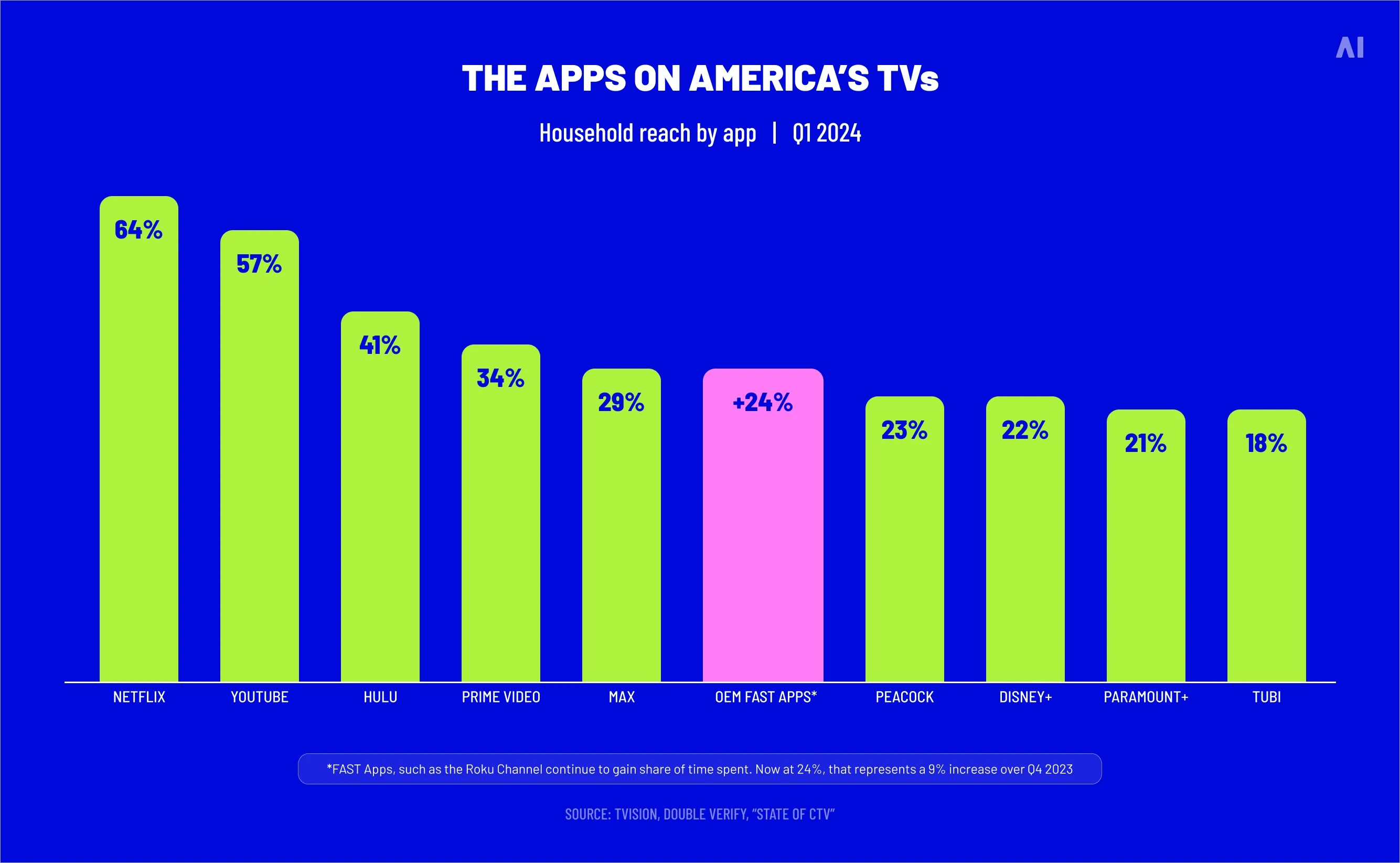
Fragmentation and duplication
CTV runs across:
- Device manufacturers
- Operating systems
- Streaming apps
- Content distributors
- Different ad serving methods (client-side vs server-side insertion)
Each layer can affect what you can measure and how consistent the logs are.
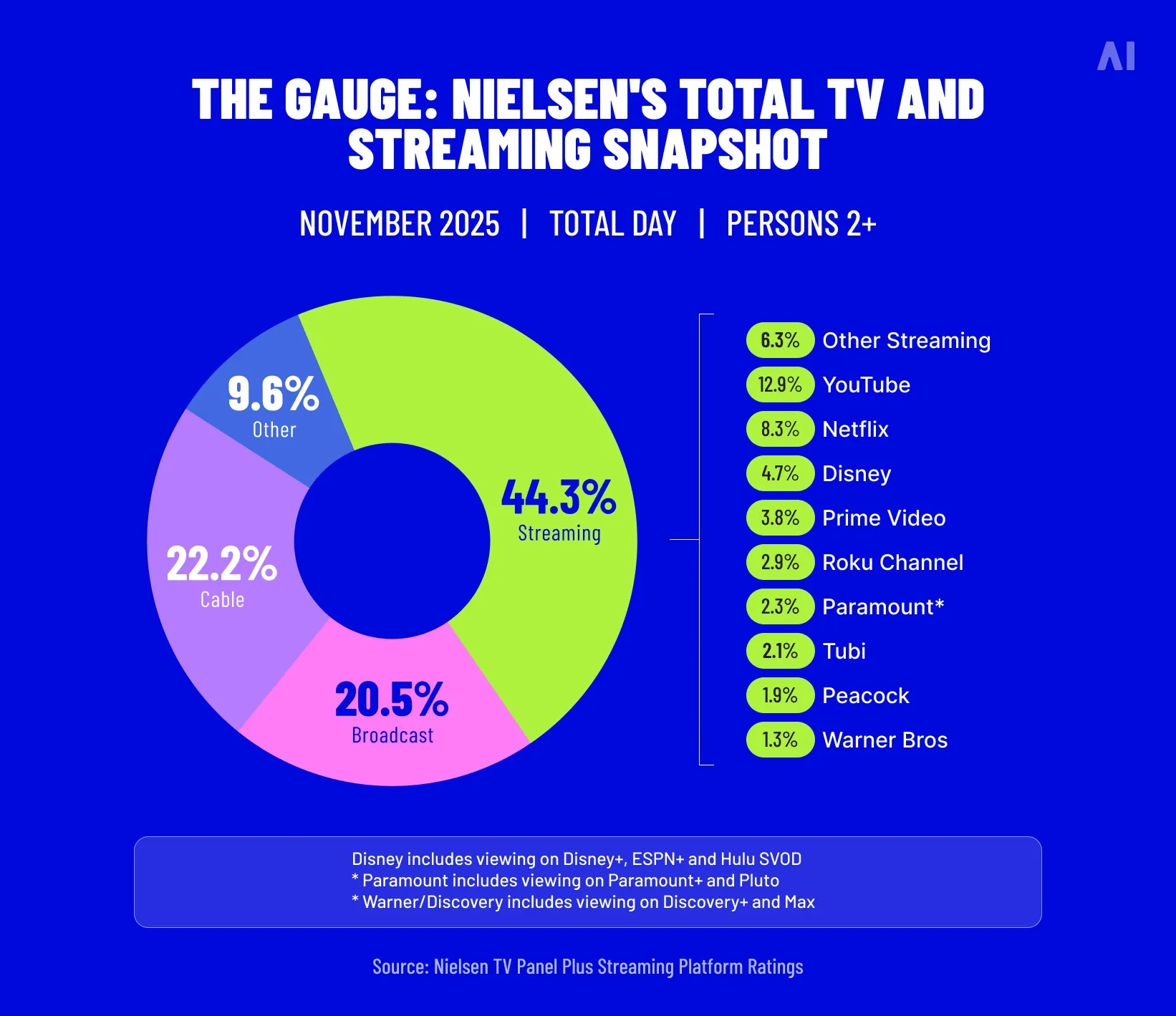
A practical consequence is reach/frequency distortion. Innovid’s 2025 CTV Advertising Insights Report highlights this clearly: in 2024, the average CTV household reach was 19.64% with an average frequency of 7.09 across campaigns measured through its platform. That’s a classic “high frequency on a limited slice of households” pattern, and it’s exactly what fragmentation and duplication tend to create.
Limited transparency and walled gardens
Even when you buy programmatically, you may not receive:
- Complete app identifiers
- Consistent content signals
- Full log-level data
- Comparable measurement methods across publishers
IAB’s CAPI guide points to this transparency gap directly: only 21% of surveyed sellers said they always provide advertisers access to logs or dashboards, which limits trust and adoption.
If you’re trying to do cross-publisher reach/frequency, this becomes a real constraint. It’s also why cross-media measurement providers emphasize deduplication and comparability.
Nielsen’s explanation of cross-media measurement is blunt and useful: cross-media measurement makes it possible to deduplicate audiences across publishers and calculate reach and frequency. That is exactly the capability CTV marketers want, and exactly what walled gardens often restrict.
💡 For explainer on walled gardens, please see: Walled gardens: The hidden cost for digital advertisers
Privacy and signal loss
CTV measurement is also happening during an era of shrinking identifiers and tighter privacy expectations. That affects:
- Identity resolution (match rates drop)
- Cross-device attribution confidence (more modeled outcomes)
- Retargeting and frequency controls (less deterministic control)
IAB’s State of Data 2024 report reflects how widespread this pressure is: 95% of respondents expect data/identity disruption to continue, driven by regulation and signal loss.
💡 For a take on what data loss means in practice, see our POV piece: Navigating the cookie-less future: challenges and opportunities for advertisers
Viewability and fraud in a living-room context
In CTV, “served” does not always mean “seen,” and “seen” does not always mean “paid attention.”
Two practical wrinkles:
- Measurability isn’t guaranteed. The ANA benchmark notes that CTV remains fragmented, though measurability has improved, with a median measurability of 64.1% in its Q1 2025 benchmark.
- IVT risk is real. The same benchmark reports IVT ranges up to 26.1% for some marketers, with a median of 3.5% in CTV—seven times higher than non-CTV inventory’s median in that dataset.
None of this means CTV is “worse.” It means CTV measurement needs explicit guardrails: agreed definitions, verification, and a framework that prioritizes decision-making over vanity reporting.
{{26-CTV-Measurement-SEO-2="/tables"}}
The key CTV metrics that will define successful CTV campaigns
This is the section teams use to decide what goes on the dashboard. The mistake is treating every metric as equally meaningful. Instead, you want a small set of metrics that connect together logically:
delivery → exposure quality → audience → cost → outcomes → incrementality
💡 For a full set of marketing KPIs, see our primers: 15 essential digital marketing KPIs to track (and improve) in 2026 & How to measure TV advertising ROI
{{26-CTV-Measurement-SEO-3="/tables"}}
Impressions and eligible impressions
Impressions in CTV typically represent an ad served (and often started). But the more useful concept is eligible impressions: impressions that meet your minimum standard for:
- measurable delivery
- fraud filtering thresholds
- agreed completion rules (or at least “started” rules)
- app transparency requirements (so you can optimize supply)
How to use it well:
- Report total impressions, but optimize to eligible impressions so buyers don’t “win” cheap inventory that can’t be measured.
- Confirm whether “impression” means served, started, or viewable in each report.

Unique households and reach
CTV reach is commonly reported as unique households (HH reach). It’s powerful, but it’s easy to misuse.
Key nuance: HH reach can be:
- within one publisher/app
- deduplicated across multiple publishers (harder, but far more decision-useful)
Innovid’s finding (average HH reach 19.64%) is a reminder that campaigns can look large in impression volume while still reaching a relatively small share of households.
How to use it well:
- Always pair HH reach with frequency (reach without frequency hides overexposure).
- For multi-publisher buys, push for deduplicated reach wherever possible (this is where cross-media measurement matters).
Frequency and frequency management
Frequency answers: how often did the average household see the ad?
In CTV, frequency is not just a planning metric. It’s a quality control mechanism:
- Too low: you won’t build recall or drive outcomes.
- Too high: you burn budget, irritate viewers, and distort attribution.
Innovid’s reported average campaign frequency of 7.09 is a good illustration of how frequency can climb quickly when reach is constrained.
How to use it well:
- Monitor frequency distribution, not just the average (the average can hide a long tail of households seeing 20+ exposures).
- Use frequency caps, but validate they work across publishers—many caps are siloed.
{{26-CTV-Measurement-SEO-4="/tables"}}
Viewability
Viewability in CTV is improving, but it is also one of the most definition-sensitive metrics in the channel.
The ANA benchmark reports a median viewability of 21.4% in its Q1 2025 dataset, while also warning that vendor methodology and definitions can vary (including requirements like full-screen with sound on).
How to use it well
- Treat viewability as a vendor-defined measurement, not a universal truth.
- Compare like with like: the same vendor, same definition, same supply subset.
Completion rate and CPCV
Completion rate is the percentage of video starts that reach 100% completion.
On CTV, completion rates tend to be relatively strong because many ads are not skippable, but you still need to confirm:
- what counts as a “start”
- whether a completion requires audio on
- how buffering or player errors are treated
CPCV (cost per completed view) is often more meaningful than CPM when:
- you’re optimizing for completed exposures
- creative is longer-form
- you want to control for “wasted starts”
💡 If you want a deeper primer on CPCV, see the piece: What Is CPCV? Deep dive + cost per completed view formula.
Quick CPCV formula:
- CPCV = spend ÷ completed views
Attention and quality of exposure
Attention is where CTV ad measurement is heading next, because it addresses what viewability can’t: did anyone actually watch?
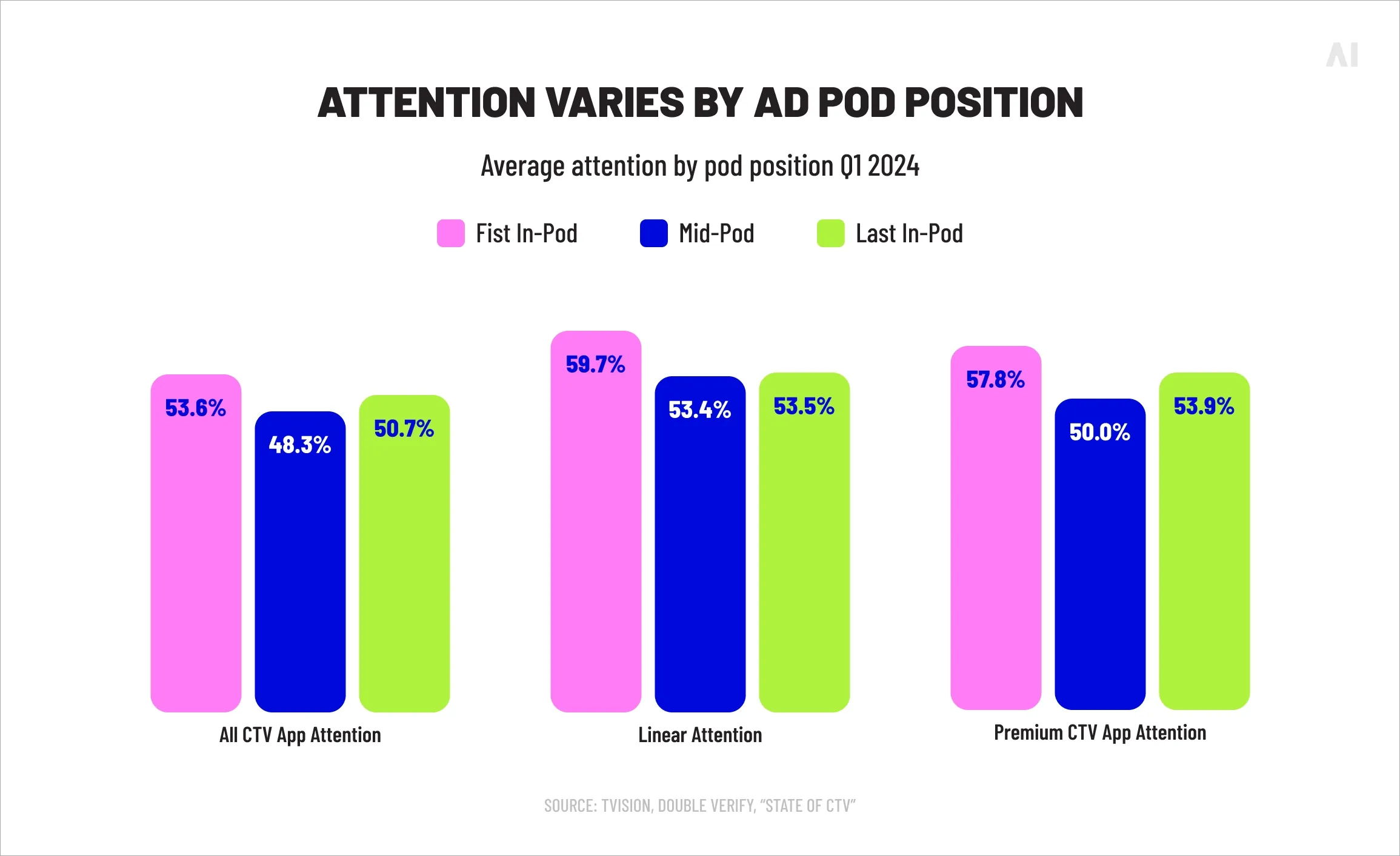
TVision’s State of CTV Advertising report for Q1 2024 reported 51.5% average CTV ad attention, with higher attention for premium apps in that dataset.
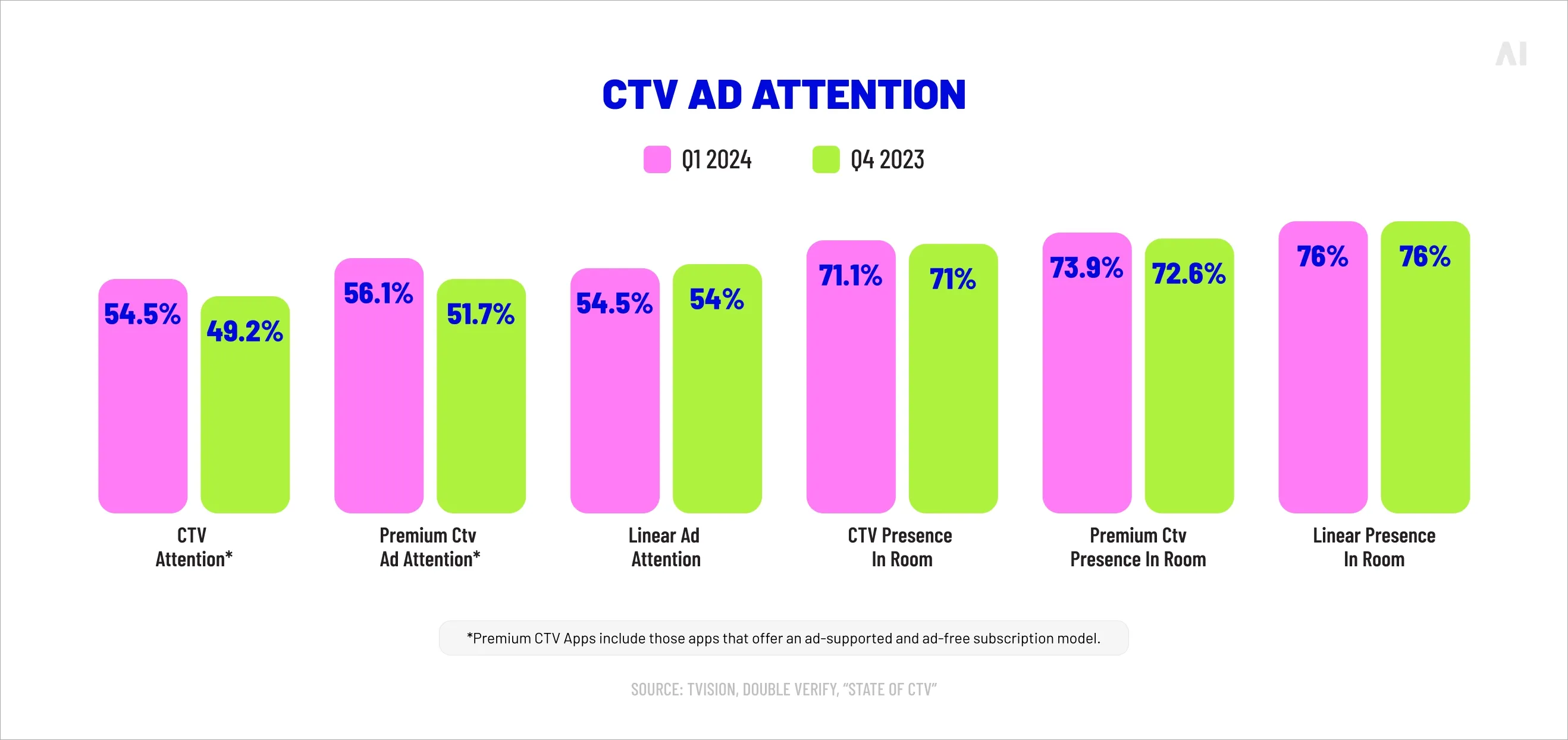
Attention metrics are still evolving, and they vary by methodology (eyes-on-screen panels, ACR-based approaches, modeled attention), but the practical use is already clear:
- Attention helps explain why two placements with the same completion rate can perform differently.
- It can guide creative and placement decisions beyond “cheap CPM.”
CPM and cost efficiency
CPM (cost per thousand impressions) is still a CTV buying language. The problem is that CPM alone can reward low-quality supply.
A better approach is to track:
- CPM on eligible impressions
- cost per incremental reach point
- CPM adjusted for attention or completion (when available
💡 For a primer on CPM, see: What is CPM in TV advertising.
CPA, ROAS, and performance outcomes
CTV is increasingly evaluated using performance metrics, especially for lower-funnel use cases, but those metrics only matter if:
- the attribution method is credible
- conversion windows are defined and consistent
- incrementality is used to validate outcomes
You can absolutely report CPA and ROAS in CTV. Just avoid treating them as “proof” unless you’ve tested causality.
View-through conversions and attribution windows
View-through conversions (VTCs) credit conversions that happen after ad exposure without a click.
They can be useful, but they’re also one of the easiest ways to fool yourself, because:
- many people would have converted anyway
- conversion windows can be overly generous
- household matching can over-credit the ad
How to use it well:
- Use conservative windows (and document them).
- Treat VTC as directional, then validate with incrementality.
Incrementality lift
Incrementality answers the real question: Did the campaign cause additional outcomes that would not have happened otherwise?
It typically requires:
- a control group (unexposed)
- an exposed group
- matching and/or randomization design (geo tests, audience splits, ghost ads)
This is where CTV ad measurement becomes decision-grade. It’s also where many teams realize their data pipeline isn’t ready.
Cross-device attribution accuracy
Cross-device attribution accuracy depends on how exposure is matched to outcomes. Two practical indicators to monitor are:
- match rate (how many exposed households can be linked to outcome signals)
- false positives risk (how often you might link the wrong household/device)
Accuracy improves when you have stronger first-party data and privacy-safe collaboration.
IAB’s State of Data 2024 report shows how common privacy-safe infrastructure has become: 66% of respondents are investing in or planning to invest in data clean rooms. That matters because clean rooms can improve governance and consistency in matching, even when cookies and mobile IDs are less available.

Role of AI in modern CTV measurement
AI can meaningfully improve CTV measurement, but only when it’s applied to concrete problems: identity resolution, anomaly detection, and predictive decisioning. It’s not a substitute for bad definitions or missing logs.
💡 For a broader perspective, you can reference: The rise of AI in TV advertising & AI Digital Elevate redefines media intelligence with transparent, AI-driven insights
AI for identity resolution and deduplication
AI models can help:
- predict household connections when signals are incomplete
- reduce duplication across devices
- estimate deduplicated reach when deterministic IDs are unavailable
But the key discipline is to label outputs correctly: modeled reach is modeled, not observed.
IAB’s State of Data 2024 report notes that 32% of respondents are using AI/ML to enhance first-party profiles. That’s a strong hint of where the industry is focusing: making first-party identity assets more useful for measurement.
AI for anomaly detection and fraud prevention
CTV fraud evolves fast because supply chains are complex and spoofing can be profitable. AI-based anomaly detection can identify:
- impossible device patterns
- suspicious traffic spikes
- abnormal completion behavior
- app-level inconsistencies
This matters even more in CTV because invalid traffic can distort both delivery and outcome metrics.
AI for predictive measurement and optimization
The most practical “AI win” in CTV measurement is using outcome signals to improve decisions:
- predicting which supply paths drive incremental outcomes
- guiding bid strategies when click signals are absent
- forecasting frequency saturation risk
IAB’s CAPI guide includes a useful indicator of how outcome signals feed optimization: 61% report using CAPI to power bidding optimization, and 50% apply it to segmentation.
That’s where measurement stops being a report and becomes a control system.
How to build CTV measurement framework
This section is designed to be operational. A good framework is less about tooling and more about aligning definitions, partners, and decision rules.
Step 1: Start with the business question, not the dashboard
Before you pick metrics, write the decision you want to make:
- “Which publishers should get more budget next flight?”
- “Is CTV incremental vs paid social for new-to-brand customers?”
- “Do we need broader reach or tighter frequency control?”
This keeps reporting from becoming a weekly ritual with no consequence.
Step 2: Lock metric definitions before launch
Write definitions for:
- impression (served vs started vs viewable)
- completion (100% vs “audible and visible”)
- viewability definition and vendor
- attribution window (and what counts as a conversion)
- deduplication scope (publisher-only vs cross-publisher)
This sounds basic. It’s also the fastest way to prevent post-campaign confusion.
Step 3: Choose your measurement stack deliberately
Most advertisers need a combination of:
- platform reporting (directional, fast)
- verification (quality controls)
- cross-media measurement (dedup reach/frequency where possible)
- incrementality testing (causal validation)
- MMM (long-term planning, budget allocation)
Pick the minimum set that answers your business question. More tools do not automatically produce more truth.
Step 4: Build an outcome pipeline that can survive signal loss
If you want performance measurement, you need outcome signals that can be shared in privacy-safe ways.
IAB’s CAPI guide is worth reading here because it outlines how Conversion APIs can support outcome measurement where clicks and cookies are weak, and it documents barriers that commonly slow adoption (for example, technical complexity and compliance concerns).
Step 5: Design incrementality into the plan (not as a postscript)
If incrementality matters, plan for it:
- define holdout design (geo, audience split, ghost ads)
- confirm minimum sample size
- align which outcomes count (sales, leads, store visits)
- decide how you’ll interpret null results
A lift test that wasn’t designed into the buy often becomes a compromised analysis later.
Step 6: Create optimization rules tied to measurement
Your framework should produce actions, not just insights.
Examples:
- If frequency exceeds X with flat reach growth, shift budget to reach expansion tactics.
- If IVT exceeds threshold, block the supply path and reallocate.
- If attention is consistently low on a set of apps, revisit creative fit or placement type.
- If view-through conversions rise but lift is flat, tighten windows and re-evaluate attribution.
Common mistakes advertisers make
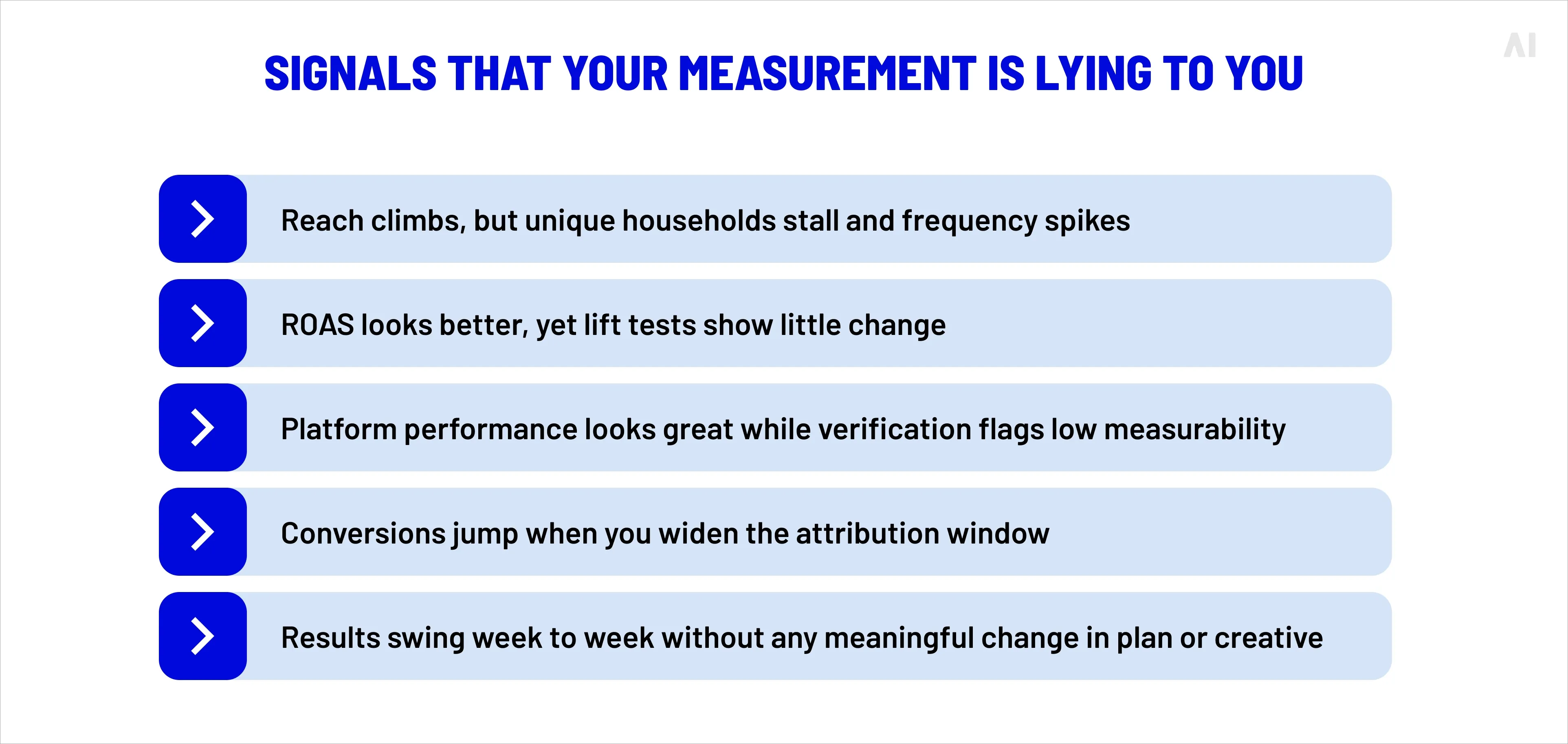
Most CTV measurement problems are predictable. Here are the ones that show up most often—and what to do instead.
- Treating platform reporting as cross-platform truth: Use platform data, but validate with independent measurement where possible.
- Optimizing to cheap CPM without an “eligible impression” standard: Cheap impressions are not cheap if they can’t be measured or are IVT-heavy.
- Looking at average frequency only: Always check distribution. Averages hide saturation.
- Assuming viewability means the same thing everywhere: Confirm the definition and vendor methodology up front.
- Using view-through conversions as “proof”: Treat VTC as directional and validate with incrementality.
- Skipping deduplicated reach planning: Cross-media measurement exists for a reason: deduplicated reach and frequency are foundational for modern campaigns.
- Adding AI before definitions are stable: AI can improve modeling, but it cannot rescue inconsistent inputs.
{{26-CTV-Measurement-SEO-5="/tables"}}
⚡ Bad measurement doesn’t just misreport performance — it trains your next campaign to repeat the wrong decisions.
Conclusion: What defines a successful CTV campaign today
CTV measurement is finally being treated like what it is: the foundation for budget confidence. The channel can deliver both reach and outcomes, but the measurement layer has to be designed with intent.
If you want a practical north star, use this sequence:
- Make delivery measurable
- Protect quality
- Deduplicate reach and control frequency
- Measure outcomes carefully
- Validate with incrementality
- Use AI to improve modeling and detection, not to paper over missing standards
And if you’re ever unsure whether a metric is telling you the truth, ask one question: “What decision would I make if this number were wrong?” That usually reveals where your framework needs to be tighter.
If you want CTV measurement you can actually trust, talk to AI Digital. We help you plan, buy, and measure across the Open Internet with DSP-agnostic managed service, Smart Supply (premium selection + SPO), and Elevate (AI-powered intelligence + optimization).