vMVPD Advertising in 2026: How Brands Win Live TV Audiences at Scale


Live TV didn’t disappear. It simply changed its delivery method, its economics, and the knobs advertisers can pull.
If you’re building a modern “TV” plan in the U.S., you’re likely already buying CTV apps, some amount of programmatic OTT, and at least a slice of traditional linear TV. What’s often underweighted (or misunderstood) is the fourth piece: vMVPD advertising—inventory inside the paid streaming bundles that look and behave like cable, but run over the internet.
In 2026, that matters for one reason above all: live audiences still gather at scale, and vMVPDs are one of the cleanest ways to reach those viewers with more control than legacy MVPD buys, without inheriting the fragmentation of app-by-app OTT planning.
This guide explains the vMVPD meaning, how vMVPD ads work, who the major vMVPD providers are, where vMVPD fits next to SVOD and FAST, and how to use vMVPD as a pragmatic lever in a performance-minded TV plan.
⚡ vMVPDs are where linear-scale viewing meets streaming-era controls.
What is vMVPD advertising?
Before you can plan it, you need to separate three things people often mash together: device, delivery, and experience. vMVPDs are not “just CTV,” and they are not “just OTT.” They’re a specific distribution model with a familiar linear TV experience.
vMVPD definition
vMVPD stands for virtual multichannel video programming distributor. In plain terms: it’s a paid streaming service that delivers a bundle of live, linear channels (often plus cloud DVR and VOD) over broadband instead of coax/satellite.
The “MVPD” part comes from the regulatory/industry concept of delivering multiple channels for purchase (the classic pay-TV bundle). A baseline definition of multichannel distribution in U.S. communications law describes a multichannel video programming system as one that makes multiple channels of video programming available for purchase.
A vMVPD keeps the bundle and the channel-grid behavior, but swaps the delivery pipe: internet in, live channels out.
💡 If you want a broader refresher on how streaming “TV” inventory sits across formats and buying models, AI Digital’s Streaming TV overview is a helpful companion.
How vMVPD ads work
vMVPD advertising looks like “TV advertising” to the viewer—ad pods, mid-roll breaks, live programming—but the infrastructure is closer to digital video.
At a high level:
- A viewer streams a linear channel inside a vMVPD app (for example: live sports, news, or entertainment).
- Ad break markers signal an insertion opportunity. In streaming workflows, this is often driven by standards like SCTE-35, which help define where an ad can be inserted or replaced.
- An ad decision is made (direct-sold, programmatic, or hybrid). Some vMVPD inventory is sold by networks, some by the distributor, and some through marketplaces depending on rights and packaging.
- Ads are inserted (often server-side), which can reduce buffering and ad blockers, and can support addressable-like variation by household depending on the provider’s stack and data permissions. IAB Tech Lab’s CTV programmatic guidance is a useful technical reference for how programmatic components map to CTV supply chains.
Two practical implications for planners:
- Live scale + digital controls are both possible, but not uniformly across all inventory. Some avails behave like legacy linear; others behave like addressable streaming.
- Your “who sold it” matters (network vs distributor vs platform marketplace), because it affects data, measurement, frequency control, and transparency.
{{26-vMVPD-Advertising-in-2026-1="/tables"}}
💡 For related context on modern TV buying systems and where programmatic fits, AI Digital’s guide to programmatic TV is worth scanning.
Leading vMVPD providers
The vMVPD market is dynamic (and increasingly consolidated), but a few providers consistently shape U.S. paid live streaming bundles.
Here are the names most planners will encounter:
- YouTube TV – A leading vMVPD with broad channel coverage and a large subscriber base. Industry forecasts from Omdia put YouTube TV at 9.3 million subscribers at the end of 2025, with a path to becoming the largest U.S. pay-TV operator by 2027.
- Hulu + Live TV / Fubo (combined business) – In late 2025, Disney’s Hulu + Live TV and Fubo completed a business combination, creating a larger vMVPD footprint with nearly 6 million subscribers across North America and a strong sports positioning.
- Sling TV – Longstanding value-oriented channel bundles, often used as a lower-cost alternative to broader lineups.
- Others you may plan against (depending on audience and rights): DIRECTV STREAM, Philo, and smaller regional/skinny bundles.
💡 If your team needs a YouTube TV-specific planning lens—how YouTube TV ads work, what targeting is available, and how it differs from linear and pure OTT — AI Digital’s YouTube TV guide is directly aligned to that question.
Why vMVPDs matter more in 2026 than they did a few years ago
vMVPDs benefit from a structural shift: viewing time keeps moving toward streaming, but the largest shared moments still look “linear.”

A few datapoints illustrate why vMVPD inventory is increasingly strategic:
- Streaming passed a major threshold in 2025. In May 2025, Nielsen reported streaming at 44.8% of TV viewing, edging past broadcast + cable combined (44.2%) for the first time.
- Streaming hit new highs by the end of 2025. Nielsen’s December 2025 Gauge showed streaming at 47.5% of TV viewing, and Christmas Day became the most-streamed day ever with 55+ billion viewing minutes, driven by marquee live programming (including NFL games on streaming platforms).
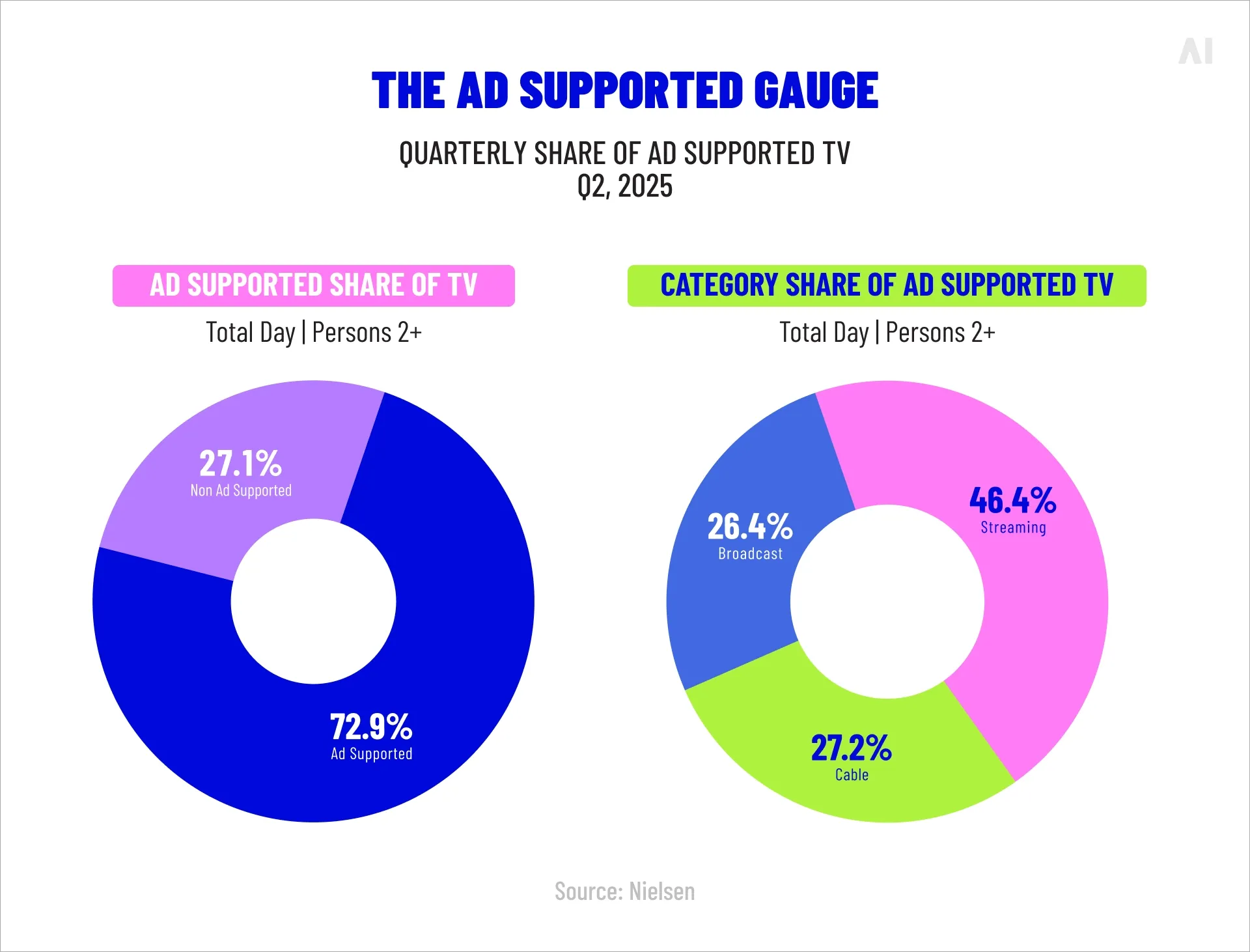
- Ad-supported viewing is dominant. Nielsen’s Ad Supported Gauge found ad-supported TV represented 74.2% of overall TV viewing in Q4 2025.
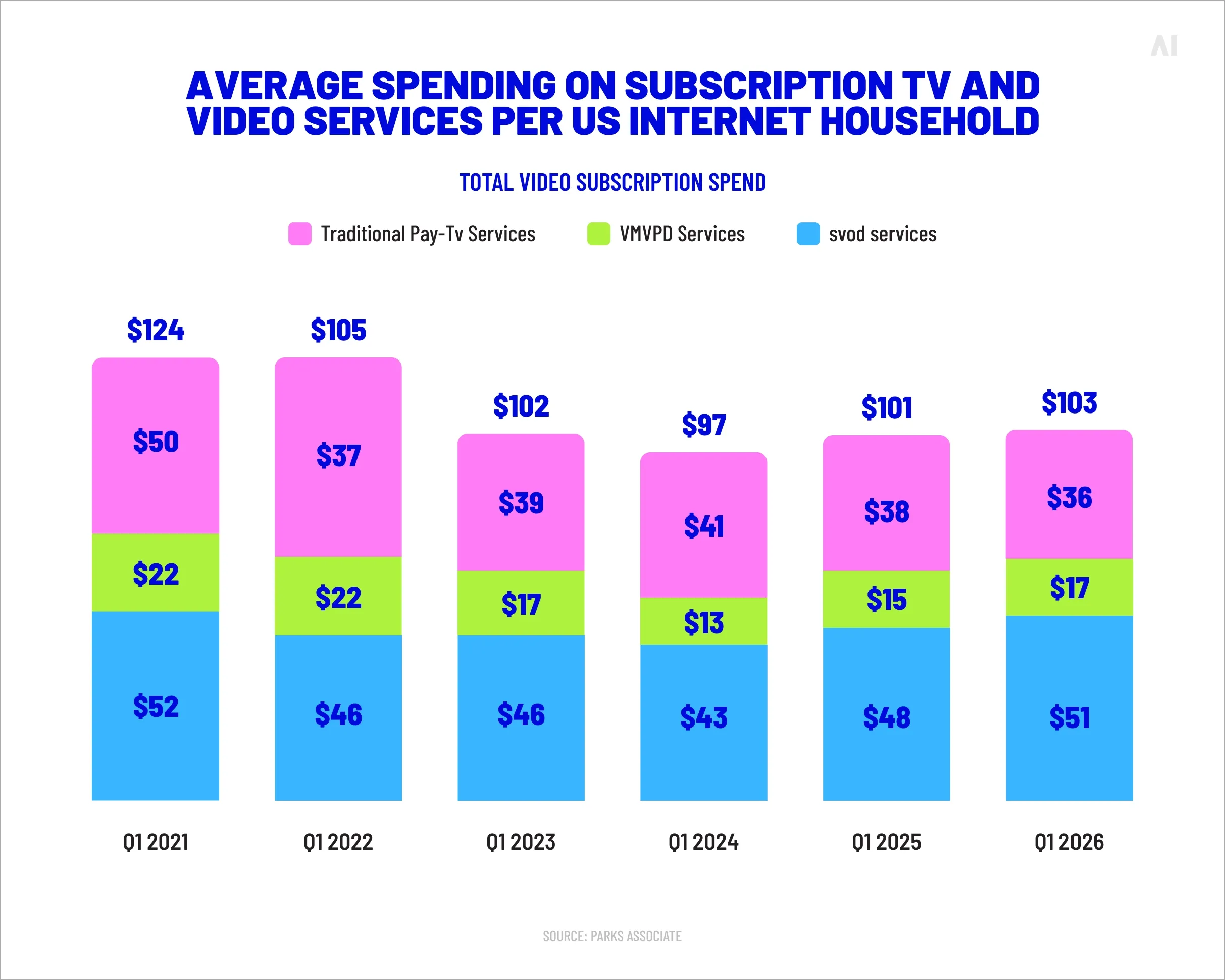
⚡ U.S. households are becoming more cost-sensitive across streaming bundles. Parks Associates reported average monthly spending on video subscriptions declined from $124 (2021 peak) to $101 in 2025.
That combination—more streaming time, more ad-supported consumption, and live tentpoles moving into streaming distribution—sets up vMVPDs as a practical way to buy live TV outcomes without treating live as “only linear.”
vMVPD vs other video advertising models
Once you’re clear on what vMVPD inventory is, the next question is when it’s the right tool versus other video buckets. The easiest way to evaluate is by viewer mindset, content type, and control surface (targeting + measurement + frequency).
{{26-vMVPD-Advertising-in-2026-2="/tables"}}
vMVPD vs traditional TV (MVPDs)
Traditional MVPD advertising (cable/satellite) still has strengths: broad reach, entrenched upfront workflows, and certain local/regional patterns. But vMVPDs change the distribution layer, which changes what’s possible.
Where vMVPDs typically pull ahead:
- Better alignment to streaming households. vMVPD subscribers are already streaming-first by behavior, even if they’re paying for a “cable-like” bundle.
- More modern ad decisioning in parts of the supply. Streaming ad delivery is often built for dynamic insertion and digital-like optimization, though the degree varies by provider and inventory.
- Clearer paths to outcome measurement. It’s not automatically “closed loop,” but it’s generally easier to connect exposure to downstream signals when the delivery is digital.
Where traditional MVPD still holds advantage:
- Some local inventory structures and legacy market processes (especially where agencies have mature linear operations).
- Certain “can’t miss” linear programming where rights and distribution still skew heavily to traditional pay TV in specific windows or regions.
A good way to frame it is this: vMVPDs are not “replacing” MVPDs. They are one of the most efficient bridges between linear-scale viewing and a streaming measurement mindset.
💡 For a deeper breakdown of cable TV, as well as linear vs streaming tradeoffs, AI Digital’s CTV vs linear TV & Cable TV advertising primers are useful reference points.
vMVPD vs SVOD
SVOD is primarily on-demand viewing. Many SVOD services now have ad-supported tiers, but the advertising experience is different from vMVPDs in three planner-relevant ways:
- Content type: SVOD is bingeable and catalog-heavy; vMVPD is live channel-driven (sports, news, appointment shows).
- Reach mechanics: SVOD reach often comes from large, on-demand minutes across many titles; vMVPD reach often comes from concentrated live moments and habitual channel usage.
- Ad load and pacing: SVOD ad loads can be lighter and more controlled; vMVPD feels closer to linear pods (though again, it varies).
Use SVOD when you want premium on-demand attention and title adjacency. Use vMVPD when you want live “gathered” audiences and the planning benefits that come with channel bundles.
💡 If Netflix is part of your comparison set (or you’re explaining SVOD ad models to stakeholders), AI Digital’s Netflix advertising guide is a straightforward explainer.
vMVPD vs FAST channels
FAST (free ad-supported streaming TV) is often confused with vMVPD because both can look like “channels” inside a streaming UI. But the economics and content strategy are different.
Key differences:
- Payment model: FAST is free to the viewer; vMVPD is paid subscription.
- Content makeup: FAST leans heavily on library content, themed channels, and increasingly some live/linear-like programming; vMVPD leans on traditional cable network feeds and live events.
- Brand safety and adjacency: FAST can be excellent, but quality varies widely by platform and channel. vMVPDs generally anchor around established network programming and more consistent content standards.
FAST is not “lower quality” by default, but it requires more supply scrutiny and more careful expectations around audience composition and delivery consistency.
⚡ Adoption is meaningful: Parks Associates reported 45% of U.S. internet households watched FAST in Q1 2025.
A simple heuristic:
- Choose FAST when you need efficient reach and you can actively manage supply quality.
- Choose vMVPD when you need live adjacency, predictable environments, and linear-like audience behavior delivered through streaming.
Benefits of vMVPD advertising
The point of adding vMVPDs to a plan is not novelty. It’s that they can solve specific problems that pure linear or pure OTT buys struggle with—especially when you’re accountable to outcomes.
Brand-safe live content
vMVPDs are one of the most direct ways to access professionally produced live programming in a streaming distribution context: sports, major news, award shows, and appointment viewing.
Two signals planners can use to justify prioritizing live environments:
- Live sports is increasingly central to the TV ecosystem. In November 2025, Nielsen reported that sports drove a surge in broadcast viewing, with sports representing 37% of broadcast viewership that month.
- Sports streaming behavior is no longer niche. Parks Associates found 38% of U.S. internet households subscribed to at least one sports-specific streaming service in 2025 (up sharply from prior years), reinforcing that live sports consumption is now deeply intertwined with streaming distribution.
⚡ Live moments are increasingly creating platform-specific spikes, not just “streaming broadly.” Nielsen noted that in December 2025, Netflix reached a 9.0% share of TV and The Roku Channel hit a 3.0% best-ever share, showing how big events concentrate attention in a few places.
This matters because brand safety is not only about “avoiding unsafe content.” It’s also about predictable adjacency and viewer mindset—what kind of content people choose when they’re engaged, present, and watching with others.
💡 Related read: The ultimate guide to sports OTT streaming in 2026.
Incremental reach beyond linear TV
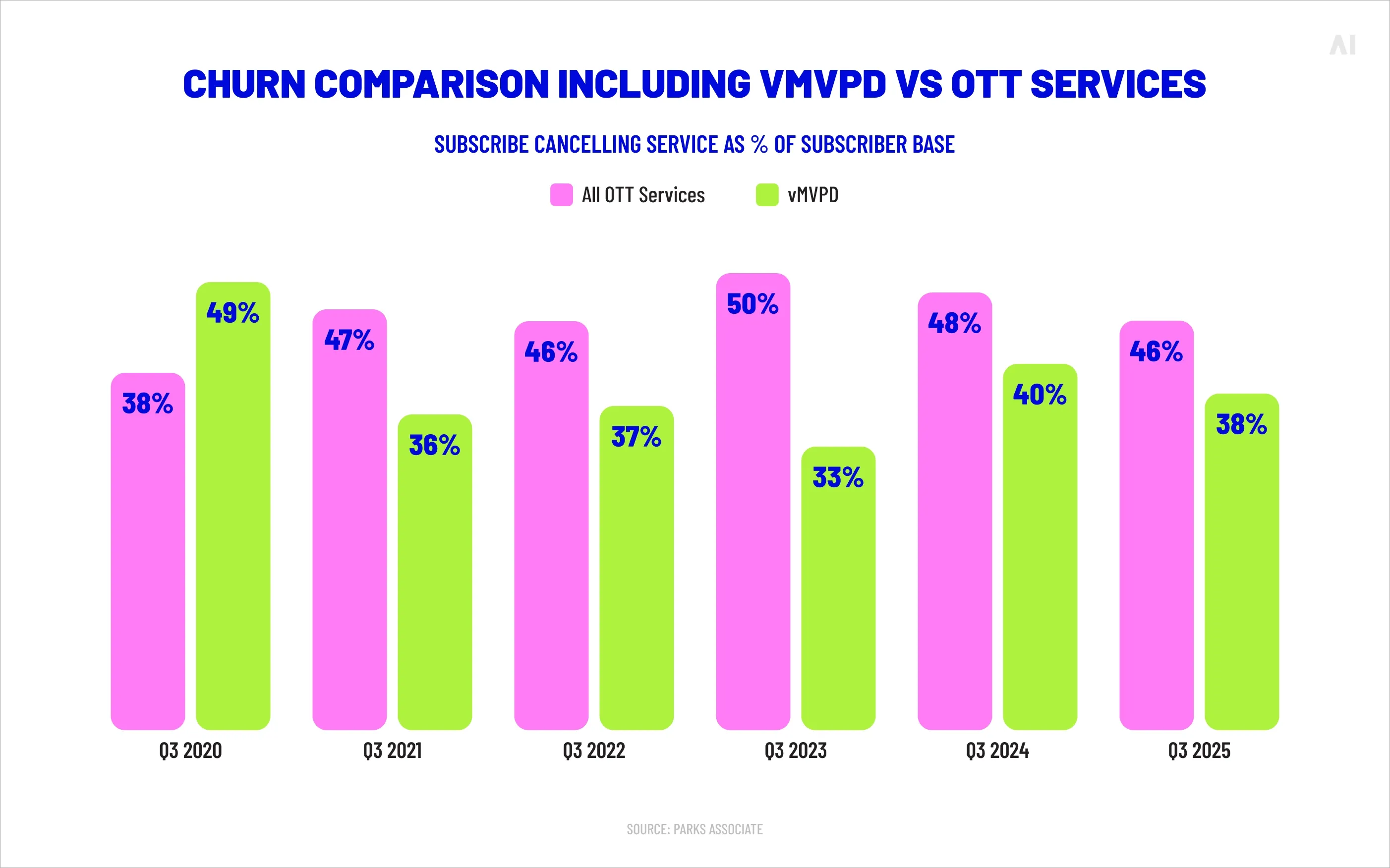
vMVPD reach is often incremental to traditional linear, even though the experience looks similar.
The reason is practical: a vMVPD subscriber is paying for a channel bundle but consuming it in a streaming-first household. That frequently means:
- More cord-cutters and cord-nevers in the reachable audience than a purely MVPD-centric plan.
- More light-linear viewers (people who will show up for live moments but don’t maintain the legacy cable habit).
Incremental reach is not a guarantee. It depends on overlap, market, and how your linear buys are already allocated. But vMVPDs are one of the few places you can pursue “linear-like scale” while still treating the delivery as part of a streaming identity and measurement ecosystem.
💡 If you need a quick supporting explanation for stakeholders, AI Digital’s linear vs CTV comparison is a clean way to articulate the “reach vs control” tradeoff.
Advanced targeting at TV scale
The promise of vMVPD targeting is best understood as a spectrum, not a binary.
On one end, some inventory behaves like classic linear: broad demographic targeting, limited data overlays, and planning based on networks and dayparts. On the other end, you can access household-level targeting, frequency controls, and segments built from first-party or partner data—depending on the provider, the sales path, and privacy permissions.
What tends to make vMVPD targeting attractive is that it can combine:
- Scale from live programming
- Targeting layers from streaming infrastructure
💡 If you’re explaining addressable concepts internally, or you want a plain-English way to differentiate “targeted TV” from “digital video,” AI Digital’s addressable TV guide and AI-targeted advertising overview are useful references.
Measurable, performance-driven outcomes
The strongest case for vMVPD advertising in a 2026 plan is that it can support measurement approaches that look more like performance marketing than legacy TV reporting.
{{26-vMVPD-Advertising-in-2026-3="/tables"}}
That includes:
- Incrementality and lift (geo tests, matched markets, holdouts when available)
- Attribution models that incorporate exposure data alongside conversion signals (online or offline)
- Quality controls (viewability equivalents, completion behavior where applicable, fraud screening on programmatic paths)
It’s still “TV,” and you should still expect some ambiguity (especially for brand outcomes). But when the delivery is digital and identity is more durable than in legacy linear, the measurement toolbox is simply broader.
💡 If measurement is a core stakeholder concern, AI Digital’s CTV measurement guide is a strong baseline primer.
Flexible buying and activation models
One of the most operationally useful benefits of vMVPD inventory is that it can be activated through multiple buying paths, depending on your goals and constraints:
- Direct / upfront-style commitments (for premium live adjacency and predictability)
- Programmatic guaranteed / PMPs (for more control with more flexibility)
- Biddable programmatic (for optimization and efficiency, where supply is available and brand safety governance is strong)
{{26-vMVPD-Advertising-in-2026-4="/tables"}}
This flexibility is part of a broader shift: digital video buying is increasingly built around auction dynamics and automation. The IAB projected U.S. digital video advertising revenue at $72B in 2025, underscoring how much budget is now flowing through digital-style pipes even when the screen is “TV.”
💡 If you need a clean, non-technical explainer for what a DSP is and why it matters to streaming activation, AI Digital’s DSP guide is designed for that use case.
Challenges and limitations of vMVPD
It’s tempting to position vMVPDs as the “best of both worlds.” In practice, they’re a powerful lever—but only if you plan around the constraints.
Here are the tradeoffs that most commonly affect performance.
- Fragmented rights and inconsistent ad product surfaces. Not all “live channel” inventory is sold the same way. Rights can sit with networks, distributors, or platforms, and that changes what data, measurement, and frequency control you can actually use.
- Measurement is better than legacy linear, but not fully standardized. You may still deal with mismatched definitions across partners: what counts as an impression, what completion means in a server-side world, and how deduplication is handled across linear + streaming.
- Frequency management is still hard across the total TV plan. Within a single platform, you may have strong controls. Across multiple vMVPDs, CTV apps, and linear buys, unified frequency is often limited by data walls and tooling boundaries.
- Transparency varies by buying path. Some deals provide clear reporting and strong levers. Others behave more like classic TV, especially when inventory is bundled or intermediated.
- Consolidation changes the playing field. As mentioned, the late-2025 Hulu + Live TV / Fubo combination is a reminder that distributor power and packaging can shift quickly, impacting pricing, inventory access, and competition dynamics.
💡 If you want language to explain the strategic cost of closed ecosystems (especially when you’re trying to coordinate buys across platforms), AI Digital’s perspective on walled gardens is directly relevant.
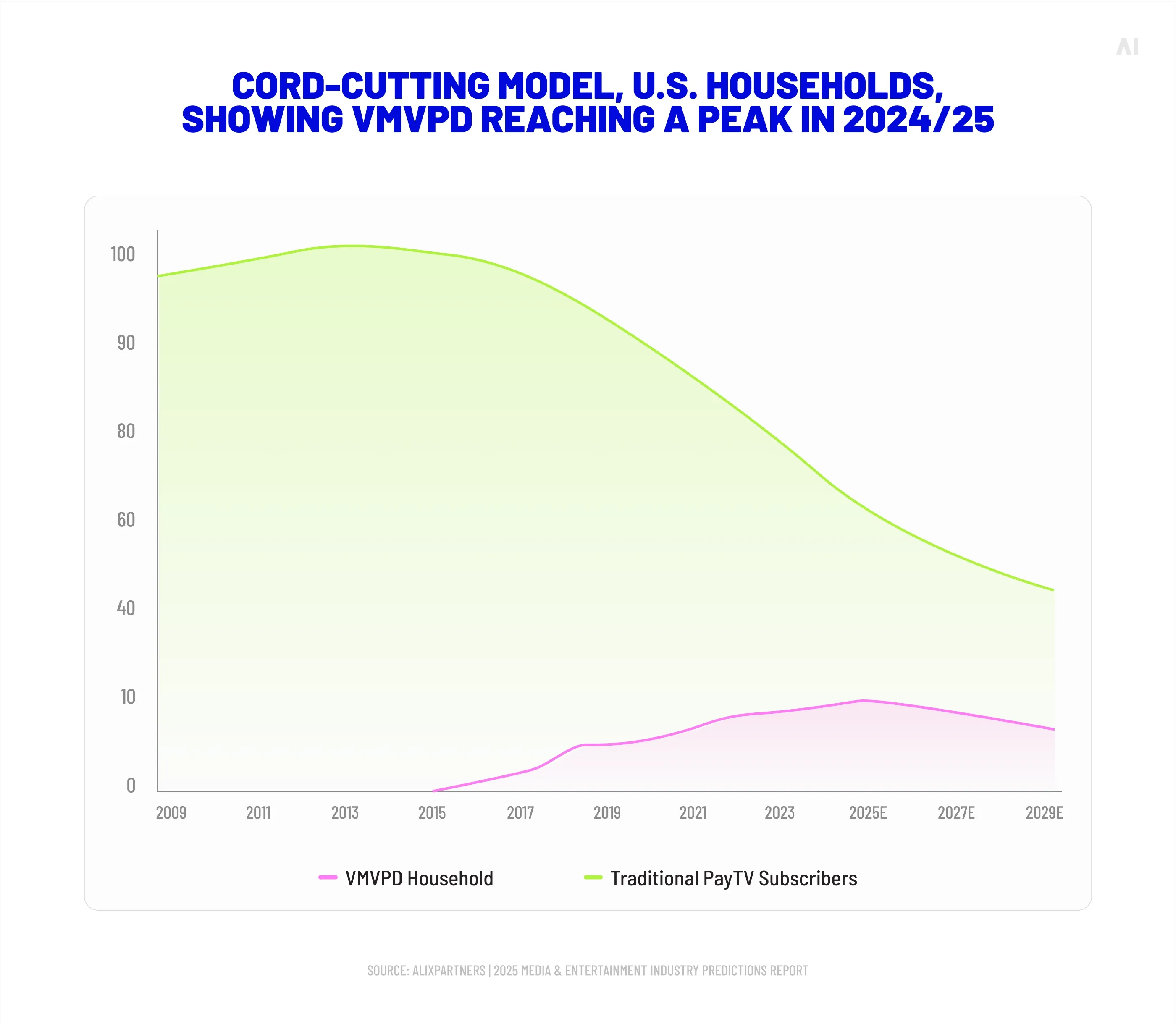
⚡ The risk isn’t that vMVPDs don’t work. The risk is assuming they behave the same across every buying path.
How vMVPD fit into a CTV and OTT strategy
At this point, the goal is not to crown a winner between vMVPD, CTV apps, and OTT buys. The goal is to assign each one a job.
A helpful reset:
- OTT refers to internet-delivered video that bypasses cable/satellite infrastructure.
- CTV refers to OTT viewed on a television screen via connected devices.
vMVPDs sit inside that world as OTT delivery with a linear channel bundle.
💡 If you need a clear distinction for teams that still mix these terms, AI Digital’s OTT vs CTV explainer is built for that exact confusion.
vMVPD vs CTV & programmatic OTT
Most “CTV plans” are a mix of:
- App-based CTV inventory (network apps, platform channels, AVOD services)
- Programmatic OTT/CTV supply (biddable marketplaces, curated PMPs)
- Publisher-direct streaming deals
- And sometimes: vMVPD inventory (often treated separately because it looks like linear)
The key difference is not the device. It’s the viewer context and the concentration of live audiences.
vMVPDs tend to outperform when you need:
- Live adjacency (sports, news, appointment viewing)
- Predictable environments (established channel brands)
- Scale that behaves more like linear, but with digital activation options
Programmatic OTT tends to outperform when you need:
- Efficient reach at scale
- Rapid optimization loops
- Flexible targeting and creative testing, particularly for performance goals
App-direct CTV often wins when you need:
- Premium publisher adjacency
- Known content alignment
- Clear packaging and reporting within a single ecosystem
💡 If your plan needs a clean OTT baseline (definitions, formats, strategy), AI Digital’s OTT advertising guide and Connected TV advertising guide are good anchors.
When to prioritize vMVPD
There are a few situations where prioritizing vMVPD budget is not only reasonable—it’s strategically clean.
Prioritize vMVPD when:
- Your campaign depends on live moments. If the message needs the cultural “room” that live viewing creates, vMVPD helps you buy that room in streaming distribution.
- You need reach that feels like linear, but you still want modern levers. This is especially true when stakeholders demand outcomes, not just delivery.
- You want a brand-safe alternative to broad, undifferentiated OTT reach. vMVPDs can narrow the gap between “open reach” and “trusted environments.”
- Your measurement plan includes lift or incrementality. Digital delivery increases the likelihood you can connect exposure to outcome signals (with the usual caveats).
One macro trend reinforcing this: streaming keeps capturing more of total TV usage, and major live events are increasingly distributed through streaming platforms. As mentioned—by December 2025, Nielsen recorded streaming at 47.5% of TV viewing and highlighted record-breaking streaming consumption on Christmas Day.
💡 If you want a broader planning lens for what’s changing across media in 2026 (and what’s becoming non-negotiable), AI Digital’s Media Trends 2026 report is positioned as that high-level reference.
Conclusion: Planning vMVPD advertising for 2026
vMVPD advertising is not a niche tactic. It’s a planning lever that becomes more valuable as two realities collide:
- Streaming dominates more of total TV time (and continues to set new highs).
- Live programming still produces the most concentrated attention—and advertisers still want that attention in environments they can defend and measure.
For brands and agencies trying to win live TV audiences at scale, the practical takeaway is simple:
Treat vMVPDs as the “live spine” of a streaming-era TV plan. Use them for premium live reach, controlled environments, and modern activation models—then complement with app-direct CTV and programmatic OTT for reach extension, testing, and performance optimization.
If you plan vMVPD with the same discipline you apply to digital—clear outcomes, clear measurement, clear supply rules—it can become one of the most stable parts of a 2026 TV strategy.
If any of this resonates and you’d like to talk through your 2026 TV and streaming strategy, reach out to AI Digital—we’re always happy to help.