Programmatic TV Advertising: What It Is, How It Works, and How It Drives Results

Programmatic TV advertising sits where TV’s reach meets digital’s precision. Instead of buying broad spots against a show or a time slot, brands use automation, data, and real-time optimization to decide which households see which TV ad, at what moment, and at what price. Done well, programmatic TV ads turn a historically blunt channel into something targeted, measurable, and accountable across CTV, OTT, and even linear TV.
⚡Programmatic TV takes TV from ‘we think this reached the right people’ to ‘we know what this impression did for the business.’
In this guide, we’ll break down what programmatic TV advertising is, how programmatic CTV advertising and programmatic linear TV fit together, and—most importantly—how to plan, buy, and measure programmatic television advertising so that every TV impression contributes to real business impact.
The current state of TV viewing and buying
TV viewing has changed faster than TV buying.
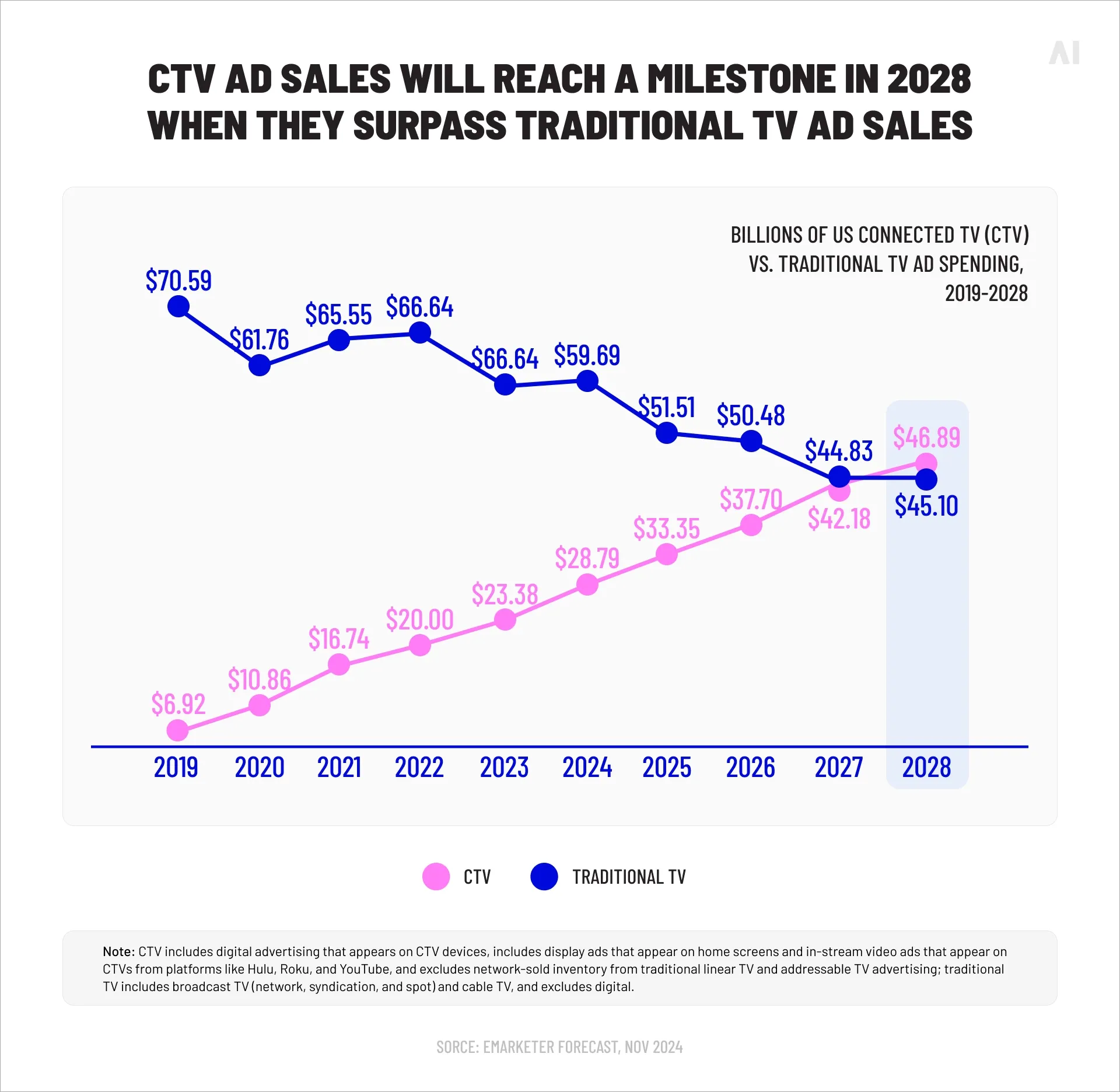
Viewers now bounce between smart TVs, streaming services, set-top boxes, and mobile apps. In the US, connected TV (CTV) ad spend is forecast to reach around $33.35 billion in 2025, up 15.8% year on year, with eMarketer expecting it to climb toward $47 billion by 2028 as CTV ad sales overtake traditional TV. At the same time, digital video as a whole—including CTV—is projected to hit about $72 billion and capture nearly 60% of all US TV and video ad budgets in 2025, after growing 18% in 2024.
⚡ Streaming has changed where people watch TV; programmatic has changed how you decide which of those moments is worth buying.
Marketers are chasing those viewers, but the old way of TV buying hasn’t kept up. Manual insertion orders, limited targeting, and panel-based ratings do not match modern expectations around audience precision and performance accountability. Buyers want TV to behave more like digital: audience-first, measurable, and optimizable in near real time.
That’s where programmatic TV advertising comes in. By applying automated buying and granular data to CTV, OTT, and addressable linear inventory, brands can:
- Reach defined audiences rather than generic demographics.
- Extend campaigns across screens without losing control of frequency.
- Measure outcomes like site visits, leads, and sales—not just GRPs.
💡 If you want a broader primer on TV as a channel before diving into the programmatic side, start with AI Digital’s overview of TV advertising, then come back here for the more advanced controls.
What is programmatic TV advertising?
At its core, programmatic TV advertising is the automated buying and selling of TV ad inventory using software, data, and algorithms rather than manual negotiations and flat-priced buys.
Instead of phoning a network sales rep to book a 30-second spot in a given show, you:
- Define your audience and goals.
- Set parameters in a demand-side platform (DSP) or programmatic buying tool.
- Let the platform bid on impressions across CTV apps, streaming services, and addressable linear inventory that match those parameters.
- Use real-time reporting and optimization to adjust budget, bids, and creative as results come in.
From a viewer’s perspective, a programmatic TV ad looks just like a regular TV commercial. The difference is how that impression was bought:
- Audience-based rather than purely content-based.
- Biddable and dynamic rather than fixed and pre-booked.
- Measured at impression level rather than estimated from panels alone.
Behind the scenes, programmatic television advertising typically involves:
- A DSP where the advertiser sets targeting, bids, budgets, and pacing.
- One or more supply-side platforms (SSPs) where publishers (streaming apps, MVPDs, vMVPDs, smart TV OEMs) make their inventory available.
- Data providers and identity graphs used to build audiences and connect TV exposures to outcomes.
- Ad servers and measurement partners that handle ad delivery, verification, and attribution.
As IAB’s digital video reports show, advertisers are increasingly treating CTV and digital video as performance-capable channels: 54% of CTV buyers now say business outcomes such as sales, store visits, or leads are their primary KPI for success. Programmatic TV is how those business-outcome expectations are operationalized in TV buying.

How programmatic TV works in practice
A typical programmatic TV buy runs like this:
- Audience and objective definition: You start with a clear goal: reach in-market auto intenders, drive incremental e-commerce revenue, or re-engage lapsed subscribers. You then define an audience using first-party CRM data, third-party segments, or contextual signals (for example, sports enthusiasts, parents with young kids).
- Campaign setup in a DSP: You select TV environments (CTV, addressable linear, OTT), geo, budgets, and pacing. You may also define preferred supply paths, like private marketplace (PMP) deals with specific networks or streaming platforms.
- Real-time bidding and allocation: When a user starts a stream or hits an ad pod, that impression is offered into an auction. If it matches your targeting, your DSP can bid in milliseconds. For programmatic guaranteed deals, the impression is reserved, but pricing and delivery still run through the same pipes.
- Delivery and frequency management: The winning creative is delivered to the device. Identity graphs and device graphs track exposures across CTV, mobile, and desktop so you can cap frequency across channels rather than in silos.
- Measurement and optimization: Exposures are matched to downstream outcomes (search lift, site visits, sign-ups, sales). You use that data to adjust tactics: shift budget to better-performing publishers, refine segments, or rotate creative based on response.
{{26-Programmatic-TV-Advertising-SEO-1="/tables"}}
⚡ Programmatic TV makes every impression a decision, not just a placement.
This same pattern applies across CTV and addressable linear; the main difference is where and how the ad is inserted, which we’ll come back to when we explore programmatic CTV versus programmatic linear TV.
Types of programmatic TV
Programmatic TV sits inside a larger advanced TV universe that includes several overlapping formats:
- Programmatic CTV advertising (connected TV): Ads delivered via internet-connected devices and streaming apps: smart TVs, Roku, Amazon Fire TV, Apple TV, gaming consoles. This is where most programmatic TV growth is concentrated. As mentioned, CTV ad spend is forecast to reach around $33.35 billion in 2025 and is projected to surpass $47 billion by 2028.
💡 For a deeper dive into this environment, see AI Digital’s guide to connected TV advertising .
- OTT programmatic (over-the-top): OTT is often used as an umbrella for streaming video delivered over the internet, whether to TVs, mobiles, or laptops. Programmatic OTT deals might include inventory in streaming apps accessed on any screen.
💡 AI Digital’s article on what is OTT advertising breaks down how OTT fits with CTV and mobile.
- Addressable TV advertising: Addressable TV allows different households watching the same linear broadcast or VOD stream to see different ads based on data, usually at the set-top box or smart TV level. It combines the reach of traditional TV with household-level targeting. Recent industry research shows addressable TV is now considered a “must-buy” by a majority of TV advertisers.
💡 AI Digital’s guide to addressable TV advertising goes deeper on how this works.
- Programmatic linear TV: Linear TV is scheduled, channel-based viewing (broadcast, cable, satellite). Programmatic linear TV uses addressable capabilities and ad-replacement systems to insert data-driven ads into live or time-shifted linear feeds, and to transact those impressions via programmatic pipes instead of pure upfront IOs.
To simplify, you can think of programmatic TV as the buying method, and CTV, OTT, and addressable linear as the environments where those buys show up.
{{26-Programmatic-TV-Advertising-SEO-2="/tables"}}
A helpful way to frame it:
- Programmatic CTV / OTT: Streaming, IP-delivered, on-demand content, with strong identity signals and full impression-level logs.
- Programmatic addressable linear: Traditional scheduled programming, but with addressability and automation layered on.
⚡ Think of programmatic TV as a buying style and CTV, OTT, and addressable as the screens where it shows up.
Programmatic TV vs. traditional TV advertising
Traditional TV advertising and programmatic TV advertising sometimes show the same 30-second creative, but they are built on very different mechanics.
How traditional TV buying works
In the traditional model, you typically:
- Buy upfronts or scatter based on projected GRPs.
- Target broad demographics (e.g., adults 25–54) and specific shows or dayparts.
- Commit budgets weeks or months in advance.
- Measure performance using panel-based ratings and brand-lift studies.
This approach is powerful for mass reach, but precision and flexibility are limited. If half the audience for a show is outside your target market, you still pay to reach all of them. If a campaign underperforms, there is usually limited scope to adjust mid-flight.
⚡ Traditional TV buys impressions in bulk; programmatic TV decides on each impression one at a time.
How programmatic TV changes the model
Programmatic TV keeps the power of TV’s storytelling but changes how you decide which impression to buy:
- Audience-first, not schedule-first: Instead of starting with “which shows should we buy?” you start with “which people do we want to reach?” and then let the platform find those households across multiple publishers.
- Automated decisioning rather than fixed reservations only: Bids can adjust based on data signals (context, audience value, time of day, channel performance) and campaign goals.
- Closed-loop measurement rather than panel-only estimates: Exposures are logged at impression level and can be linked to site visits, app actions, or sales using identity graphs and conversion APIs.
Programmatic vs traditional TV comparison
Here’s a simple comparison:
Traditional TV:
- Manual IOs with networks.
- Demographic and program-based targeting.
- Limited optimization once the schedule is locked.
- Measurement focused on reach, frequency, and brand lift.
Programmatic TV advertising:
- Automated buying through DSPs and programmatic platforms.
- Audience, contextual, and behavioral targeting.
- Ongoing optimization with real-time reporting.
- Measurement tied to business outcomes and cross-device behavior.
{{26-Programmatic-TV-Advertising-SEO-3="/tables"}}
The shift also shows up in how money moves. The ANA’s Programmatic Benchmark Study found that 59% of programmatic ad spending in 2024 went through private marketplaces (PMPs), up from 41% the previous year, reflecting a broad push for more controlled, transparent programmatic buying across premium inventory. That logic applies directly to TV, where buyers are using programmatic pipes to secure better access to high-quality CTV and addressable TV supply.
⚡ With programmatic TV, you’re no longer buying a show and hoping your audience shows up. You’re buying your audience and letting the tech find where they actually watch.
How programmatic TV drives results
Programmatic TV advertising isn’t just a different way to place TV ads. It materially improves how precisely those ads reach the right viewers, how much premium inventory you can access, and how effectively you can measure and optimize your spend.
Target the right audience
The most immediate advantage of programmatic TV ads is audience precision.
In CTV, streaming environments are inherently logged-in, IP-addressable, and device-identified. Identity graphs can link those devices to households and, in many cases, to deterministic identifiers like hashed emails or subscriber IDs. That lets you:
- Build segments based on first-party CRM data (e.g., current customers, lapsed subscribers, high-value buyers).
- Layer third-party attributes such as in-market behaviors, demographics, or interests.
- Combine contextual and behavioral signals, like genre preferences or viewing time patterns.
Recent data from StackAdapt, drawing on eMarketer, shows the US had 233.9 million CTV viewers across about 115 million CTV households in 2024, with CTV usage expected to reach nearly 70% of the population in 2025. In other words, audience-based targeting on TV is no longer a niche add-on; it covers the majority of US households.
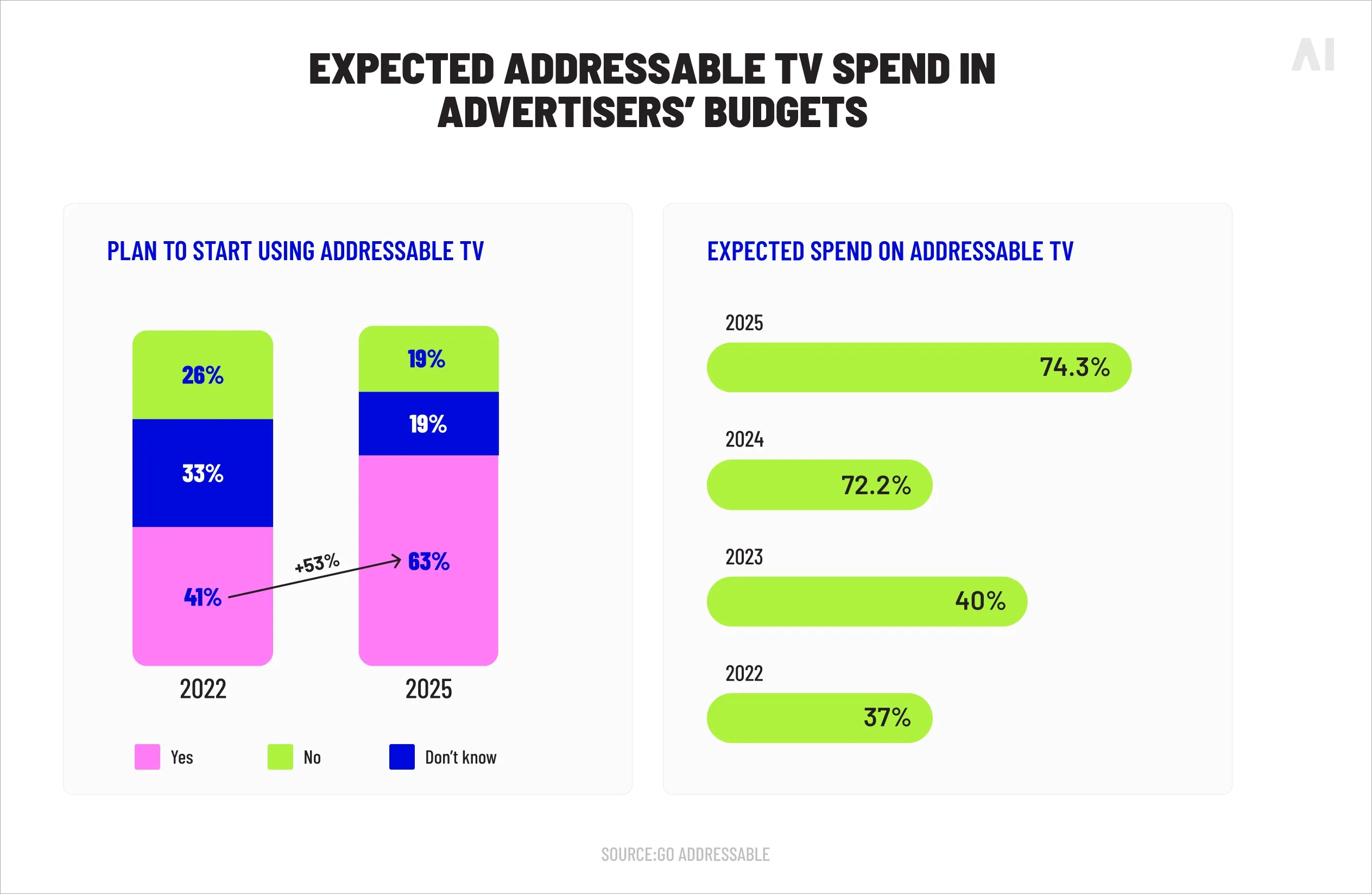
On the linear side, addressable TV has moved firmly into the core plan. In 2025, Go Addressable and Advertiser Perceptions report that 43% of advertisers expect to spend more on addressable TV in 2026 than in 2025, while 67% say addressable will feature in their 2025–2026 upfront negotiations and 80% are using or planning to use it this year.
💡 AI-led targeting amplifies this further. If you want to go deeper on how AI modeling, lookalikes, and predictive scoring enhance audience building, AI Digital’s piece on AI targeted advertising: how smart targeting is redefining ROI and personalization is a useful complement to this section.
Access premium TV inventory
Programmatic TV often gets confused with “remnant” or low-quality inventory. In reality, the programmatic pipes are how many brands now access the best TV supply.
Several trends are important here:
- Premium streaming apps lean into programmatic tools: IAB’s 2025 Digital Video Ad Spend insights show digital video (CTV, social video, OLV) capturing a growing share of total TV/video dollars, with CTV rebounding to 16% year-over-year growth in 2024 as live events, sports, and self-serve tools expand. Major players like Hulu, YouTube, Amazon, and network-owned apps make a significant portion of their inventory accessible programmatically, often via curated PMPs.
- CTV is taking a larger share of TV ad budgets: As mentioned, CTV is taking an ever larger share of overall ad spend and is set to command around 40% of US TV ad spending, while linear TV still accounts for just under 60%—a split expected to invert within a few years. That growth is heavily fueled by brands accessing streaming inventory through programmatic buying.
- Programmatic as the default transaction for CTV: According to AdExchanger’s reporting on IAB data, roughly three-quarters of all CTV transactions are now programmatic, highlighting that programmatic is the standard execution method in CTV, not a niche.
For buyers, the key advantage is that programmatic pipes can aggregate premium supply across many publishers. Instead of negotiating with each network separately, you can secure access to:
- National network streaming apps.
- Free ad-supported TV (FAST) services.
- MVPD and vMVPD apps.
- Smart TV OEM inventory.
Programmatic also opens up premium linear inventory. A recent Dish Media study with Janus Strategy & Insights found that 94% of US adults can be reached via TV targeting, but 13%—about 31.6 million people—are only reachable through addressable TV, and that reallocating just 10% of a campaign budget to addressable TV can increase light-TV viewer reach by 38% and deliver double-digit revenue gains. That kind of incremental reach is only feasible when you can tap into addressable pools across multiple distributors, which is where programmatic comes in.
In short, programmatic TV is how many brands unlock both breadth and quality of TV supply without losing control over where and how their ads run.
⚡ If you want premium TV at scale, you go where the pipes are—and those pipes are programmatic.
Real-time bidding and decisioning
Programmatic TV doesn’t always mean open auctions, but real-time decisioning is a core part of the value.
In many CTV and OTT environments, impressions are sold via:
- Open auctions (open exchange).
- Private marketplaces (PMPs) with curated supply and invite-only buyers.
- Programmatic guaranteed or preferred deals, where pricing and priority are set but delivery still runs through programmatic ad calls.
Real-time bidding (RTB) is the mechanism that decides, in a fraction of a second, which ad gets served. Your DSP evaluates:
- How closely the impression matches your audience criteria.
- The expected value of showing an ad to this household now.
- Budget constraints, pacing, and frequency caps.
- Historical performance of similar impressions.
It then bids accordingly. That decisioning is informed by ongoing performance data and can be tuned toward different outcomes—reach, completion rate, incremental conversions, or a blend.
💡 If you want a dedicated deep dive on RTB mechanics, see AI Digital’s article “What is real-time bidding (RTB): Definition, benefits, and how it works in 2026” and, in the meantime, the explainer on programmatic vs RTB is a helpful bridge.
On the supply side, the shift from open auctions to more controlled deals is notable. As mentioned previously, the ANA’s 2024 Programmatic Benchmark shows a flip from 59% open / 41% private marketplace in 2023 to 41% open / 59% private marketplace in 2024, as advertisers chase better control and performance across channels. TV buyers are applying that same approach in CTV: lean on PMPs and programmatic direct for quality, while still using RTB to optimize within those pools.
⚡ The net effect: every TV impression becomes a dynamic decision, not a static booking. That’s where much of the efficiency gain comes from.
Optimization & reporting
Programmatic TV comes with digital-grade reporting, which is the foundation for continuous optimization.
Instead of waiting for post-campaign summaries, you get:
- Impression-level delivery data (what ran, where, and to whom).
- View-through and completion metrics (how many viewers watched 25%, 50%, 75%, 100%).
- Cross-device outcomes, such as site visits, app installs, or conversions following exposure.
- Incremental lift and reach analysis when paired with A/B or geo-based testing.
IAB’s 2025 Digital Video Ad Spend & Strategy report goes even further, stating that store visits and sales are now the most important KPI for video buyers, with IAB’s Chris Bruderle noting that “driving bottom-funnel business outcomes is now far and away the most important KPI for video buyers—deliver, or you’ll get cut.” The same study finds that failure to deliver business outcomes is the number one reason buyers reduce or remove spend with streaming partners, which only reinforces how critical it is to instrument programmatic TV campaigns with robust tracking and measurement partners.
The appetite for better measurement is strong. Comcast Advertising’s 2024 report found:
- Over 50% of advertisers rank delivering specific reach and frequency among their top two success factors for video campaigns.
- 56% say they would increase video ad spend if better measurement, attribution, or optimization capabilities were available.

Programmatic TV buyers are responding by:
- Demanding log-level data (LLD) from platforms to run their own optimization and auditing.
- Using incrementality tests (regional holdouts, matched markets) to validate lift.
- Integrating TV exposure data into multi-touch attribution (MTA) and marketing mix models (MMM).
In practical terms, this makes optimization a continuous loop:
- Launch programmatic TV ads with clear, outcome-aligned KPIs.
- Monitor delivery and outcomes in near real time.
- Shift spend toward segments, creatives, and publishers with stronger performance.
- Refine targeting and frequency caps based on what the data shows.
That is the key difference from traditional TV. You’re not just “setting and forgetting” a schedule; you are running TV as a living, optimizable channel.
How different programmatic TV models work
From a planning perspective, it helps to split programmatic TV into two main models:
- Programmatic CTV
- Programmatic linear TV
Both matter, and each adds something different to your plan.
Programmatic CTV
Programmatic CTV is the workhorse of most modern TV strategies.
How it works:
- Ads are delivered in streaming environments like ad-supported tiers of major SVOD services, FAST channels, network apps, and OEM-owned channels on smart TVs.
- Inventory is accessed via SSPs and ad exchanges, with a growing share transacted through PMPs and programmatic direct.
- Identity is based on device IDs, IP addresses, and log-ins, often stitched together by independent identity providers.
Because CTV is digital at its core, it supports:
- Household-level targeting using deterministic IDs.
- Behavioral and contextual targeting based on content type, genres, and viewing behavior.
- Dynamic creative optimization, where creatives adapt based on data such as location, weather, or viewer segment. For example, The Weather Company has shown that using real-time weather data for CTV ad targeting can increase relevance and ROI by tailoring creatives to conditions like temperature or precipitation.
- Full-funnel measurement, connecting exposures to site visits, app usage, and online or offline sales.
💡 For numbers to anchor your CTV planning, AI Digital’s connected TV stats collection is a solid reference.
What CTV is best at:
- Reaching cord-cutters and cord-nevers at scale.
- Running precision campaigns against high-value audiences.
- Testing new creative and offers quickly, with clear cross-device attribution.
- Extending the impact of digital campaigns into a TV environment.
⚡ If you’re not planning CTV as a core video channel, you’re planning around where a huge chunk of your audience actually watches.
Programmatic Linear TV
Programmatic linear TV brings data-driven buying to traditional broadcast and cable.
How it works:
- MVPDs (cable and satellite providers) and vMVPDs (virtual providers) enable addressable ad replacement in linear feeds, often via set-top boxes or smart TV operating systems.
- Portions of commercial breaks can be sold as household-targeted impressions, even though the underlying show is the same for everyone.
- Those impressions can be packaged and sold via programmatic platforms, so buyers can tap them using the same DSP, audiences, and measurement stack they use for CTV.
Several trends are worth noting:
- Addressable linear TV ad spend in the US was estimated in the low single-digit billions in the early 2020s and has continued to grow, as more MVPDs activate their addressable inventory and more buyers fold addressable into their upfront and scatter plans.
- Go Addressable and Comscore report that MVPD and vMVPD members collectively deliver 51 million unduplicated US households, with virtually no duplication across providers, while a bundle of major ad-supported streamers loses about 46% of its apparent reach once overlapping subscribers are removed. That makes addressable TV a powerful way to secure incremental reach beyond standard linear or single-platform streaming campaigns.

Programmatic linear TV is particularly useful when you want to:
- Layer precision onto big-reach moments, like national sports, award shows, or tentpole premieres.
- Complement CTV to reach light streamers who still watch some linear.
- Take a more flexible, test-and-learn approach to linear buys, rather than locking everything into long-term upfront commitments.
💡 AI Digital’s article on CTV vs linear TV is a helpful companion if you want a side-by-side view of how these two environments behave and how to balance them in your plan.

Measurement and attribution in programmatic TV
Measurement and attribution are where programmatic TV breaks away from traditional models the most. TV will never look exactly like click-based channels, but we are much closer to closed-loop TV measurement than even a few years ago.
What you can measure today
With programmatic TV, especially on CTV, you can typically track:
- Impressions and delivery: Exact counts of how many impressions ran, in which apps, at what times, and to which device IDs or households.
- Viewability and completion rates: How many viewers saw 25%, 50%, 75%, or 100% of the ad.
- Cross-device actions: Site visits, app installs, or conversions that occur after a TV exposure, using device graphs and conversion APIs.
- Incremental lift: Brand-lift studies, sales lift, or incremental site traffic by comparing exposed vs control groups.
Industry research confirms that advertisers are using these capabilities to evolve TV from pure awareness to outcome-driven planning.
Tools and techniques
To make measurement work, brands typically combine:
- Platform analytics: DSP-level reporting on delivery, completion, and basic outcomes (like clicks or site visits if there’s an interactive element).
- ACR and device-graph data: Automatic content recognition (ACR) data from smart TVs and device graphs from partners that can link a TV exposure to other devices in the household.
- Attribution partners: Vendors that ingest exposure logs, match them to outcomes (online or offline), and build models of incremental impact.
- Conversion APIs (CAPIs): Server-to-server integrations that allow publishers and advertisers to pass conversion events in a privacy-safe way without relying solely on browser cookies. The IAB has recently encouraged the adoption of standardized conversion APIs to close the “outcome gap” for CTV measurement and bring it closer to the standard of search and social.
{{26-Programmatic-TV-Advertising-SEO-4="/tables"}}
Comcast Advertising’s 2025 research with AdExchanger reports that 63% of advertisers would increase TV spending if better attribution could prove uplift in consumer spending, even though they are currently 30% more likely to use TV for awareness than direct response. In parallel, new attribution work with Mastercard shows 3× incremental ROAS and measurable uplifts in transactions and sales for home furnishing brands, reinforcing that the real constraint on TV investment is measurement, not demand.
Challenges to be aware of
Despite the progress, there are still some friction points:
- Fragmented measurement: Different CTV platforms and linear providers offer different data sets and have different rules about data sharing. You may need to stitch together multiple sources.
- Walled gardens: Some major streaming apps limit how much impression-level data leaves their environment. You can still run campaigns and measure outcomes, but you might not see as much detail as you would on the open web.
- Privacy and regulation: Data usage must stay compliant with CCPA, CPRA, and other privacy frameworks, especially when using household-level and cross-device data. Conversion APIs and clean rooms are helping here but require thoughtful setup.
- Currency change: The industry is experimenting with alternative measurement currencies beyond legacy panel providers, but adoption has been gradual. Cross-media currency for converged TV is still a work in progress.
The practical takeaway: build a measurement framework up front. Decide which KPIs you care about (reach, incremental conversions, revenue), ensure the right tracking and partners are in place, and budget for testing. Programmatic TV gives you the data; you still need a clear plan for how to use it.
💡 For more on how AI-based optimization and supply-side intelligence contribute to better measurement and efficiency, see AI Digital’s articles on how AI Digital embraces AI technologies to change the programmatic game and supply-side optimization with AI.
Tips for buying programmatic TV ads
Once the strategy is clear, the question becomes: how do you actually buy programmatic TV effectively? These five areas are where most of the leverage sits.
Use demand-side platforms (DSPs)
A DSP is the central control panel for your programmatic TV buying. It lets you:
- Build and onboard audiences.
- Access CTV, OTT, and addressable linear inventory.
- Set budgets, pacing, and bid strategies.
- Apply frequency caps across publishers (and often across channels).
- Plug in measurement and attribution partners.
Some teams work directly in one or more DSPs; others use a partner like AI Digital that is DSP-agnostic and can orchestrate across multiple platforms, selecting the best path to inventory on a case-by-case basis.
When evaluating DSPs for programmatic TV:
- Check CTV and TV supply integrations: Do they have meaningful scale with the major streaming services and OEMs you care about?
- Assess data connectivity: Can you easily onboard first-party data? Are there strong third-party segments relevant to your category?
- Understand TV-specific features: Things like household-level frequency capping, cross-screen reach reporting, and support for advanced TV formats (shoppable CTV, interactive overlays).
💡 For a detailed breakdown of DSP capabilities and how they fit into a broader programmatic strategy, AI Digital’s guide to the demand-side platform is a good reference.
Leverage private marketplaces & programmatic direct
Open auctions still have a role, especially for scaling reach and testing, but premium TV supply is increasingly transacted via PMPs and programmatic direct deals.
The ANA benchmark noted earlier showed the programmatic mix shifting toward private marketplaces. That shift is directly relevant to CTV and programmatic TV:
- Publishers prefer PMPs and programmatic guaranteed for brand safety, pricing stability, and control.
- Buyers use them to secure higher-quality inventory with clearer transparency on where ads appear.
You should:
- Identify priority publishers: Major network apps, premium FAST services, and OEM channels that have the audiences you care about.
- Use PMP and PG deals for those environments: Lock in floor pricing and quality while still using programmatic for delivery and optimization.
- Reserve the open market for reach and testing: Use safeguards (inventory filters, brand-safety lists) to avoid low-quality environments.
- Explore curated marketplaces: Some partners offer curated CTV and premium video deals that bundle top-tier supply with pre-applied quality filters.
The combination of PMPs for premium and open exchange for incremental reach gives you the best mix of control and flexibility in programmatic TV buying.
Prioritize CTV in planning
CTV shouldn’t be an afterthought or just a bucket in the “digital” column. It deserves its own planning line. That doesn’t mean linear is “dead.” It does mean:
- CTV deserves a dedicated budget line.
- CTV creative and messaging should be planned intentionally (lengths, formats, calls-to-action).
- CTV’s addressability and measurability should be baked into your performance strategy, not treated purely as upper-funnel.
In practice:
- Set clear objectives for CTV—incremental reach, performance, or both.
- Make sure you allocate enough budget to CTV to achieve meaningful frequency within your key audiences.
- Integrate CTV with your other programmatic efforts (display, audio, online video) for consistent storytelling and shared learning.
Manage cross-channel frequency
One of the easiest ways to waste money in TV today is to overexpose the same households across multiple platforms. Without careful frequency management, a viewer might:
- See your ad several times on different CTV apps.
- Receive similar messages through addressable linear.
- Be hit again on desktop or mobile.
Some repetition is good; too much drives annoyance and diminishing returns.
To manage this:
- Use identity graphs and cross-device IDs: Work with partners that can tie CTV devices, set-top boxes, and personal devices into a unified household view.
- Set campaign-level frequency caps: Not just within a single DSP or publisher, but across as much of your TV and video stack as possible.
- Monitor reach and frequency distribution: Look beyond averages; identify pockets of the audience getting very high exposure and adjust your caps or exclusions.
- Coordinate linear and CTV buys: If your addressable linear provider offers exposure logs, integrate them into your frequency management strategy so that linear and CTV do not over-serve the same households unintentionally.
Evaluate measurement and attribution capabilities
Finally, treat measurement and attribution as a buying criterion, not a nice-to-have.
When assessing partners (DSPs, SSPs, networks, measurement vendors), ask:
- Can we tag campaigns with third-party measurement pixels or conversion APIs?
- Do we get log-level data for deeper analysis, or only aggregated reports?
- Are there standard integrations with our existing analytics stack (MMPs, CDPs, MMM providers)?
- Can we run clean-room or privacy-safe data matching to connect exposures to first-party data and sales?
The more you can prove TV works, the more budget it earns.
The right programmatic TV ads partner: what AI Digital offers
Programmatic TV is powerful, but also complex. Fragmented supply, evolving identity, and multiple DSPs and measurement tools can easily overwhelm internal teams.
AI Digital exists to help brands run programmatic TV and digital media as a disciplined, outcome-driven channel, not just another budget line. We do that through our Open Garden framework, Smart Supply, and Elevate.
{{26-Programmatic-TV-Advertising-SEO-5="/tables"}}
DSP-agnostic, Open Garden buying
AI Digital operates on a DSP-agnostic, Open Garden model, which means we are not locked into a single buying platform or stack. Instead, we:
- Connect advertisers to 15+ DSPs and multiple SSPs, giving campaigns access to premium CTV, OTT, display, and other digital inventory without platform bias
- Select the most effective DSP—or mix of DSPs—for each campaign based on supply, capabilities, and performance.
- Shift spend between platforms and supply paths as performance, pricing, or inventory availability changes.
The Open Garden framework is specifically designed to avoid walled-garden constraints and unify data and buying across platforms so decisions are made on performance, not on the limits of a single ad tech stack.
💡 For more detail, see the DSP-agnostic approach that gives AI Digital an edge in fragmented media buying.
Smart Supply: quality, transparency, and efficiency
Smart Supply is AI Digital’s premium supply selection layer. Rather than leaving supply decisions entirely to default DSP settings, Smart Supply focuses on:
- Selection high-quality, brand-safe ad inventory—including CTV and OTT placements—by filtering out low-value, non-viewable, or fraudulent traffic before it ever reaches your campaigns.
- Optimizing supply paths with AI-powered SPO to reduce unnecessary ad-tech fees and increase the share of budget that becomes working media.
- Ensuring full transparency into where ads run, how much is paid, and which supply paths are driving value through detailed, placement-level reporting.
Behind the scenes, Smart Supply uses direct relationships with top-tier SSPs and proprietary AI filters to deliver predominantly premium inventory, while giving advertisers clear line of sight into every impression.
This sits neatly alongside broader industry moves (from ANA, IAB and others) away from low-quality, opaque supply and toward curated, high-value programmatic inventory.
Elevate: planning, optimization, and measurement
Elevate is AI Digital’s AI-driven intelligence platform, designed to sit on top of Open Garden buying and Smart Supply. It brings your programmatic CTV and digital strategy together by providing:
- Cross-platform planning across CTV, OTT, display, social, search, and other digital channels, with predictive analytics and automated budget allocation to hit your business KPIs.
- Real-time optimization, using AI to adjust bids, budgets, and targeting every few minutes based on performance, and to prioritize the combinations of audience, supply, and creative that deliver the strongest impact.
- Transparent, AI-driven insights and attribution, including performance forecasting, an “Ask Elevate” assistant for on-demand analysis, and multi-touch attribution that helps you see which elements of your campaigns are driving conversions.
Because Elevate is built around custom KPI optimization and business outcomes, it fits neatly with how modern advertisers are evaluating CTV and broader video investment: not just on reach, but on revenue, customer acquisition cost, and lifetime value.
⚡ Programmatic TV only works if the pipes, the data, and the decisions are aligned. That’s the job of your partner.
If you want to show where programmatic TV fits into the wider picture, AI Digital’s what we do page is still the best top-level overview to link to.
Conclusion: Turn every TV impression into business impact
TV has always been a powerful medium. Programmatic TV advertising makes it more precise, more flexible, and more measurable.
By using programmatic CTV advertising and programmatic linear TV together, marketers can:
- Reach the right households instead of just broad demographics.
- Secure premium TV inventory without sacrificing control.
- Make real-time decisions about where each TV dollar goes.
- Measure outcomes like sales, leads, and visits—not just estimated reach.
The opportunity now is to treat TV like the rest of your data-driven marketing: set clear objectives, instrument campaigns properly, and optimize continuously.
If you get the fundamentals right—audience strategy, supply quality, frequency control, and measurement—programmatic TV ads stop being a test line and become a core driver of both short-term performance and long-term brand growth.