.webp)
As TV advertising continues its dramatic evolution, streaming environments are rapidly overtaking traditional broadcast and cable. In the U.S. in 2025, streaming accounted for roughly 44.8% of total TV usage, surpassing broadcast and cable combined for the first time. Within that shift, ad-supported viewing now represents nearly three-quarters of all TV consumption, highlighting just how much attention audiences are giving to CTV advertising opportunities.
YouTube TV advertising sits at the intersection of two powerful trends: the decline of linear viewing habits and the rise of internet-connected video platforms. YouTube itself captures a leading share of screen time, accounting for over 12% of all U.S. TV viewing, as more audiences consume YouTube content via connected TVs rather than mobile devices.
💡In this environment, YouTube TV ads present media buyers and brand strategists with a compelling mix of premium, high-attention inventory and data-driven targeting options. Yet this channel operates differently from traditional YouTube in-stream campaigns.
Sales mechanics, ad formats, measurement frameworks, and audience definitions—often accessed through DV360—align more closely with CTV advertising than with standard digital video. Understanding advertising on YouTube TV, from YouTube TV advertising cost expectations to when these placements actually drive impact, is essential before committing meaningful budget.
This practical guide will unpack how YouTube TV advertising works, clarify how ads on YouTube TV differ from both linear and digital video buys, and show when this channel delivers real strategic value. You’ll gain clarity on targeting, measurement, pricing, and the right audience use cases—so you can decide with confidence whether YouTube TV should play a role in your next campaign.
⚡️For broader context on CTV strategies, buying models, audience targeting, and performance measurement across streaming environments, this primer on Connected TV advertising explains how the channel fits into modern TV advertising plans and how brands can scale campaigns effectively across OTT and connected TV inventory.
What is YouTube TV advertising?

YouTube TV advertising refers to paid video placements served within the YouTube TV streaming service, a live and on-demand internet-based television platform that delivers traditional TV networks over connected devices. Unlike open digital video inventory, ads on YouTube TV appear in lean-back, full-screen viewing environments where audiences are watching long-form TV content, not scrolling or multitasking.
From a buying perspective, advertising on YouTube TV is executed through Google’s programmatic TV and CTV infrastructure, typically via DV360, and follows many of the same planning principles as modern TV advertising. Campaigns are designed around reach, frequency, and audience composition rather than direct-response clicks, making YouTube TV advertising best suited for upper- and mid-funnel brand objectives.
Because YouTube TV operates as a premium OTT streaming service, YouTube TV advertising cost is closer to other CTV advertising environments than to standard YouTube in-stream video. Buyers are paying for high-attention inventory, controlled ad loads, and television-style placements, not for the massive scale and auction flexibility associated with open YouTube.

⚡️For a broader view of how YouTube TV fits into today’s evolving TV ecosystem, see our overview of modern TV advertising. In the current U.S. landscape, more than 70% of all TV viewing time is spent on ad-supported services, and advertisers are increasingly shifting budget toward streaming and CTV channels as a result.
How it differs from YouTube
Although they share the same brand ecosystem, YouTube and YouTube TV are fundamentally different products, and that distinction matters significantly for advertisers. YouTube functions primarily as a user-generated content (UGC) platform, where viewers actively choose individual videos, creators, and formats. In contrast, YouTube TV is an OTT streaming service that delivers live TV channels, on-demand programming, and cloud DVR within a lean-back, television-style viewing experience.
{{26-YouTube-TV-Advertising-Works-1="/tables"}}
From an inventory standpoint, this difference translates into higher perceived quality and stronger brand safety on YouTube TV. Ads on YouTube TV run within professionally produced, long-form content from established broadcasters and networks, rather than alongside unpredictable or creator-led videos. For advertisers, this means greater control over context and fewer brand-adjacency risks compared to standard YouTube placements.
Viewer behavior also diverges sharply. Traditional YouTube audiences are often multitasking, skipping, or interacting with content, while YouTube TV viewers behave more like linear TV audiences, watching for longer sessions on connected TVs with sound on and limited distractions. This shift in attention makes YouTube TV advertising better suited for brand storytelling and reach-focused campaigns than for direct-response objectives.
This contrast explains why advertising on YouTube TV should be planned and evaluated more like TV advertising than like traditional digital video.
How YouTube TV advertising works
{{26-YouTube-TV-Advertising-Works-2="/tables"}}
YouTube TV advertising operates like modern television advertising, but with the data and measurement capabilities of digital. Ads appear within live TV streams and on-demand programming from major broadcast and cable networks, reaching viewers on connected TVs while they’re watching long-form, professionally produced content.
From a buying perspective, YouTube TV ads are typically non-skippable 15- or 30-second video spots delivered in natural TV ad breaks. Inventory is accessed through programmatic CTV buying or reserved placements, allowing advertisers to plan reach and frequency in a way that mirrors traditional TV—without relying on outdated ratings alone.
Targeting happens at the household level, using aggregated viewing signals rather than individual clicks. This makes YouTube TV especially effective for upper-funnel objectives like brand awareness, product launches, and incremental reach beyond linear TV audiences.
💡Measurement focuses on TV-relevant outcomes: completed views, reach, frequency, and lift studies, rather than direct-response metrics. The result is a controlled, brand-safe environment that combines the impact of television with the accountability of digital advertising—without the clutter and variability of user-generated platforms.
⚡️For advertisers seeking deeper context on how the mechanics of buying, targeting, and planning come together in connected TV, our article CTV Media Buying: How Connected TV Ads Are Planned, Bought, and Optimized provides a clear walkthrough of the media-buying process and decision points from start to finish
Where ads are bought: Google Ads vs DV360
This table breaks down where YouTube TV ads are actually bought and why the buying platform matters. While both Google Ads and Display & Video 360 sit within Google’s ecosystem, they serve very different roles.
{{26-YouTube-TV-Advertising-Works-3="/tables"}}
The biggest distinction is access: YouTube TV inventory is bought through DV360, not Google Ads. Google Ads is built for standard YouTube video campaigns, while DV360 is designed for premium CTV and TV-style buying.
DV360 offers TV-grade controls—household-level targeting, advanced reach and frequency management, and reserved inventory—making it suitable for brand awareness and incremental TV reach. Google Ads, by contrast, focuses on performance-driven outcomes like views, clicks, and conversions across user-generated content.
💡In short, the platforms reflect different strategies. Google Ads supports scalable, performance-oriented YouTube advertising, while DV360 enables YouTube TV advertising that behaves like modern television, with higher brand safety, consistent ad experiences, and measurement aligned to TV outcomes rather than direct response.
Where ads appear on YouTube TV
Ads on YouTube TV appear in natural TV ad breaks, closely mirroring the experience of traditional television—just delivered through a connected TV interface.
They are most commonly shown in three places:
- Live TV streams
Ads run during scheduled commercial breaks on live broadcast and cable channels. This is the closest equivalent to linear TV advertising and delivers high reach during real-time viewing moments like news, sports, and prime-time programming.
- On-demand content (VOD)
When viewers watch on-demand shows or recordings, ads are inserted before or during the program. These placements benefit from strong completion rates, as viewers are settled in for long-form content.
- DVR and catch-up viewing
Ads can also appear in recorded or time-shifted content, depending on the network and viewing rights. These placements extend reach beyond live viewing without sacrificing the TV-style environment.
Across all placements, YouTube TV ads are non-skippable and shown on the big screen, ensuring consistent visibility, high attention, and a premium brand-safe context—key reasons advertisers treat YouTube TV as a true extension of modern TV buying rather than standard online video.
YouTube TV ad formats
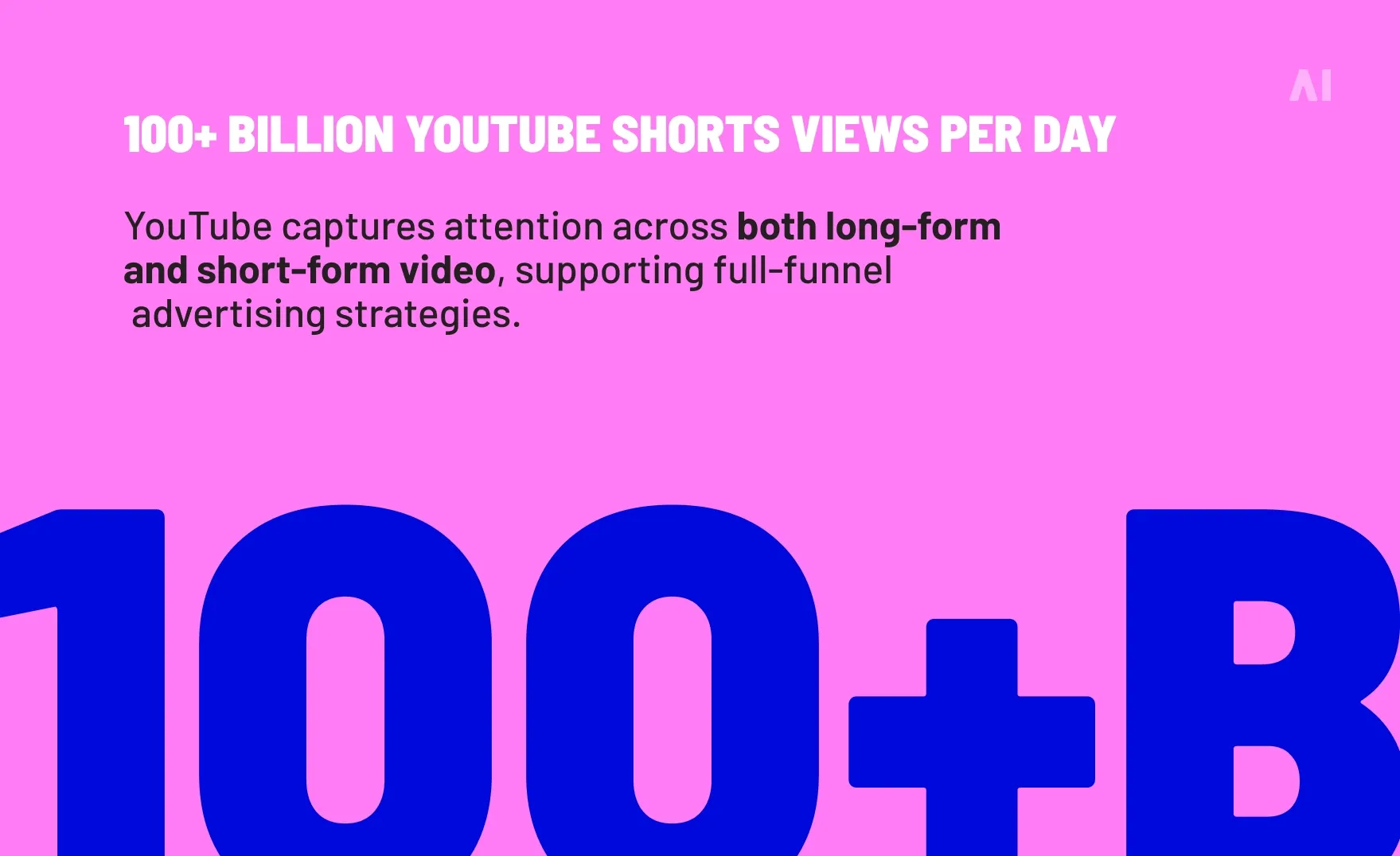
YouTube TV offers a TV-first set of ad formats designed for the living-room screen, where viewers are watching long-form, professionally produced content with high attention. Unlike standard online video, these Youtube Ad formats prioritize full-screen visibility, non-skippable delivery, and brand-safe placement within natural TV ad breaks.
Each format serves a different role in the funnel—from high-impact storytelling to efficient reach and message reinforcement—while maintaining a consistent, television-like viewing experience. Understanding how non-skippable in-stream ads, bumper ads, and skippable in-stream ads work helps advertisers choose the right creative length and buying strategy to meet awareness, reach, and engagement goals within YouTube TV campaigns.
Non-skippable in-stream ads

Non-skippable in-stream ads are full-message video ads that viewers must watch in their entirety once they start playing before, during, or after video content. On YouTube TV and connected-TV inventory, these ads are often the backbone of brand awareness campaigns because no skip button means guaranteed exposure to your creative. These formats typically include 15-second and 30-second lengths, with 30-second versions increasingly supported on CTV platforms to match traditional TV norms.
Advertisers usually buy non-skippable in-stream ads on a tCPM (target cost per thousand impressions) basis, emphasizing reach and completed views over click-through performance. Because every viewer sees the whole ad, this format is particularly strong for building recall, delivering complex brand stories, and anchoring upper-funnel campaigns in a TV-like context.
Bumper ads

Bumper ads are very short, non-skippable video ads of up to 6 seconds designed to capture attention quickly and efficiently. They play before, during, or after video content, and because they are so brief and unskippable, they serve as a high-frequency brand awareness driver that complements longer formats.
These mini-ads are ideal for reinforcing a message, slogan, or brand iconography across a broad audience. Their brevity also makes them exceptionally efficient for generating reach at scale, especially in campaigns that aim to saturate a target audience with repeated, memorable exposure
Skippable in-stream ads

Skippable in-stream ads give viewers the option to skip the ad after the first 5 seconds. They can appear before, during, or after other videos, and advertisers are typically charged only if a viewer watches a substantial portion (e.g., 30 seconds) or interacts with the ad.
While skippable formats are more common on standard YouTube feeds and partner sites, they can also be eligible on YouTube TV through certain inventory types and campaign structures (e.g., broader YouTube Select placements).
This format balances audience choice with advertiser control: viewers who skip are less engaged, while those who watch beyond the skip point signal higher relevance to your message. It’s particularly effective for consideration-stage campaigns where engagement and interaction matter.
Targeting capabilities on YouTube TV
YouTube TV uses a TV-native targeting model built around reach, relevance, and privacy rather than individual user actions. The targeting options below—ranging from demographics and geography to behavioral signals and household profiles—work together to help advertisers reach the right audiences at the right moment, without disrupting the lean-back TV experience.
⚡️For marketers deciding between programmatic CTV buying and Google Ads–driven approaches, understanding these targeting options is key to choosing the strategy that delivers the strongest reach, relevance, and brand impact.
Demographic and interest targeting
Advertisers can refine who they reach by age, gender, and interest categories, tapping into aggregated viewing signals to align ads with audiences that matter most for a brand. While the focus isn’t on individual click behavior, these segments help shape campaigns around broad cultural and lifestyle groups—for example, sports enthusiasts, young adults, or tech adopters—ensuring relevance without leaning on intrusive tracking.
Geographic targeting
Geographic targeting (⚡️See: “Geotargeting 2026. What Is It? How Does It Work?” ) emphasizes that location remains a cornerstone of effective media planning on YouTube TV. Advertisers can pinpoint viewers at the country, region, metro, or zip code level, which is powerful for local campaigns, regional launches, or markets with unique media habits. Geographic targeting ensures that brands are present where audiences live and watch—much like traditional TV buys, but with more precise delivery controls and real-time optimization.
Behavioral and cross-platform signals
YouTube TV uses aggregated viewing behavior across Google’s ecosystem to inform targeting decisions while preserving privacy. This includes what audiences watch on YouTube, browsing patterns outside the TV screen, and broader engagement trends across devices. These cross-platform signals help align TV placements with broader interests and media consumption habits, increasing the likelihood that your message lands with an engaged household.
Household profiles and multi-user behavior
Connected TV thrives on household-level targeting, where multiple people in a home share a screen. Rather than tracking single users, YouTube TV builds profiles around household viewing patterns, device usage, and content preferences. This lets advertisers reach the collective decision unit—the family or group making viewing decisions—enabling campaigns that resonate with real-world TV audiences, not just isolated devices.
What’s not available
Despite its rich set of targeting layers, YouTube TV doesn’t offer the same individual-level retargeting and search-driven signals that standard YouTube campaigns can leverage. You won’t target specific search keywords, micro-behavioral segments tied to browsing history, or click-based custom intent audiences the way you might on Google Ads. The emphasis is on broad, brand-focused reach rather than minute performance signals, preserving both privacy and the lean-back TV experience that makes YouTube TV distinct.
Measurement and reporting
Measurement on YouTube TV is built around TV-first metrics that reflect viewing behavior on big screens. Because viewers are watching long-form content rather than interacting in a click-focused environment, advertisers should expect reports that emphasize attention, reach, and completed exposure rather than click-through metrics.
Core metrics include impressions (how many times an ad was shown), reach (how many unique households saw your spots), and frequency (how often those households saw your ads). Completion rate tells you the percentage of ads watched to the end—a critical signal in TV contexts—while CPM (cost per thousand impressions) and CPV (cost per view) help benchmark efficiency across formats and placements. You’ll also see device-level insights showing how viewers engaged on different screens, though this is typically household-aggregated rather than user-specific.
Traditional click-through data plays a minimal role on YouTube TV because TV-screen viewing limits clicking. Attribution instead leans on view-through measures, lift studies, and cross-device behavior modeling to infer impact on brand awareness and downstream outcomes.
⚡️For a broader perspective on how performance is evaluated across channels, Digital Marketing KPI explains the core metrics advertisers use to assess success—from impressions and reach to efficiency and outcome-based indicators—and how these KPIs shift depending on channel, funnel stage, and campaign objective.
⚡️This context helps frame why CTV and YouTube TV measurement looks different from click-driven digital media and why traditional web KPIs alone aren’t sufficient for TV-screen environments. For a deeper, CTV-specific lens, CTV Measurement: The Key Metrics That Will Define Successful Campaigns focuses on the signals that matter most in connected TV, including reach, frequency, completion rate, incremental lift, and cross-device impact.
How much YouTube TV advertising costs
YouTube TV sits at the premium end of connected TV inventory, and pricing reflects its blend of high attention, brand safety, and curated sports, news, and entertainment content. Costs vary based on several factors: market demand, ad format, audience specificity, and seasonality. During major events or peak viewing periods, demand spikes and so do rates; niche audience segments or highly targeted buys typically cost more than broad reach campaigns.
Pricing models
YouTube TV primarily uses CPM-based buying (cost per thousand impressions) across its ad formats, with CPV (cost per view) options available depending on buying strategy and inventory access. Reserved buys lock in inventory and pricing ahead of time, while programmatic deals use real-time bidding and optimization.
Cost drivers
Several elements push pricing up or down. Premium content like live sports or prime-time programming commands higher rates. Audience targeting precision—for example, reaching specific demos or geographic segments—tends to increase CPM. Campaign seasonality matters too: rates climb during holidays and major cultural events when advertiser competition intensifies.
Typical budget ranges
While exact figures vary by market and campaign design, YouTube TV’s premium placement usually results in higher average CPMs than standard YouTube video inventory. Advertisers should plan for elevated baseline costs compared with many other OTT/CTV channels, especially when aiming for prime slots or tight audience segments.
How YTTV pricing compares to other CTV channels
Relative to the broader CTV landscape, YouTube TV’s inventory often sits at the higher end of the pricing spectrum thanks to its brand-safe environment, scale in key demos, and Google’s measurement ecosystem. While some CTV publishers may offer cheaper CPMs, they often trade off reach, content quality, or measurement depth. YouTube TV’s positioning is closer to traditional TV in how it’s valued—premium reach, consistent environments, and strong viewer engagement justify the price for many brand-focused advertisers.
Advantages of YouTube TV advertising
YouTube TV advertising stands out as a TV-first, data-driven channel that blends premium content with modern targeting and measurement. Its strengths make it especially effective for upper-funnel and brand-building campaigns.
- Access to premium content
Ads appear alongside professionally produced programming such as live sports, news, and prime-time entertainment, environments that typically drive higher trust and recall than user-generated video.
- High viewer attention on the big screen
YouTube TV ads are full-screen and non-skippable, delivered within natural TV ad breaks. This format supports strong completion rates and consistent exposure—key for brand storytelling.
- Younger, streaming-first audiences
The platform reaches cord-cutters and cord-nevers who are increasingly difficult to reach through linear TV, helping advertisers extend reach beyond traditional broadcast.
- Brand-safe, curated inventory
All placements run within licensed TV content, reducing contextual risk and ensuring ads appear in high-quality viewing environments.
- Data-driven targeting and planning
Household-level targeting, geographic controls, and aggregated behavioral signals enable advertisers to plan campaigns with greater precision than legacy TV buying.
- Strategic execution with AI Digital
At AI Digital, YouTube TV is activated as part of a broader data-first CTV strategy, combining premium inventory with advanced audience planning, reach and frequency controls, and cross-channel measurement. This approach helps brands maximize awareness impact while minimizing wasted impressions across the connected-TV ecosystem.
Limitations of YouTube TV advertising
While YouTube TV offers premium reach and high-attention environments, it also comes with operational and strategic constraints that advertisers should factor into planning. Understanding these limitations helps teams balance YouTube TV’s upside with realistic expectations around cost, flexibility, and scale.
- Higher CPMs than standard video
YouTube TV commands premium pricing due to its big-screen placement and licensed content. CPMs are typically higher than standard YouTube and many other CTV platforms, which can challenge efficiency for brands without clear upper-funnel objectives. AI Digital addresses this by modeling reach and frequency upfront, helping brands understand where premium placements add incremental value—and where budget is better allocated elsewhere in the CTV mix.
- Limited local and hyper-granular targeting
While geographic targeting is available, it lacks the precision of hyper-local digital formats. This can limit usefulness for store-level or tightly localized campaigns. However, AI Digital mitigates this by pairing YouTube TV with complementary CTV and digital channels, ensuring local relevance without sacrificing premium reach.
- Restricted interactivity and click-based attribution
YouTube TV is built for lean-back viewing, which means limited interactivity and minimal click-through data. Performance measurement relies more heavily on view-through impact and lift studies rather than direct response. AI Digital plans YouTube TV as part of a broader measurement framework, aligning TV exposure with downstream signals across devices to evaluate true brand impact.
- Inventory scarcity during high-demand periods
Live sports, prime-time programming, and seasonal moments have finite inventory, often leading to increased competition and pricing pressure. AI Digital helps brands navigate these constraints through early planning, inventory forecasting, and flexible buying strategies across the CTV ecosystem.
- CTV-wide risks still apply
💡Even in curated environments, connected TV faces industry-wide challenges such as invalid traffic and measurement complexity. Advertisers should maintain verification standards and transparency.
⚡️For deeper context, see our What is CTV Ad Fraud & How Advertisers Can Prevent it, where we draw on hands-on experience managing CTV campaigns at scale to break down how fraud actually shows up in connected-TV environments—and, more importantly, how to stop it.
By accounting for these limitations and activating YouTube TV within a data-driven, multi-channel strategy, brands actually can capture its advantages while avoiding common planning and execution pitfalls.
When YouTube TV is the right choice — and when it isn’t
YouTube TV lives at the intersection of digital precision and TV-scale reach, and current trends show why it’s become a must-consider for many advertisers. Streaming now represents a larger share of total TV usage than broadcast and cable combined, with streaming usage up over 70% since 2021 and capturing record viewership share in 2026. This shift toward internet-delivered TV makes connected TV advertising a central part of modern media plans, and YouTube TV is increasingly prominent within that ecosystem.
According to Google, YouTube’s connected TV inventory also delivers strong audience impact—research shows ads on CTV screens are often more relevant and memorable than traditional linear placements, driving higher recall and engagement.
When YouTube TV is a smart choice:
- National or broad audience reach: If your goal is to reach large audiences at scale, YouTube TV’s premium content lineup—sports, news, and entertainment—is ideal for brand awareness and top-of-funnel campaigns.
- Brand building and attention: With compelling content and high completion rates typical of CTV environments, YouTube TV excels when the objective is message resonance, not direct clicks.
- Younger, streaming-leaning viewers: Platforms like YouTube TV attract audiences that are shifting away from traditional cable, making it easier to connect with 18–34 and 25–54 demos that might be under-served by linear TV buys.
- Extension of linear TV plans: For advertisers already buying broadcast TV, YouTube TV offers incremental reach and measurement sophistication, helping bridge legacy and streaming audiences.
When other platforms may perform better:
- Efficiency or lower-cost priorities: If your key metric is cost per conversion or highly efficient performance outcomes, other CTV platforms or programmatic video on standard YouTube might provide lower CPMs and deeper interactivity.
- Highly localized campaigns: YouTube TV’s targeting is powerful at national and regional scales, but it’s generally less granular than some local DSP buys or ad-supported FAST channels for neighborhood-level campaigns.
- Direct response focus: When your primary objective is immediate action (clicks, conversions, signups), formats and placements outside of traditional CTV inventory often deliver stronger bottom-funnel signal and measurable ROI.
YouTube TV shines where brand impact, attention, and scale matter most, and it’s increasingly part of combined TV/digital strategies. In contrast, other CTV channels or standard YouTube video may offer greater cost efficiency and performance depth for goals that require direct response or tight audience microtargeting. By aligning your objective with the strengths of each channel, you can decide whether YouTube TV is the right fit—or whether you should complement it with more performance-oriented or localized CTV tactics in your overall media mix.
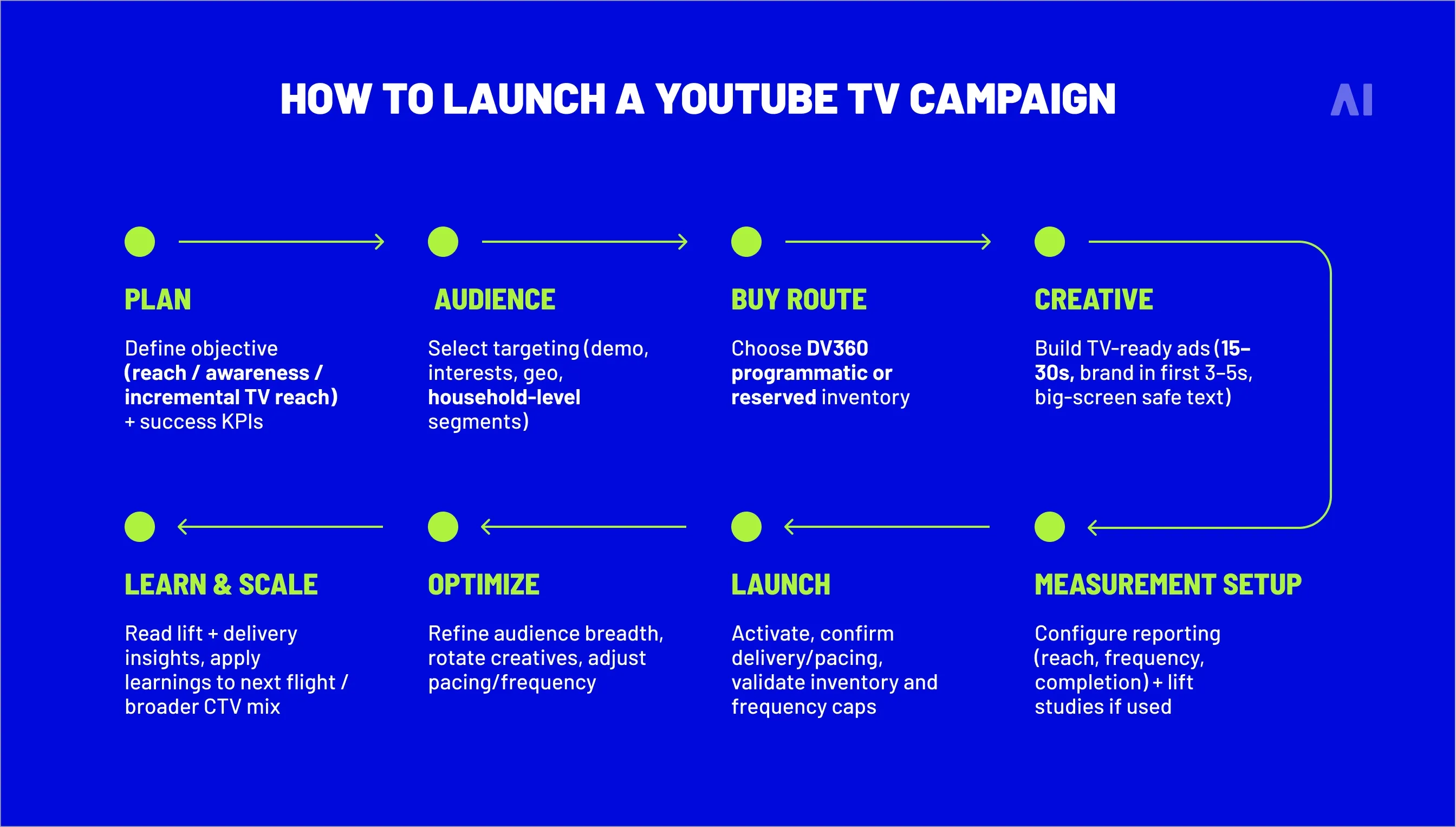
How to launch a YouTube TV campaign (step-by-step)
This breaks down the practical workflow advertisers follow to launch a YouTube TV campaign—from early planning and audience definition to buying strategy, creative execution, and optimization—so the process feels structured, achievable, and aligned with real media realities that marketers face today.
Common mistakes to avoid
Even though YouTube TV looks familiar to traditional TV buyers, it behaves very differently in practice. These are the most common pitfalls advertisers run into—and how to think about them more clearly.
{{26-YouTube-TV-Advertising-Works-4="/tables"}}
Avoiding these mistakes helps advertisers use YouTube TV as it’s meant to be used: a high-attention, premium channel for building brand impact at scale, not a repackaged version of standard online video.
Conclusion
YouTube TV advertising sits firmly in the premium tier of connected TV, combining high-attention, big-screen viewing with modern data and measurement. It excels when the goal is brand awareness, national reach, sports alignment, and incremental TV coverage, but it’s not a universal solution for every campaign. Higher CPMs, finite inventory, and limited interactivity mean YouTube TV delivers the strongest results when it’s used selectively and strategically, not treated as a replacement for all digital video.
In practice, YouTube TV performs best as part of a diversified CTV strategy—one that blends premium environments with more flexible, efficiency-driven channels. Evaluating fit should always come back to objectives, budget tolerance, audience scale needs, and measurement expectations, rather than defaulting to platform familiarity.
Next actions to consider with AI Digital →
- AI Digital helps brands determine whether YouTube TV aligns with campaign goals or whether other CTV channels can deliver better efficiency or performance outcomes.
- Using data-first planning models, AI Digital forecasts reach, frequency, and incremental impact to ensure premium inventory is used where it adds real value.
- AI Digital supports creative strategy tailored for the living room—ensuring messaging, pacing, and branding are optimized for high-attention TV viewing.
- Rather than relying on a single platform, AI Digital integrates YouTube TV with complementary CTV and digital channels to maximize scale and minimize wasted spend.
- AI Digital sets up measurement frameworks focused on reach, lift, and cross-device impact, giving advertisers a clearer view of how YouTube TV contributes to long-term brand growth.
Used thoughtfully, YouTube TV can be a powerful lever within modern TV advertising—and with the right strategy and execution, it becomes part of a cohesive, results-driven CTV approach rather than a standalone bet.