In-Stream vs Out-Stream Video Ads: How to Choose the Right Format for Your Goals

Video advertising no longer lives in a single environment. Today, video spans Connected TV (CTV) and streaming platforms, premium publisher sites, online video players, and social media feeds — each with different rules for attention, pricing, and measurement. As video ad spend continues to surge—global digital video advertising surpassed $190 billion in 2026 and is still growing at double-digit rates—the question for marketers is no longer whether to use video, but which format actually matches the goal.
This is where the in-stream vs out-stream decision becomes strategic.
- In-stream vs out-stream video ads aren’t just different placements. They shape user intent, viewability standards, pricing models, and even how confidently you can attribute performance.
- An in-stream ad plays within video content a user has chosen to watch. Out-stream video ads appear within editorial or social environments, often auto-playing as users scroll. Same asset, radically different context—and radically different outcomes.
The rise of streaming and CTV has further sharpened this divide. In premium environments, instream ads can deliver completion rates above 90%, while outstream video ads often optimize for reach and viewability, with benchmarks tied to 50% of pixels in view for 2 seconds. These differences affect everything from CPMs and engagement to how “success” is defined across platforms.
⚡️If you’re investing in video advertising across channels—including CTV, which now accounts for a growing share of brand budgets—it’s essential to understand how these formats behave in the real world. (For a deeper look at how streaming has reshaped video advertising, see our guide on Connected TV advertising)
This article breaks down in-stream vs out-stream video, not as abstract formats, but as tools with distinct strengths, trade-offs, and measurement realities.
What are in-stream video ads?
In-stream video ads are video ads that play within video content a user has intentionally chosen to watch. They appear before (pre-roll), during (mid-roll), or after (post-roll) a piece of video content and are delivered inside a video player—on CTV and streaming platforms, online video (OLV), and premium publisher inventory.
💡In the broader in-stream vs out-stream debate, this placement is the defining difference: the viewer is already in a lean-in viewing mode, not passively scrolling.
This context is why in-stream vs out-stream video ads behave so differently. With in-stream ads, attention is anchored to the screen. The user has pressed play, audio is usually on, and skipping is often limited or delayed. That intentionality translates into performance: completion rates on CTV instream ads routinely exceed 85–95%, while OLV in-stream ads commonly deliver 60–80% video completion rates, depending on format and length. In contrast, outstream video ads optimize for exposure during scroll, not committed viewing.
From a buyer’s perspective, in-stream ads sit at the high-attention end of the out-stream vs in-stream spectrum—but performance is not universal. Results depend heavily on inventory type and creative fit:
- CTV and streaming instream ads prioritize full-screen delivery, sound-on environments, and household-level reach, making them strong for brand lift, recall, and upper-funnel impact.
- OLV instream ads on desktop and mobile often balance attention with scale, but are more sensitive to ad length and skip mechanics.
- Premium publisher video content typically delivers higher viewability and brand safety, but at higher CPMs.

Because the ad interrupts or brackets the content, creative alignment matters more in instream ads than in outstream video. Shorter formats (6–15 seconds), strong opening frames, and messaging that respects the viewing experience consistently outperform generic video assets. When the creative mismatches the context, even high-quality instream inventory can underperform.
⚡️To understand how instream ads operate specifically within online video ecosystems, our OLV advertising guide breaks down formats, pricing, and measurement in more detail: https://www.aidigital.com/blog/olv-advertising
Types of in-stream ads
When marketers compare in-stream vs out-stream video ads, the first distinction inside the in-stream category is how the ad is delivered during video playback. In-stream ads come in several formats, each with different attention dynamics, pricing expectations, and performance profiles.

- Pre-roll instream ads appear before video content starts and typically capture the highest completion rates, especially on CTV and premium OLV, because viewers are still fully engaged and less likely to abandon the session.
- Mid-roll in-stream ads run during longer video content and benefit from sustained attention, though frequency and timing matter—poor placement can increase drop-off.
- Post-roll ads play after the content ends and usually deliver lower completion rates, making them less common for performance-focused video advertising.
Beyond timing, skippable vs non-skippable in-stream ads also shape outcomes.
💡Non-skippable formats (often 6–15 seconds) dominate CTV and premium streaming, where completion rates regularly exceed 90%. Skippable instream ads—common in online video and social environments—trade some attention for scale and cost efficiency.
Platform-specific formats matter too. On streaming and CTV, in-stream ads are typically full-screen, sound-on, and TV-like, optimized for brand impact. On platforms like YouTube, in-stream ads include skippable in-stream, non-skippable in-stream, and bumper ads, each designed for different campaign goals and creative lengths.
⚡️For a detailed breakdown of YouTube’s in-stream formats and how they behave across the funnel, see our YouTube ad formats: Which ones actually drive results?.
Placement of in-stream video ads
Placement is what turns in-stream ads into a high-attention format. Unlike out-stream video ads that appear alongside content, in-stream video ads are embedded directly within the video playback experience, making them harder to ignore and easier to measure. This is the core advantage in the in-stream vs out-stream comparison.
On CTV and streaming platforms, in-stream ads are inserted into professionally produced content—TV shows, movies, and long-form programming. These environments deliver lean-back but focused attention, with full-screen playback, limited multitasking, and household-level reach. As a result, instream ads on streaming TV consistently outperform other video ad placements on ad recall, brand lift, and completion rate.

⚡️To understand how in-stream ads function inside modern streaming ecosystems, our guide to streaming TV advertising offers a deeper breakdown.
In online video (OLV) and premium publisher environments, placement quality varies more. Ads can run within editorial video content, news clips, or entertainment segments. Here, player size, position on the page, and content relevance directly affect performance. An in-stream ad placed in a large, above-the-fold player delivers far stronger outcomes than one buried deep in an article—even though both are technically instream ads.
Social platforms blur the line slightly, but true in-stream ads still appear inside selected video content, not between feed items. This distinction is critical when comparing in-stream vs out-stream video ads, because outstream ads optimize for viewability during scroll, while instream placements optimize for intentional viewing and sustained attention.
For media buyers, the takeaway is simple: in-stream ads perform best when placement aligns with viewer intent and content quality. High-quality inventory amplifies the strengths of instream formats, while poor placement can erode the very attention advantage that makes in-stream video advertising valuable in the first place.
Where in-stream inventory comes from
Understanding where in-stream inventory comes from is critical when evaluating in-stream vs out-stream video ads, because supply quality directly affects attention, pricing, and measurement reliability.
{{26-In-Stream-vs-Out-Stream-1="/tables"}}
The largest source of in-stream inventory today is CTV and streaming platforms. This includes ad-supported streaming services, FAST channels, and broadcaster-owned apps, where instream ads are inserted into professionally produced TV-like content. These environments account for a rapidly growing share of video ad spend, driven by cord-cutting and the shift of TV budgets into programmatic channels. In fact, CTV now captures 30%+ of total digital video ad spend in many mature markets, with year-over-year growth still in the double digits.
A second major source is online video (OLV) across premium publishers and video platforms. News sites, entertainment publishers, and long-form video creators supply instream ads through embedded players that support pre-roll, mid-roll, and post-roll formats.
⚡️This inventory is often accessed via programmatic video advertising, where buyers can layer targeting, brand safety, and frequency controls at scale. A deeper look at how this inventory is bought and optimized programmatically is covered here, in our guide to Programmatic Video Advertising.
💡In-stream vs out-stream video becomes a question of inventory control. In-stream supply is more constrained, more premium, and more expensive—but it also delivers clearer attention signals and more stable performance, especially when aligned with TV-style buying strategies.

⚡️For buyers bridging digital and linear planning, this overview of modern TV Media Buying provides helpful context.
How in-stream is measured
Measurement is where in-stream vs out-stream video ads diverge most sharply. Because in-stream ads run inside a video player, measurement is deterministic, not inferred. Advertisers know when the ad starts, how long it plays, whether sound is on, and whether it completes.
{{26-In-Stream-vs-Out-Stream-2="/tables"}}
At a baseline, in-stream ads are measured using video-first metrics: impressions, viewability, video completion rate (VCR), quartile tracking (25%, 50%, 75%, 100%), and average watch time. On CTV and premium OLV, completion rate is often the primary KPI, with benchmarks ranging from 80% to 95%+, depending on format and environment. This level of consistency is difficult to achieve with outstream video ads, where exposure depends on scroll behavior.
⚡️In-stream vs out-stream video is also a choice between measurement confidence vs scale efficiency. In-stream ads provide cleaner signals, stronger benchmarks, and better alignment with TV-style KPIs. For a detailed breakdown of how these metrics connect to business outcomes, our guide explains how to measure TV advertising ROI and key performance indicators.
What are out-stream video ads?
Out-stream video ads are video placements that run outside a primary video stream, embedded directly within pages, feeds, or editorial layouts rather than inside video content the user intentionally selected. In the in-stream vs out-stream comparison, this is the fundamental difference: out-stream ads are discovered while scrolling, not while watching.
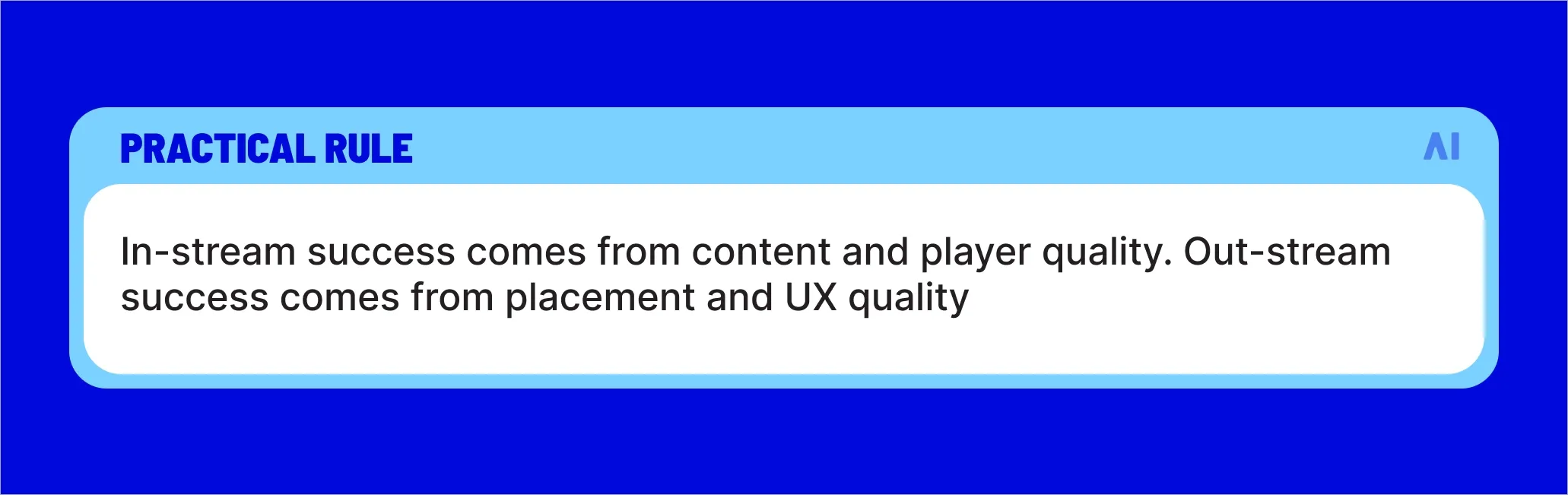
These formats commonly appear between paragraphs on publisher sites, inside social media feeds, or within native content modules. Because the user did not press play, out-stream vs in-stream video ads behave very differently in terms of attention, pricing, and performance. Out-stream video relies on viewability triggers—such as scroll position, time-in-view, and player size—to even start playback. As a result, success depends less on the video itself and more on UX quality and placement logic.
💡When executed poorly—small players, aggressive autoplay, cluttered pages—they suffer from low engagement and unreliable signals. In other words, in-stream vs out-stream video isn’t a quality hierarchy; it’s a trade-off between intentional viewing and opportunistic exposure.
⚡️Out-stream video ads are most often used to extend reach beyond premium video inventory, support upper-funnel awareness, or complement in-stream campaigns. As native and feed-based video continues to evolve, these formats are increasingly discussed alongside native video advertising strategies (see Native Video Advertising: Types, Strategies & Best Practices for 2026).
Types of out-stream ads
Out-stream formats vary widely, but all share one trait: they live outside traditional video players.
The most common types include:
- in-article video, where the player appears between blocks of text
- in-feed video, which blends into social or content feeds
- native out-stream video units, designed to visually match surrounding content.
In publisher environments, in-article outstream video ads often aim for high viewability and contextual alignment, while in-feed formats prioritize scroll-based exposure and volume. On social platforms, outstream ads dominate video inventory—most feed-based video ads are technically out-stream, even though users may perceive them as “video ads.”
Because these formats are not tied to video content, creative tolerance is lower. Shorter durations (6–15 seconds), immediate branding, and motion in the first second consistently outperform longer, story-driven assets originally built for instream ads.
Playback triggers and viewability thresholds
This is where out-stream vs in-stream differs the most mechanically.
Most out-stream video ads autoplay muted once a predefined portion of the player enters the viewport—commonly 50% of pixels in view. Playback pauses automatically when the ad falls out of view and may resume if the user scrolls back. Sound is user-initiated, not default.
Viewability rules define what counts as an impression or a view. Typical standards include:

Because playback is tied to scrolling, time-in-view becomes the real currency. A fast-scrolling user may technically generate an impression without meaningfully consuming the video.
This is why UX quality—player size, page layout, scroll speed, and clutter—has an outsized impact on out-stream performance. In contrast, in-stream ads are time-based and player-controlled. Out-stream ads are behavior-controlled, making them powerful for reach but less predictable for engagement.
How out-stream is measured
Measurement for out-stream video ads is shaped by these mechanics. Standard metrics include viewability rate, average time-in-view, video starts, and muted autoplay views. Completion rates are typically much lower than instream benchmarks and are rarely the primary KPI.
Click-through rate (CTR) often plays a larger role in evaluating outstream ads, especially in feed and native environments where interaction is optional and intent-driven. However, CTR must be interpreted carefully—high CTR does not always indicate strong attention, just effective placement or creative cues.
⚡️For context on realistic engagement benchmarks, our breakdown of CTR for display ads is a useful reference.
Compared to in-stream vs out-stream video, attribution confidence is lower for outstream formats. Exposure may be brief, fragmented, or muted, which complicates downstream measurement. As a result, out-stream video ads are best evaluated using reach efficiency, incremental lift, and assisted impact, rather than direct-response metrics alone.
Used strategically, out-stream ads complement instream campaigns by extending reach and frequency. Used indiscriminately, they inflate numbers without building meaningful attention. The difference lies not in the format itself, but in how well viewability logic, UX, and measurement expectations are aligned.
In-stream vs out-stream: key differences that change results
This comparison is where strategy turns into outcomes. In-stream vs out-stream video ads don’t just behave differently—they optimize differently, price differently, and tell different stories in your reporting. Below is a decision-aligned comparison, built for how marketers actually plan, buy, and evaluate video advertising.
User intent and attention
In the out-stream vs in-stream dynamic, intent is the root variable. In-stream ads appear when users choose to watch video content. Out-stream video ads appear while users are doing something else—reading, scrolling, browsing.
{{26-In-Stream-vs-Out-Stream-3="/tables"}}
Takeaway: If attention quality matters (brand lift, recall, storytelling), in-stream wins. Out-stream video trades depth of attention for broader exposure opportunities, making it better suited for reach and amplification. This difference becomes even more pronounced as interactive formats emerge in CTV environments, where engagement is no longer passive but action-driven (see Interactive Video Ads: How CTV Interactivity Turns Attention into Action).
Placement context and brand perception
Placement context shapes trust, credibility, and brand safety—not just visibility. This is one of the most underestimated in-stream vs out-stream video differences, especially when it comes to safety in programmatic advertising.
{{26-In-Stream-vs-Out-Stream-4="/tables"}}
Takeaway: In-stream placements inherit credibility from the content. Out-stream ads demand active brand safety governance to avoid perception risk.
Reach, scale, and frequency control
This is where out-stream video ads shine — if controlled properly.
{{26-In-Stream-vs-Out-Stream-5="/tables"}}
Takeaway: Use out-stream to extend reach efficiently. Use in-stream to control frequency and message exposure.
Engagement and completion behavior
Completion metrics often get compared directly but they shouldn’t be.
{{26-In-Stream-vs-Out-Stream-6="/tables"}}
Takeaway: High VCR is expected for in-stream. For out-stream, time-in-view is the meaningful signal—not completion.
Pricing and efficiency
CPM differences often drive the out-stream vs in-stream decision—but CPM alone is misleading.
{{26-In-Stream-vs-Out-Stream-7="/tables"}}
Takeaway: In-stream buys attention efficiency. Out-stream buys reach efficiency. They optimize different cost curves.
Measurement and attribution complexity
Measurement is where in-stream vs out-stream video ads diverge most clearly.
{{26-In-Stream-vs-Out-Stream-8="/tables"}}
Takeaway: If measurement confidence and attribution clarity matter, in-stream is structurally stronger.
Which video format wins for each goal
This is the most actionable part of the in-stream vs out-stream decision. The format you choose should follow the goal first, then dictate creative choices and KPIs not the other way around.
When to use in-stream ads
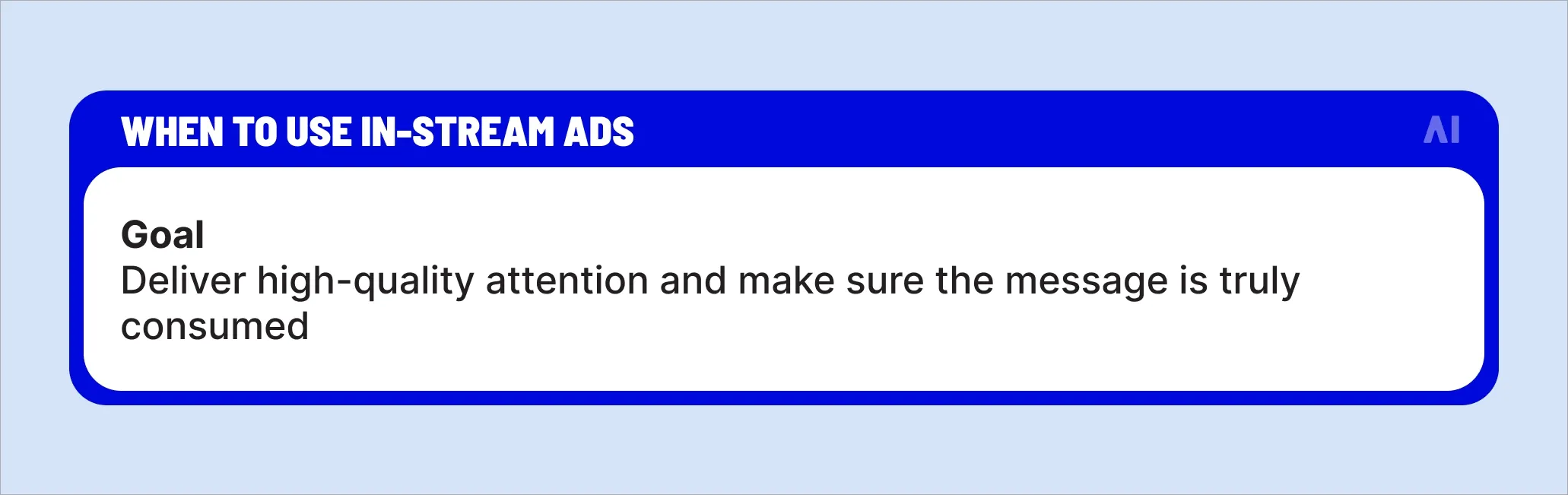
Choose in-stream video ads when your campaign depends on brand lift, recall, or storytelling. These formats work because users have already opted into watching video content, creating a stable, sound-on environment where messaging can unfold over time.
Creatively, in-stream performs best with 6–15 second formats, strong opening frames, and early branding. Narrative structure matters here—viewers will stay if the message respects the viewing experience. This is especially true on CTV and premium online video, where completion rates regularly exceed 80–90%.
💡The primary KPIs for in-stream should focus on completion rate, ad recall lift, brand lift, and view-through performance, not clicks. These signals align with what in-stream is built to do: hold attention and shape perception.
📌Use in-stream when watching the ad is the point.
When to use out-stream ads
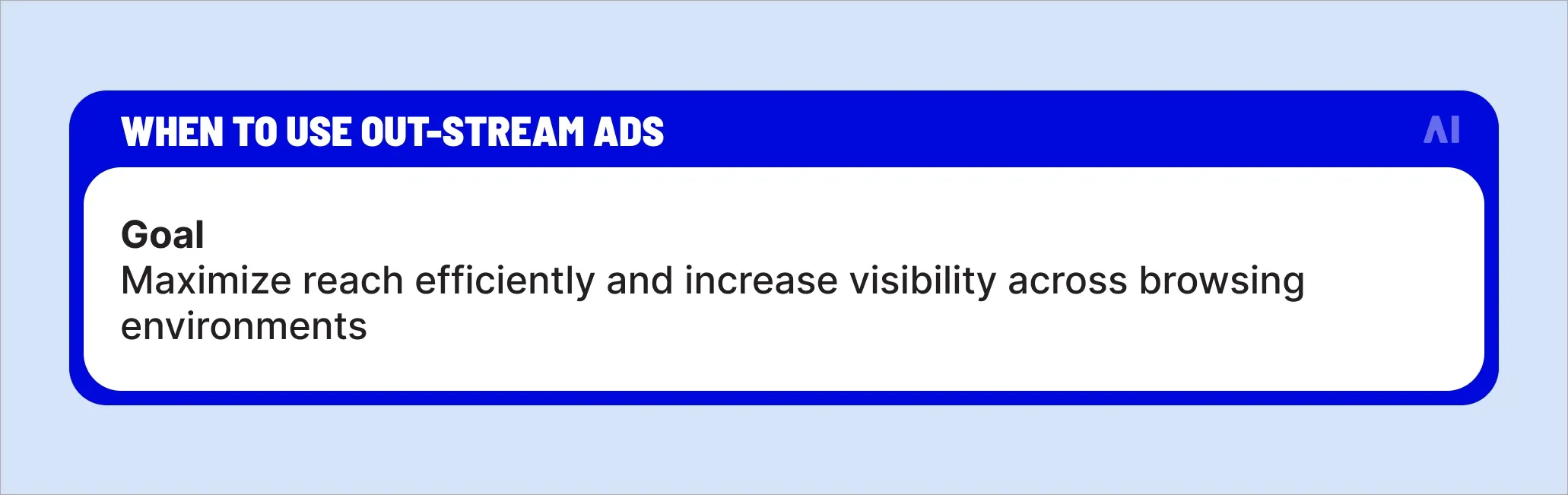
Out-stream video ads are best suited for upper-funnel reach, frequency extension, and cost-efficient exposure. In the out-stream vs in-stream trade-off, this format prioritizes scale over depth of attention.
Out-stream creative must work without sound and without context. Short durations, immediate branding, and strong visual motion in the first second are essential. These ads are discovered while scrolling, so they must communicate value instantly or be skipped unintentionally.
Measurement should focus on viewability rate, time-in-view, reach, and CPM efficiency.
💡Completion rates are less meaningful here, because playback depends on scroll behavior and page layout, not user commitment.
📌Use out-stream when being seen more often matters more than being watched longer.
When to run both together
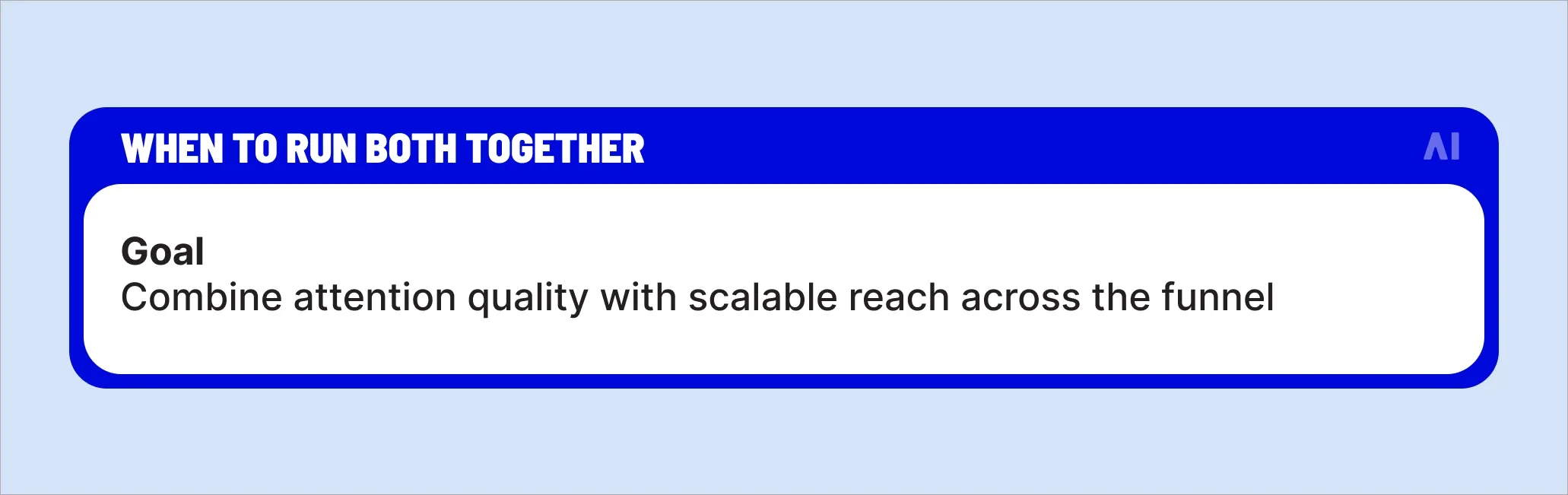
The most effective answer to in-stream vs out-stream video is often both. This approach reflects real audience behavior: people watch premium video in some moments and scroll feeds in others.
In-stream ads should lead the strategy by establishing the core message, narrative, and brand positioning. Out-stream ads then amplify that message, extending reach, reinforcing frequency, and supporting awareness at a lower incremental cost.
Creatively, this only works if assets are format-specific. In-stream video should be designed for sound-on storytelling, while out-stream versions should be shortened, simplified, and optimized for muted autoplay. Reporting should keep formats separate to avoid misleading averages.
📌Run both when you need strong attention and efficient scale—and want control over how each contributes to performance.
Choosing in-stream vs out-stream video ads: a simple decision framework
The fastest way to get in-stream vs out-stream video ads right is to stop thinking in placements and start thinking in mechanics: Where is the user? What are they doing? What counts as a meaningful exposure? Follow this roadmap and you’ll end up with a format (or mix) that matches your goal.
Define the objective and the primary KPI
Start with one sentence: “This campaign wins if ____ happens.” Then pick one primary KPI that actually proves it.
- If the goal is awareness / brand lift / recall, your KPI should be reach + frequency, brand lift, or completed views (depending on environment).
- If the goal is consideration, focus on qualified views, view-through signals, and downstream engagement.
- If the goal is response, use cost-per-action metrics—but be honest about whether video is the main driver or an assist.
💡This matters because out-stream vs in-stream often fails at the KPI level: teams judge out-stream like it’s in-stream (completion), or judge in-stream like it’s display (CTR).
⚡️Pick the KPI first, then choose the format that can realistically deliver it. For a clean overview of how to define and use KPIs in digital campaigns. If you can’t name the primary KPI in 10 seconds, you’re not ready to pick a format.
Map audience behavior and context
Next, answer: Is your audience in “watch mode” or “scroll mode”?
- Watch mode (CTV, long-form OLV, premium video): users tolerate interruption, audio is often on, and attention is time-based → in-stream video ads fit naturally.
- Scroll mode (feeds, articles, social browsing): users are moving fast, audio is muted, exposure is viewability-based → out-stream video ads match the behavior.
This is the real core of in-stream vs out-stream video: it’s not about what you prefer—it’s about what the user is doing when your ad appears.

Align to inventory and placement quality
Now pressure-test the supply you’ll actually buy.
- For in-stream, inventory quality is about the video environment: full-screen playback, premium content adjacency, predictable ad pods, and stable delivery.
- For out-stream, inventory quality is about placement logic: player size, clutter, scroll speed, and whether autoplay/viewability triggers create real exposures.
If your out-stream inventory is buried low on pages or uses aggressive autoplay in tiny players, the format will “work” on paper but fail in reality. If your in-stream inventory is cheap but low-quality (questionable content, low viewability, inconsistent delivery), you’ll pay for “video” without getting the benefits of in-stream attention.
Balance efficiency with attention
This is the trade-off marketers feel in their bones:
- In-stream is usually higher CPM, but you buy attention density (more seconds watched, stronger recall, cleaner measurement).
- Out-stream is usually lower CPM, but you buy exposure opportunities (more reach, more placements, more variability).
To balance this without spinning, decide what you’re optimizing for:
- If you need message retention, accept higher CPM and optimize completed views / lift.
- If you need coverage, take lower CPM and optimize viewability + time-in-view + incremental reach.
- If you need both, use a split: in-stream to establish the message, out-stream to amplify it.

Protect ad experience and brand safety
Finally, protect the part that destroys campaigns quietly: bad experience = bad performance + brand damage.
- For out-stream, cap frequency, avoid intrusive units, demand viewability transparency, and keep creative short and muted-friendly. Your goal is presence, not annoyance.
- For in-stream, manage pod load and repetition, ensure content alignment, and avoid mismatched creative lengths that cause drop-off or irritation.
Brand safety isn’t optional—especially in open web and programmatic supply. Use inclusion lists, blocklists, contextual controls, and placement reporting. The more scalable the inventory, the more guardrails you need.
How AI Digital supports both formats
Choosing between in-stream vs out-stream video ads is only half the equation. The other half is execution—how precisely the format is activated, optimized, and measured in real time. This is where AI Digital comes in: not as a format picker, but as a performance engine that makes both formats work harder.
AI Digital approaches in-stream and out-stream as complementary tools, each optimized around audience behavior, placement logic, and attention signals—not generic benchmarks.
- Audience reach is intentional, not incidental. AI Digital uses AI-driven targeting models to match video formats to real viewing contexts. High-intent audiences are prioritized for in-stream environments like CTV, streaming, and premium OLV, where time-based attention delivers stronger brand lift. For out-stream video ads, the focus shifts to scalable reach and incremental exposure, using contextual, behavioral, and predictive signals to appear where scrolling attention is most likely to convert into meaningful time-in-view.
- Placement quality is treated as a performance lever, not an afterthought. For in-stream, AI Digital emphasizes premium inventory, sound-on environments, and controlled ad pods that protect completion rates and brand perception. For out-stream, placement decisions are guided by UX logic—player size, position, scroll behavior, and viewability triggers—ensuring ads are seen without becoming intrusive. This is critical in the out-stream vs in-stream comparison, where poor placement can erase the cost advantage of lower CPMs.
- Creative is optimized for instant attention, not reused blindly. AI Digital adapts assets to format mechanics: narrative, sound-on storytelling for in-stream; short, motion-led, muted-first creative for out-stream. AI-assisted creative analysis helps identify which openings, visuals, and pacing patterns retain attention in each environment—often within the first 1–2 seconds, where most video ads win or lose.
- Brand safety and experience are protected by design. AI Digital applies strict brand safety controls, contextual alignment, and real-time monitoring across both formats. This matters especially for out-stream inventory at scale, where variability is higher. Frequency, repetition, and placement fatigue are actively managed so visibility never turns into annoyance.
Finally, insights are turned into action in real time. Instead of static reporting, AI Digital continuously analyzes performance signals—completion rates, time-in-view, attention proxies, and lift indicators—and feeds them back into bidding, placement, and creative decisions. This allows marketers to see not just what ran, but what actually worked, and adjust while campaigns are live.
⚡️AI Digital doesn’t treat in-stream vs out-stream video as a binary choice. It treats them as attention systems—activated with precision, protected by design, and optimized through AI to deliver measurable results. For a deeper look at how AI powers this approach across channels, read our guide to AI in Digital Marketing.
Conclusion
Video advertising is no longer about choosing a single format. It’s about orchestrating attention across contexts. In-stream and out-stream video ads serve different jobs in the funnel, operate under different mechanics, and succeed by different rules. In-stream delivers time-based, sound-on attention that drives recall and brand lift. Out-stream delivers behavior-based exposure that scales reach and frequency efficiently. The advantage goes to marketers who respect those differences instead of averaging them away.
💡The difference isn’t about which is better. It’s about which is right for the goal you’re trying to achieve. The real advantage comes from a disciplined workflow that moves from goal → format → placement → creative → KPI and then uses validated performance signals—not assumptions—to optimize in real time.
This means defining what success looks like first, choosing the format (or mix of formats) that can deliver it, placing that format where the audience is most receptive, adapting creative to the mechanics of exposure, and finally measuring the outcomes with metrics that reflect real engagement and impact.
⚡️For a broader look at how these forces are shaping the future of media, and why alignment across formats will matter even more in the years ahead, see Media Trends 2026.
When that alignment is strong, video campaigns become more than a line item—they become measurable engines of reach, attention, and value.
- Lock the objective and KPI before choosing the format.
Decide what success means first. Use brand lift, recall, and completion for in-stream. Use reach, viewability, and time-in-view for out-stream. Never judge one format by the other’s metrics.
- Map attention, not just audience.
Ask whether your audience is in watch mode or scroll mode. In-stream wins in intentional viewing environments like CTV and premium OLV. Out-stream wins where browsing behavior dominates.
- Match creative to mechanics.
Build sound-on, narrative assets for in-stream. Build short, motion-first, muted-friendly assets for out-stream. Reuse intelligently, not blindly—and refresh on a set cadence to avoid fatigue.
- Control exposure and supply quality.
Cap frequency at the household and cross-channel level, curate supply paths, and prioritize placement quality—especially for out-stream. Lower CPMs only help if impressions are actually seen.
- Measure what matters—and keep formats separate.
Report deduplicated reach, frequency, completion, time-in-view, and lift by format. Anchor reporting in in-stream where signals are strongest, and evaluate out-stream on incremental contribution, not raw totals.
If you want to put this framework into practice, AI Digital can help—from strategy and KPI design to Smart Supply curation, Elevate-powered activation, creative optimization, and a measurement framework that proves real impact across both formats.