Best Video on Demand (VOD) Platform Providers for Businesses in 2026

%2520Platform%2520Providers%2520for%2520Businesses%2520in%25202026.webp)
In 2026, choosing the right VOD platform is no longer a tactical media decision as it is a core business infrastructure choice. Video on demand platforms now sit at the center of digital revenue strategies, as video accounts for over 65% of global internet traffic and continues to outperform other formats in engagement and conversion across web, mobile, OTT, and CTV environments.
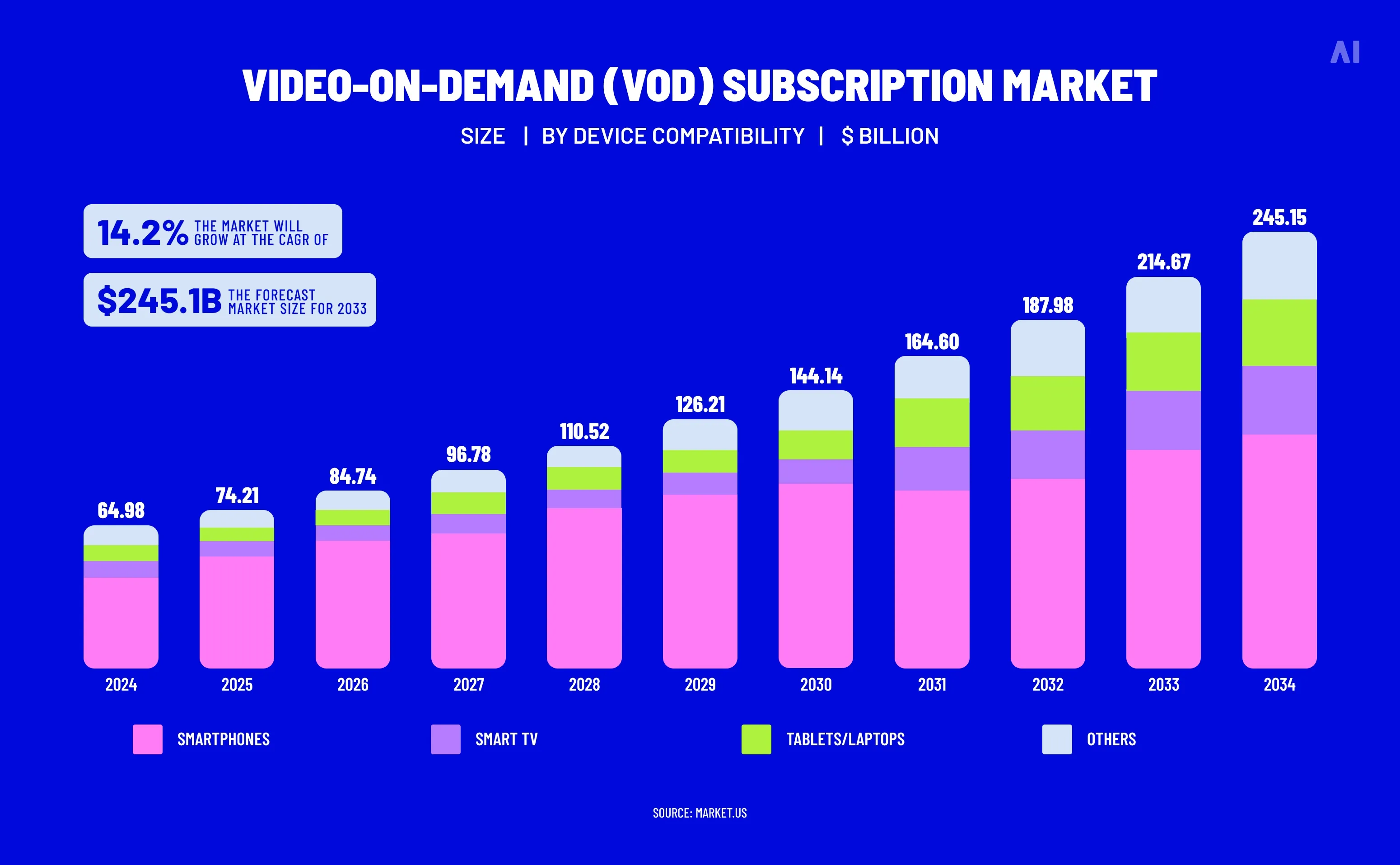
Global video markets are expanding structurally, not cyclically. Paid video subscription services, FAST channels, and ad-supported VOD models are driving double-digit growth, with FAST ad revenues alone projected to surpass $12 billion globally by 2027, according to industry forecasts. At the same time, customer acquisition costs for digital media have increased by 30–60% over the past five years, forcing businesses to prioritize first-party data, owned audiences, and direct monetization rather than platform-dependent reach.
This shift explains why companies are rapidly moving away from open consumer video platforms toward professional video on demand platform providers built for scalability, security, performance measurement, and revenue optimization. The best VOD platforms in 2026 are no longer defined by video hosting or reach, but by their ability to support subscription management, advertising monetization, advanced analytics, DRM, and multi-device distribution at scale.
This guide is designed to help businesses evaluate video on demand platforms as commercial systems, explaining how modern VOD infrastructures are used in practice and how to select the best VOD platform providers based on monetization models, data ownership, distribution strategy, and long-term business control—not surface-level features.
What is a Video-on-Demand (VOD) platform?
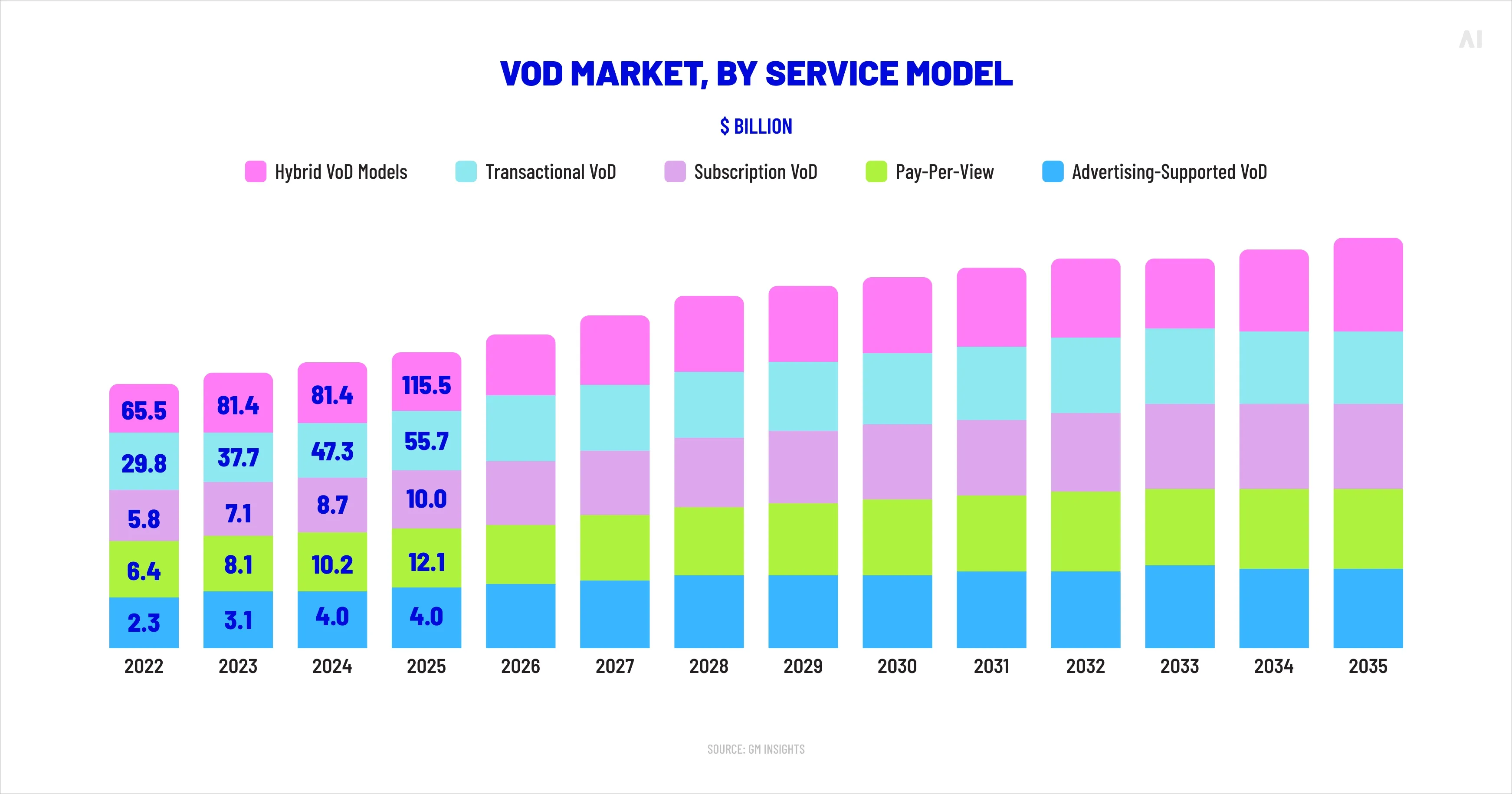
A video-on-demand (VOD) platform is a professional solution that enables businesses to host, manage, distribute, and monetize video content on demand, giving viewers the ability to watch content whenever they choose rather than at a scheduled broadcast time.
In a business context, VOD platforms function as revenue and distribution infrastructure, not just media libraries. They are used to power subscription video services, ad-supported streaming, transactional video, OTT apps, and on-demand TV experiences across web, mobile, and Connected TV environments.
💡Unlike live streaming, which focuses on real-time broadcasts, VOD platforms are optimized for catalog management, long-tail consumption, and repeat viewing, making them more predictable and scalable revenue drivers.
💡Unlike social video platforms, professional VOD platforms give businesses full control over monetization models, audience data, branding, and content access, instead of relying on opaque algorithms or revenue-sharing frameworks.
⚡️This distinction has become increasingly critical as CTV and OTT adoption accelerates. Businesses deploying VOD strategies alongside Connected TV advertising benefit from unified audience targeting, cross-device measurement, and owned distribution, rather than fragmented platform dependency. For a deeper look at how VOD integrates with modern TV ecosystems, see AI Digital’s analysis of Connected TV advertising.
In 2026, a VOD platform is best understood as a video revenue system, one that supports direct subscriptions, advertising, commerce, analytics, and long-term audience ownership.
How video-on-demand platforms work

At a high level, video-on-demand platforms operate through a modular architecture designed to scale content delivery and monetization efficiently, while remaining flexible for different business models.
The core building blocks include:
{{1-Best-Video-on-Demand-Platform-Providers-for-Businesses-26="/tables"}}
💡The key difference in 2026 is integration: the best VOD platforms connect video delivery directly to marketing, advertising, and revenue systems. This transforms VOD streaming from a cost center into a aligned with broader OTT and CTV strategies.
In practice, a modern VOD platform is not a single tool, but a coordinated ecosystem designed to deliver video content profitably, securely, and at scale.
Different business use cases for VOD platforms
Video-on-demand platforms are now widely adopted across industries, not as experimental tools but as core operating infrastructure. Independent industry research consistently shows that VOD usage has reached mass adoption wherever video is tied to revenue, education, or organizational performance.
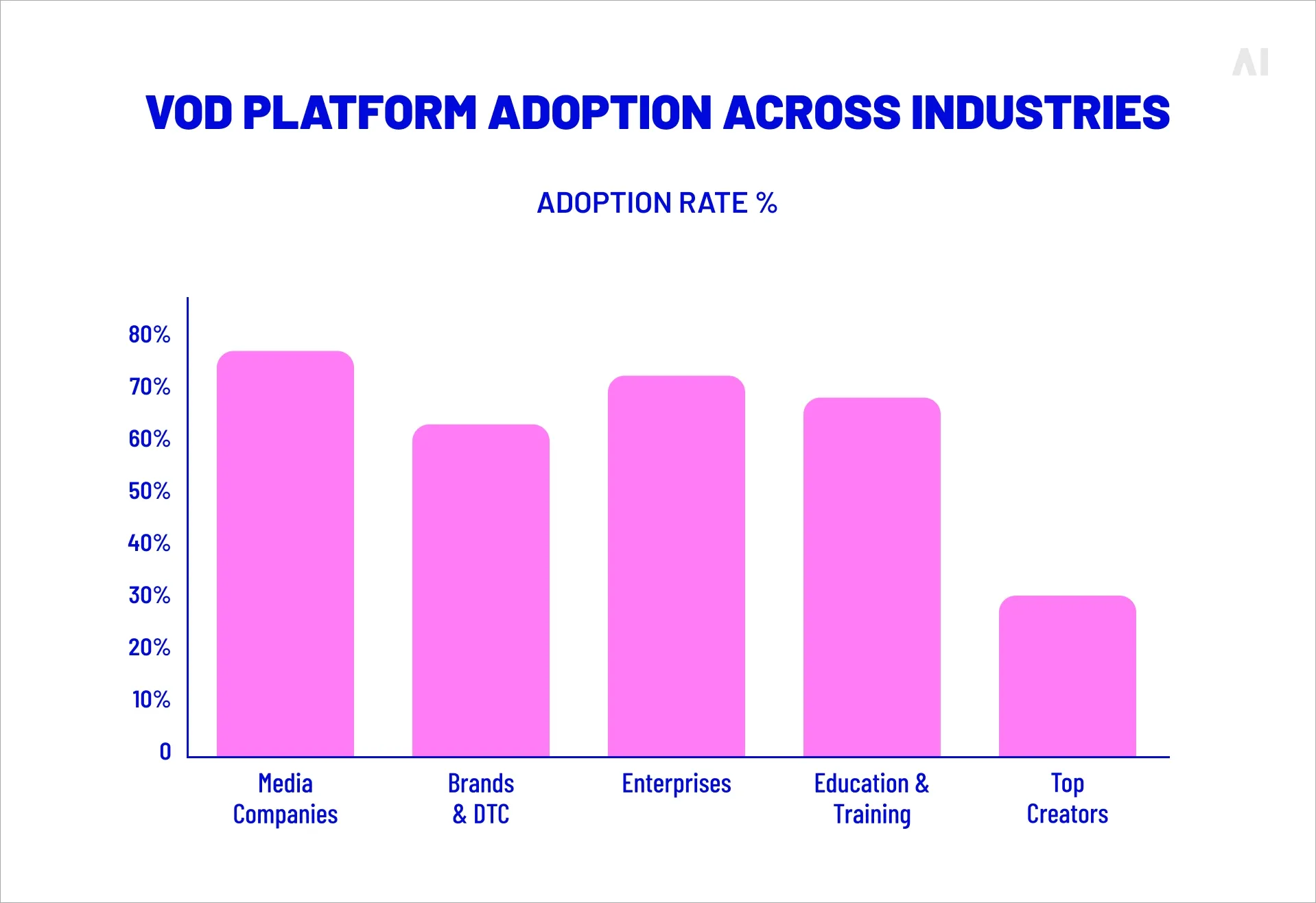
For media companies, VOD platforms have become the primary distribution layer, not a secondary channel. According to Deloitte Digital Media Trends and PwC’s Global Entertainment & Media Outlook, more than 85% of global media organizations now operate at least one VOD or OTT service, reflecting the structural decline of linear-only strategies.
Audience behavior data supports this shift. Nielsen and Ofcom report that OTT and VOD account for over 55% of total TV viewing time in the U.S. and Western Europe. Meanwhile, Amagi, Omdia, and eMarketer estimate that FAST platforms surpassed 170 million active households globally, with FAST ad revenues growing at 20%+ CAGR. These trends explain why publishers increasingly rely on hybrid SVOD + AVOD + FAST monetization models, enabled by professional VOD platforms rather than consumer video services.
Brand adoption of VOD platforms is driven by measurable performance outcomes. Wyzowl’s 2025 Video Marketing Statistics show that 91% of businesses use video as a marketing tool, but HubSpot and Google Marketing Platform case studies indicate that approximately 70% of enterprise video strategies now include gated or owned VOD environments to capture first-party data.
Performance data explains why. Brands using owned VOD platforms report 2–3× higher conversion rates than social video, according to HubSpot and Meta Marketing Science, primarily because engagement data can be tied directly to CRM and commerce systems. In addition, Nielsen, Roku Ads, and Amazon Ads have documented 10–30% incremental conversion lift when VOD exposure is combined with CTV and programmatic video advertising—reinforcing VOD’s role as a revenue channel rather than a branding asset.
In education, VOD is the dominant content format. HolonIQ and UNESCO report that the global e-learning market exceeded $325 billion, with on-demand video representing the majority of instructional delivery across higher education, edtech, and professional certification.
Corporate learning data from the LinkedIn Workplace Learning Report shows that over 80% of enterprise training content is now delivered via VOD. Platforms such as Coursera and edX report that asynchronous VOD courses achieve 20–40% higher completion rates than live-only formats, particularly for global and working-professional audiences. These outcomes depend on secure hosting, access control, and progress analytics, which consumer video platforms do not provide at scale.
VOD adoption inside enterprises is equally well documented. Gartner and the Microsoft Work Trend Index indicate that approximately 75% of large enterprises use internal video platforms for onboarding, executive communications, compliance, and knowledge management.
According to IBM and McKinsey corporate learning studies, organizations that centralize video delivery through internal VOD systems achieve 30–50% reductions in training and communication costs, alongside faster onboarding and improved information retention. In this context, VOD platforms are treated as secure internal infrastructure, prioritizing authentication, analytics, and reliability over public distribution.
The creator economy provides further evidence of VOD’s scale. Goldman Sachs and SignalFire estimate the global creator economy surpassed $250 billion, with subscription-based video on demand identified as the fastest-growing monetization model.
Data from Patreon, Vimeo OTT, Substack Video, and Stripe’s Creator Economy Report shows that creators operating owned VOD platforms generate 4–6× higher lifetime value per user compared to ad-only social platforms. As a result, Linktree and ConvertKit report that over 30% of top-earning creators now operate their own VOD or OTT platforms, prioritizing recurring revenue, pricing control, and audience ownership.
Across industries, independent sources converge on the same conclusion:
- VOD platform usage is widespread and mature
- Owned VOD platforms outperform open platforms on revenue and data control
- Hybrid monetization models are now standard practice
- VOD adoption correlates with lower CAC, higher LTV, and better retention
In 2026, businesses adopt VOD platforms not because video is popular but because the data consistently shows they deliver superior economic and strategic outcomes.
Benefits of VOD streaming for businesses
As video becomes a primary growth channel, businesses increasingly adopt VOD streaming platforms to regain control over revenue, data, and distribution. Unlike third-party or consumer video platforms, professional VOD systems are designed to support commercial outcomes, not platform-level engagement metrics. The benefits below explain why VOD has become foundational infrastructure for modern businesses.
{{2-Best-Video-on-Demand-Platform-Providers-for-Businesses-26="/tables"}}
💡Taken together, these benefits explain why VOD streaming platforms are replacing third-party video platforms as the default choice for businesses in 2026. VOD is no longer about hosting video and it is about owning a scalable, data-driven video business.
Types of video-on-demand platforms
Not all video-on-demand platforms are built for the same business objectives. In practice, VOD platforms can be classified by who they are designed for, how they monetize content, and how deeply they integrate with OTT and CTV distribution. Understanding these categories helps businesses avoid mismatched platforms and select infrastructure aligned with long-term strategy.
Enterprise-focused VOD platforms
Enterprise VOD platforms are designed for organizations that use video as an internal or B2B asset rather than a consumer-facing media product. Typical use cases include employee training, onboarding, compliance, executive communications, and knowledge management.
These platforms prioritize security, access control, and reliability over public reach. Common capabilities include single sign-on (SSO), role-based permissions, private hosting, encrypted playback, and detailed engagement analytics. Monetization is often secondary or irrelevant; the primary value lies in operational efficiency, cost reduction, and information consistency at scale.
Enterprise-focused VOD platforms are most common in large corporations, regulated industries, and global organizations where video must be secure, auditable, and centrally managed.
White-label VOD platforms for brands
White-label VOD platforms are built for brands, media companies, and businesses that want to operate video as a direct revenue and marketing channel under their own identity.
These platforms enable full control over branding, user experience, pricing, and customer journeys. Businesses can deploy subscription services, gated content hubs, or branded VOD streaming apps without third-party logos, competing ads, or algorithmic interference.
White-label VOD platforms are commonly used by:
- DTC brands launching premium video experiences
- Media companies building niche OTT services
- SaaS companies monetizing education and customer enablement
The defining feature is ownership: businesses retain control over content, data, monetization, and audience relationships—making these platforms central to long-term brand equity and revenue strategy.
Creator-focused VOD platforms
Creator-focused VOD platforms are optimized for individual creators, studios, and small teams transitioning from social platforms to owned distribution and recurring revenue.
These platforms typically emphasize ease of use, rapid deployment, and built-in monetization features such as subscriptions, memberships, or pay-per-view access. While they may offer fewer customization or enterprise integrations, they significantly outperform social platforms in revenue predictability and audience ownership.
Creators adopt these platforms to:
- Reduce dependence on algorithm-driven reach
- Increase lifetime value through subscriptions
- Build direct relationships with their audiences
This category has grown rapidly as creators prioritize stability and control over scale at any cost.
OTT-first and distribution-led VOD platforms
OTT-first VOD platforms are designed for businesses whose primary objective is large-scale distribution across connected TV ecosystems. These platforms focus on app deployment, FAST channel support, ad insertion, and integration with CTV operating systems and marketplaces.
Rather than acting purely as hosting solutions, distribution-led VOD platforms function as video delivery and monetization engines across smart TVs, streaming devices, and OTT environments. They are commonly used by broadcasters, FAST networks, and digital publishers monetizing inventory through advertising rather than subscriptions alone.

⚡️As OTT and CTV consumption continue to rise, these platforms play a critical role in bridging VOD content with advertising infrastructure. For a deeper breakdown of this ecosystem, see AI Digital’s guide on OTT advertising.
VOD platforms vs OTT platforms
The terms VOD platforms and OTT platforms are often used interchangeably, but they represent different layers of the video ecosystem. Understanding this distinction is essential for businesses designing scalable video, CTV, and monetization strategies.
At a high level, OTT platforms are consumer-facing distribution environments, while VOD platforms are the underlying infrastructure that powers video delivery, monetization, security, and data ownership behind the scenes.
- OTT platforms are where audiences watch content. They aggregate apps, channels, and services and control the end-user environment (discovery, recommendations, device access).
- VOD platforms are how businesses operate video. They manage hosting, encoding, monetization logic, access control, analytics, and integrations—often feeding content into one or multiple OTT environments.
⚡️In practice, OTT platforms sit “on top” of VOD infrastructure. Most OTT services do not replace VOD systems; they rely on them. For a deeper breakdown of OTT ecosystems and platform types, see AI Digital's guide on OTT Platforms.
{{3-Best-Video-on-Demand-Platform-Providers-for-Businesses-26="/tables"}}
At AI Digital, video-on-demand platforms are not treated as standalone tools—they are designed and deployed as core monetization and distribution infrastructure within a broader OTT, CTV, and programmatic video ecosystem.
AI Digital’s approach is rooted in a clear principle: VOD platforms must serve business outcomes, not just video delivery. This means aligning technology choices with revenue models, audience ownership, data strategy, and long-term scalability from day one.
Rather than recommending one-size-fits-all solutions, AI Digital evaluates VOD platforms based on how they function as infrastructure layers:

💡This infrastructure-first mindset ensures that businesses are not constrained by platform limitations as their video strategy evolves. The result is a unified video stack where VOD is the system of record, and OTT platforms act as scalable distribution endpoints.
VOD platforms vs YouTube and social video platforms
For many businesses, YouTube and social video platforms are effective top-of-funnel distribution channels—but they are increasingly inadequate as owned revenue infrastructure. As video becomes central to monetization, data strategy, and customer lifetime value, companies are moving away from platform-dependent models toward VOD platforms built for control and scalability.

💡The shift is driven by four structural limitations of YouTube and social video: loss of control, constrained monetization, fragmented branding, and algorithm dependency.
{{4-Best-Video-on-Demand-Platform-Providers-for-Businesses-26="/tables"}}
Importantly, this is not an either/or decision. Mature video strategies use both layers intentionally:
- YouTube and social video for discovery, awareness, and demand generation
- VOD platforms for monetization, retention, data ownership, and long-term value
In this model, social platforms function as acquisition channels, while VOD platforms operate as the system of record for video revenue and audience relationships.
⚡️This distinction becomes even more relevant as social and TV ecosystems converge. For context on how YouTube operates within CTV and TV ad environments, see AI Digital’s analysis of YouTube TV advertising / YouTube ad formats: Which ones actually drive results?
Key factors to consider when choosing a VOD platform provider
Selecting a VOD platform provider is a strategic decision that impacts revenue, data ownership, scalability, and long-term operating costs. The evaluation criteria below reflect how businesses assess platforms in 2026, not by surface features, but by how effectively the platform supports monetization, control, and growth.
Video hosting and streaming quality
At the foundation, a VOD platform must deliver reliable, high-quality playback at scale. This includes adaptive bitrate streaming, global CDN delivery, fast start times, and consistent performance across web, mobile, OTT, and CTV environments.
For businesses, streaming quality is not cosmetic—it directly affects engagement, completion rates, churn, and ad performance. Platforms should support modern codecs, device compatibility, and traffic spikes without degradation. Poor playback quality quickly erodes trust and revenue, especially in subscription and ad-supported models.
Monetization options (SVOD, TVOD, AVOD)
Monetization flexibility is one of the most important differentiators among video on demand platform providers. Leading platforms support:
- SVOD (subscriptions, recurring billing)
- TVOD (pay-per-view, rentals, one-off purchases)
- AVOD (advertising-supported viewing)
- Hybrid combinations of all three
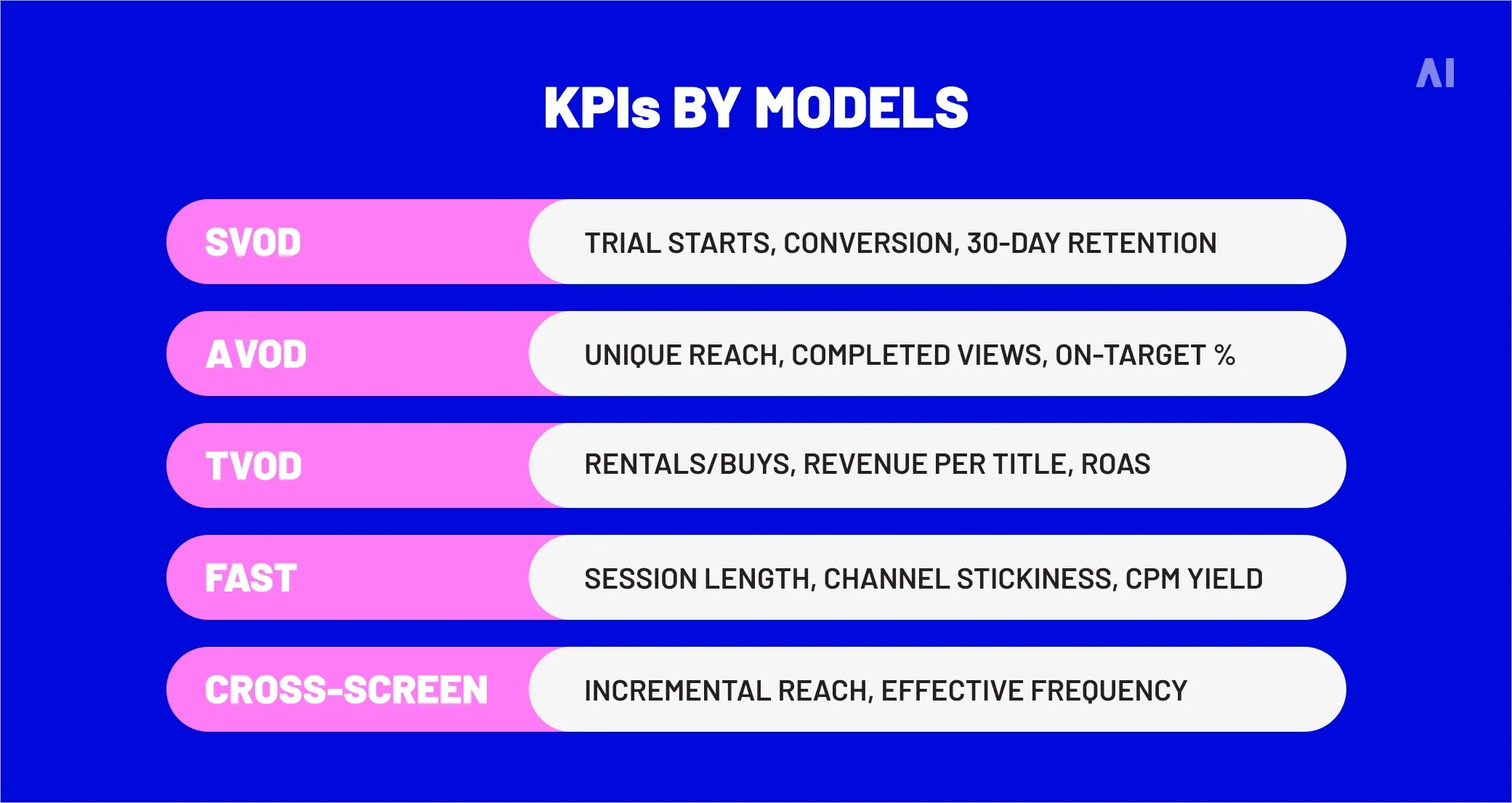
⚡️The ability to configure monetization by content type, audience segment, geography, or device is critical as business models evolve. For a detailed breakdown of these models and when to use each, see AI Digital’s guide to SVOD, AVOD, and TVOD.
White-label and branding capabilities
For businesses building owned platforms, white-label functionality is non-negotiable. A VOD platform should allow full control over branding, UI, UX, domain, and customer touchpoints—across players, apps, and checkout flows.
Brand consistency directly impacts perceived value, trust, and retention, particularly for premium content and subscription services. Platforms that impose third-party branding, ads, or UI constraints limit a company’s ability to differentiate and build long-term audience relationships.
Analytics and audience insights
Modern VOD platforms must go beyond basic view counts. Businesses require actionable analytics that connect video performance to commercial outcomes.
Key capabilities include:
- Engagement depth and completion rates
- Subscriber behavior and churn signals
- Ad performance and monetization metrics
- Cross-device and cohort analysis
The most valuable platforms provide first-party data access and integrate with CRM, CDPs, and marketing analytics tools—turning video into a measurable, optimizable growth channel rather than a black box.
Security and content protection
For premium, educational, or enterprise video use cases, content protection is critical. A VOD platform should support DRM, tokenized playback, geo-restrictions, authentication, and secure delivery workflows.
Security is not only about piracy prevention—it is also about licensing compliance, user access control, and brand risk management. Platforms lacking robust security features may be unsuitable for monetized or regulated content environments.
Scalability and pricing flexibility
Finally, businesses must evaluate how a VOD platform scales—both technically and financially. This includes support for growing content libraries, expanding audiences, OTT/CTV distribution, and international markets.
Equally important is pricing transparency and flexibility. Rigid pricing models, bandwidth penalties, or feature-based lock-ins can become constraints as usage grows. The best VOD platform providers align pricing with business growth rather than punishing success.
VOD platform pricing comparison (by model and cost drivers)
VOD platform pricing in 2026 is not standardized. Costs vary significantly based on usage, scale, monetization model, feature depth, and support requirements. For this reason, businesses should evaluate pricing structures and cost drivers, not headline monthly fees.
Most video on demand platform providers price their services based on a combination of platform category, infrastructure usage, and commercial functionality. The matrix below compares how pricing works, rather than what a platform “costs.”
{{5-Best-Video-on-Demand-Platform-Providers-for-Businesses-26="/tables"}}
Key Takeaways for Pricing Evaluation
- Pricing follows business model: Platforms optimized for creators or SMBs prioritize ease of entry, while brand and enterprise platforms prioritize control and scalability.
- Bandwidth and storage are major cost drivers: As usage grows, infrastructure-based pricing becomes more important than flat fees.
- Monetization fees matter: Revenue shares can significantly impact margins over time, especially for subscription-based services.
- White-label access affects long-term value: Platforms that restrict branding often limit ownership and differentiation.
- Support and SLAs scale with cost: Enterprise-grade reliability typically requires enterprise pricing.
- Scalability is not linear: The cheapest platform at launch is rarely the most cost-effective at scale.
At AI Digital, pricing is evaluated in context. Platform recommendations consider:
- Projected audience growth and content volume
- Monetization mix (SVOD, AVOD, TVOD, FAST)
- OTT and CTV expansion plans
- Data, analytics, and integration requirements
💡The goal is not to minimize short-term cost, but to optimize long-term unit economics and flexibility. In 2026, the right VOD platform is the one whose pricing model scales with the business.
Best video on demand platform providers in 2026
There is no single best VOD platform for every business. In 2026, video on demand platform providers are differentiated by business focus, monetization depth, scalability, and operational complexity. The platforms below represent archetypes—each category serves a distinct set of needs, budgets, and technical requirements.
This framework helps businesses identify which type of VOD platform fits their strategy, before evaluating specific vendors.
Platform 1: Enterprise-focused VOD solution
Best for: Large enterprises, regulated industries, internal communications, corporate training, B2B video delivery
Enterprise-focused VOD platforms are designed for security, compliance, and internal scalability, not consumer monetization. According to Gartner, over 75% of enterprises with more than 1,000 employees now use internal VOD platforms for onboarding, compliance training, and executive communications.
These platforms emphasize:
- Secure hosting with DRM, SSO, and role-based access
- High availability SLAs and global delivery
- Engagement analytics for compliance and training effectiveness
Studies from IBM and McKinsey show that enterprises using centralized VOD systems reduce training and communication costs by 30–50%, validating VOD as operational infrastructure rather than a media tool.
Trade-off: Limited consumer monetization and OTT distribution capabilities.
Platform 2: Monetization-first VOD platform
Best for: Subscription businesses, paid video platforms, hybrid SVOD + AVOD models
Monetization-first VOD platforms are optimized to maximize revenue per viewer. This category aligns with broader market trends: PwC and Omdia report that subscription and hybrid VOD revenues continue to grow at double-digit rates, even as pure subscription fatigue increases.
These platforms support:
- SVOD, TVOD, AVOD, and hybrid monetization
- Advanced subscription and entitlement management
- Monetization analytics tied to churn and lifetime value
Data from Stripe, HubSpot, and Roku Ads shows that businesses using owned VOD monetization platforms achieve 2–3× higher lifetime value per user than those relying on ad-only or platform-controlled video environments.
Trade-off: Higher operational and technical complexity.
Platform 3: White-label VOD platform for brands
Best for: Brands, DTC companies, SaaS platforms, owned media ecosystems
White-label VOD platforms reflect a major shift in brand strategy. According to Wyzowl and HubSpot, while 91% of businesses use video, nearly 70% now prioritize owned video environments to capture first-party data and reduce CAC.
Key capabilities include:
- Fully branded players, apps, and user journeys
- Direct audience ownership and identity control
- Flexible gating, subscriptions, and commerce integration
Nielsen and Google Marketing Platform data shows that brands using owned VOD platforms combined with CTV and retargeting generate 10–30% incremental conversion lift versus social-only video strategies.
Trade-off: Distribution reach must be actively built, not inherited.
Platform 4: VOD platform for media companies
Best for: Publishers, broadcasters, FAST networks, OTT and CTV services
Media-focused VOD platforms are built for distribution scale and advertising yield. Deloitte and PwC report that over 85% of global media companies now operate at least one VOD or OTT service, while FAST households exceeded 170 million globally (Amagi, eMarketer).
These platforms emphasize:
- OTT and CTV app deployment
- FAST and AVOD monetization workflows
- Programmatic ad insertion and yield optimization
Media companies increasingly rely on these platforms to extend content lifecycles and monetize long-tail libraries as linear viewing continues to decline.
Trade-off: Reduced brand control and limited first-party data in some distribution-led models.
Platform 5: SMB-friendly VOD provider
Best for: Small businesses, early-stage creators, startups validating video monetization
SMB-friendly VOD platforms prioritize low entry cost and simplicity. This aligns with creator economy data from Stripe, SignalFire, and Patreon, showing that early-stage creators and businesses often start with lightweight VOD solutions before migrating.
These platforms typically offer:
- Simple setup and entry pricing
- Basic subscriptions or pay-per-view
- Limited customization and analytics
While effective for validation, data from Vimeo OTT and ConvertKit shows that as audiences grow, platform fees and revenue shares can materially impact margins, prompting many SMBs to upgrade within 12–24 months.
Trade-off: Limited scalability and monetization depth.
VOD monetization models supported by platform providers 2026
From AI Digital’s expert standpoint, VOD monetization in 2026 is no longer about choosing between SVOD, TVOD, or AVOD—it is about architecting platforms that can activate all three dynamically based on audience behavior, acquisition cost, and lifetime value.
Businesses that treat monetization as static underperform. Those that treat it as a programmable layer within their VOD infrastructure consistently outperform on revenue, retention, and scalability.
Subscription video on demand (SVOD)
Subscription video on demand (SVOD) allows users to access a video catalog for a recurring fee (monthly or annual). SVOD remains the dominant model for predictable, recurring revenue, particularly for premium, serialized, or high-engagement content.
In 2026, SVOD platforms support:
- Tiered subscriptions (basic, premium, ad-free)
- Bundled access across web, mobile, OTT, and CTV
- Free trials, intro pricing, and churn-prevention logic
- Subscriber analytics tied to retention and lifetime value
Despite increasing competition, SVOD continues to grow, especially when paired with niche or value-driven content. Industry data from PwC and Omdia shows that subscription and hybrid VOD revenues maintain double-digit growth, even as general-purpose streaming services face saturation. The advantage of SVOD on owned platforms is pricing control and direct customer relationships, rather than platform-imposed revenue sharing.
SVOD works best for businesses focused on long-term audience relationships, predictable cash flow, and content depth.
Transactional video on demand (TVOD)
Transactional video on demand (TVOD) enables users to pay for individual pieces of content through rentals, pay-per-view, or one-time purchases. TVOD is commonly used for premium, time-sensitive, or exclusive content where subscriptions are unnecessary or undesirable.
VOD platforms support TVOD by enabling:
- Pay-per-view events and live-to-VOD access
- One-off purchases with permanent or time-limited access
- Regional pricing and currency localization
- Secure access control and entitlement management
TVOD has proven especially effective in verticals such as sports, live events, education, entertainment releases, and professional training. Data from Stripe and Vimeo OTT indicates that TVOD often delivers higher average revenue per user (ARPU) than entry-level subscriptions, particularly when bundled with upsells or post-event access.
TVOD is most effective when paired with scarcity, exclusivity, or event-driven demand, and many platforms now combine TVOD with SVOD to maximize revenue per viewer.
Ad-supported video on demand (AVOD)
AVOD monetizes content through advertising instead of direct user payments. In 2026, AVOD is primarily driven by CTV and FAST consumption, not desktop video alone.
VOD platforms that support AVOD must provide:
- Server-side or client-side ad insertion
- Programmatic ad demand integration
- Ad load and frequency control
- Revenue and fill-rate reporting
AVOD is used to scale reach and monetize price-sensitive audiences. Businesses increasingly deploy AVOD tiers to offset acquisition costs, reduce subscription friction, and monetize long-tail content that would not convert under SVOD or TVOD models.
Common challenges with VOD platforms
Despite widespread adoption, VOD platforms are not without structural challenges. From AI Digital’s experience working with brands, media companies, and OTT operators, most issues do not stem from video delivery itself—but from misalignment between platform capabilities and business strategy.
Below are the most common challenges encountered in 2026.
Limited monetization flexibility
Many VOD platforms technically “support” multiple monetization models but lock businesses into rigid implementations. Common limitations include:
- SVOD-only or AVOD-only architectures
- Inflexible pricing logic
- Revenue share structures that erode margins over time
💡However, monetization flexibility must be programmable, not predefined. Platforms that cannot combine SVOD, TVOD, and AVOD dynamically limit revenue optimization and force businesses to compromise strategy around platform constraints.
Vendor lock-in
Vendor lock-in remains one of the most underestimated risks in VOD platform selection. This occurs when:
- Content libraries cannot be easily migrated
- User data is not portable
- Monetization and analytics are tied to proprietary systems
AI Digital frequently encounters businesses forced to re-platform after 12–24 months due to restricted data access or inflexible contracts. Platforms that control identity, billing, or analytics layers create long-term dependency that increases switching costs and strategic risk.
Analytics and attribution gaps
Many VOD platforms provide surface-level analytics—views, play starts, or watch time—but fail to connect video performance to business outcomes.
Common gaps include:
- No attribution to conversions or revenue
- Limited cohort or lifecycle analysis
- Poor integration with CRM, CDP, or ad-tech stacks
Video without attribution is a cost center. Businesses that cannot tie VOD engagement to retention, churn, or monetization decisions are unable to optimize content or justify investment at scale.
Scaling costs and infrastructure complexity
VOD platforms often appear cost-effective at launch but become expensive as usage grows. Cost drivers include:
- Bandwidth overages
- Storage expansion
- Monetization or transaction fees
- OTT and CTV app maintenance
AI Digital sees scaling issues most often when platforms are chosen for short-term affordability rather than long-term economics. Without clear visibility into how costs scale with audience and usage, businesses face margin compression as they grow.
Best practices for choosing the right VOD platform provider
Based on AI Digital’s work across OTT, CTV, and video monetization projects, successful VOD deployments follow a consistent set of best practices.
Align platform choice with business goals
The first decision is not technical. Businesses must clearly define whether the VOD platform is intended to:
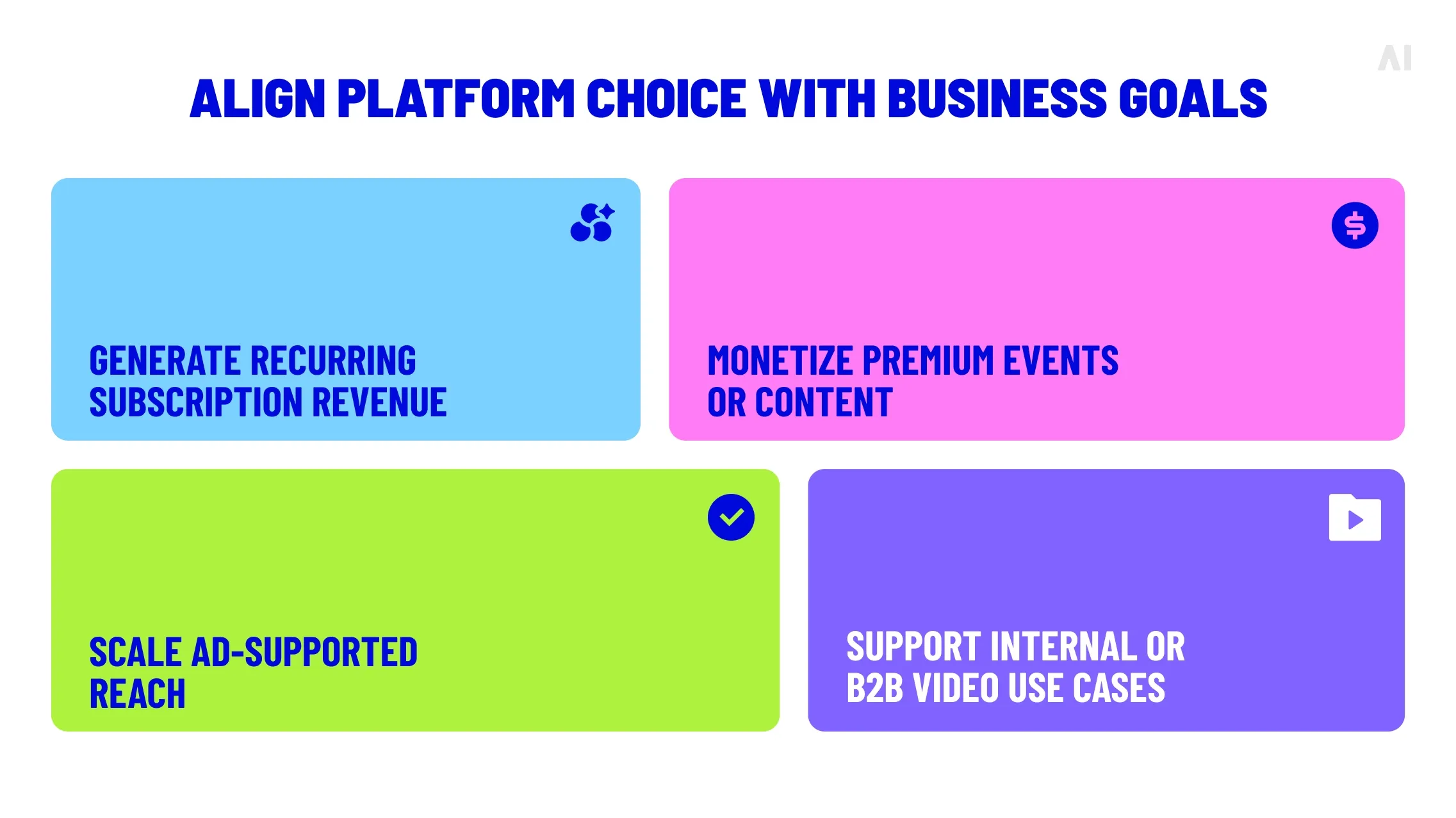
AI Digital advises selecting platforms based on primary revenue and growth objectives, not feature lists. A platform optimized for enterprise security will underperform in consumer monetization, and vice versa.
Prioritize data ownership and analytics
In 2026, data ownership is non-negotiable. Businesses should prioritize platforms that provide:
- First-party user and engagement data
- Exportable analytics
- Integration with CRM, CDP, and advertising systems
AI Digital’s position is clear: if you cannot access or move your data, you do not own your platform. Analytics depth and data portability should be treated as core requirements, not optional add-ons.
Plan for future scalability
VOD platforms must scale across:
- Content volume
- Audience size
- Devices (web, mobile, OTT, CTV)
- Monetization complexity
AI Digital recommends evaluating how platforms handle growth scenarios, not just current needs. This includes pricing elasticity, CDN capacity, OTT expansion paths, and operational overhead as usage increases.
Evaluate total cost of ownership
Finally, businesses must look beyond monthly fees. Total cost of ownership (TCO) includes:
- Infrastructure usage (bandwidth, storage)
- Monetization and transaction fees
- Support and SLA costs
- Migration and integration expenses
💡The most expensive VOD platform is often the one that must be replaced. Platforms that align cost structure with growth and avoid punitive overages or lock-in deliver the highest long-term ROI.
Conclusion: choosing the right video-on-demand platform provider
Choosing the right video-on-demand (VOD) platform provider in 2026 is not a tooling decision. As video becomes a primary revenue, acquisition, and retention channel, the platform that powers hosting, monetization, analytics, and distribution directly influences growth velocity, margin structure, and audience ownership.
Businesses that treat VOD platforms as interchangeable software often face re-platforming, data loss, or monetization ceilings within 12–24 months. Those that treat VOD as core infrastructure build durable, scalable video businesses that compound over time.
- VOD platforms enable direct control over content and revenue
Unlike consumer video platforms, business-grade VOD systems allow companies to define pricing, access, monetization logic, and content availability without platform interference.
- Platform choice must support long-term distribution strategy
The right VOD platform should integrate cleanly with web, mobile, OTT, and CTV environments—allowing expansion without rebuilding the video stack.
- Monetization flexibility is a core differentiator
Platforms that support SVOD, TVOD, AVOD, and hybrid models give businesses the ability to optimize revenue by audience, content type, and market conditions.
- Analytics and data ownership drive smarter decisions
First-party data access and actionable analytics are essential for understanding performance, reducing churn, and improving lifetime value. Without data ownership, video remains a cost center.
- Scalability matters more than feature count
The most valuable VOD platforms are not those with the longest feature lists, but those whose technology, pricing, and infrastructure scale predictably as the business grows.
⚡️At AI Digital, VOD platforms are designed and evaluated as part of a broader video monetization and distribution system. This is where Smart Supply plays a central role.
Smart Supply is AI Digital’s infrastructure-led approach to video, OTT, and CTV supply strategy. It helps businesses:
- Architect VOD platforms that scale across OTT and CTV
- Align monetization models with programmatic demand
- Preserve first-party data ownership while expanding reach
- Avoid vendor lock-in and inefficient supply paths
Rather than optimizing for short-term distribution, Smart Supply focuses on long-term control, yield efficiency, and scalable monetization across owned and distributed video environments.