Programmatic Ad Targeting: Best Strategies, Tools, and Tactics in 2026


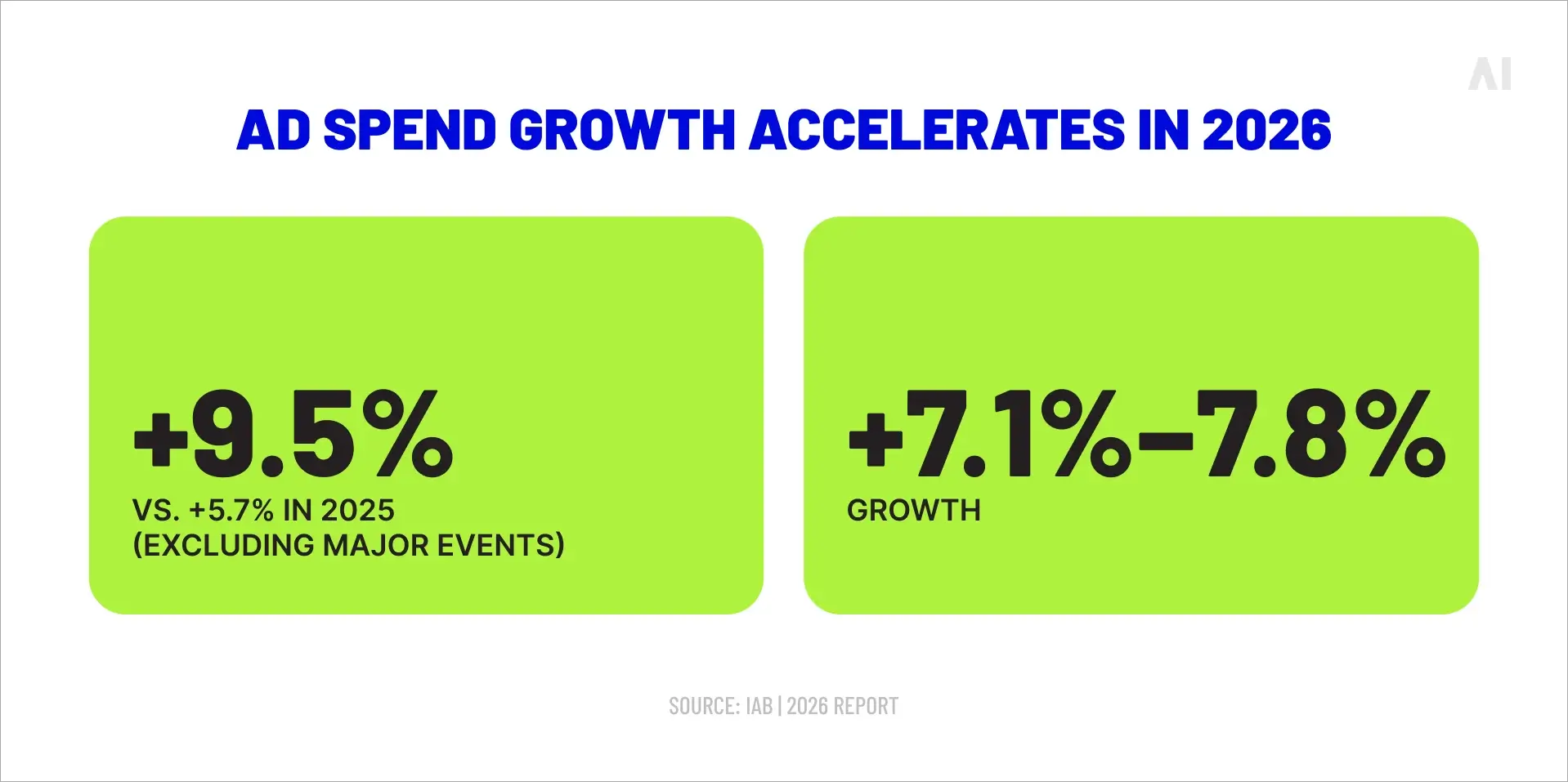
In 2026, programmatic ad targeting is no longer a tactical add-on to digital media buying — it is the primary infrastructure powering performance marketing strategy. According to recent IAB and exchange-level data, over 85% of global digital display ad spend now transacts programmatically, reflecting how deeply automation and real-time decisioning are embedded into modern advertising campaigns. As acquisition costs rise and media consumption fragments across CTV, mobile, retail media, and the open web, advertisers rely on programmatic targeting and programmatic audience targeting frameworks to reach the right target audience with measurable efficiency.
Unlike manual digital buying, where placements are pre-selected and optimization is reactive, programmatic advertising targeting evaluates each impression in milliseconds. Algorithms process contextual signals, demographic attributes, behavioral targeting inputs, and privacy-compliant data sources including first-party data and second-party data, while legacy third-party data continues to decline in reliability within a cookieless ecosystem. Each programmatic ad is dynamically auctioned and served based on predictive performance models, turning ad targeting into a continuous optimization system rather than a static media plan.
The structural shift toward privacy-first marketing has fundamentally redefined programmatic targeting options.
By 2026, more than 70% of enterprise advertisers report prioritizing first-party data strategies to offset signal loss from browser restrictions and regulatory frameworks. This transformation elevates contextual targeting, commerce data partnerships, and AI-driven modeling as core components of targeted advertising strategies. The result is a more adaptive, signal-based approach to audience targeting across channels. This guide examines programmatic ad targeting in 2026 from a strategic perspective—covering targeting types, tactical execution, platform tools, measurement frameworks, and decision criteria for selecting the right approach.
What is programmatic ad targeting?
Programmatic ad targeting is the method of delivering ads to a defined target audience by evaluating real-time audience signals and contextual data through automated buying systems such as DSPs (Demand-Side Platforms), SSPs (Supply-Side Platforms), and ad exchanges. Instead of manually selecting placements, programmatic advertising targeting uses algorithmic decisioning to assess each available impression individually—matching advertiser criteria with available inventory in milliseconds.
At its core, programmatic targeting combines audience targeting signals (demographic, behavioral, interest-based, first-party data, second-party data) with contextual targeting inputs (page content, app environment, device type, content category) to determine whether a specific impression aligns with campaign objectives. This automated infrastructure enables advertisers to execute targeted advertising at scale across web, mobile, CTV, and other digital environments.
💡Programmatic audience targeting transforms media buying from placement-based execution into impression-level decisioning—driving efficiency, scalability, relevance, and measurable performance outcomes.
Rather than committing budget to broad site buys, advertisers optimize in real time based on predicted conversion probability, lifetime value modeling, and continuous performance feedback loops. In a cookieless and privacy-regulated ecosystem, advanced programmatic targeting options increasingly rely on first-party data activation, contextual intelligence, AI-driven modeling, and outcome-based bidding strategies.
⚡️To understand how DSPs, SSPs, and ad exchanges interact within this automated ecosystem, explore AI Digital’s guide to programmatic advertising.
How it works (step-by-step)
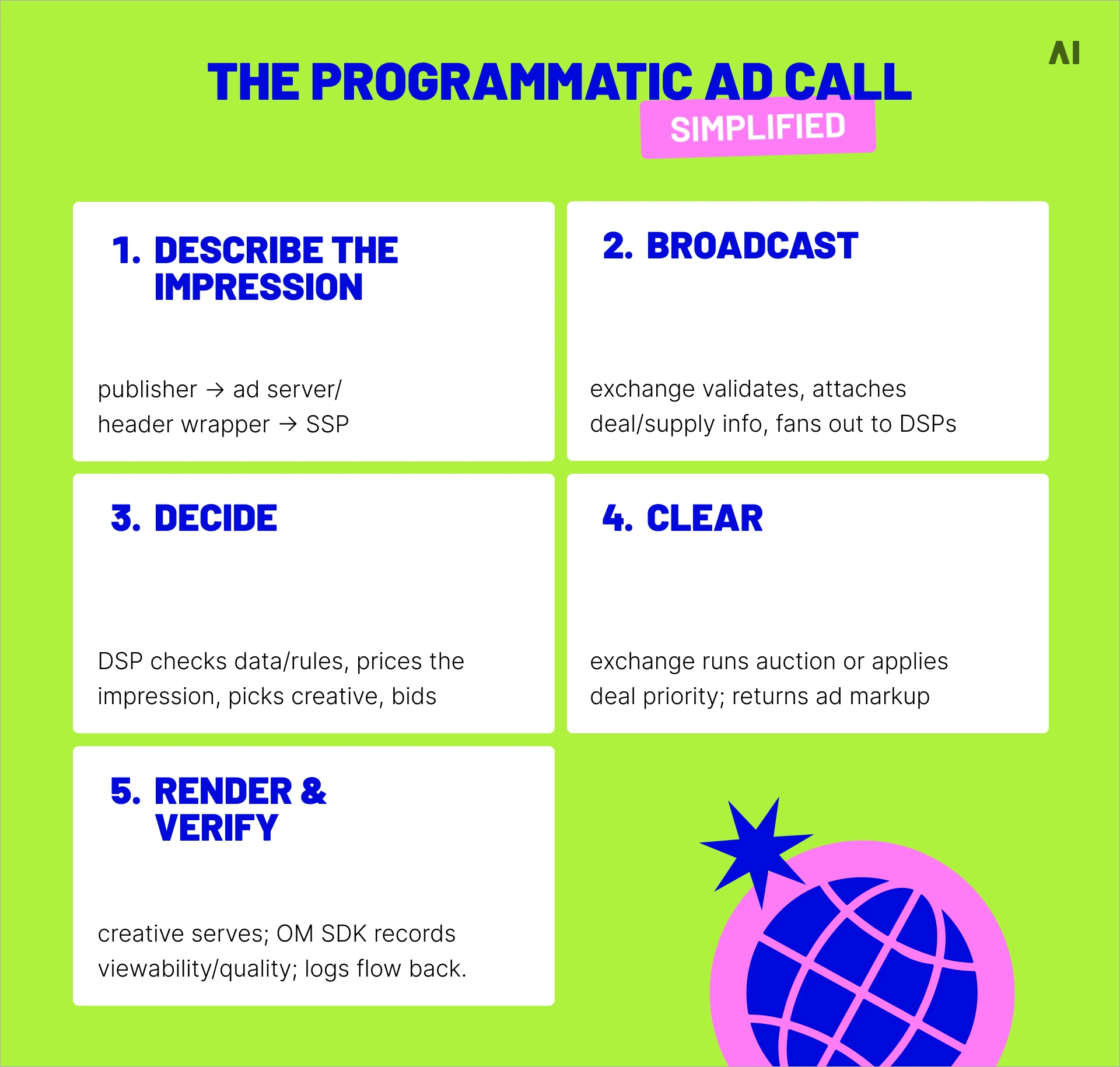
Programmatic ad targeting operates through a structured real-time workflow.
- When a user loads a webpage, opens an app, or streams CTV content, an ad slot becomes available. The publisher’s SSP packages this opportunity into a bid request that includes contextual data (content category, URL or app metadata), technical signals (device type, operating system, location), and any privacy-compliant audience signals permitted under consent frameworks.
- The bid request is transmitted through an ad exchange to multiple DSPs representing advertisers. Each DSP evaluates the impression against active campaign criteria—such as audience targeting segments, geographic constraints, frequency caps, contextual targeting rules, and bid strategy parameters.
- If the impression matches the advertiser’s programmatic targeting criteria, the DSP calculates a bid based on predicted performance value and submits both price and creative in real time. The exchange runs the auction, selects the highest eligible bid (based on auction logic and deal structure), and the winning programmatic ad is rendered on the publisher’s property.
- Measurement signals—impressions, viewability, video completion, clicks, conversions, and incremental outcomes—are then recorded. These signals feed back into bidding algorithms, allowing continuous optimization of audience targeting, contextual filters, and overall programmatic advertising targeting strategy.
💡This impression-level automation is what differentiates programmatic advertising from traditional digital buying and explains why programmatic targeting now underpins the majority of global digital advertising campaigns.
What data powers programmatic targeting?
Programmatic targeting does not rely on a single data source—its precision comes from layering multiple types of data that each serve a practical purpose in matching ads to the right audience and context. In today’s privacy-regulated, cookieless environment, the quality and activation of data are often more valuable than sheer volume, and smart advertisers shift allocation toward reliable, consented signals that drive performance and relevance.
First-party data is information you collect directly from your own audience and customers through your website, apps, CRM, subscriptions, loyalty programs, and direct engagements. It includes:
- User behaviors on owned properties (page views, app events, purchase history, clicks)
- Customer attributes (demographic, profile data, signup information)
- Engagement signals (email opens, content preferences)
This data is high-quality, fully consented, and inherently aligned with your business objectives, making it the foundation for accurate audience segmentation, behavioral targeting, and performance optimization. Many performance marketers now prioritize first-party data because it offers the most reliable basis for granular targeting in the absence of third-party cookies
Core programmatic ad targeting options
Modern DSP campaigns are built on layered targeting logic. Rather than relying on a single signal, advertisers combine multiple programmatic targeting options to balance scale, precision, and performance stability. Below are the core programmatic ad targeting types used in 2026, with practical guidance on when each works best and how brands apply them in real campaigns.
Demographic targeting
Demographic targeting delivers ads based on user attributes such as age, gender, household income, parental status, education level, and sometimes inferred interests. These attributes are derived from first-party data, publisher-declared data, identity graphs, or modeled datasets within DSPs.
When it works best:
- Upper- and mid-funnel awareness campaigns
- Products with clearly defined audience profiles
- Brand repositioning toward specific age or income brackets
Real-world use case:
A premium skincare brand launching a new anti-aging serum may target women aged 35–54 with higher household income tiers across CTV and premium publisher environments. Demographic filters narrow the eligible audience before layering contextual and behavioral signals for additional refinement.
Demographic targeting is foundational—but on its own, it rarely delivers peak efficiency. It performs best when combined with behavioral or contextual layers inside broader programmatic advertising targeting strategies.
Geographic targeting (Geo-targeting & Geofencing)
Geographic targeting enables advertisers to deliver ads based on a user’s physical location—country, region, city, ZIP/postal code, or proximity to a specific point of interest.
Geofencing goes further by creating a virtual boundary around a precise physical location (such as a retail store, competitor location, or event venue) and targeting devices detected within that perimeter.

When it works best:
- Retail store traffic campaigns
- Local service providers
- Event-based marketing
- Regional promotions
Real-world use case:
A national restaurant chain launching a limited-time menu item may deploy geofencing around competitor locations within a 2 km radius, serving mobile ads with promotional offers to drive foot traffic.
⚡️For a deeper breakdown of location-based strategies, read:
Geographic targeting remains one of the most efficient programmatic targeting options for localized ROI measurement and proximity-driven campaigns.
Behavioral targeting
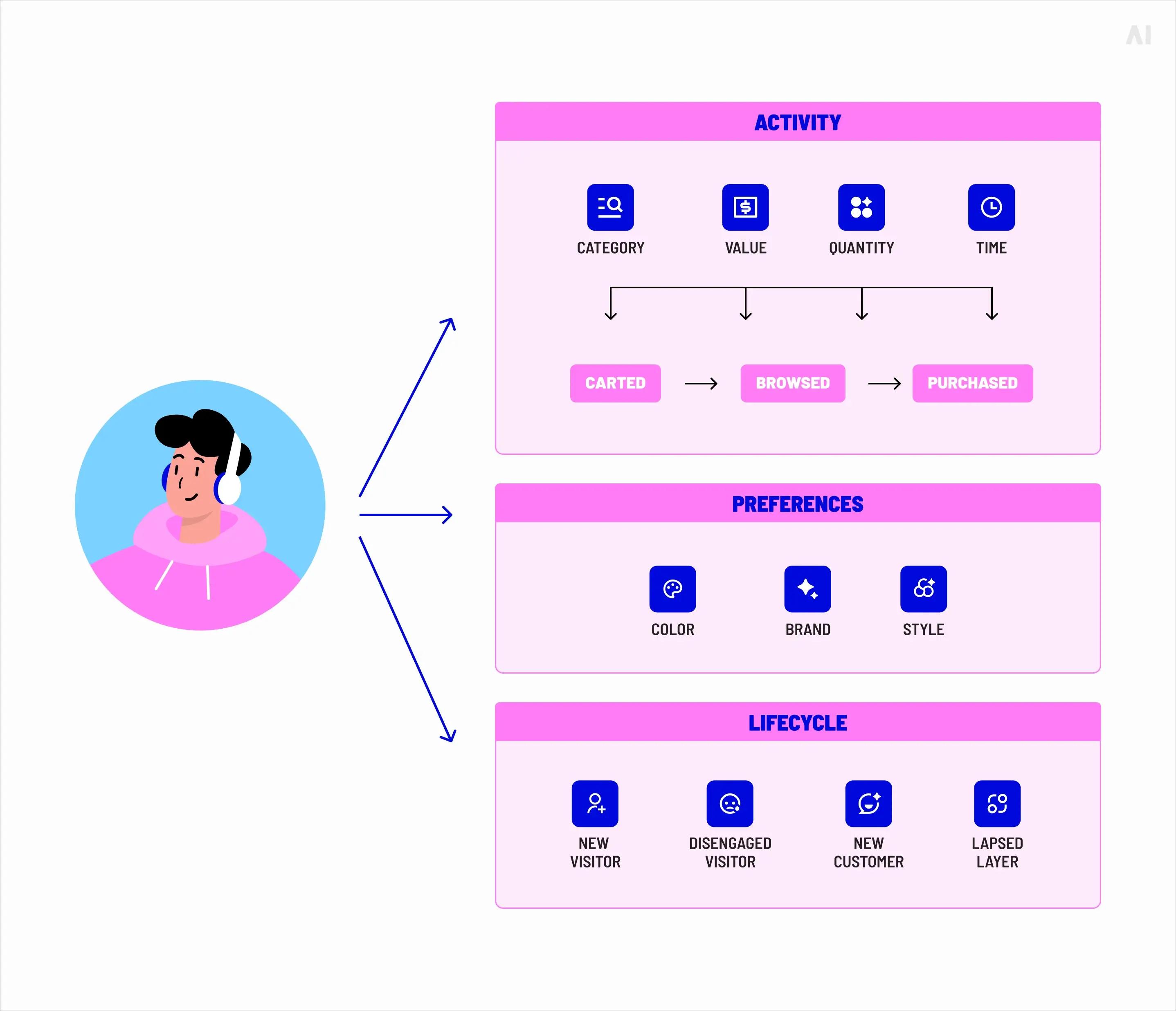
Behavioral targeting reaches users based on past browsing behavior, content consumption patterns, purchase intent signals, and online activity across digital environments.
Signals may include:
- Recent product searches
- Category page visits
- Cart activity
- Content engagement patterns
When it works best:
- Mid- and lower-funnel performance campaigns
- High-intent verticals (travel, finance, ecommerce)
- Personalized dynamic creative strategies
Real-world use case:
An online electronics retailer may target users who recently browsed “gaming laptops” or “high-performance PCs,” serving dynamic programmatic ads featuring current promotions on related SKUs. Behavioral targeting increases relevance but must operate within privacy-compliant frameworks and increasingly relies on first-party data or modeled intent rather than third-party cookie pools.
Contextual targeting

Contextual targeting delivers ads based on the content a user is currently viewing rather than who the user is. DSPs analyze page content, keywords, sentiment, category classifications (often aligned with IAB taxonomies), and sometimes semantic meaning.
When it works best:
- Cookieless environments
- Brand safety-sensitive campaigns
- CTV and publisher-direct inventory
- Privacy-first advertising strategies
Real-world use case:
A sports apparel brand promotes running shoes on fitness blogs, marathon training guides, and health-focused video content. The ad aligns with the user’s current interest context, increasing engagement without relying on persistent identifiers.
⚡️For deeper analysis, read: Programmatic Contextual Targeting: How It All Works Together.
Contextual targeting has evolved into a performance-capable strategy thanks to AI-driven semantic analysis and real-time content classification.
Retargeting / Remarketing

Retargeting (remarketing) engages users who have previously interacted with your brand—visited your website, viewed a product, started checkout, or engaged with your app.
When it works best:
- Cart abandonment recovery
- Subscription sign-ups
- Multi-touch conversion journeys
- Sequential messaging strategies
Real-world use case:
A fashion ecommerce brand retargets users who viewed a product but did not purchase, serving dynamic ads with the exact SKU and a limited-time discount to drive conversion.
⚡️Retargeting remains one of the highest-ROI forms of targeted advertising, particularly when integrated across CTV, mobile, and display. For CTV-specific retargeting strategies, read more in our guide, CTV Retargeting.
Interest and affinity targeting
Interest and affinity targeting segments users based on long-term content consumption patterns and lifestyle signals, often structured around IAB audience taxonomy categories (e.g., sports enthusiasts, luxury travelers, financial investors).
When it works best:
- Prospecting campaigns
- Brand awareness initiatives
- Expanding reach beyond core audiences
Real-world use case:
An investment platform targets users categorized under “Personal Finance Enthusiasts” and “Active Investors” to drive webinar registrations. These segments are typically built from aggregated behavioral data and audience modeling within DSP environments.
Lookalike / modeled targeting
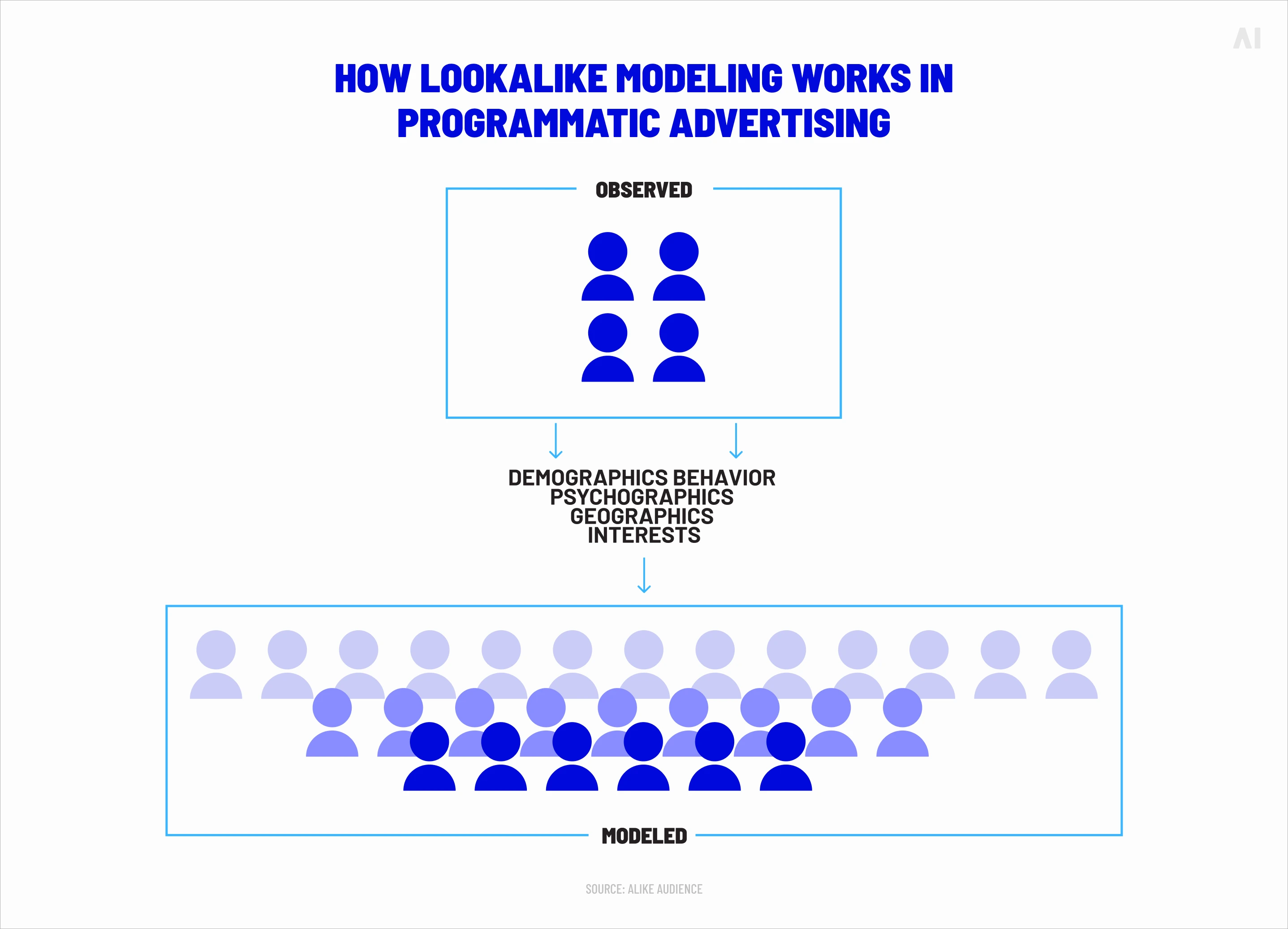
Lookalike targeting uses a seed audience (e.g., converters, subscribers, high-value customers) and applies machine learning models to identify new users with statistically similar characteristics.
When it works best:
- Prospecting at scale
- Expanding first-party audience reach
- Scaling high-performing campaigns
Real-world use case:
A subscription-based SaaS company uploads its highest LTV customers into a DSP and builds a modeled audience to find similar users across open-web inventory. Lookalike modeling is one of the most widely used programmatic audience targeting techniques for efficient growth.
⚡️For infrastructure context, read Demand Side Platforms.
Device targeting
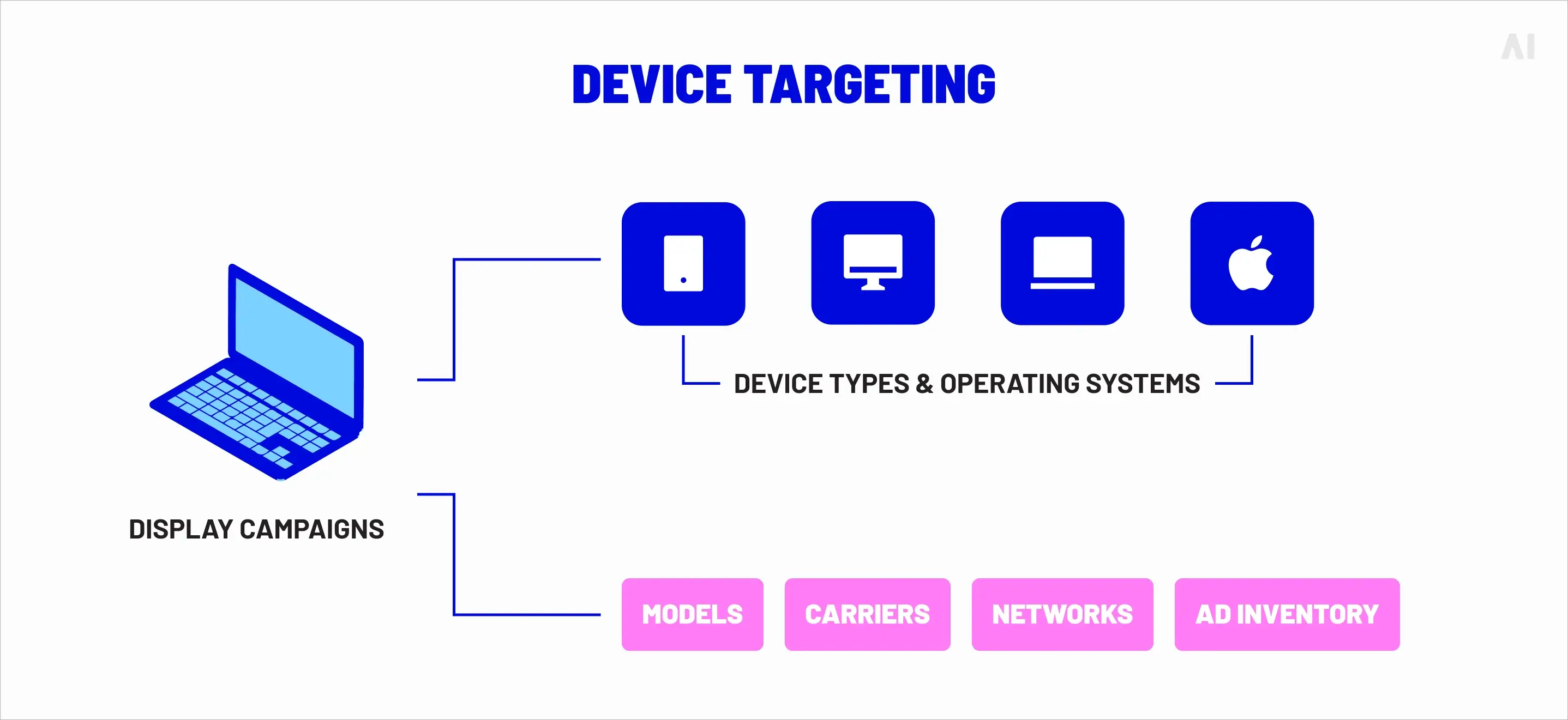
Device targeting filters delivery based on device type (mobile, desktop, tablet, CTV), operating system (iOS, Android), browser, carrier, or connection type.
When it works best:
- App install campaigns
- Creative format optimization
- CTV vs mobile budget allocation
- OS-specific performance strategies
Real-world use case:
A mobile gaming app targets Android users on Wi-Fi connections to optimize install rates and reduce data-related friction. Device targeting supports creative alignment and performance efficiency within multi-channel programmatic advertising.
Cross-device targeting
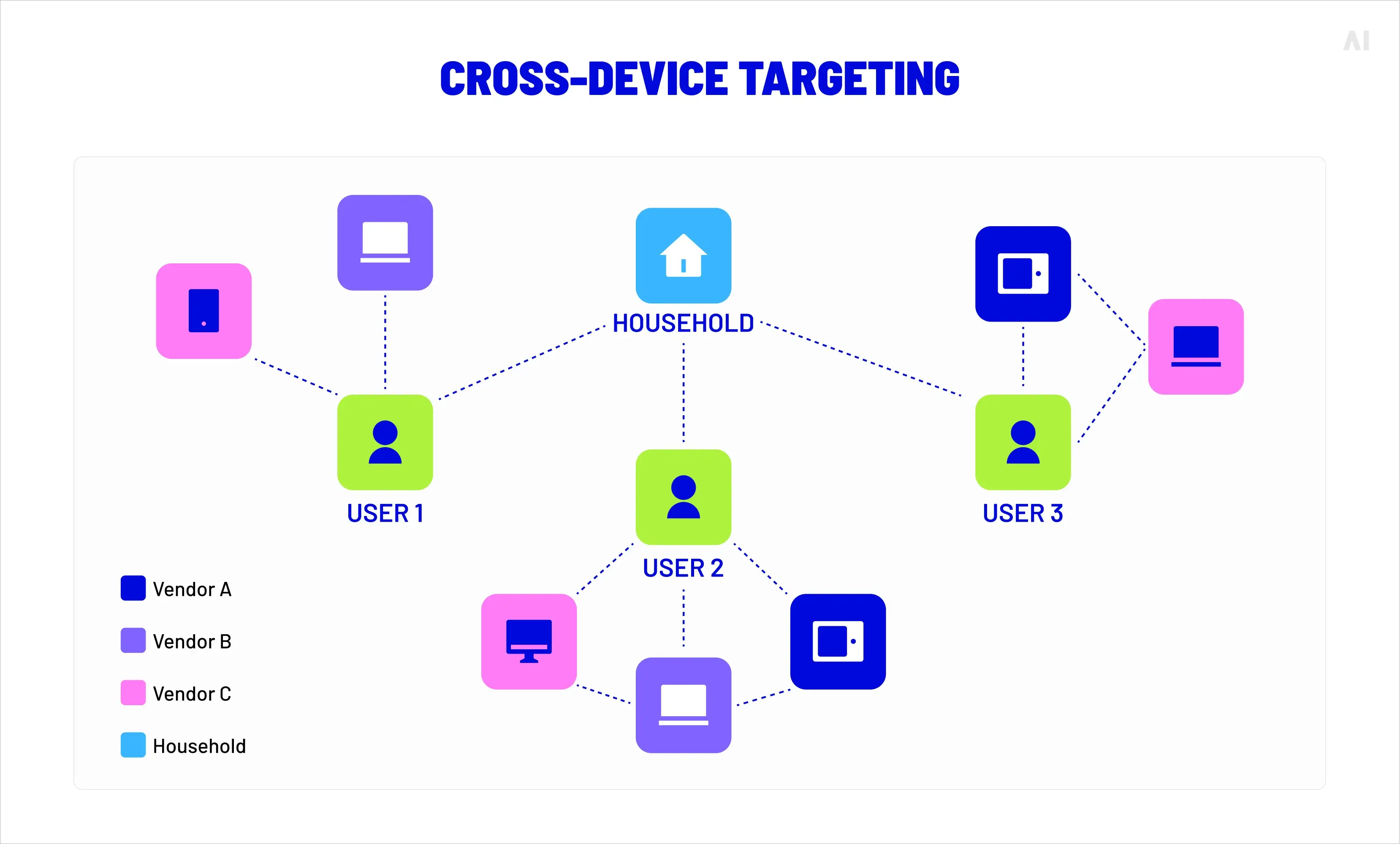
Cross-device targeting links user activity across multiple devices using deterministic identifiers (logged-in user data) or probabilistic identity modeling (device graphs and behavioral correlation).
Why it matters:
Modern consumer journeys are fragmented—users may discover a product on CTV, research on mobile, and convert on desktop. Without cross-device identity mapping, performance attribution and sequential messaging break down.
Real-world use case:
A consumer electronics brand serves awareness ads on CTV, retargets exposed households on mobile display, and attributes conversions that occur on desktop ecommerce environments (for a deeper dive, see: Cross-Device Ad Targeting). Cross-device targeting is essential for omnichannel programmatic strategies and accurate performance measurement in 2026.
Collectively, these programmatic targeting options form the operational backbone of modern digital advertising campaigns. The most effective strategies layer demographic, geographic, behavioral, contextual, and modeled signals—creating an adaptive targeting architecture that balances reach, precision, and measurable ROI.
Advanced programmatic targeting strategies
Basic DSP filters—demographic, geographic, contextual, behavioral—form the foundation of programmatic ad targeting. But in 2026, performance leaders move beyond static segments toward adaptive, AI-driven, privacy-resilient systems that optimize in real time across the full customer journey.
💡Advanced programmatic targeting strategies focus on predictive modeling, identity-light frameworks, dynamic creative orchestration, and structured sequencing logic. These tactics elevate programmatic advertising targeting from audience selection to intelligent demand forecasting and controlled message progression.
AI-driven targeting and predictive optimization
AI-driven targeting uses machine learning models to anticipate audience behavior and dynamically adjust bidding, audience inclusion, and creative delivery based on predicted outcomes.
Instead of relying only on predefined segments, modern DSPs evaluate hundreds of real-time signals—context, device, time of day, prior engagement patterns, conversion probability models, and incremental lift predictions. Algorithms continuously retrain on campaign performance data, improving bid accuracy and reducing wasted impressions.
This shifts programmatic targeting from reactive optimization to predictive outcome modeling.
When it works best:
- Performance campaigns optimizing toward conversions or ROAS
- Large-scale prospecting where manual segmentation would be inefficient
- Omnichannel campaigns across CTV, mobile, and display
Real-world use case:
An ecommerce brand running acquisition campaigns feeds high-LTV customer data into a DSP. The system builds predictive models identifying users most likely to convert at similar lifetime value thresholds, dynamically adjusting bids per impression based on predicted purchase probability. (for a deeper exploration read AI in targeted advertising)
Cookieless targeting strategies
With third-party cookies deprecated across major browsers and stricter global privacy regulation, advertisers must deploy privacy-compliant programmatic targeting options that do not depend on cross-site identifiers.
Cookieless strategies include:
- First-party data activation (CRM onboarding, hashed identifiers)
- Contextual targeting with semantic analysis
- Cohort-based and aggregated modeling
- Publisher first-party audience collaboration
- Clean room environments for secure data matching
- Probabilistic modeling using consented signals
💡The strategic shift is from identity tracking to signal-based targeting.
When it works best:
- Privacy-sensitive industries (finance, healthcare)
- Markets with strict regulatory frameworks
- CTV and environments where cookies never existed
Real-world use case:
A financial services advertiser activates first-party customer segments through secure identity frameworks and layers contextual targeting around investment-related content to maintain scale without relying on legacy third-party data pools.
⚡️For more on privacy-first programmatic strategies, read our guide on Navigating in a cookie less world.
Real-time personalization at scale
Advanced programmatic advertising targeting increasingly integrates Dynamic Creative Optimization (DCO) to personalize messaging based on audience segment, context, device, and behavioral signals.
Rather than serving a single static creative, DCO systems assemble ads in real time using modular creative components:
- Product images tailored to browsing behavior
- Location-specific offers
- Price updates synced to inventory
- Context-matched headlines
- Segment-specific messaging variations
Contextual creative matching further aligns message tone and imagery to the environment in which the ad appears.
When it works best:
- Retail and ecommerce campaigns
- Travel and hospitality promotions
- Multi-market campaigns requiring localization
Real-world use case:
A travel brand dynamically inserts destination imagery based on the user’s browsing behavior and adjusts promotional copy depending on proximity to departure dates.
⚡️For deeper insights read our piece on Dynamic Content personalization.
Sequential messaging (full-funnel targeting)
Sequential messaging structures ad exposure across defined stages of the buyer journey—awareness, consideration, and conversion—rather than repeatedly serving the same creative.
This strategy uses audience segmentation and exposure logic to ensure that users see the next message only after completing a prior engagement condition (e.g., watched 50% of a video, visited a landing page, interacted with a product page).
Sequencing reduces creative fatigue and increases conversion efficiency by aligning message depth with audience readiness.
When it works best:
- High-consideration purchases
- CTV-to-digital retargeting flows
- Product education campaigns
Real-world use case:
A consumer electronics brand first delivers CTV awareness ads to broad affinity audiences. Exposed households are then retargeted on mobile with feature-focused messaging. Finally, high-intent visitors receive promotional offers to close conversion.
⚡️For strategic comparison of awareness-focused targeting approaches, see the our article, Which Targeting Option Is Best for Achieving Brand Awareness: Reviewing Programmatic & Google Ads
Advanced programmatic targeting strategies are not about adding complexity—they are about structuring intelligent decision systems. The most effective advertisers integrate AI-driven modeling, cookieless activation, real-time personalization, and structured sequencing into a unified targeting architecture that adapts continuously to performance signals.
Frequency capping and audience fatigue prevention
Frequency control is one of the most overlooked—but financially critical—components of programmatic ad targeting. Frequency capping limits the number of times a single user or household is exposed to an ad within a defined time window. Without it, campaigns risk oversaturation, diminishing returns, and wasted impressions.
This is especially important in CTV environments, where impressions are delivered at the household level and CPMs are significantly higher than standard display. Excessive repetition can lead to audience fatigue, lower incremental lift, and even negative brand perception.
The strategic goal is not maximum repetition—it is optimal exposure.
Best practice frameworks in 2026 typically focus on:
- Setting frequency caps per device or household (e.g., 2–4 impressions per day for CTV awareness campaigns)
- Using recency controls (cool-down windows between exposures)
- Adjusting caps dynamically based on engagement signals
- Monitoring marginal lift curves to identify diminishing return thresholds
Real-world use case: A streaming service launching a new show caps CTV exposure at three impressions per household per day, then retargets engaged viewers on mobile with sequential messaging rather than continuing high-frequency CTV delivery. Balancing reach versus repetition requires ongoing analysis of incremental reach curves and conversion elasticity. In performance-driven campaigns, frequency is optimized based on measurable lift rather than arbitrary caps.
Brand safety, fraud prevention, and supply quality targeting
Advanced programmatic advertising targeting must extend beyond audience logic into supply quality control. Not all inventory is equal—viewability rates, fraud exposure, and content adjacency risks vary significantly across exchanges and publishers.
Brand safety targeting ensures ads appear in suitable environments aligned with brand guidelines. Fraud prevention protects against invalid traffic, bot activity, domain spoofing, and fabricated CTV inventory. Supply quality targeting prioritizes premium, transparent, and verified inventory sources.
Key tactical layers include:
- Pre-bid fraud filtering and verification integrations
- Viewability thresholds
- Ads.txt and app-ads.txt compliance
- Inclusion/exclusion lists
- Private marketplace (PMP) deals
- Direct publisher relationships
- Supply path optimization (SPO)
⚡️AI Digital’s Smart Supply framework addresses these risks at the infrastructure level rather than treating fraud prevention as a reactive layer.
Smart Supply operates on three core principles:
- Curated inventory architecture
Instead of buying broadly across open exchanges, Smart Supply prioritizes vetted publisher relationships, verified app environments, and transparent supply chains. This reduces exposure to arbitrage-heavy resellers and low-quality intermediaries.
- Supply path optimization (SPO) intelligence
Smart Supply analyzes auction duplication, reseller chains, and bid density to identify the most direct and efficient path to inventory. By minimizing redundant hops between SSPs and exchanges, advertisers reduce hidden fees and exposure to spoofed supply.
- Integrated fraud and quality controls
Pre-bid filtering, ads.txt validation, IVT monitoring, and CTV app authentication are embedded into the supply curation process. This ensures impressions are evaluated before bidding—not only audited afterward.
In practice, this means:
- Higher verified viewability rates
- Reduced invalid traffic exposure
- Greater transparency in CTV delivery logs
- More stable performance benchmarks
- Improved cost efficiency per incremental outcome
High-performance programmatic advertising is not only about precise audience targeting—it is about controlling where and how inventory is sourced. Smart Supply reframes supply quality from a defensive measure into a performance lever.
⚡️For a detailed breakdown of CTV fraud risks and mitigation frameworks, see our guide on CTV Ad Fraud.
Continuous optimization tactics
Programmatic targeting is not static. Its advantage lies in iterative optimization driven by measurable performance feedback.
A disciplined optimization workflow typically includes:
{{26-Programmatic-Ad-Targeting-1="/tables"}}
💡Optimization is a continuous feedback loop—test, measure, refine, scale.
In 2026, advanced advertisers combine automated algorithmic optimization with human strategic oversight. AI adjusts bids and delivery in real time, while performance teams interpret cross-channel lift, budget allocation efficiency, and long-term revenue contribution.
Together, frequency control, supply quality management, and disciplined optimization separate average programmatic campaigns from high-efficiency, scalable performance engines.
Platforms and tools used in programmatic targeting
Programmatic ad targeting is powered by a tightly integrated technology stack. The modern programmatic ecosystem consists of demand platforms, supply platforms, exchanges, data systems, and measurement infrastructure. Each plays a specific operational role in enabling scalable, privacy-compliant, and performance-driven targeting (for a broader comparison of major buying platforms, read Programmatic Advertising Platforms).
DSP (Demand-Side Platform)
A Demand-Side Platform (DSP) is the advertiser-facing system used to buy inventory programmatically across multiple exchanges and publishers. It is the primary control center for programmatic audience targeting.
What a DSP enables:
- Audience segmentation (demographic, behavioral, contextual, lookalike)
- Bid strategy configuration (CPM, CPA, ROAS optimization)
- Frequency capping and pacing control
- Cross-device targeting logic
- Creative rotation and dynamic optimization
- Real-time reporting and performance modeling
DSPs evaluate each impression in milliseconds using real-time bidding (RTB) protocols. Modern DSPs integrate AI-driven predictive models to estimate conversion probability and adjust bids dynamically.
In 2026, leading DSPs differentiate on:
- Identity resolution frameworks for cookieless targeting
- CTV-native buying capabilities
- First-party data onboarding integrations
- Supply path optimization controls
- Incrementality and lift measurement tools
The DSP is where targeting strategy becomes executable.
SSP (Supply-Side Platform)
A Supply-Side Platform (SSP) is the publisher-facing technology used to manage, price, and sell ad inventory programmatically. While DSPs represent advertisers, SSPs represent publishers.
What an SSP enables:
- Inventory monetization
- Floor price management
- Auction configuration (open auction, PMP, programmatic guaranteed)
- Demand partner connections
- Fraud and quality filtering
- Yield optimization
In a fragmented media environment, SSP consolidation and supply transparency have become critical issues. Supply path optimization (SPO) strategies increasingly evaluate which SSP connections provide the most efficient, direct, and fraud-resistant access to inventory.
⚡️For deeper insight into SSP evolution and market dynamics, see our guide, What is a Supply-Side Platform (SSP). Understanding SSP mechanics is essential for controlling supply quality and auction efficiency.
Ad Exchange
An ad exchange is the marketplace where SSPs and DSPs transact inventory via real-time auctions. It facilitates bid requests, bid responses, and auction clearing between supply and demand.
In RTB workflows:
- A publisher makes inventory available via an SSP.
- The SSP sends a bid request to the exchange.
- The exchange distributes the request to connected DSPs.
- DSPs submit bids.
- The exchange selects a winner and returns the creative.
Ad exchanges can operate as:
- Open exchanges (broad access)
- Private marketplaces (invite-only deals)
- Programmatic guaranteed environments
Exchange-level transparency and auction logic significantly impact CPM efficiency, duplication, and fraud exposure.
DMP and CDP (Data activation tools)
Data activation tools fuel programmatic targeting precision.
{{26-Programmatic-Ad-Targeting-2="/tables"}}
As third-party identifiers decline and first-party data becomes the primary strategic asset, understanding the evolving role of the Data Management Platform (DMP) is critical. While traditional DMPs were originally built to aggregate cookie-based audience segments for broad-scale prospecting, their function is shifting in a privacy-first ecosystem toward modeled, aggregated, and interoperable audience frameworks.
⚡️For a deeper technical breakdown of how DMPs operate, how they differ from CDPs, and how they are adapting to cookieless environments, read more in our guide, Data management platform (DMP).
Equally important is understanding how DMPs compare structurally to DSPs. Many marketers confuse data organization tools with media buying platforms, yet their roles within the programmatic stack are fundamentally different. A DSP executes and optimizes media buying decisions, while a DMP structures audience intelligence that feeds into those decisions. Knowing when you need data enrichment versus bidding infrastructure directly impacts performance outcomes and budget allocation efficiency.
⚡️ A detailed strategic comparison is covered in the guide, DMP vs DSP in Digital Marketing & Advertising: What’s Better?
Ad servers and tracking infrastructure
Ad servers and measurement infrastructure provide delivery control, creative management, and attribution tracking.
They enable:
- Creative hosting and rendering
- Impression and click tracking
- Viewability measurement
- Conversion tracking
- Cross-device attribution modeling
- Frequency management across campaigns
- Incrementality and lift studies
Ad servers act as the execution backbone for both advertisers and publishers. They ensure that targeting decisions made inside DSPs are accurately delivered, tracked, and reconciled.
In 2026, advanced tracking infrastructure increasingly integrates:
- Server-side tagging
- Privacy-compliant identity frameworks
- Clean room data collaboration
- CTV measurement reconciliation
- Incremental lift experimentation
💡The effectiveness of programmatic targeting depends not only on audience logic—but on the reliability of the platforms executing and measuring it.
Together, DSPs, SSPs, exchanges, data platforms, and tracking systems form the operational architecture behind modern programmatic advertising targeting. Mastery of this stack separates tactical media buyers from strategic performance operators.
How to choose the right targeting strategy
Choosing the right programmatic targeting strategy is not about selecting the most advanced option—it is about aligning targeting architecture with measurable business objectives, available data assets, media mix, and regulatory constraints. In 2026, with programmatic representing the majority of digital display spend globally (IAB industry reporting), targeting decisions must be structured around performance outcomes, not platform features.
Below is a practical decision framework used by advanced performance teams.
Aligning strategy with campaign goals
Start with the objective. Targeting strategy must directly reflect whether the campaign is designed for:
{{26-Programmatic-Ad-Targeting-3="/tables"}}
The common failure point in programmatic ad targeting is misalignment—using broad prospecting logic for bottom-funnel KPIs or overly narrow targeting for awareness campaigns.
Audience segmentation and persona mapping
Effective programmatic audience targeting requires structured persona modeling before activating DSP filters.
A strategic approach includes:
- Define core personas
- Demographic attributes
- Behavioral patterns
- Purchase intent signals
- Content affinities
- Device preferences
- Map personas to funnel stage
- Broad interest audiences → awareness
- Behavioral segments → consideration
- Retargeting pools → conversion
- Identify data availability
- Do you have strong first-party data?
- Are you reliant on modeled third-party segments?
- Can you activate second-party partnerships?
In 2026, first-party data maturity strongly influences targeting depth. Brands with structured CRM and CDP infrastructure can execute higher-precision targeting compared to those dependent on generic audience pools. Persona mapping also supports creative alignment. Messaging consistency across segments improves engagement and reduces wasted impressions.
Omnichannel and cross-device reach
Modern consumer journeys are fragmented across CTV, mobile, desktop, and in-app environments. Selecting a targeting strategy requires evaluating how your audience interacts across screens.
Decision criteria:
- Is your campaign upper-funnel heavy? Consider CTV for incremental reach.
- Are users researching on mobile and converting on desktop? Prioritize cross-device identity solutions.
- Is creative format different across environments? Adjust device targeting accordingly.
Cross-device targeting—using deterministic (logged-in) or probabilistic identity frameworks—enables sequential messaging and more accurate attribution modeling. Without cross-device integration, advertisers risk duplication, inefficient frequency, and underreported conversions. Targeting strategy should follow user behavior—not channel silos.
Privacy and compliance considerations
Privacy regulation (GDPR in the EU, CPRA in California, and global equivalents) reshapes how targeting is executed. Strategy selection must account for:
- Consent availability
- Data processing agreements
- First-party data governance
- Identifier limitations in cookieless browsers
- CTV-specific data constraints
Advertisers operating in regulated markets should prioritize:
- Contextual targeting
- First-party data activation
- Aggregated cohort modeling
- Clean room collaborations
- Publisher-direct audience activation
Privacy-resilient targeting is not only a compliance requirement—it is increasingly a performance safeguard. Heavy reliance on unstable third-party identifiers introduces volatility into campaign results.
Before activating any programmatic targeting option, marketers should answer four core questions:
- What is the primary measurable objective?
- What data assets do we control?
- Where does our audience actually consume media?
- What privacy constraints apply to this market?
The optimal programmatic targeting strategy emerges from the intersection of these variables—not from platform defaults. In 2026, expert performance operators treat targeting as a structured system: objective-led, data-informed, omnichannel-aware, and privacy-resilient.
Measuring programmatic targeting performance
Programmatic ad targeting is only as strong as its measurable outcomes. Precision segmentation, AI-driven bidding, and advanced DSP infrastructure mean little if performance cannot be quantified, validated, and optimized.
Evaluating whether programmatic targeting works requires separating delivery metrics (what was served), engagement metrics (how users interacted), and outcome metrics (what business results were generated). In 2026, leading advertisers increasingly focus on incremental performance and contribution to revenue rather than surface-level engagement.
Effective measurement frameworks answer three questions:
- Did the campaign reach the intended audience?
- Did exposure influence behavior?
- Did it generate incremental business value?
Optimization decisions should always be tied back to these dimensions.
Key metrics to track
The right KPIs depend on campaign objectives, but core performance indicators in programmatic advertising targeting typically include:
{{26-Programmatic-Ad-Targeting-4="/tables"}}
⚡️For a comprehensive breakdown of KPI frameworks across digital campaigns, read more Digital Marketing KPI. Advanced performance teams prioritize outcome and lift metrics over vanity metrics.
Attribution models and reporting
Attribution models determine how credit for conversions is assigned across touchpoints. In programmatic targeting, this is critical because consumer journeys are rarely linear.
Common attribution models include:
- Last-click attribution – assigns full credit to the final touchpoint
- First-click attribution – credits the initial interaction
- Linear attribution – distributes credit evenly
- Time-decay attribution – weights recent touchpoints more heavily
- Data-driven / algorithmic attribution – uses statistical modeling to estimate contribution
While last-click remains common due to simplicity, it often undervalues upper-funnel channels such as CTV and awareness display campaigns. Advanced programmatic advertisers increasingly rely on:
- Multi-touch attribution (MTA)
- Incrementality testing
- Geo-based experiments
- Household-level attribution for CTV
- Footfall attribution for physical store impact
💡Footfall attribution is particularly relevant for geo-targeted campaigns, where advertisers measure store visits influenced by digital exposure. For deeper insight into location-based measurement, read more Footfall Attribution.
⚡️A detailed breakdown of attribution methodologies is covered in our new guide, Multi-Touch Attribution Explained. Accurate reporting is not a post-campaign exercise—it is a real-time optimization engine.
Performance teams use attribution data to:
- Adjust bid strategies
- Reallocate budget across audience segments
- Refine frequency caps
- Expand high-performing lookalike audiences
- Suppress underperforming placements
In 2026, measuring programmatic targeting performance means moving beyond click-based reporting toward contribution analysis and incremental revenue validation. Only when targeting is tied to verified business outcomes can it be scaled confidently and sustainably.
Common programmatic targeting mistakes
Even sophisticated advertisers undermine performance by misconfiguring core targeting elements. Below are frequent programmatic targeting mistakes observed in DSP campaigns—and how to avoid them.
{{26-Programmatic-Ad-Targeting-5="/tables"}}
Programmatic targeting fails not because the technology is flawed—but because strategy, supply, and measurement are misaligned.
Conclusion: Building a smarter targeting strategy in 2026
Programmatic ad targeting in 2026 is no longer defined by simple audience filters. It is an integrated system that combines:
- Core targeting types (demographic, geographic, behavioral, contextual, retargeting, lookalike)
- Advanced strategies (AI-driven modeling, cookieless activation, personalization, sequential messaging)
- Robust infrastructure (DSPs, SSPs, exchanges, CDPs, verification layers)
- Structured measurement and attribution frameworks
The highest-performing campaigns are not those with the narrowest audience—but those built on quality data, intelligent supply control, predictive optimization, and disciplined performance measurement. At AI Digital, targeting strategy is engineered as a unified system—not as isolated DSP settings. Our approach integrates:
- Curated, fraud-resistant supply architecture
- AI-driven predictive audience modeling
- Privacy-resilient first-party data activation
- Cross-device orchestration
- Incrementality-focused measurement frameworks
⚡️We design targeting ecosystems that balance reach, precision, and scalable ROI across CTV, mobile, and open-web environments. To explore how AI Digital builds advanced programmatic strategies, explore what we do.
⚡️If you’re ready to develop a smarter, performance-led targeting architecture for 2026, connect with our team.
In a fragmented and privacy-first media landscape, smarter targeting is not about adding complexity—it is about building structured intelligence across data, supply, and optimization.