What Is a Supply-Side Platform (SSP)? How SSPs Work in Programmatic Advertising
_%2520How%2520SSPs%2520Work%2520in%2520Programmatic%2520Advertising.webp)
If you’ve ever googled “what is an SSP” while trying to make sense of SSP advertising, you’re not alone. A supply-side platform (SSP) is the technology layer publishers use to package, price, and sell ad inventory into programmatic demand—often through real-time bidding (RTB), private marketplaces, and curated paths—while keeping control over revenue, quality, and user experience.
In practical terms, an SSP sits between your inventory and the market. It decides what information buyers see in the bid request, who gets access to which placements, how auctions and floors behave, and how results are reported back so you can adjust what you sell and how you sell it. That matters more than it sounds, because programmatic outcomes aren’t only driven by “more demand.” They’re shaped by market structure: the rules, the packaging, and the path the impression takes.
⚡ An SSP isn’t just a pipe. It’s where a publisher turns inventory into a product.
What is a Supply-Side Platform (SSP)?
A supply-side platform (SSP) is software that helps publishers and media owners sell their available ad inventory to advertisers in an automated way. Think of it as the “sell-side operating system” for programmatic: it connects your inventory to demand sources (DSPs, exchanges, agency buying teams), runs auctions, enforces pricing rules, and reports back what happened—so you can improve yield over time.
💡 If you want a broader view of the full stack, AI Digital’s overview of programmatic advertising platforms can help you map where each layer sits.
Why this layer exists at all
Publishers don’t just want more bids. They want:
- The right bids (quality buyers, brand-safe creative, measurable outcomes)
- The right price (floors, deal terms, competition dynamics)
- The right experience (latency, ad load, layout stability, frequency)
- The right accountability (sellers.json, ads.txt, supply chain transparency)
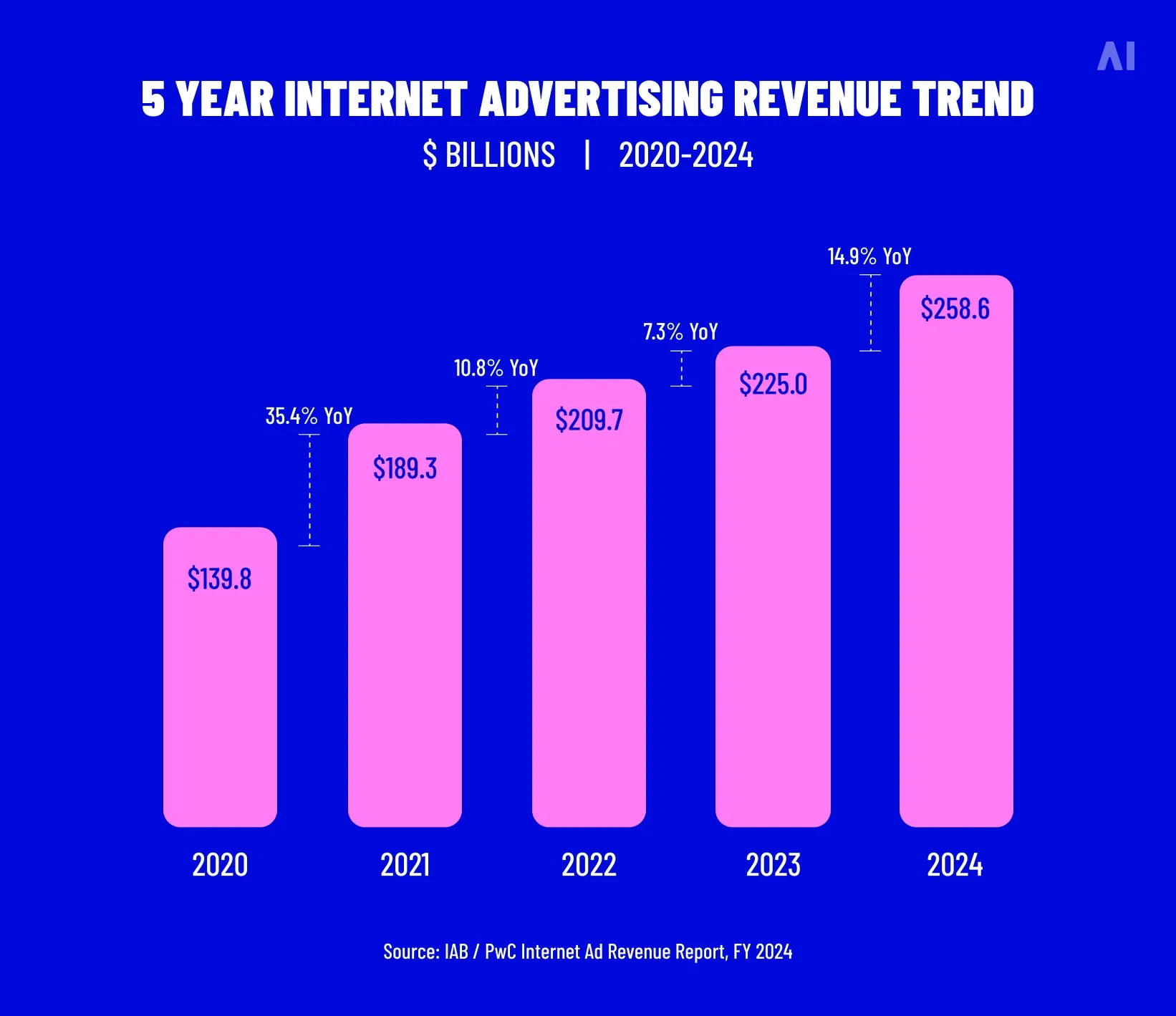
In the U.S., the scale of digital advertising makes these controls non-negotiable. The IAB reported U.S. internet advertising revenues of $258.6B in 2024, up 14.9% year over year—a market where small efficiency changes become very real dollars.
Where SSPs fit in the programmatic advertising ecosystem
An SSP sits on the publisher side of the transaction and acts as the marketplace engine that turns “available impressions” into “monetizable opportunities.”
A simplified flow looks like this:
- Publisher (site/app/CTV service) generates an ad opportunity.
- Ad server decides what to prioritize (direct campaigns vs programmatic).
- SSP sends bid requests to demand partners and runs an auction (or fulfills a deal).
- Winning creative is returned, validated, and served to the user.
- Reporting feeds back into pricing, packaging, and quality controls.
How an SSP works: step-by-step workflow
Most supply side platforms differ in UI and feature depth, but the workflow is consistent. The easiest way to understand it is to follow one impression from setup to reporting—because almost every “yield lever” you’ll use later (floors, deals, curation, SPO) ultimately changes what happens at one of these steps.
{{26-What-Is-a-Supply-Side-Platform-1="/tables"}}
Inventory setup and classification
Before any auction can run, the SSP needs to understand what it’s selling. That means defining:
- Ad units (size, placement type, allowed formats)
- Context (content category, page/app section, device type)
- Supply identifiers (domain/app bundle, seller IDs, ads.txt/sellers.json alignment)
- Rules (blocked categories, creative constraints, buyer allowlists/denylists)
In practice, this stage is where you build your inventory taxonomy so the SSP can treat “top-of-article on desktop,” “in-feed on mobile,” and “CTV mid-roll” as different products—not just different placements. It’s also where you set early guardrails that protect the business: which buyers can access which inventory, which creative types are allowed, what verification requirements apply, and what “good” looks like for UX (for example, limits on heavy creatives, audio-on, or intrusive formats).
This is where you decide whether an impression is “remnant display” or “premium homepage takeover candidate.” The SSP is the system that operationalizes those distinctions, so they stay consistent even when demand sources change.
Bid request generation (what data gets sent)
When an eligible impression appears, the SSP creates a bid request that describes the opportunity. The bid request typically includes:
- Placement details (format, size, position, viewability signals where available)
- Device and environment (web/app/CTV, OS, browser/app SDK info)
- Contextual signals (content category, language, geo at the appropriate granularity)
- Privacy/consent signals (where required)
- Deal metadata (deal IDs, auction type, floor logic, allowed buyers)
Two nuances matter here. First, bid requests are not “everything you know”—they’re “what you’re allowed to send” plus “what’s useful to buyers.” In other words, better bid requests are usually the result of better classification, cleaner consent handling, and tighter signal hygiene—not simply adding more fields.
Second, this is where signal loss becomes financially visible. If identifiers are missing, consent is absent, or the environment restricts measurement, bid density and bid value tend to fall. When that happens, pricing and packaging matter more: floors need to reflect reality, and deals (or curated paths) often do more for yield than simply adding another open-auction connection.
Demand connections (exchanges, DSPs, curated marketplaces)
An SSP doesn’t “sell to advertisers” directly in most cases. It sells into demand sources:
- DSP connections (direct pipes to buying platforms)
- Exchanges (broader liquidity pools)
- Curated marketplaces (pre-filtered, quality-defined supply bundles)
- Programmatic direct pipes (preferred deals, programmatic guaranteed)
This is where many publishers accidentally create the appearance of competition without the reality of it. If the same buyer can reach you through multiple intermediaries, you can end up with duplicated auctions (more bid requests, more latency, more cost) without a meaningful increase in clearing price. A cleaner connection strategy often wins: fewer, higher-quality paths, clearer rules, and better insight into who is actually paying.
💡 More on DSPs: Demand-side platform (DSP): how it works, benefits, and examples in 2026.
Real-time bidding auction (RTB) + price floors
In RTB, demand partners respond with bids in milliseconds. The SSP:
- Validates bids and creative metadata
- Applies auction rules (often first-price auctions today)
- Enforces floor prices and deal terms
- Selects a winner (or passes back the best eligible bid)
Floors are the practical lever here, but they work best when they’re tied to inventory segments rather than applied as a blunt global rule. A high-attention placement may support a higher floor because buyers consistently clear above it, while long-tail inventory may need a lower floor to avoid chronic non-fill. Deals add another layer: a PMP might override open-auction dynamics entirely, while preferred/PG can prioritize predictability over pure auction pressure.
💡 If you want a dedicated primer on RTB mechanics, this is a helpful companion: What іs real-time bidding (RTB): definition, benefits, and how it works in 2026.
Ad decisioning + ad server delivery
After the SSP selects a winner, the outcome typically routes back through the publisher’s ad server for final decisioning and delivery. Depending on setup, the ad server may:
- Choose between direct campaigns and programmatic
- Apply frequency rules and competitive separation
- Enforce additional brand safety or creative constraints
This step is where “technical details” become revenue details. Timeouts decide whether an auction completes at all. Caching and creative approval flows affect how fast ads render and whether buyers get rejected for avoidable reasons. In-app SDK behavior can change the true latency budget. In CTV, ad pod rules, competitive separation, and creative QA can determine whether programmatic is sustainable at premium rates.
Reporting, measurement, and optimization feedback loop
SSP value compounds when reporting is actionable. Strong reporting lets you answer questions like:
- Which placements have pricing power vs commoditized supply?
- Which buyers drive lift (not just CPM)?
- Which deal packages are sustainable and scalable?
- Where are you paying hidden “taxes” in the path?
The goal is not “more dashboards.” The goal is better market design: smarter floors, cleaner pipes, better packages, and fewer wasted auctions. When you can see what’s happening at the auction level (bids, clears, timeouts, deal performance), you stop guessing—and you start making controlled changes that hold up week after week.
⚡ Yield isn’t a number you ‘get.’ It’s a result of rules you choose.
Key components and features of a supply side platform
Below are the core SSP capabilities publishers tend to rely on. Before the list, one framing point: features only matter if they improve outcomes you can measure—revenue, quality, UX, or governance. If a feature doesn’t change a decision you make (or a result you can see), it’s usually just an extra toggle in the UI.
{{26-What-Is-a-Supply-Side-Platform-2="/tables"}}
A practical way to evaluate features is to ask: “What would I do differently if I had this?” If the answer is unclear, the feature is probably not a priority.
Inventory and yield management
This is the set of tools that helps you turn raw impressions into sellable products:
- Inventory grouping (by placement, device, content, user cohorts where permitted)
- Performance segmentation (high-value vs low-value slices)
- Yield controls (floors, throttling, prioritization by buyer type)
In real operations, this is where you stop treating inventory as “one pool” and start managing it like a portfolio. A homepage placement, a mid-article unit, and a long-tail page may all be “display,” but they behave differently: different buyer interest, different viewability, different price sensitivity, different latency tolerance. The SSP’s inventory tooling is what lets you set rules that respect those differences—so pricing and deal access don’t get flattened into averages.
Auction logic and pricing controls
This is where SSPs differ meaningfully. Look for:
- Floor controls (static, dynamic, buyer-specific where policy allows)
- Auction types (open auction, PMP, preferred, PG)
- Timeout and latency controls
- Bid shading / decision logic support (as permitted by platform design)
A good mental model: auction logic is your market design. It decides how “fair” and “predictable” the marketplace is for buyers, and how much pricing power you can realistically hold onto as a seller. Floors are the obvious lever, but they’re not the only one. Timeouts and latency controls, for example, can quietly have the same impact as a floor change: if buyers don’t have time to respond, you’re not running a competitive auction—you’re running a partial auction and accepting the consequences.
Deal types (Open auction, PMP, preferred deals, PG)
An SSP should make it easy to operate across multiple commercial models:
- Open auction: broad demand, more variability
- PMP: negotiated access and rules, typically higher quality control
- Preferred deals: fixed terms with priority access (often with a floor-like price)
- Programmatic guaranteed (PG): reserved, guaranteed delivery under contract terms
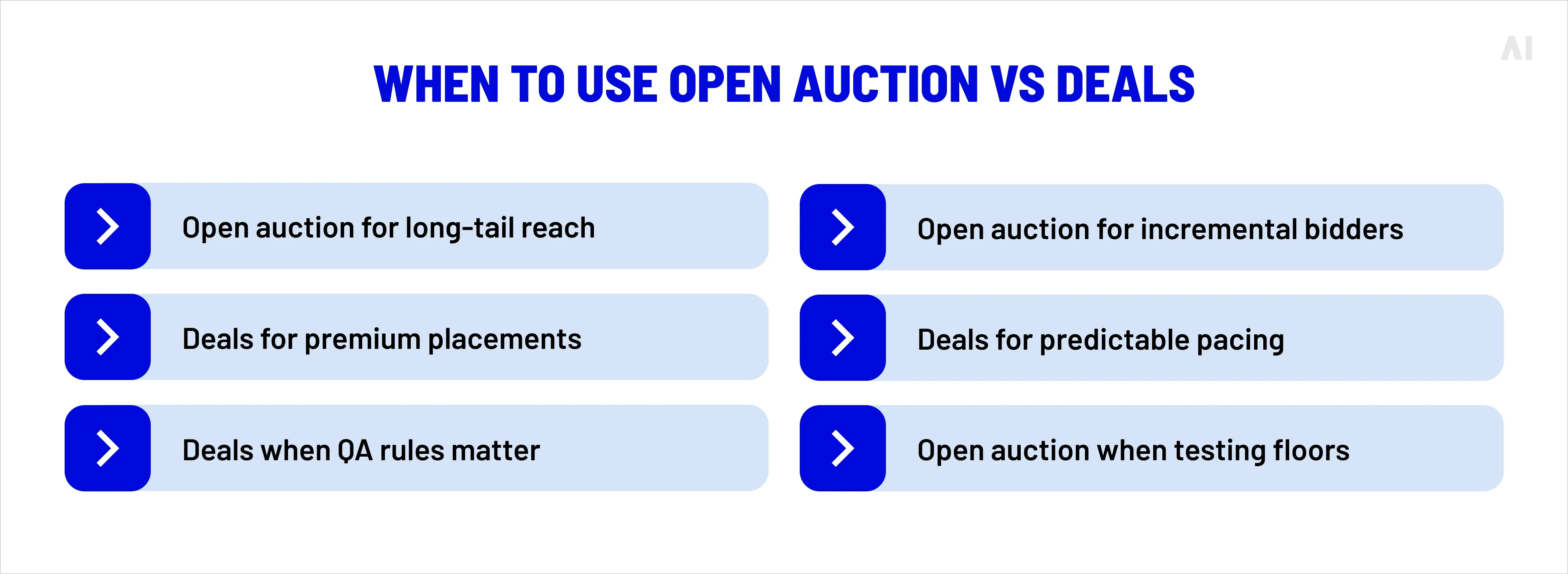
Deal tooling matters because it determines how painless it is to run a deliberate mix. The practical goal is rarely “all PMP” or “all open.” It’s usually something like: keep open auction healthy for long-tail and incremental demand, while using PMPs/PG to protect premium inventory, reduce volatility, and make the buying experience consistent for your most valuable partners.
You’ll see later why deal mix matters more than most teams expect—especially in CTV and premium content—because buyer expectations (frequency control, transparency, QA) tend to be stricter.
Header bidding support
For many publishers, header bidding is the mechanism that creates competitive pressure. SSP features here include:
- Prebid support (client-side or server-side)
- Unified auction compatibility
- Tools to reduce duplicate auctions and wasted calls
- Transparent win-rate and timeout reporting
The “hidden” feature to look for here isn’t a checkbox called “header bidding.” It’s the ability to operate header bidding without turning it into chaos. That means being able to see overlap (the same buyer reaching you through multiple paths), measure timeout losses, and tune partner participation so you’re actually increasing competition rather than simply increasing request volume. Transparent reporting is what makes this manageable—without it, teams tend to keep adding partners and hoping the average CPM rises.
Brand safety, fraud prevention, and compliance tools
Quality control isn’t optional. At a minimum, SSPs should support:
- Ads.txt / app-ads.txt enforcement
- Sellers.json and supply chain object support
- Creative scanning and policy enforcement
- Integration pathways for verification vendors
- Controls for MFA exposure and domain/app quality
This category is less about “nice-to-have protections” and more about operational stability. If you can’t block what you need to block, approve what you need to approve, and audit what actually ran, you’ll spend a surprising amount of time cleaning up problems after the fact. The point is simple: if you can’t control what runs, you can’t protect your brand—or your users.
Identity and audience activation tools
This section is where modern SSPs are evolving fast. Depending on environment and consent, SSPs may support:
- Contextual and content-based signals
- Seller-defined audiences (publisher-built segments)
- Support for identity alternatives (where applicable)
- Clean-room-friendly activation patterns (more common in large ecosystems)
Two clarifications help keep this grounded. First, SSPs typically enable audience value rather than “doing targeting” the way a DSP does. They help you package inventory or cohorts in a way buyers can transact on—often through deals or curated access. Second, identity tooling is only useful if it works inside your real constraints: consent requirements, browser/app environment, and the measurement you can actually support. Strong SSPs make it easier to operate in mixed conditions (some traffic addressable, some not) without treating the whole program as one uniform problem.
Analytics and performance reporting
The best SSP reporting answers “why,” not just “what.” Look for:
- Auction-level transparency (bids, clears, floors, outcomes)
- Deal-level performance reporting
- Buyer-level insights (who’s paying, who’s timing out, who’s low-quality)
- Troubleshooting data (latency, errors, mis-matched creatives)
The practical test here is whether reporting changes your next action. Can you confidently raise a floor on one segment without tanking fill? Can you see that a particular buyer “wins” often but delivers poor quality outcomes? Can you isolate whether revenue dropped because bid density fell, timeouts increased, or a deal under-delivered?
When the reporting is strong, optimization becomes controlled and repeatable. When reporting is weak, teams end up optimizing based on averages, anecdotes, or whichever partner shouted loudest that week.
SSP vs DSP vs Ad Exchange vs Ad Server
This is where many explanations get fuzzy—so here’s a clean separation.
- SSP (sell-side): Helps publishers sell inventory, control pricing, package deals, and manage quality.
- DSP (buy-side): Helps advertisers buy inventory, target audiences, and optimize toward outcomes.
- Ad exchange: A liquidity layer where buying and selling meet; an SSP can plug into exchanges, and some SSPs operate exchange-like infrastructure.
- Ad server: The publisher’s decision engine for what to show, and when—often balancing direct sold and programmatic.
💡 If you want a full side-by-side breakdown with examples, this deeper comparison is useful: DSP vs. SSP vs. ad exchange: Understanding the differences in programmatic advertising.
How SSP targeting works
SSP targeting can sound contradictory at first: “Isn’t targeting a DSP job?” Mostly, yes—but SSPs influence targeting in three practical ways. The simplest way to think about it is this: DSPs decide who to bid on and how much to pay. SSPs decide what opportunity exists and what rules apply to that opportunity. That’s targeting by market design rather than by audience selection.
They control what information is available in the bid request
The bid request is the “product description” the buyer sees. If it’s vague, inconsistent, or missing critical signals, even the best DSP can only make coarse decisions.
This is where SSP setup becomes a targeting lever:
- Taxonomy and content classification: If “Sports” sometimes means live scores, sometimes commentary, and sometimes betting content, buyers can’t separate premium intent from general interest. Clean, consistent categories improve buyer confidence and bidding behavior.
- Context quality signals: Viewability signals (where available), placement position, and content context help buyers decide whether this impression is worth paying for—even without IDs.
- Consent and privacy signals: If consent strings are missing or inconsistent, some buyers will not bid at all, while others will bid conservatively. The DSP can’t reconstruct consent downstream; it can only react to what you send.
- Environment clarity: Web vs app vs CTV isn’t a cosmetic label. It changes measurement, creative constraints, and latency tolerance, which directly changes who bids and at what price.
A practical takeaway: improving bid request quality often “improves targeting” without adding any new data. You’re simply making the opportunity more legible.
They enable sell-side segmentation and packaging
SSP “targeting” often shows up as how you slice and package inventory—especially when user-level identifiers are limited.
Publishers can define cohorts such as:
- Contextual segments (content categories, page types, recency signals)
- High-attention placements (position + layout + engagement patterns)
- Publisher first-party cohorts (where permitted and consented)
- Device/environment segments (app vs mobile web vs desktop vs CTV)
Then the SSP makes those segments transactable via:
- Deal IDs (so buyers can target the segment directly)
- Curated supply packages (so the segment comes with quality rules)
- Pricing rules tied to the segment (floors that reflect the segment’s value)
This is one of the biggest differences between “we have inventory” and “we have products.” Buyers don’t just want reach—they want predictable, describable reach they can plan around.
They shape who gets access
Access is an underappreciated targeting mechanism. If you restrict inventory to certain buyers, you’re shaping which advertisers can appear in a given environment, and which buying strategies can compete.
Access controls typically include:
- Private marketplaces (PMPs): only invited buyers can bid.
- Preferred deals: a specific buyer gets priority access under defined terms.
- Programmatic guaranteed: the buyer gets reserved delivery, reducing auction variability.
- Allowlists/denylists: buyer-level, category-level, or brand-level controls.
- Curation rules: pre-filtering supply paths so only governed, high-quality demand touches premium inventory.
This matters because many buyers run different strategies depending on where they’re allowed in. Open auctions often attract broad optimization logic; PMPs often attract brand and quality-driven budgets. You’re not just changing access—you’re changing the types of campaigns that show up.
A useful mental model
DSPs choose who to reach; SSPs choose what is being sold and under what rules. The SSP doesn’t “target” in the classic sense. It defines the marketplace conditions that make certain types of targeting possible, reliable, and worth paying for.
⚡ SSP targeting is less about picking people and more about packaging opportunities—so buyers can buy the right context, at the right price, under the right controls.
Why publishers use SSPs: key benefits
A strong SSP setup doesn’t just “increase CPM.” It changes the reliability of revenue and the controllability of the entire monetization program.
Higher revenue and stronger eCPMs
The most obvious upside is yield. But the important nuance is why eCPM improves:
- Better competition (more qualified bidders, fewer wasted auctions)
- Better price control (floors that reflect real willingness to pay)
- Better packaging (deals that align value with buyer intent)
💡 If you’re building your internal yield vocabulary, AI Digital has an article that goes deeper on the mechanics of eCPM, rCPM, and fill rate.
Improved fill rate and inventory utilization
SSPs help reduce “unsold” inventory by matching supply to the right demand sources and deal types. Fill rate becomes more stable when:
- Demand is diversified across buyers
- Low-latency setups reduce timeouts
- Floors are realistic rather than aspirational
Better demand diversification (less dependency on one buyer)
Single-platform dependency is a quiet risk. The stronger your SSP connectivity and deal strategy, the less exposed you are to:
- Policy changes
- Auction dynamics shifting
- Sudden buyer pullbacks in a given vertical
Faster monetization operations through automation
SSPs can reduce manual workload by standardizing:
- Deal creation and enforcement
- Reporting workflows
- Buyer onboarding rules
- Inventory updates across formats and environments
Better control over ad quality, brand safety, and UX
This is the benefit many teams underweight—until something breaks. SSP controls help prevent:
- Misaligned creative formats
- Overly repetitive ads (especially in CTV)
- MFA-heavy supply leakage
- Latency spikes that degrade page/app performance
In the U.S., consumer attention is a hard constraint. Deloitte’s 2025 Digital Media Trends found people have about six hours of entertainment time per day—meaning your ad experience is competing inside a fixed attention budget, not an infinite one.
How publishers monetize across channels with SSPs
SSPs are no longer “display pipes.” Modern monetization is cross-format and, increasingly, cross-device—so the job shifts from “maximize fill” to “design a market” that balances yield, quality, and user experience across environments.
{{26-What-Is-a-Supply-Side-Platform-3="/tables"}}
Display and native inventory
Display remains a volume driver, but native can be a quality driver when implemented well—mainly because native forces you to be disciplined about presentation rules (layout, image ratios, headline lengths, click behavior) instead of letting “any banner” compete in a generic slot.
The SSP role here is to:
- Standardize native request/response formats so buyers can bid without breaking the page/app layout
- Enforce creative and layout rules (this is where native succeeds or fails in practice)
- Protect UX while maintaining demand access (e.g., avoid “native that behaves like a pop-up”)
A useful operational nuance: native tends to monetize best when your SSP setup treats it as a distinct product (separate floors, separate buyer access, separate QA thresholds), not as “display with a different skin.” That packaging discipline is often what turns native from “CPM lift in a deck” into “repeatable revenue line.”
💡 If you’re deciding where native fits, this overview can help: 10 benefits of native advertising that drive engagement and ROI
Mobile app monetization
Apps add complexity: SDK behavior, device identifiers, measurement limits, and latency constraints all matter. A practical SSP approach to apps focuses on:
- Clean app-ads.txt alignment and seller authorization
- SDK performance and timeout control (because “slow” becomes “lost impressions”)
- Demand diversity without duplication overload (more pipes only help if you control overlap)
The subtle monetization challenge in apps is that the “cost of a bad auction” is higher. In web, a messy auction might mean a lower CPM. In apps, it can also mean a worse user experience (jank, longer load times, more battery drain), which then reduces retention and session depth—the things that create inventory in the first place.
If you want one dataset-driven signal that apps can get crowded: ANA’s Q3 2025 benchmark shows mobile app inventory at 8.2% of programmatic delivery in its dataset—smaller than web and CTV, but still meaningful enough that “get the SDK + supply chain right” isn’t optional.
💡 AI Digital also has a piece on mobile monetization dynamics: The future of mobile advertising: key trends shaping it in 2026 and beyond.
Video, OTT, and Connected TV (CTV)
This is where SSPs have become strategically important. CTV inventory is premium, but it’s also operationally sensitive (frequency, fraud, measurement, and brand adjacency all get more scrutiny).
Even though some of the numbers below from IAB’s 2025 digital video research have already been mentioned, it’s worth revisiting them again here for context:
- CTV ad spend: $23.6B in 2024, projected $26.6B in 2025
- Total U.S. digital video ad spend: $64B in 2024, projected $72B in 2025
- Digital video is expected to capture nearly 60% of total TV/video ad spend in 2025
.webp)
So what does that mean for SSP-led monetization decisions?
- Deal mix stops being a “sales preference” and becomes a market-structure choice. In premium video/CTV, private pipes often dominate because they reduce risk (brand safety, fraud, adjacency) and create predictable trading rules.
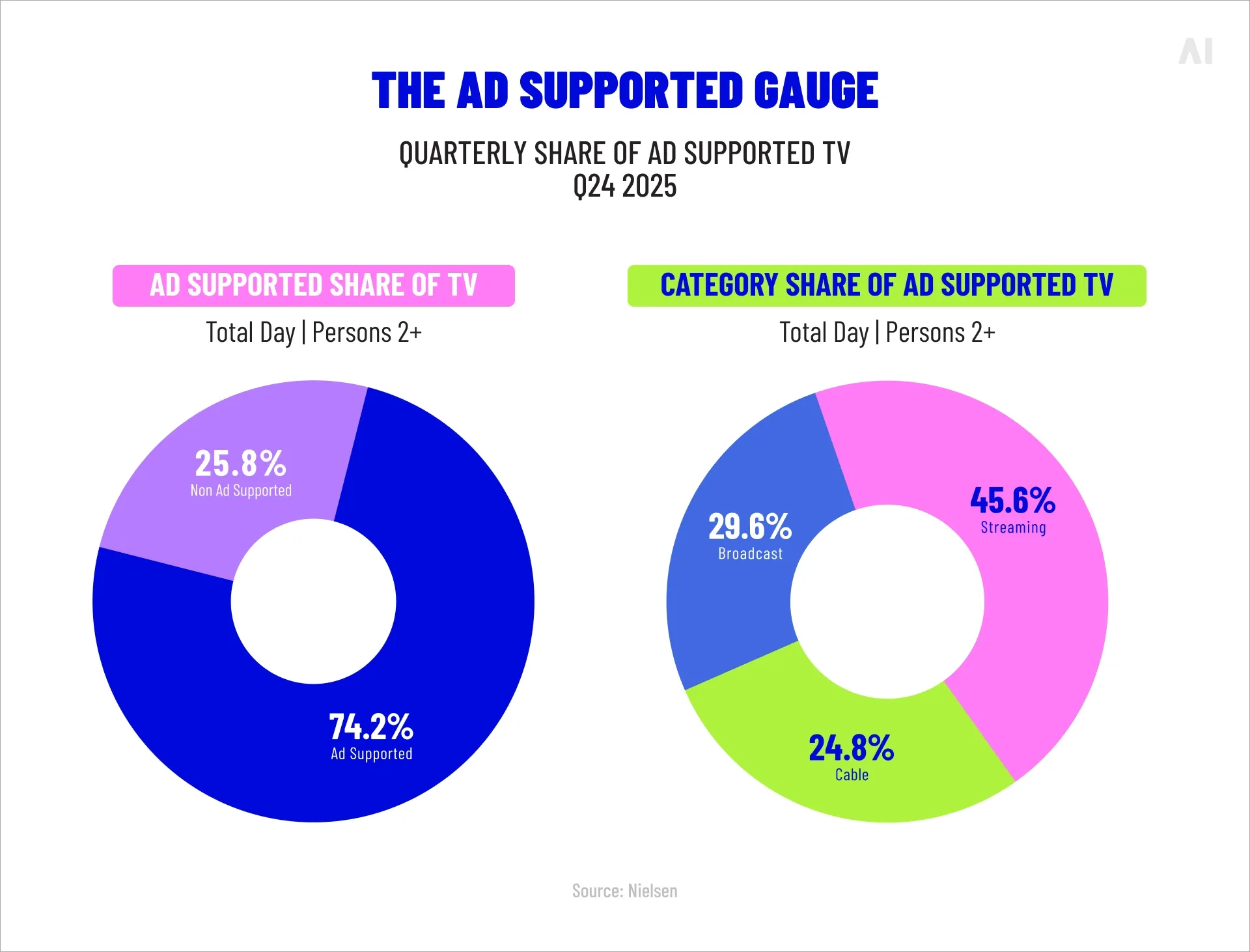
- Curation is not a buzzword in CTV—it’s how the channel operates. ANA reports that in its Q3 2025 dataset, CTV represented 45.6% of programmatic spend, and 100% of measured CTV spend occurred through PMPs.
- Supply consolidation changes negotiation leverage. The same benchmark notes the top 5 SSPs/exchanges controlled 82.4% of CTV ad spending in the measured dataset—fewer pipes, bigger consequences for who you partner with and how you govern quality.
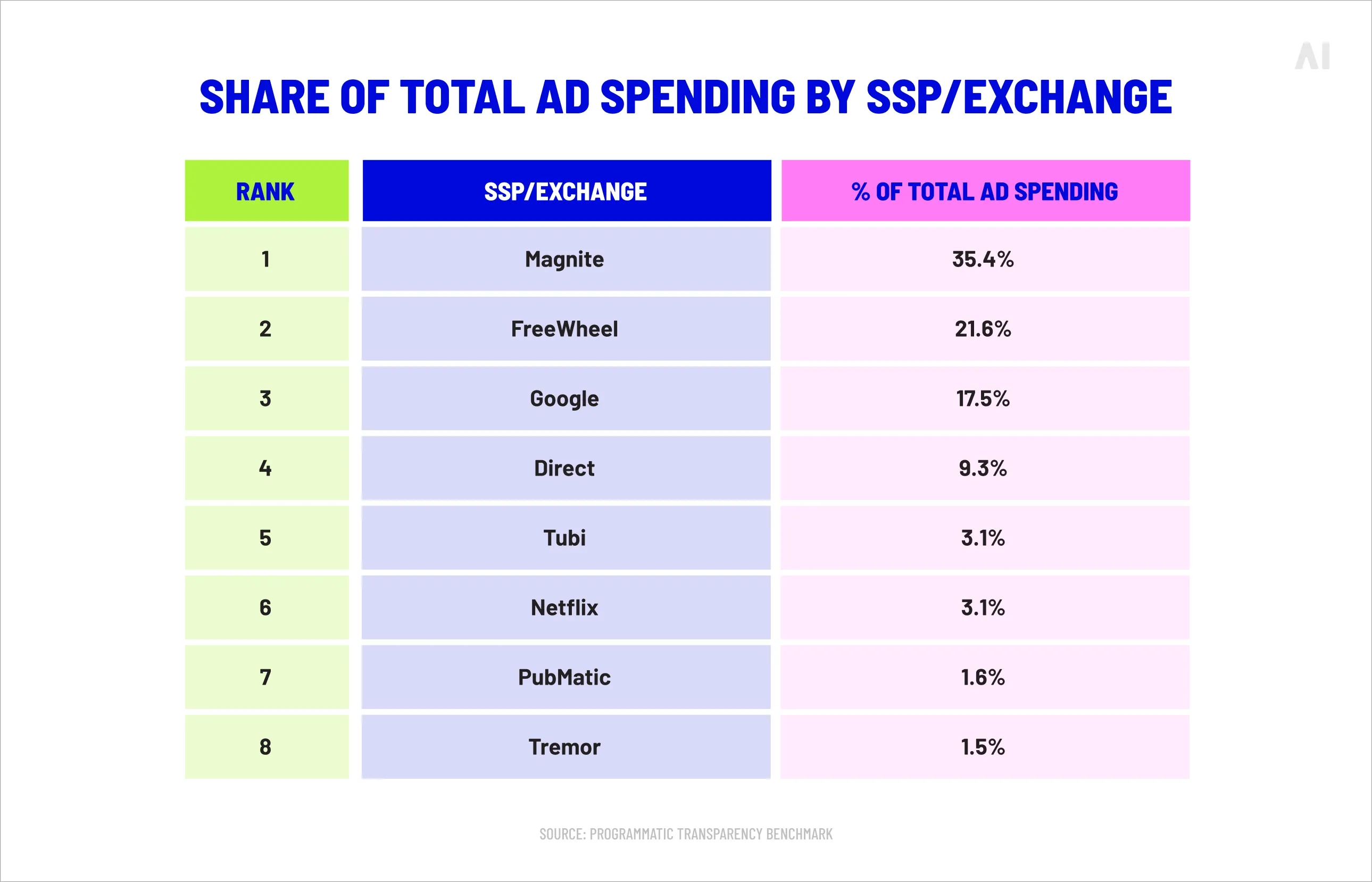
CTV growth is also being fueled by live events, sports, and programmatic tooling, and IAB notes that a lot of 2025 CTV budget is being reallocated from linear TV (36%) and social media (36%)—meaning buyers bring “video expectations” and “digital optimization habits” into the same channel. SSP controls (deals, floors, curation, verification hooks) are what make that executable without wrecking UX.
💡 If you want channel-level context, these are good complements:
Digital audio and emerging formats
Audio monetization adds its own constraints: limited ad slots, attention sensitivity, and strict user tolerance for repetition. SSPs support audio when they can:
- Enforce frequency and separation rules (audio fatigue is real, and it happens fast)
- Support quality controls and verification integrations
- Offer deal packaging for premium placements (podcasts, music streaming)
A useful stat to justify the “audio is small but real” argument: IAB reports Podcast ad revenue at $2.43B in 2024, growing 26.4% YoY—not massive compared to display/video, but meaningfully positive momentum.
The SSP angle is simple: when slots are scarce, wasted auctions and repetitive delivery hurt more. That pushes audio monetization toward better packaging, cleaner buyer access, and tighter governance—especially for podcasts where brand adjacency and host-read integrity can matter as much as CPM.
💡 More on the channel: Digital audio advertising
SSP yield optimization strategies
This is where an SSP becomes more than “access to demand.” Yield strategy is a set of choices about market structure: pricing, competition, packaging, and path hygiene.
Dynamic floors and AI-driven pricing
Dynamic floors are not magic. They’re simply a way to adjust pricing based on observed clearing behavior—so you stop underpricing premium inventory and stop overpricing commodity inventory.
A good dynamic floor strategy typically:
- Uses enough history to avoid reacting to noise
- Separates inventory into meaningful segments (not “everything”)
- Protects UX by avoiding auction churn (constant floor changes can increase timeouts)
💡 If you’re thinking about how decision automation fits into marketing operations more broadly, AI Digital’s overview is here: AI in digital marketing: how artificial intelligence is transforming strategies in 2026
Header bidding vs waterfall
A waterfall prioritizes networks or partners in sequence. Header bidding tends to run a more competitive process up front.
Before the list, one practical note: the right answer depends on latency tolerance and demand quality, not ideology.
In general:
- Waterfalls can be simpler but may under-serve competition.
- Header bidding can improve competition but can also increase complexity if you don’t manage duplication, timeouts, and partner overlap.
⚡ More demand partners isn’t the same as more competition.
Audience segmentation and deal packaging
Yield improves when you stop selling “impressions” and start selling defined products:
- Contextual segments (e.g., high-intent content categories)
- First-party publisher segments (where consent and policy allow)
- High-attention placements (layout + viewability + session context)
- Brand-safe, verified supply paths
Packaging works best when it is legible to buyers: clear definition, consistent delivery, and transparent measurement.
Private marketplaces (PMPs), preferred deals, and PG
PMPs and curated paths keep growing because they align incentives:
- Buyers get more predictability and quality control
- Sellers get pricing stability and clearer demand intent
The ANA benchmark found 81.6% of spend flowed through PMPs in Q3 2025 in its dataset—an indicator of how “private” has become the default for many premium transactions.
.webp)
Supply path optimization (SPO) and reducing bid duplication
SPO is one of those topics that sounds technical but has a straightforward goal: fewer intermediaries and fewer redundant auctions between buyer and seller.
Here’s why it matters in practice:
- Duplicate paths can inflate CPM without improving outcomes.
- Extra hops introduce latency and reduce win-rate predictability.
- More paths often means more measurement and governance risk.
The ANA benchmark also reported that 94.37% of web ad spending was delivered on 3,000 websites—a reminder that concentration is real, and that thoughtful consolidation can outperform “spray and pray” distribution.

How to choose an SSP
Most SSP selection mistakes come from evaluating a platform as “features” rather than as an operating model. To make this concrete, use a checklist that connects platform capability to business outcomes.
Here’s a practical evaluation checklist for publishers:
- Demand quality: Which buyers show up, and under what deal types?
- Control depth: Floors, buyer rules, creative enforcement, transparency logs
- Path hygiene: SPO tools, duplication controls, seller authorization enforcement
- Measurement compatibility: Verification support, log-level accessibility, reporting fidelity
- Operational fit: Integrations with your ad server, Prebid stack, and analytics tooling
- Support model: Implementation help, troubleshooting depth, roadmap clarity
⚡ Don’t pick an SSP by feature count. Pick it by what you can run reliably, explain clearly, and improve week over week.
A vendor can look “full featured” and still be a mismatch if it can’t support the constraints of your environment (especially apps and CTV).
Common SSP challenges
You don’t need a pessimistic view of SSPs—you need a realistic one. These are the issues that actually show up once systems are live, and the ones worth designing around.
Fee opacity and unclear take rates
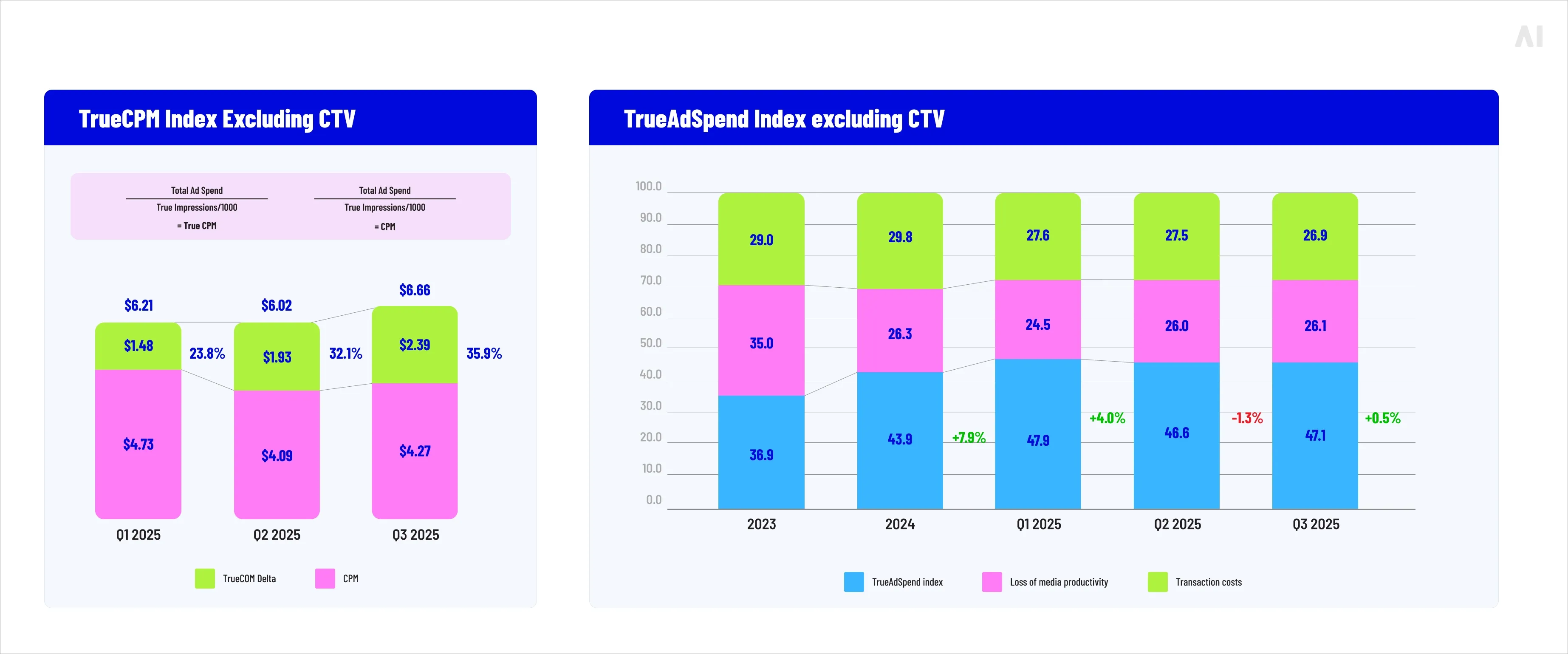
If you can’t explain where money went, you can’t optimize. In practice, “take rate” is rarely one number—it’s a stack of platform fees, operational leakage, and quality losses that only becomes visible when you can reconcile log-level data across partners. The ANA benchmark’s cost-waterfall framing is useful here because it quantifies that reality: in Q3 2025, transaction costs were 26.9% (web + mobile), and even within one channel (CTV) SSP platform costs moved from 14.7% to 12.8% QoQ, shifting more value to sellers. That kind of swing is exactly why “we think fees are fine” isn’t a governance strategy.
Latency and timeout losses
Especially in header bidding and in-app SDK setups, timeouts silently destroy value—not because auctions fail loudly, but because bids arrive after the decision has already been made. A useful proxy signal is supply-path rationalization: when teams cut redundant connections and concentrate spend, they reduce duplicated calls, lower auction clutter, and typically see fewer lost opportunities from “late” demand. In Q3 2025, the ANA benchmark explicitly ties cost improvements on the open web to rationalizing redundant SSP connections via supply path optimization, and it shows the accessible supply surface contracting (for example, open marketplace domains/apps fell from 27,166 to 21,870 in the benchmark period). Fewer, cleaner paths usually means fewer wasted auctions and less timeout-driven value loss.
Signal loss and measurement gaps
Missing identifiers, limited measurement in certain environments, and privacy constraints reduce bid density and pricing power. What matters isn’t only “ID or no ID,” but whether the bidstream contains enough usable signals for buyers to price the impression confidently—and whether measurement can validate outcomes. One way this shows up economically is that buyers pay a growing premium for impressions they can verify and measure. In Q3 2025 (web + mobile, excluding CTV), the benchmark shows TrueCPM ($6.66) vs CPM ($4.27)—a $2.39 delta—which reflects the market pricing in quality and measurability, not just raw reach.
Fraud and MFA exposure
Quality leakage doesn’t just waste spend; it damages buyer trust in your supply. Two practical observations tend to hold once you look at the data: (1) fraud/IVT can be meaningfully different by environment, and (2) open marketplaces tend to carry more MFA risk than curated/private pipes unless you’re aggressive with filtering.
For environment-level risk, Pixalate’s Q3 2025 North America benchmarks put U.S. mobile app IVT at 24%, desktop/mobile web at 21%, and CTV at 18% (IVT includes ad fraud in their framing).

For MFA specifically, the ANA benchmark shows OMP MFA rates higher than PMP (Q3 2025: 1.40% vs 0.41%), and it also shows median MFA exposure compressing materially over time—evidence that disciplined inclusion lists and detection can move the needle, but only if you treat it as an always-on control, not a quarterly cleanup.
Auction pressure and “race to the bottom” dynamics
Without smart floors and packaging, open auctions can commoditize inventory quickly—especially in the long tail where quality is less consistent and buyers have more substitutable options. The data tends to show a price–quality gradient: as you move down publisher tiers and into broader open-market reach, IVT and MFA risk rises and outcomes degrade, which pushes buyers to bid more conservatively unless you repackage the inventory into something they can trust. The ANA benchmark spells this out directly: OMP carries higher MFA exposure than PMP, and the broader market response has been supply rationalization (fewer domains/apps in both OMP and PMP over time), which is basically the ecosystem choosing “less, better” over “more, cheaper.”
How AI Digital helps publishers maximize SSP performance
Most SSP programs don’t underperform because a platform is “bad.” They underperform because the market design around the platform is fuzzy: too many overlapping paths, unclear economics, inconsistent inventory packaging, and quality controls that live in three different places. AI Digital’s approach (Open Garden + Smart Supply) is built to make those decisions more deliberate—so you can improve yield and reduce operational noise.
Build a transparent baseline across your sell-side stack
Before you change floors or add partners, you need a reliable “what’s actually happening” picture. AI Digital starts by mapping:
- Which SSPs and exchanges are active (and why)
- Where overlap is creating duplicate auctions rather than real competition
- How deal types are being used (open vs private vs guaranteed)
- Where cost and value are leaking (fees, timeouts, low-quality supply)
This is the practical expression of the Open Garden idea: if you can’t see the path, you can’t govern the path.
Improve inventory packaging and deal strategy without turning it into a manual grind
Publishers usually already have “premium” and “long tail”—the question is whether buyers can understand and buy those distinctions consistently. The core idea behind Smart Supply is that deal IDs shouldn’t be one-size-fits-all and should be built around the outcome a buyer cares about (not generic labels). Applied on the publisher side, that translates into:
- Clear segment definitions (context, placement, environment, quality thresholds)
- Deal terms that match the inventory’s real behavior (and the buyer’s intent)
- A scaling plan so private deal revenue doesn’t remain a trickle
In other words: treat deals as products you can repeat, not one-off exceptions you babysit.
Reduce inventory bias and keep access decisions performance-led
Another important point is platform bias—the way some buying environments steer spend toward preferred inventory relationships. While publishers can’t control how every buyer’s platform behaves, you can control how you present and package supply so performance is the deciding factor.
AI Digital leans into a neutral execution philosophy—DSP-agnostic, inventory-agnostic—and applies that logic to supply selection and deal distribution, so priority is driven by KPI performance rather than “who owns what.”
Tighten quality and governance so buyers trust the supply
Higher CPMs tend to follow trust. AI Digital’s Smart Supply focuses heavily on pre-qualifying inventory and filtering out low-value traffic, including indirect paths that add cost and lower quality, plus protections against invalid traffic. For publishers, the equivalent outcomes are:
- Fewer low-quality win patterns that hurt repeat spending
- Cleaner supply paths that buyers can validate
- A tighter brand safety posture that reduces buyer objections and makegoods
This is also where contextual screening and stricter inclusion rules can support premium programmatic without relying on identity-heavy signals.
Operate cross-channel without fragmenting your playbook
For publishers, the key is not to run a separate “mini SSP strategy” for each format. It’s to reuse the same operating logic:
- Define the product (inventory + rules)
- Choose the access model (open/private/guaranteed)
- Control the path (reduce redundant hops)
- Measure what changed and adjust
That’s how you keep the program scalable as inventory shifts across screens.
Future of Supply-Side Platforms: Key Trends Shaping SSPs in 2025–2026
This is the direction SSPs are moving: more packaged supply, more accountability, and more pressure to prove value in logs—not just in summaries.
💡 A useful wider lens on where media is heading: 2026 Media Trends Report
Supply path optimization and supply consolidation
“SPO” has shifted from a specialist practice to a baseline expectation. The reason is simple: buyers are under pressure to justify outcomes, and messy paths make outcomes harder to defend.
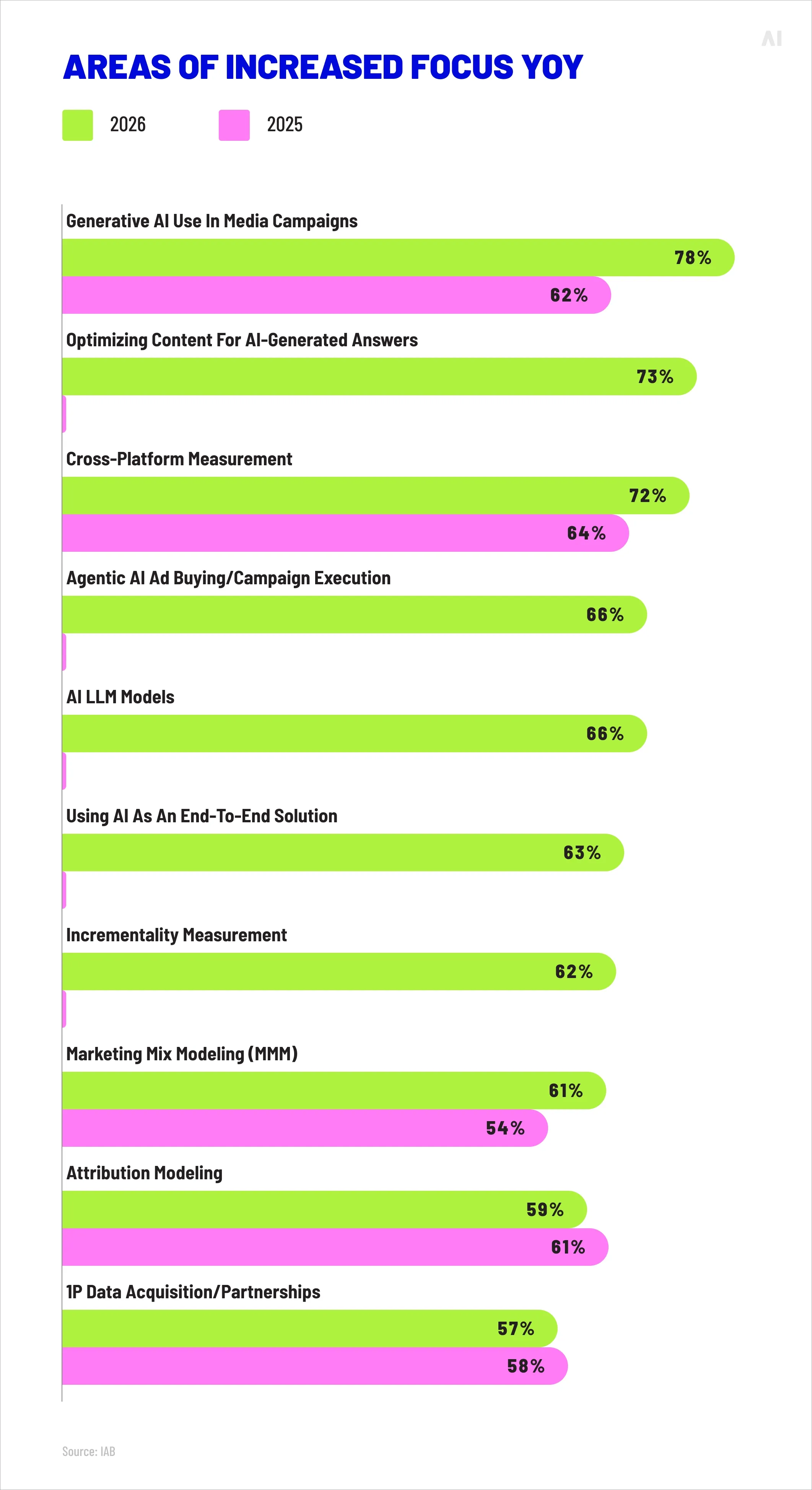
Two signals from the U.S. market make that clear. In IAB’s 2026 outlook, cross-platform measurement was the top KPI for 72% of respondents—up from 64% a year earlier, and “customer acquisition” was the #1 objective for 54%. When measurement becomes the KPI, the “how” of delivery (which intermediaries touched the impression, what signals were present, what fees were taken) stops being a back-office detail.
On the operational side, the ANA Programmatic Transparency Benchmark gives a concrete illustration of what “cleaner paths” look like in numbers: in Q3 2025, the benchmark’s TrueAdSpend Index (excluding CTV) was 47.1%, and transaction costs (excluding CTV) were 26.9%. You don’t need to adopt every framework in that report to take the point—when buyers can quantify leakage, they start demanding fewer hops and clearer accountability.
Deal-led marketplaces and “premium wrappers” around programmatic
Premium programmatic is becoming more deal-led, and the infrastructure is catching up. This shows up as more pre-qualified marketplaces (tight definitions of what supply is included, who can buy it, and what measurement rules apply), not just “open auction + hope.”
A useful proof point here is standards work: the IAB Tech Lab finalized Deals API v1.0 in February 2026 to standardize how deal details are synchronized across selling and buying systems, explicitly targeting the manual mismatches and under-delivery that plague deal-based buying. The meta-message for publishers: deal operations are being treated as a first-class system problem, not a spreadsheet problem.
Seller-defined audiences and first-party packaging becomes more formal
As addressability fragments, SSPs are being pushed to support sell-side segmentation that is clearly defined, permission-aware, and measurable—especially for PMPs and deal-led buying.
Standards are evolving in that direction too. IAB Tech Lab’s work on “seller-defined audiences” (now positioned as a broader audience-packaging framework) is explicitly about making these segments interoperable and deal-addressable across platforms, rather than bespoke to one vendor’s UI.
The practical implication: segments that used to live as “publisher intuition” are being pressured into becoming repeatable products with consistent delivery rules, not one-off tactics.
CTV growth forces stricter premium controls
CTV inventory still commands attention, but the real shift is that ad-supported viewing keeps rising, which puts more weight on frequency discipline, fraud controls, and supply-path clarity.
In the U.S., Nielsen reported that ad-supported television represented 74.2% of total TV viewing in Q4 2025 (its highest point during 2025). In December 2025, streaming also hit 47.5% of total TV viewing—another reminder that “TV” now largely means cross-app, cross-platform distribution, not a single controlled environment.
What that means for SSPs: the winners in premium CTV won’t be the platforms that simply maximize bid volume. They’ll be the ones that can enforce the constraints buyers care about—frequency, adjacency controls, verification integrations, and supply-chain integrity—without breaking delivery.
AI-driven yield optimization becomes normal, but governance becomes the differentiator
Automation will keep expanding across floors, packaging, and anomaly detection. The constraint won’t be the availability of algorithms; it’ll be whether the inputs are reliable and the behavior is governable.
IAB’s State of Data 2025 report found that only 30% of agencies, brands, and publishers had fully integrated AI across the media campaign lifecycle, and nearly two-thirds cited data quality/protection and fragmentation as top barriers. In other words: the industry wants more automation, but it keeps tripping over the same fundamentals—clean signals, controlled data use, and explainable decisioning.
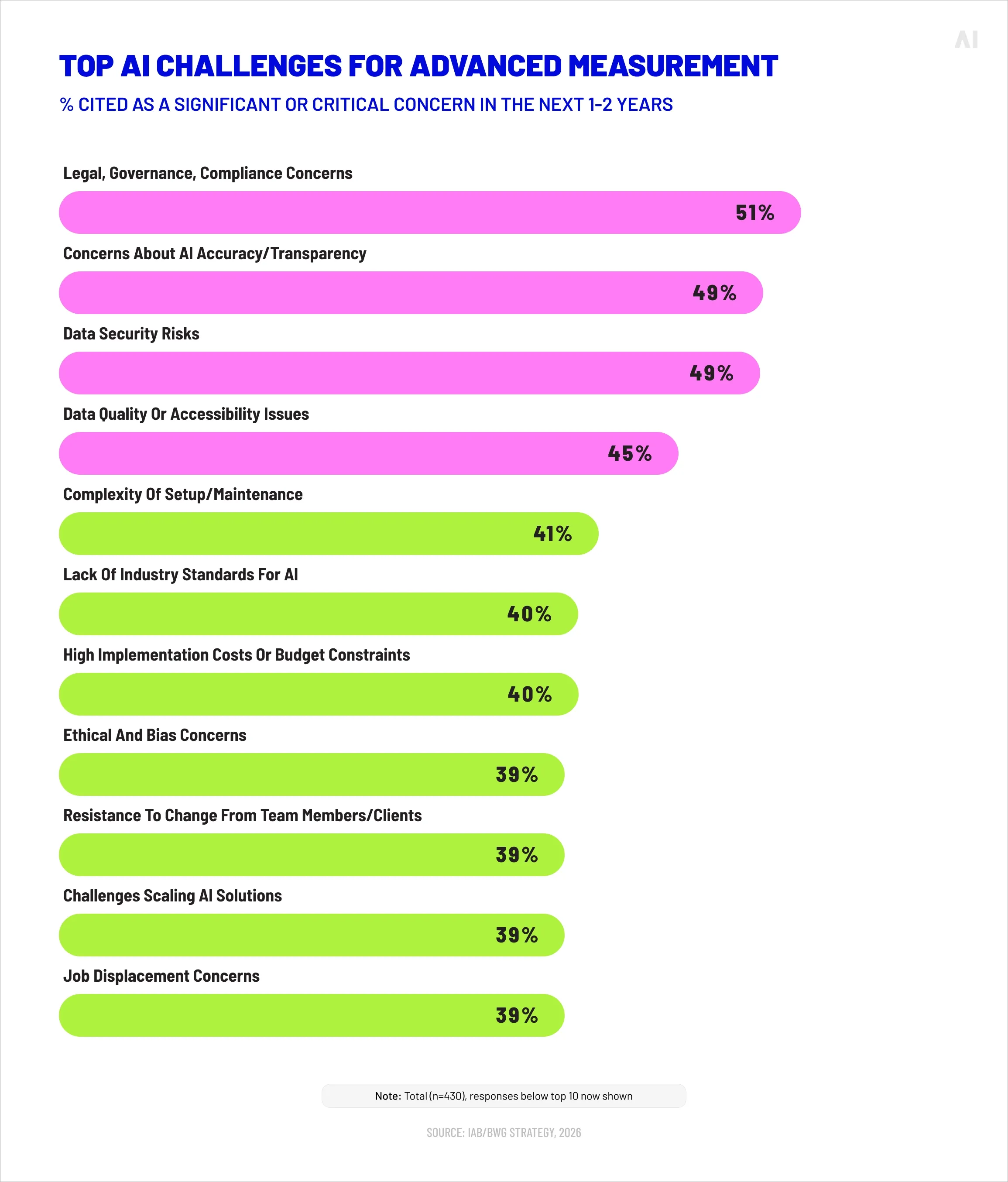
So the future isn’t “AI everywhere.” It’s AI where the rules are explicit: what the model can optimize, what it must never touch, and how you audit outcomes when a buyer asks “why did this clear?”
Transparency and fee pressure intensify
This pressure doesn’t relax, because it’s being reinforced by buyer priorities. When measurement and acquisition outcomes rise to the top of planning, the supply side has to show its work.
That same IAB 2026 outlook also notes that 73% of respondents prioritize creating content optimized for AI-generated answers. That’s not an SSP stat, but it matters: if traffic patterns and content discovery shift, publishers will feel new volatility in sessions, formats, and engagement. Volatility is where fee scrutiny spikes, because every unknown looks like a “tax” until proven otherwise.
Net: in 2025–2026, SSP value is getting judged less on access to demand and more on market design—the ability to package supply cleanly, reduce waste, enforce quality, and back claims with data you can actually defend.
Conclusion: Supply side platforms are the core monetization engine for modern publishers
A supply-side platform is where monetization becomes a repeatable system: rules, pricing, quality controls, packaging, and feedback loops. When it’s set up well, your SSP program doesn’t just lift revenue. It improves the stability of revenue, reduces operational noise, and gives buyers a clearer reason to keep spending with you.
The most important shift to keep in mind is structural. SSP performance is less about “adding more demand” and more about designing cleaner, more intentional selling paths. That means treating inventory like a portfolio, using the right mix of open and deal-based buying for each format, and tightening governance so you can explain where money moved and why.
If you want a practical next step, start with three questions. Are we selling the same buyer the same impression through multiple routes? Are our floors and segments aligned with what clears, or with what we wish would clear? And can we see enough in reporting to make changes confidently rather than guessing?
If you want help auditing your supply path, rationalizing SSP connections, or designing a cleaner deal strategy, AI Digital can help: Get in touch: Start your programmatic journey