Retail Forecasting: A Guide to Smarter Planning, Media, and Growth

Retail forecasting used to be treated as an operations problem: estimate demand, order inventory, hope markdowns don’t get ugly. In 2026 and beyond, that view is too narrow. The modern retail forecast has to connect three systems that influence each other every day:
- Demand signals (what shoppers are doing and likely to do next)
- Marketing performance (what spend is producing, by channel and audience)
- Revenue planning (how those signals roll up into targets, margin, and cash)
What changed is not just the amount of data. It’s the speed of feedback. Media performance arrives in hours, not weeks. Promotions can be launched or paused quickly. Supply constraints and lead times are still real, but decision cycles have shortened.
This guide explains what retail forecasting is, the major forecasting types, and the methods teams use—from traditional models to predictive AI. It then gets practical: how to build a forecast you can actually run the business on, and how to turn forecasting into a growth habit rather than a once-a-quarter spreadsheet exercise.
⚡ A forecast only matters if it changes a decision before money is committed.
What is retail forecasting?
At its core, retail forecasting uses historical data, market signals, and increasingly media and customer behaviour insights to anticipate demand, revenue, and performance outcomes. The aim has never been perfect prediction. It's a forecast reliable enough to act on—one anchored to the levers you can actually pull.
The clearest way to understand retail forecasting is to contrast it with two activities that often get confused with it:
- Reporting looks backward. It tells you what happened.
- Static planning locks assumptions in place. It tells you what you hoped would happen.
- Retail forecasting looks forward and stays adjustable. It tells you what is likely to happen if conditions stay the same—and what changes when you adjust the inputs (pricing, promo depth, media spend, inventory availability, channel mix).
{{26-Retail-Demand-Forecasting-1="/tables"}}
💡 If you’re aligning forecasting to broader retail growth, it helps to ground it in a full retail digital marketing system—how channels, data, creative, and measurement work together to drive demand instead of simply recording it.
The core types of retail forecasting
The fastest way to make forecasting useful is to stop treating it as one monolithic model. Retail teams forecast different things for different decisions, and those forecasts are best managed as a coordinated set.
💡 Before the breakdown, one practical note: this section pairs well with a data-driven strategy approach. If you’re building the wider operating model (objectives, KPIs, governance, and measurement), you’ll want a companion piece like Creating a data-driven marketing strategy. It also helps to understand how forecasting fits into modern media planning and buying, because a growing share of demand is influenced by decisions made in ad platforms and auction dynamics, not just in merchandising calendars.
Here’s the simplest way to categorize forecasting in retail without losing nuance:
{{26-Retail-Demand-Forecasting-2="/tables"}}
This breakdown is useful because each type has different inputs, different time horizons, and different error costs. A forecasting approach that’s “good enough” for staffing can be unacceptable for a high-stakes seasonal buy.
Sales and demand forecasting
Sales and demand forecasting predicts how much you’re likely to sell, when, and under what conditions. It typically operates at multiple levels:
- Total business (revenue, units)
- Category and subcategory
- SKU, variant, or store cluster
- Time buckets (daily, weekly, monthly)
The immediate value is obvious: you can’t plan inventory without an estimate of demand. The less obvious value is that sales and demand forecasting is where you test business logic.
For example, if demand is expected to grow, you need to know whether that growth is coming from:
- Traffic increases (more people showing up)
- Conversion improvements (more people buying)
- Basket changes (AOV up or down)
- Price/mix shifts (more premium items, fewer discounts, different bundles)
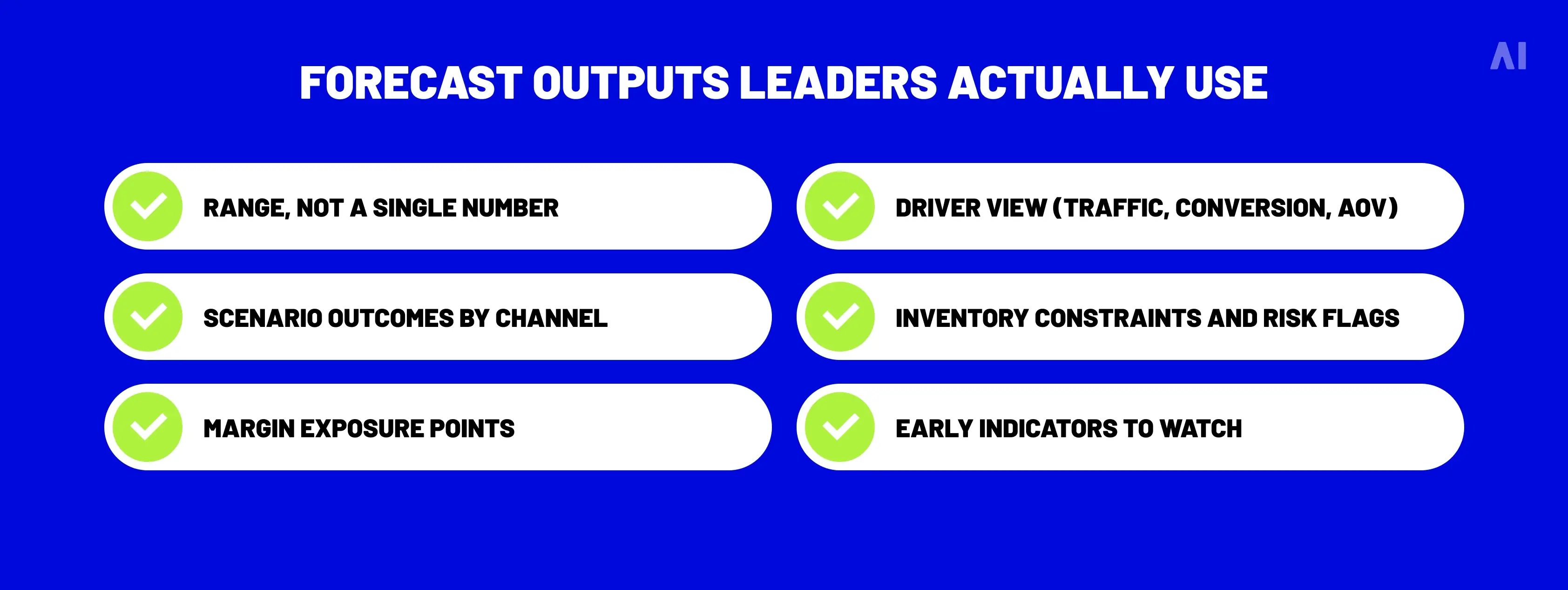
Those drivers determine what you should do next. A forecast that only outputs a revenue line might be accurate yet still unhelpful, because it doesn’t tell you how the outcome is being created.
To make demand forecasting more usable, start by adding a short “driver view” alongside the forecast:
- Traffic expectation
- Conversion expectation
- Average order value expectation
- Availability constraints (inventory, fulfillment capacity)
That driver view turns the forecast into a planning tool rather than a number finance approves and everyone else hopes is right.
Marketing and media forecasting
Marketing and media forecasting predicts what performance looks like before you spend the money. That includes outcomes such as:
- Expected sales lift (direct and indirect)
- Customer acquisition volume at different spend levels
- ROAS or MER ranges by channel
- Incremental lift estimates when you have test/control capability
- Pacing and saturation risk (when more budget stops helping)
This is where forecasting becomes a growth discipline, because it forces teams to quantify trade-offs:
- If we shift budget from paid social to retail media, what changes?
- If we move more into CTV for reach, how does that affect short-term performance?
- If we promote earlier, do we pull demand forward or create true incremental sales?
💡 Media forecasting depends on ad platforms and measurement systems, which is why it sits close to the adtech ecosystem. Understanding how auctions, targeting, and optimization work improves the quality of the forecast inputs.
The most useful framing for media forecasting is scenario modelling. You're laying out plausible futures side by side and choosing your commitments based on what you can defend.
⚡ Forecasting doesn't predict what will happen. It helps you weigh what a decision will cost before you've already made it.
Customer behavior forecasting
Customer behavior forecasting predicts what shoppers are likely to do next—repeat, churn, react to a promo, upgrade, lapse, or respond to a specific message. It’s the bridge between short-term performance and long-term growth.
This category includes models and rules such as:
- Churn risk or reactivation likelihood
- Next purchase timing
- Category affinity and cross-sell probability
- Predicted lifetime value direction (not just current LTV)
- Offer sensitivity and promo responsiveness
Customer behavior forecasting becomes especially valuable when you’re trying to grow profitably. Acquisition can be scaled with spend. Retention and margin are harder, and they’re where forecasting helps you stop wasting incentives.
💡 Because behavior forecasting often feeds personalization, it ties closely to AI-driven personalization systems—how models decide who to show what, in which channel, and at what time.
Strategic decisions enabled by retail forecasting
Retail forecasting influences strategy because it changes how confidently you can make commitments across revenue, inventory, pricing, and media. The forecast becomes a “decision engine” when it answers the questions leaders actually have:
- What outcomes are realistic if we keep the same strategy?
- What happens if we change a lever (promo depth, channel mix, inventory availability)?
- What risks are we accepting, and what’s our mitigation plan?
Below are the decisions most directly improved by forecasting, along with how to frame them.
Revenue planning that admits uncertainty
A forecast that claims certainty is usually hiding assumptions. A better forecast shows ranges, confidence, and what would need to be true for the upside case to happen.
NRF’s 2025 outlook is a good example of how credible planning is often expressed as a range rather than a single-point estimate: U.S. retail sales were forecast to grow between 2.7% and 3.7% over 2024, reaching roughly $5.42–$5.48 trillion.
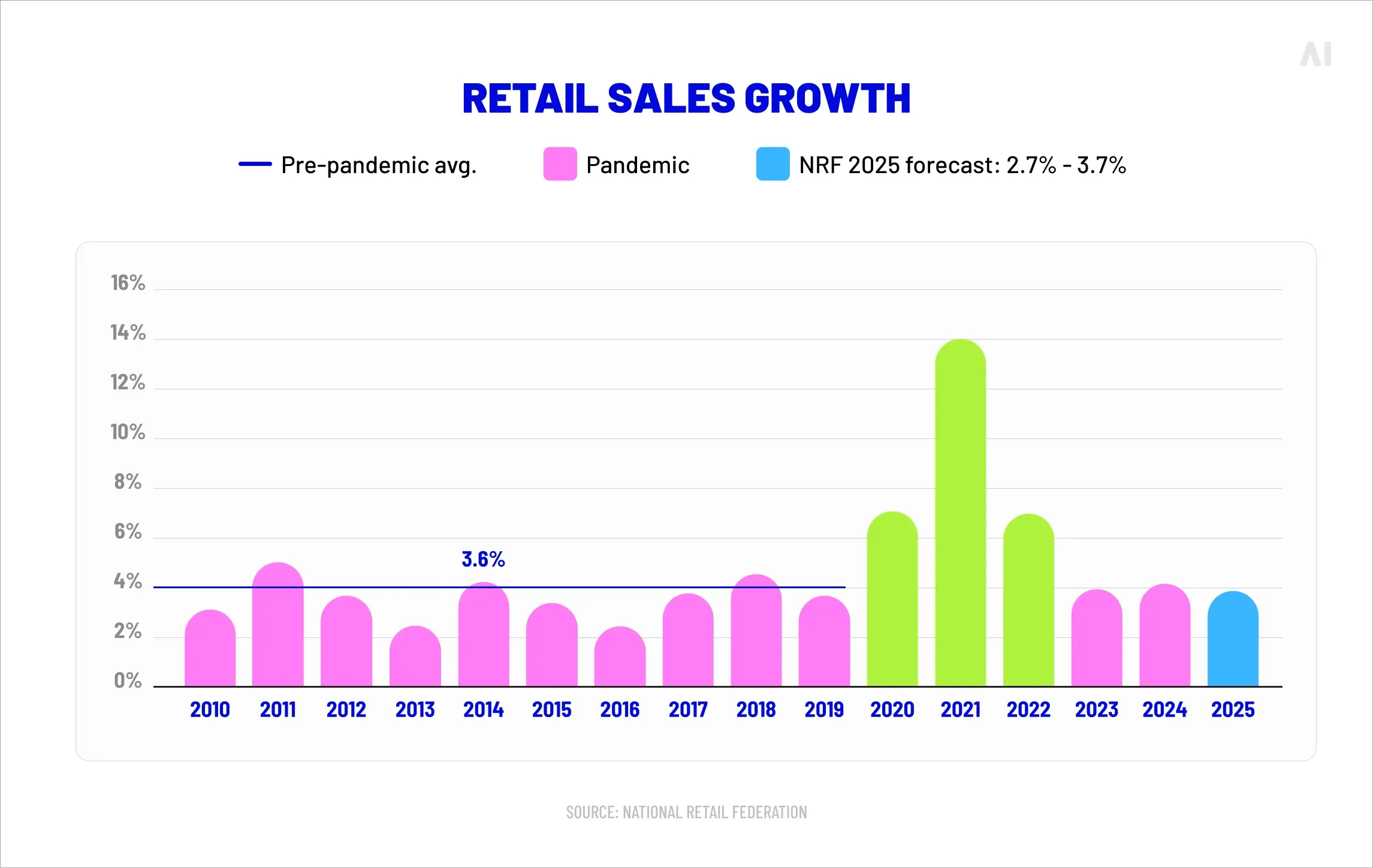
The exact number matters less than the discipline behind it. Plan for a base case, define a tight set of alternate outcomes, and tie your actions to early indicators that tell you which scenario is unfolding.
Inventory balance that matches demand shape
Inventory decisions fail when they assume demand is smooth. It isn’t. Demand moves with promotions, weather, competitor actions, and channel shifts.
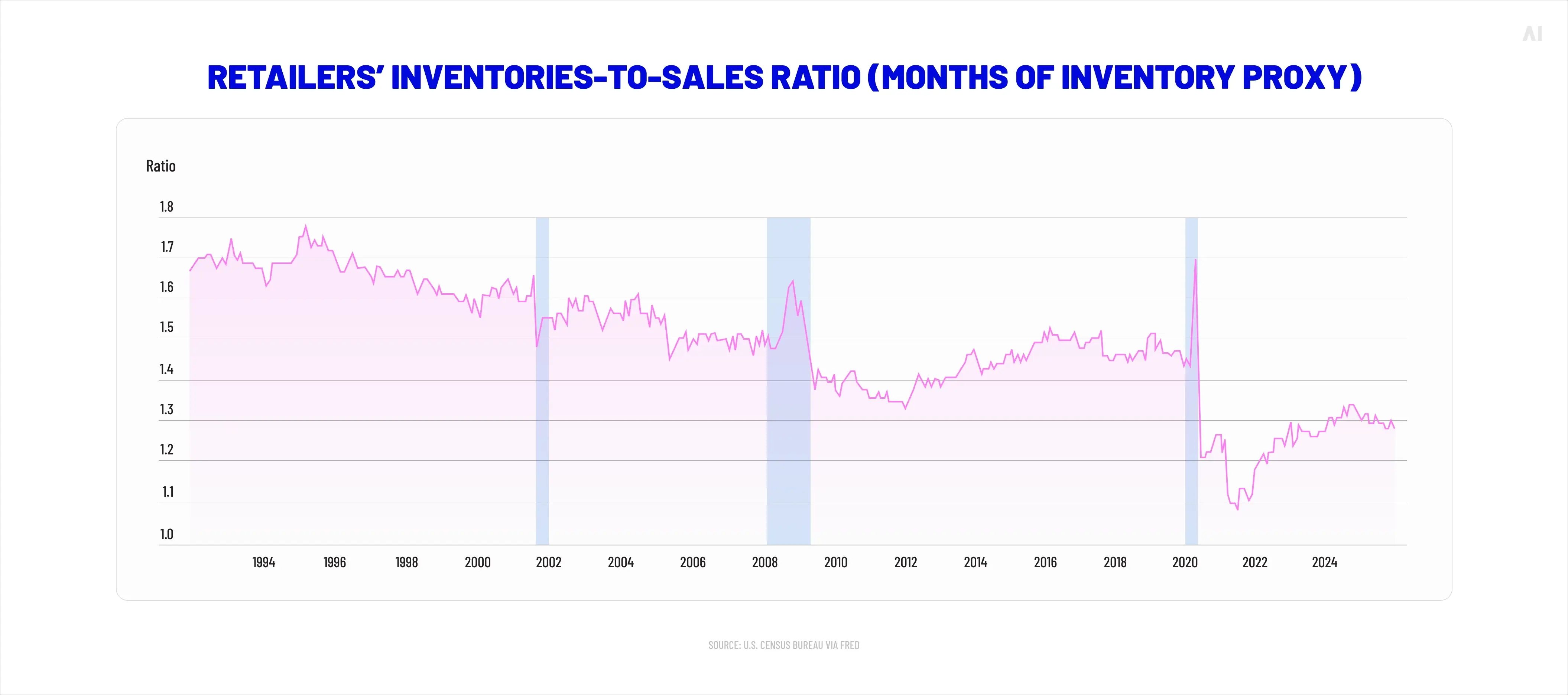
A practical forecasting approach links demand forecasts to inventory policies:
- Safety stock rules by volatility
- Reorder points tied to lead times
- Allocation logic when supply is constrained
- Markdown timing based on sell-through probability
This is also where “bad data” becomes expensive. If inventory availability isn’t reliably reflected in your forecasting inputs, you end up forecasting demand you can’t fulfill—and then blaming marketing for the gap.
Pricing and promotion strategy that avoids self-inflicted chaos
Promotions are a forecasting stress test. They distort baseline demand, change basket mix, and create operational strain. Forecasting makes promotions safer by answering two questions:
- What is the expected lift versus baseline?
- How much of that lift is incremental versus pulled-forward demand?
That second question matters because pulled-forward demand looks great in the moment and then shows up later as a slump. A forecasting discipline that tracks post-promo decay helps teams stop repeating the same mistake with different creative.
Retail media investment timing
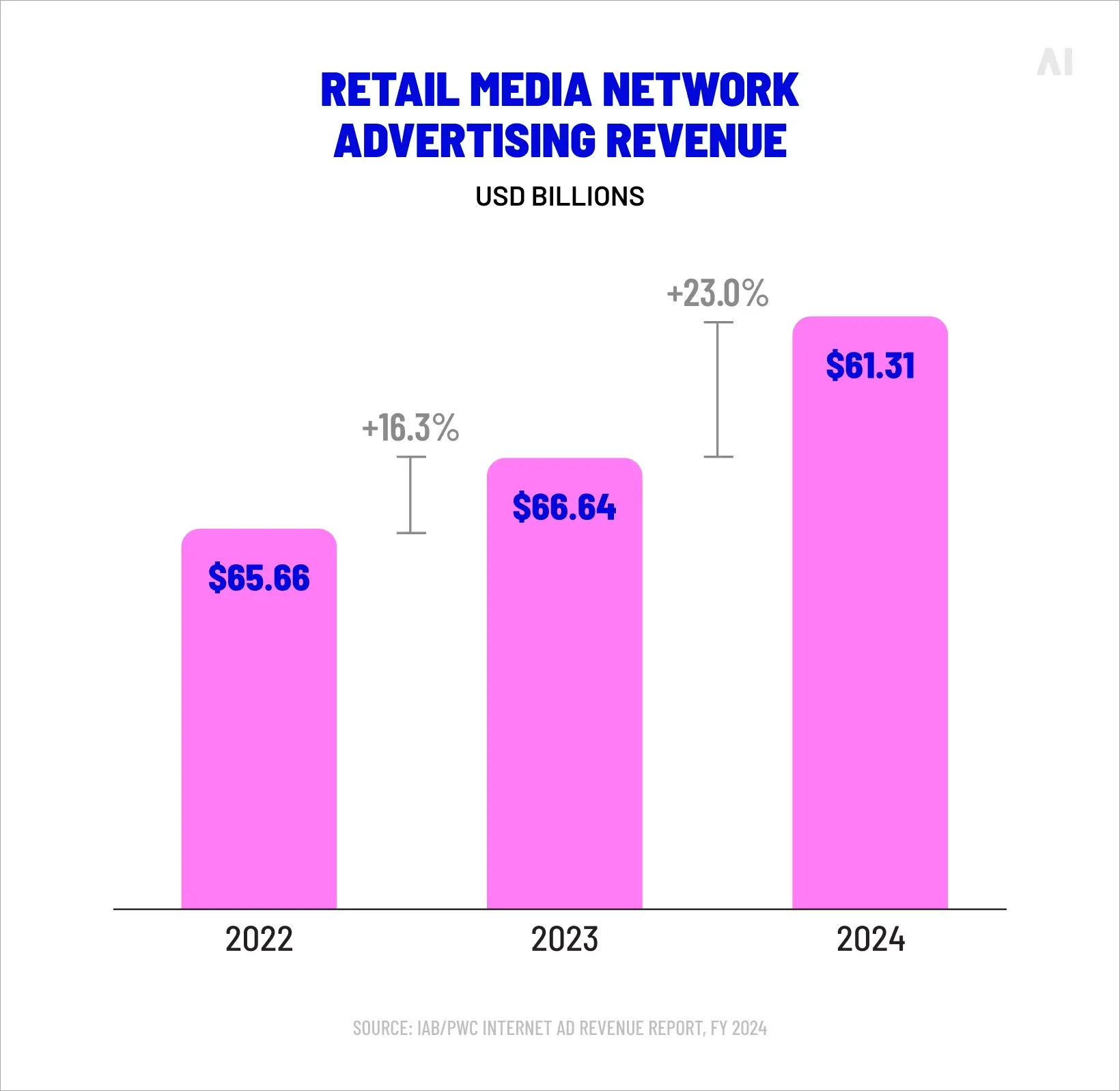
Retail media changes forecasting because it provides shopper data and conversion signals close to purchase. It also changes budget behavior: teams move money faster when they can see outcomes faster.
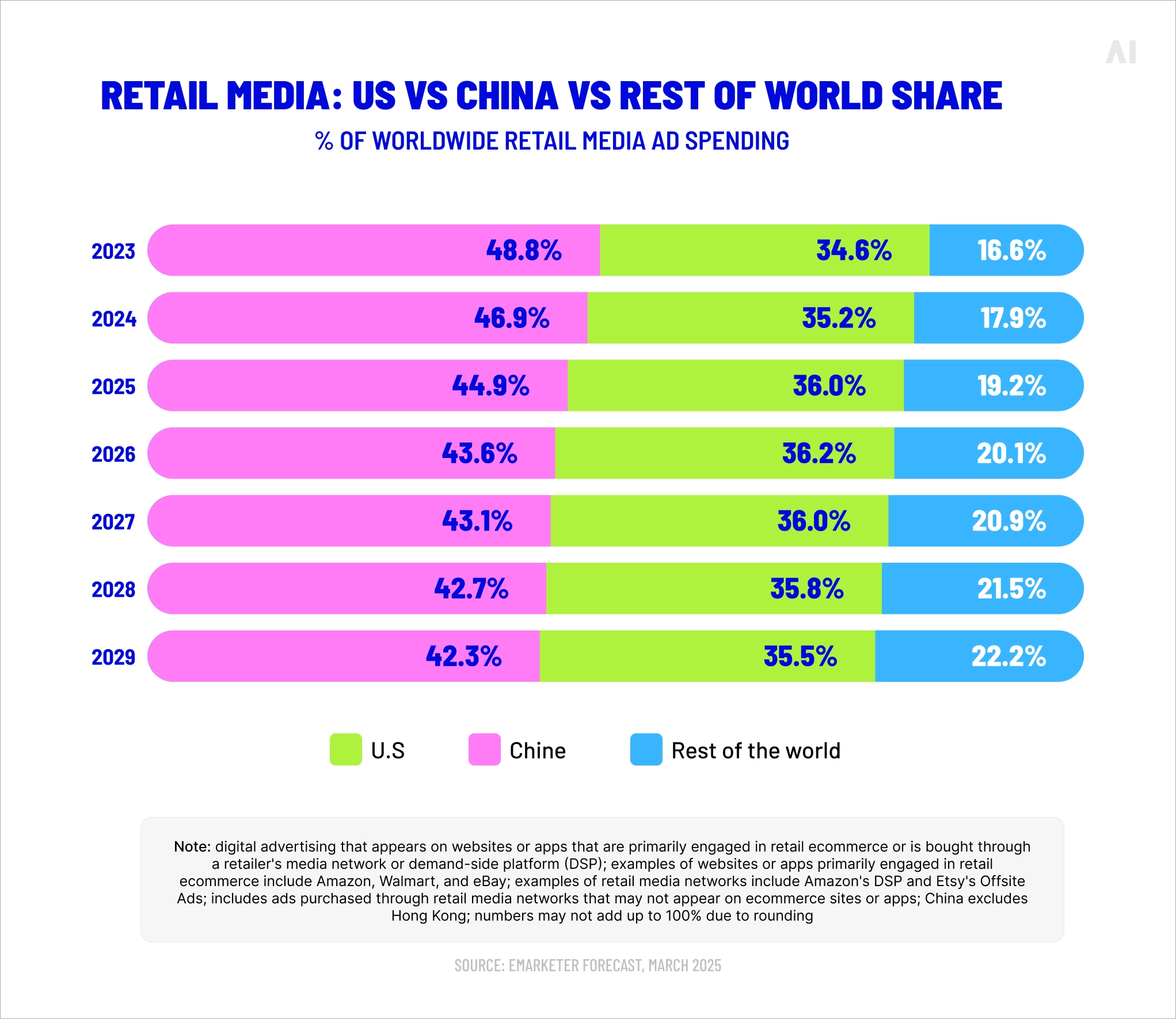
In 2025, U.S. retail media spend was forecast to be roughly $58.79B, with growth continuing into 2026. At that scale, retail media has moved well beyond niche tactic status—it now functions as part of the core demand engine for many retailers and brands.
Forecasting helps you decide:
- How much budget should sit in “always-on” demand capture
- How much should be reserved for seasonal surges
- When to invest in upper-funnel channels that feed retail media outcomes later
💡 If you want a deeper breakdown of how retail media networks operate and why their measurement is structured differently, AI Digital’s overview of RMNs is a helpful primer.
Channel mix decisions grounded in reality
Retail is now structurally multichannel. Even when you sell primarily in-store, online behavior affects in-store demand.
The U.S. Census Bureau’s quarterly e-commerce report illustrates this shift in a tangible way: in Q3 2025, e-commerce accounted for 15.8% of total retail sales, with e-commerce growing faster than total retail.
Forecasting turns that kind of signal into action by asking: if digital demand is growing faster, are we forecasting the right fulfillment load, customer support volume, and media mix?
The data and technology behind accurate forecasts
Forecast accuracy depends on inputs more than algorithms. Better modeling helps, but only after you’re confident in what’s flowing into the model.
A clear way to think about forecast inputs is to group them into four categories:
- Commerce performance data (sales, units, conversion, basket, returns)
- Pricing and promotion signals (price changes, promo depth, calendar effects)
- Customer and audience signals (segments, repeat behavior, loyalty, propensity)
- Media and supply path signals (delivery, quality, cost dynamics, audience reach)
{{26-Retail-Demand-Forecasting-3="/tables"}}
The fourth category is often underweighted in retail forecasting. Yet media delivery quality and cost dynamics directly shape demand creation, especially when you rely heavily on programmatic buying and retail media.
Why DSP intelligence matters
Forecasts break when paid media performance gets treated as a fixed input. In reality, cost and delivery are influenced by auctions, targeting constraints, creative fatigue, and inventory access.
💡 That’s why AI inside DSPs matters: it affects how spend translates into reach and conversions, and it can change performance quickly when algorithms shift.
What this means for forecasting is simple. Your assumptions should move at the same speed as your media reality. When costs rise, inventory access shifts, or a platform throttles delivery, the forecast needs to reflect that before you make your next commitment.
.webp)
Why supply chain transparency matters (even for forecasting)
“Supply chain” in this section isn’t about pallets. It’s about the digital advertising supply chain—the path your budget takes before it becomes an impression, a click, or a conversion.
If you assume media quality is consistent but your supply path is not, your forecast will drift. You’ll attribute performance changes to seasonality or creative when the real issue is that you’re buying different inventory through a different route.
💡 For a clear breakdown of how the digital advertising supply chain works and where value can leak, see AI Digital’s explainer.
The role of AI as a practical tool, not a buzzword
AI improves forecasting in two ways:
- It can detect non-obvious patterns (combinations of signals that correlate with demand shifts).
- It can update more frequently without forcing analysts to rebuild models constantly.
In a 2025 supply chain survey summary, ABI Research noted that many leaders consider AI capabilities important in technology decisions, reflecting broader momentum toward AI-assisted planning.
This doesn't require an all-in bet on AI. It does require acknowledging that planning cycles are accelerating faster than manual workflows can comfortably handle.
Retail forecasting methods: from traditional models to predictive AI
Forecasting methods sit on a spectrum. Most retailers use a combination, even if they don’t label it that way, because different decisions need different levels of precision, speed, and explainability.
A useful rule is to match methods to decision risk.
- Low-risk decisions (light promo tweaks, weekly staffing adjustments, minor budget shifts) can rely on simpler models that are easy to explain and maintain.
- High-risk decisions (seasonal buys, big promo calendar changes, major channel reallocation, new market launches) need deeper scenario work, tighter monitoring, and faster refresh cycles.
{{26-Retail-Demand-Forecasting-4="/tables"}}
One more practical distinction: as you move along the spectrum, you’re not only changing the model. You’re changing the operating rhythm around it—how often inputs update, how quickly you detect drift, and how confidently different teams can act on the output.
Traditional foundations
Traditional forecasting is built on structured historical analysis. It includes methods such as:
- Trend analysis (what direction are we moving, and how fast?)
- Seasonality modeling (what repeats, when, and at what magnitude?)
- Regression models (how do drivers like price, promo depth, and traffic relate to outcomes?)
- Baseline modeling (what happens without a promo or major change, so lift can be isolated?)
These approaches are still useful because they force discipline. They make you define baselines and drivers rather than relying on intuition. They also tend to be easier to communicate across teams, which matters when finance, merchandising, and marketing need to trust the same number.
Traditional methods struggle when the business changes shape: new channels, new fulfillment options, major assortment shifts, or a step-change in media costs. In those moments, the model can be “accurate in the past” and quietly wrong in the present.
To keep traditional models practical, add a short assumptions sheet next to the forecast. It should state:
- What period defines the baseline (and why that period is representative)
- How promotions are normalized (and how you treat unusually deep discounts)
- How stockouts and availability constraints are handled (ignored, imputed, or modeled explicitly)
- Which external factors are included (holiday shifts, weather events, competitor pricing) and which are not
- The time horizon the model is reliable for, plus what “reliable” means (error tolerance, confidence bands, bias)
That assumptions sheet reduces the most common forecasting failure: different teams arguing over the number when they’re actually disagreeing on the inputs.
Predictive AI modeling
Predictive AI forecasting uses machine learning to generate forward-looking estimates based on patterns in large, multi-source datasets. It can capture non-linear relationships and interactions that are hard to model manually, especially when drivers move together (for example, promo depth changes conversion, which changes inventory position, which changes delivery experience, which changes conversion again).
In plain terms, predictive AI helps when:
- There are many interacting drivers (price, promos, media, weather, competitor activity)
- The business changes quickly (new channels, new customer mix, new assortment)
- You need frequent updates (weekly or daily forecasting cycles)
The key is positioning predictive AI as decision support, not expecting it to produce a single definitive answer.
The best implementations keep humans responsible for the questions and constraints:
- What decisions are we supporting?
- What risks are unacceptable?
- Which metrics define success (margin, availability, CAC, repeat rate)?
- What constraints matter (inventory, fulfillment capacity, brand rules)?
Two execution details make or break AI forecasting in practice:
- Backtesting that matches reality. You test models on historical periods that include promotions, holidays, and channel shifts, not just “clean” weeks.
- Monitoring for drift. The model needs simple alerts when performance changes (rising costs, falling conversion, new promo patterns) so you don’t keep trusting a forecast built for yesterday’s conditions.
💡 If you’re building this inside a marketing organization, it often lives alongside an advertising intelligence layer that unifies performance signals across platforms and turns them into decisions you can defend.
⚡ Models won't do your thinking for you. What they will do is expose whether any real thinking happened in the first place.
Unified cross-channel forecasting
Unified cross-channel forecasting is where retail forecasting becomes most strategic. Instead of predicting sales in isolation, it links demand creation across channels to business outcomes, so you can plan growth without double-counting impact or relying on last-click logic.
That means combining:
- Retail media signals (on-site and off-site)
- Programmatic display/video, including CTV
- Paid social and search
- Owned channels (email/SMS/app)
- Commerce outcomes (sales, returns, margin)
A single model that explains everything sounds appealing but misses the mark. Business-aligned projections built on ranges, not false certainty, give leaders something far more useful: a clear basis for deciding where to invest and what to expect.
A unified forecast is usually built on three practical moves:
- Standardize outcome definitions. Decide what counts as a conversion, how returns affect revenue, and how you treat in-store versus online outcomes.
- Calibrate channel impact. Use experiments, lift studies, or controlled comparisons where possible so channels aren’t judged purely on attribution artifacts.
- Run scenario curves, not single points. Estimate “if spend changes by X, outcomes move by Y” and show confidence bands so leaders can see both upside and risk.
A practical unified forecast answers questions like:
- If we shift 15% of budget into retail media for six weeks, what is the expected sales lift range?
- What happens to CAC and repeat rate if we reduce discount intensity but increase targeting quality?
- How much of a seasonal spike can we support given current inventory and fulfillment constraints?
How to build a practical retail forecast
A practical retail forecast is a workflow, not a spreadsheet. It’s the process your team can run repeatedly without heroics.
The steps below are designed to be executed by teams with a medium level of technical depth—strong analysts, solid channel operators, but not necessarily a research lab.
Before the steps, one important framing: the goal is not to predict perfectly. The goal is to reduce bad surprises and make decisions earlier, with better inputs.
Align goals, data, and teams
The first step is to align on what the forecast is for. Different goals produce different forecasts.
Start by making three things explicit:
- Which decisions the forecast will support (inventory buys, promo timing, budget allocation, expansion targets)
- Which metric defines success (revenue, contribution margin, CAC, repeat rate, inventory turns)
- Which constraints cannot be violated (service level, margin floors, brand rules, capacity limits)
Now map the data you need. Keep it simple at first:
- Sales and product data (by channel and category)
- Pricing and promotions (calendar + depth)
- Media delivery and performance (spend, impressions, clicks, conversions, cost)
- Customer signals (new vs returning, loyalty tiers, repeat cadence)
After you map the data, you need owners. Forecasting fails quietly when no one owns the inputs.
To make ownership clear, here’s a short checklist you can assign:
- Commerce analytics owns revenue and conversion definitions
- Merchandising owns pricing and promo inputs
- Marketing owns media and creative inputs
- Finance owns planning horizons and scenario requirements
- Ops owns availability constraints and fulfillment capacity
That ownership model actually speeds things up by eliminating the recurring argument over which "truth" to use.
Model scenarios across channels
Once alignment exists, you build scenarios. Scenario modeling is where forecasting becomes useful for leadership decisions.
At minimum, build three scenarios:
- Baseline scenario: what happens if you keep today’s strategy
- Growth scenario: what happens if you add investment (and where)
- Constraint scenario: what happens if costs rise or inventory tightens
{{26-Retail-Demand-Forecasting-5="/tables"}}
Before you list scenarios, include a short statement of what will change between them. Then keep the differences controlled—otherwise you won’t know what caused the outcome change.
Here’s a practical way to define scenario levers. Use only what you can actually influence:
- Budget by channel (including retail media and programmatic)
- Promo calendar changes (timing + depth)
- Pricing adjustments (category-level if needed)
- Inventory availability assumptions (best case / expected / constrained)
- Audience strategy changes (prospecting vs retention balance)
💡 Once scenarios are defined, you compare them using a consistent scorecard. A performance marketing framework is useful here, because it gives you a shared language for how spend turns into outcomes.
After you compare scenarios, summarize them in plain English. Leaders need the implication, not the model detail:
- “This plan grows revenue, but margin is exposed if CAC rises.”
- “This plan protects margin, but inventory risk increases.”
- “This plan requires availability we do not have.”
Continuously optimize with real-time signals
A forecast becomes fragile when it’s updated too slowly. The solution isn’t to rebuild everything daily. It’s to define which signals should trigger an update.
Start with a weekly cadence for most retailers, then tighten where volatility is high (peak seasons, major promos, high-spend periods).
Signals that should trigger forecast updates include:
- Media cost changes (CPM/CPC shifts, auction pressure)
- Conversion changes (site issues, offer fatigue, fulfillment delays)
- Inventory constraints (stockouts, late deliveries, allocation changes)
- Competitive moves (major category discounts, shipping changes)
- Assortment shifts (new product, discontinued SKUs, vendor delays)
{{26-Retail-Demand-Forecasting-6="/tables"}}
Before you implement this, add a short “what we changed” note each update cycle. Forecast drift is easier to manage when you can trace why the forecast moved.
Turning forecasting into predictable growth
Forecasting becomes a growth engine when it is tied to execution loops. That means you forecast, act, measure, learn, and update—without waiting for quarterly resets.
A practical “forecast-to-growth” loop has three layers:
- Planning layer: scenarios, targets, constraints
- Activation layer: channel execution, promos, inventory allocation
- Learning layer: measurement, incrementality where possible, model updates
To put it differently, forecasting becomes “predictable growth” when:
- the forecast is tied to real levers,
- updates happen at the speed the business changes,
- and results are fed back into future scenarios.
💡 If your forecasting work is detached from your media operating model, it will stay theoretical. That’s why it’s useful to align forecasting with modern media planning and buying practices—channel orchestration, pacing, and measurement discipline.
When businesses should upgrade their forecasting approach
Most retailers don’t need a full rebuild on day one. They do need to recognize when the current approach is no longer safe.
You should consider upgrading your forecasting approach when you see signals like these:
- Multi-channel complexity increases: more channels, more data, more interactions, less clarity.
- CPAs rise without clear explanation: performance changes faster than your planning cycle.
- Inventory volatility increases: availability shifts invalidate older assumptions.
- Retail media becomes material: RMNs move from “test” to “core budget line.”
- CTV and video enter the mix: upper-funnel investment needs stronger scenario logic.
- Teams argue over numbers, not decisions: forecasting has become a political artifact rather than a planning tool.
The simplest diagnostic is this question: Do you trust your forecast enough to commit inventory and budget at the same time? If the answer is no, your forecast is not integrated enough yet.
Conclusion: From forecasting in retail to growth strategy
Retail forecasting earns its place when it connects demand signals, marketing performance, and revenue planning inside one decision loop. The payoff is fewer blind spots when commitments are on the line—something no reporting upgrade can deliver on its own.
One principle worth carrying forward from this guide: stop chasing the perfect forecast and start building one that sharpens decisions. Ground it in clear drivers, model scenarios around the levers you actually control, and update it the moment the landscape shifts.
If you'd like to pressure-test your current forecasting approach—from inputs and scenarios to how media and retail signals connect—AI Digital's team can help you design a model that's practical, measurable, and built around growth decisions.


