From Data to Decisions: How Marketing Intelligence Transforms Performance Strategy


The better the tracking has become, the harder it is to say what actually works. Two decades of investment in analytics have given marketing teams a near-complete record of what happened — every impression, click, view and visit, logged and dashboarded — and left them, in many cases, less certain about cause than they were when they had far less to go on.
The reason is that measurement and proof are not the same thing, and the gap between them has widened as channels have multiplied. A platform can tell a brand, accurately, that it served the impression before the sale. It cannot tell the brand whether the sale would have happened anyway. Multiply that limitation across paid search, social, programmatic, CTV, email, the CRM and a lengthening list of retail media networks — each measuring on its own terms and crediting itself wherever it plausibly can — and a marketing team ends up holding a dozen confident accounts that cannot all be true. Spending has followed the anxiety rather than resolved it: the CMO Survey, run since 2008 by Duke University's Christine Moorman with Deloitte and the American Marketing Association, finds data analytics ranked as the single biggest marketing investment priority, as leaders fund the collection of data faster than they build the means to act on it.
Marketing intelligence is the name for that second capability. Where analytics records and attribution apportions, a marketing intelligence system reconciles — pulling the scattered, self-interested signals from across channels into one view coherent enough to decide from, then carrying that view forward into the choices that govern performance.
What follows sets out what marketing intelligence means in practice, the distinct kinds of signal that feed it, and how it sharpens the decisions behind performance — and connects them to the systems that buy and run media.
Why marketing intelligence emerged
Marketing intelligence emerged because the older tools stopped answering the questions leaders were being asked. For most of the past decade, the standard measurement kit — platform dashboards, last-click attribution, a weekly performance report — was adequate because the environment was simpler. Fewer channels, more reliable user-level tracking, and a tolerance for "the platform says it worked" that no longer exists.
Three pressures changed that.
- The first is channel proliferation: a campaign that once ran across three or four platforms now spreads across a dozen, each with its own measurement logic and none of them designed to talk to the others.
- The second is signal loss. Consent requirements, mobile tracking restrictions, and the data that walled-garden platforms keep to themselves have all thinned out the user-level record that attribution models were built on — a constraint that persists regardless of the on-again, off-again status of third-party cookies.
- The third is accountability. Finance teams have grown sceptical of media metrics that do not reconcile with revenue, and the pressure to prove commercial impact has hardened. In The CMO Survey's most recent readings, demonstrating the effect of marketing on financial outcomes remains the top challenge marketing leaders name, and more acutely for B2B firms with long buying cycles.
Dashboards and attribution were never designed to carry that weight. A dashboard records; it does not recommend. An attribution model distributes credit within a click path; it cannot tell you whether the path would have converted anyway. Marketing intelligence is the response to a measurement stack that can show a marketer a great deal and still leave them unsure what to do on Monday morning.
What marketing intelligence actually means
Marketing intelligence is the practice of turning marketing data into decisions — a system for converting signals from across channels into insight that improves performance, sharpens forecasting, and guides where investment goes. The word system matters more than it looks. A single clever report is not intelligence. Intelligence is the connected capability to gather data from everywhere it lives, reconcile it into a consistent picture, interpret what the picture means for the business, and feed that interpretation back into planning and optimization on a cadence fast enough to be useful.
What separates it from the analytics function most teams already run is direction.
- Analytics looks backward and describes.
- Marketing intelligence looks forward and prescribes, treating the historical record as raw material for forecasts and recommendations rather than as the finished product.
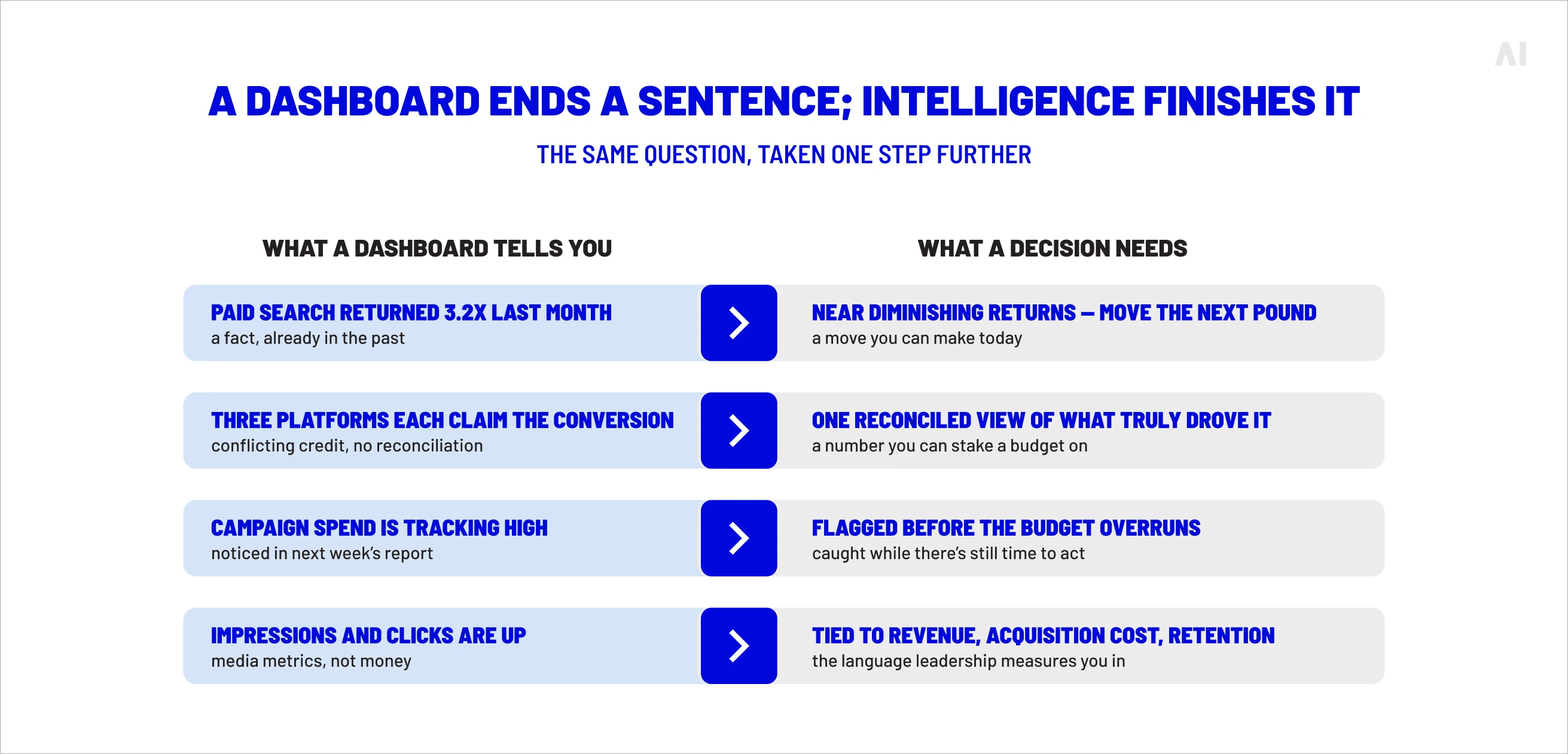
It is the difference between a report that tells you paid search delivered a 3.2 return last month and a system that tells you paid search is approaching diminishing returns and the next pound is better spent on CTV.
💡 Related reads: Marketing measurement strategy: how to measure and optimize performance across channels
Marketing intelligence vs business intelligence
Business intelligence and marketing intelligence are often confused because both turn data into reporting, but they answer to different masters.
- Business intelligence serves the whole enterprise — finance, operations, supply chain, HR — and is built around operational and financial reporting: revenue by region, inventory turns, headcount, margin. It is generalist by design, optimized to give leadership a reliable read on the state of the company.
- Marketing intelligence is the specialist. It is built specifically to improve marketing performance, and so it concerns itself with things a general BI tool handles poorly or not at all: audience behaviour, campaign efficiency, channel contribution, creative performance, competitive positioning, and the forecasting that informs media planning.
A finance dashboard can tell you marketing spent £4m last quarter. It takes marketing intelligence to tell you which £400,000 of that was wasted, and where it should have gone instead.
Marketing intelligence vs attribution reporting
Attribution reporting and native platform analytics remain useful, but they describe a narrower world than marketing intelligence does.
Attribution assigns credit for conversions to the touchpoints in a user's path — a genuinely valuable input for tactical, in-channel optimization. Its limits show the moment you ask a question that lives outside the click path: what did upper-funnel activity contribute, how did offline media perform, what would have happened without the campaign at all. Platform analytics carry an additional problem, which is that the platform reporting on performance is also the party selling the media. The numbers may be accurate within their own frame and still flatter the channel that produced them.
Marketing intelligence treats attribution as one signal among several rather than the answer. It sits above the individual platforms, reconciles their competing accounts, and adds the forecasting and causal measurement that attribution alone cannot supply. The deeper mechanics of why traditional attribution falls short — and where causal methods take over — are worth a piece of their own, and we link to those below.
💡 Related reads: Marketing Analytics vs Marketing Intelligence: Why the Difference Matters for Growth
The table below sets the four approaches side by side, since the distinctions are easy to blur in conversation and expensive to blur in practice.
{{dtd-1}}
Why dashboards alone are not enough
A dashboard shows you the data; it does not decide anything for you. That distinction is the reason so much measurement investment fails to translate into better performance. Teams buy visibility and assume intelligence will follow, when in practice the two are separated by a layer of interpretation and action that most dashboards leave entirely to the human staring at them.
The problem compounds when the tools multiply. Marketing technology now absorbs roughly a fifth of the typical marketing budget, and a meaningful share of those platforms sit underused or redundant, according to Gartner. Every new dashboard adds a view without adding a decision. Three structural problems recur: reporting arrives too late to act on, each platform reports a different version of the truth, and even when the data is timely and reconciled, most teams lack the analytical capacity to convert it into a move before the next planning cycle. Intelligence is the layer that does the converting.
The intelligence signals marketers use to improve performance
Marketing intelligence draws on four distinct kinds of signal, and strong teams treat them as a portfolio rather than picking one. Each answers a different strategic question, draws on different data, and supports a different class of decision. Understanding them separately is what stops "marketing intelligence" from collapsing into a vague synonym for "having dashboards."
The table below summarises the four before we take each in turn.
{{dtd-2}}
Customer intelligence
Customer intelligence is the work of understanding who responds to your marketing and why. It draws on behavioural data, audience insight, customer-journey mapping, and lifecycle analysis to sharpen the four things that move performance most: who you target, how you keep them, how personally you can speak to them, and how efficiently you acquire the next cohort.
The richer the behavioural picture, the less a brand relies on demographic guesswork and the more it can act on observed intent. This is the signal that powers the move from broad targeting to genuinely audience-led media.
💡 Related reads: AI targeted advertising | Ad personalization
Competitive intelligence
Competitive intelligence is the systematic monitoring of what rivals are doing — their campaigns, pricing moves, messaging, media investment, and market positioning — so that strategy is set against the field rather than in a vacuum.
It is a fast-formalising discipline: the competitive-intelligence-tools market was valued at around $0.71bn in 2025 and is forecast to reach roughly $4bn by 2034, a compound growth rate above 20%, with North America the largest regional share. Gartner now maintains a dedicated Magic Quadrant for competitive and market intelligence platforms — a useful tell that buyers increasingly treat this as core infrastructure rather than an occasional research exercise.
The value is directional: knowing where a competitor is concentrating spend tells you as much about where the gaps are as where the contest is.
Performance intelligence
Performance intelligence is the signal that asks the hardest question in marketing — what is actually working, and by how much. It leans on cross-channel measurement, incrementality testing, forecasting, and efficiency analysis to separate the activity that creates outcomes from the activity that merely captures credit for them.
This is where marketing intelligence does its most commercially significant work, because it is the signal a finance team will accept as evidence.
The causal methods that underpin it — media mix modelling, geo experiments, holdout testing — are a substantial subject in their own right, and we treat them in depth elsewhere in the series.
⚡ Knowing which channel converted is cheap. Knowing which combination, at which spend, produces the next unit of growth is the whole game.
Market intelligence
Market intelligence widens the lens from the campaign to the category. It tracks emerging trends, shifts in customer demand, new opportunities, and the structural changes reshaping an industry, feeding the long-range decisions that campaign data alone cannot inform.
Where performance intelligence optimizes the plan you already have, market intelligence questions whether it is still the right plan.
A brand watching demand migrate toward a format it has not funded — short-form video, retail media, a new CTV environment — learns it from market intelligence first, and from declining campaign performance second, by which point the move is overdue.
Why marketers need connected marketing intelligence
The shortcoming of most marketing measurement is not a lack of data but a lack of connection between the pieces. A team can hold customer insight in one tool, performance data in another, and competitive research in a slide deck, and still be unable to answer a straightforward planning question, because nothing joins them. Connected marketing intelligence is the move from a collection of disconnected views to a single environment where forecasting, optimization, and reporting draw on the same reconciled data.
💡 Related reads: Performance marketing strategy | Integrated marketing systems: why connected operations drive better performance.
The limits of fragmented reporting
Fragmented reporting produces delay, doubt, and blind spots in roughly equal measure. When each platform reports in its own taxonomy and on its own cadence, the work of reconciling them by hand becomes a job in itself — and a slow one, performed after the fact, with the campaigns it describes already weeks into flight. Inconsistent metrics across systems erode confidence in any single number, and budget debates drift back toward opinion because no reconciled figure commands agreement.
The deeper structural causes of this — how silos differ from genuine fragmentation, and how walled gardens entrench it — we cover separately, since the mechanics deserve more room than a single section allows:
💡 Related reads: Walled gardens vs open internet | Alternatives to walled gardens
Building unified intelligence workflows
A unified workflow is what turns scattered tools into a system. Rather than exporting from one platform, cleaning in a spreadsheet, and rebuilding the same report every cycle, a centralised intelligence environment connects reporting, forecasting, optimization, and performance analysis so that an insight in one feeds a decision in another.
The gain is partly speed and partly consistency: teams stop re-litigating which version of a number is correct and start working from a shared one. That consistency scales in a way manual reconciliation never does, across more channels and more people, without the error rate climbing in step.
💡 Related reads: Unified marketing measurement: why attribution alone no longer works.
Cross-platform normalisation and signal quality
Connected intelligence is only as good as the data poured into it, which makes normalisation the unglamorous foundation everything else rests on. Standardized taxonomies, a consistent attribution logic, shared reporting frameworks, and clean inputs are what allow signals from a dozen sources to be compared at all. Without them, unification simply collects the inconsistencies in one place. A conversion defined three ways across three platforms does not become one conversion because the data now lives in the same environment; it becomes a reconciliation problem that has merely changed address. Getting the inputs clean is the difference between intelligence and an expensive aggregation of noise.
💡 Related reads: Sustainable programmatic supply path
Moving toward predictive intelligence
The endpoint of a connected system is prediction rather than description. Once data is unified and clean, AI-driven forecasting, anomaly detection, and automation let a team move from reacting to last week's numbers toward anticipating next week's — flagging a campaign trending toward overspend before the budget is gone, surfacing an audience that is outperforming, catching a measurement anomaly the moment it appears. This is the threshold where reporting becomes intelligence, and where the underlying data work pays back.
First-party data is increasingly the fuel for it: The CMO Survey records marketers raising first-party data from about 11% of digital budgets toward roughly 16% heading into 2026, precisely because predictive models are only as reliable as the owned signal beneath them.
💡 Related reads: Digital experience analytics
How marketing intelligence improves business performance
The case for marketing intelligence is ultimately a commercial one: it improves the quality and speed of the decisions that determine where money goes and what it returns. Four improvements account for most of the value.
💡 Related reads: Advertising intelligence
Smarter budget and media decisions
The first and most measurable gain is allocation. Marketing intelligence identifies which channels are genuinely pulling their weight, which have hit diminishing returns, and where the next unit of spend will work hardest — replacing the habit of funding channels by last year's split or by whichever platform claimed the most credit. Wasted spend shrinks not because budgets get cut but because they get aimed. For an organization spending at scale, even a modest improvement in allocation efficiency compounds into a material number by year end.
Faster optimization and forecasting
Speed is its own form of performance. Real-time insight and predictive analysis let teams respond to a shift in performance while it is still happening, rather than diagnosing it in a retrospective two weeks later. The same forecasting that improves planning accuracy also shortens the loop between a result and the decision it should trigger. A plan that can be adjusted mid-flight, on evidence rather than instinct, is worth more than a perfect plan that can only be evaluated once the spend is gone.
⚡ A forecast's worth is in how early it lets you be wrong, and how cheaply.
Connecting marketing performance to business KPIs
Marketing intelligence earns its place in the boardroom by speaking the language spoken there. Rather than reporting impressions and click-through rates, it connects campaign activity to revenue, profitability, customer acquisition cost, retention, and the growth targets the business is actually measured against.
That translation is what closes the credibility gap behind The CMO Survey's standing finding that proving financial impact is marketers' hardest task. A team that can trace media to outcomes argues for budget from a stronger position than one defending media metrics in isolation.
Measuring the impact of intelligence beyond dashboards
The honest test of a marketing intelligence investment is not how good the dashboards look but whether the business decides better. Useful measures are operational: has forecasting accuracy improved, has the time from data to decision shortened, has spend become more efficient, has the marketing function's overall performance moved.
These outcomes are harder to screenshot than a tidy chart, which is exactly why they matter more. An intelligence capability that produces beautiful reporting and no change in decisions has failed, however impressive the interface.
The challenges limiting marketing intelligence
For all its promise, marketing intelligence runs into real constraints, and naming them plainly is more useful than pretending the path is smooth. Fragmented ecosystems, inconsistent measurement, signal loss, governance gaps, and the limits of attribution all stand between marketing data and reliable strategic decisions.
💡 Related reads:The Problem with Platform-Reported Data: Why You Can’t Trust the Numbers | Advertising governance
The limits of attribution reporting
Attribution's limits deserve restating because so many measurement programmes still rest the bulk of their weight on it. Traditional models and platform-reported metrics increasingly fail to reflect true business impact across long, fragmented customer journeys — over-crediting whatever sat closest to the conversion, blind to anything outside the tracking window, and unable to say whether a credited touchpoint caused the outcome or merely witnessed it. Treating attribution as a complete measurement system, rather than as the tactical layer it is suited to, is now a common source of misallocated budget.
Fragmented platforms and inconsistent data
Disconnected systems do more than slow reporting down; they corrode confidence in it. When taxonomies differ and each platform applies its own reporting methodology, the same campaign can look like a success or a failure depending on which screen you open, and teams lose the shared basis for agreement that decisions require. The operational confusion is real, but the deeper cost is trust: a number that cannot be reconciled is a number nobody will stake a budget on.
Causal measurement
The most reliable answer to attribution's weakness is causal measurement, and it is moving from the margins toward the mainstream of serious measurement programmes.
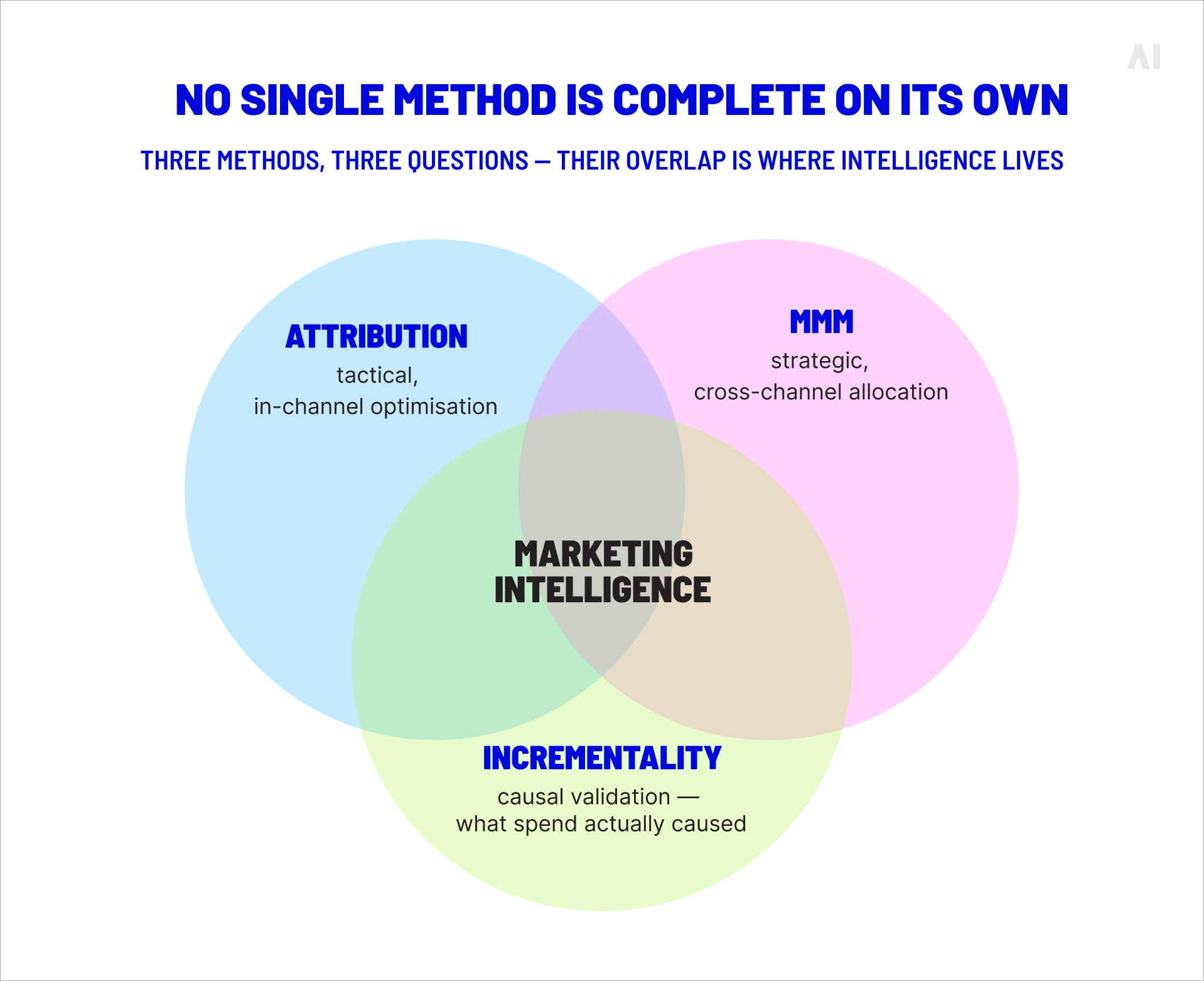
- Incrementality testing isolates the lift a campaign actually caused by comparing exposed and unexposed groups.
- Media mix modelling estimates each channel's contribution from aggregate data, unaffected by signal loss and able to see offline and upper-funnel activity that user-level tracking cannot.
Used together, these methods give marketing intelligence the causal backbone that attribution lacks. The methodology runs deeper than this section allows, and the linked pieces take it apart in detail.
💡 Related reads: Marketing measurement framework: how to build a scalable system | Best incrementality testing tools and platforms
Operational and governance challenges
The last set of constraints is organizational rather than technical, and often the most stubborn. Integration complexity, inconsistent reporting standards, gaps in data governance, siloed teams, and the difficulty of keeping a cross-channel measurement framework accurate over time all conspire to keep intelligence from scaling. Tools can be bought; the operating discipline to feed them clean data and act on their outputs has to be built. More marketing intelligence programmes stall on governance than on technology.
💡 Related reads: Cross-platform measurement governance
How marketers use AI-driven intelligence to improve performance
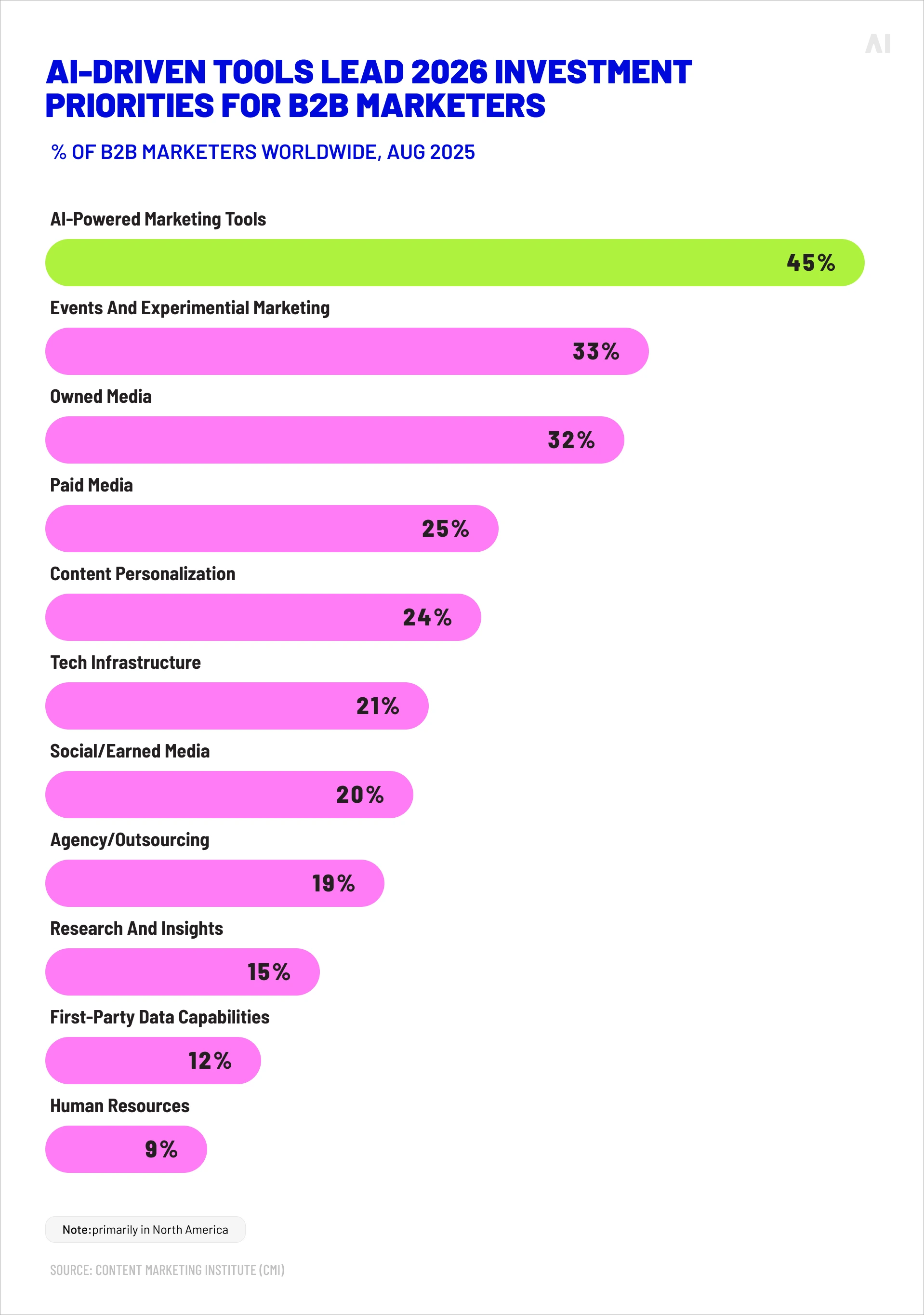
Artificial intelligence is what moves digital market intelligence from reactive to predictive, and adoption has reached the point where it is closer to standard practice than to early advantage. McKinsey's most recent global survey puts AI use at 89% of organizations in at least one function, up from 78% a year earlier, with marketing the second most common area of deployment. Within marketing specifically, The CMO Survey records AI powering 17.2% of marketing work and leaders projecting that to reach 44.2% within three years. The direction of travel is not in doubt; the open question is depth of use.
💡 Related reads: AI in digital marketing
Predictive performance forecasting
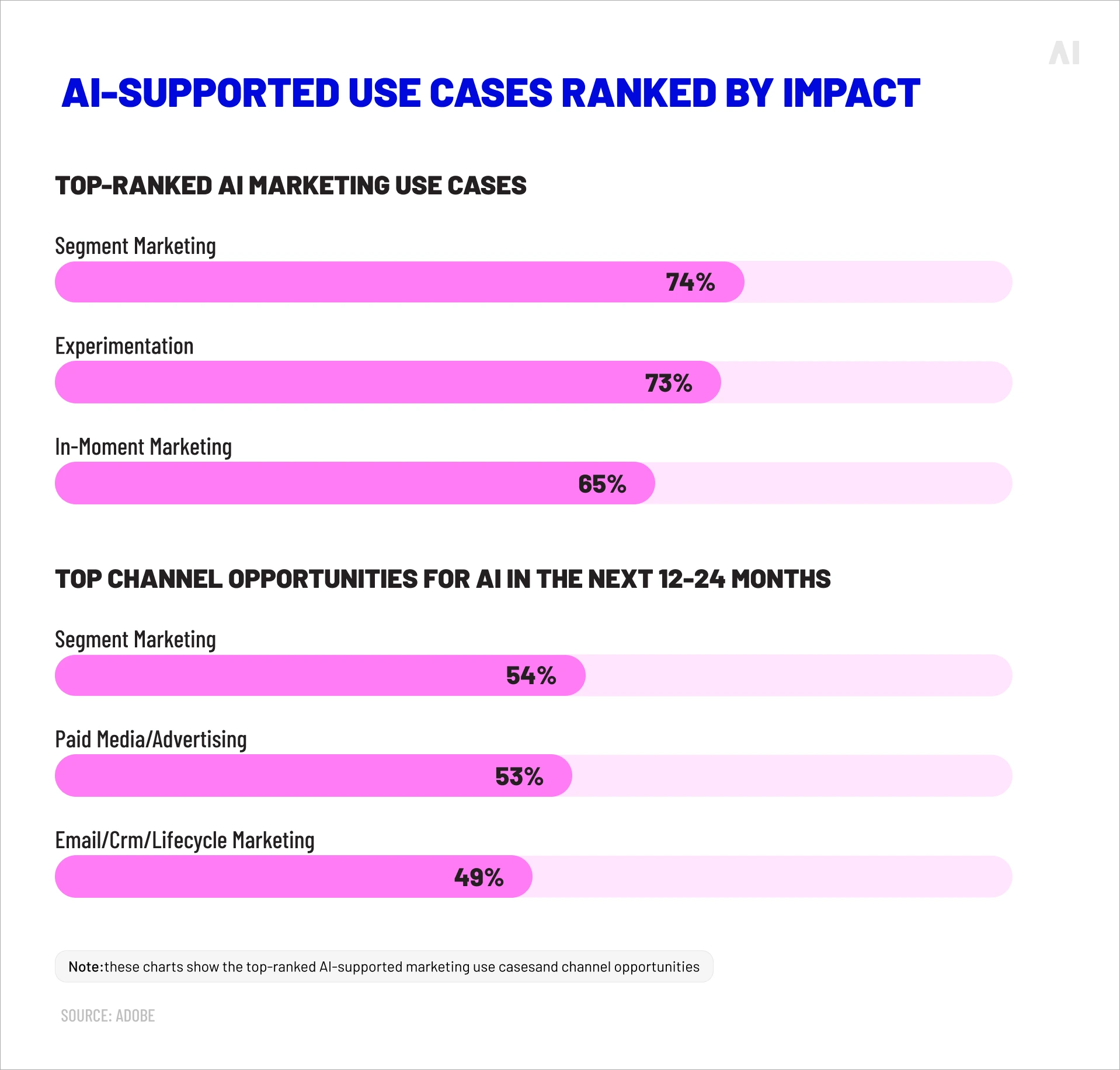
AI-driven forecasting lets marketers act on what is about to happen rather than what already has. Trained on historical campaigns, audience signals, and external variables, predictive models project performance under different budget scenarios with an accuracy spreadsheet-based planning never reached, and flag performance risk before results visibly decline. The practical effect is earlier intervention: a campaign drifting toward inefficiency is caught while there is still budget left to redirect.
💡 Related reads: Retail forecasting
Automated optimization and decision-making
Automation handles the decisions that are too frequent or too granular for human cadence. AI engines reallocate budget toward what is working, detect anomalies as they emerge, and adjust targeting against live performance on a timescale measured in minutes rather than reporting cycles. This produces a closed loop — forecasts inform allocation, allocation produces outcomes, outcomes refine the forecasts — that keeps improving without a person in the chair for every adjustment. The human role moves up the stack, from making each call to setting the objectives and governing the system that makes them.

💡 Related reads: AI in marketing automation
Smarter audience and performance insights
Beyond forecasting and automation, AI is good at finding the patterns a human analyst would need weeks to surface — behavioural clusters, emerging segments, the quiet inefficiency buried three layers down in a cross-channel report. These systems read across campaigns and customer journeys at a scale and speed that changes what is discoverable, turning audience and performance analysis from a periodic exercise into a continuous one. The value is not that AI replaces the analyst's judgement but that it points that judgement at the things worth examining.
💡 Related reads: AI-driven personalisation
Connecting marketing intelligence with media execution
Marketing intelligence delivers its full value only when it is wired into the systems that actually buy and run media. Insight that ends in a slide deck is insight half-spent; insight that flows directly into planning, supply decisions, and live optimization is what changes outcomes. The connection between the intelligence layer and the execution layer is where strategy becomes spend.
AI-powered intelligence and planning
This is the problem AI Digital's Elevate is built to solve. As a marketing intelligence platform, Elevate brings research, planning, optimization, and reporting into one environment, drawing on intelligence from 150 billion data points monthly and more than 10,000 audience attributes so that pre-campaign planning, live optimization, and post-campaign analysis run on the same connected layer rather than in separate tools.
Audience definition, persona generation, competitive analysis, scenario testing, and client-ready reporting sit together, which is what lets a forecast in planning carry through to a decision in optimization without being rebuilt by hand.
The point is continuity: the intelligence that shapes the plan is the same intelligence that adjusts it in flight.
Smarter supply and media efficiency
Intelligence about audiences is worth little if the inventory it buys is wasteful, which is where supply efficiency enters the picture. AI Digital's Smart Supply works to make sure budget reaches quality inventory through direct, efficient paths rather than leaking into the intermediary hops and low-value placements that inflate cost and degrade measurement. Cleaner supply improves the data flowing back into the intelligence layer, which sharpens the next round of decisions — a virtuous loop where efficiency and insight reinforce each other. Supply path optimization is the mechanism underneath this, and we cover it in full separately.
Open ecosystems improve intelligence quality
The quality of any cross-channel intelligence depends on whether the underlying ecosystem lets data move at all. Interoperable, vendor-neutral frameworks unify fragmented platforms, inventory sources, and measurement systems into a picture that closed environments cannot produce on their own.
AI Digital's Open Garden framework is one model for this — an approach designed to connect across platforms rather than lock data inside any single one, on the principle that intelligence built on a partial view of the market is partial intelligence. The more open the ecosystem, the more complete the signal feeding the decisions.
Digital marketing intelligence in modern advertising
Pulled together, digital marketing intelligence is what lets a brand operate coherently across programmatic, paid social, search, and CTV at once — applying consistent targeting, optimization, and forecasting logic across channels that would otherwise each be run on their own terms. The fragmentation that pushed the discipline into being is the same fragmentation it now manages, and the modern advertising operation increasingly assumes an intelligence layer sitting above the channels rather than treating each as a standalone effort.
💡 Related reads: Open web programmatic · CTV advertising trends
Modern marketing intelligence platforms
The platforms built to deliver marketing intelligence vary widely, and the category label hides real differences in what each tool actually does. Some are built to connect and report; some to predict and optimize; the gap between them is the gap between visibility and intelligence. Knowing which problem a platform solves is the first step in choosing one that fits.
Data integration and reporting platforms
The foundational tier collects and unifies. These platforms pull marketing data from across channels, tools, and reporting systems into a single environment, standardising it enough that it can be compared and read in one place. This is necessary work and it is not sufficient on its own: integration solves the where-does-the-data-live problem without touching the what-should-we-do-about-it problem. A team that stops here has bought a very good filing system.
AI-powered marketing intelligence platforms
The advanced tier adds the decision layer. On top of integrated data, these platforms automate reporting, forecast outcomes, optimize campaigns, surface performance trends, and shorten the loop from insight to action. Adoption signals how quickly this has become expected rather than exotic: Salesforce's latest State of Marketing research finds three-quarters of marketers now using at least one form of AI — predictive, generative, or agentic. The distinction from the integration tier is direction of travel; these platforms are built to tell you what to do next, not only what already occurred.
What businesses should evaluate before choosing a platform
Choosing a marketing intelligence platform is less about feature counts than about fit against a handful of criteria that determine whether it will still serve you in three years. Scalability, depth of data integration, transparency in how the platform reaches its conclusions, interoperability with the rest of the stack, governance controls, and readiness for a privacy-constrained data environment all matter more than the length of the feature list. Transparency deserves particular weight: a platform whose recommendations cannot be interrogated asks for a kind of trust that sits awkwardly with the accountability marketers are themselves under
What capabilities define a modern marketing intelligence platform
The table below sets out the capabilities that separate a genuine marketing intelligence platform from a reporting tool wearing the label.
{{dtd-3}}
From intelligence marketing to smarter performance strategy
Marketing intelligence is changing from a reporting convenience into a strategic capability, and the brands treating it that way are pulling ahead of those still mistaking dashboards for decisions. The throughline of this piece has been a single movement: from fragmented reporting toward connected intelligence, from describing the past toward predicting and shaping what comes next, from media metrics toward business outcomes. Causal measurement supplies the rigour, AI supplies the speed and the foresight, and a connected platform supplies the environment where the two become decisions rather than slides. The teams that win are not the ones with the most data. They are the ones whose data reliably becomes the right move.
That is the work AI Digital does. Through the Elevate marketing intelligence platform, Smart Supply's approach to efficient inventory, and the vendor-neutral Open Garden framework, the aim is to connect intelligence to execution so that strategy reaches the market intact. If your marketing data is producing more reports than decisions, it is worth a conversation.