AI in Marketing Automation: 10 Practical Use Cases for Scalable Growth

AI in marketing automation has shifted from a productivity tool to a core growth infrastructure for modern marketing organizations. Instead of only automating repetitive workflows like email scheduling or lead scoring, AI driven marketing automation now processes massive datasets, predicts customer behavior, and dynamically adjusts campaign strategy across channels in real time. For growth-focused marketing leaders, this shift is fundamentally about performance outcomes—improving acquisition efficiency, optimizing media investment, and scaling revenue predictably.
Adoption reflects this strategic importance. Recent industry research shows that 88% of marketers now use AI in their daily work, while a similar share of organizations report measurable improvements in productivity and decision-making from AI adoption. At the same time, companies implementing AI in marketing are seeing 10–20% improvements in sales ROI and measurable revenue gains of 3–15%, demonstrating that AI is increasingly tied directly to financial performance rather than experimentation.
The economic upside is substantial. McKinsey estimates that generative AI alone could increase marketing productivity by 5–15% of total marketing spend globally, representing hundreds of billions of dollars in potential efficiency gains. Meanwhile, organizations deploying AI powered marketing automation report significantly higher campaign performance, including improved targeting, faster optimization cycles, and stronger personalization outcomes.
This is where AI based marketing automation becomes strategically important. By analyzing behavioral signals, campaign performance metrics, and audience patterns, AI systems can:
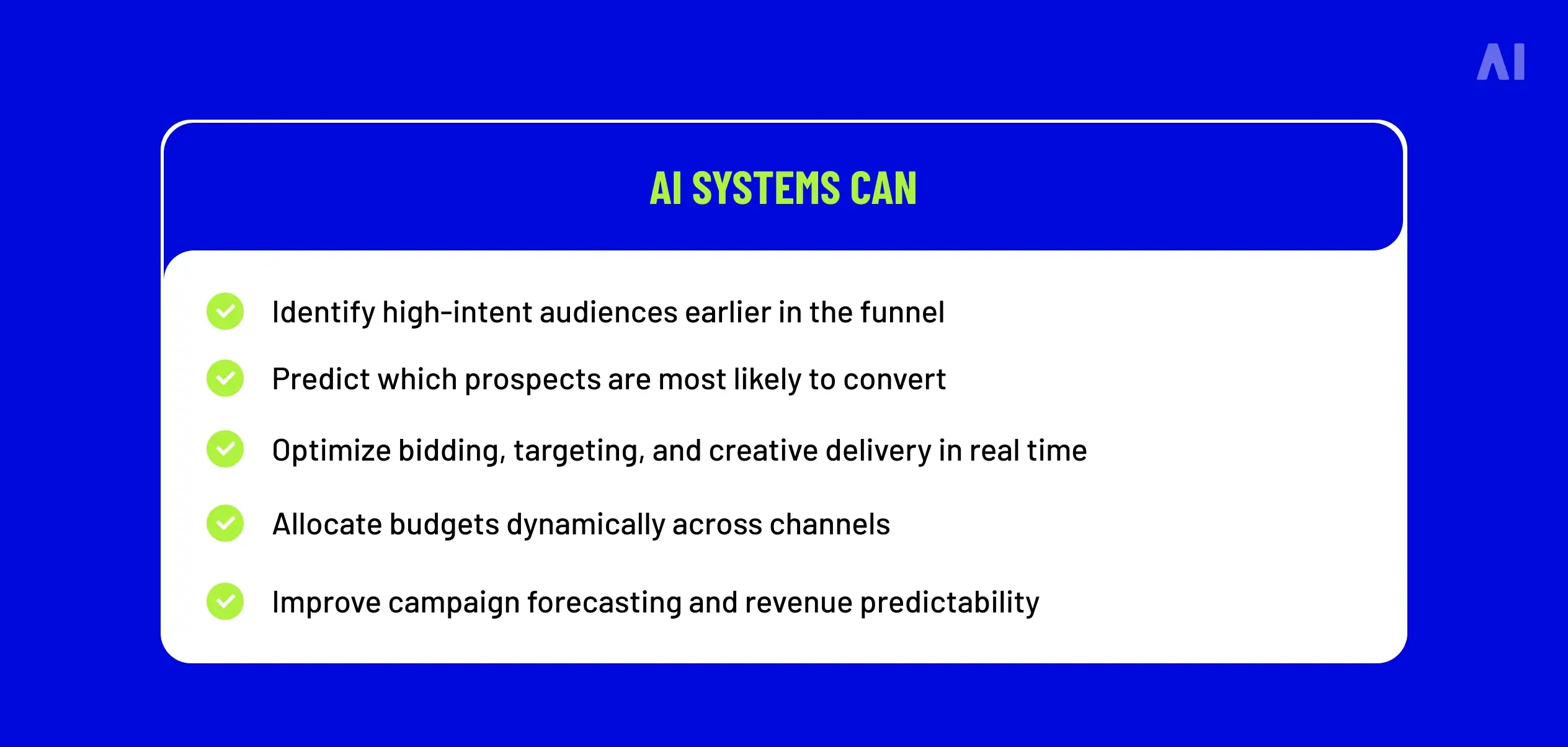
Organizations that successfully integrate AI marketing automation into their strategy are therefore not simply automating tasks. They are building predictive marketing systems that continuously learn from performance data and optimize how marketing resources are deployed.
This article explores 10 practical use cases of AI in marketing automation that directly influence scalable growth.
⚡️For a broader perspective on how artificial intelligence is transforming modern digital marketing strategy, see AI Digital’s guide on AI in Digital Marketing, which explores how AI technologies are reshaping marketing ecosystems and performance-driven campaigns.
What is AI in marketing automation?
AI in marketing automation refers to the integration of machine learning, predictive analytics, and data-driven decision systems into traditional marketing automation platforms. Instead of simply executing predefined workflows, AI powered marketing automation systems analyze customer behavior, campaign performance, and large datasets to continuously improve marketing decisions over time.
Traditional marketing automation platforms were primarily rule-based systems. Marketers configured workflows such as:
- If a user downloads a whitepaper → send a follow-up email
- If a lead reaches a scoring threshold → notify sales
- If a customer abandons a cart → trigger a reminder campaign
💡While these workflows improved operational efficiency, they depended entirely on static rules defined by marketing teams. The system itself did not learn or adapt based on campaign results or changing customer behavior.
AI driven marketing automation fundamentally changes this model. Instead of relying on fixed instructions, AI systems evaluate historical and real-time marketing data, identify patterns in customer interactions, and automatically adjust campaign decisions to improve outcomes. This allows marketing programs to become adaptive rather than procedural.
From an operational perspective, marketing automation with AI enables several new capabilities that traditional automation cannot deliver:
- Predictive targeting that identifies high-conversion audiences
- Dynamic campaign optimization across channels and devices
- Automated budget allocation based on performance signals
- Personalized content delivery driven by behavioral data
- Forecasting models that estimate campaign performance before launch
These systems rely heavily on machine learning models trained on large datasets, including customer behavior signals, engagement patterns, purchase history, and cross-channel campaign results. As more campaign data flows into the system, the algorithms refine predictions and improve targeting precision.
⚡️ For a deeper exploration of how data infrastructure supports modern marketing performance, see Creating a Data-Driven Marketing Strategy, which explains how organizations structure their data environments to support advanced analytics and AI-driven marketing decisions.
The advantage of AI marketing automation
AI marketing automation creates a structural advantage for modern marketing organizations. In highly fragmented digital ecosystems—where campaigns run across search, social, programmatic, retail media, and owned channels—manual optimization cannot keep pace with the scale and speed of data generation.
AI powered marketing automation systems process large volumes of behavioral, campaign, and performance data in real time, allowing organizations to detect patterns, evaluate opportunities, and optimize campaigns continuously. Instead of relying on periodic manual adjustments, marketing teams can respond to performance signals immediately.
This capability improves three critical areas of marketing performance:
- Faster decision-making driven by real-time analytics
- More efficient budget allocation across channels and campaigns
- Scalable campaign execution without proportional increases in operational complexity
💡As marketing environments become more complex and privacy regulations limit traditional tracking signals, AI driven marketing automation provides the analytical infrastructure needed to maintain targeting precision and performance visibility.
From automation to predictive decisions
Traditional marketing automation primarily focuses on task execution—sending emails, triggering workflows, and scheduling campaigns based on predefined rules. While these systems reduce manual work, they do not actively influence outcomes.
AI driven marketing automation introduces predictive decision systems. Instead of executing static workflows, machine learning models analyze historical and real-time marketing data to anticipate customer behavior and determine which actions are most likely to produce results.
These systems enable marketing teams to:
- Predict which prospects are most likely to convert
- Prioritize high-value audience segments
- Optimize campaign timing and messaging dynamically
- Allocate budgets toward the highest-performing channels
Predictive modeling and dynamic optimization allow organizations to move from reactive marketing toward anticipatory marketing operations, where campaigns adapt continuously as new performance signals emerge.
.webp)
⚡️For a deeper perspective on how AI systems transform marketing decision-making, see AI Digital’s guide on Advertising Intelligence.
Where AI impacts the marketing funnel
One of the most important advantages of AI in marketing automation is its ability to create value across the entire marketing funnel. Rather than improving only one stage of the customer journey, AI enhances multiple layers of marketing performance simultaneously.
{{26-AI-in-Marketing-Automation-10-Use-Cases-1="/tables"}}
Because improvements occur across multiple stages of the funnel, AI powered marketing automation produces cumulative performance gains rather than isolated campaign improvements.
AI must improve core revenue metrics
For marketing leaders, the value of AI based marketing automation ultimately depends on measurable business outcomes. AI systems become strategically valuable only when they improve core revenue and efficiency metrics.
Key performance indicators most influenced by AI for marketing automation include:
- Customer Acquisition Cost (CAC): improved targeting reduces wasted spend
- Lifetime Value (LTV): better retention and engagement increase long-term revenue
- Return on Ad Spend (ROAS): dynamic optimization improves media efficiency
- Conversion Rate: personalization and predictive targeting increase engagement
- Pipeline Velocity: improved lead prioritization accelerates sales cycles
- Churn Rate: predictive retention campaigns protect existing revenue
Organizations that successfully deploy AI marketing automation treat these metrics as the primary evaluation framework. AI is not valuable because it is advanced technology; it is valuable because it improves measurable marketing performance and sustainable growth.
⚡️For a deeper breakdown of the metrics that guide performance-driven marketing strategies, see AI Digital’s guide on Digital Marketing KPI.
10 examples of AI in marketing automation
AI marketing automation is most valuable when it produces measurable improvements in marketing performance. The following examples illustrate 10 practical applications of AI in marketing automation that help marketing teams scale acquisition, improve conversion rates, and optimize long-term customer value across the marketing funnel.
Predictive customer segmentation
One of the most impactful applications of AI in marketing automation is predictive customer segmentation. Traditional segmentation models typically rely on static attributes such as demographics, location, or basic purchase history. While useful, these approaches often fail to capture the dynamic behavioral signals that reveal real purchase intent.
AI driven marketing automation changes this by analyzing large volumes of behavioral, engagement, and transactional data. Machine learning models identify patterns across browsing activity, product interactions, campaign engagement, and historical conversions. These insights allow marketers to segment audiences based on intent probability and behavioral similarity, not just demographic categories.
This approach improves campaign performance in several ways:
- Higher targeting precision, focusing spend on high-intent users
- Reduced media waste, by deprioritizing low-probability audiences
- Earlier identification of high-value prospects, enabling faster engagement
- More relevant messaging, aligned with customer behavior and interests
Predictive segmentation also enables dynamic audience updates. As new behavioral signals appear—such as product searches, website engagement, or ad interactions—AI models continuously adjust audience classifications. This ensures campaigns remain aligned with real-time customer intent rather than outdated segmentation rules.
A widely cited example of AI powered marketing automation in segmentation is Amazon.
Amazon’s recommendation and targeting systems analyze browsing patterns, purchase history, and product interactions to predict what customers are most likely to buy next. These models power personalized product recommendations, email campaigns, and advertising targeting across Amazon’s ecosystem.
The impact is significant. By continuously learning from behavioral signals, Amazon can surface highly relevant products and promotions to individual users, increasing engagement and improving conversion rates. This same principle is increasingly applied across programmatic advertising, retail media, and CRM marketing environments.
.%2520.webp)
💡For organizations investing in AI marketing automation, predictive segmentation becomes the foundation for many other capabilities, including personalization, dynamic creative optimization, and performance-driven media allocation.
⚡️For a deeper look at how AI improves targeting accuracy in digital campaigns, see AI Targeted Advertising.
⚡️You can also explore advanced targeting strategies in Programmatic Ad Targeting: Best Strategies, Tools, and Tactics in 2026, which examines how programmatic platforms apply AI-driven audience intelligence to improve campaign performance.
Lifetime value (LTV) modelling
Lifetime value (LTV) modelling is a key application of AI in marketing automation. Instead of optimizing campaigns only for short-term conversions, AI powered marketing automation analyzes purchase history, engagement behavior, and retention patterns to predict how much revenue a customer is likely to generate over time.
Machine learning models process signals such as transaction frequency, product preferences, and engagement across channels to estimate future customer value. These predictions help marketing teams identify audience segments with stronger long-term revenue potential.
This allows brands to make more profitable acquisition decisions. Instead of prioritizing the lowest cost per acquisition, marketers can allocate budget toward audiences likely to generate higher LTV, improving long-term ROAS and margin efficiency.
LTV modelling also supports smarter budget allocation across campaigns and channels, ensuring marketing investment focuses on customers who deliver sustainable growth.
⚡️For a broader framework on measuring marketing efficiency across channels, see our guide on Mixed Media Modeling (MMM): Understand Your Marketing Efficiency in 2026.
AI-powered lead scoring
AI-powered lead scoring is a major advancement in AI marketing automation because it allows organizations to rank prospects based on real conversion probability rather than static scoring rules.
Traditional lead scoring systems assign points manually—for example, when a user downloads content, opens emails, or visits pricing pages. While useful, these models are limited because they rely on fixed assumptions about buyer behavior.
With AI driven marketing automation, machine learning models analyze large volumes of behavioral, contextual, and engagement signals in real time. These signals may include website activity, campaign engagement, product interactions, firmographic data, and historical conversion patterns.
%2520.webp)
By evaluating these signals simultaneously, AI models predict which leads are most likely to convert. Marketing and sales teams can then prioritize high-intent opportunities while reducing time spent on low-value prospects.
This improves several critical outcomes:
- Higher close rates for sales teams
- Faster pipeline velocity
- Better alignment between marketing and sales
- More efficient resource allocation
⚡️AI-powered lead scoring is also closely tied to attribution and performance measurement frameworks. For a deeper explanation of how marketing interactions influence pipeline performance, see Multi-Touch Attribution.
Real-time campaign optimization
Real-time campaign optimization is one of the most powerful applications of AI in marketing automation. Instead of waiting for periodic reports or manual adjustments, AI powered marketing automation systems continuously evaluate campaign performance while campaigns are live.
Machine learning models analyze large volumes of campaign, audience, and engagement data to detect performance signals in real time. Based on these insights, AI systems can automatically adjust key campaign variables, including:
- Bidding strategies in programmatic environments
- Audience targeting and segmentation
- Creative combinations and message delivery
- Budget pacing and channel allocation
💡This continuous optimization allows campaigns to adapt dynamically as new data becomes available. High-performing audiences or creatives receive more investment, while underperforming segments are deprioritized. The result is reduced media waste, improved efficiency, and stronger return on ad spend (ROAS).
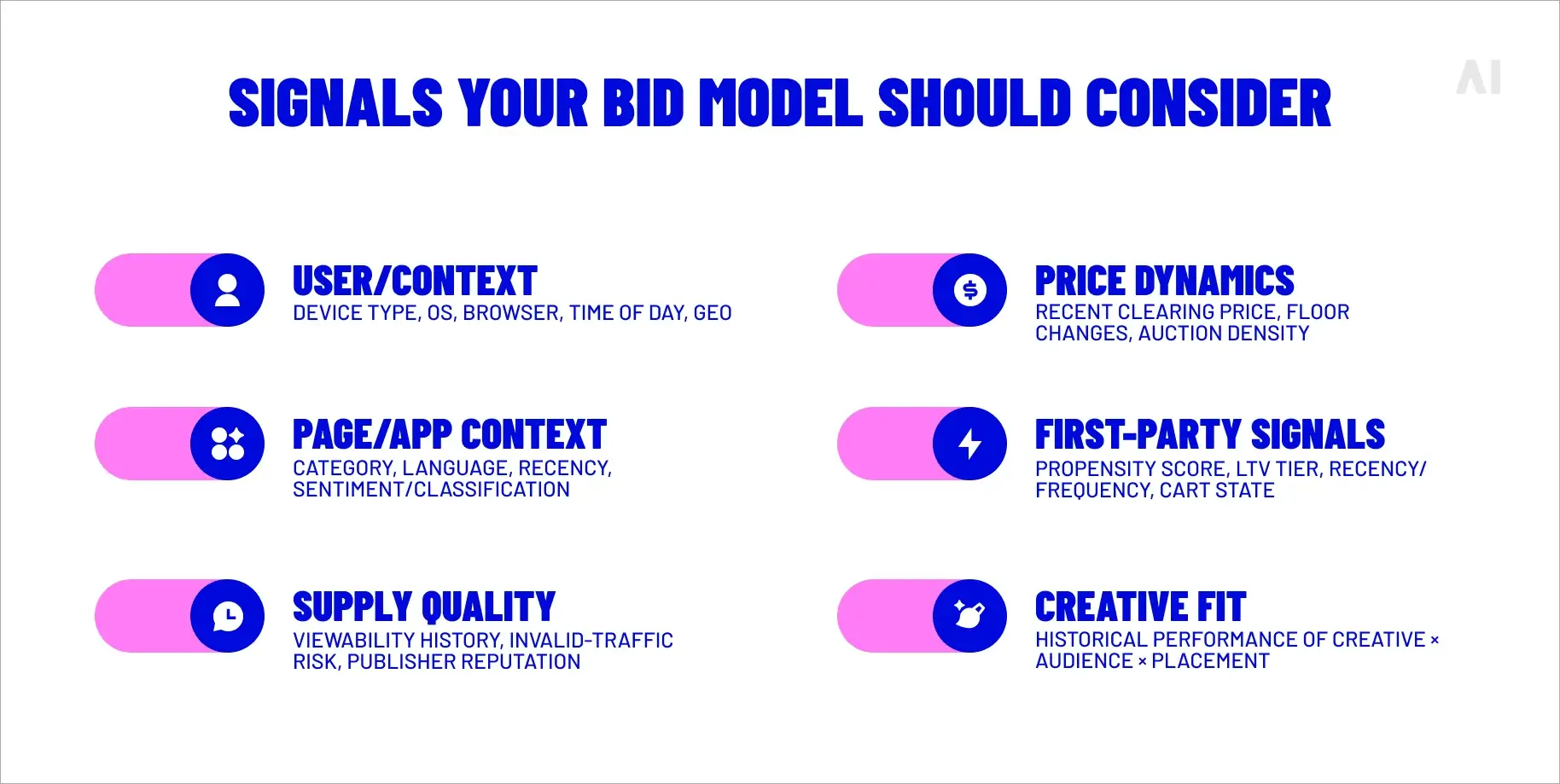
Real-time optimization is especially important in programmatic advertising environments, where buying decisions occur within milliseconds. AI models evaluate impression-level data during auctions and determine whether a specific ad opportunity is likely to generate value.
These systems are commonly used within demand-side platforms (DSPs) and other automated media buying environments that rely on real-time bidding (RTB) infrastructure.
⚡️For a deeper explanation of how real-time bidding works in programmatic advertising, see Real-Time Bidding.

⚡️You can also explore how machine learning powers optimization inside programmatic platforms in AI in DSPs.
Automated cross-channel budget reallocation
Automated cross-channel budget reallocation is a powerful capability enabled by AI in marketing automation. Instead of relying on periodic manual adjustments, AI powered marketing automation systems continuously compare performance across channels, audiences, and placements to determine where marketing investment generates the strongest results.
Machine learning models analyze campaign performance data, conversion signals, and engagement patterns across environments such as search, social, programmatic display, retail media, and connected TV. Based on these insights, AI systems dynamically shift budget toward the channels and placements delivering the highest return.
This approach improves overall media efficiency in several ways:
- Scaling high-performing campaigns faster
- Reducing wasted spend on underperforming placements
- Improving return on ad spend (ROAS)
- Allocating budget based on real performance signals
Automated reallocation is particularly important in programmatic ecosystems, where thousands of ad opportunities appear continuously across multiple supply sources. AI systems can evaluate these opportunities faster than human teams, ensuring budget flows toward the most valuable inventory.
⚡️This process also highlights the importance of transparent supply paths and cleaner inventory environments. When marketers understand where impressions originate and how supply chains operate, AI optimization models can allocate budget more efficiently and reduce exposure to low-quality or duplicated inventory. For a deeper understanding of how the digital advertising supply chain operates, see Digital Advertising Supply Chain Explained.
⚡️AI-driven media planning also benefits from curated inventory environments designed to improve transparency and performance. AI Digital supports this approach through Smart Supply, which connects advertisers with higher-quality inventory paths and optimized media environments.
AI-powered media planning and campaign forecasting
AI-powered media planning and campaign forecasting allow marketers to evaluate campaign performance before launch rather than relying on trial-and-error optimization after campaigns are live. Using historical performance data, audience behavior patterns, and market signals, AI in marketing automation can estimate how different media strategies are likely to perform.
Machine learning models analyze past campaign outcomes across channels, audience segments, and placements to identify patterns that influence results. These insights help marketing teams simulate different media mix scenarios, forecast potential reach and conversions, and evaluate how budget allocation may affect outcomes.
This predictive approach reduces uncertainty during the planning phase. Instead of relying on assumptions or historical averages, marketers can use AI driven marketing automation to test multiple investment scenarios and identify the strategies most likely to deliver strong ROAS, conversion performance, and efficient budget distribution.
Predictive planning also improves collaboration between strategy, media buying, and performance teams. By aligning decisions around data-driven forecasts, organizations can make more confident budget allocation decisions and scale campaigns more efficiently.
⚡️Solutions like Elevate illustrate how predictive analytics can support media planning by modeling campaign performance and evaluating potential media mix strategies before activation.
💡By combining historical data analysis with predictive modeling, AI powered marketing automation helps marketing teams move from reactive optimization to more strategic, forward-looking campaign planning.
Hyper-personalised content and messaging
Hyper-personalised content and messaging is one of the most visible applications of AI in marketing automation. Instead of delivering the same message to large audience segments, AI powered marketing automation systems adapt content dynamically based on user behaviour, preferences, and intent signals.
Machine learning models analyze signals such as browsing activity, previous purchases, engagement history, and content interactions. Based on these insights, AI systems can automatically tailor website experiences, email content, and advertising creatives to match the interests of each user or audience segment.
This approach improves marketing performance in several ways:
- Higher relevance, because content reflects real user interests
- Stronger engagement, as messages align with behavioral signals
- Improved conversion efficiency, through more targeted messaging
AI also enables dynamic creative optimization, where multiple creative elements—headlines, visuals, product recommendations, or calls to action—are combined and tested automatically. The system then prioritizes the combinations most likely to drive engagement for specific audiences.
A well-known example of large-scale personalization is Netflix. Netflix uses machine learning to analyze viewing behavior and engagement patterns, allowing the platform to recommend highly relevant content and personalize the user experience for millions of viewers.
The same principles increasingly apply to digital advertising and marketing automation environments, where AI systems adapt messaging across campaigns to improve performance.
⚡️For deeper insight into how personalization strategies influence advertising environments, see Netflix Advertising. You can also explore the broader concept of advanced personalization in Hyper-Personalization.
Predictive churn detection and retention automation
Predictive churn detection is an important capability within AI in marketing automation, particularly for businesses that rely on repeat purchases or subscriptions. Instead of identifying churn only after customers disengage, AI powered marketing automation systems analyze behavioral signals to detect early warning patterns.
Machine learning models evaluate indicators such as declining engagement, reduced product usage, fewer purchases, or changes in interaction frequency. By comparing these patterns with historical retention data, AI systems can estimate which customers are most likely to churn.
Once risk signals appear, automated retention workflows can trigger targeted responses—such as personalized offers, product recommendations, or re-engagement campaigns. Acting early allows brands to protect customer lifetime value (LTV) and reduce revenue loss caused by churn.
Conversational AI for revenue automation
Conversational AI is another practical application of AI marketing automation, helping brands engage customers in real time through intelligent chat interfaces and automated assistants.
AI-powered conversational systems can qualify leads, answer product questions, guide discovery, and address objections while users browse websites or interact with digital channels. By analyzing user inputs and contextual signals, these systems adapt responses dynamically and direct prospects toward relevant products or solutions.
This reduces friction in the buying process and improves conversion outcomes by:
- Qualifying prospects earlier in the funnel
- Providing instant responses to product questions
- Guiding users through purchasing decisions
- Supporting customers across multiple touchpoints
💡As a result, conversational AI helps shorten sales cycles and improves the efficiency of both marketing and sales operations.
AI-powered marketing analytics
AI powered marketing analytics enables organizations to move from periodic reporting to continuous performance intelligence. Instead of waiting for manual analysis, AI driven marketing automation systems monitor campaign performance in real time, detecting anomalies, surfacing patterns, and forecasting likely outcomes.
Machine learning models analyze large volumes of campaign, audience, and engagement data, allowing marketing teams to identify opportunities or performance issues much faster. This provides teams with actionable insights that support quicker strategic decisions.
AI analytics systems can also unify performance data across channels, creating transparent reporting environments that reveal how campaigns, audiences, and creative strategies influence outcomes. Platforms such as Elevate demonstrate how AI-powered insights layers can support campaign analysis, performance visibility, and data-driven optimization across complex marketing environments.
⚡️For a deeper exploration of how analytics frameworks measure user behavior and digital interactions, see Digital Experience Analytics: How to Turn User Behavior into Revenue.
Rise of autonomous AI agents
AI in marketing automation is gradually evolving from assistive tools into more autonomous decision systems. Early automation primarily supported execution—scheduling campaigns, triggering workflows, or generating reports. Today, advances in machine learning and predictive analytics allow AI powered marketing automation to handle increasingly complex optimisation tasks.
These systems can analyze large volumes of campaign performance data, audience signals, and market dynamics, enabling them to recommend or automatically implement adjustments in areas such as targeting, bidding, creative combinations, and budget pacing.
However, it is important to keep expectations realistic. Fully autonomous marketing systems are not yet the standard across most organizations. Effective deployment still requires high-quality data infrastructure, transparent governance, and clear strategic oversight from marketing teams.
Where these foundations exist, AI driven marketing automation can take on larger operational responsibilities. Instead of marketers manually managing hundreds of optimization decisions, AI systems can monitor performance signals continuously and respond faster than human teams could at scale.
This evolution does not eliminate the role of marketers. Instead, it shifts their focus toward strategy, experimentation, and long-term growth planning, while AI handles increasingly sophisticated analytical and operational tasks.
Build predictable growth with AI marketing automation
Ultimately, AI marketing automation is no longer just about saving time or simplifying workflows. It is becoming a strategic growth system that helps organizations improve marketing efficiency, allocate budgets more intelligently, and scale performance in increasingly complex digital environments.
By combining predictive analytics, real-time optimization, and continuous performance monitoring, AI powered marketing automation enables brands to move toward more data-driven and adaptive marketing operations. Campaign decisions become more responsive to real-world signals, reducing wasted spend and improving long-term marketing returns.
Organizations that deploy AI based marketing automation effectively tend to focus on three foundations:
- Strong data infrastructure that enables accurate analysis and forecasting
- Transparent execution environments that improve media quality and measurement
- Clear performance metrics tied to business outcomes such as CAC, LTV, ROAS, and retention
When these elements work together, AI becomes more than an operational tool—it becomes a framework for predictable growth.
⚡️For organizations exploring how to integrate AI-driven marketing strategies into their operations, you can learn more or start a conversation here, Get in Touch.
.webp)