Integrated Marketing vs. Omnichannel Marketing: Key Differences & Strategy Guide

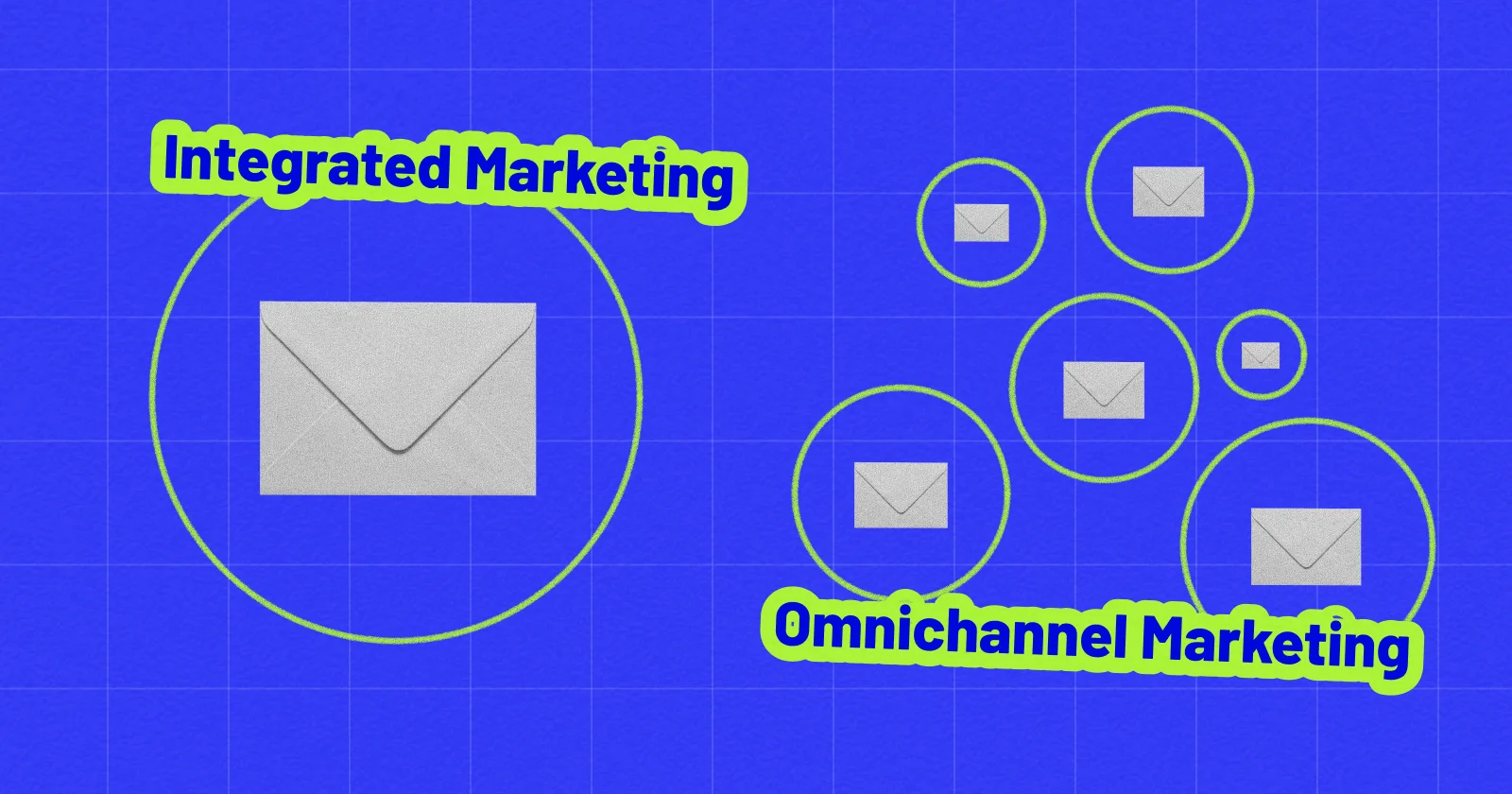
At a high level, the distinction between integrated marketing vs omnichannel marketing comes down to coordination vs connection. Integrated marketing focuses on aligning campaigns, messaging, and creative execution across channels. It ensures that a brand speaks with one voice, whether the customer encounters it through social, search, email, or display. The emphasis is on consistency in communication and coordinated campaign delivery.
Omnichannel marketing, by contrast, operates at the infrastructure level. It connects customer data, channels, and interactions into a unified system, enabling businesses to deliver continuous, context-aware experiences across the entire customer journey. Instead of simply aligning campaigns, it aligns the underlying data and decision-making logic that powers them.
This difference is not just semantic — it has direct implications for how marketing organizations are structured, how technology is deployed, and how performance is measured.
⚡️From AI Digital’s perspective, one of the most common failure points in modern marketing strategies is treating these two models as interchangeable. In practice, they operate on different layers of the marketing system:
- Integrated marketing optimizes how campaigns are executed across channels
- Omnichannel marketing transforms how customer interactions are connected and activated through data
Both are valuable. Neither is sufficient on its own.
As customer journeys become less linear and more distributed, relying only on campaign-level coordination limits scalability. At the same time, investing in omnichannel infrastructure without clear campaign alignment often results in underutilized systems and unclear performance outcomes.
This guide breaks down omnichannel vs integrated marketing in practical terms — examining how each approach works, where it creates value, and how businesses can combine them to improve efficiency, strengthen customer experience, and drive measurable growth. The objective is not to declare a winner between omnichannel vs integrated marketing, but to provide a clear framework for deciding when to use each approach — and how to make them work together in a scalable marketing strategy.
Integrated marketing: When simplicity wins
In the discussion around integrated marketing vs omnichannel marketing, integrated marketing is often underestimated. Yet for many businesses, it is the most practical and efficient starting point.
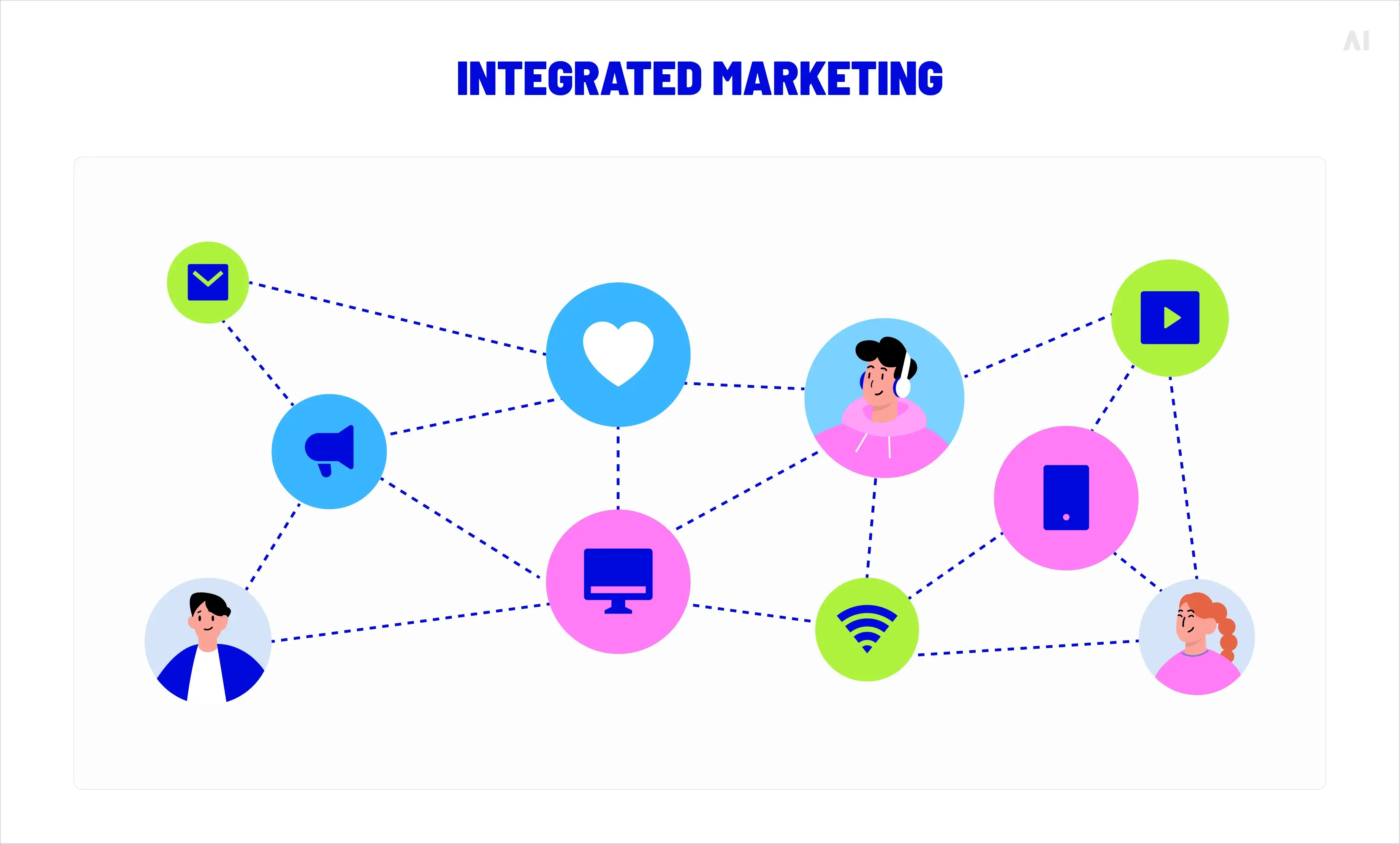
At its core, integrated marketing is a coordinated approach to campaign execution. It aligns messaging, creative, and timing across channels—such as paid media, social, email, and web—so that the brand presents a consistent and unified narrative.
It does not require fully connected data systems or advanced identity resolution. Instead, it relies on structured planning, clear messaging frameworks, and cross-channel coordination.
From an operational standpoint, this makes integrated marketing significantly easier to implement. And in the right context, that simplicity becomes a competitive advantage.
According to HubSpot, companies that maintain consistent brand messaging across channels can increase revenue by up to 23%. The gain does not come from deeper personalization—it comes from clarity, repetition, and recognition.
This is why integrated marketing works best in environments where:
- Customer data is limited or fragmented
- Marketing budgets require tight control and efficiency
- The primary objective is acquisition rather than lifecycle management
- Teams need to move quickly without heavy infrastructure dependencies
In these cases, trying to implement a full omnichannel system can create unnecessary complexity. Integrated marketing allows teams to execute well before they scale deeply.
Because it does not unify customer data across touchpoints, integrated marketing cannot deliver real-time personalization or adaptive customer journeys. It coordinates campaigns—but it does not fully connect experiences.
Benefits of integrated marketing
The strength of integrated marketing lies in operational discipline. When executed properly, it creates clarity across channels without increasing complexity.
{{26-Integrated-Marketing-vs-Omnichannel-Marketing-1="/tables"}}
💡From AI Digital’s perspective, this simplicity is often what allows organizations to reach operational maturity faster, especially in early or growth-stage environments.
When to use integrated marketing (+ example)
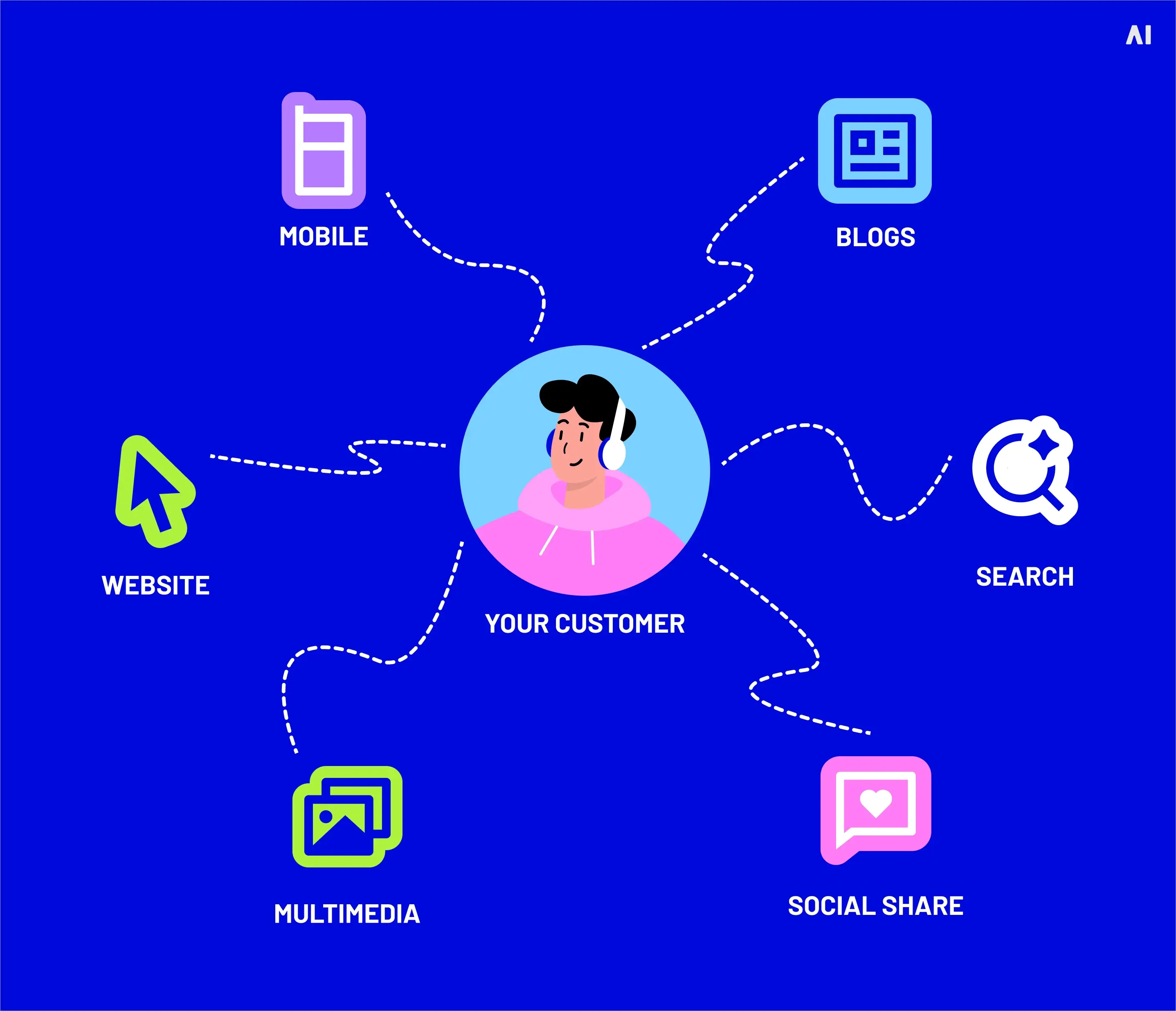
Choosing between omnichannel vs integrated marketing depends largely on your current capabilities—not just your ambitions.
Integrated marketing is the right approach when there are clear structural constraints in data and infrastructure.
You should prioritize integrated marketing if:

These are not weaknesses—they are signals of a system that is optimized for execution, not orchestration.
Attempting to force an omnichannel model in this context often leads to fragmented implementations, underutilized tools, and unclear ROI.
Example scenario
Consider a mid-sized e-commerce brand expanding into new markets.
The team runs campaigns across paid search, social, and display. Data is available at the platform level, but there is no centralized customer database or real-time data synchronization between channels.
In this case, an integrated marketing approach would focus on:
- Aligning messaging across all acquisition channels (same value proposition, offers, and creative themes)
- Coordinating campaign timing (launches, promotions, seasonal pushes)
- Standardizing performance metrics across platforms
- Optimizing media spend based on channel-level efficiency signals
The result is a cohesive acquisition strategy without the overhead of building a full omnichannel infrastructure.
From a strategic standpoint, this is often the most effective way to scale in the early and mid-stages of growth. It allows businesses to maximize efficiency with the resources they have, while building the foundation needed for more advanced models later.
In the broader comparison of integrated marketing vs omnichannel, this is where integrated marketing clearly wins: when simplicity, speed, and cost-efficiency matter more than deep personalization and real-time orchestration.
Omnichannel marketing: Powered by data

If integrated marketing is about coordination, omnichannel marketing is about connection.
In the broader comparison of integrated marketing vs omnichannel marketing, omnichannel represents a more advanced, system-driven approach. It connects customer data, channels, and interactions into a unified environment, allowing businesses to deliver continuous, context-aware experiences across the entire journey.
This is not just about running campaigns across multiple channels. It is about ensuring that every interaction is informed by previous behavior, preferences, and intent signals—regardless of where it happens.
According to Salesforce, 88% of customers say the experience a company provides is as important as its products or services. At the same time, research from Twilio shows that companies investing in personalization generate up to 54% more revenue from those activities compared to slower adopters.
This is the value omnichannel marketing is designed to unlock.
However, it comes with structural requirements. Omnichannel marketing depends on:
- Unified customer data platforms (CDPs) or equivalent infrastructure
- Cross-channel identity resolution
- Real-time or near-real-time data synchronization
- Advanced analytics and decisioning systems
- Integrated media and CRM ecosystems
Without these components, omnichannel strategies tend to break down into disconnected personalization attempts.
⚡️From AI Digital’s perspective, omnichannel marketing should be treated as an operating model — not a campaign tactic. It requires a deliberate shift toward data-centric marketing architecture. If you're building toward that, the first step is establishing a clear foundation for how data is collected, unified, and activated across channels (read more Creating a Data-Driven Marketing Strategy).
Benefits of omnichannel marketing
The primary advantage of omnichannel marketing is its ability to move beyond static campaigns and deliver adaptive, customer-level experiences.
{{26-Integrated-Marketing-vs-Omnichannel-Marketing-2="/tables"}}
⚡️Unlike integrated marketing, which aligns messaging broadly, omnichannel systems personalize at the individual level. This includes product recommendations, dynamic content, triggered messaging, and cross-channel sequencing—all based on real-time signals. (For a deeper look, read how AI-Driven Personalization works in practice).
At scale, these benefits compound. The system becomes more efficient as it learns—driving both short-term performance and long-term value creation.
When to use omnichannel marketing (+ example)
In the context of omni channel vs integrated marketing, omnichannel is the right choice when your organization has both the technical foundation and strategic need to operate at a higher level of complexity.
You are ready for omnichannel marketing if:
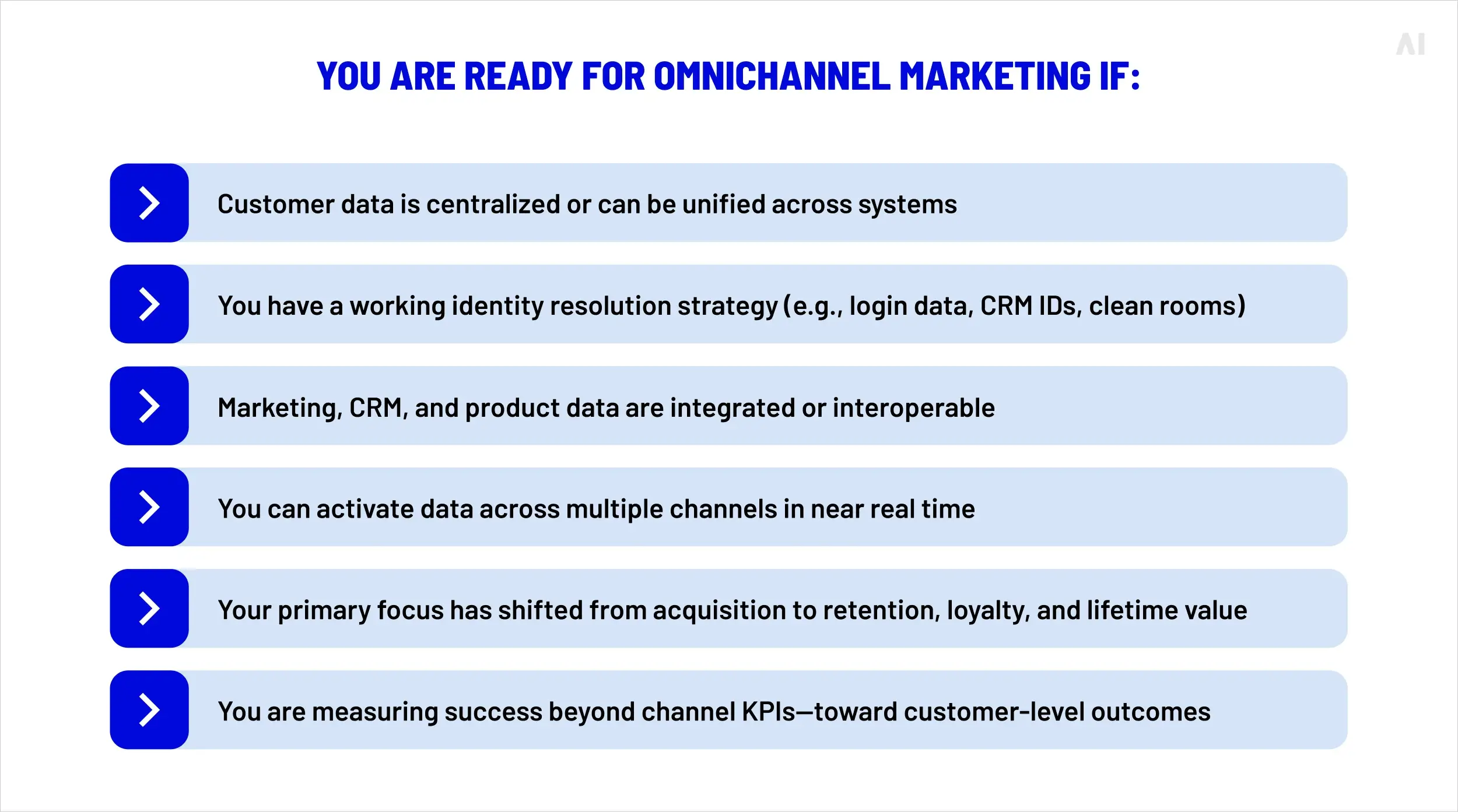
These signals indicate that your organization can support the operational demands of omnichannel marketing.
Example scenario
Consider a subscription-based business (e.g., streaming, fintech, or health services) operating across mobile apps, web platforms, email, and paid media.
The company has:
- A centralized CRM with behavioral and transactional data
- Real-time event tracking across platforms
- Integrated media buying and lifecycle marketing teams
In this case, omnichannel marketing enables:
- Personalized onboarding journeys based on user behavior
- Cross-channel messaging (e.g., email, push, paid retargeting) triggered by real-time events
- Frequency control and sequencing across paid and owned channels
- Dynamic offers and recommendations tailored to each customer
⚡️In highly regulated or complex industries—such as healthcare and pharma—this approach is increasingly critical to manage both engagement and compliance across channels (read more: TV in Pharma Marketing).
The outcome is not just better campaigns, but a cohesive customer experience that evolves over time.
💡From AI Digital’s perspective, this is where omnichannel vs integrated marketing diverges most clearly. Omnichannel is not about doing more across channels—it is about making every interaction more relevant, connected, and measurable. But that level of sophistication only works when the underlying system is ready to support it.
Integrated vs omnichannel: The real difference is infrastructure
At a surface level, the debate around integrated marketing vs omnichannel marketing often focuses on messaging or channel strategy. In practice, the real difference sits deeper—in the infrastructure that supports execution.
Integrated marketing operates at the campaign layer. Omnichannel marketing operates at the system layer.
Understanding this distinction is critical, because it directly impacts how decisions are made, how data is used, and how performance scales over time.
{{26-Integrated-Marketing-vs-Omnichannel-Marketing-3="/tables"}}
💡This is where many organizations misstep. They attempt to apply omnichannel expectations to integrated systems—or expect integrated marketing to deliver outcomes that require data-level orchestration.
Execution vs. Infrastructure
The most important distinction in integrated marketing vs omnichannel marketing is not about channels—it is about how the system behind those channels works.
Integrated marketing is execution-focused. It ensures campaigns are aligned across channels—same messaging, same timing, same creative logic. It answers the question: “Are we showing up consistently?”
Omnichannel marketing, on the other hand, is infrastructure-driven. It connects the systems behind those campaigns—data platforms, CRM, media, analytics—so that every interaction is informed by shared, real-time intelligence.
This difference becomes critical as complexity increases. According to industry research, 73% of customers now interact with multiple channels during their journey, often switching between platforms before making a decision. Coordinating campaigns is no longer enough—you need systems that can follow and adapt to that behavior in real time.
From AI Digital’s perspective, this is where many organizations hit a ceiling. They try to scale execution without upgrading infrastructure.
⚡️If you're aiming for true cross-channel visibility and decision-making, the next step is building independent measurement and data layers beyond platform silos (read more: Alternatives to Walled Garden Reporting: Building Independent Cross-Channel Visibility).
Data and customer view
The difference between omnichannel vs integrated marketing becomes operationally clear when you look at how data is used.
Integrated marketing relies on:
- Campaign-level performance metrics (CTR, CPA, ROAS)
- Platform-specific reporting
- Aggregated audience segments
This provides a channel-centric view of performance. You know which campaigns work—but not necessarily how individual customers move between them.
Omnichannel marketing relies on:
- Unified customer profiles
- Cross-channel interaction data
- Behavioral and transactional signals
- Real-time updates across systems
This creates a customer-centric view of performance.
Why does this matter?
Because decision-making shifts from optimizing isolated campaigns to optimizing entire customer journeys.
For example, instead of increasing spend on a high-performing channel in isolation, omnichannel systems can identify:
- When a user has already converted in another channel
- When frequency is too high across platforms
- When messaging should change based on recent behavior
This level of visibility directly impacts efficiency. Without it, businesses risk overlapping spend, inconsistent messaging, and misattributed performance.
Personalization
Personalization is where the gap between integrated marketing vs omnichannel becomes most visible to the customer.
Integrated marketing delivers:
- Consistent messaging across channels
- Segment-based targeting
- Predefined campaign logic
This ensures coherence—but it remains largely static.
Omnichannel marketing enables:
- Real-time, behavior-driven messaging
- Trigger-based communication (events, actions, timing)
- Cross-channel sequencing tailored to each individual
This shift is structural.
According to McKinsey & Company, 71% of consumers expect personalized interactions, and 76% become frustrated when they don’t receive them. At the same time, personalization leaders consistently outperform in revenue and customer loyalty.
⚡️This is why omnichannel marketing is increasingly tied to AI-driven personalization systems, where messaging adapts continuously based on user behavior (read more: Personalized Advertising Explained)
From a strategic standpoint, integrated marketing ensures your brand is recognized.
Omnichannel ensures it is relevant in the moment.
Cost and complexity
The trade-off between omni channel vs integrated marketing ultimately comes down to resources and operational maturity.
Integrated marketing is:
- Faster to implement
- Lower cost
- Easier to manage across teams
- Less dependent on advanced technology
This makes it ideal for organizations prioritizing speed, efficiency, and controlled execution.
Omnichannel marketing requires:
- Investment in data infrastructure (CDPs, data pipelines, identity systems)
- Integration across marketing, product, and data teams
- Ongoing governance and system maintenance
- Advanced tooling for automation and decisioning
It is also worth noting that only a small percentage of companies fully connect customer context across channels—one study suggests as low as 13% achieve this level of integration. That gap highlights how difficult omnichannel execution actually is in practice.
💡From AI Digital’s perspective, the mistake is not choosing one over the other—it is underestimating the operational requirements of omnichannel while overcomplicating integrated marketing.
The most effective organizations treat these as complementary layers:
- Integrated marketing ensures efficient execution
- Omnichannel marketing ensures intelligent, data-driven orchestration
Understanding where your business sits between those two is what ultimately determines performance.
ROI and timeframe
The difference between integrated marketing vs omnichannel marketing becomes most tangible when you look at how and when ROI is generated.
Integrated marketing is optimized for short-term performance.
It delivers faster, more predictable returns because it focuses on campaign efficiency, reach, and immediate conversion signals.
With aligned messaging across channels, businesses can:
- Launch campaigns quickly
- Measure performance through clear channel-level KPIs (CPA, ROAS)
- Reallocate budget in near real time
This makes integrated marketing particularly effective for acquisition-driven growth, where speed and cost control matter.
There is evidence to support this efficiency. Multi-channel campaign coordination (even without full omnichannel infrastructure) can deliver up to 2x higher ROI compared to single-channel approaches, primarily due to improved reach and consistency.
💡However, this ROI is typically linear and campaign-bound. Once spend stops, performance tends to decline.
Omnichannel marketing, by contrast, is designed for long-term value creation.
Its ROI comes from retention, engagement, and customer lifetime value (CLV) rather than immediate conversion spikes.
Because omnichannel systems connect data across the entire journey, they enable:
- Ongoing engagement across lifecycle stages
- Higher purchase frequency
- Reduced churn
- More efficient reactivation and upsell
The impact compounds over time.
For example:
- Companies with strong omnichannel engagement can reach up to 89% customer retention, compared to 33% for weaker approaches
- Omnichannel customers purchase up to 250% more frequently and spend more per transaction
- Businesses implementing omnichannel strategies report up to 179% faster revenue growth
These are not short-term gains—they reflect compounding effects across the customer lifecycle.
From AI Digital’s perspective, this is the strategic trade-off:
- Integrated marketing → immediate, controllable ROI (campaign-driven)
- Omnichannel marketing → delayed but compounding ROI (customer-driven)
The mistake many organizations make is evaluating omnichannel using short-term performance metrics. Early in implementation, ROI may appear lower due to infrastructure costs and longer feedback loops.
But over time, as systems mature, omnichannel marketing shifts the economics of growth:
- Lower reliance on constant acquisition
- Higher value per customer
- More efficient budget allocation across the lifecycle
In practice, high-performing organizations do not choose one over the other. They use integrated marketing to capture demand efficiently, while building omnichannel capabilities to retain and expand that demand over time.
Why most businesses fail — and how to fix it
In the debate around integrated marketing vs omnichannel marketing, most failures are misdiagnosed.
It is rarely about choosing the wrong model.
In practice, underperformance almost always traces back to three structural issues:
- Fragmented data
- Disconnected systems
- Inefficient execution
According to Gartner, poor data quality alone costs organizations an average of $12.9 million per year, while studies from Forrester consistently show that disconnected marketing technology stacks are one of the primary barriers to performance improvement.
💡Companies attempt to scale results—more channels, more tools, more spend—without fixing the foundation.
The result is predictable: more complexity, but not more performance.
Broken data & Systems
This is where most omnichannel strategies fail before they even begin.
Omnichannel marketing depends on connected, high-quality data. But in reality, most organizations operate with:
- CRM data in one system
- Media platform data in another
- Analytics and attribution in separate environments
- Limited or no real-time synchronization
The result is a fragmented customer view.
Instead of a unified profile, businesses see partial, inconsistent signals—which leads to:
- Poor attribution (channels over- or under-valued)
- Weak personalization (generic or mistimed messaging)
- Inefficient decisions (budget misallocation, duplicated reach)
Research from McKinsey & Company highlights that companies effectively leveraging unified customer data can generate significantly higher marketing ROI, yet very few organizations have achieved full data integration at scale.
⚡️This is precisely the gap that structured frameworks are built to solve. Approaches like AI Digital’s Open Garden Framework move beyond fragmented platform logic by unifying data, connecting systems, and enabling consistent cross-channel activation. The result is a more stable foundation for omnichannel execution—where decisions are driven by independent, interoperable data rather than isolated platform signals.
💡Rather than relying on isolated platform ecosystems, this model builds a connected, flexible infrastructure that supports true omnichannel execution.
⚡️For a deeper view on how this model tackles fragmentation at scale, explore The Open Garden Framework: A New Operating Model for Programmatic Advertising. It outlines how businesses can move from disconnected platform ecosystems to a more unified, interoperable marketing infrastructure that supports consistent performance and measurement.
Inefficient execution
While omnichannel struggles with data, integrated marketing often fails at execution.
On paper, integrated marketing is straightforward: align campaigns, coordinate messaging, optimize across channels.
In reality, many teams operate with:
- Manual campaign management
- Slow optimization cycles
- Channel-level silos (search, social, display managed independently)
- Limited cross-channel feedback loops
This creates a system that is technically integrated—but operationally inefficient.
The impact is measurable:
- Delayed responses to performance signals
- Budget wasted on underperforming channels
- Inconsistent pacing and frequency across platforms
- Limited ability to scale winning strategies
According to Deloitte, organizations that adopt automation in marketing and media operations can significantly improve efficiency and responsiveness, particularly in complex, multi-channel environments.
⚡️This is where execution-focused solutions become critical. AI Digital’s Smart Supply addresses this by:
- Automating media buying and optimization
- Analyzing supply paths to reduce inefficiencies
- Enabling faster, data-informed decision-making
- Aligning execution with performance signals in real time
From manually managing campaigns → to structuring how execution happens across the ecosystem.
Strategy without infrastructure (root problem)
This is the underlying issue that connects both failure modes.
Businesses often invest in:
- New tools (CDPs, automation platforms, analytics layers)
- New strategies (omnichannel transformation, personalization, lifecycle marketing)
- More channels and media spend
But they do so without fixing the underlying infrastructure.
The result is a disconnect between ambition and capability.
From AI Digital’s perspective, this leads to three common outcomes:
- Overinvestment in technology with low adoption or utilization
- Fragmented execution, despite having “advanced” tools
- No meaningful improvement in performance, despite higher costs
This is why the question is not simply omnichannel vs integrated marketing.

Until that alignment exists, neither integrated nor omnichannel marketing will deliver their full potential. Fixing that foundation—data first, systems second, execution third—is what turns strategy into measurable performance.
Hybrid approach: Integrated + Omnichannel Marketing
Most high-performing organizations operate in a hybrid model—using integrated marketing to drive efficient acquisition, while layering in omnichannel capabilities to improve retention, personalization, and long-term value.
This approach reflects a simple reality:
- Acquisition requires speed, control, and cost efficiency
- Retention requires data, continuity, and personalization
Trying to solve both with a single model often leads to trade-offs. A hybrid structure allows businesses to optimize each stage of the customer lifecycle with the right level of complexity.
{{26-Integrated-Marketing-vs-Omnichannel-Marketing-4="/tables"}}
The key is not separation, but connection between the two layers.
Acquisition campaigns generate demand and bring users into the system.Omnichannel infrastructure then captures that data and activates it across future interactions.
Over time, this creates a feedback loop:
- Better acquisition data → more precise targeting
- Better customer data → higher retention and lifetime value
- Higher LTV → more efficient acquisition spend
The challenge for many businesses is not understanding this model—it is operationalizing it without overcomplicating the system too early.
💡Full omnichannel infrastructure requires time, investment, and organizational alignment. But delaying all data-driven capabilities until that system is complete creates a performance gap.
⚡️This is where solutions like AI Digital’s Elevate play a critical role.
Elevate is designed as an intelligence and orchestration layer that sits between integrated execution and omnichannel ambition. It enables businesses to:
- Centralize and analyze cross-channel performance data
- Generate predictive insights for planning and budget allocation
- Improve decision-making without relying entirely on platform-reported metrics
- Support more coordinated, data-informed campaign execution
In practical terms, Elevate helps teams move beyond isolated channel optimization—without requiring a fully built omnichannel stack from day one.
How to choose the right strategy for your business
Choosing between integrated marketing vs omnichannel marketing is not a matter of preference—it is a matter of readiness, resources, and business objectives.
Most organizations already operate across multiple channels. The real question is whether their data, systems, and execution model can support deeper orchestration—or whether they should focus on improving coordination first.
💡From AI Digital’s perspective, the most effective way to make this decision is to evaluate four core dimensions: data maturity, business goals, operational capacity, and readiness signals. If these are misaligned, even the most advanced strategy will underperform.
1. Start with your data readiness
Your data maturity is the single most important factor in deciding between omnichannel vs integrated marketing.
If your data is limited or fragmented, integrated marketing is the right approach.
This typically means:
- Data is stored across multiple platforms (CRM, analytics, media) without integration
- Reporting is platform-based rather than customer-based
- There is no real-time data flow between systems
In this environment, attempting omnichannel execution will lead to:
- Inconsistent customer views
- Weak personalization
- Misleading attribution
If your data is unified and accessible, omnichannel becomes viable.
This includes:
- Centralized or connected customer data
- Cross-channel tracking and identity resolution
- Ability to activate data across systems in near real time
⚡️Research from Gartner indicates that organizations with higher data maturity significantly outperform peers in marketing effectiveness—but only when that data is operationalized across systems. If your data is not yet at that level, the priority should not be omnichannel—it should be fixing the foundation (read more: Why Fragmented Data Is Breaking Cross-Platform Performance).
2. Align strategy with business goals
Your growth objectives should directly shape your approach to integrated marketing vs omnichannel.
Integrated marketing is best suited for:
- Customer acquisition
- Market expansion
- Campaign efficiency and cost control
- Short-term performance optimization
It enables businesses to scale reach and conversions quickly, with clear performance visibility at the channel level.
Omnichannel marketing is designed for:
- Retention and loyalty
- Customer lifetime value (CLV) growth
- Cross-sell and upsell strategies
- Long-term revenue optimization
According to Harvard Business Review, customers engaging across multiple channels consistently show higher spend and retention rates, reinforcing the value of lifecycle-focused strategies.
⚡️If your growth strategy depends on maximizing customer lifetime value and retention, omnichannel marketing becomes a structural requirement rather than an option. For a deeper perspective on aligning marketing strategy with measurable performance outcomes, explore our guide on Performance Marketing Strategy.
3. Evaluate budget and resources
The difference between omnichannel vs integrated marketing is also a question of investment and operational capacity.
Integrated marketing requires:
- Smaller, channel-focused teams
- Standard marketing and analytics tools
- Lower upfront investment
- Faster implementation timelines
Omnichannel marketing requires:
- Investment in data infrastructure (CDPs, data pipelines, identity systems)
- Cross-functional collaboration (marketing, data, engineering, product)
- Advanced tools for automation, orchestration, and analytics
- Ongoing governance and system maintenance
💡This is where many businesses fail: they invest in technology without building the organizational capacity to use it effectively.
⚡️When the necessary resources and organizational alignment are in place, omnichannel marketing can drive sustainable, long-term value through deeper customer engagement and lifecycle optimization. To see how these capabilities integrate within a broader marketing ecosystem, explore what we do.
4. Signals you’re ready for omnichannel
Many organizations attempt to move too early, investing in tools and strategies that their systems cannot support. The result is predictable: fragmented execution, unclear performance, and low ROI.
From AI Digital’s perspective, omnichannel becomes viable only when data, systems, and activation capabilities are aligned.
You are ready for omnichannel marketing if:
- Customer data is unified or consistently connected
You can build a reliable, cross-channel customer profile rather than relying on platform-level data.
- Systems are integrated and interoperable
Your CRM, analytics, and media platforms can exchange data without heavy manual intervention.
- You have cross-channel visibility into the customer journey
You can track how users move between channels, not just how each channel performs independently.
- Attribution goes beyond last-click models
You are using—or actively building toward—multi-touch attribution or data-driven attribution models.
- You can activate data across channels
Insights are not just reported—they are used to inform targeting, messaging, and sequencing in near real time.
- Teams are operationally aligned
Marketing, data, and product teams collaborate around shared KPIs and customer-level outcomes.
You are not ready for omnichannel if:
- Data is fragmented across platforms
Customer information exists in silos with no consistent way to unify it.
- Reporting is inconsistent or contradictory
Different platforms show different results with no reliable reconciliation.
- Campaigns are optimized in isolation
Channels are managed separately with limited coordination or shared insights.
- Personalization is minimal or static
Messaging is based on broad segments rather than real behavior.
- Tools are in place but underutilized
Technology exists, but teams lack the processes or expertise to activate it effectively.
Omnichannel marketing is not defined by the number of channels you use—it is defined by how well those channels are connected through data and decision-making. Until that connection exists, businesses will see stronger returns by focusing on integrated marketing execution, while building the infrastructure needed to scale into omnichannel over time.
How to track success in integrated and omnichannel marketing
Tracking performance in integrated marketing vs omnichannel marketing requires fundamentally different measurement approaches, because each model is designed to optimize a different layer of growth.
Integrated marketing focuses on campaign performance and acquisition efficiency. Success is measured through short-term, channel-level KPIs such as Customer Acquisition Cost (CAC), Return on Ad Spend (ROAS), Click-Through Rate (CTR), and conversion rate. These metrics provide fast feedback loops, allowing teams to quickly adjust budgets, optimize creatives, and scale high-performing campaigns. This makes integrated marketing highly effective for businesses prioritizing rapid growth, market entry, or cost-efficient acquisition.
Omnichannel marketing, by contrast, measures long-term customer value. Instead of evaluating isolated campaigns, it tracks how customers interact, convert, and generate revenue over time.
Key metrics include Customer Lifetime Value (LTV), retention rate, engagement frequency, repeat purchase rate, and churn. These indicators reflect the strength of the customer relationship and the effectiveness of cross-channel personalization and lifecycle management.
Many businesses fail by applying campaign-level metrics to omnichannel strategies, expecting immediate returns from systems designed for long-term impact. In reality, omnichannel performance compounds over time, while integrated marketing delivers more immediate but linear results.
💡From AI Digital’s perspective, the most effective approach is to align KPIs with business goals and growth stage—focusing on acquisition metrics early, then gradually shifting toward retention and customer value as data maturity increases.
⚡️For a more detailed overview of the key metrics that matter across both approaches, explore our guide to digital marketing KPIs.
Grow step by step: From integrated to omnichannel
The most common mistake is trying to jump directly into omnichannel without the necessary foundation. This often leads to fragmented execution, underutilized tools, and rising costs without corresponding performance gains.
From AI Digital’s perspective, effective marketing transformation follows a structured progression:
- Start with integrated marketing to build a foundation
Focus on aligning campaigns, messaging, and channels to drive efficient acquisition and establish operational discipline.
- Add data and systems before increasing complexity
Invest in data quality, system integration, and measurement frameworks to ensure that future decisions are based on reliable, connected insights.
- Adopt a hybrid approach as the growth stage
Combine integrated marketing for acquisition with selective omnichannel capabilities for retention and personalization. This is where most businesses achieve the best balance between efficiency and scalability.
- Move to omnichannel only when the system is ready
Omnichannel is not a starting point—it is an advanced operating model that requires unified data, connected infrastructure, and aligned teams.
- Avoid scaling complexity too early
Expanding channels, tools, or personalization efforts without a solid foundation typically results in wasted budget and limited performance improvement.
⚡️The goal is not speed. Each stage should build on the previous one, creating a system that can scale sustainably over time. If you are evaluating where your business stands and how to move forward, explore your options with AI Digital and get in touch with us.