Personalized Advertising Explained: Key Benefits, Challenges, and Best Practices for 2026

A decade ago, personalization was mostly a targeting shortcut: pick a demographic segment, layer a few interests, run a handful of creatives, and call it “targeted.” Today, that approach feels blunt.
Modern personalization is more like a decision system. It blends first-party signals, privacy-safe identity, contextual cues, and real-time delivery logic to decide which message a person should see, where they should see it, and when it should appear—without breaking trust or relying on a single data source.
That said, marketers are still wrestling with real constraints: privacy rules are tightening, identity is fragmented across platforms, creative fatigue is happening faster, and measurement is getting noisier. Even when you have the right tools, personalizing across display, social, retail media, CTV, and email can feel like running five different playbooks at once.
⚡Personalization isn’t magic. It’s a series of small, disciplined decisions — about signals, timing, and message fit — that compound into better outcomes.
💡If you want a practical example of how an advertising ecosystem can be designed to handle fragmentation (supply, platforms, and measurement), AI Digital outlines its approach in its ecosystem overview: How AI Digital embraces AI technologies to change the programmatic game.
What is personalized advertising?
Personalized advertising is the practice of tailoring ad delivery—audience, message, format, and timing—based on signals that indicate what’s most relevant for a person right now.
The most important shift to understand is this: personalization is no longer just “who to target.” It’s also:
- What to say (value prop, proof points, offer, tone)
- What to show (creative variant, product set, length, CTA)
- Where to appear (channel and placement)
- When to appear (recency, frequency, sequence)
- How to measure (incrementality, modeled conversions, MMM)

In programmatic environments, personalization typically happens through automated decisioning inside auctions, where each impression is evaluated in milliseconds.
💡 For a refresher on the mechanics of programmatic buying (and why it’s tightly connected to personalization at scale), see AI Digital’s programmatic guide. Programmatic advertising: What it is, how it works, and why it matters
How personalized advertising works
At a high level, personalization works like a pipeline: signals → interpretation → decision → delivery → learning. The details vary by channel, but the logic is consistent.
{{Personalized-Advertising-Explained-SEO-1="/tables"}}
1) Signals: what you can safely know (and use)
Signals generally fall into five buckets:
- First-party data: site/app behavior, CRM attributes, purchase history, subscriptions, loyalty status, lead stages
- Contextual signals: page/app content, video genre, app category, time of day, weather, geography
- Behavioral signals (privacy-safe): engagement patterns, modeled intent, recency of category activity
- Environmental signals: device type, placement type, ad format, connection speed
- Outcome signals: conversions, revenue, repeat rate, offline matchbacks (when possible)
The practical rule: the “best” signal is the one you can collect with consent, govern, and activate consistently across channels.
⚡ A strong signal is one you can collect, explain, and retire when it stops working. If a signal can’t survive governance and consistency, it won’t survive scale.
2) Identity and matching: connecting signals to delivery
Ad personalization needs some way to connect a signal to an ad opportunity. Depending on the channel, that might be:
- Logged-in identifiers (retail media, walled gardens)
- Deterministic first-party IDs (hashed emails, customer IDs)
- Household/device graphs (common in CTV)
- Cohorts or modeled audiences
- Pure context (no identity at all)
This is where many teams run into reality: even when they have data, they can’t always match it to media cleanly across touchpoints. For example, Forrester’s Identity Resolution Survey (referenced in TransUnion research) found 70% of marketing leaders struggle to identify and reach audiences across multiple touchpoints, and two-thirds say they’re juggling 16+ martech solutions.
⚡ Identity gaps don’t just reduce targeting accuracy—they distort measurement. When you can’t reliably connect exposure to outcomes, your optimization loop gets noisier by default.
3) Audience models: translating raw signals into usable groups
Once signals can be matched, marketers typically use:
- Segmentation (rules-based groups: “recent cart abandoners,” “high LTV repeat buyers”)
- Propensity models (likelihood to convert, churn, or upgrade)
- Lookalikes (modeled similarity audiences)
- Journey states (awareness → consideration → trial → repeat)
The key decision here is granularity. Too broad and the message is generic. Too narrow and you won’t scale, and measurement becomes fragile.
4) Creative decisioning: choosing the right message
This is where personalization often underperforms—not because targeting fails, but because creative doesn’t adapt.
Common decisioning approaches include:
- Message-to-segment mapping (segment A gets proof, segment B gets offer)
- Product-level feeds (dynamic product ads, personalized bundles)
- Sequential storytelling (step 1: introduce, step 2: compare, step 3: offer)
- Dynamic creative optimization (DCO) (assembling variants from modular assets)
⚡ Most “personalization” failures are actually creative failures. The targeting can be right, but if the message doesn’t match intent, the user still feels like the ad isn’t for them.
5) Real-time delivery and optimization
Finally, personalization is executed through delivery systems:
- In programmatic: bids, frequency, and creative rotate based on predicted value per impression
- In social: algorithmic delivery optimizes to a goal (with your inputs and constraints)
- In retail media: sponsored placements tie directly to shopping intent signals
- In email/SMS: send-time optimization, content blocks, and triggered journeys
Optimization should be tied to business intent (incremental revenue, contribution margin, qualified pipeline), not just proxy metrics.
What channels benefit most from personalized advertising?
Different channels benefit from personalization for different reasons. Some have stronger identity. Others have stronger context. Others win because the format itself carries more attention.
Here’s where personalization tends to produce the most reliable lift.
{{Personalized-Advertising-Explained-SEO-2="/tables"}}
Retail media and commerce media
Retail media is built for personalization because it sits on logged-in, high-intent signals (searches, product views, cart behavior). It also connects exposure to purchase more directly than most channels.
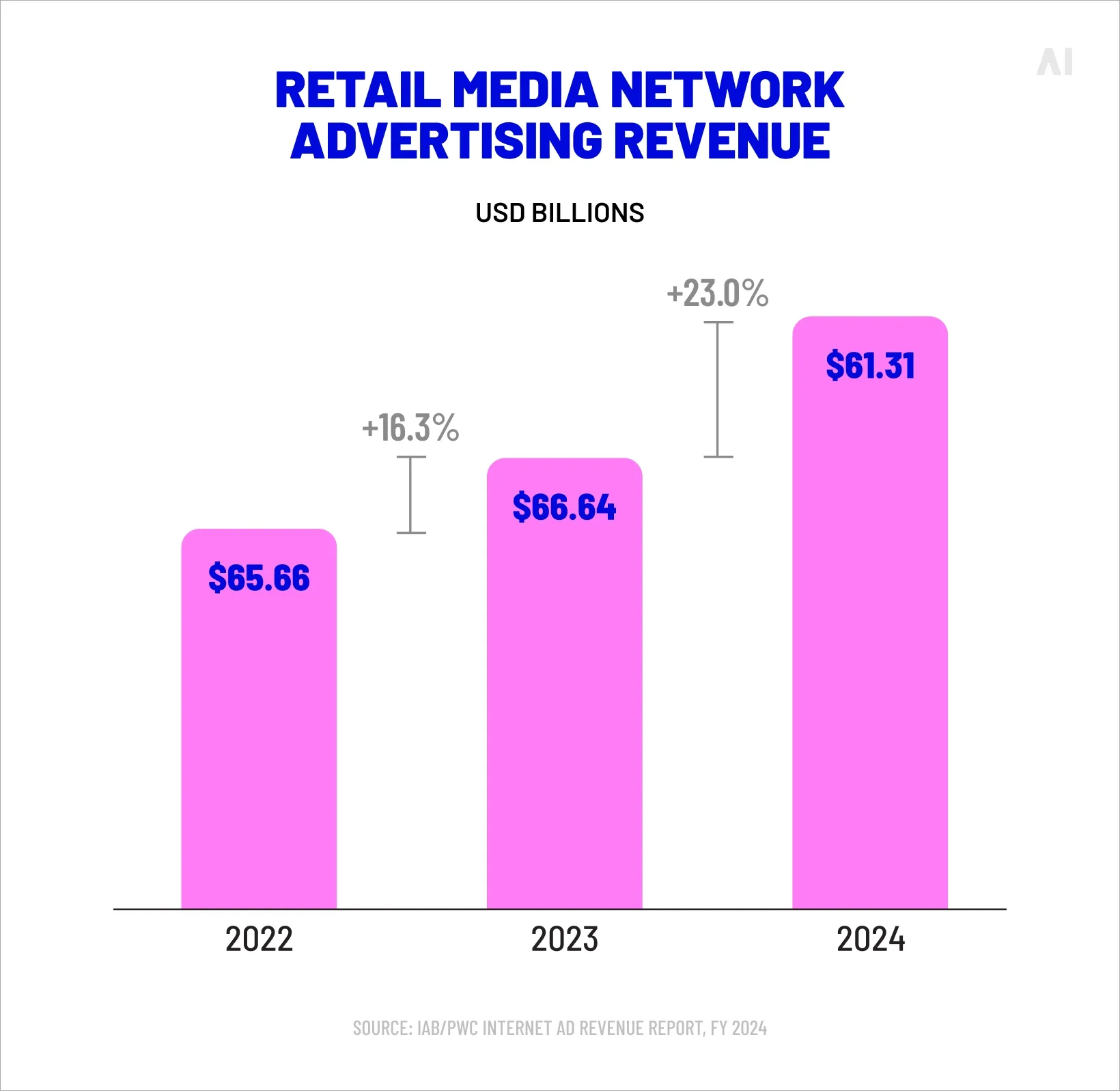
From the IAB/PwC Internet Advertising Revenue Report (full-year 2024), retail media network advertising revenues totaled $53.7B in 2024, up $10.1B year over year (23% growth)—a strong signal of where performance budgets keep moving.
Connected TV
CTV personalization often looks different than web personalization. It’s usually household-based, frequency-sensitive, and heavily shaped by viewing context.

eMarketer forecasts US CTV ad spending will reach $33.48B in 2025 (+16.8% YoY), while time spent with CTV grows more slowly—meaning competition for attention keeps rising.
On the delivery side, Innovid’s 2025 CTV report highlights a practical issue: average campaign reach was 19.64% of Innovid’s U.S. household footprint, while frequency averaged 7.09—suggesting many campaigns overserve a small slice of households instead of expanding incremental reach.
⚡ If frequency climbs while reach stays flat, you’re often paying for repetition instead of persuasion. In CTV, the fastest win is usually controlling overserve, not adding more targeting layers.
💡 If you want a channel-level overview of CTV mechanics and measurement, AI Digital’s CTV explainer is a good companion piece: Connected TV advertising in 2025: The ultimate guide for marketers
Paid social and in-app
Social is often the first place teams experience “personalization at scale” because platforms can optimize delivery quickly. The limitation is portability: performance signals can be rich inside a platform, but hard to unify across platforms.
In-app environments can also be strong for personalization because app categories, session behavior, and location context can be meaningful—especially when handled with consent and clear value exchange.
Programmatic display and online video
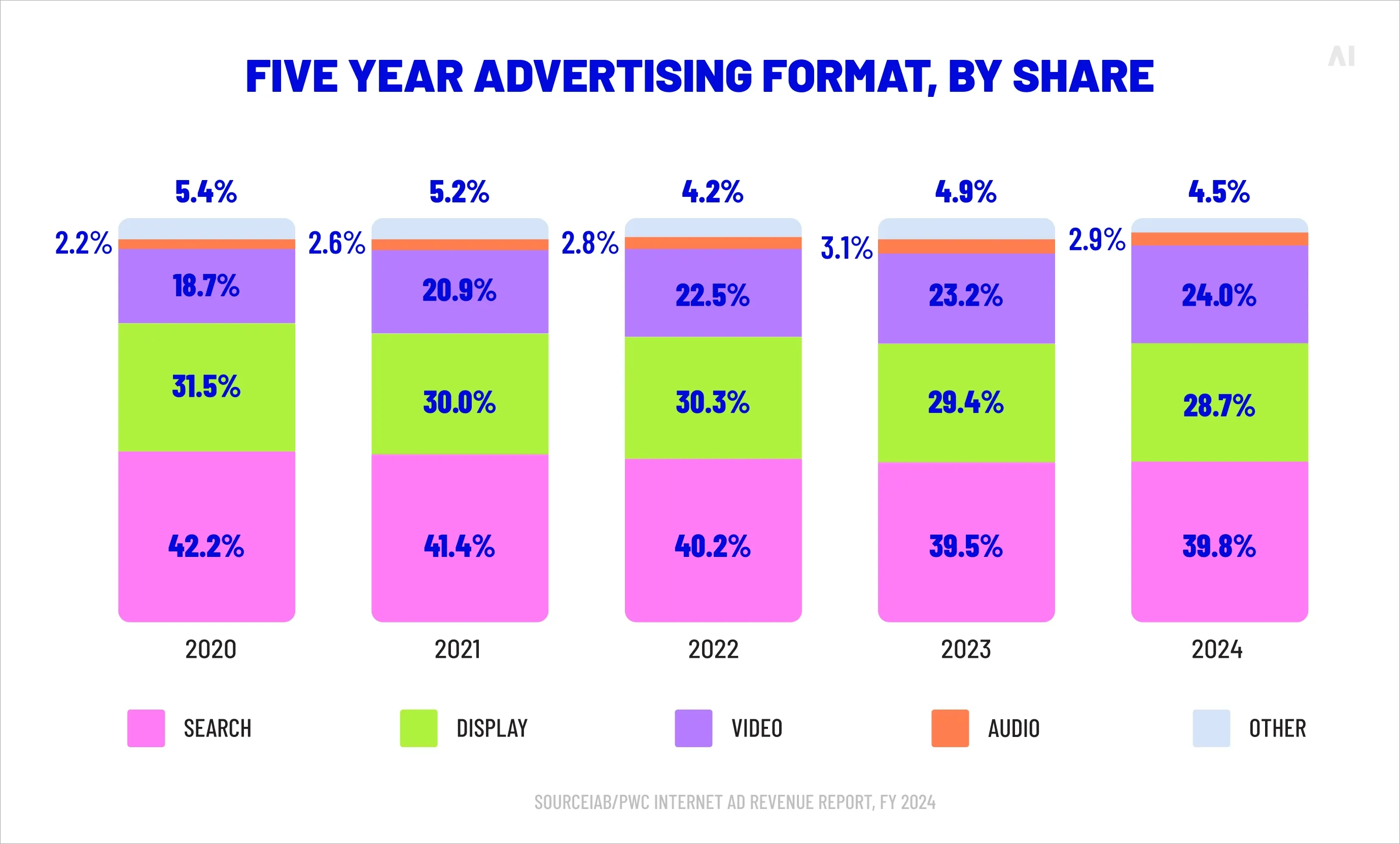
Display is where many teams operationalize multi-signal personalization: first-party + context + modeled intent + supply quality controls. It’s also where you feel fragmentation most (data, inventory quality, measurement).
💡 For more information on programmatic display and video advertising please see our dedicated explainers: What is programmatic display advertising & Complete guide to OLV advertising
Email (and lifecycle messaging)
Email is still one of the best environments for personalization because it’s built on first-party relationships. The big unlock is not “personalized subject lines,” but journey-based orchestration: triggers, content modules, and sequencing that matches intent.
A quick way to choose your “personalization priority channels”
Ask two questions:
- Where do we have the strongest consented signals?
- Where can we connect exposure to outcomes with the least measurement distortion?
That usually points to some combination of retail media, email/lifecycle, and one “reach channel” (CTV or online video), supported by programmatic display or paid social for scale.

Key benefits of personalized advertising
Personalization only pays off when it’s measurable. Below are benefits marketers can document—and what makes them real versus wishful.
{{Personalized-Advertising-Explained-SEO-3="/tables"}}
Higher relevance and engagement
Relevance is the earliest win. When people recognize why an ad is being shown, they’re more likely to pay attention.
A 2025 EMARKETER write-up of Verve research found:
- 76% of consumers were more likely to pay attention to ads that felt relevant
- About two in three said relevant/personalized ads helped them discover products they didn’t know existed
- 72% said they’d be less likely to pay to remove ads if the ads were targeted and interesting
This is important because it reframes personalization as an attention strategy, not just a conversion tactic.
⚡ Relevance is an attention strategy before it’s a conversion strategy. When ads feel timely and aligned, you earn the right to ask for the click later.
Improved performance metrics (ROAS, CPA, LTV)
Performance improvements typically come from three levers:
- Less waste: fewer impressions served to low-propensity users
- Better conversion fit: message matches the user’s stage and objections
- Better sequencing: the right follow-up ad appears at the right time
McKinsey notes that personalization done well can drive measurable commercial impact—while also emphasizing that many companies still under-execute the basics of data and operating model needed to sustain it.
💡 If you’re pressure-testing your own KPI stack (and trying to avoid optimizing to numbers that don’t map to business outcomes), AI Digital’s KPI guide is useful context: 15 essential digital marketing KPIs to track (and improve) in 2026
⚡ Good personalization doesn’t just improve conversion rate. It improves the efficiency of learning—because you get clearer feedback on which messages work for which intent states.
Better customer experience
This benefit is real, but it’s also where personalization can backfire. When it works, it reduces friction:
- Fewer irrelevant offers
- Faster path to the right product or plan
- Messaging that matches the user’s needs (not the brand’s calendar)
When it fails, it feels invasive or repetitive. Gartner found that personalization can create negative experiences for a large share of customers—and those customers are more likely to regret purchases and less likely to buy again. Specifically, Gartner reported 53% of customers experienced negative personalization, making them 3.2× more likely to regret a purchase and 44% less likely to purchase again.
So yes—customer experience improves when personalization is useful, not just precise.
More efficient media spend
Efficiency comes from two places:
- Decision quality: choosing higher-value impressions, not just cheaper ones
- Supply quality: reducing fraud, low viewability, and hidden fees
One reason this is harder in 2026 is that marketers are trying to do efficiency work while dealing with data fragmentation and measurement gaps. In the IAB State of Data 2025 report, nearly two-thirds cited issues like data quality, protection, and fragmentation as top barriers to AI-driven readiness.
Types of personalized advertising
A useful way to think about personalization types is: what signal is doing the heavy lifting? Here’s a practical breakdown.
{{Personalized-Advertising-Explained-SEO-4="/tables"}}
Demographic and geographic
This is the oldest form of personalization—and it still has a place.
Use it when:
- You need scale fast
- Your product has clear geo constraints (retail footprint, service areas)
- You’re early in learning and want clean tests
Upgrade it by adding situational relevance: seasonality, local events, weather, and time-of-day messaging.
Interest and behavior-based
This is where people often mean “personalization,” but it’s only as good as your signal freshness. Behavior changes. Cookie-like signals decay. Platform categories vary.
A practical pattern is to treat interest as “soft intent,” then let your creative do the work: comparisons, education, and proof points that help someone move forward.
Retargeting and remarketing (in a privacy-first world)
Retargeting still works, but the playbook has changed:
- Use first-party retargeting (site/app/email audiences) as the foundation
- Use frequency caps and recency windows aggressively to prevent fatigue
- Treat retargeting as a sequence, not a loop (showing the same ad 12 times rarely helps)
Also, understand the browser reality. Google has stepped back from fully deprecating third-party cookies in Chrome in favor of a user-choice approach—so “cookieless” is not a single finish line, it’s a messy transition period.
💡 Further reading: CTV retargeting: The modern approach to audience re-engagement
Contextual
Contextual advertising is having a real resurgence because it doesn’t require identity to be effective.
The modern version isn’t just keyword matching. It’s:
- content classification,
- suitability controls,
- and creative mapping (the part most teams skip).
⚡ Contextual works when creative is built for the moment. If you serve generic messaging into highly specific contexts, you’ll miss the main advantage of privacy-safe relevance.
Journey-based
Journey-based personalization is where teams become meaningfully better than competitors—because it’s hard to copy.
It requires:
- a clear journey model (stages),
- reliable event tracking,
- and creative designed for each stage.
It also forces discipline: you can’t run 40 disconnected campaigns and call it a journey.
How AI transformed ad personalization
AI didn’t “invent” personalization. What it changed is the speed and scale of decisioning — and the ability to personalize without relying on one fragile identifier.
In practice, AI has upgraded four areas:
Predictive targeting and propensity
Instead of “people who visited product page X,” models can estimate:
- likelihood to buy,
- likelihood to churn,
- likelihood to respond to an offer,
- or likelihood to convert within a window.
That matters because it lets you bid on probability, not just past behavior.
Creative variation and testing velocity
AI helps teams generate and rotate more creative variants, faster. But this only works when you have guardrails—brand fit, claims review, and experimentation structure.
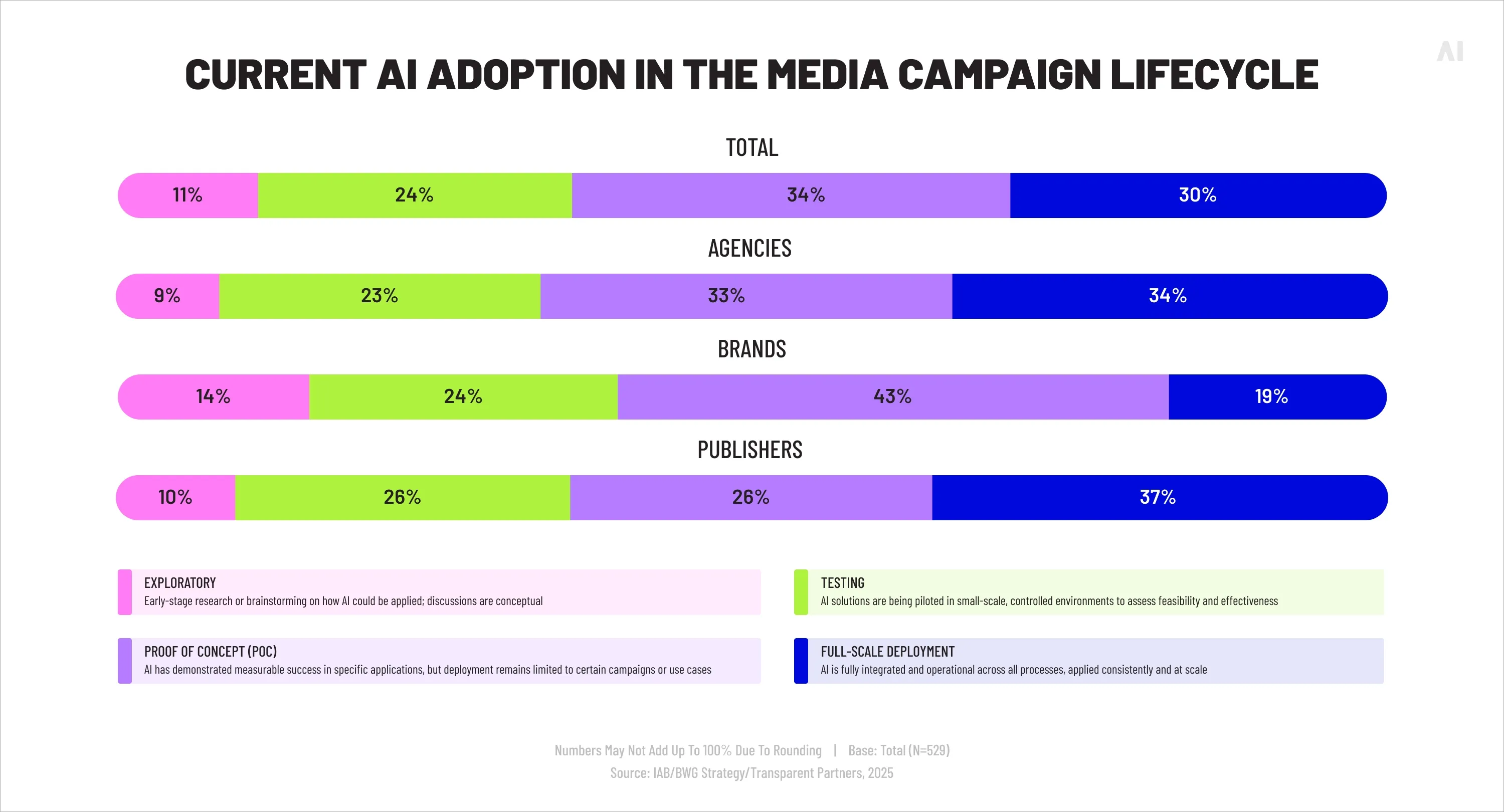
The IAB State of Data 2025 report found only 30% of companies reported fully integrating AI into their data processes, and about half of those not fully integrated expect to get there by 2026.
In other words, the advantage isn’t “using AI.” It’s operationalizing it.
Privacy-safe measurement and modeled conversions
As direct tracking becomes less complete, platforms are leaning more on modeling. Google, for example, explains how conversion modeling uses observable data and historical trends to estimate the relationship between consented and unconsented journeys—helping fill in measurement gaps when user-level paths can’t be observed.
This doesn’t remove the need for incrementality testing, but it helps keep optimization signals from going dark.
Cross-channel pattern recognition
AI is also being used to spot patterns humans miss:
- which contexts correlate with high-quality conversions,
- which sequences reduce churn,
- which creative elements fatigue first.
💡Further reading: AI-driven personalization: What it is, how it works, why it matters and AI in digital marketing
Challenges marketers face
Personalization’s upside is real. So are the traps.
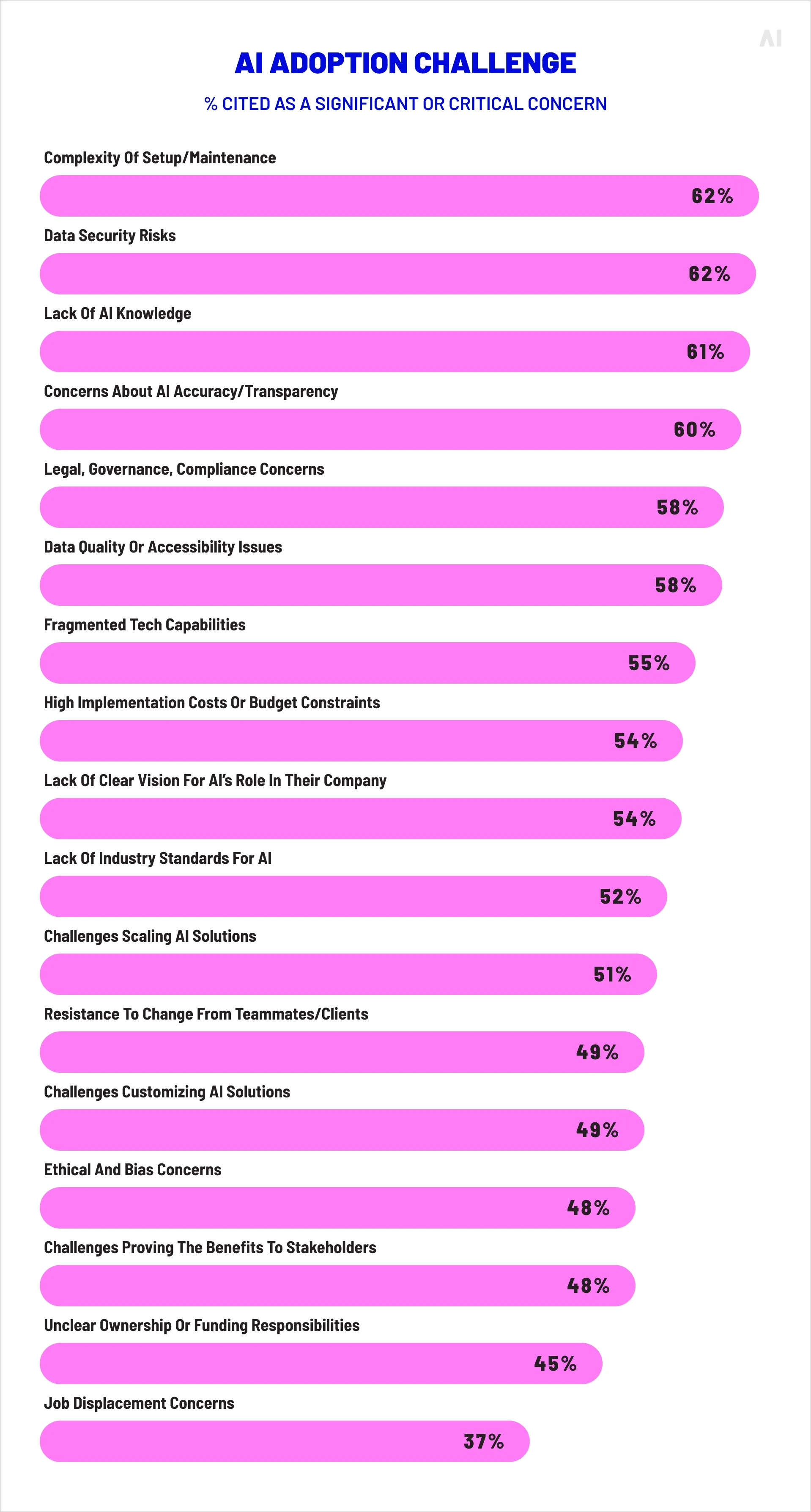
Privacy-first landscape
This is not just about compliance. It’s about feasibility.
- State privacy laws continue to evolve and expand, creating operational complexity for national brands. IAPP tracks the shifting state-level landscape and amendments.
- The FTC has been increasingly active around surveillance-style data practices and targeted advertising risks. In a 2024 staff report, the FTC highlighted extensive data collection and raised concerns around retention, sharing, and protections for teens.
- Data broker enforcement has also sharpened scrutiny around sensitive data and ad-auction collection pathways.
The practical marketer takeaway: personalization strategies must be built on consent, minimization, and transparency, not “how much data can we collect.”
💡 If you want a cookieless-specific view of how these pressures change day-to-day activation, AI Digital’s cookieless article is relevant background: Navigating the cookie-less future: Challenges and opportunities for advertisers
Data fragmentation and quality issues
Even if privacy rules didn’t exist, many teams would still struggle because data is scattered and inconsistent.
The above-mentioned Forrester/TransUnion identity findings (70% struggling across touchpoints; 16+ tools) illustrate the real issue: personalization breaks when your customer record breaks.
You can’t personalize what you can’t reliably recognize.
Over-personalization and creative fatigue
Two separate problems often get lumped together:
- Over-personalization: ads feel creepy or too specific
- Creative fatigue: the audience sees the same message too often
Gartner’s findings (also mentioned previously) on negative personalization experiences are a strong reminder that precision can create regret and churn when it’s not handled carefully.
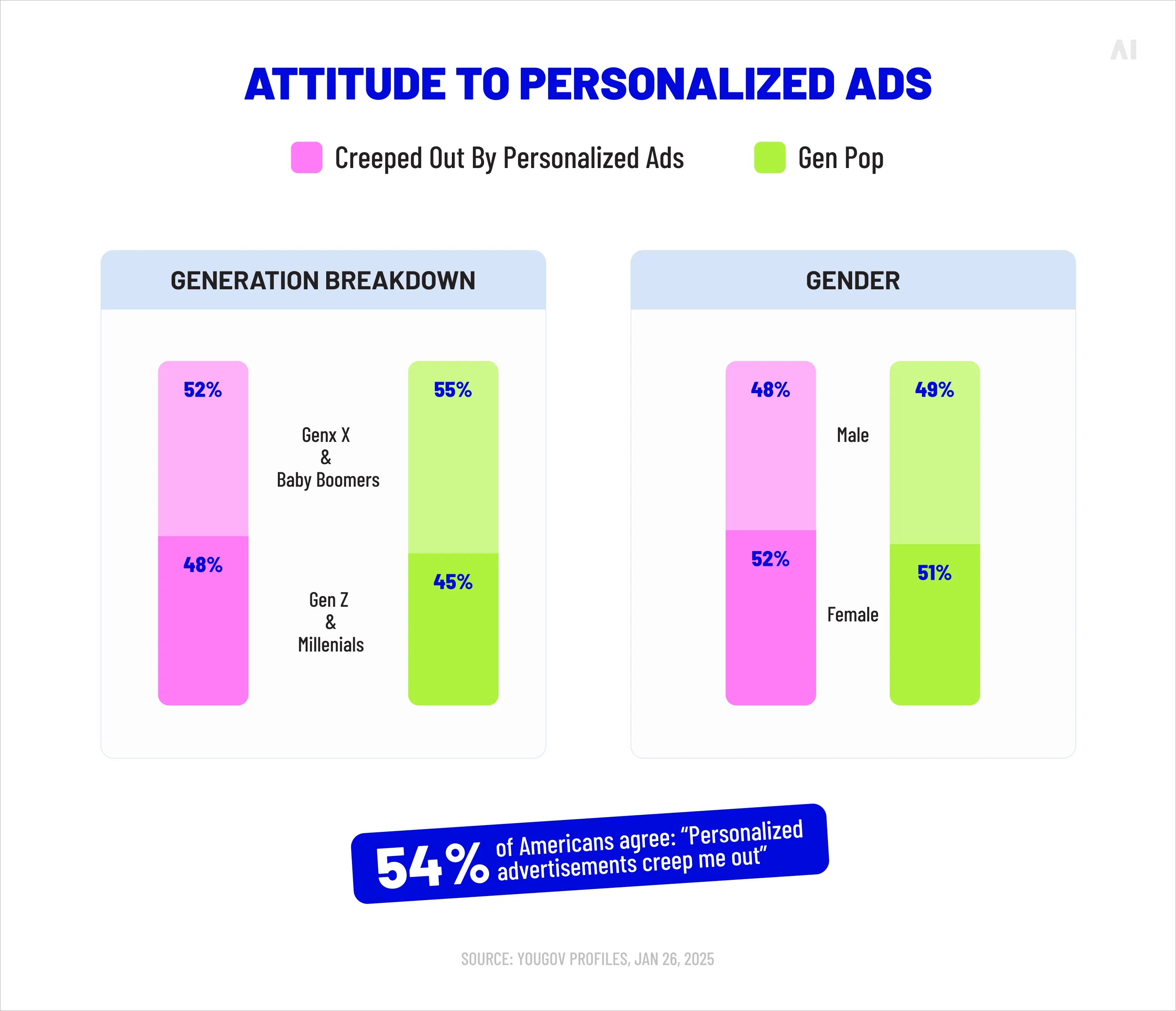

Also, consumers are still cautious about AI-created advertising. EMARKETER reported 65% of US adults felt at least somewhat uncomfortable with AI-generated ads.
So the fix isn’t “personalize less.” It’s “personalize with better taste”: clearer value exchange, lighter-touch relevance, and stronger rotation.
💡 Related reading: What is hyper-personalization and how does it work?
Scaling personalization across channels
Personalization doesn’t scale when each channel runs its own logic:
- Different audience definitions
- Different conversion definitions
- Different attribution windows
- Different creative systems
This is why many “personalization programs” turn into a set of disconnected tactics.
A scalable approach usually requires:
- one shared audience taxonomy,
- one shared creative framework,
- and measurement that can compare channels without pretending attribution is perfect.
Measurement and attribution gaps
A lot of personalization “wins” are actually measurement artifacts—especially when platforms optimize toward conversions that would have happened anyway.
The fix is to layer measurement methods:
- platform reporting (directional),
- modeled conversions (when necessary),
- and incrementality tests (when decisions are high-stakes).
Meta, for example, describes conversion lift testing as a way to measure the incremental effect of ads using test/control methodology.
💡 For a mindset reset on why dashboards can look healthy while growth slows, AI Digital’s piece on misleading metrics is useful context: Why your marketing metrics are lying about growth
Strategies for effective advertising personalized
The goal here is not “personalize everything.” It’s to personalize the parts that reliably drive outcomes—without creating privacy risk or operational chaos.
Build a strong first-party data foundation
Start with what you can actually govern:
- Define your core events (view, add to cart, lead, purchase, repeat)
- Clean identity inputs (email capture, login, preference centers)
- Create a usable customer schema (not 400 fields—10–20 that matter)
- Align consent and retention rules with legal early
Small note: this is where many teams should slow down. A shaky first-party foundation makes every downstream “AI” effort noisier.
Apply AI responsibly to enhance (not replace) decisioning
AI works best when it supports decisions you already understand:
- predicting which segments are warming up,
- allocating budget between proven plays,
- surfacing creative fatigue earlier,
- modeling conversions when direct observation is incomplete.
Use governance that’s easy to enforce:
- approved claims and guardrails,
- human review for sensitive categories,
- and a clear escalation path when automation behaves oddly.
Define the right level of personalization
Personalization is a spectrum:
- Level 1: segment-based (3–8 segments, clear creative mapping)
- Level 2: intent-based (propensity + context + triggers)
- Level 3: journey orchestration (sequencing + suppression + channel roles
- Level 4: near-1:1 modular creative (only when you have the system maturity)
Most marketers should aim for Levels 1–3 and get excellent there before chasing Level 4.
Ensure cross-channel consistency
Consistency doesn’t mean “same ad everywhere.” It means:
- same promise,
- same product truth,
- same measurement definitions,
- and a coherent story as someone moves between channels.
A practical way to do this is to build a “message architecture”:
- 3 core value props,
- 3 proof points,
- 2 objections to overcome,
- 2–3 offers, mapped across journey stages.
Use privacy-first measurement frameworks
You need measurement that still works when user-level tracking is incomplete.
Good building blocks include:
- modeled conversions where appropriate (as noted previously, Google explains the principles behind conversion modeling)
- lift testing for major budget decisions
- MMM or experiments for longer-cycle channels (CTV, upper funnel)
⚡ Attribution is not the same thing as incrementality. When budgets get tight, the safest move is proving what’s additive, even if it means fewer tests done well.
Also, keep an eye on platform-level attribution updates. Apple’s AdAttributionKit developments (and related changes) are one example of how mobile measurement keeps evolving.
Test, learn, and iterate
Personalization improves when you run controlled learning loops.
A clean testing cadence:
- Start with 2–3 segments and 2 creative angles
- Prove lift (not just CTR)
- Expand segments only when you can measure differences
- Rotate creative before fatigue sets in
- Document what worked as reusable patterns
⚡ In 2026, the brands that win aren’t the ones with the most data. They’re the ones with the best learning system.
Conclusion on ad personalization
Personalized advertising in 2026 is less about hyper-precise targeting and more about relevance you can sustain: consented signals, smart decisioning, creative that adapts, and measurement that doesn’t pretend the world is perfectly trackable.
It’s also worth repeating the uncomfortable truth: personalization can backfire when it feels invasive, repetitive, or misleading. The goal is helpful relevance—delivered with restraint, tested carefully, and measured honestly.
If you’re building a personalization program and need support connecting premium supply, cross-channel execution, and outcome-driven optimization, AI Digital positions its model around a DSP-agnostic, transparent approach (Open Garden), supported by managed service execution, supply selection, and the Elevate platform vision.
💡For more on AI Digital’s POV on applying AI in programmatic advertising, explore what we do and see our article: The future is now: how AI Digital embraces AI technologies to change the programmatic game.
Otherwise, drop us a message and we’ll get back to you shortly with practical next steps to make personalization work for your goals.
.webp)