The Modern Marketing Stack: CRM, Automation, Analytics — and What’s Missing


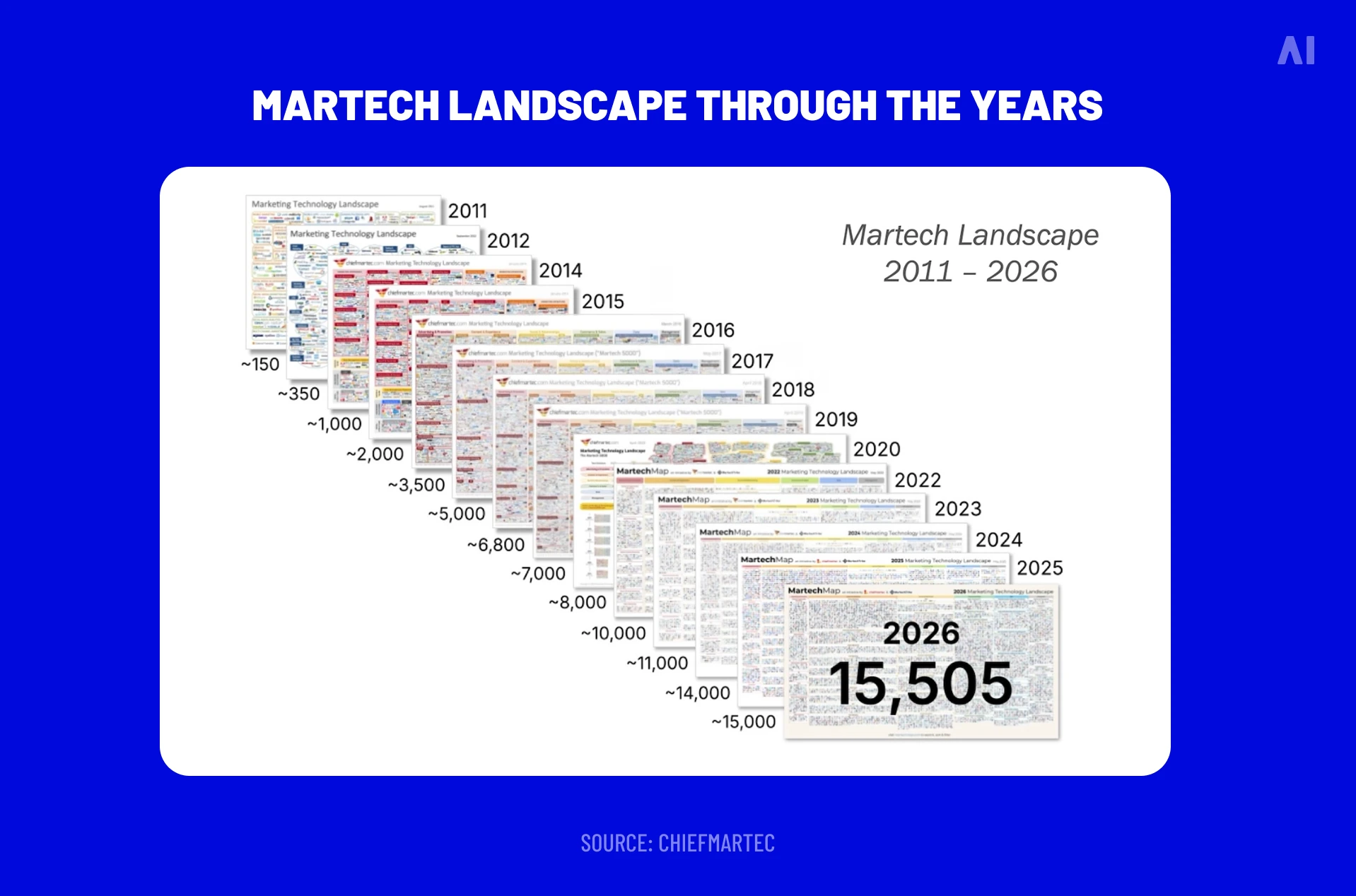
Most companies are not short on marketing tools. They already use CRM platforms to manage leads and customer records, marketing automation tools to trigger emails and workflows, analytics platforms to track traffic and conversions, and dashboards to report campaign results. The real problem is that these tools often do not work as one decision-making system. In 2025, the marketing technology landscape reached 15,384 solutions across 49 categories, which means marketing teams have more tools than ever — but also more disconnected data, duplicated reporting, and operational complexity to manage.
That complexity is now a performance issue. Gartner reports that marketing budgets stayed flat at 7.7% of company revenue in 2025, while 59% of CMOs said they did not have enough budget to execute their strategy. In that environment, a marketing stack cannot simply collect data or automate tasks. It has to help teams understand which channels drive revenue, where budget is being wasted, and which actions should happen next.
This is where many digital marketing tech stacks still fall short. CRM data may show pipeline movement, but not the marketing touchpoints that influenced it. Analytics tools may show conversion changes, but not whether those changes came from media quality, audience behavior, creative performance, or attribution gaps. Automation platforms may execute campaigns quickly, but if the audience data is incomplete or the logic is outdated, they only scale weak decisions faster. According to Gartner, only 49% of martech tools are actively used, and just 15% of organizations qualify as high performers that meet strategic goals and show positive ROI.
This is why the conversation around marketing technology needs to move beyond tool selection. A modern marketing stack should connect data, measurement, and execution so teams can make faster and more confident decisions. This article explains what today’s modern marketing data stack includes, why traditional martech setups still fail to produce consistent growth, and what businesses need to build instead: a connected performance system that turns fragmented data into clear decisions.
What is the modern marketing stack today?
A modern marketing stack is the set of systems a company uses to manage customer data, run campaigns, measure digital behavior, organize performance data, and push insights back into execution channels. In most companies, this includes five core layers: CRM, marketing automation, analytics, data infrastructure, and activation tools.
These systems are necessary, but they do not all solve the same problem. CRM records customer and pipeline data. Automation platforms execute workflows. Analytics tools show user behavior and campaign performance. Data infrastructure centralizes information from different systems. Activation layers push audiences, creative, and campaign signals back into market.
The weakness is that most of these tools were built to support execution and reporting, not strategic decision-making. They can show that a lead moved through the funnel, that an email sequence ran, or that a campaign generated conversions. But they do not automatically explain which channel created real revenue, which audience segment should receive more budget, or which part of the customer journey is blocking growth.
💡That is why the modern marketing stack should not be evaluated only by how many tools a company has. It should be evaluated by whether those tools help teams answer operational questions faster: What changed? Why did it change? What should we do next?
CRM
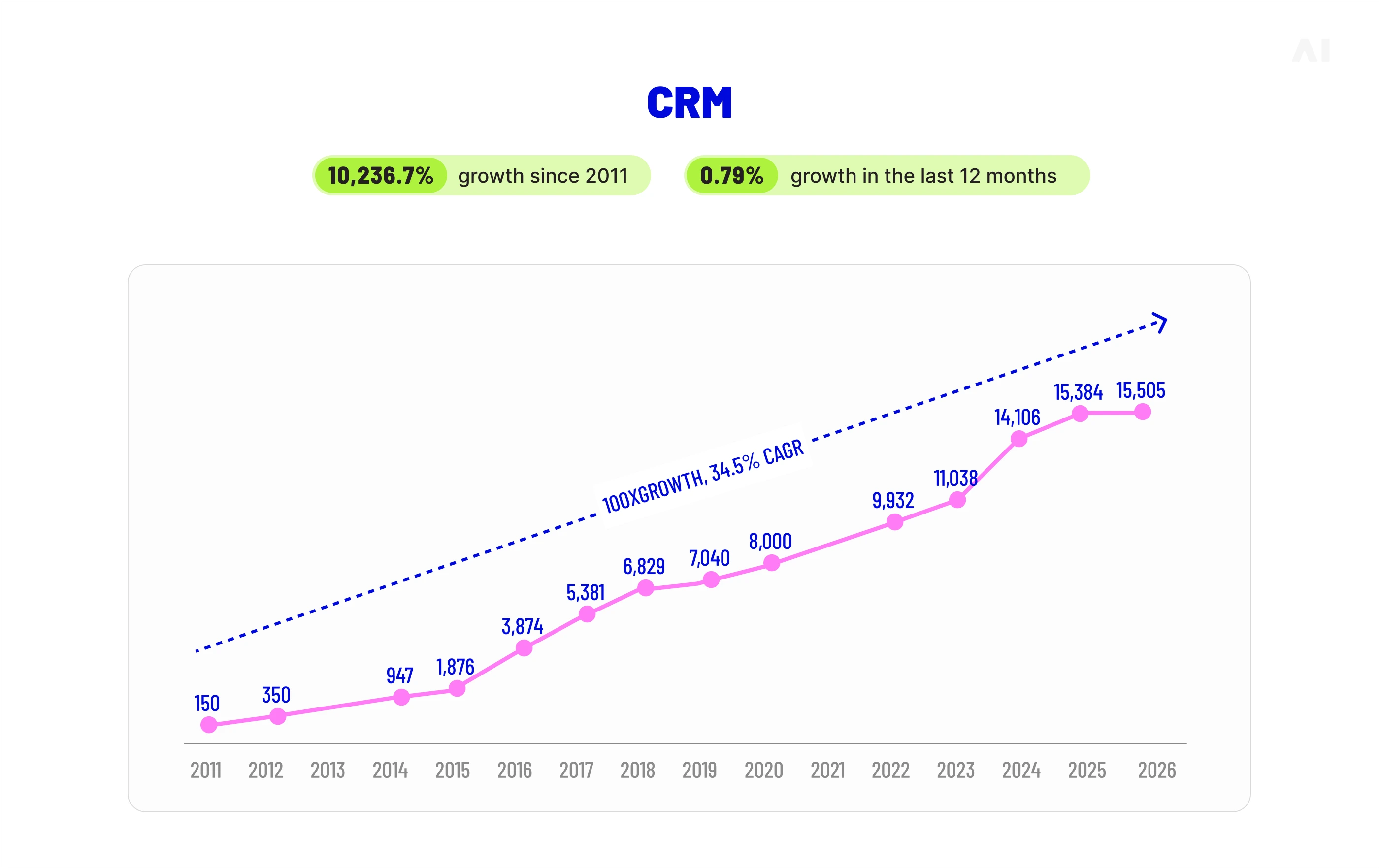
The martech landscape has expanded from 150 solutions in 2011 to 15,505 solutions in 2026, showing more than 10,236% growth over the period. However, the curve also shows that growth is slowing: the market increased by only 0.79% in the last 12 months, from 15,384 tools in 2025 to 15,505 in 2026.
A CRM system stores customer records, account data, lead status, sales activity, opportunity stages, and pipeline value. It gives marketing and sales teams a shared place to manage relationships and track commercial progress. Salesforce reports that 86% of marketers use CRM systems, which shows how central CRM has become to modern marketing operations.
But CRM data often describes the customer after an interaction has already happened. It may show that a lead became a sales-qualified opportunity, but it does not always show which campaign touchpoints influenced that movement, whether the lead came from high-quality media, or whether the pipeline value reflects genuine buying intent.
This makes CRM useful as a system of record, but limited as a system of decision-making. If CRM data is not connected to campaign performance, attribution logic, website behavior, and revenue outcomes, marketing teams can see pipeline movement without understanding the marketing activity behind it.
Automation
Marketing automation platforms help teams execute repeatable actions: email sequences, lead nurturing, lifecycle messaging, retargeting triggers, customer segmentation, and handoffs between marketing and sales. HubSpot defines marketing automation as software that automates repetitive marketing tasks such as email marketing, social posting, and ad campaigns, with the goal of improving efficiency and personalization.
The risk is that automation can make weak logic move faster. If a lead score is based on outdated behavior, if lifecycle stages are not synced with CRM, or if audience lists contain low-quality data, the automation platform will still execute the workflow. It will send the email, trigger the campaign, update the contact, or push the audience — even if the underlying decision is wrong.
So automation should not be treated as the “brain” of the stack. It is an execution layer. It helps teams scale actions, but it depends on clean data, accurate segmentation, and clear performance logic to make those actions valuable.
Analytics
Analytics tools help teams understand how users behave across websites, apps, ads, campaigns, and digital journeys. They show traffic sources, landing page behavior, conversion paths, engagement patterns, and channel-level performance. Salesforce reports that 88% of marketers use analytics or measurement tools, which makes analytics one of the most common layers in the marketing stack. But most analytics systems are still strongest at describing what happened.
They can show that paid search conversions dropped, that a landing page has a high exit rate, or that returning users convert better than first-time visitors. What they usually do not explain on their own is whether the issue comes from media quality, audience mismatch, creative fatigue, offer relevance, tracking loss, or poor page experience.
💡That is why analytics data needs to be connected to broader business context. A dashboard may show that conversion rate changed, but marketing leaders still need to connect that signal to spend, revenue quality, customer segment, sales outcomes, and margin.
⚡️AI Digital's new Digital Experience Analytics: How to Turn User Behavior into Revenue can go deeper into this point: experience data becomes more useful when it is tied to commercial outcomes, not reviewed as isolated website behavior.
Data infrastructure
Data infrastructure includes warehouses, pipelines, APIs, ETL tools, customer data platforms, identity resolution systems, and integration layers. This is the part of the stack that moves data out of individual platforms and into a more controlled environment where teams can compare, clean, and analyze it.
This layer is becoming more important because marketers are working with more first-party data, more privacy constraints, and more AI-driven use cases. Salesforce reports that 84% of marketers use first-party data, but only 31% are fully satisfied with their ability to unify customer data. That gap matters because first-party data only becomes useful when teams can connect it across CRM, media, analytics, lifecycle, and revenue systems.
Snowflake’s 2026 Modern Marketing Data Stack report also reflects this shift toward centralized data infrastructure. Its methodology analyzed usage data from more than 11,100 Snowflake customers over a 12-month period to identify the technologies used across the marketing data stack. The point is not that every company needs the same warehouse or pipeline setup. The point is that modern marketing increasingly depends on a data foundation that can support cross-channel visibility, measurement, and activation.
Still, infrastructure alone does not create better decisions. A warehouse can centralize spend, clicks, impressions, leads, opportunities, and revenue. But it does not automatically decide which KPI should guide budget allocation, which data source should be trusted, or how performance should be interpreted. Data infrastructure creates the foundation; governance and decision logic turn that foundation into business value.
Activation and execution layers
Activation layers connect insights back to the systems where marketing actions happen. This includes CRM updates, paid media audiences, email personalization, website personalization, creative testing, bidding rules, suppression lists, and sales triggers.
This is where a modern stack becomes more advanced. Instead of leaving insights inside dashboards, activation layers help teams act on performance signals. For example, if data shows that a segment has high click-through rates but weak revenue quality, the system should help marketers adjust bidding, exclude that audience, change the offer, or update qualification rules. If a creative message performs well for one audience but poorly for another, that signal should inform creative rotation and personalization, not just appear in a weekly report.
Adobe’s 2026 AI and Digital Trends report points in this direction: organizations want customer experiences that are highly personalized and anticipatory in real time, but Adobe also notes that stronger data foundations and better cross-functional alignment are needed to turn early AI and personalization gains into sustained customer experience improvements.
⚡️Our guide on Dynamic Creative Optimization (DCO): How It Works & How to Drive Real Performance expands on this activation layer in more detail. DCO is a useful example because it shows how a stack can move beyond reporting. Instead of only measuring which creative worked after the campaign ends, teams can use audience, context, and performance signals to adjust creative delivery while the campaign is still active.
This is the real role of the modern marketing stack today: not just storing data, launching workflows, and producing reports, but creating a closed loop where customer data, campaign performance, measurement logic, and activation systems work together. When that loop is missing, the stack remains operational. When it works, the stack becomes a performance system.
Examples of modern marketing stacks
Modern marketing stacks are not built the same way in every business. The structure depends on how the company sells, how long the customer journey is, how many channels it uses, and how much control it needs over data.
A B2B SaaS company usually builds its stack around CRM and pipeline visibility. An e-commerce brand builds around transactions, product behavior, lifecycle messaging, and customer value. An enterprise organization usually needs a governed data layer because reporting has to work across teams, markets, business units, and platforms. A hybrid stack combines centralized data control with flexible execution tools.
The useful question is not, “Which tools are in the stack?” The better question is, “What decision does this stack help the business make faster?”
B2B SaaS growth stack
A B2B SaaS growth stack usually combines a CRM, marketing automation platform, website analytics, BI reporting, and a shared data layer. A typical setup might use Salesforce as the CRM, HubSpot or Marketo for automation, Google Analytics for web behavior, Tableau or Looker for reporting, and a warehouse to combine marketing and sales data.
The goal is not simply to count leads. In B2B SaaS, the more important question is whether marketing activity is creating qualified pipeline. A paid search campaign, webinar, comparison page, LinkedIn ad, demo request, and sales email may all influence the same account before revenue is created.
This matters because B2B buying is rarely individual. 6sense reports that 92% of B2B purchases involve buying groups of three or more people, and 65% involve groups of five or more. That changes how the stack should work: it cannot only track one form fill or one last-click source. It needs to connect account activity, buying group engagement, campaign influence, and pipeline movement.
In a weak B2B SaaS stack, marketing reports that a campaign generated 500 leads. In a stronger stack, the team can see how many of those leads came from target accounts, how many became sales-qualified, how much pipeline they influenced, and whether the cost per qualified opportunity supports the growth target.
E-commerce performance stack
An e-commerce performance stack is usually built around the commerce platform. A brand may use Shopify or Magento as the transaction layer, Klaviyo for email and SMS automation, Google Analytics for website behavior, paid media platforms for acquisition, and BigQuery or another warehouse to compare product, customer, and campaign performance.
The main job of this stack is speed. E-commerce teams need to know which products are selling, which campaigns are bringing profitable customers, which abandoned cart flows recover revenue, and which customer segments are likely to buy again.
Klaviyo’s 2025 benchmark report is useful here because it is based on billions of emails and text messages across verticals including apparel, accessories, health, and beauty. That kind of benchmark shows how important lifecycle messaging has become in e-commerce, especially when brands need to compare email, SMS, product behavior, and purchase data together.
The decision problem is specific. A high open rate does not automatically mean the campaign worked. An e-commerce team needs to know whether the message drove orders, increased average order value, improved repeat purchase rate, or brought back customers who were likely to churn.
That is why stronger e-commerce stacks connect acquisition data, product catalog data, purchase history, lifecycle engagement, and customer value. Without that connection, teams can overinvest in campaigns that drive short-term purchases but attract low-margin or one-time buyers.
Enterprise marketing data stack
An enterprise marketing data stack is usually built around a controlled data environment. Data from CRM, ad platforms, analytics tools, offline sales systems, customer service platforms, and finance systems is moved through integration pipelines, cleaned, modeled, and then used for BI reporting, forecasting, attribution, and activation.
This structure is common in companies with multiple regions, brands, agencies, platforms, and stakeholder groups. The issue is not whether the company can launch campaigns. The issue is whether everyone is working from the same version of performance.
For example, one team may define a conversion as a form fill. Another may define it as a qualified lead. Finance may only care about closed revenue. Paid media platforms may report conversions using their own attribution windows. Without a governed data layer, all of those numbers can exist at the same time, and each platform can make performance look different.
The infrastructure cost behind this is not small. Fivetran’s 2026 Enterprise Data Infrastructure Benchmark Report found that enterprises spend an average of $29.3 million per year on data programs, with $2.2 million spent just on keeping data pipelines running.
For marketing leaders, that means data infrastructure is no longer a background technical function. It directly affects whether campaign reports are trusted, whether teams can compare channels fairly, and whether AI or analytics tools have clean enough data to work with.
A strong enterprise stack does not only centralize information. It creates rules for how data is defined, validated, joined, and used. That makes it easier to compare media spend, lead quality, customer behavior, sales outcomes, and revenue across the business.
Hybrid stack: data layer + execution tools
A hybrid stack combines a centralized data layer with flexible execution tools. This model is often the most practical option for companies that want more control over data without slowing down marketing execution.
In this setup, the warehouse, CDP, or data layer acts as the source of truth. It holds cleaned customer, campaign, product, and revenue data. Execution tools then use that data to run campaigns, sync audiences, trigger workflows, personalize content, suppress low-value users, and optimize media.
This structure matters because marketing teams increasingly need both control and speed. They need data that is reliable enough for measurement, but they also need campaign systems that can act quickly.
The risk is that data movement itself becomes fragile. A 2026 Fivetran release reported that 97% of senior data leaders said pipeline failures have affected their organizations, and the average cost of pipeline failures reached $3 million per month. For marketing, that is not only an IT problem. If data pipelines fail, audiences may not update, reports may be delayed, campaign optimization may use stale data, and leadership may make budget decisions from incomplete information.
This is why hybrid stacks work best when there is a clear separation between the source of truth and the systems of action. The data layer should define what is accurate. The execution tools should use that data to act.
⚡️This also sets up the next article on Types of AI Marketing Platforms: Automation, Analytics, Personalization, and Performance. AI marketing tools can automate tasks, analyze performance, personalize experiences, or optimize media. But their value depends on the stack underneath them. If the data layer is weak, AI becomes another execution tool working from incomplete signals. If the data layer is strong, AI can support faster and more reliable decisions.
💡The best modern marketing stack is not the one with the longest software list. It is the one where each layer has a clear job: CRM tracks customer and revenue status, automation executes lifecycle actions, analytics measures behavior, infrastructure connects and validates data, and activation tools turn insights into campaign changes. When those layers work together, the stack supports decisions. When they do not, it only produces more disconnected reports.
Beyond the modern martech data stack
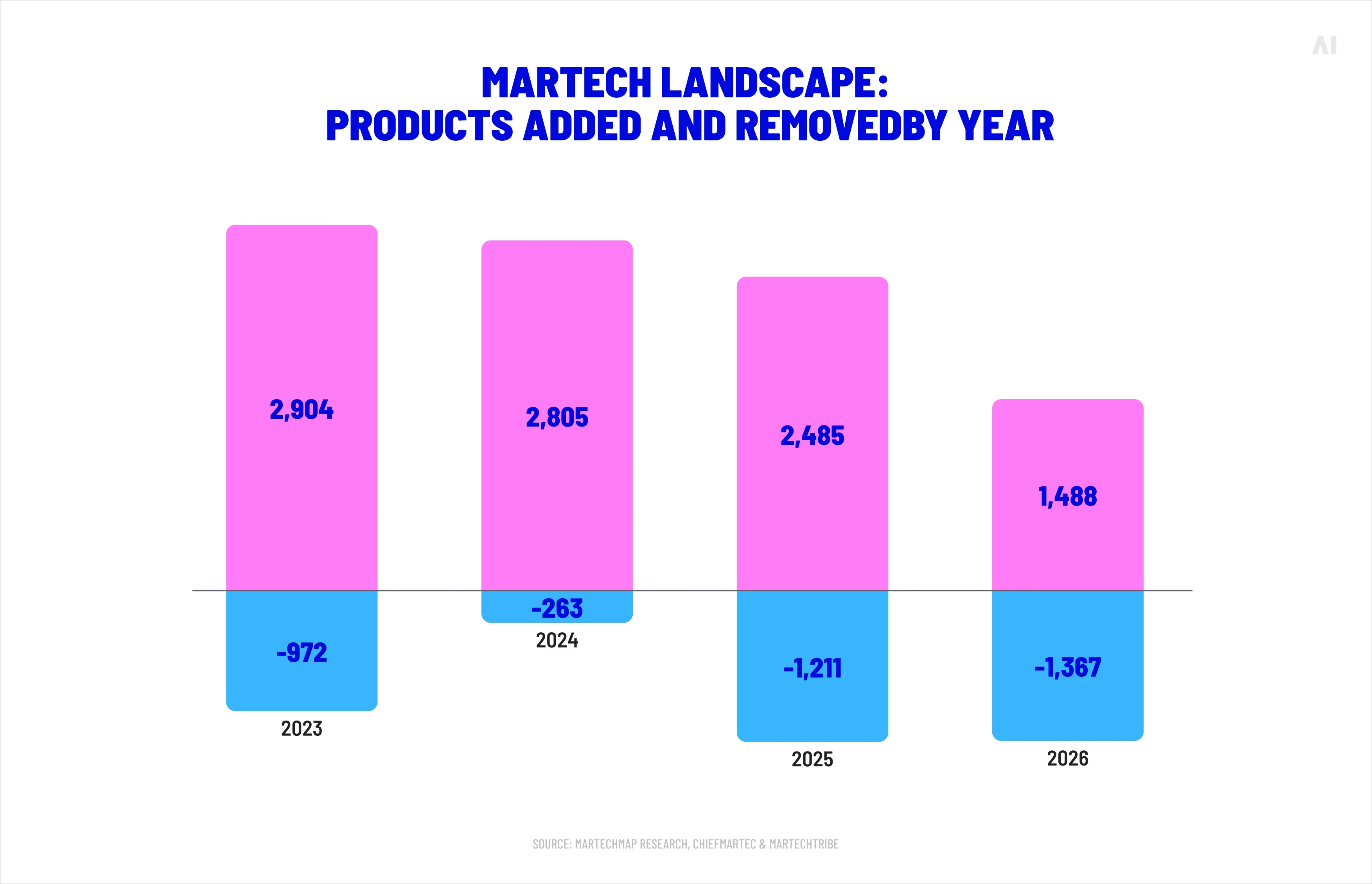
The chart shows that the martech landscape is still expanding, but with more churn and slower net growth. In 2026, 1,488 new martech products were added, while 1,367 were removed, leaving only a small net increase.
The modern marketing stack is moving beyond a collection of tools. A CRM, automation platform, analytics tool, and dashboard can help teams run campaigns, but they do not automatically create consistent performance. The next stage is a data-driven operating system where customer data, media data, campaign data, and revenue data are structured in one environment and used to guide decisions across teams.
This shift matters because marketing decisions now affect more than campaign execution. Budget planning, forecasting, customer segmentation, attribution, creative testing, and sales alignment all depend on whether teams trust the same data. When each platform reports performance through its own logic, marketing leaders end up comparing numbers that were never built to match.
The goal is not to replace every tool in the stack. The goal is to stop letting individual platforms define the business view of performance. Modern martech works better when the data layer becomes the foundation, and execution tools sit on top of that foundation.
Data-centric architecture
A data-centric architecture starts with the assumption that marketing performance cannot be managed inside separate platforms. Paid media platforms, CRM systems, web analytics tools, commerce platforms, and automation tools each capture part of the customer journey. None of them sees the full commercial picture alone.
That is why companies are moving toward centralized data environments where different sources can be joined, cleaned, modeled, and compared. This may include a data warehouse, customer data platform, lakehouse, identity layer, or integration pipeline. The exact setup depends on the business, but the logic is the same: data should be organized around the customer, the campaign, the channel, and the revenue outcome — not trapped inside separate vendor dashboards.
This is especially important as companies invest more in customer data platforms and customer data infrastructure. The CDP Institute’s July 2025 update, summarized by CDP.com, tracked 208 CDP vendors globally, with total industry funding reaching $9.396 billion and employment reaching 18,361 people. The growth of this category shows how much pressure companies feel to unify customer data across systems.
For marketing leaders, the point is simple: customer data unification is no longer a technical side project. It is becoming part of how businesses decide who to target, how much to spend, which journeys to personalize, and which audiences to suppress.
Legacy vs. modern martech systems
A legacy martech system is usually platform-led. Each tool has its own data, its own reports, and its own definition of performance. The CRM reports pipeline. The ad platform reports conversions. The analytics platform reports web behavior. The automation platform reports email or workflow engagement. Each report may be accurate inside its own environment, but the business still lacks one connected view.
That creates practical problems. A campaign may look efficient in an ad platform but generate low-quality leads in the CRM. A landing page may show strong conversion rates but attract customers with weak retention. An email segment may show high engagement but contribute little to revenue. In a legacy setup, these signals are often reviewed separately, so teams optimize pieces of the journey without seeing the total business effect.
A modern martech system works differently. It connects measurement, insights, and execution through a shared data foundation. Instead of asking each platform to explain performance on its own, the business uses centralized data rules to compare spend, audience quality, engagement, pipeline, revenue, and customer value.
This matters because poor data quality has direct financial consequences. IBM’s 2025 Institute for Business Value research found that 43% of chief operations officers identify data quality issues as their most significant data priority. IBM also reports that more than a quarter of organizations estimate they lose over $5 million annually because of poor data quality, while 7% report losses of $25 million or more.
For marketing, poor data quality does not only mean messy reports. It means budget can be shifted toward the wrong channels, audiences can be misclassified, sales teams can receive weak leads, and forecasts can be built on incomplete signals.
Cloud data warehouses
Cloud data warehouses are becoming a foundation for modern marketing operations because they give companies a scalable place to store and analyze data from multiple systems. Platforms like Snowflake, BigQuery, Amazon Redshift, and Databricks help teams bring together CRM records, media spend, web analytics, commerce transactions, offline sales, customer service data, and product data.
This changes the role of the marketing stack. Instead of each tool acting as the source of truth, the warehouse becomes the place where data is validated and modeled. The CRM still manages customer and pipeline activity. The automation platform still runs workflows. The analytics platform still measures behavior. But the warehouse gives the business a stronger base for comparing those signals against each other.
The value is not just storage. It is control. A warehouse allows teams to define shared metrics, create consistent naming rules, build attribution logic, connect campaign data to revenue, and feed trusted audiences back into execution platforms.
McKinsey makes a similar point in its 2025 personalization research: to improve targeted promotions and content, marketers need to strengthen the underlying technology stack and build better capabilities across data, decisioning, design, distribution, and measurement. McKinsey specifically notes that better personalization requires expanding data architecture beyond basic data lakes and CDPs.
For AI Digital’s positioning, this is important. The warehouse is not the strategy by itself. It is the infrastructure that makes strategy measurable. Businesses still need clear KPI logic, governance, attribution discipline, and activation workflows to turn centralized data into better decisions.
Real-time data and cross-channel visibility
The expectation for marketing data is also changing. Teams no longer want to wait for weekly reports to understand what happened. They need faster visibility into how campaigns, audiences, creative, channels, and customer journeys are performing across the full ecosystem.
This is where traditional stacks struggle. A paid media platform may update quickly, but only for its own campaigns. CRM data may be accurate, but delayed. Web analytics may show user behavior, but not revenue quality. Lifecycle platforms may show engagement, but not always downstream value. Without cross-channel visibility, marketing teams react to isolated signals instead of managing performance across the full journey.
Adobe’s 2026 AI and Digital Trends report shows how high this expectation has become. According to Adobe, 80% of organizations want customer experiences that are highly personalized and anticipatory in real time, while 72% want experiences to be seamless across digital and physical touchpoints. Adobe also notes that stronger data foundations and deeper cross-functional alignment are needed to translate early AI wins into sustained customer experience progress.
💡For marketing teams, that means real-time visibility is not just about faster dashboards. It is about knowing whether the same customer, campaign, audience, and revenue signals can be understood across channels. ⚡️AI Digital’s new article on Digital Marketing Measurement Across Channels: Why Modern Attribution Is No Longer Enough expands on how measurement changes when teams move from platform-level reporting to cross-channel performance logic.
⚡️Another guide on How to Gain Full Visibility Across Your Marketing Ecosystem goes deeper into the operational side: how to connect data sources, define shared KPIs, validate platform-reported numbers, and build workflows that turn visibility into action.
The larger point is this: modern martech is becoming operational infrastructure. It shapes how budgets are allocated, how forecasts are built, how teams interpret performance, and how quickly campaigns can be adjusted. Traditional stacks help teams run marketing activity. Data-driven systems help teams manage performance.
What’s missing from modern martech stacks
Most martech stacks do not fail because companies lack tools. They fail because the tools do not operate as one connected decision system. A company may have CRM data, paid media data, analytics dashboards, automation workflows, and sales reports, but if those systems use different definitions, different reporting windows, and different attribution logic, marketing leaders still cannot see what is actually driving growth.
This is the missing layer in many modern stacks: a connected system that aligns data, measurement, and execution. Without it, teams can report activity but struggle to explain performance. They can see campaign results but cannot always identify the revenue drivers behind them. They can collect insights but cannot reliably turn those insights into budget, audience, creative, or channel decisions.
That gap is measurable. Adverity’s 2025 research found that CMOs estimate 45% of the data used to drive marketing decisions is poor quality, and not a single CMO in the study said their decision-making data was more than 75% complete, accurate, and up to date. That means many marketing decisions are being made with incomplete or unreliable inputs before teams even reach the dashboard stage.
Unclear performance drivers
The first missing piece is a clear view of what actually drives revenue. Fragmented data makes this difficult because each platform shows only part of the journey. A paid media platform may show conversions. A CRM may show pipeline. A web analytics tool may show traffic and engagement. An automation platform may show email clicks or workflow performance. But none of those views alone explains which campaigns, audiences, channels, or touchpoints are creating valuable customers.
This creates a common reporting problem: marketing teams can say what happened, but not why it happened. They may know that leads increased, but not whether those leads came from the right accounts. They may know that conversions improved, but not whether those conversions created revenue. They may know that paid media performed well inside the platform, but not whether that performance survived once CRM and sales data were added.
⚡️This is where a unified data foundation becomes essential. AI Digital’s Open Garden Framework supports this shift by connecting fragmented marketing environments instead of forcing teams to rely on isolated platform reports. The related article on what the Open Garden Framework is can be used here to reinforce the idea that performance visibility requires open, connected, and interoperable systems.
💡The point is simple: teams cannot improve what they cannot connect. If spend, audience, engagement, pipeline, and revenue data stay separated, performance drivers remain unclear.
Slow and unreliable decisions
The second missing piece is decision speed. In many stacks, reporting arrives after the useful decision window has already passed. By the time teams reconcile campaign data, check CRM updates, compare platform numbers, and discuss which metric is correct, the campaign has already spent more budget.
Slow decisions usually come from two problems: delayed data and inconsistent metrics. If one team uses platform-reported conversions, another uses CRM-qualified leads, and another uses revenue contribution, the organization spends time debating the numbers instead of improving performance.
This makes optimization reactive. Teams pause campaigns after waste has already happened. They shift budget after the strongest opportunity has already passed. They adjust audiences after weeks of weak signal quality.
⚡️Structured and validated data helps reduce that delay. AI Digital’s Smart Supply fits naturally here because the issue is not only speed, but the quality of the data and supply paths behind decisions. Faster optimization is only useful when the inputs are clean enough to trust.
Weak data governance
The third missing piece is governance. Without clear standards, teams cannot trust the stack. Campaign names may be inconsistent. UTMs may be incomplete. Conversion definitions may change by platform. Attribution windows may differ across channels. Data ownership may be unclear. When this happens, the stack produces reports, but not confidence.
Weak governance also makes performance easier to misread. A campaign may look successful because one platform counts a conversion differently from another. A dashboard may show growth because duplicated records were not removed. A budget decision may look rational because the reporting model ignores offline sales, sales quality, or customer value.
IBM’s 2025 Institute for Business Value research shows why this matters beyond marketing. It found that 43% of chief operations officers identify data quality as their most significant data priority, and more than a quarter of organizations estimate they lose over $5 million annually because of poor data quality.
For marketing teams, weak governance turns into practical problems: unreliable dashboards, duplicated reporting, poor attribution, wasted spend, and low trust between marketing, sales, finance, and data teams.
⚡️This is why weak governance should be treated as a performance risk, not just a reporting issue. AI Digital’s new article, The Problem with Platform-Reported Data: Why You Can’t Trust the Numbers goes deeper into how ad platforms use their own attribution windows, conversion models, and reporting logic, often making performance look cleaner than it is.
💡Another guide on advertising governance expands on the operational side: how teams can create standards, controls, and accountability around campaign data so reporting becomes more reliable for decision-making.
Insights without action
The fourth missing piece is the ability to turn insights into execution. Many stacks stop at reporting. They show that something changed, but they do not help the team decide what action should follow.
A dashboard may show that acquisition cost increased. But should the team reduce spend, change targeting, adjust creative, exclude a segment, review landing page friction, or check tracking quality? A report may show that one audience converts better than another. But should that audience receive more budget, different messaging, a new offer, or a sales follow-up?
This is the difference between analytics and decision intelligence. Analytics identifies signals. Decision intelligence connects those signals to recommended actions, business priorities, and execution workflows.
⚡️AI Digital’s Elevate fits here because the value is not another dashboard. The value is helping teams move from “we can see the problem” to “we know what to do next.” That is especially important for senior marketing leaders who need to defend budget, explain trade-offs, and connect marketing activity to commercial outcomes.
Inefficient budget allocation
The fifth missing piece is reliable budget allocation. When measurement is inconsistent, spend moves toward the channels that look best in reports, not necessarily the channels that create the most value.
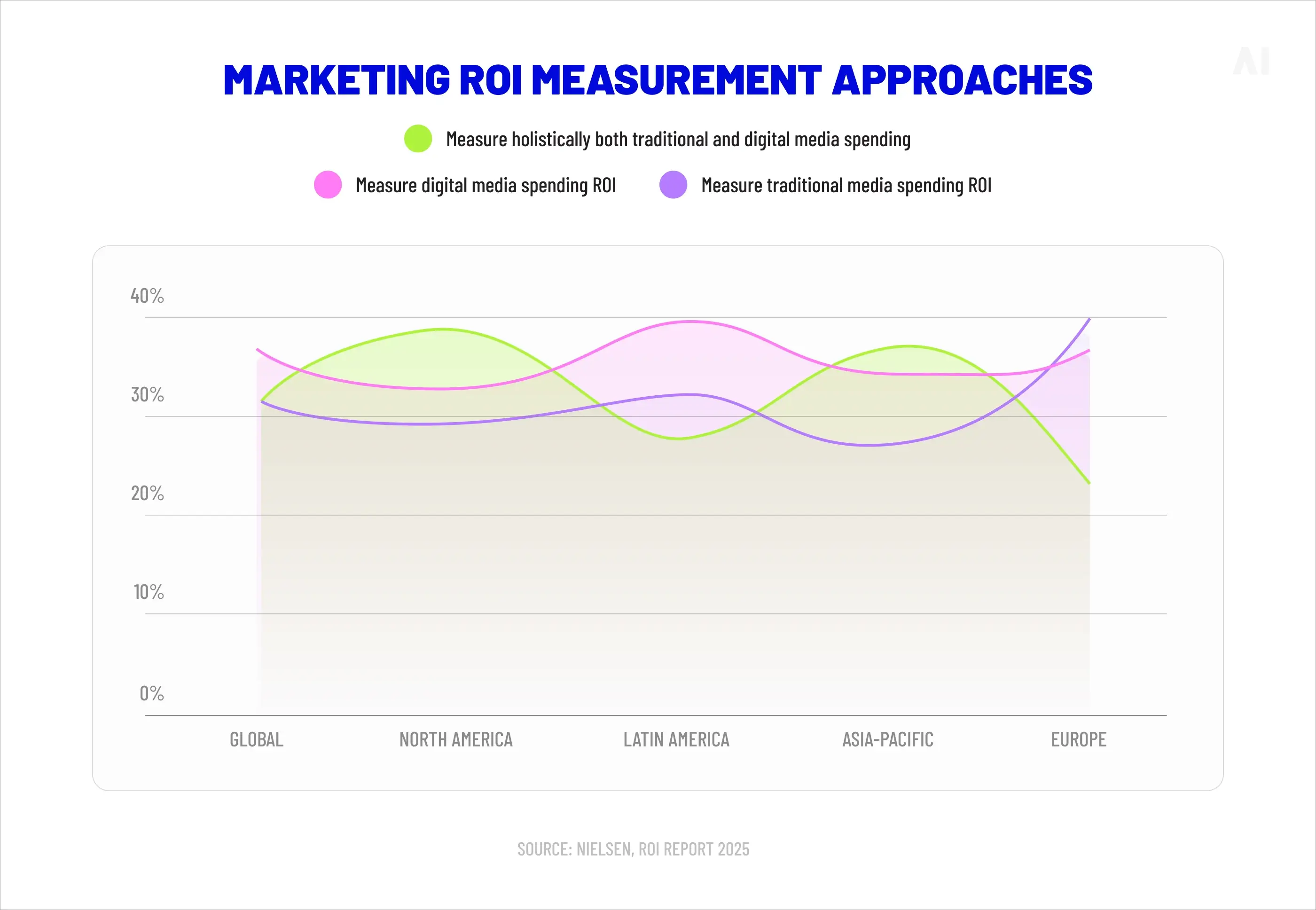
This is a serious issue because many marketers still lack a full view of media performance. Nielsen’s 2025 research found that 85% of marketers express confidence in their ability to measure ROI, but only 32% actually measure ROI holistically across traditional and digital media channels. That gap matters because confidence without holistic measurement can lead teams to overvalue easy-to-measure channels and undervalue channels that contribute earlier or indirectly in the customer journey.
For budget decisions, aligned digital marketing KPIs are essential. Teams need to know whether they are optimizing for leads, qualified pipeline, revenue, margin, retention, incrementality, or customer lifetime value. If the KPI is unclear, attribution becomes political: each team defends the metric that makes its channel look strongest.
⚡️This is also where dashboard and attribution problems become visible. Marketing Dashboards: Why Data Doesn’t Turn Into Decisions explains why reporting interfaces often show performance changes without clarifying the next action.
⚡️Another article, Marketing Attribution Challenges: Why Traditional Attribution Models Don’t Work Anymore then goes deeper into why channel credit is difficult to assign when customer journeys span paid media, organic search, email, social, direct traffic, and sales interactions.
Reactive optimization
The final missing piece is a feedback loop between measurement and execution. In disconnected stacks, optimization is usually manual and delayed. A team reviews performance, exports data, discusses results, updates a plan, changes campaigns, and waits for the next reporting cycle. That process is too slow for modern media environments.
Reactive optimization creates two problems. First, teams waste money before they identify the issue. Second, they miss opportunities because strong signals are not acted on quickly enough. A profitable audience may not receive more budget. A weak creative may continue running. A high-intent segment may not move into the right sales or lifecycle workflow.
A connected martech system works differently. Performance data flows back into execution. Audience quality affects targeting. Revenue data affects budget allocation. Creative performance affects rotation. CRM outcomes affect lead scoring. Measurement does not sit at the end of the process; it feeds the next action.
That is what most modern martech stacks are missing. Not more platforms, but a system that connects data quality, measurement governance, decision logic, and execution. When that system is absent, the stack produces reports. When it exists, the stack supports performance decisions.
How AI changes modern martech stacks
AI does not remove the need for a connected marketing stack. It makes the stack more important. When teams add AI to campaign planning, audience segmentation, bidding, personalization, content production, or reporting, the system becomes more dependent on the quality of the data underneath it.
This is the main shift: AI does not only execute tasks faster. It also makes decisions based on the inputs, rules, constraints, and measurement logic available to it. If customer data is incomplete, if campaign taxonomies are inconsistent, if attribution is unclear, or if platform-reported numbers are treated as final truth, AI can scale those weaknesses across more campaigns, audiences, and decisions.
That is why AI in modern martech should be treated as a control issue, not only a productivity upgrade. SAS and Coleman Parkes found that 93% of CMOs using GenAI report clear ROI, while 83% of marketing teams report ROI from GenAI tools. The same research also shows strong benefits in personalization, large-dataset processing, and operational efficiency. But those gains depend on whether teams can monitor, explain, and govern how AI is being used.
⚡️This is especially important in performance environments such as programmatic media, lifecycle automation, and cross-channel optimization. AI Digital’s new article, AI in Programmatic Advertising: How It Improves Targeting, Bidding, and Optimization can explain how AI improves bidding, targeting, and inventory decisions. But this section should make the larger point first: AI works best when it sits on top of structured data, transparent measurement, and clear business rules.
💡The same logic applies to AI in marketing automation. AI can help personalize journeys, recommend next-best actions, and automate campaign decisions, but it needs reliable audience data, lifecycle definitions, and performance feedback. Without transparency in advertising, teams may not know whether AI is improving performance or simply making optimization harder to inspect.
AI and data quality
AI makes data quality harder to ignore. In a traditional stack, poor data may create inaccurate dashboards or weak segmentation. In an AI-enabled stack, the same poor data can influence automated recommendations, audience creation, content personalization, bidding logic, and campaign prioritization.
That risk is not theoretical. Semarchy’s 2025 AI and data quality study found that 74% of businesses planned to invest in AI initiatives, but less than half — 46% — were confident in their data quality. The study surveyed 1,050 senior business leaders across the US, UK, and France.
For marketers, this means AI readiness is not mainly about buying another AI tool. It is about knowing whether the data used by that tool is complete, current, correctly labeled, and connected to business outcomes. If an AI system uses fragmented CRM data, outdated audience segments, duplicated customer records, or inconsistent conversion definitions, it may produce outputs that look sophisticated but remain commercially weak.
This is why AI should be framed around risk and control. The question is not only, “Can AI automate this task?” The better question is, “Do we trust the data, rules, and measurement logic behind the automation?”
This problem also sets up the need for deeper articles on fragmentation and AI impact.
⚡️Fragmented Martech Stacks Are Killing Marketing Performance — Here’s Why expands on how disconnected systems damage the basics: personalization becomes less accurate, targeting uses incomplete audience signals, reporting becomes harder to trust, and optimization happens too late.
Black-box optimization
AI also changes how teams think about visibility. Many AI-powered marketing systems optimize toward a goal, but they do not always show enough detail about why a decision was made. A bidding system may shift spend toward one audience. A personalization engine may choose one message over another. A recommendation model may prioritize one customer segment. If the team cannot inspect the logic, it becomes difficult to know whether the system is improving performance or hiding risk.
This is the black-box problem. It is not limited to advanced machine learning teams. It affects everyday marketing decisions when platforms automate targeting, bidding, attribution, creative rotation, and recommendations without giving marketers a clear view of the underlying decision path.
NIST’s AI Risk Management Framework makes transparency and accountability central to AI governance. It states that documentation can improve transparency, support human review, and strengthen accountability across AI system teams.
For marketing teams, that translates into practical requirements: clear documentation of AI use cases, defined performance goals, human review points, explainable reporting, and escalation rules when automated decisions affect spend, targeting, or customer experience.
⚡️AI Digital’s new read on Black Box AI in Marketing: Risks and Limitations explains why opaque AI systems create problems for budget accountability, brand safety, audience fairness, compliance, and performance diagnosis.
AI amplifies system weaknesses
AI does not treat strong and weak systems equally. It amplifies both. If the stack has clean data, consistent KPIs, governed measurement, and strong feedback loops, AI can help teams move faster and optimize with more precision. If the stack is fragmented, AI can produce faster outputs without improving the quality of decisions.
This is why many companies struggle to move from AI experimentation to scaled value. BCG’s 2025 research found that only 5% of companies are achieving AI value at scale, while 60% report minimal revenue and cost gains despite substantial investment. BCG ties scaled AI value to broader transformation, including strategy, operating model, technology, data, and adoption.
For marketing leaders, the lesson is clear. AI cannot compensate for a stack that lacks trusted data, connected measurement, and execution discipline. It can generate more content, process more data, and automate more decisions, but if the system cannot validate performance, the organization still cannot know what is working.
This is where the modern martech stack needs to evolve from a toolset into a decision system. AI should not sit on top of disconnected dashboards and inconsistent metrics. It should sit on top of a connected environment where data quality, measurement logic, governance, and activation workflows are already aligned.
⚡️From Data to Decisions: How Marketing Intelligence Transforms Performance Strategy shows how teams move beyond raw signals — clicks, impressions, conversions, pipeline changes, and revenue data — and turn them into clear planning, budget, and optimization decisions.
⚡️How AI Platforms Improve Cross-Channel Marketing Performance explains the AI layer in more practical terms: AI becomes more useful when it can work from consistent signals across paid media, CRM, web analytics, lifecycle campaigns, and revenue systems, instead of trying to optimize each channel in isolation.
💡The practical takeaway is simple: AI changes the modern marketing stack by raising the standard for data and transparency. It does not make structure less important. It makes structure the condition for useful automation.
Signs modern martech is working
A modern martech stack is working when it changes how the business makes decisions. The clearest sign is not a cleaner dashboard or a longer list of connected tools. It is a marketing system where teams can see what is driving performance, shift budget with more confidence, respond to changes faster, and explain results in language that sales, finance, and leadership can trust.
That is where connected martech becomes more than campaign infrastructure. It becomes an operating system for performance management. Data shows what happened, measurement explains what mattered, and decision workflows turn that insight into budget, audience, creative, and channel actions.
Deloitte’s 2025 marketing investment research shows why this matters commercially: organizations that invest more in marketing technology than working media report 18% greater sales lift from marketing and 7% greater overall revenue growth than organizations that invest more in working media than martech. The point is not that businesses should simply spend more on technology. The point is that martech creates value when it improves the quality, speed, and accountability of marketing decisions.
⚡️AI Digital’s new article on Marketing Measurement Strategy: How to Measure and Optimize Performance Across Channels builds on this by showing how businesses define consistent KPIs, connect channel data, and evaluate performance beyond platform-level reports.
Efficient budget allocation
One sign of a working martech stack is that budget decisions become less political and more evidence-based. Teams can see which channels, campaigns, audiences, and creative assets contribute to qualified outcomes instead of relying only on surface metrics like clicks, impressions, or platform-reported conversions.
This matters because cross-channel measurement is still difficult. Nielsen’s 2025 ROI research identifies stakeholder alignment, data volume, and data incomparability as major barriers when marketers try to calculate ROI across media channels. In practical terms, teams often struggle not because they have too little data, but because each channel reports performance in a different way.
A connected stack reduces that problem by creating shared rules for performance evaluation. Paid media, CRM, analytics, sales, and revenue data can be compared against the same business outcomes. That helps teams move spend toward channels that actually support growth, not just channels that look strong inside their own reporting environment.
💡This is where marketing mix modeling becomes useful. AI Digital’s article on mixed media modeling can support this discussion by showing how MMM helps marketers evaluate channel contribution across online and offline activity.
⚡️Media Mix Optimization: How to Use MMM for Budget Allocation article can go deeper into how marketers use modeled contribution, incrementality, and scenario planning to decide where the next dollar should go.
Faster decision-making
A working martech stack also shortens the time between signal and decision. Teams do not need to wait for manual exports, spreadsheet reconciliation, or separate platform reviews before they understand what changed.
For example, if paid social conversion quality drops, the team should be able to check whether the issue comes from audience fatigue, creative performance, landing page friction, tracking loss, or weak lead quality. If search spend rises but pipeline does not move, the team should be able to compare search terms, form submissions, CRM status, and revenue outcomes without rebuilding the report from scratch.
Faster decision-making does not mean reacting to every small fluctuation. It means teams can separate noise from meaningful performance changes earlier. A connected system helps marketers decide whether to pause, scale, test, suppress, or investigate while the campaign is still active.
Real-time optimization
Real-time optimization is another sign that the stack is working. In a disconnected setup, performance data sits in reports. In a connected setup, performance data feeds the next action.
This can include bid adjustments, audience suppression, creative rotation, lifecycle triggers, CRM updates, or sales alerts. For example, if a segment is producing conversions but poor revenue quality, the system should help reduce spend or change qualification logic. If one audience is moving from engagement to purchase faster than expected, the system should support budget reallocation or message sequencing.
The IAB’s 2025 Conversion API report shows how stronger signal flow can change optimization behavior. In CTV, two-thirds of advertisers reported improved ROAS after implementing CAPI, and 75% said they would move spend between publishers based on conversion performance data. The same report found that CAPI signals are already being used for audience targeting and suppression by 92% of advertisers and bid strategy adjustments by 67%.
💡That is the difference between reporting and optimization. Reporting tells teams what happened. Real-time optimization gives campaign systems better signals to act while performance is still being shaped. This section can naturally link to AI Digital’s article on real-time bidding, because RTB depends on fast, accurate signals that help platforms decide which impressions are worth buying.
Predictable performance
A connected martech stack should also make performance easier to forecast. This does not mean every campaign becomes perfectly predictable. It means teams have enough structured data to understand patterns, model likely outcomes, and identify risk earlier.
Predictability improves when marketing data is connected to business context: revenue, margin, inventory, seasonality, customer value, sales capacity, and historical demand. Without that context, forecasts often depend too heavily on channel trends or last-period performance. With connected data, teams can make more realistic assumptions about what is likely to happen and what levers can change the outcome.
Google’s 2025 measurement guidance makes this point from a media planning perspective. It recommends using long-term measurement approaches such as MMMs to capture the full value of marketing investments and balance brand-building activity with performance tactics. Google specifically recommends aiming for 50–60% allocation to brand-building activities and 40–50% to performance tactics, while using measurement to understand both short- and long-term impact.
⚡️This is where AI Digital’s article on retail forecasting can support the section. Forecasting becomes stronger when teams connect marketing activity to demand signals, customer behavior, and business constraints.
⚡️Another read on Marketing Intelligence Platforms: From Data to Decisions to Performance article can then explain how marketing intelligence platforms organize those signals into planning, forecasting, and optimization workflows.
Better alignment across teams
The final sign is organizational alignment. When martech works, marketing, sales, analytics, finance, and leadership do not argue over five different versions of performance. They use shared definitions, shared KPIs, and shared reporting logic.
This alignment changes the quality of business conversations. Marketing can explain not only how many leads or conversions were generated, but which activities influenced revenue. Sales can see which campaigns are producing qualified opportunities. Finance can evaluate marketing spend against business contribution. Data teams can focus on improving models and governance instead of constantly reconciling inconsistent reports.
This is especially important in cross-channel environments. Nielsen’s 2025 ROI research points to stakeholder alignment as one of the biggest challenges in proving ROI across media channels, which shows that measurement is not only a technical issue. It is also an organizational issue.
⚡️Unified Marketing Measurement: What It Is and Why It Matters expands this point by showing how shared measurement frameworks help teams move from channel-by-channel reporting to one performance view.
That is the real sign the martech stack is working: it does not just produce more data. It gives the business a shared basis for deciding what to do next.
How to audit your current marketing stack
Auditing a modern marketing stack should not start with a software inventory. It should start with a decision test: can the current stack produce trusted data, fast insight, and clear next steps? If the answer is no, the issue is not only technical. It means the stack is limiting how well the business can measure performance, allocate budget, and respond to change.
💡AI Digital’s approach to cross-platform measurement governance is useful here because it frames governance as the layer that makes fragmented platform data comparable and trustworthy, not just collected in one place. The article explains that governance defines how data is collected, deduplicated, validated, and reported across platforms so teams are not comparing incompatible numbers.
⚡️AI Digital’s new article on Creating a Data-Driven Marketing Strategy builds on this by showing how clean data, shared KPIs, and measurement rules guide planning. Another one, What Is Incrementality Testing in Marketing then explains how teams move beyond attributed conversions and test whether marketing activity caused outcomes that would not have happened otherwise.
1. Evaluate data quality
Start by checking whether data from different systems can be trusted together. CRM data, paid media data, analytics data, lifecycle data, and revenue data should align around the same customer, campaign, channel, and conversion definitions.
If the same campaign produces different conversion numbers across platforms, the audit should identify why. The issue may come from attribution windows, duplicate conversions, missing UTMs, inconsistent naming, delayed CRM updates, or platform-controlled reporting. AI Digital’s article on cross-platform measurement explains this problem clearly: walled garden platforms use their own data, attribution logic, and reporting standards, which can create conflicting performance signals across channels.
2. Measure insight speed
Next, measure how long it takes to move from performance change to explanation. A stack is not working well if teams need several days of exports, manual checks, and meetings just to understand why campaign performance shifted.
The audit should ask: how quickly can the team identify whether a drop in performance came from audience quality, creative fatigue, media cost, tracking issues, landing page friction, or sales follow-up?
⚡️Marketing Planning Software: How to Connect Planning, Optimization, and Reporting in One System expands this by showing how a connected operating model reduces the delay between planning, measurement, and action.
3. Identify decision gaps
Finally, check whether the stack only reports performance or actually supports decisions. A dashboard that shows conversion rate, ROAS, or cost per lead is useful, but it is not enough if the team still does not know what to change.
The audit should identify where decisions break down: budget allocation, audience suppression, channel mix, creative testing, attribution, lead qualification, or forecasting. This is where AI Digital’s positioning is strongest.
The goal is not simply to connect tools. It is to build a performance system where data quality, measurement governance, and decision logic work together — so marketing teams can move from “what happened?” to “what should we do next?”
Modern martech works when systems work
Most businesses already have the core tools of a modern marketing stack. They have CRM systems, automation platforms, analytics dashboards, media platforms, and reporting tools. The problem is that these systems often operate separately. They collect data, launch campaigns, and produce reports, but they do not always help teams understand what is driving performance or what decision should come next.
Modern martech works when the stack becomes a connected performance system. That means customer data, campaign data, media signals, measurement logic, and business outcomes are aligned into one operating model. When this happens, teams can move beyond disconnected reporting and start making clearer decisions about budget, targeting, creative, forecasting, and optimization.
⚡️This is also where AI Digital’s approach fits. The Open Garden Framework is built around a vendor-neutral, DSP-agnostic model that connects data, inventory, technology, and outcomes instead of locking brands into one platform view. AI Digital describes Open Garden as a framework that helps marketers control strategy, data, and outcomes across a fragmented digital ecosystem.
The key takeaways are simple:
- More tools do not guarantee better performance. A stack only creates value when its systems are connected around shared data and business outcomes.
- Measurement has to be governed. If every platform defines success differently, teams cannot trust the numbers enough to make budget decisions.
- AI needs structure. AI can support planning, optimization, and decision-making, but only when the underlying data and measurement logic are reliable.
- Execution should feed learning. Campaign results should not stay trapped in dashboards; they should flow back into planning, audiences, creative, bidding, and channel decisions.
- The goal is control. Modern martech should help marketers understand where performance comes from, where spend is wasted, and which actions can improve outcomes.
Sustainable growth does not come from adding another disconnected platform to the stack. It comes from aligning data, measurement, and execution into one system that helps teams make better decisions faster.
⚡️For businesses ready to move from fragmented tools to a connected performance model, AI Digital’s get in touch page invites teams to start a programmatic strategy conversation and discuss available options.