Marketing technology was meant to make the job easier. For a time, it did. CRMs brought order to customer records. Automation platforms gave teams a practical way to manage email and nurture journeys. Analytics tools made performance easier to read. Media platforms opened up search, social, display, connected TV, retail media and programmatic channels, giving marketers more ways to reach people than any previous generation of advertising could have imagined.
Then the operating model began to strain.
The issue is no longer simply that marketing teams have accumulated too many tools. It is that many organizations are not getting enough usable value from the technology they already own. Gartner’s 2025 Marketing Technology Survey found that martech utilization has dropped to 49%, exposing a gap between what companies buy and what teams can actually use well.
This is the real context behind the debate over AI marketing vs traditional marketing. It is not a neat contest between old and new. It is a business decision about how marketing work gets planned, executed, optimized, measured, and improved.
Traditional martech stacks give teams specialized systems. AI marketing platforms aim to bring data, analytics, decision-making, automation, and execution into a more connected operating model. One is built around tools. The other is built around intelligence and action.
Marketing leaders do not need to be persuaded that AI is genuinely impressive. The question that actually requires an answer is whether their current stack can keep pace with what the business expects—in speed, in visibility, and in results.
What is a traditional martech stack
A traditional martech stack is a collection of marketing technologies used to manage customer data, campaigns, analytics, content, automation, advertising, and reporting. In most companies, it did not arrive as a single planned architecture. It grew piece by piece.
A team needed a CRM, so it bought one. The email team added a marketing automation tool. Paid media teams worked inside DSPs, social platforms, search platforms, retail media networks, and analytics dashboards. Product marketing adopted content tools. The data team added customer data platforms, tag management, attribution software, and business intelligence systems.
Each tool may solve a real problem. The difficulty begins when the tools have to work together.
A traditional stack can support complex marketing operations, but it often requires manual coordination, custom integrations, vendor management, data cleaning, and constant interpretation. As marketing scales, the stack can become less like a neatly arranged control room and more like a row of separate monitors showing different versions of the same business.
Core components of a traditional martech stack
Most traditional martech stacks include several layers. The exact mix depends on company size, industry, maturity, sales motion, and media investment, but the basic structure is familiar.
{{26-Marketing-Platform-vs-Traditional-Martech-Stack-1="/tables"}}
This model is not inherently broken. It gives specialists the tools they need to do their jobs well. A lifecycle marketer does not use the same interface as a media trader. A CRM manager has different needs from a creative strategist. Specialized tools became popular because marketing itself became specialized.
The issue is that customer behavior does not follow the org chart. A customer may see a CTV ad, search later, click a retail media placement, receive an email, visit a product page, and convert after a social retargeting impression. If every system tracks only its own part of that journey, the marketing team may be busy, but the business view remains incomplete.
💡 Related reading: Marketing technology
Where traditional stacks start to break
Traditional stacks usually start to break in quiet ways before the problem becomes obvious.
Reports take longer to prepare. Different teams bring different numbers to the same meeting. Paid media optimizations happen inside each platform, but no one can easily explain cross-channel impact. New campaign ideas take longer to launch because every channel requires its own setup, naming convention, audience build, QA process, and reporting view.
The signs are practical:
- Data silos become normal. Teams accept that campaign, customer, content, and revenue data live in different systems.
- Manual work fills the gaps. Spreadsheets, exports, screenshots, and status meetings become the real connective tissue.
- Optimization slows down. Teams make decisions after weekly or monthly reporting cycles rather than during the campaign.
- Costs become harder to see. The invoice for each tool is visible. The labor cost of making them work together is less obvious.
- Measurement becomes contested. Every platform claims credit through its own reporting logic.
The stack may still function, but it stops giving marketing leaders the one thing they need most: a clear view of what is working, what is wasting money, and what should change next.
💡 Related reading: Why fragmented martech stacks kill marketing performance
What is an AI marketing platform
An AI marketing platform is an integrated system that uses artificial intelligence to connect data, analysis, planning, optimization, and reporting. It does not merely automate isolated tasks. At its best, it helps marketing teams move from manual coordination to faster, more governed decision-making.
It is important to be specific about what this distinction means, because the market is not short of AI: content assistants, subject line generators, automated bidding tools, audience builders, chatbots, reporting summaries, predictive scoring models. Useful, certainly. But an AI feature inside a disconnected tool does not automatically solve stack fragmentation.
An AI marketing platform is broader. It creates a decision layer across multiple parts of the marketing process. It can help teams understand audiences, forecast performance, build media plans, optimize campaigns in flight, compare outcomes, and turn reporting into recommended next steps.
In other words, the value is not “AI” in isolation. The value is AI connected to the work.

Key capabilities of AI marketing platforms
AI marketing platforms vary widely, but the strongest ones tend to support five practical capabilities.
- First, they unify data from different sources. This may include campaign performance, audience signals, web behavior, CRM records, media cost, creative performance, sales outcomes, and third-party or contextual data.
- Second, they support predictive analytics. Instead of waiting for a campaign to finish, teams can model likely outcomes, compare scenarios, and adjust plans before money is fully committed.
- Third, they improve real-time optimization. Traditional optimization often depends on humans reviewing dashboards and making manual changes. AI can identify patterns faster, recommend adjustments, and support budget reallocation while campaigns are still active.
- Fourth, they help coordinate channels. This matters as media plans stretch across CTV, programmatic display, DOOH, audio, social, retail media, search, and publisher-direct environments. U.S. digital advertising revenue reached $294.6 billion in 2025, according to IAB and PwC, so the scale of digital investment is still rising, even as measurement becomes harder.
- Fifth, they make reporting more useful. Instead of producing static dashboards, AI platforms can surface performance drivers, anomalies, waste, and next-best actions.
The important word here is “support.” AI should not remove judgment from marketing. It should reduce the time spent assembling evidence, so teams have more time to decide what the evidence means.
💡 Related reading: Programmatic advertising | How AI platforms improve cross-channel marketing performance
AI platforms vs AI-powered tools
An AI-powered tool improves a specific task. An AI platform improves the way multiple tasks connect.
That is why the common martech vs marketing automation comparison only explains part of the issue. Marketing automation is one layer of the stack. It can trigger emails, score leads, build journeys, and automate customer communications. But it does not necessarily unify media planning, cross-channel measurement, budget allocation, creative performance, audience strategy, and business outcomes.
An AI-powered tool might help a team write faster, bid smarter, summarize reports, or create audience variants. Those are useful gains. But if each AI tool lives inside a separate system, the organization may simply end up with a more automated version of the same fragmented stack.
An AI marketing platform should do something larger. It should help answer questions such as:
- Which audience is most likely to respond across channels?
- Which inventory is efficient, safe, and aligned with campaign goals?
- Where is spend being wasted?
- Which channels are driving incremental outcomes rather than duplicated credit?
- What should change now, not after the campaign ends?
AI tools help with tasks. AI platforms help with operating rhythm.
How AI Digital approaches platform architecture
AI Digital sits in this debate from an unusual angle: it isn't a platform vendor and it isn't a traditional agency. It's an AI-native programmatic consultancy that runs media on behalf of brands and agencies, using three components designed to work as one rather than three separate products.
- The first is Elevate — the intelligence engine. It unifies research, planning, optimization, and reporting in one environment, draws on more than 150 billion data points monthly and over 10,000 audience attributes, and connects pre-campaign intelligence with live optimization and post-campaign analysis.
- The second is Smart Supply, the media-curation engine: AI-driven supply path optimization that keeps working media on premium, brand-safe inventory and out of the long tail.
- The third is the Open Garden Framework, which is more an operating principle than a product—a deliberately vendor-agnostic stance that connects to the wider ecosystem on the client's terms rather than fencing the client into someone's walled garden, including AI Digital's own.
The reason this matters for the platform-versus-stack question is that it offers a third option. Most teams don't actually want to become martech operators; they want the outcomes a platform-led model delivers. A consultancy with platform-grade intelligence, operated by people whose job is to make decisions in the client's interest, is a different proposition from buying software and figuring out the rest yourself.
💡 Related reading: The Open Garden Framework: A new operating model for programmatic advertising
AI marketing platform vs Martech stack: Key differences
The difference between an AI marketing platform and a traditional martech stack is not simply the presence of artificial intelligence. Many traditional tools now include AI features. The deeper difference is how work is organized.
- A traditional stack distributes work across specialized systems.
- An AI marketing platform aims to connect data and decisions across those systems, or in some cases replace parts of them with a more unified model.

{{26-Marketing-Platform-vs-Traditional-Martech-Stack-2="/tables"}}
The table shows the central trade-off. Traditional stacks offer flexibility and specialization. AI marketing platforms offer coordination, speed, and a more unified operating model.
Data management and integration
Traditional stacks often struggle because marketing data is stored according to tool function, not business question. CRM data sits in one system. Media data sits in another. Website behavior lives elsewhere. Offline sales, call center activity, retail data, and customer service signals may sit outside marketing entirely.
This creates a familiar problem. Leaders ask a straightforward question—“Which channels are driving profitable growth?”—and the team has to stitch together evidence from systems that were not designed to answer it together.
AI marketing platforms do not magically fix poor data. They still need data quality, consent management, naming discipline, and integration work. But they can create a more usable layer on top of fragmented inputs. When data is connected and made actionable, insight quality improves because the system can compare signals across the whole campaign rather than inside one channel.
💡 Related reading: Data management platform
Speed and decision-making
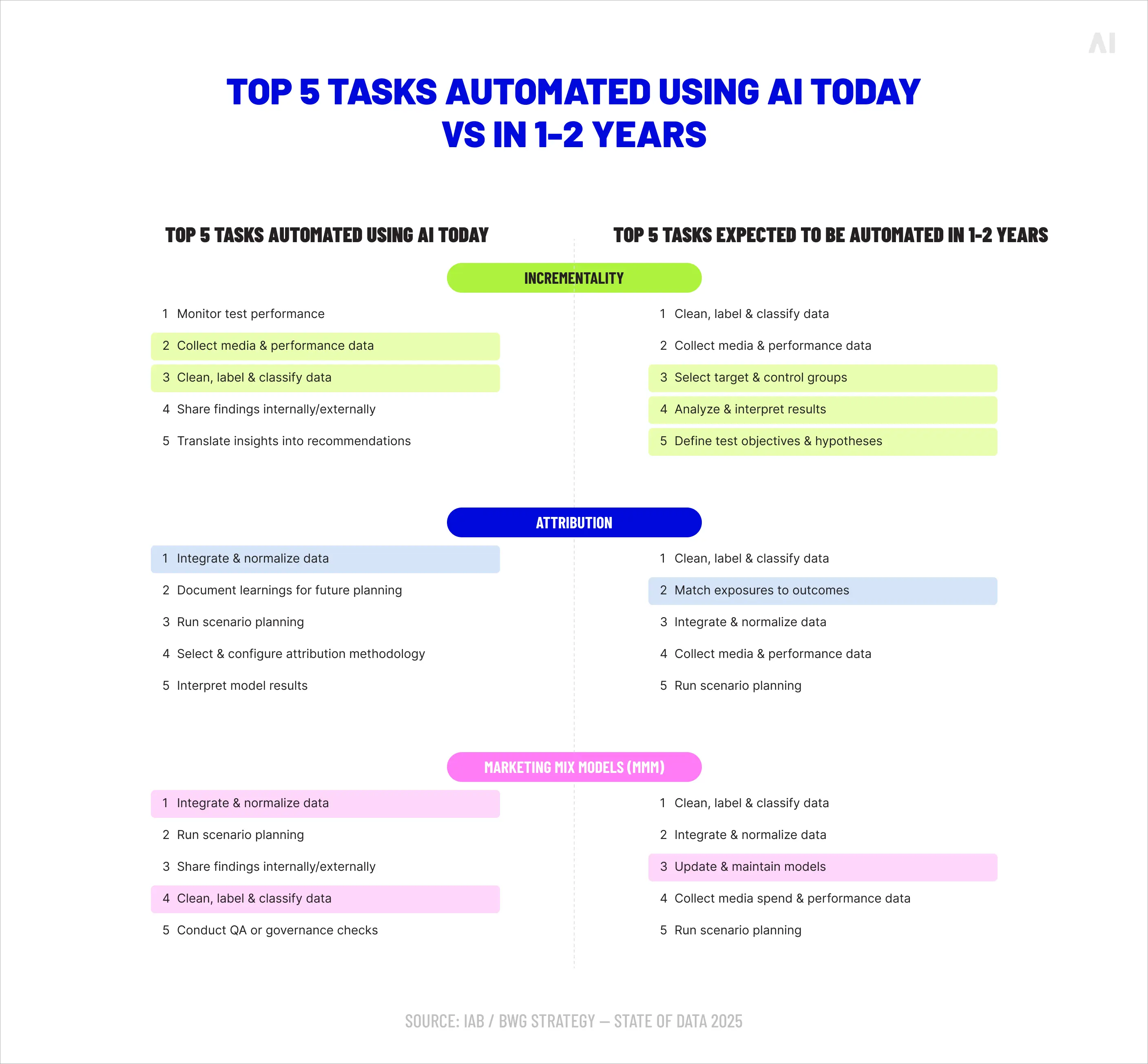
Speed is one of the biggest practical differences.
In a traditional stack, the decision cycle is often slow. A campaign launches. Data accumulates in each platform. Teams export reports. Analysts clean the numbers. Managers review performance. Recommendations are discussed. Changes are made days or weeks later.
That rhythm is increasingly out of step with modern media buying. Campaign performance can shift quickly because of auction dynamics, creative fatigue, audience saturation, publisher quality, budget pacing, competitive activity, and changing customer behavior.
AI platforms can shorten the gap between signal and action. They can flag underperforming placements, recommend budget shifts, identify audience patterns, surface anomalies, and support faster scenario planning. This is particularly useful in programmatic and cross-channel media, where manual review cannot realistically evaluate every placement, audience, bid, and creative combination at scale.
⚡ An AI marketing platform should not be judged by how much it automates, but by whether it helps teams make better decisions sooner.
Cost efficiency and resource allocation
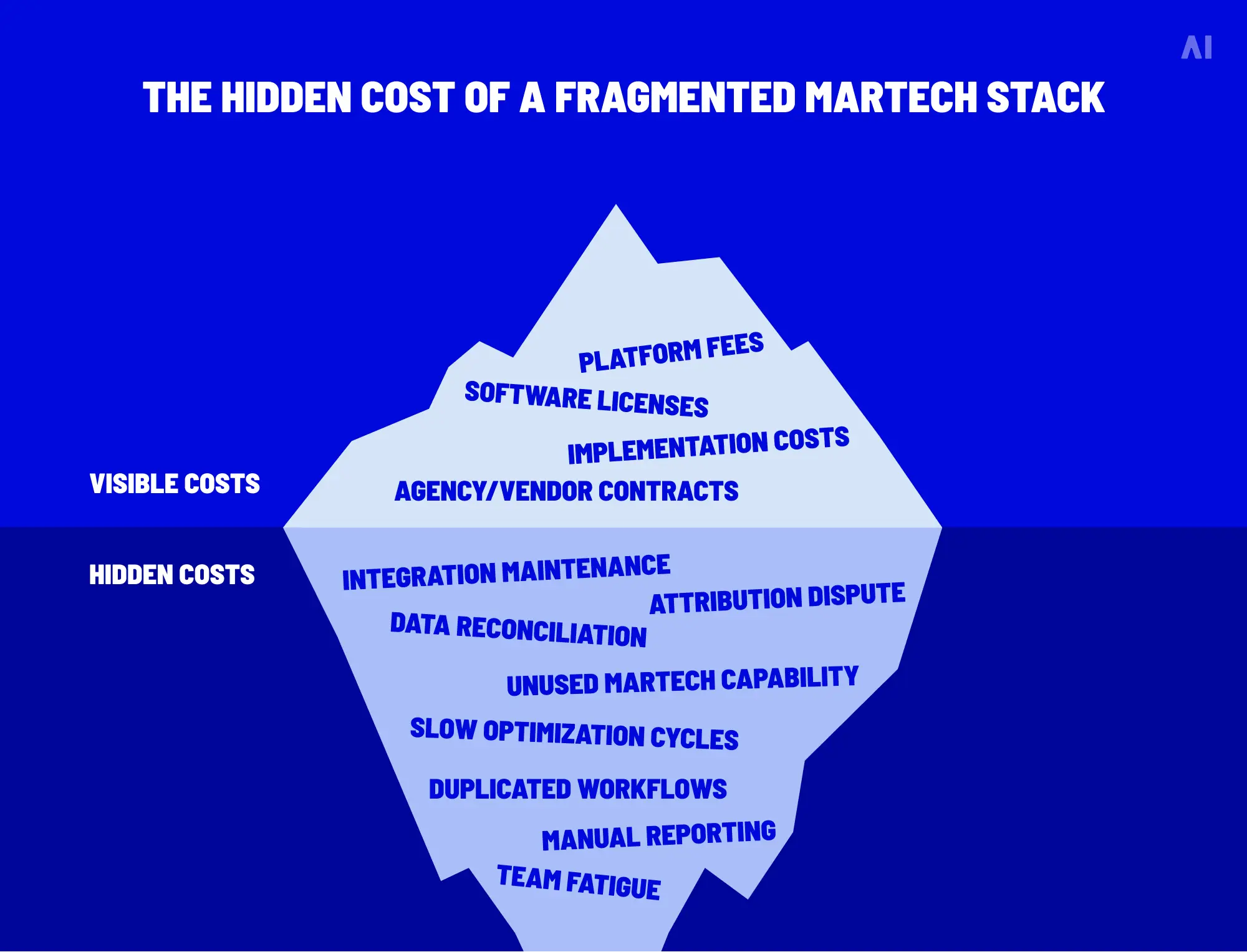
Traditional stacks carry visible and invisible costs.
- The visible costs are easy to spot: software licenses, media platform fees, service contracts, agency retainers, implementation projects, data tools, analytics platforms, and technical support.
- The invisible costs are harder to quantify but often more damaging: duplicated work, unused capabilities, manual reporting, integration maintenance, slow campaign setup, misallocated spend, and team fatigue.
This is not an academic concern, because the budgets are not there to paper over bad decisions. Gartner's 2025 CMO Spend Survey found marketing budgets stuck at 7.7% of company revenue—flat, not growing. In that climate, every martech decision has to justify itself on productivity and performance. Novelty is not a business case.

An AI marketing platform may reduce cost by consolidating workflows, improving media efficiency, reducing manual reporting, and helping teams allocate budget based on stronger signals. However, this only works when the platform is adopted properly. Buying an AI platform while leaving old processes untouched can simply add another cost layer.
Scalability across channels
Traditional stacks often scale by addition. A team adds a CTV partner, then a DOOH platform, then a retail media network, then another analytics tool, then another dashboard to understand the first dashboard. That may be manageable at first. Over time, every new channel adds more data structures, more reporting formats, more optimization rules, and more meetings.
AI marketing platforms scale differently. They aim to bring cross-channel signals into a shared planning and optimization process. This becomes important as media plans expand across connected TV, programmatic DOOH, retail media, audio, display, social, search, and publisher-direct campaigns.
The challenge is not merely buying across channels. It is understanding how the channels work together. A platform-based model can help teams compare performance, manage frequency, evaluate incremental contribution, and move budget toward the combinations that support business outcomes.
💡 Related reading: Connected TV advertising | Programmatic DOOH | Retail media networks
Transparency and measurement
Measurement is where stack fragmentation becomes most visible.
Every platform has its own reporting logic. Search may emphasize click-based attribution. Social may claim view-through influence. Retail media may report sales within its own environment. CTV and DOOH often require different measurement methods. Web analytics may undercount or overcount depending on consent, tagging, device behavior, and browser restrictions.
Traditional stacks can produce plenty of reports without producing a common truth.
AI platforms can help by connecting reporting across channels, surfacing patterns, and supporting methods such as marketing mix modeling, path-to-conversion analysis, and incrementality testing. AI Digital’s Elevate specifically includes advanced attribution capabilities such as MMM and path-to-conversion analysis, designed to show influence across channels rather than just last-click outcomes.
Transparency also depends on media supply. AI Digital’s Open Garden is a response to walled gardens that emphasizes DSP-agnostic execution, cross-platform data and insights, and more transparent control over where budgets are spent.
💡 Related reading: Transparency in advertising
Why traditional martech stacks struggle in modern marketing
Traditional martech stacks struggle because they were not built for the current level of channel fragmentation, privacy pressure, media complexity, and performance scrutiny. They can still be powerful, but they often require too much manual work to keep the system coherent.
This is not a criticism of the individual tools. Many are excellent. The issue is structural.
Tool fragmentation and operational overhead
Tool fragmentation creates operational overhead because every system requires configuration, governance, training, integration, reporting, procurement, vendor management, and troubleshooting.
A stack that looks sophisticated on a slide can feel very different in day-to-day work. A campaign manager may need five dashboards to understand performance. A data team may spend hours reconciling naming conventions. A strategist may wait for exports before making recommendations. A marketing leader may hear three different versions of the same campaign result.
Over time, the organization develops workarounds. People build spreadsheets. They hold extra alignment meetings. They create “manual source of truth” documents. They hire specialists to manage tools that were originally purchased to save time.
That is the hidden tax of fragmentation.
Data silos limit performance insights
Data silos make it difficult to understand the full customer journey and the true contribution of each channel. This becomes more serious as marketing shifts toward omnichannel planning and more privacy-safe measurement.
If CRM data, media exposure data, web behavior, offline activity, and sales outcomes are disconnected, marketers may optimize for what is easiest to measure rather than what matters most. That usually favors lower-funnel channels with obvious clicks while undervaluing upper-funnel media, brand activity, CTV, DOOH, and other channels that influence demand earlier in the journey.
This is one reason AI marketing platforms often include MMM, attribution, or cross-channel analytics capabilities. They are not just reporting tools but attempts to give marketers a more rounded view of contribution.
Manual optimization cannot scale
Manual optimization has limits.
A person can review campaign performance by channel, audience, placement, creative, and geography. A good analyst can find waste and opportunity. But when campaigns span thousands of placements, multiple DSPs, dozens of audience segments, retail media networks, CTV inventory, creative variants, and changing bids, human review alone becomes too slow.
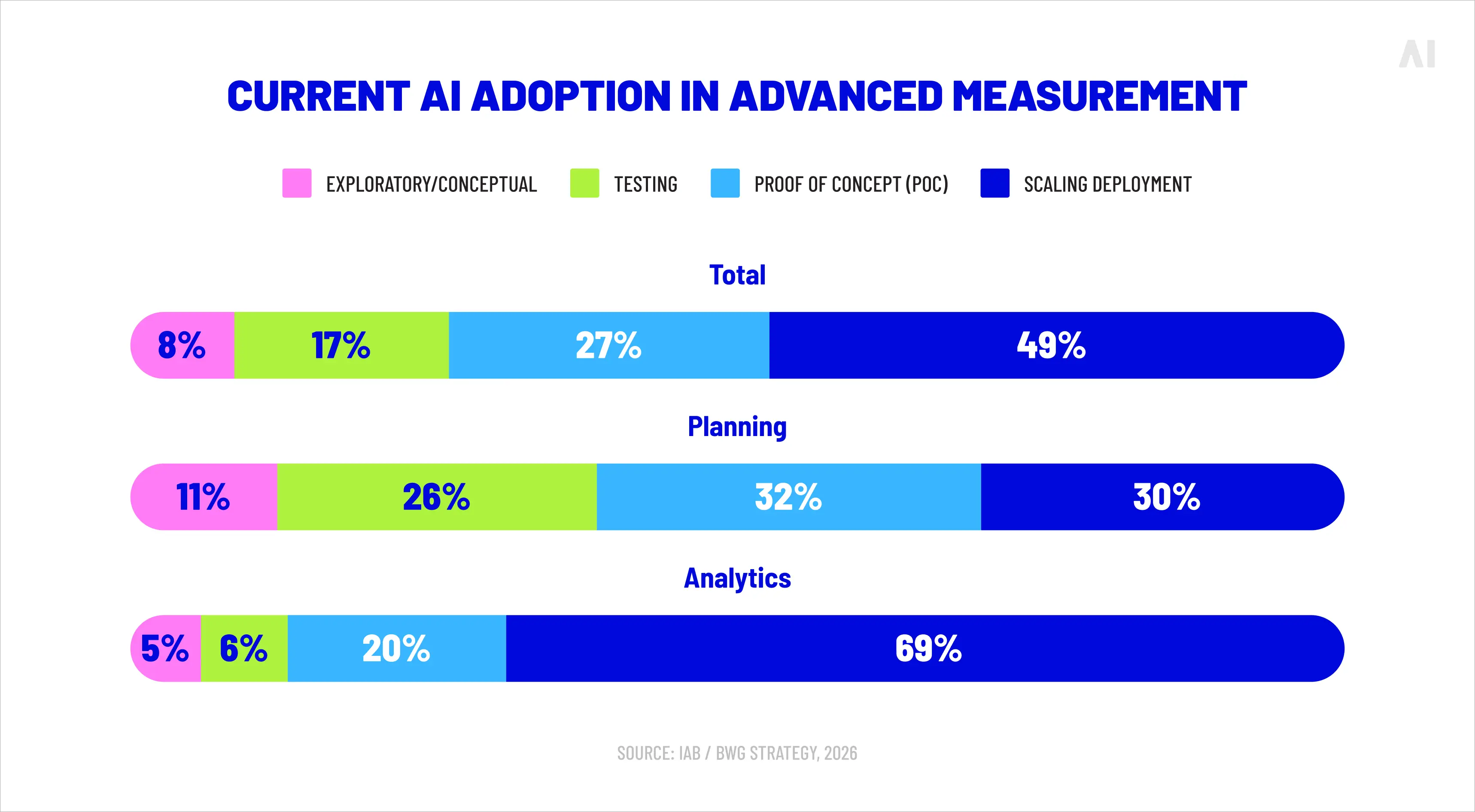
EMARKETER reported in 2025 that 46% of advertisers planned to use AI for media strategy, while the same share used AI for bidding optimization and mid-flight plan optimization. That is not because marketers suddenly stopped valuing human judgment. It is because the volume of campaign decisions now exceeds what manual workflows can handle efficiently.
The future is not human or AI. It is human judgment supported by machine-speed analysis.
Where AI marketing platforms deliver real business value
AI marketing platforms deliver real value when they improve how marketing decisions are made, not merely how reports are generated. The strongest benefits appear in speed, media efficiency, orchestration, and operational control.
Faster time-to-insight and action
Traditional reporting often explains what happened. AI-assisted intelligence can help teams decide what to do next.
That difference matters. A dashboard may show that CPM has risen, CTR has dropped, or conversions have slowed. A stronger platform can help identify why the change happened, whether it matters, what it may affect, and which action is likely to improve performance.
A faster time-to-insight also changes team behavior. Instead of waiting for a weekly performance review, marketers can adjust targeting, creative, pacing, supply paths, and budget allocation while there is still time to influence the outcome.
The benefit is not just speed for its own sake. It is speed with context.
Improved media efficiency and ROI
Media efficiency is one of the most concrete places AI platforms can prove value.
Wasted spend often hides in poor inventory quality, inefficient supply paths, duplicate reach, weak audience matching, brand safety issues, high fees, and platform-level optimization that does not align with the advertiser’s true KPI. Traditional stacks may expose some of this waste, but often only after teams combine data manually.
Smart Supply is AI Digital’s supply-side curation solution, designed to provide premium, brand-safe inventory using AI and human expertise. Its role is curating high-quality inventory, optimizing supply paths, filtering out low-value or fraudulent traffic, and giving advertisers more transparent reporting into placements, pricing, and performance.
That connects directly to the larger platform argument. AI should not be treated as an abstract benefit. It should help improve inventory selection, reduce waste, and move more budget toward working media.
Cross-channel orchestration at scale
Cross-channel orchestration is where AI platforms move beyond analytics. The goal is not simply to know what happened across channels. The goal is to coordinate planning and optimization across them.
For example, a marketing team may need to understand how CTV builds awareness, how programmatic display supports consideration, how retail media captures demand near purchase, and how search responds to demand already created elsewhere. In a traditional stack, each channel may appear to optimize itself. The business needs a view of the whole system.
Elevate is designed to support this broader operating model by bringing research, planning, optimization, and reporting into one intelligence layer. Its AI-assisted media planner uses campaign inputs to produce structured media plans, scenario testing, and recommendations, with human verification from AI Digital media planners.
That last point is important. For senior leaders, the attractive model is not blind automation. It is AI-supported planning with human oversight.
💡 Related reading: What is cross-platform advertising? Strategy, challenges, and measurement
Reduced operational complexity
A good AI marketing platform should reduce the number of manual handoffs required to run modern campaigns.
That does not always mean fewer tools on day one. In many organizations, the platform first sits above the existing stack, connecting data and workflows while the business gradually rationalizes what it owns. Over time, duplicated tools can be retired, reporting can be simplified, and teams can spend less time maintaining the stack.
Reduced complexity has several practical effects:
- Teams spend less time assembling reports.
- Leaders get more consistent performance views.
- Campaigns can launch with cleaner planning inputs.
- Optimization can happen closer to real time.
- Measurement can focus on business outcomes rather than platform claims.
The result is not a perfect machine. Marketing is too human, too creative, and too market-dependent for that. But the work becomes less tangled.
AI platform vs Traditional martech stack: when to choose
The right choice depends on complexity, budget, maturity, team structure, and performance pressure. A traditional stack may still be perfectly reasonable. An AI platform may be necessary. A hybrid model may be the most realistic answer.
{{26-Marketing-Platform-vs-Traditional-Martech-Stack-3="/tables"}}
The best decision is rarely ideological. It is operational.
When a traditional martech stack is still a viable option
A traditional martech stack can still work well when marketing complexity is limited and the team has a clear operating model.
For example, a smaller business with a simple channel mix may not need a broad AI platform. A CRM, email automation tool, analytics setup, paid media accounts, and a manageable reporting process may be enough. The same is true for companies with stable customer journeys, low media complexity, and strong internal processes.
Traditional stacks may also make sense when the business has already invested heavily in core systems that are well adopted. If utilization is high, data quality is strong, and teams can act quickly, replacing the stack may create more disruption than value.
The key test is not whether the stack is traditional. It is whether it still supports confident decisions.
💡 Related reading: Media Mix Optimization: How to Use MMM for Budget Allocation
When an AI marketing platform is the better choice
An AI marketing platform becomes the better choice when marketing complexity starts to slow the business down.
That usually happens when:
- Campaigns run across multiple paid media channels.
- Reporting depends on manual exports and reconciliation.
- Leadership lacks confidence in attribution.
- Teams cannot optimize campaigns fast enough.
- Media waste is difficult to identify.
- Customer data exists but is not easily actionable.
- The business needs stronger ROI without adding large operational headcount.
- Planning, activation, optimization, and reporting happen in separate systems with limited connection.
In these cases, the platform is not a luxury. It becomes a way to make marketing manageable again.
The hybrid reality: AI layered on top of existing stacks
For most businesses, the realistic path is hybrid.
Few organizations will rip out their CRM, analytics tools, automation systems, data warehouse, and media platforms in one move. Nor should they. Many existing systems remain valuable. The better question is how to create an intelligence layer that connects them, makes their data more useful, and helps teams act faster.
This is where AI Digital’s Open Garden Framework is especially relevant. Open Garden is an alternative to restrictive walled garden models, with DSP-agnostic execution, cross-platform insights, neutral inventory access, and transparency into media decisions.
A hybrid model lets companies keep what works while addressing what does not. It avoids the false choice between “old stack” and “total replacement.” Instead, it asks where the business needs better decision-making, cleaner measurement, and faster optimization.
⚡ The realistic path for most businesses is not replacement. It is consolidation, connection, and a stronger decision layer above the tools they already use.
From a fragmented stack to an AI-driven model
Moving from a fragmented stack to an AI-driven model should be done in stages. The goal is not to bolt AI onto every workflow at once. The goal is to identify where better intelligence will have the greatest commercial effect.
💡 Related reading: AI in digital marketing

1. Audit your current stack and identify inefficiencies
Start with the stack you already have.
List every tool used across CRM, data, analytics, automation, media, reporting, content, workflow, and measurement. Then look for overlap and friction. Which tools are essential? Which are underused? Which require manual exports? Which duplicate another system? Which reports does leadership actually use?
The audit should include cost, but not only license cost. It should also include:
- time spent preparing reports;
- time spent reconciling data;
- tools with low adoption;
- duplicated functionality;
- campaign setup delays;
- vendor lock-in;
- unclear ownership;
- manual optimization points;
- performance blind spots.
This stage often reveals a useful truth: the company may not need more technology. It may need a clearer operating model.
2. Unify data and establish a decision layer
AI depends on usable data. If data is fragmented, inconsistent, or poorly governed, AI will only move faster toward questionable conclusions.
The next step is to identify the most important data inputs for marketing decisions. These may include campaign data, audience data, CRM records, web behavior, sales outcomes, inventory quality, creative performance, and media cost.
Then establish a decision layer. This is where platforms such as Elevate become relevant. Elevate is designed to unify research, planning, optimization, and reporting, connecting pre-campaign intelligence with live optimization and post-campaign analysis.
The decision layer does not need to replace every system immediately. Its role is to make the existing environment more actionable.
3. Prioritize high-impact AI use cases
AI adoption works best when it starts with specific business problems.
The first use cases should be practical, measurable, and close to revenue or efficiency. Good candidates include:
- Media optimization: shifting budget toward higher-performing audiences, placements, and channels.
- Supply path optimization: reducing waste and improving inventory quality.
- Audience planning: translating customer goals into channel-specific audience strategies.
- Reporting automation: reducing time spent building and interpreting recurring reports.
- Scenario planning: comparing budget and channel options before launch.
- Attribution and MMM: improving understanding of channel contribution.
The point is not to “use AI.” The point is to improve a decision or workflow that already matters.
💡 Related reading: What is supply path optimization in programmatic advertising?
4. Scale toward full orchestration
Once high-impact use cases are working, the business can move toward broader orchestration.
This may include connecting media planning to campaign activation, adding more advanced reporting, integrating MMM or path-to-conversion analysis, applying AI-assisted audience development, and linking optimization to business KPIs rather than media metrics alone.
AI Digital’s materials describe this kind of progression across Elevate, Smart Supply, managed services, and Open Garden: planning, execution, supply curation, optimization, reporting, and transparency working together rather than sitting in separate operational lanes.
The final goal is not a fully automated marketing department. It is a marketing system where teams can see more clearly, act faster, and spend with greater confidence.
Common mistakes of AI marketing platforms adopting
AI marketing platform adoption can fail when businesses treat it as a software purchase rather than an operating model change. The technology may be powerful, but the commercial impact depends on data readiness, workflow design, governance, and team adoption.
💡 Related reading: Marketing measurement strategy: How to measure and optimize performance across channels
Treating AI as just another tool
The first mistake is treating AI as one more point solution in an already crowded stack.
If AI is added without rethinking workflows, it may create more noise. Teams get another dashboard, another set of recommendations, another vendor relationship, and another layer of interpretation. The stack becomes more impressive and less usable.
AI should change the way decisions are made. That means defining who reviews AI recommendations, who approves changes, how performance is measured, how exceptions are handled, and how teams learn from outcomes.
Ignoring data readiness
The second mistake is ignoring data readiness.
AI models need reliable inputs. Poor naming conventions, inconsistent campaign taxonomy, missing cost data, broken tags, duplicate customer records, and unclear consent signals all weaken the output. The platform may still produce recommendations, but those recommendations may not be trustworthy.
Data readiness does not mean perfection. It means enough structure, governance, and quality control for AI-assisted decisions to be useful.
Marketing leaders should ask:
- Which data sources are required?
- Who owns each source?
- How often is data updated?
- What quality checks are in place?
- Can campaign data connect to business outcomes?
- Are privacy and consent rules clear?
- Can teams explain how recommendations are produced?
Without these answers, AI adoption becomes theater.
Expecting instant results without process change
The third mistake is expecting instant results while leaving the old process untouched.
AI can reduce manual work, but it cannot make a slow organization fast by itself. If budget approvals take weeks, data access is restricted, reporting definitions are contested, and channel teams operate in isolation, an AI platform will hit the same organizational barriers as every previous tool.
Adoption should include process change. Teams need new review cycles, decision rights, escalation paths, performance definitions, and training. Senior leaders need to decide what they want AI to improve: efficiency, speed, measurement, media quality, customer experience, or all of the above in stages.
⚡ AI in martech only becomes useful when it moves work from manual coordination to governed, measurable action.
💡 Related reading: Creating a data-driven marketing strategy
AI marketing platforms vs traditional martech stacks: from complexity to marketing clarity
The shift from traditional martech stacks to AI marketing platforms is really a shift from tool accumulation to decision quality.
Traditional martech stacks helped marketing teams specialize. They gave CRM teams, automation teams, media buyers, analysts, content teams, and lifecycle marketers the systems they needed to do more sophisticated work. That value has not disappeared.
But as marketing grows across channels, data sources, privacy requirements, and performance expectations, the old model starts to strain. More tools can mean more capability, but also more handoffs, more manual reporting, more measurement disputes, and slower optimization.
AI marketing platforms offer a different model. They bring data, analytics, planning, automation, optimization, and reporting closer together. Their greatest value is not that they make marketing look more advanced. It is that they help teams move from scattered information to faster, better decisions.
Key takeaways on AI vs traditional marketing
- Traditional martech stacks create complexity that slows execution and limits visibility as marketing scales.
- AI marketing platforms unify data, decision-making, and execution into a more efficient system.
- The biggest impact comes from speed and automation, not just better analytics.
- Most businesses will adopt a hybrid model before fully moving to AI-driven platforms.
- Competitive advantage now depends on how quickly you can turn data into action, not how many tools you use.
For leaders evaluating the next step, the right question is simple: where does your current stack slow the business down?
If the answer is fragmented reporting, inefficient media buying, slow optimization, unclear attribution, or too much manual coordination, AI Digital can help. Through Elevate, Smart Supply, managed services, and the Open Garden Framework, AI Digital supports brands and agencies with intelligence-led planning, transparent media execution, supply efficiency, optimization, and cross-channel performance visibility.
To discuss how AI Digital can help you move from fragmented tools to clearer marketing decisions, get in touch: Contact AI Digital

.webp)