%2520and%2520How%2520Does%2520It%2520Work.webp)
Out-of-home advertising is no longer immune to performance pressure. As budgets tighten and ROI expectations rise, brands are demanding the same measurability and agility from physical media that they get from digital channels. This shift is accelerating adoption of programmatic DOOH (pDOOH), where programmatic digital out of home meets data-driven buying. With global DOOH spend projected to exceed $20B by 2026, automation and real-time optimization are quickly becoming the new standard for programmatic out of home campaigns.
Experts see programmatic DOOH advertising as the bridge between digital precision and real-world impact. Powered by modern programmatic media platforms, pDOOH allows campaigns to respond dynamically to location, time, context, and audience signals — turning screens into flexible, intelligent media assets. This evolution mirrors the broader rise of programmatic advertising, where automation replaces rigid planning with continuous optimization across channels.
💡For marketers, the value is simple: more control, less waste. Digital out of home programmatic buying enables faster launches, smarter targeting, and clearer performance signals within omnichannel strategies. As programmatic DOOH continues to scale, it’s redefining how brands plan, activate, and measure DOOH campaigns in the real world — efficiently, confidently, and at speed.
What is programmatic DOOH advertising?
Programmatic DOOH advertising (pDOOH) is the automated buying and delivery of digital out of home programmatic media using data, technology, and real-time decisioning. Instead of reserving fixed placements in advance, advertisers activate programmatic digital out-of-home campaigns through a platform that uses audience and contextual signals, such as location, time, weather, or movement patterns, to decide when, where, and how ads appear.
At its core, programmatic DOOH combines automated media buying, dynamic creative activation, and flexible campaign delivery. This allows brands to treat out of home advertising more like digital media: responsive, measurable, and optimized continuously rather than locked in upfront. The result is programmatic out of home that adapts to real-world conditions while staying aligned with performance goals.
How pDOOH differs from traditional OOH
The difference between traditional out of home, standard DOOH, and programmatic DOOH advertising lies in control and intelligence. Traditional OOH relies on static placements and long-term commitments, while early DOOH introduced digital screens but kept the buying process largely manual. pDOOH represents the next step — shifting from fixed media plans to flexible, data-driven activation.
{{What Is Programmatic DOOH (pDOOH) and How Does It Work?="/tables"}}
With programmatic digital out of home, campaigns can be launched, paused, adjusted, or scaled in real time based on media performance or contextual triggers. Targeting moves beyond location alone to include audience signals, and optimization happens continuously rather than after the campaign ends. This evolution mirrors the broader shift toward automated, accountable media buying already familiar from programmatic advertising and modern DOOH marketing practices.
How programmatic DOOH works
At a high level, programmatic DOOH operates like digital advertising but executes in physical environments. Campaigns are planned, bought, and optimized through programmatic media platforms, using data signals to determine ad delivery in real time. Instead of purchasing fixed screens for fixed periods, buyers activate programmatic digital out of home inventory dynamically, allowing campaigns to respond to real-world conditions while maintaining centralized control, pacing, and measurement. This ecosystem turns DOOH from a static placement into a living media channel.
The pDOOH ecosystem: DSPs, SSPs, and media owners

The pDOOH ecosystem connects advertisers, DSPs, ad exchanges, SSPs, and publishers to automate digital outdoor advertising (Source).
The pDOOH ecosystem mirrors the structure of digital programmatic advertising. Advertisers and agencies use Demand-Side Platforms (DSPs) to plan, target, and buy inventory, while media owners make their DOOH inventory available through Supply-Side Platforms (SSPs). These platforms connect in real time, enabling automated transactions across thousands of screens.
From our perspective at AI Digital, DSPs are the strategic control layer, where audience logic, budgets, pacing, and optimization live. SSPs handle inventory access, availability, and pricing, while media owners maintain screen quality, placement, and playback integrity. This structure allows programmatic out of home to scale efficiently while preserving transparency across the supply chain.

⚡️Learn more about how DSPs power this ecosystem here: Demand-Side Platform (DSP): How It Works, Benefits, and Examples
Audience and contextual signals
What differentiates programmatic DOOH advertising from traditional OOH is its reliance on signals, not assumptions. Campaigns can activate based on contextual inputs such as location, time of day, weather, traffic density, venue type, or anonymized mobility patterns. These signals allow brands to align messaging with real-world moments — for example, promoting cold beverages during heat spikes or retail offers during peak foot traffic.
💡Rather than targeting individuals, programmatic digital out of home focuses on situational relevance. The result is smarter reach, reduced waste, and stronger alignment between message, environment, and audience presence.
Real-time bidding and trigger-based activation
In many pDOOH environments, inventory is accessed through real-time bidding (RTB) or automated decisioning logic. When a trigger condition is met — such as a time window, weather change, or audience threshold — the system evaluates eligible campaigns and delivers the most relevant creative.
This doesn’t mean every impression is auctioned like display ads, but it does mean delivery is logic-driven rather than schedule-bound. For brands, this unlocks agility: campaigns can adapt instantly without renegotiation or manual intervention.
⚡️A deeper breakdown of this mechanism is covered in What is Real-Time Bidding (RTB): Definition, Benefits, and How It Works in 2026.
Creative delivery and playback verification
Once a campaign is activated, creative assets are delivered digitally to screens and played according to predefined rules. Programmatic DOOH platforms log proof-of-play data, confirming when and where each creative was displayed. This playback verification is critical — it forms the foundation for reporting, performance analysis, and attribution modeling.
From an execution standpoint, this is where DOOH marketing finally meets accountability. Advertisers gain confidence that their media ran as planned, while creative teams gain the flexibility to rotate, localize, or update messaging without disrupting the broader campaign. In practice, this closes the loop between planning, activation, and measurement — the core promise of programmatic digital out of home done right.
Key advantages for marketers
From our perspective at AI Digital, the value of programmatic DOOH lies in how it removes friction from out of home while preserving its unique strength: real-world impact. By applying programmatic logic to physical media, marketers gain flexibility, intelligence, and accountability that simply weren’t possible with traditional OOH. Below are the advantages we see driving sustained adoption among performance-focused teams.
Flexibility and real-time control

Programmatic DOOH advertising gives marketers direct control over live campaigns. Budgets, pacing, creative rotation, and activation rules can be adjusted in real time — without renegotiating placements or waiting for post-campaign reports. This flexibility is especially powerful in fast-moving environments where conditions change daily. Instead of committing spend weeks in advance, brands can scale up, pause, or redirect programmatic out of home campaigns based on performance or business priorities.
Smarter targeting
Unlike traditional OOH, programmatic digital out of home is activated by signals, not static assumptions. Campaigns can respond to contextual and audience-based inputs such as location, time, venue type, weather, or mobility patterns. This approach doesn’t rely on personal data; it relies on relevance. The result is more efficient reach, stronger message alignment, and less wasted exposure — a core advantage of modern DOOH marketing strategies.
At a business level, strong personalization programs have been shown to lift revenue (≈5–15%) and marketing ROI (≈10–30%), which is why impression-level targeting and dynamic creative optimization are so valuable inside programmatic buys.
💡Retargeted programmatic ads also achieve click-through rates 10x higher than standard display, with 70% of consumers more likely to convert after seeing retargeted messages.
Transparent reporting
One of the biggest historical barriers to OOH adoption was measurement. Programmatic DOOH addresses this with delivery-level reporting, proof-of-play logs, and exposure data that confirm when and where ads ran. While OOH won’t mirror click-based metrics, it now offers a level of transparency that allows marketers to evaluate performance with confidence and integrate results into broader programmatic media reporting frameworks.
Cost efficiency
Automation reduces inefficiencies across the buying process. With digital out of home programmatic buying, marketers avoid overcommitting to underperforming placements and can align spend with actual opportunity.
Automation replaces RFPs and manual insertion orders with software that plans, bids, paces, and optimizes across channels. That efficiency is one reason programmatic accounts for more than 90% of US digital display spend. It’s also improving how much of your budget reaches real people: the ANA’s 2024 benchmark found 43.9% of every $1,000 entering a DSP now reaches consumers, up 7.9 percentage points year over year (an extra $79 per $1,000). Pair this with supply-path optimization—especially AI-assisted—to reduce hops and fees.
Cross-channel synergy
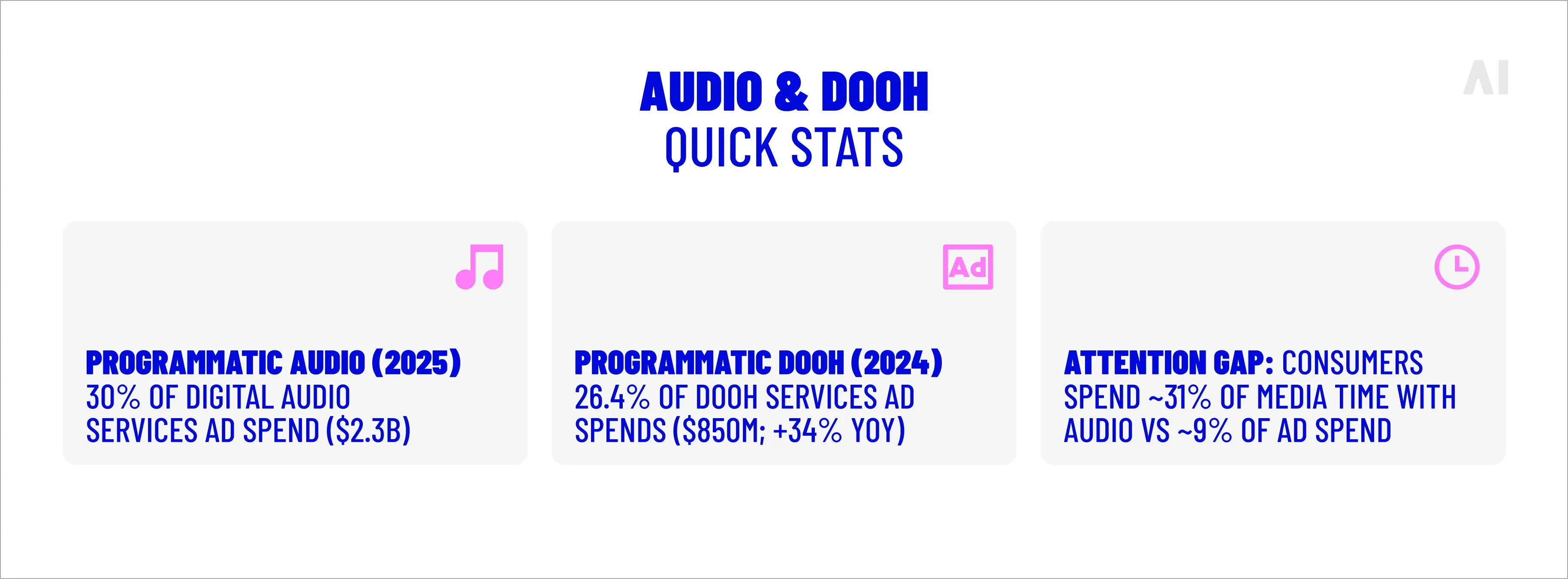
Perhaps the most strategic advantage is how seamlessly programmatic DOOH fits into omnichannel planning. pDOOH can be activated alongside display, CTV, mobile, and audio using shared data signals and coordinated messaging. This creates consistency across touchpoints while extending reach into physical environments. For marketers already operating within programmatic ecosystems, programmatic digital out of home becomes a natural extension — not an outlier — in a unified media strategy.
Common use cases of pDOOH
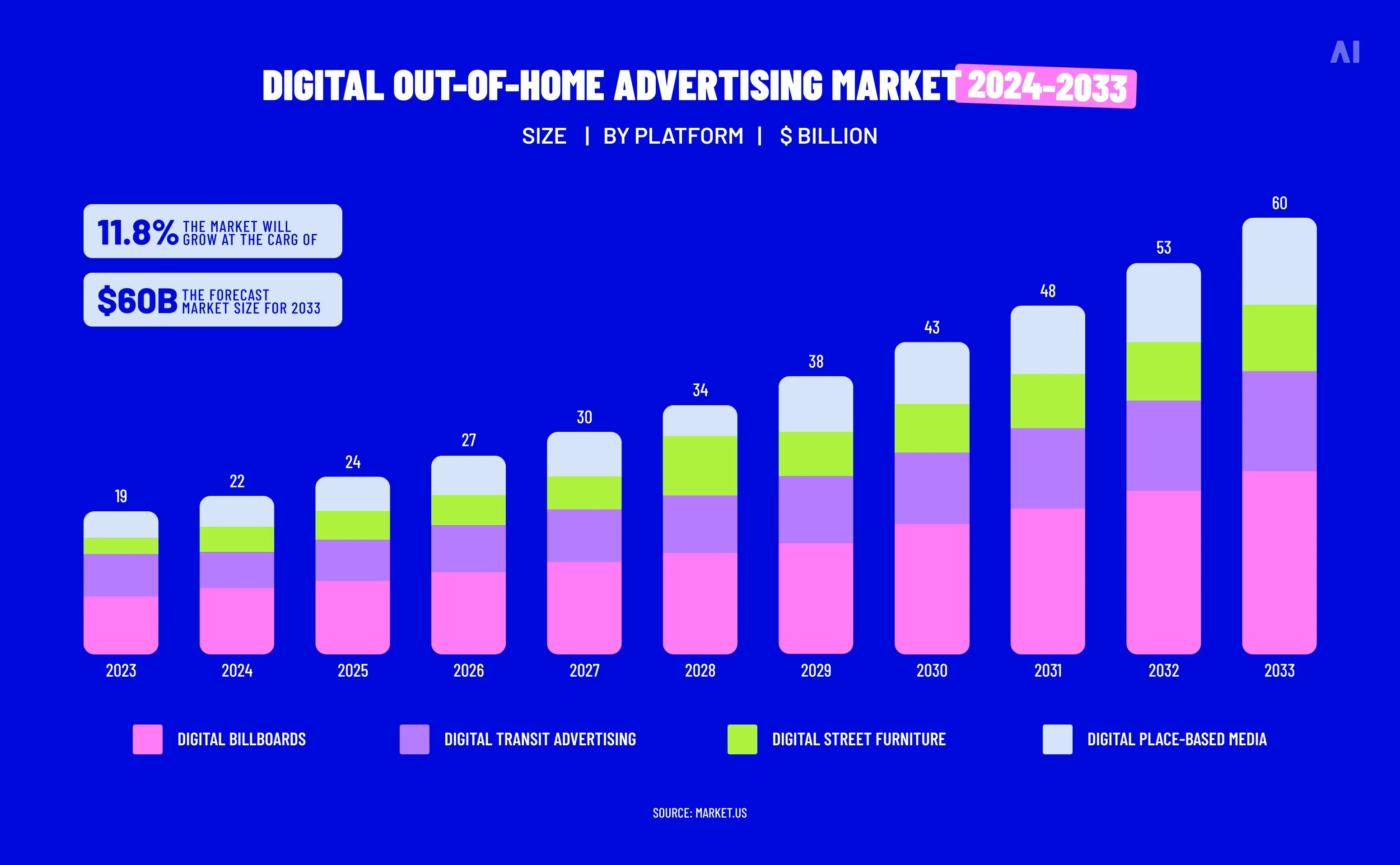
Programmatic DOOH is most effective when campaigns need contextual relevance, real-world timing, and measurable impact. Across industries, brands are turning programmatic digital out of home into a performance-ready channel that complements broader media strategies. In 2024, U.S. DOOH ad spend hit $3.2 billion, with 53 % of campaigns run programmatically — up notably from the year before — showing how quickly advertisers are embracing pDOOH’s flexibility and automation.
In retail and quick-service restaurant (QSR) environments, pDOOH campaigns leverage real-time signals like foot traffic, weather, and time of day to deliver offers when they matter most. A McDonald’s weather-responsive DOOH campaign in the Philippines saw nearly 1 million impressions in just 10 days and a 9 % lift in store visits, demonstrating how moment-based triggers can drive offline action . Place-based screens in malls, airports, and transit hubs also allow brands to match content to audience mindset — promoting breakfast during morning commutes or travel deals to arriving passengers.
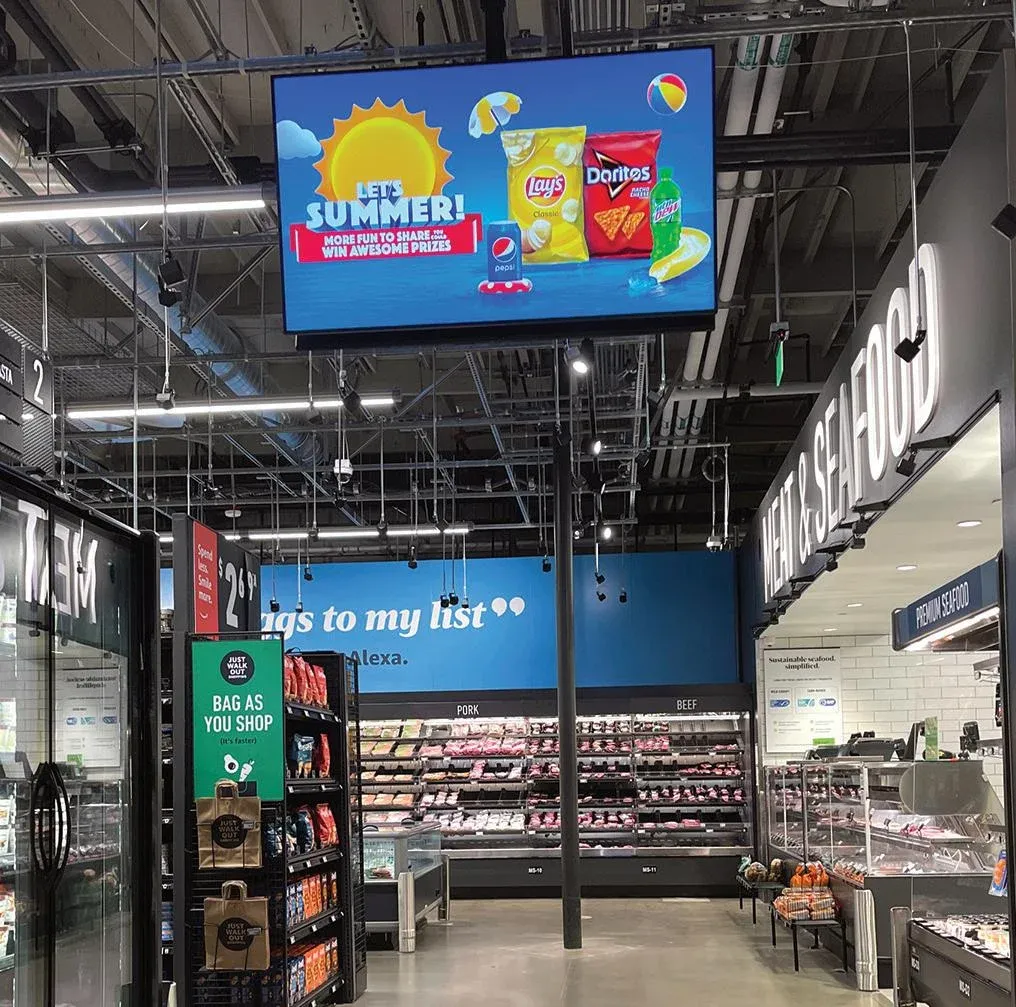
Other industries use pDOOH for creative, attention-grabbing executions that build buzz and recall. Music streaming brands like Spotify have integrated DOOH with broader cultural moments, while entertainment campaigns employ immersive visuals that blur the line between advertising and experience.

⚡️Across all these scenarios, programmatic out of home delivers not just reach but relevance — connecting messages to moments in ways that static billboards never could. For more real-world examples of these strategies in action, explore our DOOH advertising examples.
How pDOOH integrates into an omnichannel strategy
Programmatic DOOH fits naturally into omnichannel strategies because it extends digital logic into physical space — at scale. As brands diversify spend beyond saturated online channels, pDOOH has become a growth engine rather than a supporting tactic. Global DOOH investment continues to rise at double-digit rates year over year, and more than half of DOOH spend in mature markets is now programmatic, signaling a clear shift toward unified, data-driven media planning. pDOOH brings high-impact reach into moments where mobile, CTV, or desktop simply can’t operate.
In practice, programmatic digital out of home acts as an awareness and reinforcement layer that strengthens downstream performance. Brands use pDOOH to seed messages in high-traffic, real-world environments — city centers, retail zones, transit hubs — then follow up with mobile, display, CTV, or audio using aligned timing, geography, and audience signals. This enables sequential messaging: see it on the street, reinforce it on the phone, convert it online. The result is higher recall, stronger brand lift, and improved efficiency across the funnel.

From a measurement and planning standpoint, programmatic DOOH advertising increasingly aligns with omnichannel reporting frameworks. While metrics differ from click-based channels, pDOOH contributes incremental reach, frequency control, and exposure data that can be modeled alongside digital impressions. For marketers managing unified budgets across programmatic media, pDOOH is no longer an outlier — it’s a strategic connector that links digital performance with real-world presence, helping campaigns work harder across every touchpoint.
Measurement and attribution in pDOOH
Measurement in programmatic DOOH has evolved from vague eyeball estimates to data-backed exposure and distribution metrics that fit into modern performance planning. While DOOH doesn’t have clicks, it does offer hard delivery data — including impressions, proof-of-play logs, and audience estimates — that can be integrated with digital attribution models.
Industry benchmarks show that programmatic DOOH delivers predictable scale: campaigns often reach 60 %+ of key audiences in major urban areas within the first week, and daypart delivery can vary by up to 45 % across peak times compared to static buys. Proof-of-play systems register 100 % playback verification, meaning every ad impression is logged with a timestamp and location. This level of distribution data enables planners to measure actual exposure, not just planned reach.
From our perspective at AI Digital, this is where programmatic DOOH moves from a visibility channel to a measurable performance lever. With these datasets, marketers can directly connect pDOOH delivery to downstream digital behaviors. In cross-channel analyses we see consistently, audiences exposed to DOOH plus mobile display generate around 15 % higher click-through rates compared to mobile display alone, while search lift typically appears within 24–48 hours after concentrated DOOH bursts. These patterns make it clear that physical exposure is actively influencing digital intent — not operating in isolation.
⚡️For a deeper dive into the exact measurement frameworks and success metrics we use, see (D)OOH Metrics Explained: How to Measure and Improve Campaign Performance.
Challenges and considerations
From our experience at AI Digital, pDOOH delivers scale and flexibility but it’s not friction-free. The challenges below are the ones that most directly impact performance, efficiency, and comparability, and they’re the reason pDOOH still requires strategic planning, not autopilot buying.
Inventory fragmentation
Inventory fragmentation is the most immediate constraint on scale. Today, no single media owner controls more than a small fraction of total DOOH inventory, and buyers often need to work across 5–10 different supply paths to reach national coverage. Industry data shows that over 60% of DOOH inventory is still siloed by owner or platform, increasing operational overhead and limiting optimization. This mirrors a broader media trend, where fragmentation continues to accelerate and puts pressure on buyers to consolidate intelligently rather than chase raw reach.
Data standardization issues
Unlike display or CTV, pDOOH lacks universal data standards. Impression methodologies can vary by 20–30% between vendors, depending on how exposure, dwell time, and audience movement are modeled. Audience segments may be derived from mobile data, panels, or modeled traffic flows — all valid, but not directly comparable. For marketers, this means normalization and expectation-setting are essential before performance is evaluated.
Creative limitations
Creative effectiveness in DOOH is constrained by attention mechanics. Studies consistently show that average DOOH dwell time ranges from 2 to 6 seconds, which means long-form messaging simply doesn’t work. Ads must be readable in under 3 seconds, often from distance or peripheral vision. Brands that repurpose digital video without adapting format typically see lower recall and weaker lift, while DOOH-specific creative drives materially better outcomes.
Varying measurement methodologies
Measurement sophistication varies widely across markets and vendors. While 100% proof-of-play verification is now standard, attribution approaches differ — some rely on modeled exposure, others on mobility panels or lift studies.
As a result, reported performance deltas can vary significantly if methodologies aren’t aligned. In practice, marketers who pre-define success metrics see far more consistent ROI modeling than those evaluating pDOOH post-hoc.
Need for brand-safe environments
Brand safety in pDOOH is contextual, not content-based. Location matters. Screens near sensitive venues, nightlife districts, or controversial environments can introduce risk if not filtered properly. Brands that apply strict venue and geo-controls typically exclude 10–15% of available inventory, trading raw scale for contextual safety. That trade-off is intentional — and increasingly expected by global advertisers.
💡Bottom line: pDOOH is powerful, but not plug-and-play. The brands seeing the strongest results are the ones that plan for fragmentation, standardize data assumptions, design for real-world attention, and treat measurement as a modeling discipline — not a checkbox.
The future of programmatic DOOH
The future of programmatic DOOH is being shaped by scale, automation, and measurable performance — and the numbers already point to acceleration. Global DOOH ad spend is projected to surpass $25 billion by 2027, growing at double-digit CAGR, with programmatic transactions expected to account for over 60–65% of total DOOH buying in mature markets.
💡From our perspective at AI Digital, this shift is driven less by experimentation and more by necessity: marketers are reallocating budgets toward channels that combine real-world reach with digital-grade control.
AI is the primary force multiplier. Advanced machine learning models are now being used to optimize delivery based on historical performance, contextual signals, and predictive audience movement. Early adopters of AI-driven programmatic optimization report 10–25% improvements in media efficiency, achieved through better pacing, reduced waste, and smarter trigger logic. As outlined in how AI Digital applies AI across the programmatic stack, these systems increasingly automate decisions that once required manual planning — fundamentally changing how programmatic digital out of home campaigns are managed .
Audience data is also evolving rapidly. Privacy-safe mobility and location intelligence now power the majority of pDOOH targeting, and studies show that contextual and audience-based DOOH activation can drive 20–30% higher brand lift compared to static placements. At the same time, immersive formats — including 3D billboards and interactive DOOH — are delivering up to 2× higher recall than standard digital screens, accelerating adoption despite higher production costs.
⚡️For deeper insights into how AI and data are reshaping the programmatic ecosystem, check out The Future Is Now: How AI Digital Embraces AI Technologies to Change the Programmatic Game.
Conclusion
At AI Digital, we see programmatic DOOH not as an add-on, but as a foundational layer of modern media planning. It brings the logic of digital — automation, data, and measurement — into the physical world, unlocking a version of outdoor advertising that is smarter, more flexible, and more accountable.
As budgets shift toward channels that can prove impact, programmatic digital out of home is increasingly where reach and performance intersect. To unlock its full value, pDOOH must be planned intentionally. That means:
- starting with clear business objectives, activating campaigns based on context and audience signals
- treating programmatic out of home as a connected part of the omnichannel journey — not a standalone awareness play.
When integrated properly, pDOOH amplifies other digital channels, extends reach into real-world moments, and improves overall media efficiency. This is where our Open Garden approach comes into focus.
- Through Smart Supply, we give brands access to curated, high-quality, and brand-safe DOOH inventory, reducing fragmentation and waste.
- With Elevate, our analytics platform, marketers gain unified measurement — from verified impressions and exposure data to foot traffic and online lift — helping close the loop on ROI across channels.
As programmatic buying and AI continue to mature, programmatic DOOH advertising will become an indispensable, intelligent layer within the marketing ecosystem. With AI Digital’s end-to-end capabilities, brands can activate pDOOH today as a performance-ready channel — delivering meaningful, data-driven experiences at real-world scale.
⚡️Learn more about what we do to know how we make this possible.