Digital Transit Advertising: How DOOH Extends Reach Beyond Online Media

Commuter attention is one of the last scaled, high-attention environments left in modern media. Every day, billions of trips take place across buses, metros, trains, and stations, with average commute times stretching from 25 to 60+ minutes in large cities. Unlike digital feeds where attention is fragmented and constantly interrupted—transit environments concentrate attention over time, creating repeated, unavoidable exposure during daily routines.
This makes transit advertising fundamentally different from most online media. People encounter the same routes, the same stations, and the same screens day after day, allowing frequency to build without relying on cookies, logins, or retargeting loops. The result is high recall driven by physical presence and repetition, not fleeting impressions.
Digital transit advertising bridges the gap between online precision and offline impact. Screens across public transportation are now powered by programmatic delivery, real-time location data, and AI-driven planning that adapts messaging by time of day, traffic patterns, and audience movement. What used to be static out-of-home placements has evolved into a measurable channel that supports targeting, optimization, and performance analysis at city scale.
💡This convergence is why DOOH transit is increasingly planned alongside digital video, retail media, and local campaigns. Brands gain the trust and visibility of physical media while extending reach beyond personal devices and into shared urban spaces.
⚡️ For a broader foundation on how this ecosystem works, see our overview of DOOH advertising. The guide explains how digital transit advertising works in practice, from key formats and planning logic to why high-traffic transit environments consistently deliver strong brand lift and ROI when strategy, data, and creative are aligned.
What is digital transit advertising?
Digital transit advertising is the use of data-enabled digital screens across transit environments to deliver measurable campaigns at city scale. Unlike traditional out-of-home, digital transit turns these moments into addressable, optimizable media inventory rather than fixed placements bought weeks in advance.
- Scale is the defining advantage. In major metro areas, a single transit network can reach 60–90% of the working population within a typical week, often with 3–7 repeated exposures per commuter on the same routes. This natural frequency is critical: studies consistently show that brand recall increases sharply after the third exposure, and transit environments deliver that threshold without inflating impression costs.
- Modern digital transit campaigns are planned and optimized using real data. Screens are activated based on time of day, traffic volume, audience density, and proximity to points of interest, allowing brands to shift messaging between morning rush hours, midday lulls, and evening commutes. Campaigns can be adjusted in near real time, with performance measured through impression delivery, dwell time, mobility lift, and downstream location visits—metrics that were impossible in static OOH just a few years ago.
- Measurement is no longer hypothetical. Today’s transit DOOH campaigns can be linked to mobile location signals, exposing uplift in store visits that often ranges from 5% to 20%, depending on category and creative. CPMs typically sit 30–50% lower than premium digital video, while delivering significantly higher attention duration due to screen size, proximity, and lack of competing content.
⚡️Digital transit advertising extends digital reach into physical space, reinforces online campaigns with real-world presence, and supports location-based strategies across retail, QSR, entertainment, and mobility-driven categories.
💡For a deeper look at how location intelligence is reshaping transit media, AI Digital’s The Future of Location-Based Marketing: From Geo-Targeting to Location Intelligence explains how real-world movement data is now used to plan, activate, and measure campaigns with far greater precision.
Key digital transit formats
Digital transit advertising is built on screen-based, data-enabled inventory, designed to deliver flexibility, targeting, and measurement at scale. Unlike classic OOH, these formats support dynamic creative, time-based delivery, and integration with programmatic buying and location data—making them adaptable to real-world movement rather than fixed placements.
{{26-Digital-Transit-Advertising-1="/tables"}}
Digital screens in stations and transit hubs
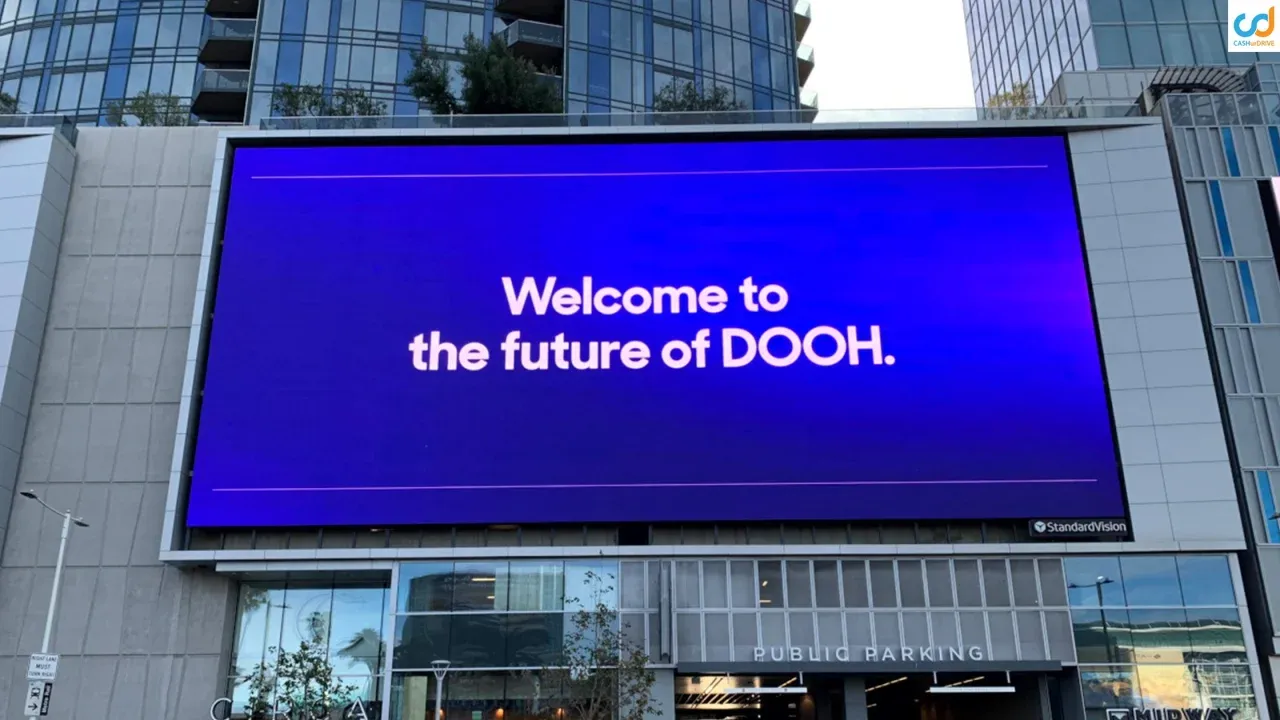
Stations and transit hubs are high-dwell, high-frequency environments. Commuters typically spend 5–15 minutes per visit waiting on platforms, navigating corridors, or passing through entrances, with exposure repeating multiple times per week. Digital screens in these locations include large-format displays, wall-mounted panels, and sequential screen networks that create visual dominance without competing content.
These screens are often connected into digital signage advertising networks, allowing media owners to activate campaigns across hundreds or thousands of screens simultaneously. Messaging can rotate by time of day, audience density, or nearby retail activity, improving relevance while keeping CPMs efficient. Large transit hubs alone can generate millions of monthly impressions, making them ideal for brand launches, retail awareness, and upper-funnel reinforcement.
In-vehicle digital displays
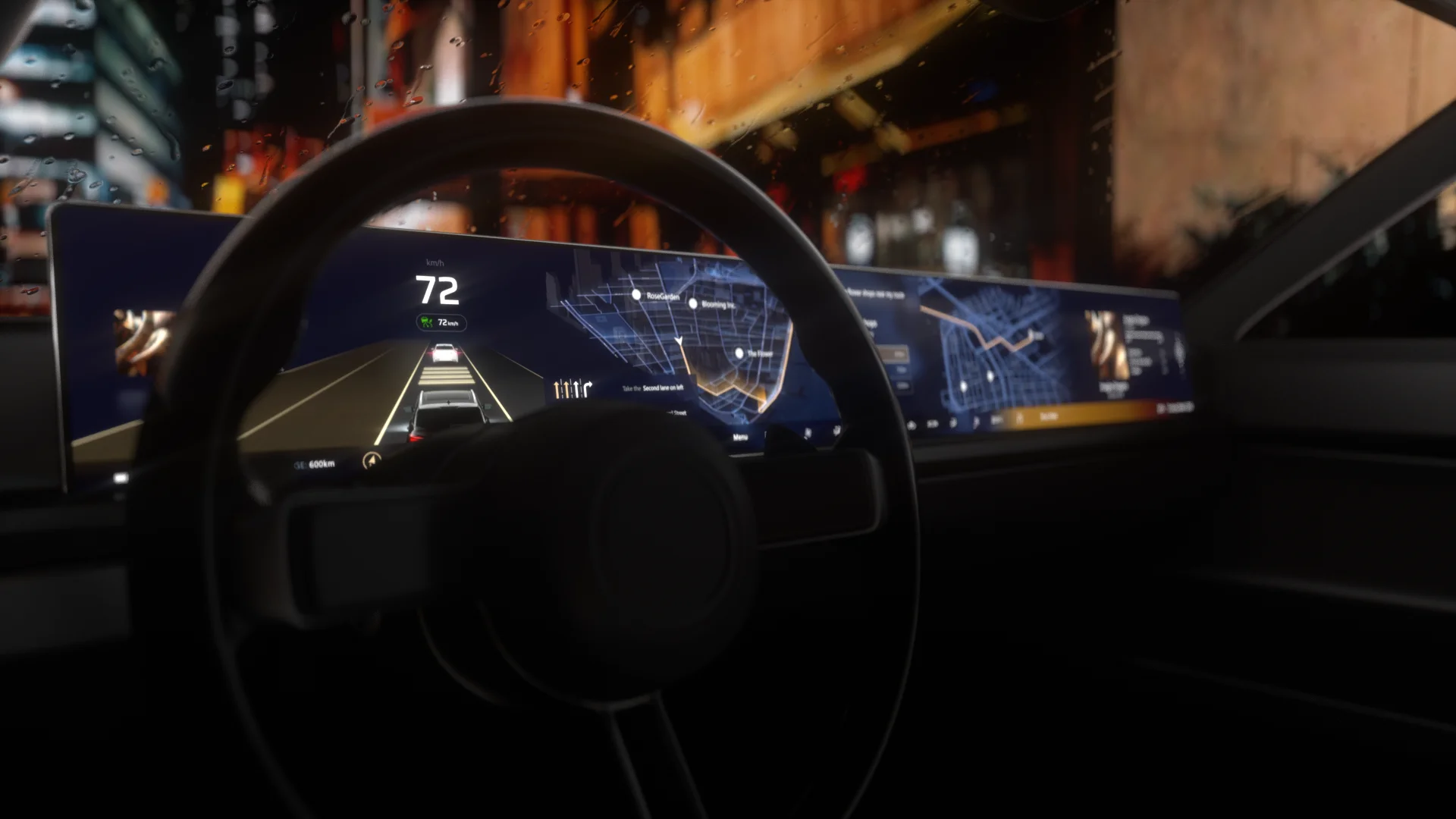
In-vehicle screens deliver some of the longest continuous exposure in DOOH. Displays inside buses, trams, trains, and ride-share vehicles capture attention during trips that average 15–45 minutes, often with limited visual distractions. This creates strong conditions for message recall, especially when creative is sequenced or updated by route and time.
Most in-vehicle inventory is now bought and managed through programmatic DOOH (pDOOH) platforms, enabling advertisers to scale campaigns across fleets while maintaining control over frequency, pacing, and budget allocation. Ads can be triggered by route location, trip duration, or proximity to destinations, turning vehicles into moving, data-driven media units.
⚡️For a more technical and execution-focused view, see AI Digital’s guide, What Is Programmatic DOOH (pDOOH) and How Does It Work?. It walks through how pDOOH platforms automate buying across transit inventory, how impressions are triggered by time, location, and audience signals, and how advertisers maintain control over budget allocation, frequency, and optimization at scale.
⚡️For a more technical and execution-focused view, see AI Digital’s guide, What Is Programmatic DOOH (pDOOH) and How Does It Work?. It walks through how pDOOH platforms automate buying across transit inventory, how impressions are triggered by time, location, and audience signals, and how advertisers maintain control over budget allocation, frequency, and optimization at scale.
Mobile-enabled and dynamic placements
Mobile-enabled transit formats turn physical exposure into measurable action. By connecting digital screens to smartphones through QR codes, NFC, short links, or proximity-based triggers, these placements close the gap between seeing a message and acting on it. In transit environments, where dwell time ranges from 30 seconds to several minutes, scan and interaction rates are consistently higher than standard OOH benchmarks—often 1.5–3× higher than static formats, depending on creative and placement. Typical post-exposure actions include map searches, store visits, app installs, offer saves, and mobile site visits, all of which can be tracked through location-based attribution.
Dynamic placements add a real-time decision layer. Creative can change automatically based on weather conditions, traffic congestion, time of day, service disruptions, or nearby events, ensuring the message aligns with what commuters are experiencing in that exact moment. Campaigns using dynamic triggers regularly show 2–4× higher engagement rates than fixed messaging, while also reducing wasted impressions during low-relevance periods. For example, retail and QSR campaigns often see 5–15% lifts in store visitation when creative is activated within defined distance and time windows around transit routes.
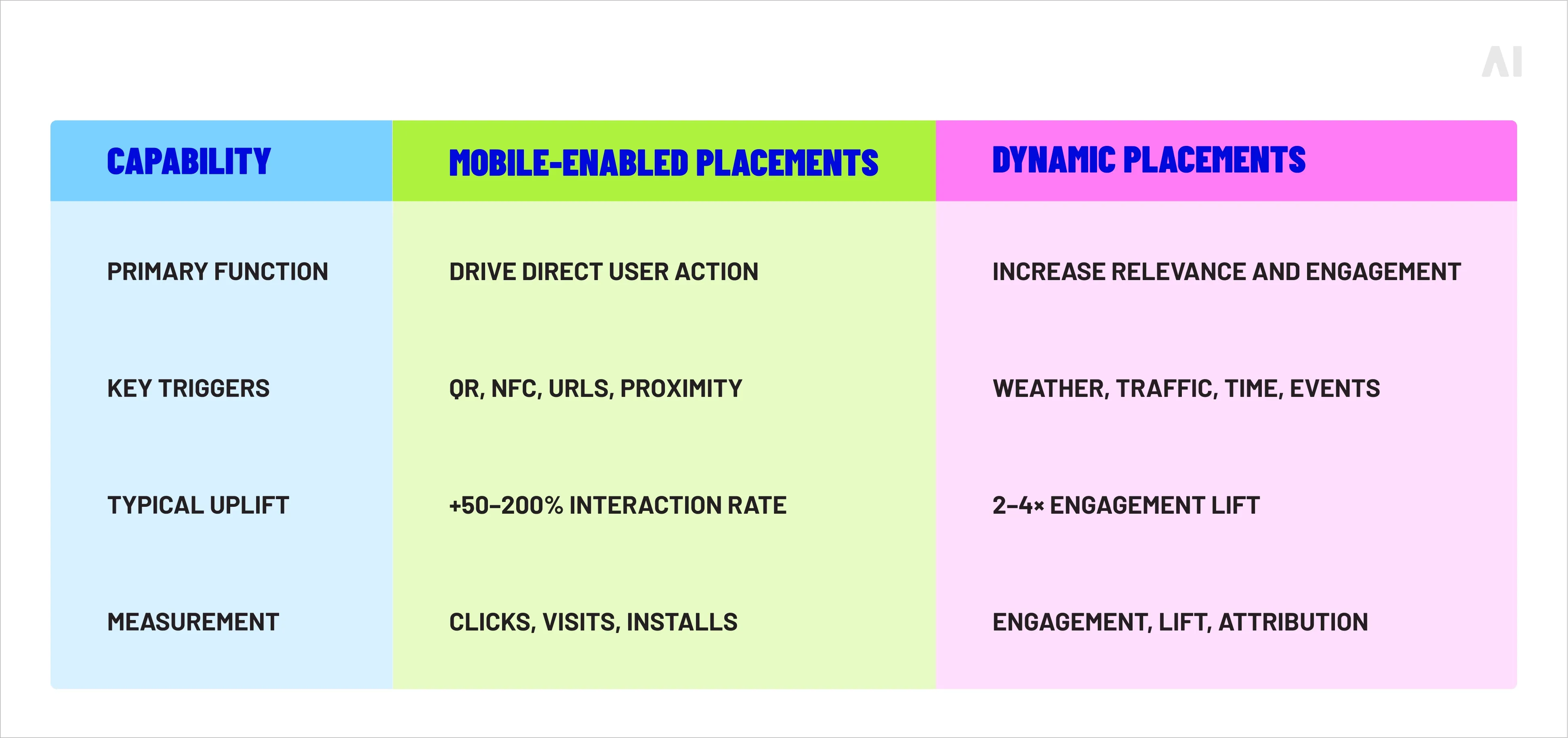
💡The result is transit media that behaves like digital while keeping physical impact. Instead of broadcasting one message to everyone, mobile-enabled and dynamic transit formats operate as responsive systems, adapting to city movement and feeding real-world behavior back into campaign measurement. This makes them especially effective for performance-driven goals, where attribution, optimization, and real outcomes matter as much as reach.
Transit advertising vs DOOH: where digital transit fits
Digital transit advertising is a specialized subset of DOOH, built for movement, repetition, and location context. While DOOH broadly includes any digital screen in public spaces—such as malls, retail stores, airports, and roadside billboards—transit advertising focuses specifically on people in motion, following predictable routes multiple times per week.
{{26-Digital-Transit-Advertising-2="/tables"}}
- The key difference is repetition driven by routine. A commuter may pass the same station, platform, or bus route 5–10 times per week, often at the same times of day. This creates automatic frequency without additional media spend, a dynamic that most other DOOH environments cannot replicate. In contrast, many DOOH placements prioritize one-time exposure in high-traffic areas, where audiences are transient and less predictable.
- Digital transit is also uniquely optimized for location relevance. Screens are activated along routes that connect residential areas, business districts, universities, and retail zones, allowing campaigns to align messaging with where people are going, not just where they are. This movement-based context enables stronger performance for categories like retail, QSR, entertainment, mobility, and local services, where proximity and timing directly influence outcomes.
💡From a planning perspective, digital transit provides continuity. Transit inventory delivers sustained exposure over days or weeks, reinforcing brand memory and improving recall rates, while still benefiting from DOOH capabilities such as programmatic buying, dynamic creative, and location-based measurement.
Why digital transit works: reach, data, and real-world attention
Digital transit advertising performs because it aligns three forces most digital channels struggle to combine at scale: real-world attention, movement-based data, and cost-efficient reach. Instead of competing for fragmented screen time, it operates inside daily routines where exposure is repeated, contextual, and measurable.
High-attention commuter environments
Transit environments capture attention when people are least distracted by choice. Commuters aren’t scrolling endlessly or skipping content; they’re waiting, riding, or moving through space. Average dwell times range from 5–15 minutes in stations and 15–45 minutes in vehicles, creating sustained exposure that online formats rarely achieve.
⚡️This matters because attention—not impressions—is what drives growth, yet most digital metrics still overvalue reach and clicks. As explored in AI Digital’s analysis of misleading performance signals, inflated online metrics often hide stagnating real impact. Transit cuts through that noise by delivering visible, unavoidable exposure that correlates more strongly with recall and brand lift.
Location-driven relevance at scale
Digital transit campaigns are activated based on where people are and where they’re going. Screens can deliver different messages by time of day, route direction, neighborhood, or proximity to retail and services, making relevance contextual rather than inferred.
At scale, this allows brands to align messaging with real-world intent—morning commuters, evening shoppers, weekend travelers—without relying on cookies or personal identifiers. The result is contextual targeting that remains privacy-safe while outperforming generic reach.
Cost-efficient reach beyond online saturation
Online media is increasingly expensive and crowded. CPMs for premium digital video have risen sharply, while attention has declined due to clutter and frequency caps. In contrast, digital transit often delivers 30–50% lower CPMs than premium online video, with built-in repetition driven by routine movement.
Because commuters encounter the same screens multiple times per week, brands achieve effective frequency without paying repeatedly for the same user, improving cost efficiency and reducing waste.
Neighborhood-level and route-based exposure
Transit advertising operates at a geographic resolution digital channels struggle to match. Campaigns can be planned around specific neighborhoods, corridors, or transit routes, making them especially effective for retail, QSR, entertainment, and local services.
When paired with addressable geofencing, transit exposure can be reinforced with mobile follow-ups or measured against post-exposure movement. This route-based logic allows advertisers to control not just who sees the message, but where and how often it appears within the urban fabric.
⚡️The AI Digital guide, What Is Addressable Geofencing? How It Works + Benefits, breaks down how geofencing layers integrate with DOOH and transit inventory, how zones are defined and activated in real time, and how advertisers use this framework to improve local relevance, frequency control, and performance measurement—without relying on personal identifiers.
Message reinforcement through daily movement
Repetition is not accidental in transit. A typical commuter may pass the same station or vehicle display 5–10 times per week, often at the same times of day. This creates consistent message reinforcement that strengthens memory encoding and brand association.
Unlike digital retargeting, which can feel intrusive or random, transit repetition feels natural because it mirrors daily life. Over time, this builds familiarity, trust, and recall, turning simple exposure into durable brand presence.
💡Together, these factors explain why digital transit works: it reaches people at scale, uses real-world data instead of assumptions, and earns attention through presence rather than interruption.
Measuring success in digital transit advertising
Measuring digital transit advertising requires shifting focus from surface-level metrics to real-world outcomes. Because transit campaigns operate in physical environments, success isn’t defined by clicks alone—it’s defined by exposure quality, movement, and behavior after exposure.
💡Modern transit measurement frameworks combine DOOH delivery data with location intelligence to show what actually changed because the campaign ran.
At the foundation are verified delivery metrics. These include impressions based on screen play-outs, dwell time, and modeled opportunity-to-see (OTS). Unlike many online metrics, these signals are grounded in physical presence and repeat exposure.
The next layer is real-world impact measurement. Using privacy-safe mobile location data, advertisers can analyze foot traffic lift, comparing exposed audiences to control groups that were not exposed to the campaign. This makes it possible to measure outcomes such as store visits, venue attendance, or neighborhood movement, often revealing 5–20% visitation lift depending on category, location, and creative.
⚡️A deeper explanation of this methodology is covered in our guide, Foot Traffic Attribution: Measuring Real-World Impact in a Privacy-First Era.
Crucially, digital transit success is evaluated through the right KPIs—not inherited digital ones. Click-through rates and last-touch attribution often understate the value of high-attention, offline media. Instead, transit campaigns are assessed using metrics such as incremental reach, effective frequency, brand lift, mobility lift, and cost per visit. These indicators better reflect how exposure in transit environments influences awareness, consideration, and action over time.
⚡️AI Digital’s breakdown of modern performance frameworks explains how to align measurement with business outcomes rather than vanity metrics.
The result is a measurement model built for reality, not proxies. By combining verified delivery, location-based attribution, and outcome-driven KPIs, digital transit advertising can be optimized with the same rigor as digital channels—while capturing value that online-only metrics routinely miss.
AI-powered digital transit campaigns with AI Digital
AI Digital applies AI-native infrastructure to make digital transit campaigns smarter, more efficient, and fully measurable at scale. Instead of treating transit as static inventory, campaigns are built on three interconnected systems—Smart Supply, Open Garden, and Elevate—that align planning, activation, and optimization with real-world movement.
- Smart Supply is the foundation. It focuses on inventory quality over raw volume, selecting transit screens based on real audience density, dwell time, route repetition, and contextual relevance. Rather than buying every available screen, digital media buying platform prioritizes placements that deliver predictable frequency and sustained attention, reducing wasted impressions and improving CPM efficiency — often by 20–40% compared to broad, untargeted buys.
- Open Garden ensures campaigns operate in a transparent, interoperable ecosystem. Transit inventory is activated programmatically and connected to location data, measurement partners, and downstream channels without locking advertisers into closed platforms. This allows brands to plan digital transit alongside CTV, mobile, and retail media, while maintaining visibility into delivery, pricing, and performance signals. The result is cross-channel consistency without sacrificing control.
- Elevate is the optimization layer. Powered by AI-driven analysis, Elevate continuously evaluates exposure patterns, movement data, and outcome signals—such as visitation lift or route-level performance—to refine delivery in real time. Budgets can be shifted toward higher-performing routes, time windows, or neighborhoods, improving results while campaigns are live rather than after they end. In practice, this leads to stronger lift, tighter frequency control, and faster learning cycles.
Together, Smart Supply, Open Garden, and Elevate turn digital transit advertising into a dynamic performance system—one that plans with intelligence, executes with transparency, and optimizes based on real-world behavior. This is how AI Digital helps brands move beyond exposure and unlock measurable impact in the flow of everyday urban life.
Conclusion: Why digital transit belongs in modern media strategies
Digital transit belongs in modern media strategies because it solves a problem most channels now struggle with: how to reach real people, in the real world, with measurable impact—at scale. It captures attention in environments defined by routine and repetition, uses location and movement data instead of guesswork, and delivers outcomes that go beyond impressions. In an era of signal loss, rising CPMs, and fragmented attention, digital transit offers something increasingly rare: predictable exposure, contextual relevance, and accountable measurement.
If you’re looking for a practical framework, here’s a transit-focused checklist teams can actually use:
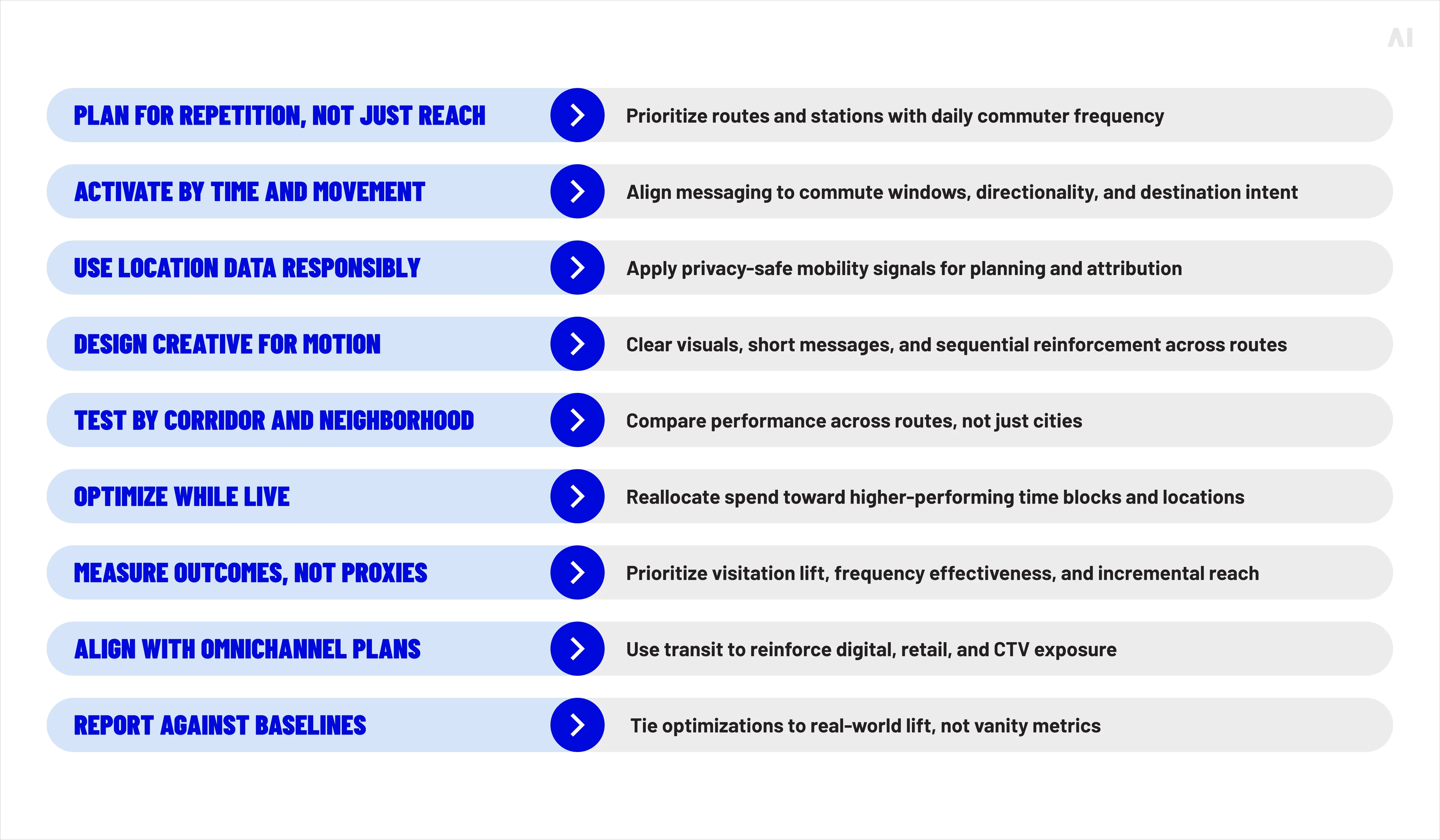
Adopt these practices, and digital transit stops being “out-of-home.” It becomes a data-driven media layer that earns attention, reinforces memory, and delivers measurable growth where people actually live their lives.
If you want help building or optimizing a digital transit strategy, AI Digital supports brands through Smart Supply, Open Garden, and Elevate—combining quality inventory, transparent activation, and AI-driven optimization to align transit media with your business goals. Get in touch to design a transit plan that works in motion, not just on paper.