

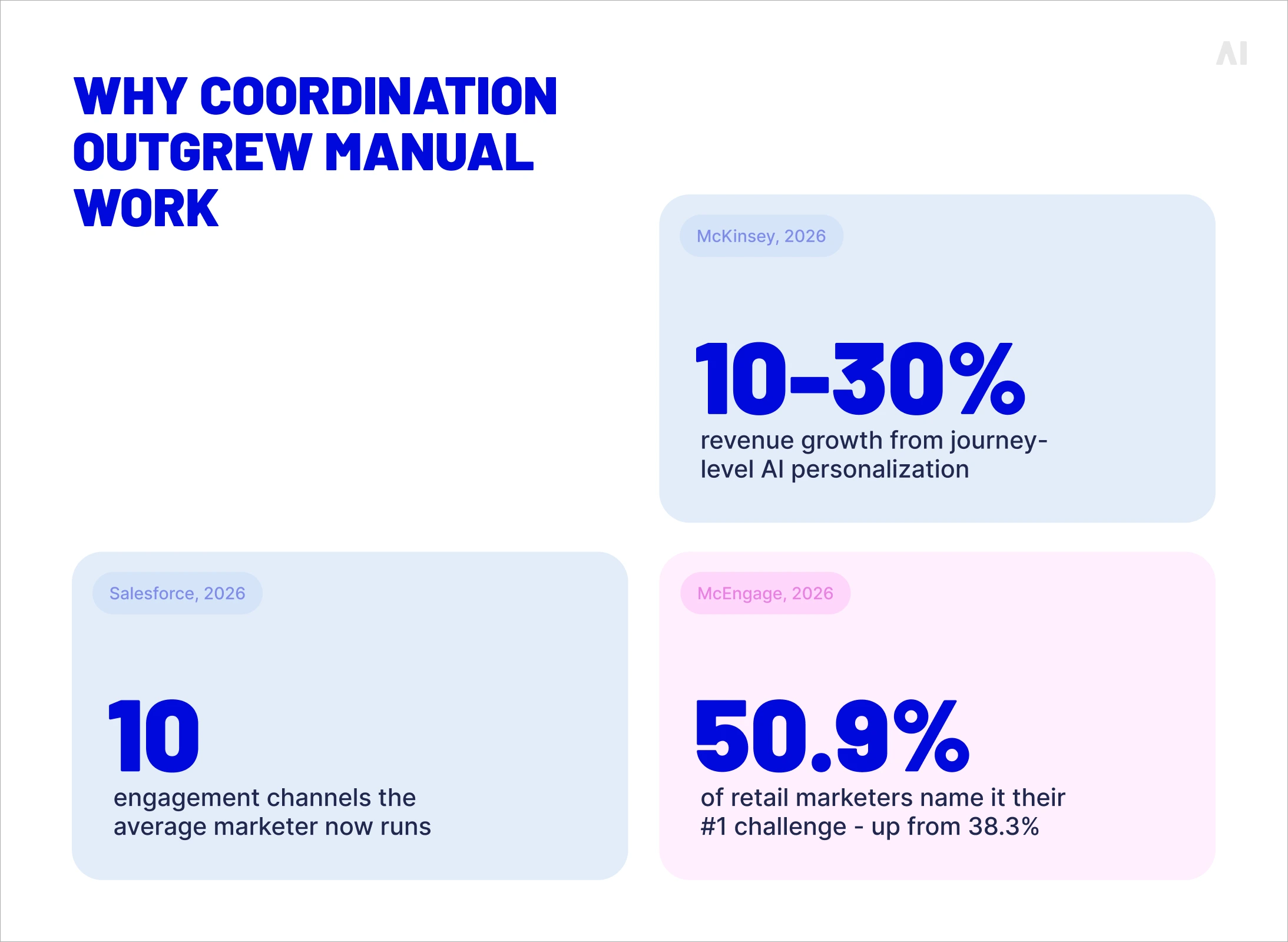
The typical B2C marketing team now juggles ten engagement channels at once, according to Salesforce’s 2026 marketing benchmarks. That figure understates the problem, because each channel comes with its own audience definitions, reporting language, billing cycle, and team. A campaign that runs across email, paid social, display, CTV, and the brand’s owned app is rarely one campaign at all. It is five coordinated efforts pretending to be one, held together by spreadsheets, weekly stand-ups, and the institutional memory of whichever marketing operations manager happened to set things up.
That arrangement worked when there were three or four channels to coordinate and customer expectations were closer to “I noticed your ad” than “you should already know what I bought yesterday.” It does not work now. The volume of customer signals, the speed at which they accumulate, and the variety of channels in which they need to be acted on have outstripped what human coordination can manage at the scale modern marketing demands.
AI-powered cross-channel marketing platforms emerged to close that gap. They combine customer data, automation, analytics, personalization, and predictive intelligence into systems that decide and execute together — not perfectly, not without supervision, but at a pace and breadth no marketing operations team can reproduce manually. Treated well, they are not a replacement for marketing strategy. They are the layer that makes strategy executable across more channels than people can hold in their heads at once.
The argument that follows is structured in three parts.
- The first looks at what cross-channel marketing solutions actually are and where their limitations sit.
- The second covers the specific ways AI improves cross-channel performance — segmentation, orchestration, personalization, allocation, forecasting.
- The third moves to where the category is going next: the separation between execution-focused and intelligence-focused platforms, and the architectures that high-performing organizations are building by combining both.
What are cross-channel marketing platforms?
A cross-channel marketing platform is software that coordinates audience signals, customer data, and outbound messaging across two or more marketing channels under shared logic. The category is broad — it includes customer data platforms, marketing automation suites, journey orchestration tools, customer engagement platforms, and various hybrid products that combine elements of all four — but the unifying feature is coordination.
- A channel-specific tool runs one channel well.
- A cross-channel platform makes several channels behave like parts of the same thing.
That distinction sounds technical until you watch how a customer experiences the difference. A buyer who abandons a cart in a brand’s app, opens a remarketing email two hours later, clicks through to a product page, then sees a display ad for the same product the next morning is interacting with one journey. To the buyer, all of those moments are connected by their own intent. To most marketing stacks, they are four disconnected events in four disconnected systems. A cross-channel platform exists to compress those four events into the single journey they actually represent, and to make decisions about what happens next based on the whole sequence rather than the most recent click.
The economic case for that compression is straightforward.
- Channels run in isolation duplicate audiences, contradict each other in messaging, and produce reports that no one can reconcile.
- Channels run with shared data, shared logic, and shared sequencing tend to do the opposite.
The cost difference is rarely cosmetic.
Cross-channel marketing vs multichannel marketing
The terms get used interchangeably. They should not be.
- Multichannel marketing describes presence — a brand running activity across email, paid social, search, display, CTV, push notifications, direct mail, and a physical retail estate is multichannel by virtue of operating in many places at once. It says nothing about whether those channels talk to each other or whether decisions in one are informed by behavior in another. Multichannel is an inventory of where you are. It is satisfied by simply showing up.
- Cross-channel marketing describes coordination. A brand doing genuinely cross-channel work uses the same customer data to make decisions in email and on its app; suppresses recently converted customers from acquisition ads on the open web; sequences messaging so that a buyer in the consideration phase sees different creative than one in the loyalty phase, regardless of which channel they are encountered on. The defining test is whether information flows between channels — whether the email platform knows what the buyer just did in the app, whether the ad platform knows the buyer has already converted, whether the CRM knows the buyer responded to the latest campaign.
Many brands describe themselves as cross-channel when they are still operating multichannel. The difference shows up in performance: in retention rates, in repeat purchase frequency, in the share of marketing spend reaching customers who are no longer in the addressable audience. The first is a presence problem; the second is a coordination problem; only the second improves with better technology.
💡 Related read: Integrated marketing vs omnichannel marketing.
Why disconnected channels create performance problems
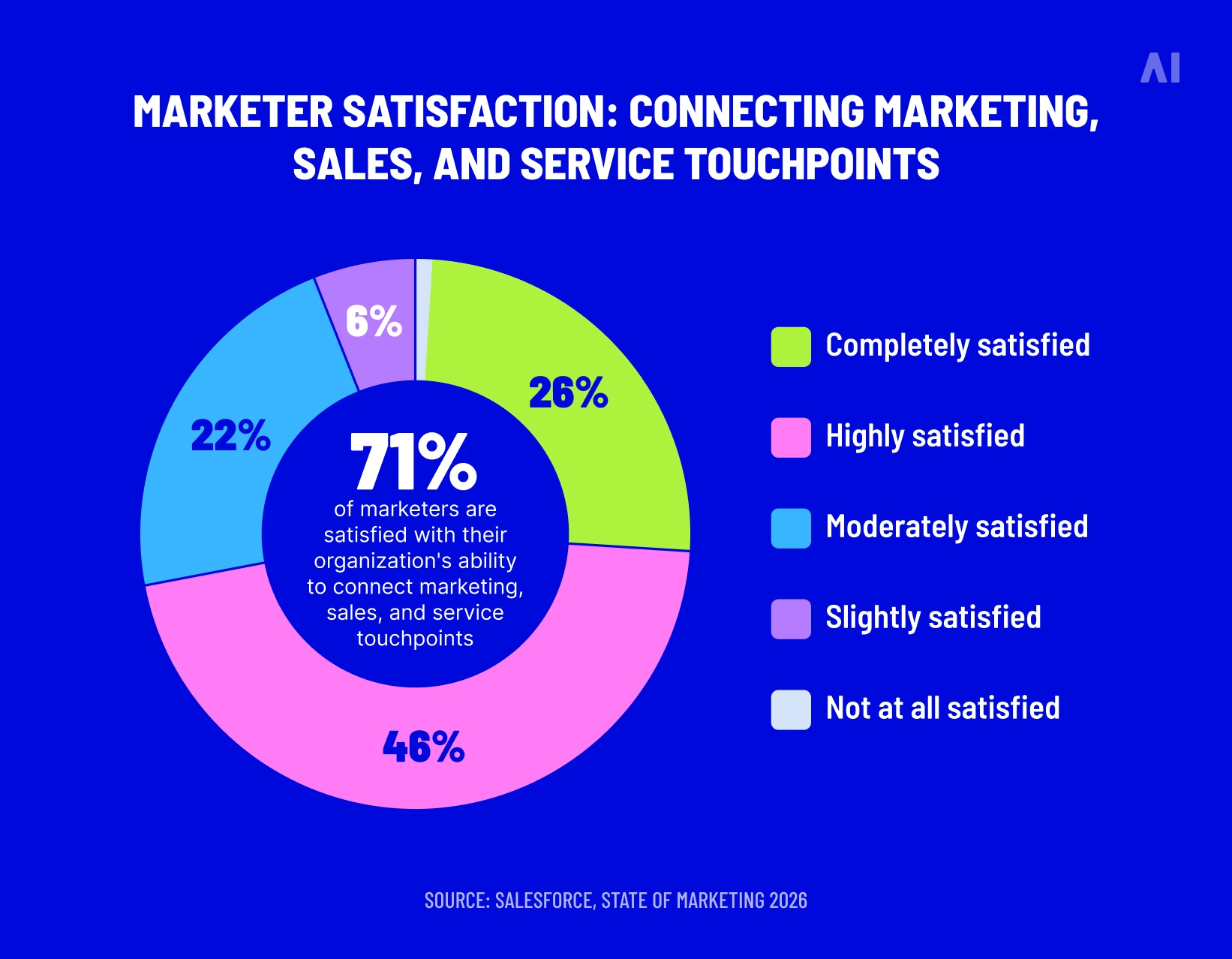
The cost of running channels in isolation is now measurable enough that marketing operations leaders bring it up unprompted. In MoEngage’s 2025 State of Cross-Channel Marketing in Ecommerce and Retail report, 50.9% of retail and ecommerce marketers named effective cross-channel communication as their single biggest challenge — up sharply from 38.3% the year before. The year-on-year acceleration is the more telling figure than the absolute number. Cross-channel coordination has become harder, not easier, even as the tools meant to fix it have proliferated.
Three categories of damage show up most consistently when channels run apart.
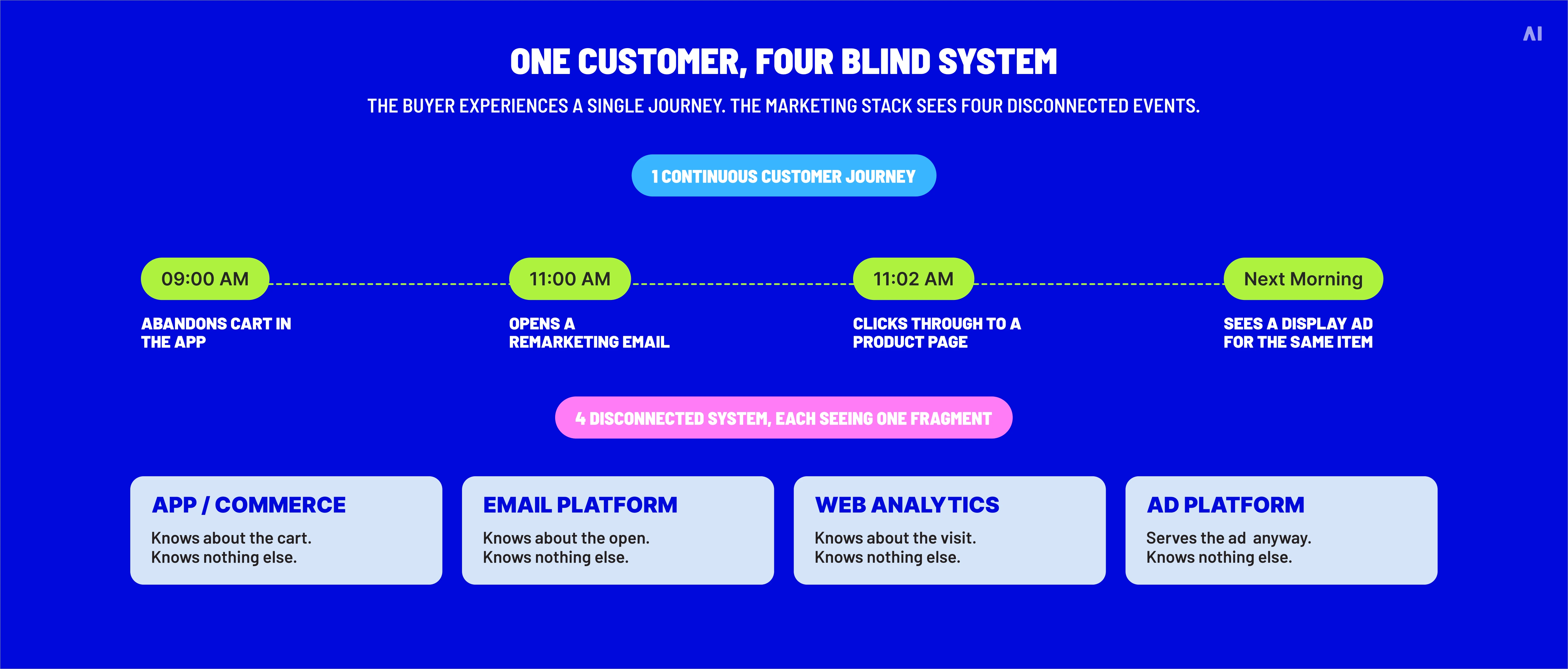
- Customer data fragments by source rather than by customer. Email data lives in the ESP, behavioral data in the analytics platform, transactional data in commerce, identity data in the CRM, and ad exposure data inside each of the ad platforms. No system has a complete view, so every system makes decisions on a partial one. Targeting suffers because audience definitions don’t match across platforms. Segmentation suffers because the segments don’t agree on who belongs in them.
- Messaging falls out of sync. A customer who converted yesterday should not receive an acquisition email today, but if the email platform doesn’t know about yesterday’s conversion, it sends the email anyway. A buyer who clicked a remarketing ad an hour ago should not be served the same ad fifteen more times that day, but if the display platform doesn’t share frequency caps with the wider stack, the over-saturation happens. The customer experiences this as a brand that isn’t paying attention. The brand experiences it as a campaign that converts less than expected for no obvious reason.
- Reporting becomes unreconcilable. Each platform reports the metrics it owns. Email reports email opens. Paid social reports social conversions. The ad platforms each report on the credit they assign themselves. No platform reports on the customer journey as a whole, because no platform has access to the whole journey. The result is a stack that produces twenty dashboards and zero answers.
{{ccm-1}}
Why AI became essential for cross-channel marketing
Cross-channel marketing was always hard. What changed is that it stopped being humanly manageable. AI moved from optional to structural because the workload it now handles is workload no team can do in real time, at the scale the modern customer journey demands.

Customer journeys became too complex
The Salesforce figure — ten engagement channels per marketer on average — is one snapshot of the wider trend. Add the device proliferation underneath it (phone, laptop, tablet, smart TV, voice assistant, in-store), the session fragmentation across them, and the rising customer expectation that brands recognize all of it, and the picture is one in which a single buyer can produce dozens of relevant signals per week that the brand could, in theory, act on.
In theory is the qualifier. The signals exist. Acting on them in time, at scale, and across the right channels requires automation, because the alternative is a marketing operations team large enough to triage them by hand — which no organization, however well-resourced, actually has. AI’s role here is operational. It manages the volume and velocity of signal-to-action coordination that human teams used to manage when there were three or four channels and a week or two of decision time. Now there are ten, and the decision time is measured in minutes.
Personalization at scale
Personalization is the term marketers use for the work AI does when it tailors content, offers, sequencing, or timing to a specific customer rather than a broad segment. The case for it is strong: McKinsey’s April 2026 research on agentic marketing workflows found that organizations implementing AI-driven personalization at the journey level can expect revenue growth in the range of 10 to 30 percent from the hyperpersonalized portion of their marketing.
"Marketing is no longer confined to campaigns and channels.” — McKinsey, Reinventing marketing workflows with agentic AI, April 2026.
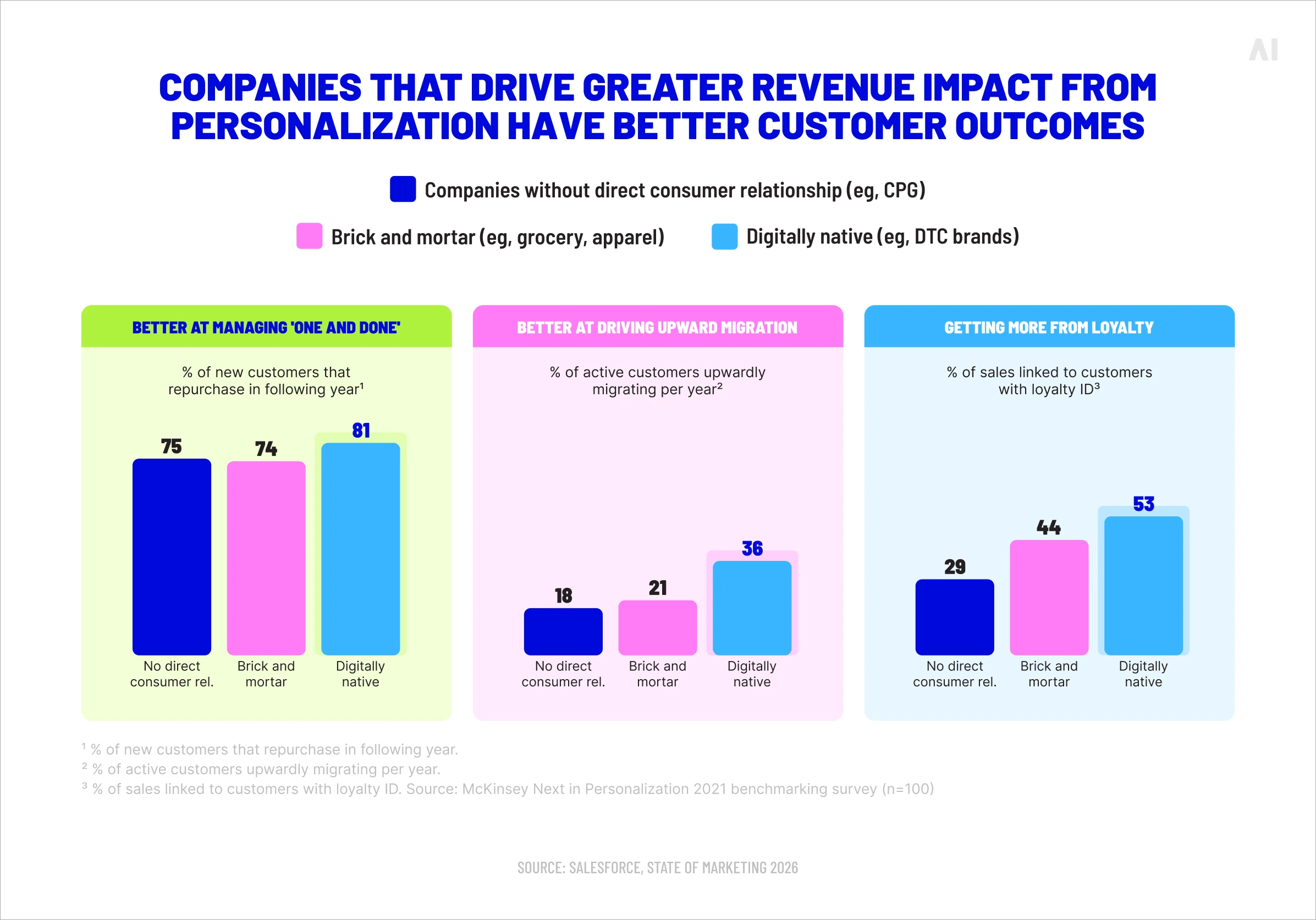
The cross-channel framing here is what changes the meaning of “personalization.” Personalization that works only inside email — better subject lines, better timing, better content blocks — is not personalization in any meaningful sense; it is channel-level targeting with extra steps. Real personalization requires the same intelligence to inform decisions in email, on the website, in the app, in display, in CTV, and in CRM-driven outbound. The lift compounds only when the customer’s behavior in one channel changes what the brand does in the others. Otherwise, the brand has just made each channel marginally smarter at being itself.
Real-time decision making
The third reason AI became essential is timing. Customer behavior is now responded to in the time it takes a buyer to move between two screens, not the time it takes a marketing team to convene a meeting. A cart abandoned at 9am cannot be productively re-engaged at 9pm the same evening; the buying intent has decayed too far. A buyer who has opened the app twice in five minutes is signaling something the brand should respond to immediately, not in the next scheduled email send.
Manual decision workflows — the if-this-then-that flowcharts that marketing automation has used for two decades — were built for slower problem spaces. They do not, by themselves, scale to the number of behaviors a modern customer can produce in a day or the number of channels in which a brand might respond. AI-driven real-time decisioning is what closes that gap: it processes the behavior, ranks the available responses, picks the best one given the customer’s context, and triggers it through whichever channel is best suited to deliver it. Without that layer, marketing teams either over-respond (saturating customers with whatever rule fired first) or under-respond (saving the slowest channels for moments where speed actually counted).
How AI improves cross-channel marketing performance
There are five places where the lift from AI shows up most reliably in cross-channel work. Each can be implemented partially; each compounds when the others are also in place.
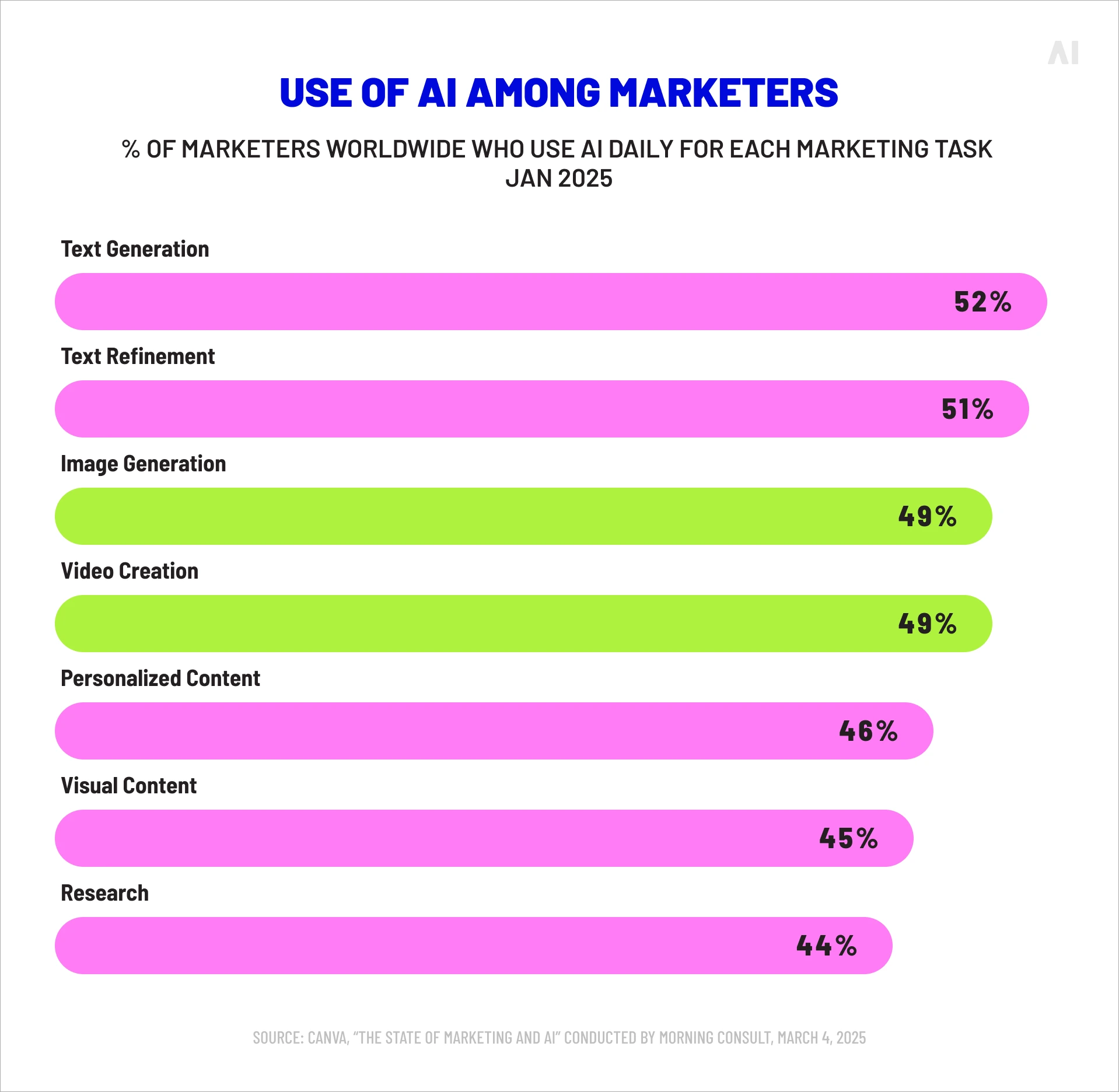
Audience segmentation and targeting
Segmentation used to mean defining a half-dozen broad segments by hand — high-value customers, lapsed buyers, recent acquisitions — and routing campaigns to them with relatively static rules. AI changes the granularity.
- Predictive segmentation builds groups based on likely future behavior rather than past attributes, which means the segments update continuously as customer behavior changes.
- Propensity scoring ranks individual customers by their likelihood of converting, churning, upgrading, or responding to a specific offer.
- Lookalike modeling extends those scores to prospects whose behavioral signatures resemble high-value existing customers.
- Dynamic audience management keeps the segments synchronized across channels, so a customer who moves from “active” to “at-risk” in the CRM is immediately treated that way in email, paid media, and on-site experiences alike.
The cross-channel value is in the synchronization rather than the segmentation itself. Static segments managed across five platforms diverge within weeks; AI-managed segments do not, because the same model is informing every channel at once.
Journey orchestration
Journey orchestration is the work of choosing the next-best message and the next-best channel for a given customer based on what they have done and what they are likely to do next. The traditional version of this is a journey builder — a visual flowchart where marketing operations encodes rules: if the buyer opened email A, send email B; if not, wait three days and send email C.
AI-driven orchestration replaces the flowchart with a model. The model evaluates the customer’s full history, ranks the available next actions across all channels, and selects the one most likely to produce the desired outcome. The decision is not what marketing operations would have hard-coded; it is what the data says works for customers who resemble this one. The advantage is largest in journeys complex enough that no person could have anticipated every branch — which, in cross-channel work, is most of them.
Personalization and recommendations
Content recommendations, product recommendations, and dynamic creative optimization are the three places where AI most visibly affects what customers actually see. Each has a relatively well-developed track record on its own; the cross-channel addition is consistency. A product recommendation surfaced to a customer on the website should not contradict the offer they received in email an hour earlier or the ad they were shown last night. Maintaining that consistency requires the recommendation engines to share state across channels — a piece of plumbing that AI-powered cross-channel platforms are built to provide and that channel-specific tools, by definition, cannot.
Budget allocation and optimization
AI shifts budget across channels based on performance signals and predictive insight, faster than any quarterly planning cycle can. The lift is largest when the shift moves money between channels rather than within them. Within-channel optimization (improving paid social efficiency, for example) is well-understood and largely solved. Cross-channel reallocation (moving budget from paid social to CTV mid-campaign because the predictive model says CTV will compound better for this audience) is where AI’s lift over manual planning is largest, and where most organizations still leave value on the table.
Forecasting future performance
Predictive analytics underpin planning. Demand forecasting tells the team what to expect; scenario modeling tells them what would happen under different budget allocations or channel mixes; performance forecasting tells them where the next quarter’s spend is most likely to convert. None of these are new disciplines, but AI has changed both the accuracy and the cost of doing them well. What used to require a dedicated analytics team running spreadsheets now runs as a layer inside the marketing platform, available to anyone making the decision.
💡 Related read: Retail forecasting.
Key capabilities of modern cross-channel marketing solutions
Once the strategic case is settled, the practical question becomes what to look for. Four capabilities recur across the platforms that high-performing organizations actually use.
Unified customer profiles
Identity resolution — the work of linking fragmented customer records into a single profile — is where most cross-channel platforms begin. A customer data platform consolidates first-party data from CRM, website, app, email, commerce, and offline sources, deduplicates against shared identifiers, and produces a unified profile that other systems can act on.
Adoption has moved past pilot stage: a Gartner survey of marketing analytics and technology leaders, reported in 2025, found that 68% of respondents’ organizations had a CDP in place, with another 18% in active deployment. That penetration changes what cross-channel platforms can assume. They no longer need to build the unified profile themselves; they need to integrate cleanly with the CDP that already produces one.
Marketing automation
Workflow automation, triggered campaigns, and lifecycle programs are the operational backbone of any cross-channel platform. The question is no longer whether to automate but how — whether the automation is rule-based or model-based, whether it operates within a single channel or coordinates across multiple, whether it can be overridden or audited when something goes wrong. The trend, slowly, is from rules toward models — fewer hard-coded “if X then Y” workflows, more AI-driven decisions chosen from a wider candidate set. Both still have a place; the right mix depends on how mature the team’s data foundation is.
Analytics and measurement
Attribution, journey analytics, and conversion tracking sit inside almost every cross-channel platform. The depth varies. Some platforms report what they ran and stop there. Others extend to journey-level analytics, multi-touch attribution, and feeds into marketing mix modeling. The platforms that do the latter are easier to defend to a CFO at the end of the year, because the reporting reflects business outcomes rather than channel-level vanity metrics. Choosing well at this layer determines how visible — and how questionable — marketing performance becomes downstream.
💡 Related read: Unified marketing measurement: what it is and why it matters.
AI-powered insights
Anomaly detection, predictive modeling, trend identification, and automated recommendations sit on top of the analytics layer rather than replacing it. They surface what the team would not have looked for on its own — an unusual drop in engagement among a high-value segment, an unexpected lift from a creative variant in one channel that has not yet been tested in the others, an early signal that a campaign is going to under-deliver against its target. The value is largest when the insights connect to the systems that can act on them, which means the AI is most useful inside the platform rather than as a separate dashboard team members open occasionally.
Common challenges cross-channel platforms cannot solve alone
The case for cross-channel platforms is strong enough that they sometimes get sold as solutions to problems they cannot, on their own, fix. Three of those problems are worth naming directly.
Poor data quality
A cross-channel platform inherits whatever data quality the systems feeding it possess. If the CRM is full of duplicate records, the platform will personalize against duplicate identities. If the analytics layer attributes conversions inconsistently, the platform’s optimization model will learn the inconsistency. If the customer data has gaps — missing consent flags, incomplete behavioral histories, inconsistent timestamps — the AI will produce confident-looking decisions on a foundation that does not justify the confidence. Organizations that invest in cross-channel platforms before the underlying data is clean tend to get faster, more visible versions of the problems they already had.
Fragmented measurement systems
A connected execution layer does not, by itself, produce connected reporting. Many organizations integrate their email platform, paid media tools, and CRM into a single cross-channel suite and still produce three different reports on what happened last week, because the measurement layer sits in a separate environment using separate definitions. Closing that gap is a measurement problem, not a platform problem. It requires standardized KPIs, shared identity across reporting systems, and analytics that work on journey-level data rather than channel-level data.
Overreliance on platform algorithms
Every major marketing platform now ships with AI built in. That is a real upgrade — the algorithms work, often well — but it has a structural limit. A platform’s native AI optimizes within the platform’s worldview: its own measurement definitions, its own inventory access, its own incentives. It cannot make decisions that contradict the platform’s commercial interests, because it does not see the alternatives. A demand-side platform’s bidding AI cannot recommend switching to a different demand-side platform. An ESP’s send-time optimization cannot recommend that the team move the budget into paid media. The optimization is local, even when the team is making decisions that need to be cross-channel.
That ceiling is why human oversight remains structurally necessary, and why a separate intelligence layer — sitting above the execution platforms, looking at all of them at once — has become the missing piece in most cross-channel architectures.
💡 Related read: Black box AI in marketing: risks and limitations.
⚡ Cross-channel marketing platforms execute well within their own boundaries. The work that crosses those boundaries — comparing platforms, allocating across them, judging which is performing — sits outside what any single platform can be asked to do for itself.
Cross-channel marketing platforms vs marketing intelligence platforms
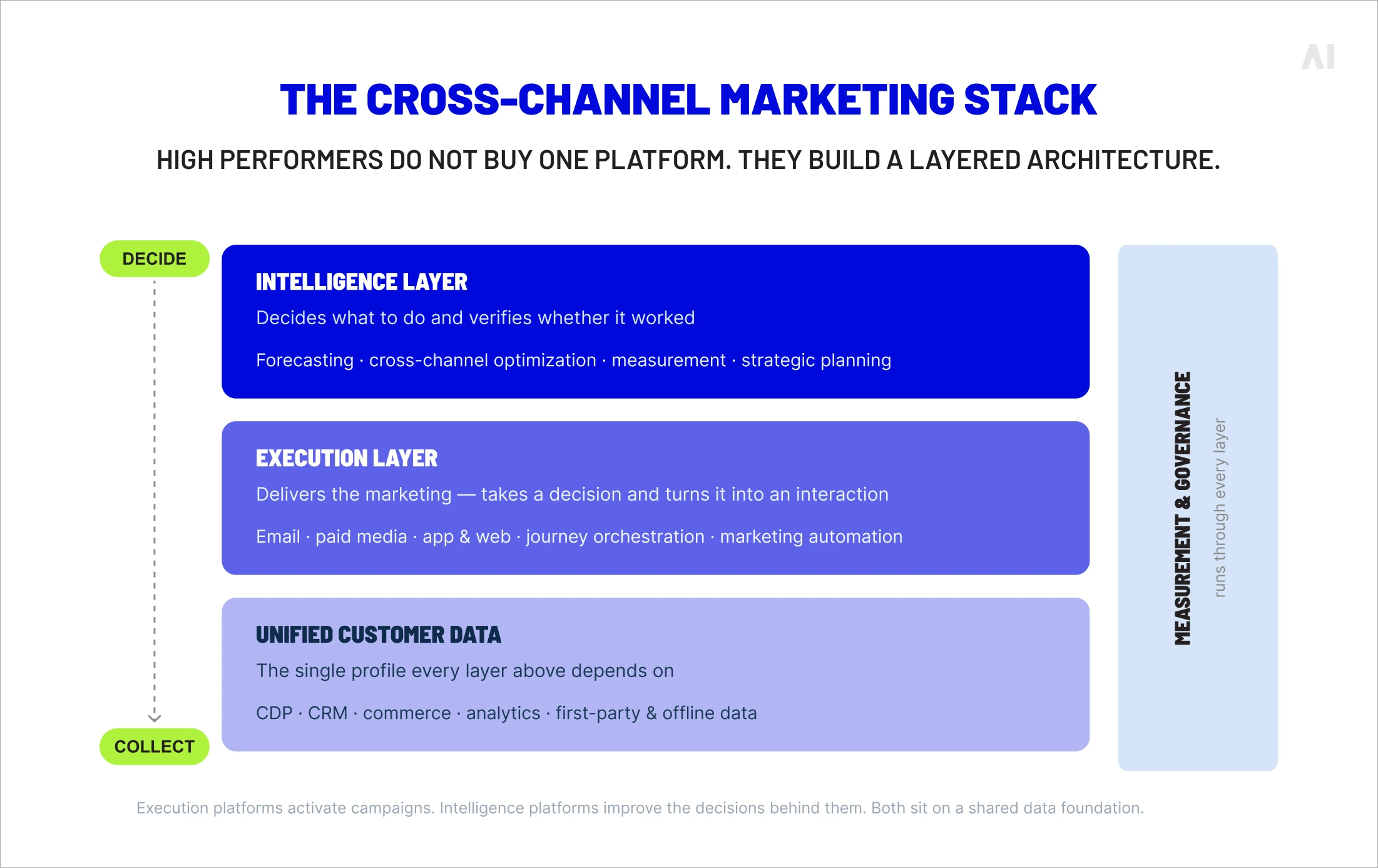
The category split now emerging in the marketing technology market separates execution from intelligence. The two categories are not in competition; they sit at different layers of the stack, do different work, and increasingly need each other.
Execution platforms activate campaigns
Execution platforms are the systems that send the email, serve the ad, push the notification, and render the personalized hero image. The category includes customer data platforms (which unify the data), marketing automation platforms (which sequence the messaging), journey orchestration tools (which coordinate the next-best-action decisions), email service providers, ad platforms, and the long tail of channel-specific delivery tools. Their primary job is to act — to take a decision and turn it into a customer interaction. They answer the question “how do we deliver this message?”
The good execution platforms do this very well. They handle high-volume sends, real-time decisioning, identity resolution, channel-specific formatting, and the operational work of getting marketing into market. They are, structurally, where most marketing spend is operationalized.
Intelligence platforms improve decisions
Marketing intelligence platforms are a newer category, sitting above the execution layer rather than alongside it. Their primary job is not delivery but decision support — forecasting, optimization, measurement, planning. They answer the question “what should we do, and how do we know it worked?”
The cleanest example is the work of allocating budget across multiple execution platforms. An intelligence platform that ingests data from all of them — every DSP, every ESP, every channel — can compare their performance on shared terms, recommend reallocations, and verify outcomes against business KPIs rather than channel-reported metrics. No execution platform can do that for itself, because no execution platform has visibility into the others.
The distinction also shows up in who uses the tool.
- Execution platforms are operated by campaign managers, channel specialists, and marketing operations teams.
- Intelligence platforms are used by media strategists, analytics leads, and the CMO’s office — the people whose work is to decide what marketing should do, not how to deliver it.
⚡ Execution and intelligence are not two ways of doing the same job. They are two different jobs that high-performing marketing organizations now staff and budget for separately.
{{ccm-2}}
Building a connected cross-channel marketing ecosystem
High-performing organizations rarely solve cross-channel performance by buying one platform. They build a layered architecture: customer data at the bottom, execution platforms in the middle, intelligence platforms on top, with measurement and governance woven through. Four characteristics show up consistently in those architectures.
Connected measurement and reporting
The reporting layer is where most cross-channel architectures either prove their worth or quietly undermine it. Connected measurement means that performance data from every execution platform flows into a single environment, identity is reconciled across them, and the KPIs reported back to the business reflect the customer journey rather than the platforms that contributed to it. Without that connection, marketing teams own a great deal of data and very little visibility — a paradox most CMOs will recognize from their own dashboards.
Open and interoperable ecosystems
Interoperability — the ability for the tools in a marketing stack to exchange data, decisions, and audience signals without being locked to a single vendor — has become a procurement criterion in its own right. The reason is partly defensive: businesses that build their cross-channel architecture inside one vendor’s ecosystem inherit that vendor’s roadmap, pricing power, and incentives. It is also strategic: interoperable architectures make it easier to add a better tool when one comes along, and easier to compare performance across vendors when none of them controls the measurement.
💡 Related reads: What is the Open Garden framework?.
Transparent media and performance optimization
Transparency at the media layer — supply path optimization, brand-safe inventory curation, fee visibility — protects the integrity of every measurement layer above it. If the data flowing into the cross-channel platform reflects opaque supply paths, redundant intermediaries, or inventory that does not match what was paid for, no amount of AI optimization downstream will recover the value lost upstream. The cleanest cross-channel architectures address this at the source: by curating supply directly, by working with partners who report what was bought, and by treating media transparency as a measurement prerequisite rather than a procurement preference.
AI-powered optimization and forecasting
The intelligence layer at the top of the architecture is where AI does its most consequential work: forecasting next quarter’s performance, modeling alternative allocations, identifying which channels are compounding and which are decaying, and generating recommendations that human strategists evaluate and approve. The category label that has begun to stick to this layer is marketing intelligence platform — software that connects the entire digital ecosystem rather than operating inside a single channel, and that produces decisions aligned with business KPIs rather than platform-reported metrics. Elevate sits in that category for AI Digital’s clients, combining research, planning, optimization, and reporting in one environment.
💡 Related read: AI in digital marketing.
How to choose the right cross-channel marketing platform
The evaluation question rarely starts with “which platform.” It starts with “what do we need this layer of the stack to do that the other layers cannot?” Once that is settled, five criteria do most of the differentiating work between candidate platforms.
Data integration capabilities
How cleanly the platform reads from and writes to the systems already in place — CDP, CRM, commerce, analytics, BI — determines how quickly it produces useful output. Native connectors, API openness, and identity portability are the practical tests.
AI and automation maturity
Whether the AI is genuinely model-driven or essentially rule-based dressed in AI language; whether it operates across channels or only within one; whether its recommendations are auditable when a marketing operations lead needs to defend a decision. The depth of AI varies more between platforms than the marketing copy suggests.
Measurement and reporting features
Journey-level analytics, multi-touch attribution, MMM support, and clean export pathways into the team’s existing BI environment. The reporting layer is where most cross-channel architectures either prove their worth or quietly undermine it.
Scalability and interoperability
Whether the platform plays well with the wider stack or imposes its own ecosystem. Composable, modular architectures tend to age better than monolithic ones, especially as AI capabilities advance and the rest of the stack changes around the platform.
Governance and privacy readiness
Consent and preference management, audit logging, regional data residency, and certified compliance with the regulatory frameworks the business operates under. IBM’s 2025 Cost of a Data Breach Report put the global average breach cost at $4.44 million, the highest figure on record. That number turns the governance criterion from a procurement checkbox into a business case. Treat governance as a primary criterion, not a final filter.
{{ccm-3}}
The future of cross-channel marketing performance
The direction the category is heading in is increasingly visible. Gartner’s 2026 marketing predictions suggest that AI agents will absorb a growing share of routine execution work — notifications, reorders, personalized guidance, lifecycle nudges — and in doing so will collapse traditional marketing technology architectures into more fluid, agent-driven systems. Marketing teams, in that future, will spend less time running campaigns and more time supervising the systems that run them.
The implications for cross-channel marketing performance are significant but not dramatic. AI agents do not change the underlying problem; they extend it. The same coordination challenges that cross-channel platforms emerged to solve — fragmented data, inconsistent messaging, broken measurement — will still need solving, only at higher speed and with less human intervention per decision. The teams that handle the transition well will be the ones whose data foundations, measurement infrastructure, and intelligence layers were already in place before agents arrived. The teams that try to fix the underlying problems with agents will find that the agents inherit the problems rather than solving them.
What is changing more visibly is the gap between organizations that have made the architectural investment and those that have not. That gap is widening. AI is making good marketing operations dramatically more efficient and exposing weaker ones more brutally.
Conclusion: Turn cross-channel marketing into a competitive advantage
High-performing organizations now treat cross-channel marketing as an architectural problem rather than a campaign problem.
- They invest in unified customer data because every downstream decision depends on it.
- They build connected measurement because performance that cannot be seen cannot be defended.
- They use AI for journey orchestration, personalization, optimization, and forecasting — but as a layer above their execution platforms, not as a replacement for the human strategic judgment that decides what the AI should optimize for.
- And they prefer interoperable ecosystems to single-vendor stacks because the durability of the architecture counts for more, over time, than the convenience of any single tool.
The competitive edge is not AI itself. It is how the AI is wired into the rest of the marketing stack — what data it sees, what decisions it is allowed to make, what measurement holds it accountable, what governance keeps it safe to scale.
AI Digital works with brands and agencies on each layer of that architecture.
- Our managed service handles cross-channel buying and optimization across paid search, social, display, CTV, audio, and native, with KPI optimization aligned to business outcomes rather than channel-reported metrics.
- Smart Supply provides supply curation, transparency, and supply path optimization that protect measurement integrity at the inventory layer.
- Elevate is our marketing intelligence platform, unifying research, planning, optimization, and reporting across the digital ecosystem in a single environment.
- The Open Garden framework is the strategic foundation underneath all of it: vendor-agnostic, interoperable, and built for cross-channel performance rather than single-platform convenience.
If improving cross-channel marketing performance is on your roadmap this year, get in touch.