Machine Learning in Advertising: How It Works and Where It’s Used


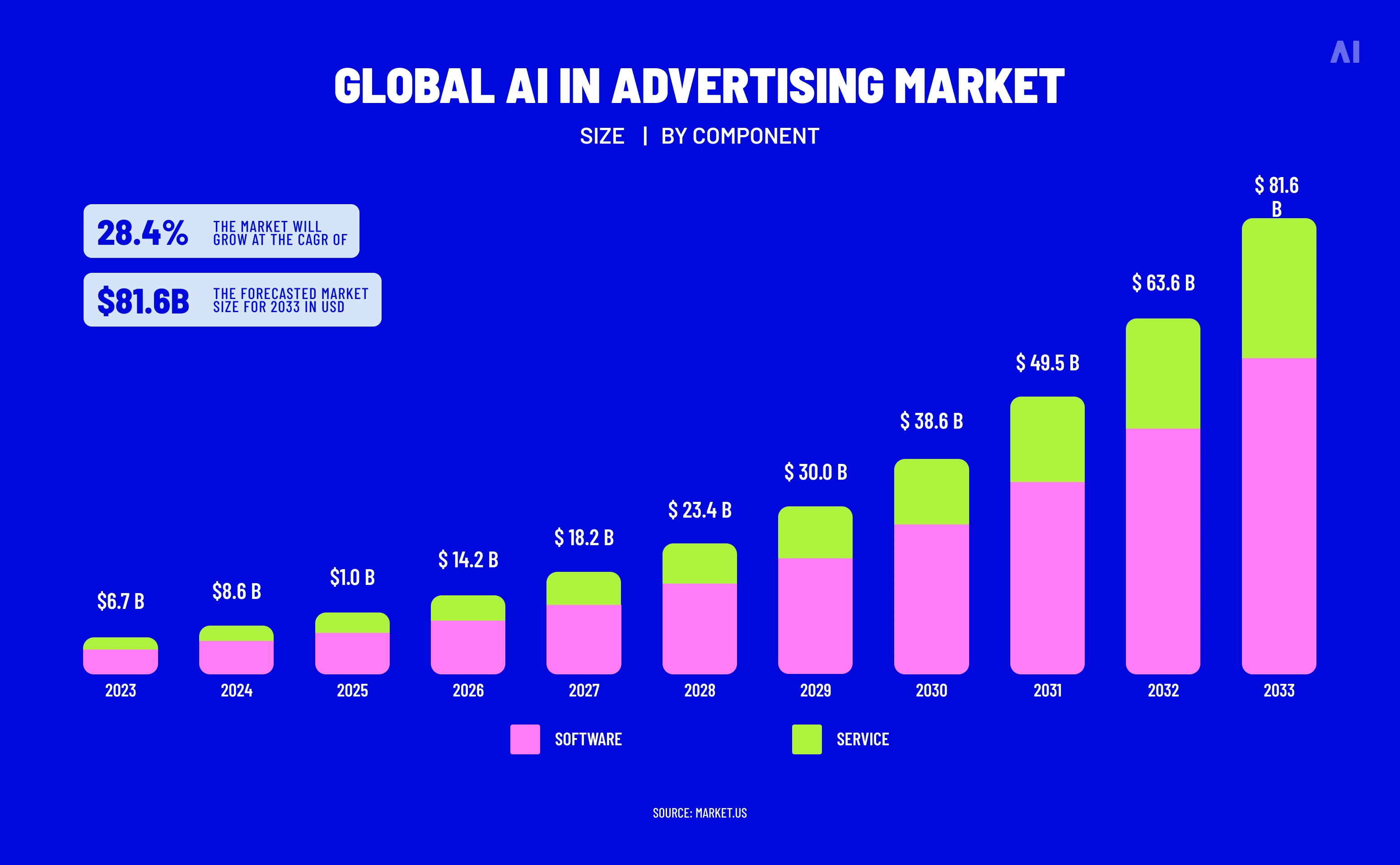
Machine learning in digital advertising is now part of the industry’s decision infrastructure. The IAB 2026 Outlook Study found that five of the six leading buyer focus areas were AI-related, with two-thirds of buyers focused on agentic AI for ad buying and campaign execution. As adoption expands, cross-platform measurement has risen from 64% to 72% as an advertiser priority.
Machine learning provides the predictive layer behind many automated decisions. Models evaluate historical outcomes and current signals to estimate response, conversion likelihood, impression value, or risk, helping advertising systems operate at a speed and scale manual workflows cannot match. Yet faster decisions create value only when they serve reliable data, clear objectives, and meaningful business outcomes.
This article explains how machine learning advertising works, where it creates value across the campaign lifecycle, how to incorporate it into strategy, and why privacy, measurement, guardrails, and human oversight remain essential.
TL;DR: Key Takeaways
- Machine learning turns advertising data into probabilities and value estimates that support decisions rather than guarantee outcomes.
- Its applications span the campaign lifecycle, including targeting, bidding, budget allocation, creative selection, measurement, forecasting, and fraud detection.
- Its advantage is selective decision-making at scale, allowing advertisers to evaluate more signals and adapt faster than manual workflows.
- Performance depends on the objective and evidence provided: unreliable data, weak KPIs, or poor guardrails can scale wrong decisions.
- Advertisers should test meaningful baselines and monitor drift, proxy optimization, privacy, and business outcomes rather than trust automation by default.
- AI Digital connects intelligence with action, aligning audience research, planning, optimization, reporting, and measurement with business goals.
What Is Machine Learning in Advertising?
Machine learning in advertising is the use of data-driven models to predict advertising outcomes and support decisions about audiences, impressions, bids, budgets, and creative delivery. Instead of relying entirely on fixed instructions created by marketers, these models identify patterns in historical data and apply those patterns to new advertising opportunities. This reflects the broader NIST definition of machine learning as computer systems that adapt and learn from data to improve accuracy.
In practice, a model may analyse campaign results, conversion events, contextual information, device type, time of day, ad placement, audience attributes, or consented first-party data. It then produces a score representing an estimated outcome, such as:
- The probability that an impression will lead to a conversion;
- The expected value of a potential customer;
- The likelihood that a user will respond to a particular creative;
- The probability that traffic or campaign activity is fraudulent.
The advertising system uses that prediction alongside the marketer’s rules and constraints—including budgets, bidding targets, frequency limits, audience exclusions, and brand-safety requirements—to support a decision.
For example, two impressions may both meet a campaign’s targeting criteria, but a model might estimate a 4% conversion probability for one and 0.8% for the other. The platform may therefore assign a higher bid to the first opportunity. Google Ads applies this principle through auction-time Smart Bidding, which predicts conversion rates or conversion value using the contextual signals available for each auction.
These scores remain probabilities, not guarantees. A model does not know whether an individual person will convert, and a strong technical prediction does not automatically make the resulting decision commercially valuable. Performance depends on the relevance and quality of the underlying data, the outcome selected for optimization, and the safeguards established by the advertiser.
⚡️Machine learning does not determine what matters to the business; it estimates what is likely to happen based on the objective marketers define.
Machine learning in digital advertising turns large volumes of changing data into predictions that can guide repeated campaign decisions at scale. Marketers remain responsible for defining the goal, deciding which outcomes have value, establishing limits, and evaluating whether model-supported decisions produce meaningful business results
Machine Learning vs. AI vs. Deep Learning
Artificial intelligence, machine learning, and deep learning are related but not interchangeable. Artificial intelligence is the broadest field, machine learning is one approach within AI, and deep learning is a specialised type of machine learning built around multilayered neural networks.
The relationship can be expressed simply as AI → machine learning → deep learning. Each category sits inside the one before it, but greater technical complexity does not automatically produce better advertising results.
In digital advertising, the term AI is often used as an umbrella label for several different capabilities. A platform described as “AI-powered” might use conventional machine learning to predict conversion probability, deep learning to interpret the content of an image, or generative AI to produce new ad variations. These systems may operate together, but they perform different functions.
As NIST research on deep learning explains, deep learning is a subset of machine learning based on artificial neural networks. Its additional complexity can help models process images, video, text, and highly complex signal combinations, but it is not automatically the best option for every campaign problem. A simpler machine-learning model may be faster, easier to interpret, and more appropriate when the available data or prediction task is relatively structured.
⚡️For advertisers, the most important question is therefore not whether a platform uses the most advanced form of AI. It is whether the system uses appropriate data and methods to improve a clearly defined advertising decision and business outcome.
How Machine Learning Works in Advertising
Machine learning in advertising works by turning historical outcomes and current signals into predictions that support media decisions. A model may estimate the probability of a conversion, the expected value of an impression, or the likelihood of fraud. A decisioning system then acts on that estimate within the advertiser’s budget, targeting, pacing, privacy, and brand-safety requirements.
The first stage is training. Historical data may include impressions, clicks, conversions, purchase values, placements, audience interactions, and examples where the desired outcome did not occur. A training algorithm uses these observations to identify relationships between available signals and campaign results.
Inference, also called scoring, is a separate stage. NIST’s predictive machine-learning taxonomy distinguishes model training from deployment, when learned parameters are applied to new data. In advertising, inference occurs when a new user, impression, search, placement, or campaign condition must be evaluated. The model combines relevant current signals—such as device, context, location, time, previous interactions, or consented first-party information—and returns a probability or expected value.
That prediction is an input, not the final decision. The advertising system must still apply campaign rules, including audience eligibility, bid limits, available budget, pacing, frequency caps, creative requirements, and inventory-quality controls. A high predicted conversion probability does not guarantee that the system will bid: the opportunity may be too expensive, unsafe for the brand, outside the target audience, or unnecessary for balanced delivery.
Meta’s explanation of its Andromeda ad-retrieval system provides a practical example. Machine learning first narrows tens of millions of eligible ads to several thousand candidates; more sophisticated ranking models then predict value for the user and advertiser before the final ads are selected. This shows why prediction and advertising decisioning are not the same step.
New outcomes can later help assess model accuracy, business performance, and changing data patterns. They do not necessarily update the model after every impression or conversion. Because results can be delayed, noisy, or incorrectly attributed, platforms may accumulate evidence and retrain models on a schedule or when monitoring identifies drift. The system becomes more adaptive through evaluation and controlled updates—not through an assumption that every event produces instant learning.
Where Machine Learning Is Used in Advertising
Machine learning is used across digital advertising wherever platforms must predict outcomes, rank alternatives, or adjust decisions repeatedly at scale. Its practical role extends from identifying valuable audiences and pricing impressions to distributing budgets, selecting creative, supporting measurement, and detecting suspicious activity.
Audience Targeting and Outcome Prediction
Machine learning improves audience targeting by estimating how likely a person or household is to respond, convert, purchase, or generate long-term value. Models translate available first-party, contextual, behavioral, and campaign signals into propensity or value scores. Advertisers can use those scores to prioritize high-opportunity audiences, suppress existing customers from acquisition campaigns, identify likely churners, or decide which offer is most relevant.
This is predictive prioritization, not certainty. A high score means an outcome appears more likely under the patterns represented in the data; it does not guarantee that a specific person will act. Results weaken when training data is incomplete, outdated, biased, or unrepresentative of the audience being reached.
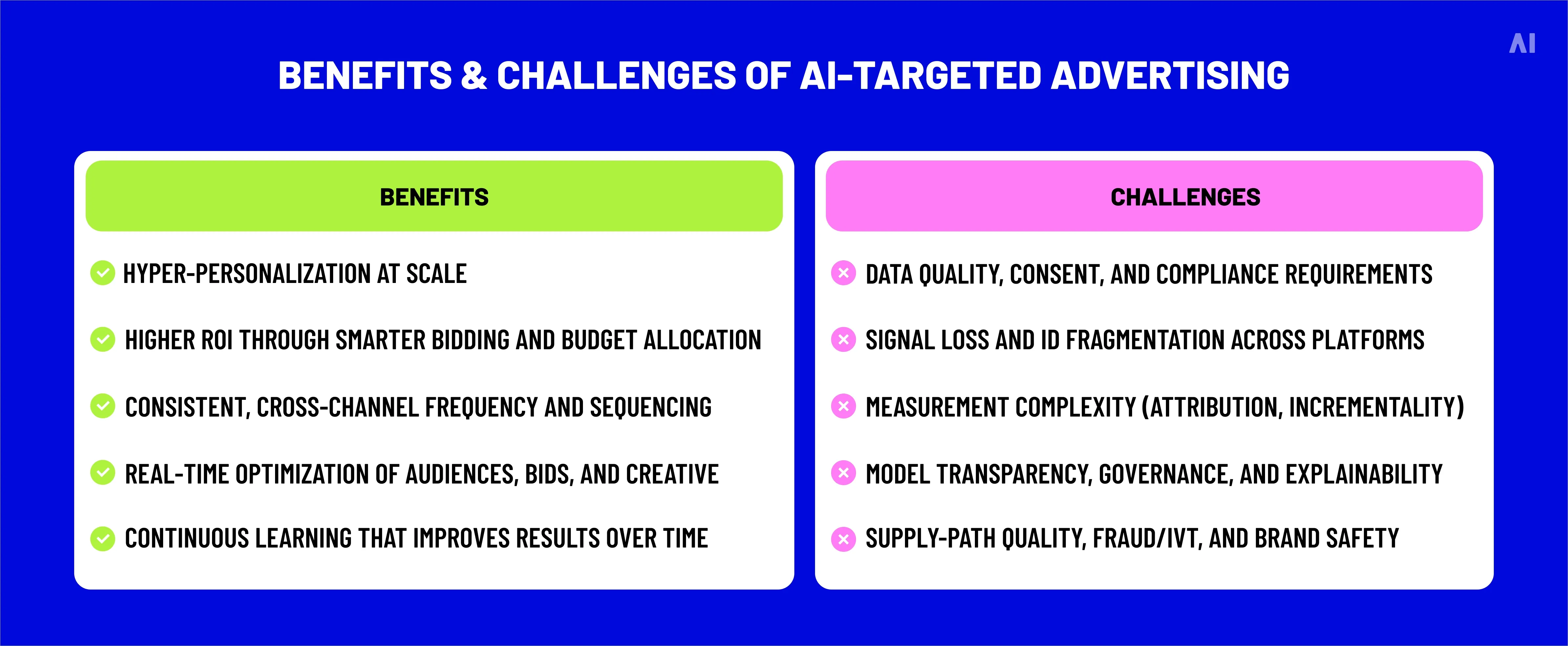
These limits are why AI-targeted advertising combines predictive signals with marketer-defined controls instead of treating model output as a final verdict. The same prediction layer also supports predictive advertising across modern media ecosystems.
Predictive Bidding and Auction Decisions
In programmatic auctions, machine learning helps determine how valuable an available impression may be before a bid is submitted. The model evaluates signals such as placement, device, context, time, prior performance, and campaign history, then estimates the probability or value of the desired outcome.
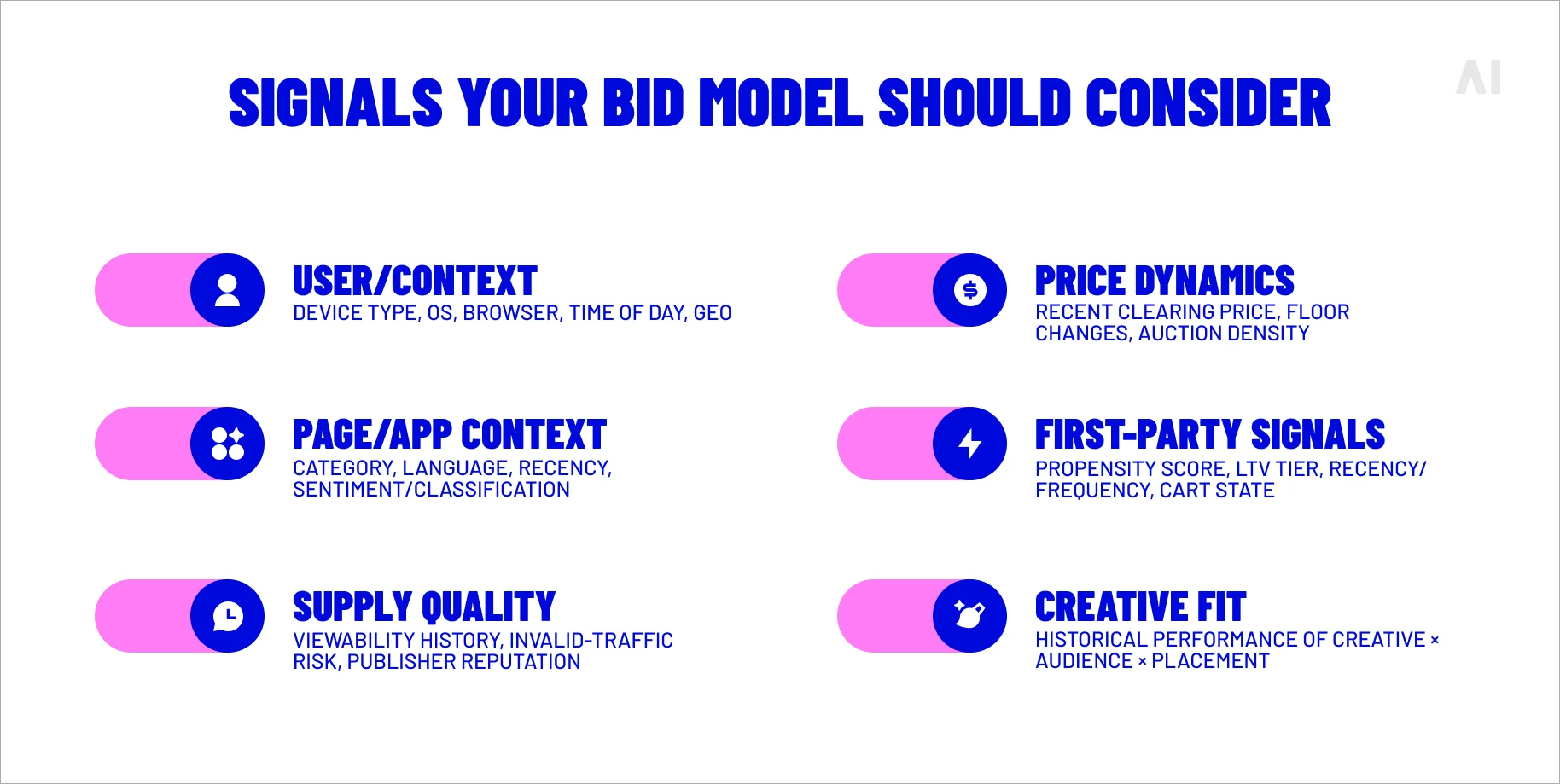
The system converts that estimate into a bidding decision under the campaign’s objective and constraints. Within AI-supported DSP decisioning, models estimate impression value before campaign controls determine the bid. The same impression may therefore receive a different bid depending on whether the advertiser prioritizes conversions, revenue, completed views, or another KPI, while budget, pacing, frequency, brand-safety, and bid limits restrict the final action. This prediction-to-bid process is central to AI-powered bidding in modern programmatic advertising.
⚡️Machine learning supplies a probability; campaign strategy determines what that probability is worth.
Budget Allocation, Pacing, and Campaign Optimization
Machine learning also helps distribute spend across campaigns, audiences, placements, channels, creatives, or periods. Models compare recent performance with delivery requirements and forecast whether the current allocation is likely to meet the campaign objective.
This can help prevent budgets from being exhausted too early, identify underdelivery, and redirect investment toward opportunities producing stronger results. However, continuous optimization is only useful when the selected KPI reflects genuine business value. A system instructed to minimize cost may favor inexpensive inventory even when it produces low-quality attention or customers. Marketers must therefore define the objective and limits before automation begins reallocating spend.
Creative Selection and Personalization
For creative decisioning, machine learning ranks approved ads, messages, products, offers, or combinations according to audience, context, placement, and previous performance. A dynamic creative system might select a product image, headline, and call to action from an approved asset library, then favor combinations associated with stronger outcomes for similar situations.
This differs from generative AI. Machine learning selection chooses among available options, whereas generative models can create or modify content.
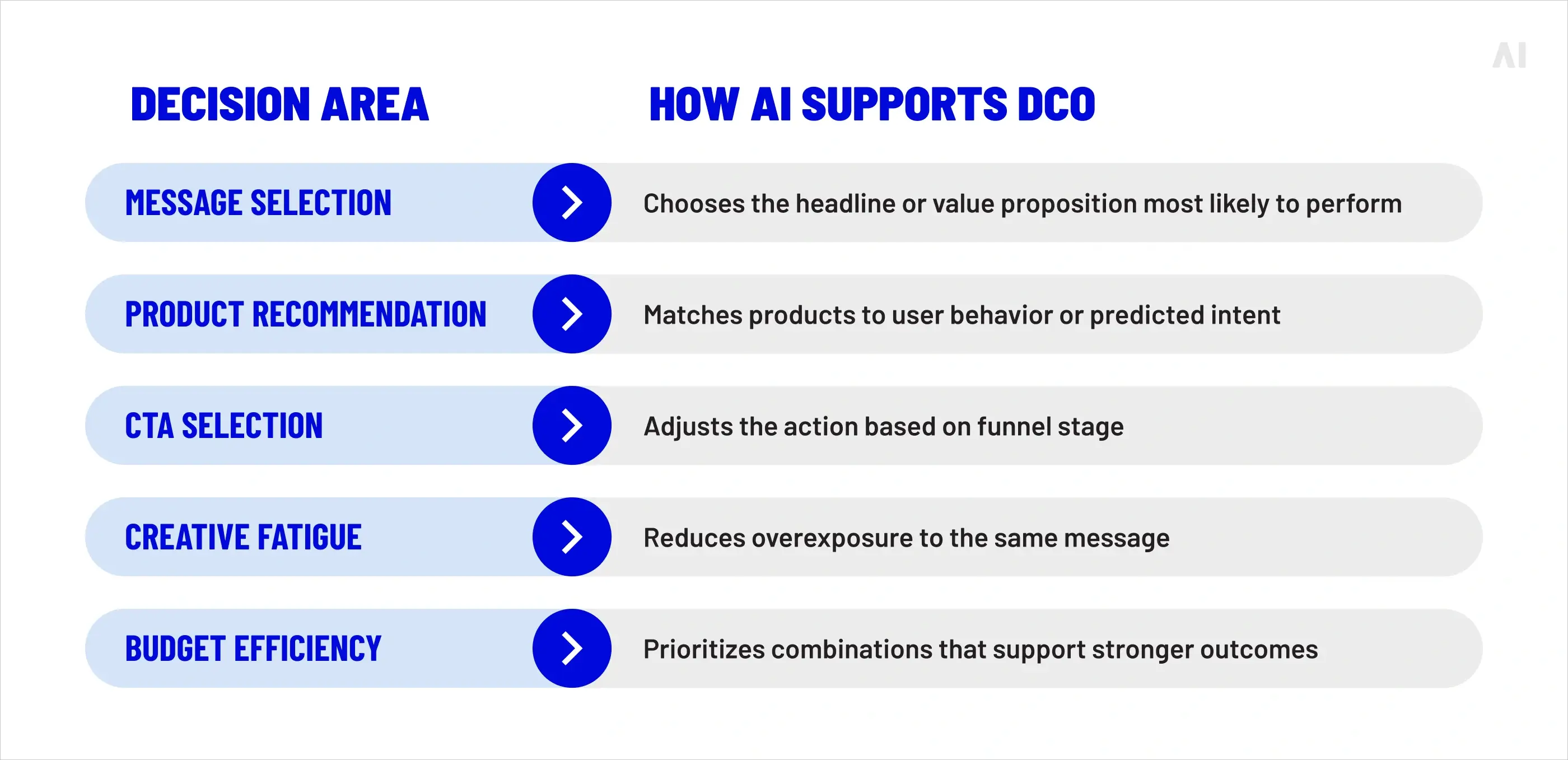
The two can work together: generative AI may produce controlled variations, while predictive models rank which eligible variation to serve. Human review remains necessary for brand consistency, accuracy, legal compliance, and creative quality. This predictive selection is central to dynamic creative optimization, which matches approved creative combinations to audience and contextual signals.
Measurement, Forecasting, and Attribution Support
Machine learning can support measurement by forecasting campaign outcomes, modeling conversions that are delayed or not directly observable, detecting unusual performance changes, and identifying patterns across customer journeys. These capabilities help marketers estimate what may happen and locate areas requiring investigation.
They should not be confused with proof of causality. An attribution model may identify touchpoints associated with conversion, but that does not establish that those touchpoints caused the result. Incrementality experiments compare exposed and control groups, while causal-inference methods attempt to estimate counterfactual outcomes. Media mix modeling often relies primarily on statistical or econometric relationships, although machine learning can complement variable selection, forecasting, calibration, and scenario analysis. This makes media mix modeling useful for cross-channel budget decisions without relying on user-level attribution.
Fraud and Anomaly Detection
Machine learning helps identify traffic and campaign behavior that differs from expected patterns. Models can flag unusual click volumes, repeated device or network activity, improbable conversion timing, abnormal engagement, or sudden performance changes that may indicate invalid traffic, manipulation, tracking errors, or operational problems.
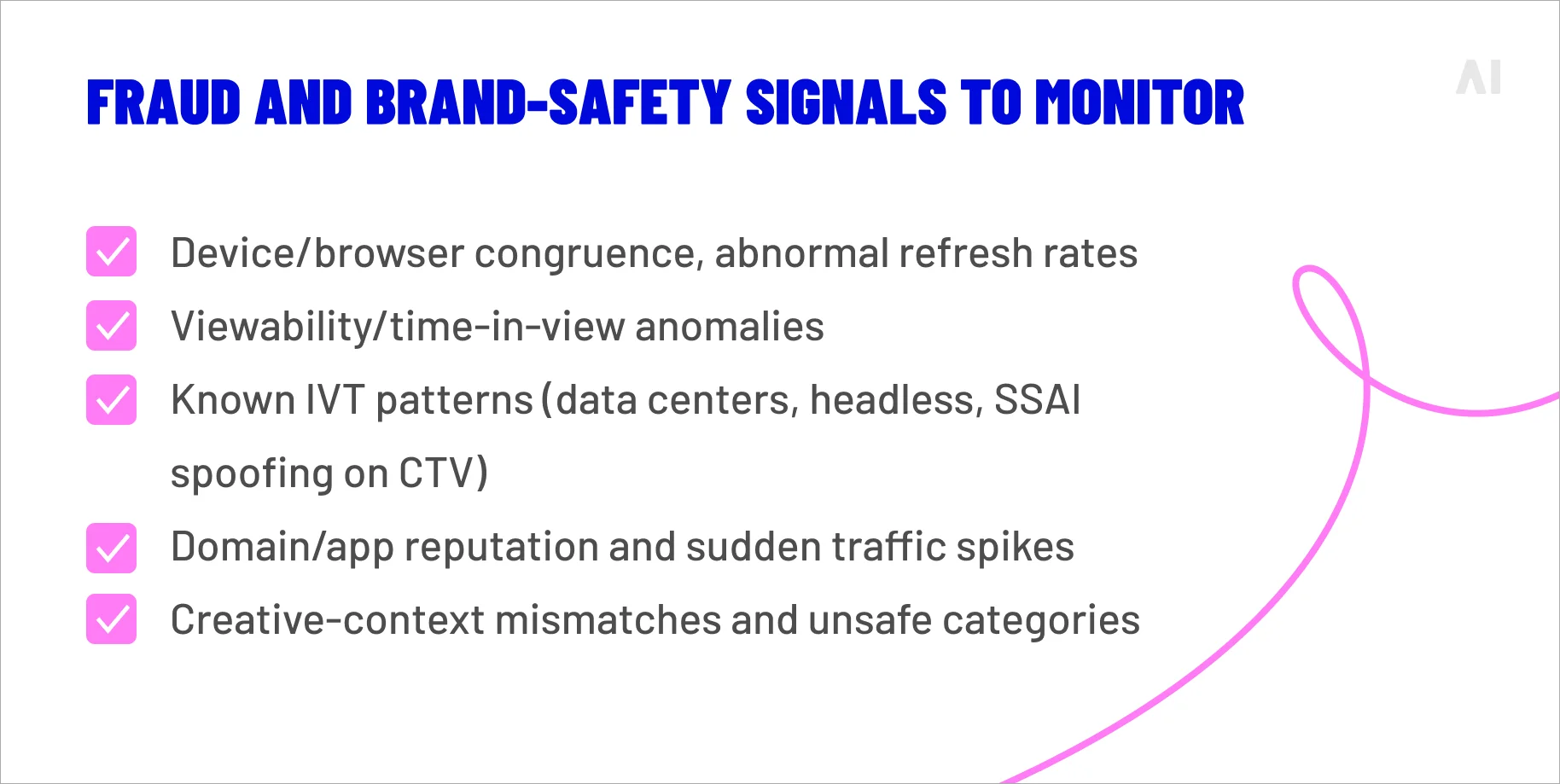
A risk score is not proof of fraud. It gives verification teams and campaign systems a basis for reviewing, blocking, or isolating suspicious activity. Because both legitimate behavior and fraud tactics change, detection should combine adaptive models with transparent rules, specialist verification, threshold monitoring, and human investigation. This makes machine learning valuable as an early-warning and prioritization layer rather than an unquestionable enforcement authority.
Why Machine Learning Is Valuable in Digital Advertising
Machine learning is valuable in digital advertising because it can evaluate more signals and support more repeated decisions than teams can manage manually. Advertising is not only a data-volume problem; it is a decision-density problem involving constant choices about value, priority, timing, and trade-offs.
Its underlying advantages are:
- Prediction: Converts historical patterns and current signals into estimates of outcomes or value.
- Prioritization: Directs limited budget toward opportunities most aligned with the campaign objective.
- Adaptability: Responds as performance, audiences, inventory, or market conditions change.
- Granularity: Supports impression-, audience-, creative-, or placement-level decisions instead of relying on broad averages.
- Scalability: Applies consistent objectives and constraints across volumes of opportunities that would overwhelm manual workflows.
The advantage is not automation for its own sake. Machine learning makes advertising more selective at scale, helping marketers concentrate resources where they are expected to create greater value. However, scale amplifies poor choices too: weak KPIs, unreliable data, or inadequate guardrails can reproduce the wrong decision faster and more consistently.
How to Use Machine Learning in an Advertising Strategy
A strong machine learning advertising strategy begins with a business decision, not a model. The technology creates value only when its predictions improve a measurable choice and commercial outcome.
Start With One Business Outcome and One Decision to Improve
Keep one primary optimization objective. Treat reach, frequency, margin, brand safety, and acquisition quality as constraints where appropriate. This prevents an ambiguous objective from producing a technically efficient but commercially unhelpful result.
Prepare Reliable Data, Signals, and Guardrails
Connect campaign exposure and cost data with conversions, revenue, CRM outcomes, or offline sales where relevant. Validate event definitions, timestamps, attribution windows, missing values, and integrations before optimization begins.
Preparation should cover:
- Signals: Relevant first-party, contextual, campaign, and outcome data;
- Permissions: Consent, access, retention, and purpose limitations;
- Guardrails: Budgets, bid limits, exclusions, frequency caps, quality thresholds, and human overrides.
When using a vendor, ask which outcome it optimizes, which signals influence decisions, how it handles delayed or missing conversions, and where marketers can inspect or override automation. “AI-powered” does not explain how a media decision is made.
Test Against a Meaningful Baseline
Compare ML-supported decisioning with the approach it should improve, such as manual allocation, fixed rules, or the existing platform strategy. Define the baseline, test conditions, and success metric before launch.
Judge results against the original business outcome—not model accuracy, prediction volume, or the number of automated adjustments. A more accurate model creates little value if its prediction does not improve an important decision. Where feasible, use controlled experiments or holdouts to determine whether the approach generates incremental improvement rather than claiming credit for outcomes that would have occurred anyway.
Monitor Performance, Drift, and Unintended Optimization
Monitor business outcomes alongside delivery patterns, audience composition, inventory quality, conversion delays, and the relationship between scores and observed results. Changes in customer behavior, products, tracking, or media supply can create drift even while the system appears to operate normally.
Watch for proxy optimization. A model pursuing cheaper conversions may find low-value customers; one maximizing clicks may favor sensational creative; one protecting short-term return may reduce prospecting and weaken future demand. Human intervention may require changing the objective, adjusting constraints, correcting data, pausing automation, or retraining the model.
⚡️The strategic discipline is to automate a decision without surrendering responsibility for its consequences.
Limitations and Risks of Machine Learning in Advertising
Machine learning in advertising becomes risky when models are trusted beyond the quality of their data, the transparency of their decisions, or the suitability of their objectives. Automation scales errors too.
Bad or Changing Data Can Produce Bad Decisions
Models learn from recorded behavior, not objective truth. Noisy conversion events, inconsistent tracking, incomplete signals, and biased historical data can teach misleading relationships. Correlation may be mistaken for value: an audience associated with conversions may already be close to purchase rather than influenced by advertising.
Overfitting occurs when a model performs well on historical data but fails under new conditions. Models can also weaken as customer behavior, products, inventory, or tracking changes. Model drift is therefore a business risk, not merely a technical metric. Marketers must confirm that predictions remain representative of current conditions.
Privacy and Black-Box Decisioning Require Attention
More data does not automatically produce better advertising. Signals require appropriate consent, access controls, retention limits, and a defined purpose. Sensitive or unnecessary information should not be used simply because it is available.
Marketers need visibility into what a system optimizes, which signal categories influence decisions, and where controls apply. Explainability does not require revealing proprietary code. It requires enough transparency to understand the objective, inputs, constraints, outputs, and limitations—and challenge questionable decisions.
Automation Still Needs Human Goals and Oversight
Machine learning cannot decide which business outcome deserves priority or which trade-offs a brand should accept. Marketers remain responsible for goals, KPIs, creative strategy, budgets, constraints, brand standards, and conflicts between short-term efficiency and long-term growth.
Oversight must be operational. Teams need authority to inspect performance, change objectives, exclude unsafe inventory, correct data, override recommendations, and pause automation. The model may optimize the decision, but accountability remains human.
How AI Digital Supports Smarter Media Decisions
AI Digital treats media intelligence as a connected decision process rather than disconnected tools. Research informs planning, planning guides execution, and campaign evidence shapes what happens next, while marketers retain control of objectives and trade-offs.
Connect Audience Intelligence and Media Planning
AI Digital brings competitive, audience, historical campaign, and media signals into planning. Competitive intelligence reveals where others invest and their messaging. Behavioral, interest, and customer data support channel-ready segments and personas, while historical execution data provides context for budgets, channels, timelines, and placements.
This connects audience understanding to media choices, helping teams turn a campaign brief into goal-aligned planning scenarios.
Optimize and Measure Against Business Outcomes
A media plan should not become static after launch. By connecting research, planning, optimization, and reporting, Elevate turns cross-channel signals into KPI-aligned media decisions. Its reporting centralizes metrics across 12+ integrated DSPs, search, and social, while its planning and measurement capabilities help teams interpret performance and reconsider allocation.
Elevate’s KPI-first positioning keeps optimization focused on revenue, conversions, and defined business outcomes rather than isolated platform metrics. The purpose is not to remove human judgment, but to give it a connected evidence base.
Machine Learning Makes Advertising More Adaptive, Not Autonomous
Machine learning can make advertising faster and more responsive, but it cannot determine what a business should value. Its predictions create an advantage only when marketers provide clear objectives, reliable evidence, and appropriate boundaries.
The central takeaways are:
- Reliable data determines what the model can learn;
- Clear objectives determine what the system prioritizes;
- Independent measurement determines whether optimization creates genuine value;
- Human oversight determines when automation should be challenged or changed.
The strongest advertising systems combine machine intelligence with human accountability. To put this principle into practice, get in touch with AI Digital and build more connected, transparent, and outcome-focused programmatic strategies.