A banner is approved and ready to run. Then a price changes, another market joins the campaign and the sales team asks to feature a different product. Each request is reasonable, but together they leave the creative team producing far more versions than anyone originally planned.
Dynamic banners can make those updates easier to manage, though they bring their own demands: someone still has to maintain the content, check the combinations and decide what each audience should see. For some campaigns, a set of carefully made, fixed-content ads will do the job well. For others, the volume and frequency of changes justify a dynamic approach. Choosing well starts with understanding the work involved and how you’ll judge the results.
TL;DR: Key takeaways
- Static means fixed content in this comparison. The banner can still animate; its message does not adapt through feeds or decisioning.
- Fixed-content banners suit tightly controlled concepts and campaigns with limited variation needs.
- Dynamic banners can support changing catalogs, offers and relevant contextual variations, provided the supporting systems are reliable.
- Animation, HTML5, responsive ads and dynamic creative optimization describe different capabilities that can overlap.
- Evaluate business outcomes and operating costs. Higher CTR or a larger asset library alone does not establish success.
What are static vs dynamic ads?
The distinction concerns how content is controlled within a banner. Both approaches belong within digital display advertising, and both can use carefully designed brand assets.
Static banner ads
Static banner ads have fixed content: the approved imagery, message, offer and CTA do not change through feeds, contextual inputs or audience-based decisioning when that creative is served.
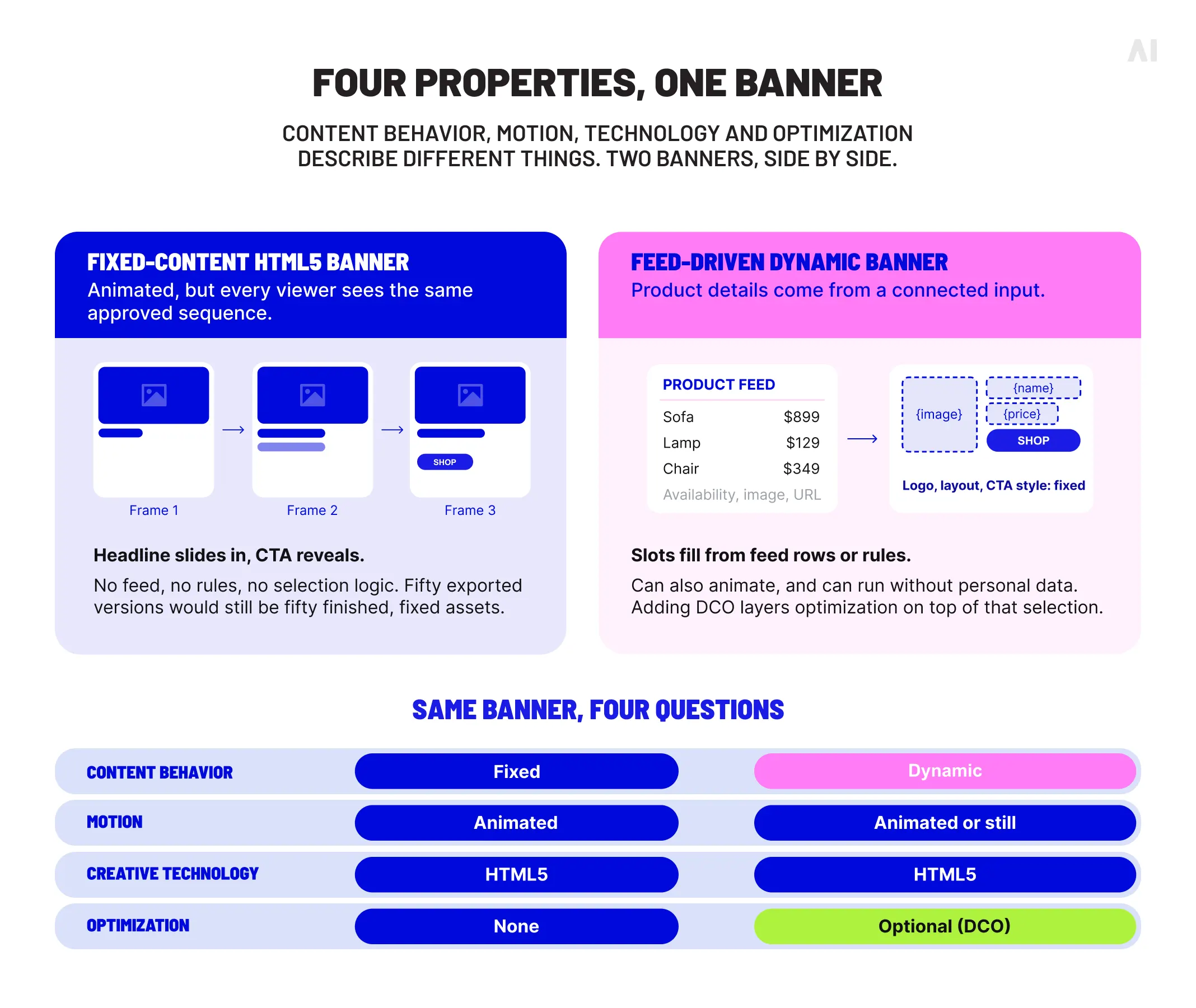
Here, “static” does not necessarily mean a still image. An HTML5 banner can animate a headline and reveal a CTA while presenting the same approved sequence to every eligible viewer. Elsewhere, “static banner” commonly describes a nonanimated image, so it helps to distinguish content behavior from motion.
Automating production also does not make an exported banner dynamic. Software can generate many fixed versions before launch; each remains a finished creative asset.
Dynamic banner ads
Dynamic banner ads use content or components that can be updated or selected through connected fields, feeds, rules or other decisioning inputs. A template might display a different product, price, image or destination URL without requiring a complete creative rebuild.
Google Studio documents both manually updated profile fields and programmatic changes through feeds and content rules. Dynamic therefore does not mean every impression must look different, or that every implementation requires a product catalog.
Nor does dynamic automatically mean personalized. Updating an offer for everyone can involve no individual behavioral profile. More advanced implementations may use dynamic creative optimization to guide selection and improvement.
Dynamic is not the same as animated, HTML5, or DCO
Animation describes motion. HTML5 is a technology used to build creative. Dynamic describes content that can change through connected inputs. These properties can coexist in the same display banner ads.
DCO adds optimization to creative selection or assembly. Amazon describes it as adapting parts of a base creative using audience, context and past performance. Its DCO guide also emphasizes templates and ongoing evaluation.
Responsive display ads are asset-based: platforms assemble supplied images and copy into suitable layouts. They can also use feeds, as Google’s documentation confirms.
💡 Our guide to responsive display ads explores that approach further.
Static vs dynamic banner ads: Key differences
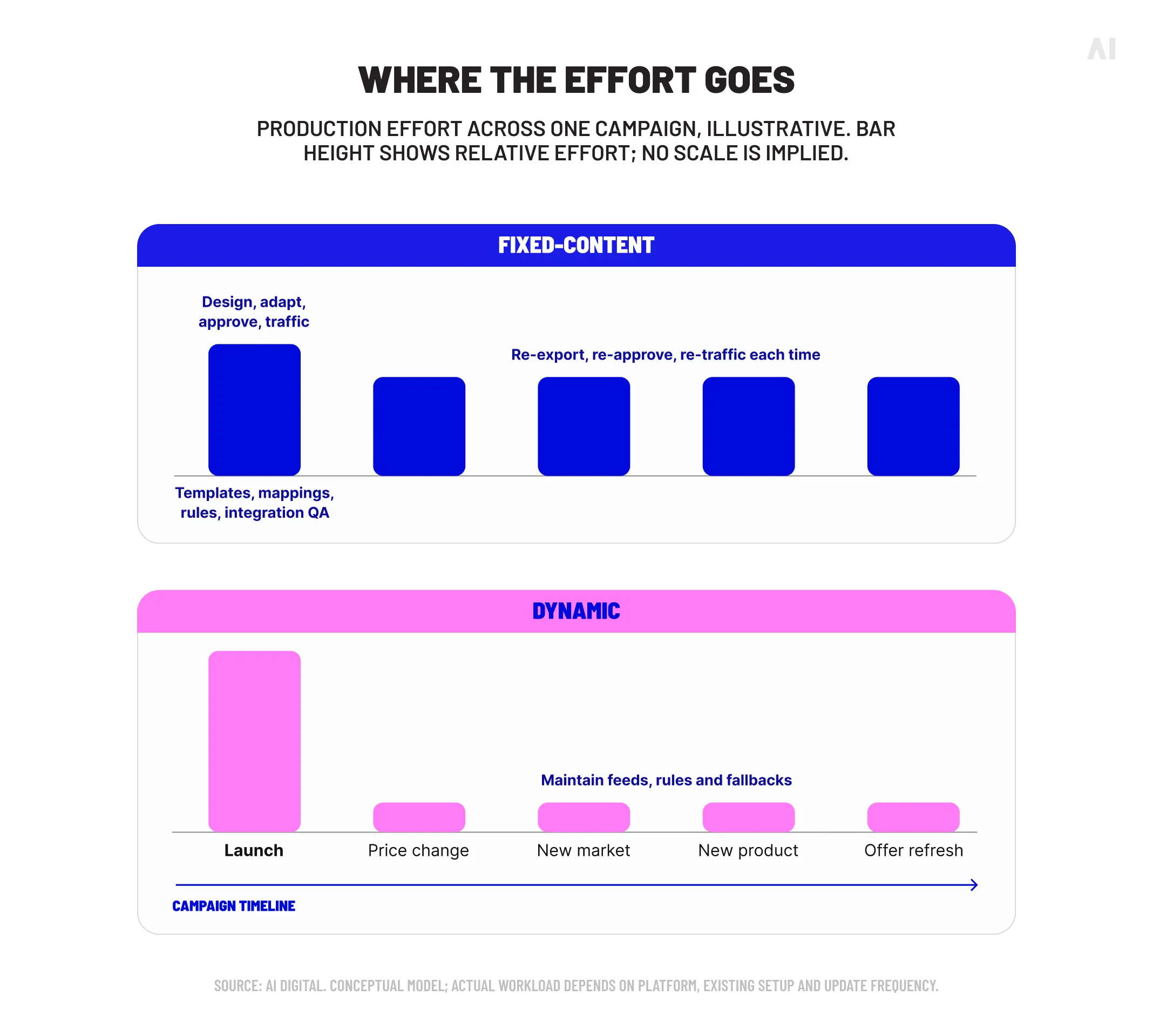
Static vs dynamic banner ads require different production decisions, although the workload depends on the platform and existing setup. A ready-to-use catalog integration may be easier to operate than a custom campaign assembled from scratch.
The useful comparison is total effort across the campaign, including maintenance. A lower initial production bill can become less attractive if every update requires another round of exports and approvals.
Which performs better: Static or dynamic banner ads?
Neither approach universally performs better. Dynamic creative earns its additional complexity when variation is useful, its inputs are dependable and the campaign can support the required production and measurement work.
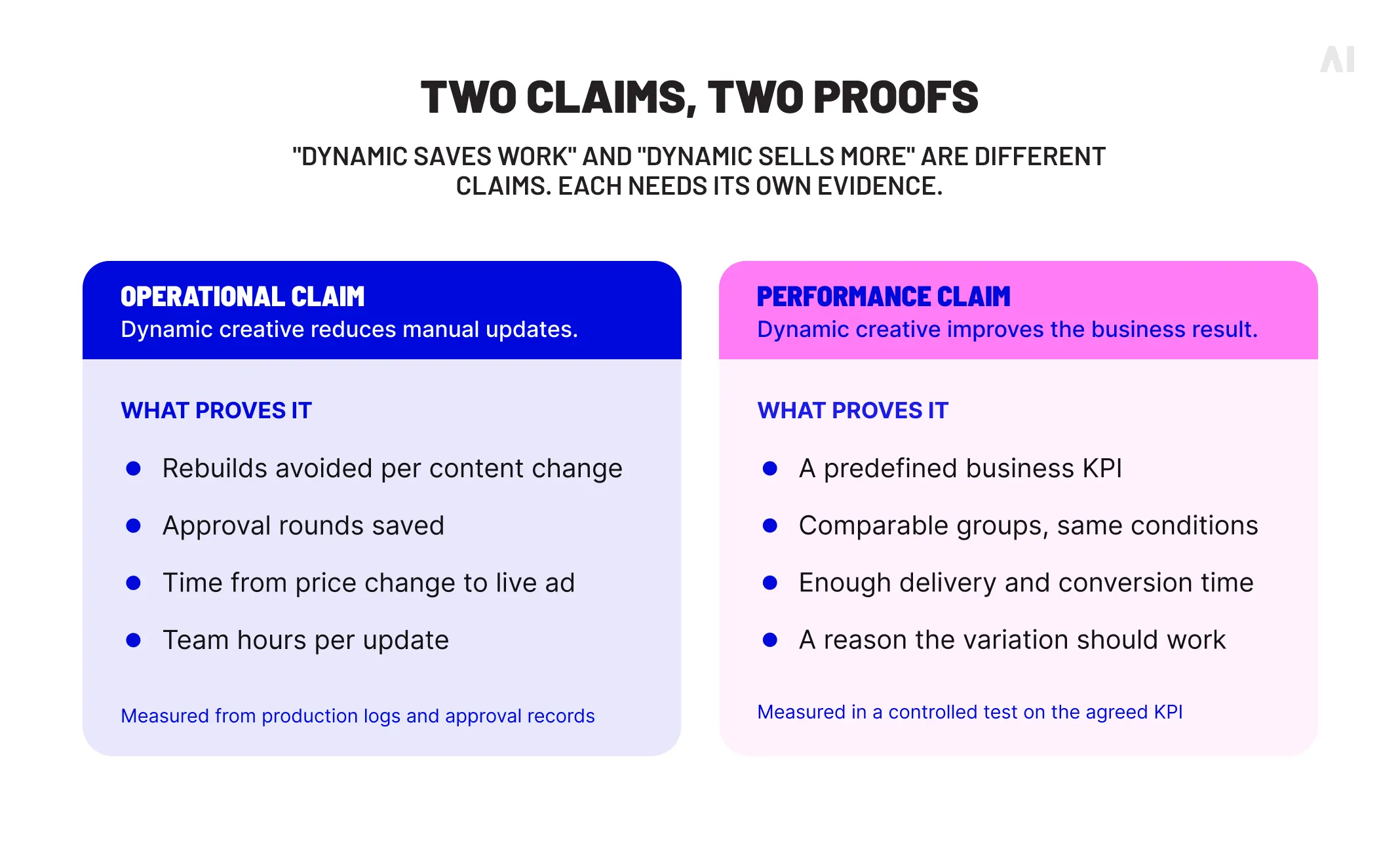
Separate the likely operational benefit from the performance hypothesis. Reducing manual product updates is a different claim from increasing sales, and each needs its own evidence.
When static can be the better choice
Fixed-content creative is a sensible starting point for a short promotion, a narrow product range or a campaign built around a distinctive visual idea. The team can approve the complete execution and spend its time improving the concept.
It can also suit smaller audiences when there is little useful variation to introduce. Personalization should answer a specific audience need; changing a headline simply because the system allows it adds work without a clear purpose.
When dynamic can create an advantage
Dynamic creative becomes useful when keeping content relevant creates a recurring workload. Examples include extensive catalogs, changing availability, regional offers and remarketing based on previously viewed products.
There is evidence of benefits in particular implementations. Amazon reported 7.2% higher ROAS among advertisers using DCO than among those without it enabled, citing internal US data from August 2025. However, its announcement does not establish a randomized static-versus-dynamic banner test. Treat the finding as platform-specific evidence, not an expected uplift.
The campaign still needs a credible explanation of why its chosen variations should improve the customer response.
When a hybrid approach makes sense
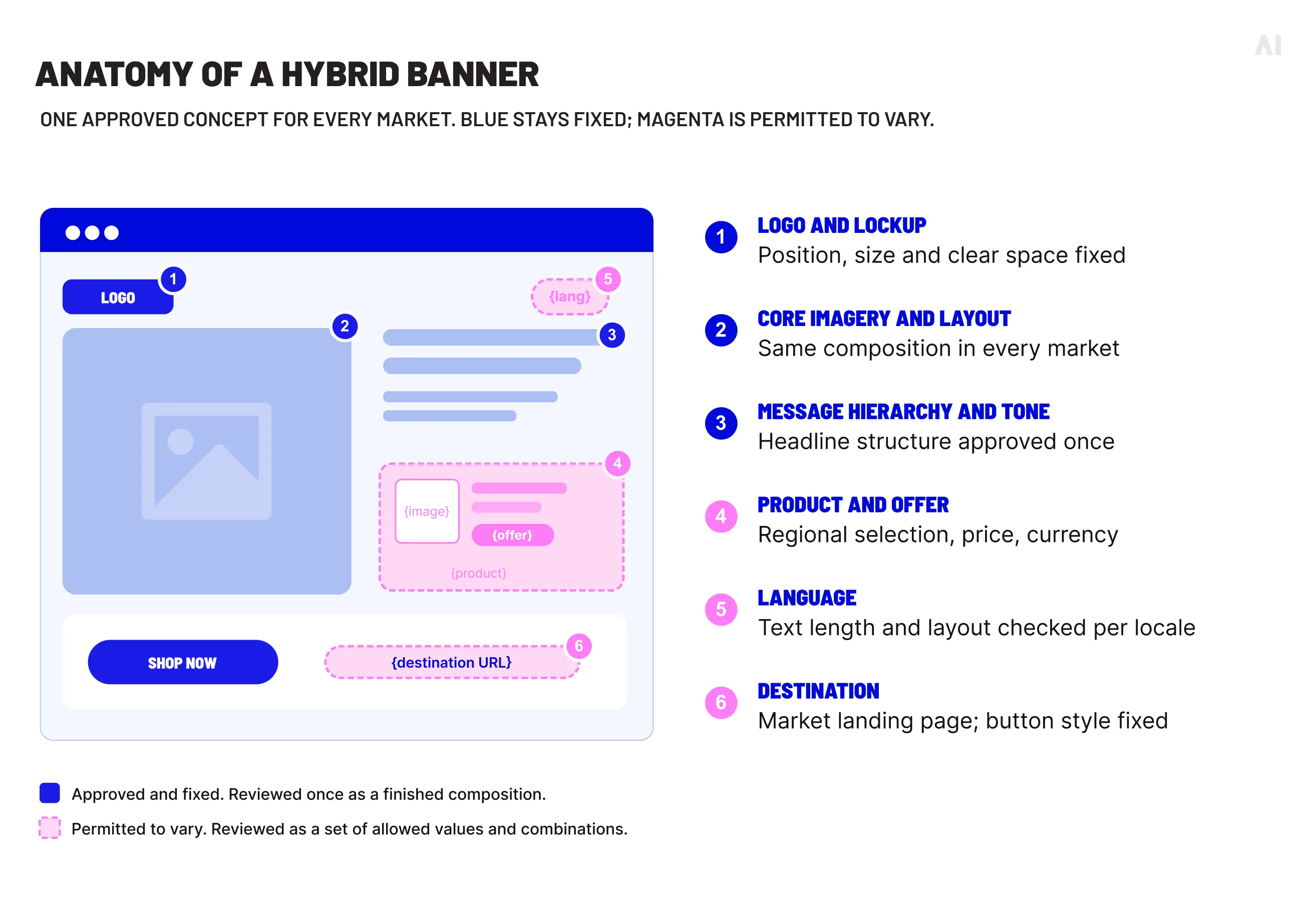
A hybrid approach preserves an approved campaign concept while allowing selected elements to vary. Brand imagery, message hierarchy and tone can remain controlled while a product panel or local offer changes.
Teams can also run fixed-content and dynamic creative in complementary campaign roles. The important decision is which elements benefit from variation and which depend on a carefully composed execution.
⚡ Every variable element creates another approval decision, even when software assembles the final ad.
What dynamic banner ads need to work well
Dynamic creative needs a maintained connection between content, rules and presentation. Before launch, establish who owns each input and who can correct or pause the campaign when something fails.
Reliable feeds, data, and decisioning rules
For product feed ads, check product identifiers, prices, availability, imagery and destination URLs. For contextual campaigns, identify the signal that selects the message and its expected update frequency. Connecting a source does not guarantee that its values are current.
Define what happens when no suitable content is available. Options might include an approved evergreen message or an alternative eligible product. In Google Studio, filtering and rotation settings govern eligible rows, while default content provides a fallback for relevant unmatched conditions.
Keep content updates and selection rules documented so another team member can understand what the campaign will show.
Brand controls and production infrastructure
Templates must accommodate the approved range of content. Review text lengths, image crops, contrast, disclaimers and language requirements before expanding the variation set.
Google’s dynamic creative design guidance highlights problems such as inconsistent text lengths, images that fit some dimensions poorly and dependent elements that undermine readability. A template approved with one attractive example has not necessarily been tested adequately.
Specify which components can change together, which combinations are prohibited and which edits trigger another review. Localization also needs layout and language checks, beyond swapping a text field.
Privacy, consent, and targeting constraints
Requirements depend on the information used and where the campaign runs. A scheduled offer update differs from banner ad personalization based on browsing history, and location signals require attention to their source and precision.
Google’s personalized advertising policy limits certain audience uses in sensitive categories and imposes additional restrictions for housing, employment and consumer finance in the US and Canada. California also gives consumers rights to opt out of covered businesses sharing personal information for cross-context behavioral advertising.
Check applicable platform, market and consent requirements before activation. First-party data should not be treated as unrestricted permission to personalize.
What can go wrong with dynamic banner ads?
Problems often arise where a valid-looking input meets an unsuitable rule or layout. The campaign can keep delivering while showing content that should have been corrected or withdrawn.
Google’s dynamic feeds QA checklist explicitly covers missing elements, clipped text, matching errors and default behavior. Use those checks alongside campaign-specific reviews, including what the customer sees after clicking.
Operational complexity can also produce little visible benefit. If teams spend more time maintaining marginal variations than developing useful ideas, simplify the strategy.
⚡ A campaign can serve without technical errors and still send customers to an offer they cannot buy.
How to test static vs dynamic banner performance fairly
A fair test compares the approaches under sufficiently similar conditions and uses a predefined business outcome. Comparing last quarter’s prospecting banners with this quarter’s dynamic remarketing confounds creative with audience intent and timing.
Start with a practical sequence:
- State the hypothesis. Identify the variation expected to improve results and why.
- Choose the primary KPI. Use the campaign objective to decide what constitutes success.
- Define the comparison. Use a supported controlled experiment with comparable groups where feasible.
- Plan delivery and evaluation. Allow for conversion delays and the volume needed to assess the expected effect.
- Record operating costs. Track production, platform and maintenance effort separately from media performance.
Google’s experimentation guidance recommends establishing the hypothesis and success metrics before testing, while controlling unrelated changes. The comparison below applies that discipline to banner campaigns.
Assess conversion rate, cost per acquisition (CPA), return on ad spend (ROAS), revenue or qualified leads as appropriate, using display advertising KPIs that reflect the objective. Click-through rate (CTR) can help diagnose response, but a click increase alone cannot establish better business performance. For awareness campaigns, use an appropriate brand outcome where measurement is available.
There is no universal minimum number of impressions, conversions or test days. Required sample size depends on variability, the effect to detect and the chosen statistical assumptions, as NIST explains. An inconclusive result should remain inconclusive.
If dynamic creative changes products, copy and imagery together, the experiment can assess that combined strategy without isolating the contribution of each component. Likewise, comparing uploaded banners with responsive formats may also introduce differences in inventory access and layout.
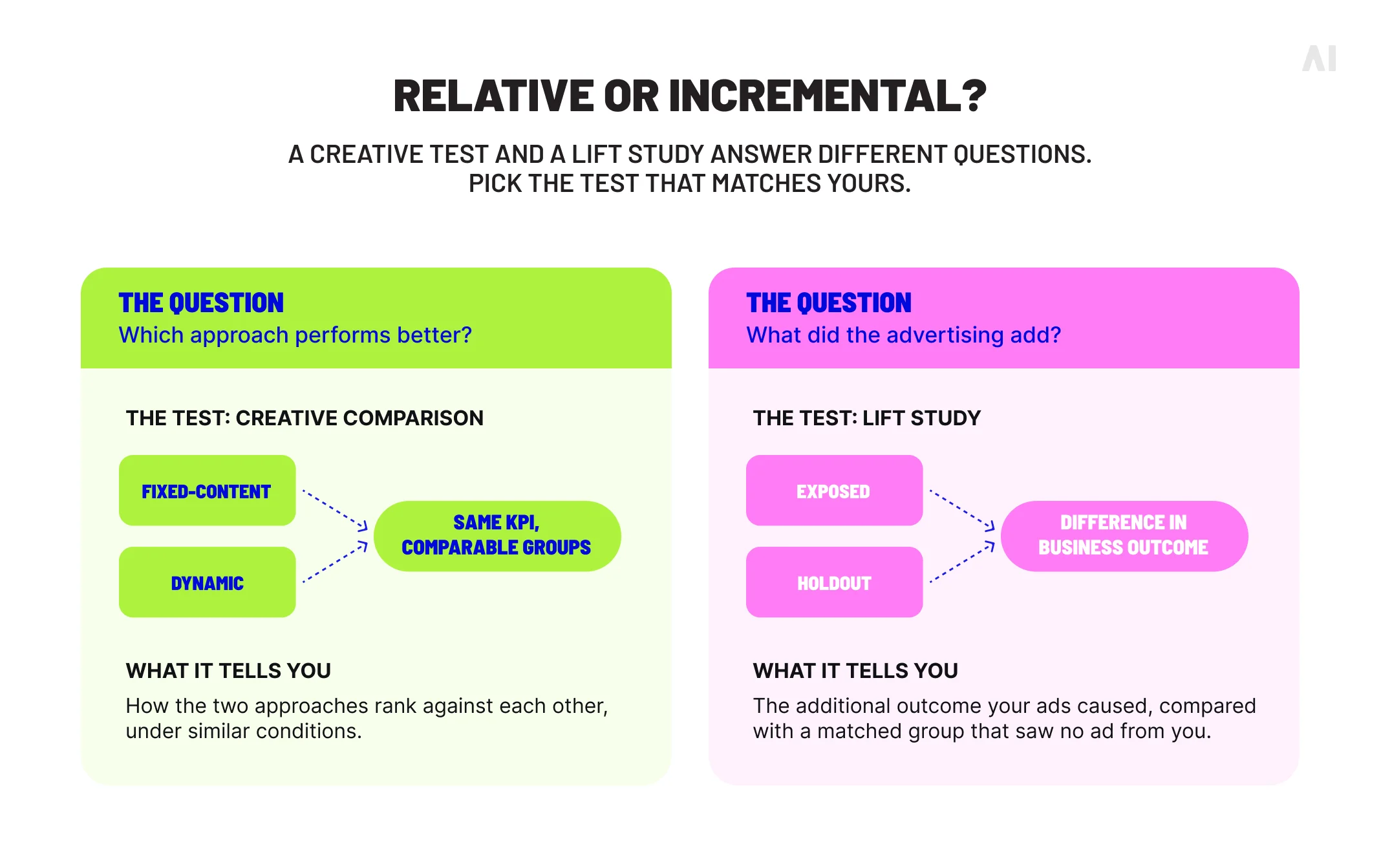
Finally, distinguish relative performance from incrementality. An appropriately designed creative test asks which approach performs better. A lift study can ask what additional business advertising caused by comparing treatment with a suitable control. Google Conversion Lift illustrates the latter, although availability is restricted. Ordinary attributed conversions do not automatically establish causality.
⚡ Agree on the business outcome before the first results arrive, when a promising metric cannot influence the choice.
Static vs dynamic banner ads: Three practical scenarios
These illustrative scenarios show how production decisions change with the campaign. They are planning examples, not measured client results.
A short brand campaign with one core message
A furniture brand launches a collection with a distinctive photograph and one invitation to explore it. Products and prices will remain stable during the campaign, and every placement needs the same visual emphasis.
Fixed-content banners give the team a manageable set of finished executions to approve. Animation remains an option if it serves the concept. There is little reason to build a content feed when the message has no useful variables.
A large ecommerce catalog with changing products
A retailer rotates seasonal products, with availability and prices changing throughout the campaign. Feed-driven creative can reduce the need to rebuild banners whenever individual product details change.
For remarketing, Google's documented setup connects product or service feeds with visitor activity and item identifiers. The retailer should validate those connections and ensure advertised products remain purchasable. Whether the implementation also qualifies as DCO depends on its optimization capabilities.
A multi-market campaign using static and dynamic creative together
A manufacturer uses one approved visual concept across regional campaigns. Local teams need different product selections, offers and language versions, but the central brand team wants consistent presentation.
A hybrid design fixes the logo, core imagery and layout while allowing approved regional content to populate designated areas. Market eligibility, currency and language should be checked together. Where an adaptation needs a substantially different composition, a separate fixed execution may be the more practical choice.
How AI Digital supports scalable banner production
An approved concept is only the beginning. Getting it ready for different placements, platforms and markets takes production time that can quickly consume your team’s capacity.
AI Digital’s AI Creative Studio helps you meet that demand by combining AI-assisted production with human creative expertise. From static banners and HTML5 creative to resizing, format adaptation, multi-platform versioning and localized variant tagging, the Studio helps extend your campaign concept across the assets you need. Human judgment guides the work, keeping each execution aligned with your brand and media requirements.
With a dedicated production partner handling adaptations and refreshes, your team has more room to develop ideas, plan tests and respond to campaign findings. For campaigns using dynamic creative, that production support works alongside the platforms and processes responsible for content selection, feed management and ad serving.
Conclusion on static vs dynamic ads: Choose the right creative model for the campaign
Begin with what needs to change, how often and for whom. Then assess data quality, available infrastructure, approval requirements and measurement readiness. Fixed-content creative can provide the precision a campaign needs; dynamic components can make recurring variation more manageable.
If you want to build a banner production approach around your campaign’s actual requirements, talk to AI Digital about developing and adapting creative across your planned placements, platforms and markets.