How to produce hundreds of banner ad variations with AI

AI display ads can be produced faster than ever, but scaling AI-generated banner ads across formats and markets requires more than asking a model for a folder full of AI banner ads. The difficult part begins after the first concept is approved, when that idea has to survive new dimensions, longer headlines, different products, local offers, legal copy and the technical requirements of each advertising platform.
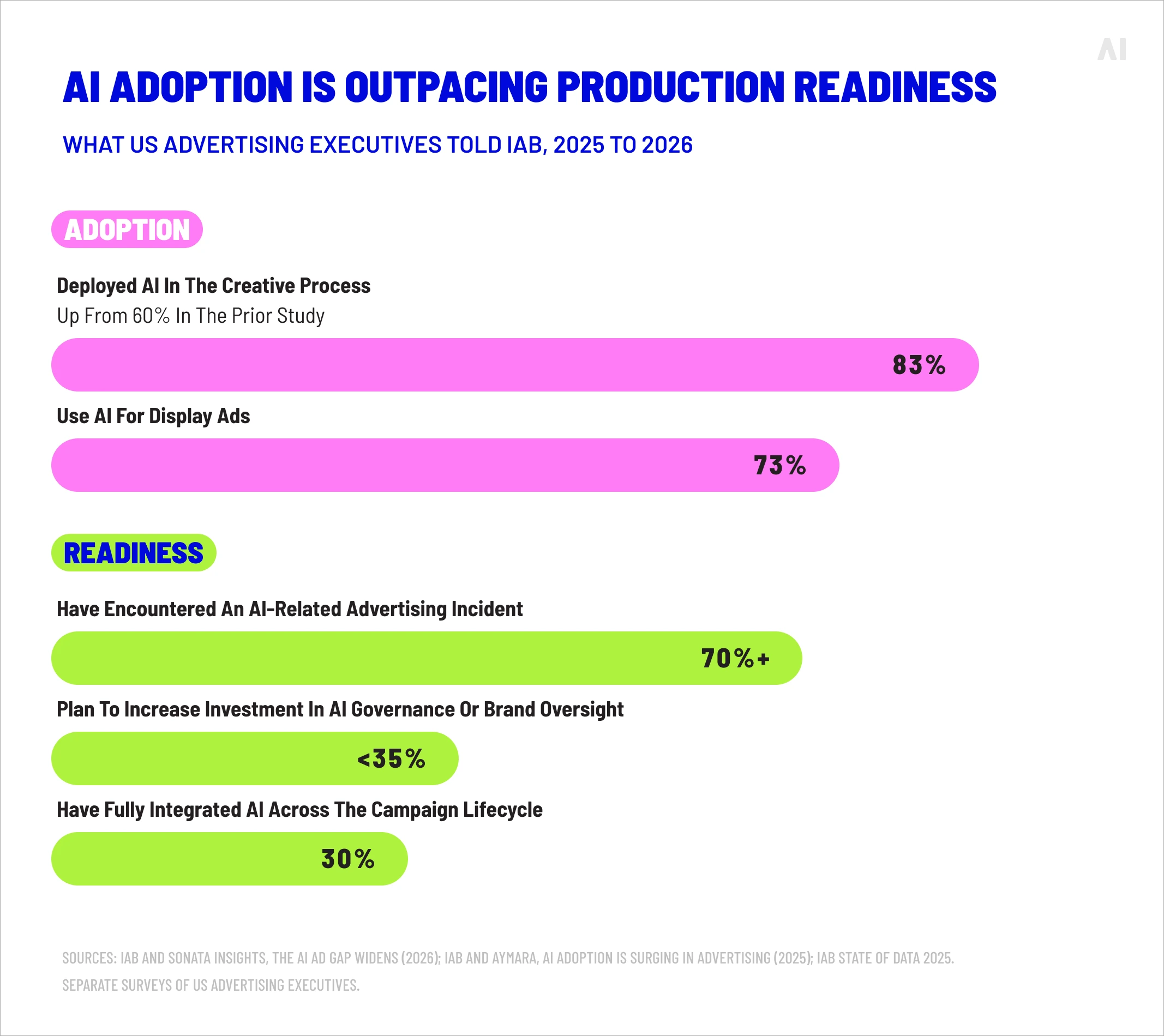
Adoption is already widespread. In a 2026 study, IAB found that 83% of advertising executives said their company had deployed AI in the creative process, up from 60% in its earlier study. Yet deployment alone does not create a dependable production operation. A brand still needs to decide which elements can change, which must remain fixed and how each output will be checked, approved and connected to the media plan.
This guide follows that production system from the variation matrix and modular master creative through generation, resizing, localization, QA and performance feedback. It also separates AI generation, creative automation, responsive asset-based ads and dynamic creative optimization (DCO).
TL;DR: Key takeaways
- Hundreds of useful banner assets should come from controlled variations of an approved concept, not unrelated outputs generated at random.
- Scalable banner ad production starts with a modular master creative that can accommodate different content lengths, products and dimensions.
- Brand elements, product facts and legal requirements should be separated from intentional variables such as headlines, images, offers, CTAs and languages.
- AI can generate copy and visual options, while creative automation handles repetitive resizing, versioning and data-driven changes.
- Responsive display formats can assemble source assets inside the advertising platform, so they do not require every possible banner combination to be exported.
- More assets create value only when they are accurate, usable and connected to a media requirement or meaningful test.
What is an AI-assisted banner ad variation?
An AI-assisted banner ad variation is an approved version of a display concept in which permitted elements change while the core visual and strategic system remains consistent. AI may write a headline, extend a background or prepare a product treatment. Creative automation then places those components into templates and produces the required versions.
This definition is narrower than “an ad made with AI.” A banner may contain an AI-generated image yet still be rebuilt manually for every placement. Another may use no generative imagery but rely on banner automation to produce product, language and format variations from structured data.
Three types of banner ad variation
Most display ad variations fall into three groups:
- Format adaptations adjust an approved concept for fixed dimensions, orientations or delivery formats, including static images and HTML5 banner ads.
- Creative variations change the headline, image, product, offer, CTA or another deliberate part of the message.
- Market or audience variations adapt language, currency, availability, legal text, imagery or an approved audience angle.
A campaign can combine all three. One product launch might require several fixed sizes, a benefit-led message and an offer-led alternative, then English and Spanish versions for separate markets. That creates a production framework, not an instruction to publish every combination the framework could theoretically support.
Prebuilt banners vs. responsive display formats
With prebuilt display ad creative, the team approves finished files for specific placements. Static units are delivered as images, while HTML5 units can include animation and interaction inside a packaged file. The brand controls the composition before it reaches the platform.
Responsive display works differently. Google describes responsive display ads as asset-based ads: advertisers upload elements such as images, headlines, descriptions, logos and videos, then the platform assembles and adapts combinations for available inventory. Production therefore focuses on strong source assets and combinations that remain coherent when assembled in different ways.
Responsive assembly is not automatically DCO. A platform may combine assets without the audience feeds, product logic or real-time decisioning associated with a fuller DCO implementation. Teams should establish what it assembles, which signals it uses and how much control remains.
Why banner ad production becomes a scaling problem
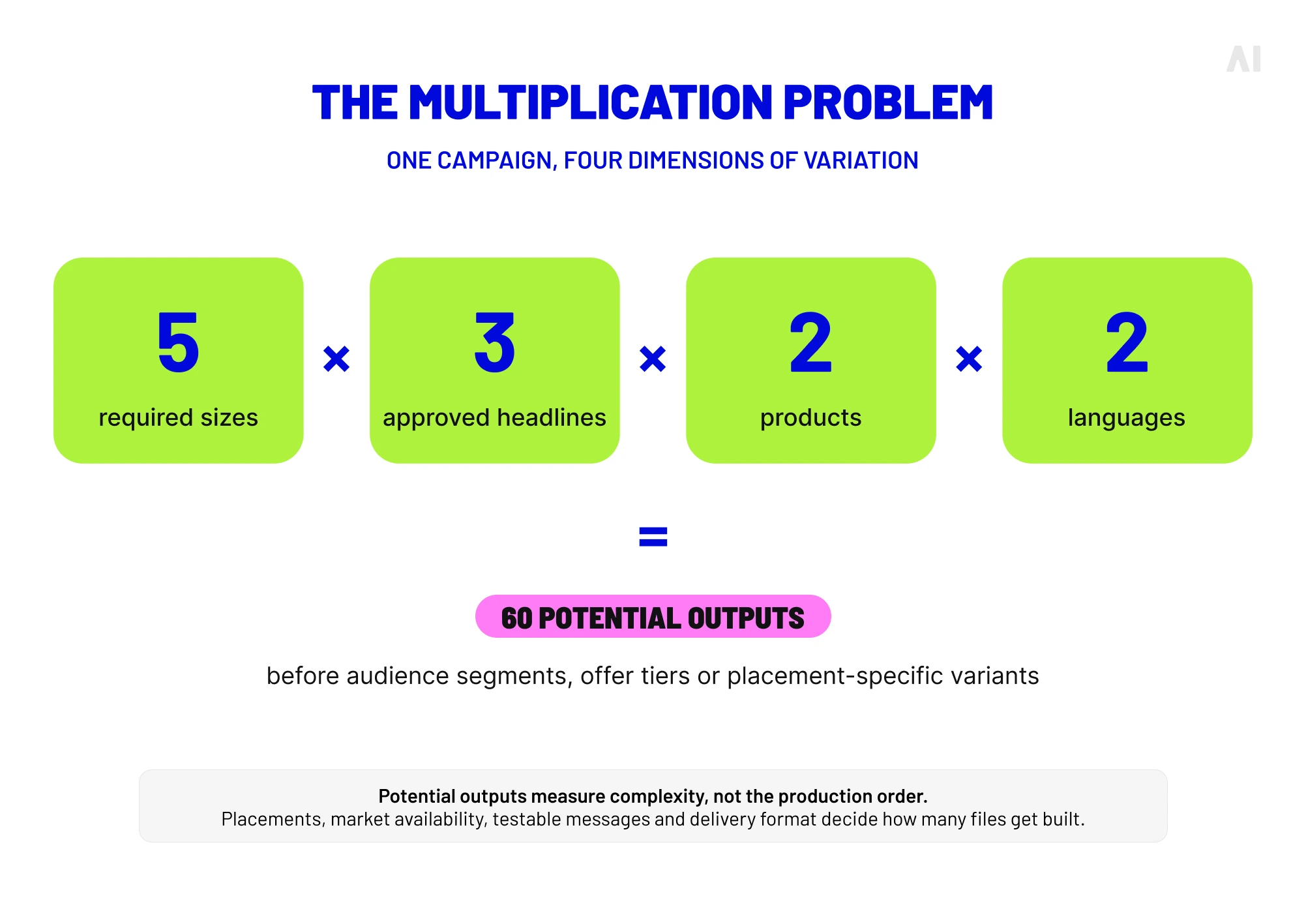
The workload grows through multiplication. Imagine a campaign with:
5 required sizes × 3 approved headlines × 2 products × 2 languages = 60 potential outputs.
That arithmetic illustrates the production problem, but it does not justify creating all 60 files. The useful count depends on placements, market availability, testable messages and delivery format. A responsive campaign may need fewer source assets, while a direct publisher buy may require finished files built to exact specifications.
Every campaign multiplies sizes, messages and markets
Each production dimension creates dependencies. A headline may fit a large rectangle but overwhelm a mobile unit. One product shot may crop cleanly into a square while another needs horizontal space. A translated CTA may be longer than the original, and a local offer may require a different disclaimer.
These are design and information problems, not simple export tasks. The more dimensions a campaign combines, the more important it becomes to define which combinations are valid before anyone begins generating files.
Manual resizing and rebuilding create repetitive work
Manual ad resizing and banner production involve far more than changing canvas dimensions. Designers adjust hierarchy, shorten copy, recrop images, move CTAs and make room for legal text. Production teams replace products or prices, rename files and return to earlier versions when an offer changes.
Automation is best applied to the parts of that work governed by repeatable rules. Design judgment is still needed when a composition has to be reconsidered for a radically different proportion or a line of copy loses its force after being shortened.
More variations create more opportunities for errors
Volume magnifies small failures. An outdated price can spread across formats, a missing disclaimer can enter every language version and an old logo can reappear from an unmanaged folder.
A structured production system reduces those errors by giving every variable an approved source, applying changes consistently and making current versions easier to identify. Speed is useful, but consistency is often the more durable benefit.
How to produce banner ad variations with AI: Step-by-step workflow
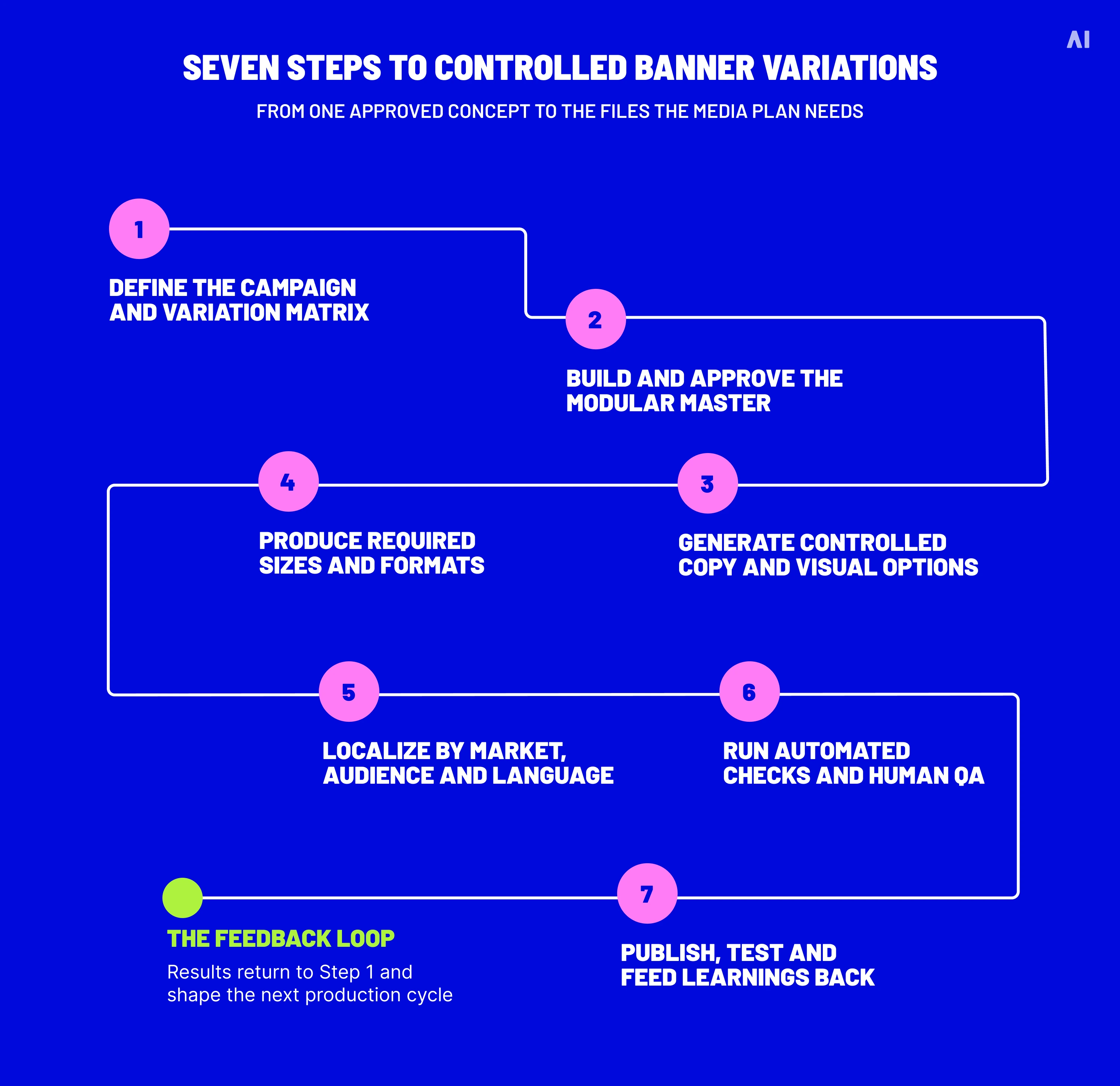
High-volume production becomes manageable when the campaign moves through a defined sequence. The following workflow keeps the creative idea, production data and media requirements connected from the start.
Step 1: Define the campaign and variation matrix
Begin with the objective, audience, offer, markets, placements and creative hypothesis. Then document what must remain fixed and what may vary. The variation matrix becomes the production brief and first defense against invalid combinations.
The source of truth need not be a complex feed. A controlled spreadsheet may be sufficient, provided teams know where approved information lives and who updates it.
Step 2: Build and approve the modular master creative
The master creative is the system that every variation will inherit. It should define the visual hierarchy, product prominence, headline area, CTA treatment, typography, imagery, brand elements and legal space. Reusable components might include product modules, offer blocks, backgrounds, badges, logos and disclaimers.
Good modular ad design lets components behave differently under defined conditions. The headline area may have a line limit and product imagery may have crop-safe boundaries. A narrow layout may move the CTA below the offer, while a wider format holds them side by side. Legal copy needs protected space and a minimum type size.
Test the master with realistic extremes: the longest headline, widest product, most demanding translation and largest legal block. Automation reproduces weaknesses in the underlying system, so an unresolved concept becomes more expensive once multiplied.
Step 3: Use AI to generate controlled copy and visual options
AI generation can broaden an approved campaign direction through headline variants, CTA wording, message angles, background concepts, image extensions and alternative product treatments. Its role is to supply options quickly, not grant automatic approval.
Display is already a prominent use case: 73% of advertisers in IAB's 2026 study said they used AI for display ads. That scale makes input discipline especially important. Prompts and source materials should include verified product facts, approved terminology, prohibited claims, brand references, market restrictions and practical limits such as headline length.
AI-generated banner ads should pass the same review as manually produced work. Copy must be checked against the source material. Generated imagery needs inspection for product inaccuracies, implausible details, licensing concerns and visual elements that conflict with the brand. An alternative becomes “high-performing” only after credible campaign evidence supports that description.
Step 4: Generate the required size and format variations
The media plan should determine which files are produced. For fixed-size image or HTML5 banners, creative automation can apply the approved system across required dimensions, but each layout still needs rules for hierarchy, copy fit, cropping, CTA placement and legal information.
Static banners are completed compositions. Animated and HTML5 banner ads add timing, transitions or interaction, introducing technical checks alongside visual review. Google accepts uploaded images in common formats and HTML5 ads as packaged files, while its HTML5 specifications define packaging and code requirements. Other platforms may set different limits, so specifications should come from the buying plan.
Responsive formats require another approach. Instead of exporting every finished size, the team supplies high-quality assets that can survive platform assembly. Images need usable crop space, headlines must make sense with several descriptions and every permitted combination must comply with the campaign's rules.
Resizing should never mean shrinking a master layout proportionally until it fits. A leaderboard, square unit and narrow mobile banner present different reading conditions. The composition must adapt to the space, even when the components remain consistent.
Step 5: Produce market, audience and language versions
The same template can support local languages, currencies, products, offers, CTAs and imagery. Map those fields to approved sources and prevent unavailable products or expired offers from entering the wrong market.
Banner localization needs more than machine translation. Reviewers must consider tone, local usage, cultural context and copy expansion. Prices, claims, dates and legal requirements need verification. A translation can be linguistically correct yet fail as display copy because it is too long, too literal or poorly matched to the visual.
Audience versions require similar restraint. Each angle should be approved and connected to a real campaign hypothesis. Producing cosmetic rewrites for every segment adds review work without necessarily adding useful creative difference.
Step 6: Run automated checks and human QA
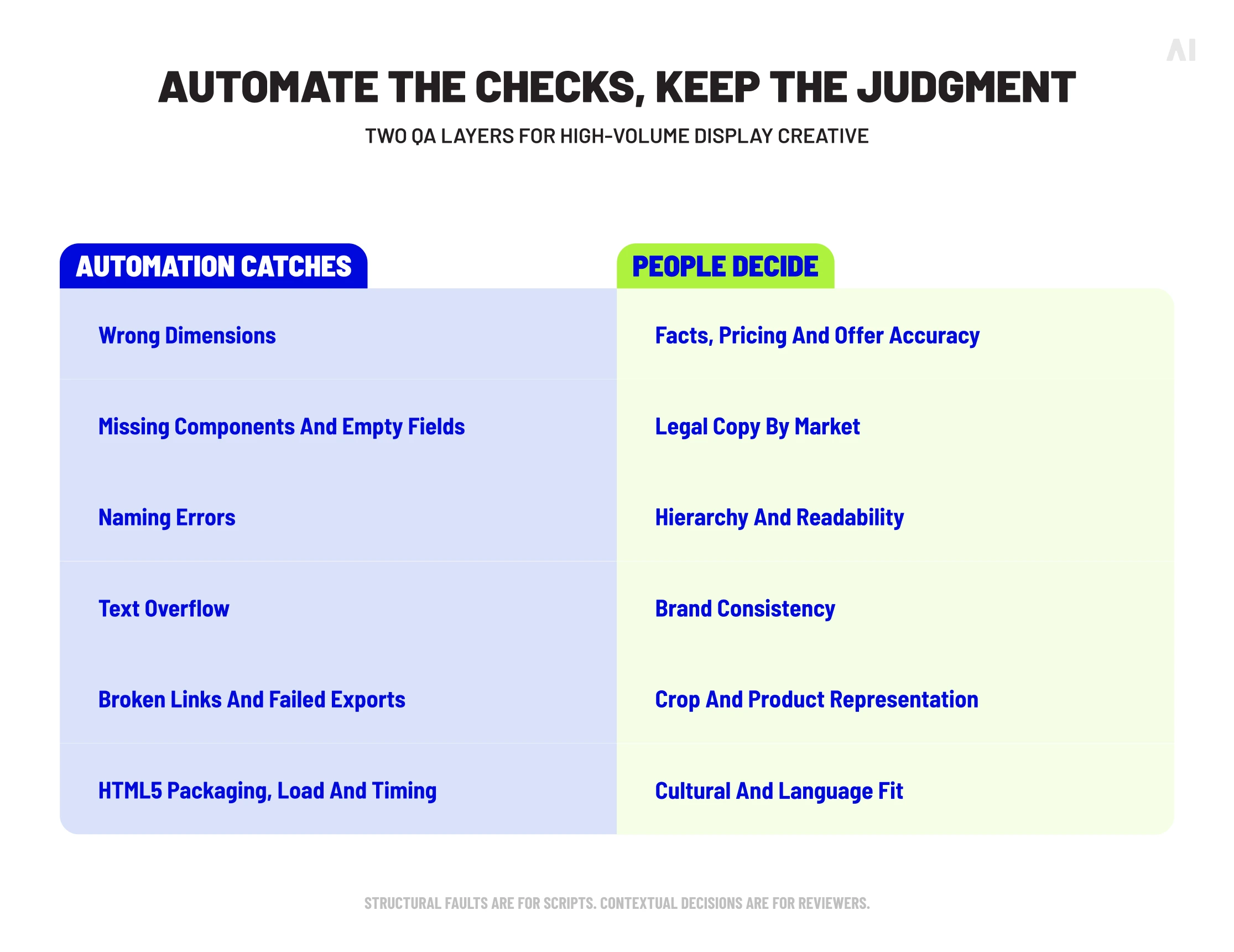
Creative QA can use automated checks to identify incorrect dimensions, missing components, empty fields, naming errors, text overflow, broken links and failed exports across hundreds of files. HTML5 and animated creative may also need checks for packaging, load behavior, timing and interaction.
Those checks do not determine if the offer is accurate, the crop is persuasive or the local wording feels natural. Human reviewers remain responsible for facts, pricing, legal copy, hierarchy, readability, brand consistency and cultural context.
The risk is already visible in current practice. IAB reported that 70% of marketers had encountered at least one AI-related advertising incident, while fewer than 35% planned to increase investment in AI governance or brand-integrity oversight. A production process that accelerates output without strengthening review can accelerate off-brand or inaccurate work as well.
The IAB AI Transparency and Disclosure Framework also recommends risk-based disclosure when AI materially affects authenticity, identity or representation. Routine assistance differs from synthetic imagery that could mislead viewers about a person, product or event.
⚡ Every variable needs an approved source, a defined limit and a reviewer.
Step 7: Publish controlled variations and feed learnings back into production
Published variations should retain identifiers connecting them to the master, message, market, product and format. That record shows what ran, helps retire outdated versions and returns credible findings to the next production cycle.
Testing should begin with a meaningful hypothesis. To understand a headline's effect, keep other major elements consistent where practical. If the headline, image, offer and CTA change together, the result describes the complete execution, not the contribution of one component.
Performance feedback can inform new AI banner ads without turning yesterday's strongest asset into a universal template. Audience, placement, timing and objective affect results. The useful outcome is a better-informed production cycle.
AI generation vs. creative automation vs. DCO
AI generation, creative automation and DCO can participate in one campaign, but they handle different jobs. Using the terms interchangeably obscures who controls the creative and where decisions occur.
Dynamic creative optimization adds a decisioning layer to modular production. Headlines, images, products, offers and CTAs can be selected using audience, contextual, behavioral or campaign signals. IAB Tech Lab's dynamic content standards similarly describe systems that can render and optimize creative components in real time.
AI may create the components, creative automation may prepare the variations and DCO may influence what is assembled or served. A campaign can use one of these approaches without using the others. Responsive AI display ads also remain dependent on the features and logic of their delivery platform rather than qualifying as full DCO by default.
How to scale banner variations without losing control
The gap between use and operational readiness remains substantial. IAB's State of Data 2025 found that only 30% of agencies, brands and publishers had fully integrated AI across the campaign lifecycle, while half lacked a strategic roadmap. Repeated high-volume production requires an operating model, not a collection of promts.
Use templates with clear guardrails
Creative templates should lock non-negotiable elements and expose approved fields. Guardrails can cover logos, colors, fonts, legal modules, image sources, copy limits and permitted combinations. Regional or performance teams then gain flexibility without inviting accidental redesign.
The template should also record fallback behavior. If a headline exceeds its limit, the system might route it for editing rather than reducing the type until it becomes unreadable. If a product image is missing, production should stop rather than publish an empty module.
Use structured data and a reliable source of truth
Structured data reduces copy-and-paste errors. Product names, prices, offers, translations and dates can come from a feed, database or controlled sheet, depending on campaign complexity and update frequency.
Ownership is as important as technology. Each source needs an editor, an approval status and a process for removing outdated entries. Creative versioning cannot compensate for an offer table that nobody maintains.
Design for content extremes and different banner sizes
Templates should be tested with short and long headlines, several product proportions, realistic translations, prices, badges and legal blocks. The aim is not to make one layout endure every case. It is to identify the layouts and rules required for the range the campaign will genuinely use.
Wide, square and vertical units may share components while using different compositions. Modular ad design protects continuity at the level of hierarchy and brand logic, rather than forcing every banner to look like a scaled copy of one canvas.
Define naming, versioning and approval rules
A naming structure might identify the campaign, market, product, message, format and version. Teams must know which asset is the approved master, which copy is current and which exports have been superseded.
Approval ownership should be explicit. Design reviews the composition, product owners verify facts, compliance checks regulated claims, local teams assess language and production confirms the final files. Higher output will otherwise move the bottleneck from design into an unprepared approval queue.
Automate checks, not final creative judgment
Rules can confirm that a logo exists, a field is populated or a file meets its required dimensions. They cannot reliably decide if AI-generated banner ads communicate the right idea, represent the product honestly or use imagery appropriate to a local audience.
Human review should concentrate on contextual decisions. Automation should support it by removing structural faults and presenting clear version histories.
Common failure modes include:
- scaling an unvalidated master concept;
- generating every possible combination instead of meaningful variations;
- changing too many variables in one test;
- using outdated product, price or offer data;
- treating resizing as sufficient design adaptation;
- treating localization as literal translation;
- allowing AI-generated copy or visuals to bypass review;
- measuring success by asset count.
Do hundreds of banner variations actually improve performance?
Greater production capacity gives a team more options to test and more markets it can support. It does not guarantee higher CTR, more conversions, lower CPA or stronger ROAS. Those outcomes depend on the creative idea, audience, media delivery, offer, landing experience and measurement method.
⚡ Asset count belongs on an operations dashboard, not a performance scorecard.
Measure production efficiency separately
Production metrics show if the system saves time and reduces rework. Advertising metrics show how the campaign performs. Creative learning records what the team can credibly carry into future work.
The total number of generated AI banner ads is not useful on its own. An asset creates operational value when it is required, accurate, approved and usable. It creates advertising value only when it contributes to a campaign objective or credible learning.
Validate advertising value through structured testing
Each variation should have a reason to exist. A benefit-led headline can be tested against an offer-led headline. A product image can be compared with a lifestyle treatment. Those differences should be intentional, documented and evaluated under sufficiently comparable conditions.
Media delivery must provide enough evidence for the decision, but no universal minimum applies. A low-volume B2B campaign and a national retailer have different conversion patterns, budgets and thresholds.
A stronger asset may show that the complete execution worked better for a particular audience and placement. It does not prove that each element belongs in future AI display ads.
When you should not generate hundreds of variations
High-volume banner automation is unnecessary when campaign complexity does not justify it. A small campaign with limited placements may need only a handful of polished files. A premium one-off execution may benefit from bespoke craft rather than modular production.
Generating at scale is also a poor choice when:
- the base concept has not been validated;
- the media investment cannot support useful comparison;
- source data is incomplete or unreliable;
- only a few creative differences are meaningful;
- the approval team cannot review the proposed volume;
- responsive or dynamically assembled formats already handle the required combinations.
The production plan should remove repetitive work, not invent extra work because the system can generate it.
How AI Digital helps scale banner and display creative
Teams that want AI display ads at volume without building the production system themselves can work with AI Creative Studio, the creative production unit AI Digital launched in May 2026 and expanded with the acquisition of a Barcelona creative agency in July.
The Studio pairs AI-powered production with human design and art direction, and its stated capabilities map onto the workflow in this article:
- static banner production,
- high-performance HTML5 banners and rich media,
- bulk resizing and adaptation,
- multi-platform versioning and cross-channel format adaptation,
- automated aspect-ratio resizing and asset downcuts, and
- localized variant tagging.
The Studio's description of the model, taking a client "from one concept to hundreds of variations," is the sequence this article has followed: an approved concept, extended across formats and audiences, with repeated production accelerated and human creative judgment retained throughout.
That positioning, "AI scale, human taste," reflects the division of labor the QA section described. AI accelerates the process; human judgment shapes the outcome, guided by strategy, brand discipline, and an understanding of where each asset will run.
Scale the creative system, not just the asset count
Successful banner production starts with a sound master creative and a clear account of what may change. Structured data supplies approved information, AI generation expands the option set and creative automation handles repeated adaptation. QA, governance and performance feedback keep that speed connected to accurate work and useful campaign decisions.
Teams planning to expand AI display ads across formats, audiences or markets can contact AI Digital to discuss a controlled production approach.