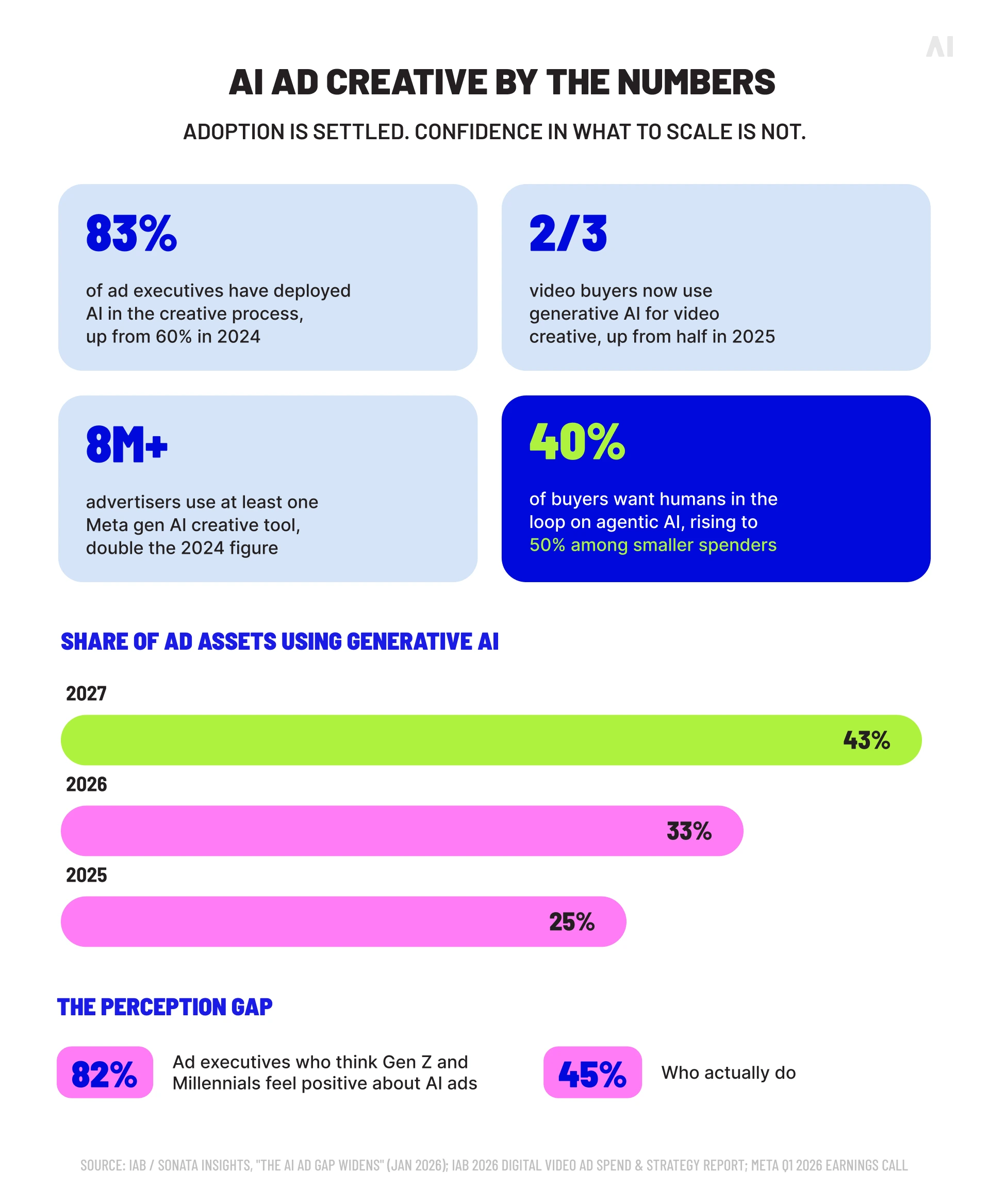
Four in five advertising executives now say their company uses AI somewhere in the creative process. IAB and Sonata Insights put the figure at 83%, up from 60% two years earlier, and generative AI advertising has followed that curve out of the pilot deck and onto national broadcast. Generative AI ads run in prime time. AI generated ads ship in a dozen markets before a traditional shoot would have finished casting. Two years on, teams can produce far more and still struggle to say which of that output deserves more money behind it.
What follows is a practical production loop, how to scale promising work without simply multiplying assets, and what performance signals can and cannot prove.
TL;DR: key takeaways
- Production speed is real and measurable. Timelines that ran in months now run in weeks, and single-asset turnarounds run in days.
- Asset volume is not an outcome. More ad creative does not mean better advertising, and volume belongs in no success metric on its own.
- Controlled variation beats open-ended generation. Scaling means building useful creative variations around a validated direction, not producing unrelated assets at random.
- Performance signals guide the next cycle without proving causation. A winning ad shows that a combination worked. It seldom shows which element did the work.
- Human review and disclosure have become operational requirements. Platform policy and consumer sentiment have both moved, and neither is housekeeping.
What is AI ad creative?
AI ad creative is advertising content created, adapted, or supported using generative AI and related AI technologies. That spans headline and body copy, still imagery, video, audio, and the multi-format versioning underneath a modern campaign. In practice it runs from a first-draft script to a thousand resized display units.
Two things frequently get bundled under the same label.
- AI-assisted production makes and adapts the asset.
- AI in advertising more broadly covers targeting, bidding, supply selection, and measurement, where models have worked for years without touching a single frame.
This article is about the first.
Where AI shows up depends heavily on how many versions a channel demands. According to the same IAB research, advertisers are most likely to use AI for social ads (85%) and display (73%), with 56% using it for TV and 42% for audio. Production economics explain the ranking: the more versions a format needs, and the cheaper each one has to be, the earlier AI arrived.
The role of AI in modern ad creative production
AI is useful at specific points in a creative workflow and unhelpful at others. It accelerates ideation and moodboarding, produces credible first drafts, generates original assets from a brief, adapts approved work across formats and languages, and absorbs the repetitive versioning that eats disproportionate studio time.
It does not set the strategy, write the brief, or decide what a brand stands for. AI-assisted production is one stage inside a longer process that begins with a business problem and ends with a human signature on the work.
IAB's 2026 Digital Video Ad Spend & Strategy Report puts numbers on the trajectory. Nearly two in three video buyers now use generative AI for digital video creative, up from half in 2025. A third of their ad assets will use generative AI this year against a quarter last year, with that share projected to reach 43% by 2027. Read those figures for what they describe: a growing proportion of assets inside workflows that remain human-directed.
An AI-assisted ad creative production loop
Ad creative automation works best as a cycle rather than a tool. Each stage produces an artifact, and each stage carries a decision that has to be made before the next one starts.
Start with a clear creative direction
Generative models are excellent at producing something and indifferent about producing the right thing. The difference sits entirely in the input.
Before anything gets generated, a team needs campaign objectives, a clear audience picture, the message hierarchy, the brand rules that cannot bend, the specific offer, and reference assets that demonstrate the intended tone. A vague brief yields plausible, generic output at enormous speed, which is a worse problem than a slow studio.
Generate initial concepts and assets
Treat generation as a funnel rather than a tap. Volume goes in, a small number of usable assets come out, and the ratio between them is a normal cost of the method rather than a sign something has gone wrong.
Generative AI earns its place by making exploration cheap. A team can test five tonal directions in an afternoon instead of committing to one and defending it for three weeks. The creative work happens after the generating: selecting, cutting, refining, and rebuilding the promising material into something a brand would sign off.
Create controlled variations
Once a concept is approved, AI can adapt it across the dimensions a campaign actually needs:
- Formats and aspect ratios, from a six-second bumper to a full display suite
- Placements, with the specs and safe zones each one demands
- Audiences, adjusting emphasis without changing the underlying proposition
- Offers and messaging, swapping the commercial hook while holding the creative frame
- Languages and markets, adapting rather than translating
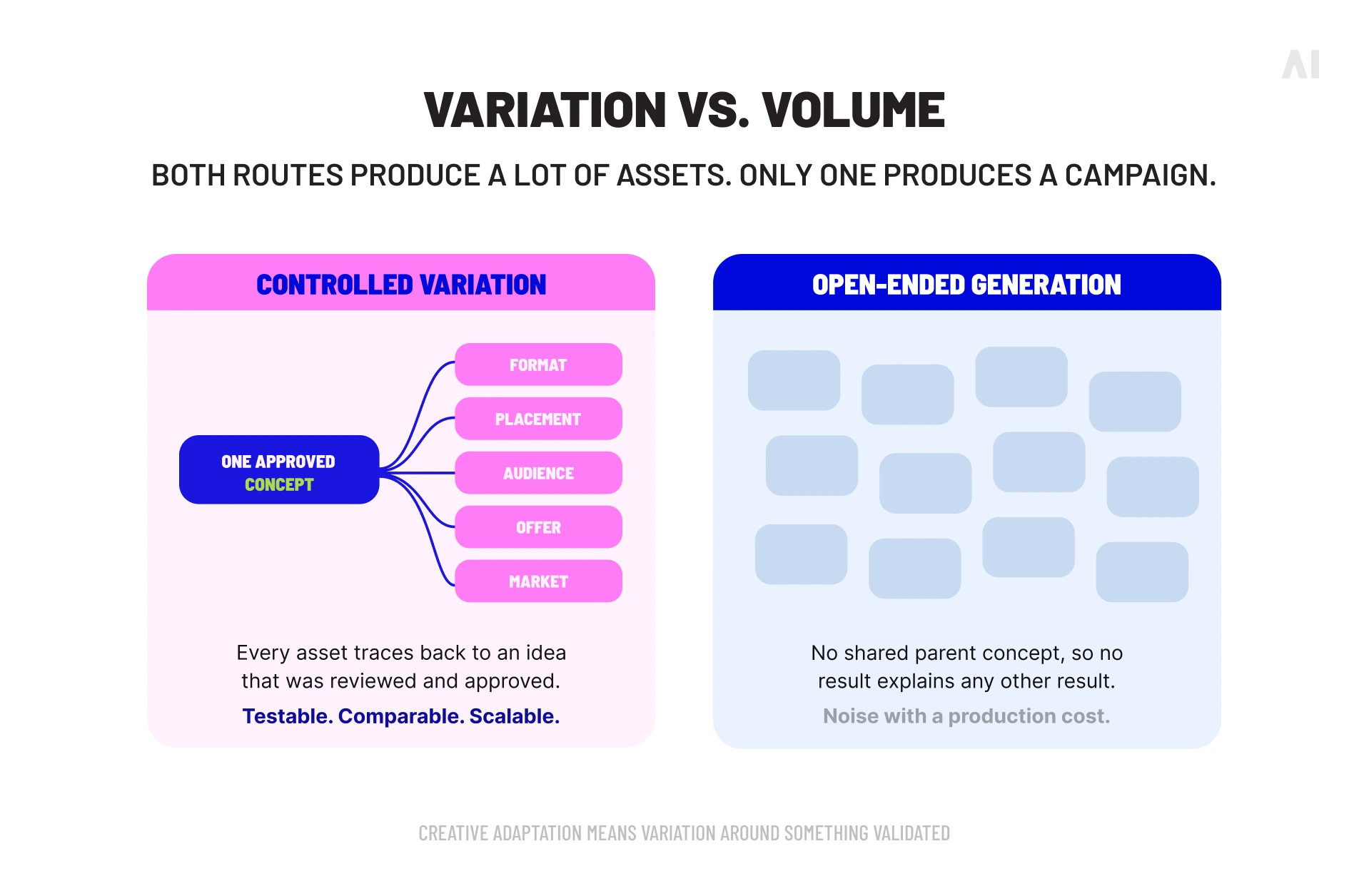
Every item on that list assumes an approved idea underneath it. Creative adaptation means variation around something validated. Generating a hundred unrelated assets is not adaptation, it is noise with a production cost attached.
Apply human review and quality control to generative AI advertising
Every asset needs a check before it goes live, and the checklist for AI-generated ad creative runs longer than the one for a conventional shoot:
- Brand consistency, including logo treatment, typography, and color accuracy
- Factual accuracy, particularly any product claim or specification
- Visual integrity, watching for the artifacts models still produce at the edges of a frame
- Claims and regulatory language, especially in regulated categories
- Localization, covering idiom, cultural reference, and local legal requirements
- Platform specifications, which change more often than most teams track
Buyers are asking for that oversight explicitly, though the clearest data covers automation in media buying rather than in the studio. IAB's 2026 Digital Video Ad Spend & Strategy Report found that while 96% of buyers see a role for agentic AI in programmatic, 40% want humans kept in the loop, rising to 50% among small and medium spenders, with 36% wanting an audit trail for explainability and 31% wanting guardrails limiting what agents can do unsupervised. The instinct transfers to creative with more force, not less, because the output carries the brand's name on it.
⚡AI has made generation cheap and selection expensive. The scarce resource in a modern creative team is no longer output. It is judgment about which output deserves a budget.
Launch, test, and collect performance signals
Once creative is live, look for patterns rather than winners.
- Which concepts hold attention.
- Which messages carry across audiences.
- Which formats deliver against the objective.
A high-performing ad demonstrates that a combination worked. It rarely proves which individual element caused the result. Creative, audience, placement, timing, and bidding all move together, and crediting the headline because the headline changed is the most common analytical error in creative performance work. Structure tests so the thing you want to learn about is the thing that varies.
Use learnings to guide the next iteration
Creative iteration works when the next production cycle inherits something specific from the last one. Prioritize the directions that showed promise, retire the ones that did not, and reserve a defined share of production capacity for ideas with no supporting data yet.
Skip that reserve and the loop converges on a local maximum, refining proven material until the audience tires of it, with nothing queued behind.
How to scale what works without just making more ads
Scaling creative is often described as producing more. A more useful definition: increasing useful variation around directions that have shown they work, while keeping enough diversity in the mix to find the next one.
The industry is drifting the other way. IAB and Sonata Insights found cost efficiency has become the top cited benefit of AI at 64%, up from fifth place in 2024, while creative innovation slipped from 64% to 61%. IAB reads that first number two ways.
- As a sign of maturity, since advertisers are applying harder metrics to what AI delivers.
- And as a warning, because using AI primarily to reduce production costs could undermine quality.
Scaling well means holding several things at once:
- Iterate in a controlled way. Change one meaningful variable at a time so the next round of data means something.
- Keep creative diversity alive. Concentrating all production behind one apparent winner leaves a campaign with nothing to fall back on when it fatigues.
- Respect audience and placement context. A concept that performs on short-form social will not necessarily survive a CTV pod, and scaling it into one without adaptation wastes both.
- Distrust a single strong result. One winner, one week, one audience, is a hypothesis. Treat it as one until it repeats.
Cheap production capacity plus thin performance signal produces a recognizable outcome: an enormous quantity of near-identical work, and an account with more assets than it has ideas.
What should be automated and what should stay human?
Execution divides from judgment. AI absorbs repetitive production work extremely well. Decisions with brand, legal, or cultural consequence stay with people.
The right-hand column reads as a job description rather than a list of restrictions. As production gets cheaper, the value of the people deciding what to produce goes up.
AI ad creative across formats, channels, and markets
The same loop applies everywhere. What changes is where the pressure lands.
Static and display creative
Display has lived with ad creative automation longest, because the format demands volume by design. AI supports concept imagery, layout exploration, message variation, and the resizing work that turns one approved design into a full placement suite. The review burden stays comparatively light and the efficiency gain arrives immediately.
Social, video, and CTV creative
Video carries the largest gains and the largest risks together. AI supports concept development, scripting, visual variation, voiceover, and repurposing long-form material into platform-native cutdowns. On Meta's first-quarter 2026 earnings call, the company reported more than 8 million advertisers using at least one of its generative AI ad creative tools, double the 4 million recorded at the end of 2024, with the majority of them small and medium-sized businesses.
The review bar rises with the format. Realism, motion coherence, tone, and brand fit all need human eyes, and a CTV placement gets scrutinized on a large screen by a seated audience in a way a mobile feed unit never does.
Multi-market and localized campaigns
Localization offers AI's biggest speed advantage and demands its tightest controls. A model will translate a script, adapt a visual, and render a market-specific version in hours. It will not tell you the resulting scene misreads locally, that the claim is not permitted in that jurisdiction, or that the terminology is wrong for the category.
Language adaptation is a production task. Cultural judgment is not, and the distance between them has produced some of the most instructive public examples in the category.
AI-generated advertising examples: what teams can learn
Three campaigns cited in IAB's research illustrate three different production lessons. Each is worth reading for what it reveals about method rather than for any performance claim.
Kalshi: cheap is not the same as easy
In June 2025, the prediction market platform ran a fully AI-generated 30-second spot during an NBA Finals game. NPR reported that the ad appeared in the YouTube TV stream of Game 3 on 11 June, took two days to make, and cost under $2,000 in prompting, running alongside spots that likely cost hundreds of thousands of dollars and took months to produce. Reaching 15 usable clips took roughly 300 to 400 generations. Its director, an advertising veteran, added the line worth carrying out of the whole example: "Just because this was cheap doesn't mean anyone can do it." Generation behaved as a funnel, and the selecting was done by someone with a career of commercial directing behind them. NPR also notes that Kalshi's resemblance to a betting platform has drawn scrutiny from gambling regulators, which is worth knowing before treating the campaign as a template.
Coca-Cola: production scale is a coordination problem
The brand's 2025 "Holidays Are Coming" campaign rebuilt its truck spot with AI studios Silverside and Secret Level. TODAY reported, citing the campaign's behind-the-scenes film, that five specialists generated and refined more than 70,000 video clips over 30 days. Coca-Cola has said around 100 people worked on the project overall. Chief marketing officer Manolo Arroyo told the Wall Street Journal, as reported by MediaPost, that the process moved from starting a year in advance to taking about a month.
Two observations follow.
- The timeline compressed dramatically while the team stayed large, which suggests AI redistributed the work rather than removing it.
- And audience response remained mixed for a second consecutive year despite visibly improved craft, which suggests reception is a separate problem from throughput.
Volvo: local speed can outrun central governance
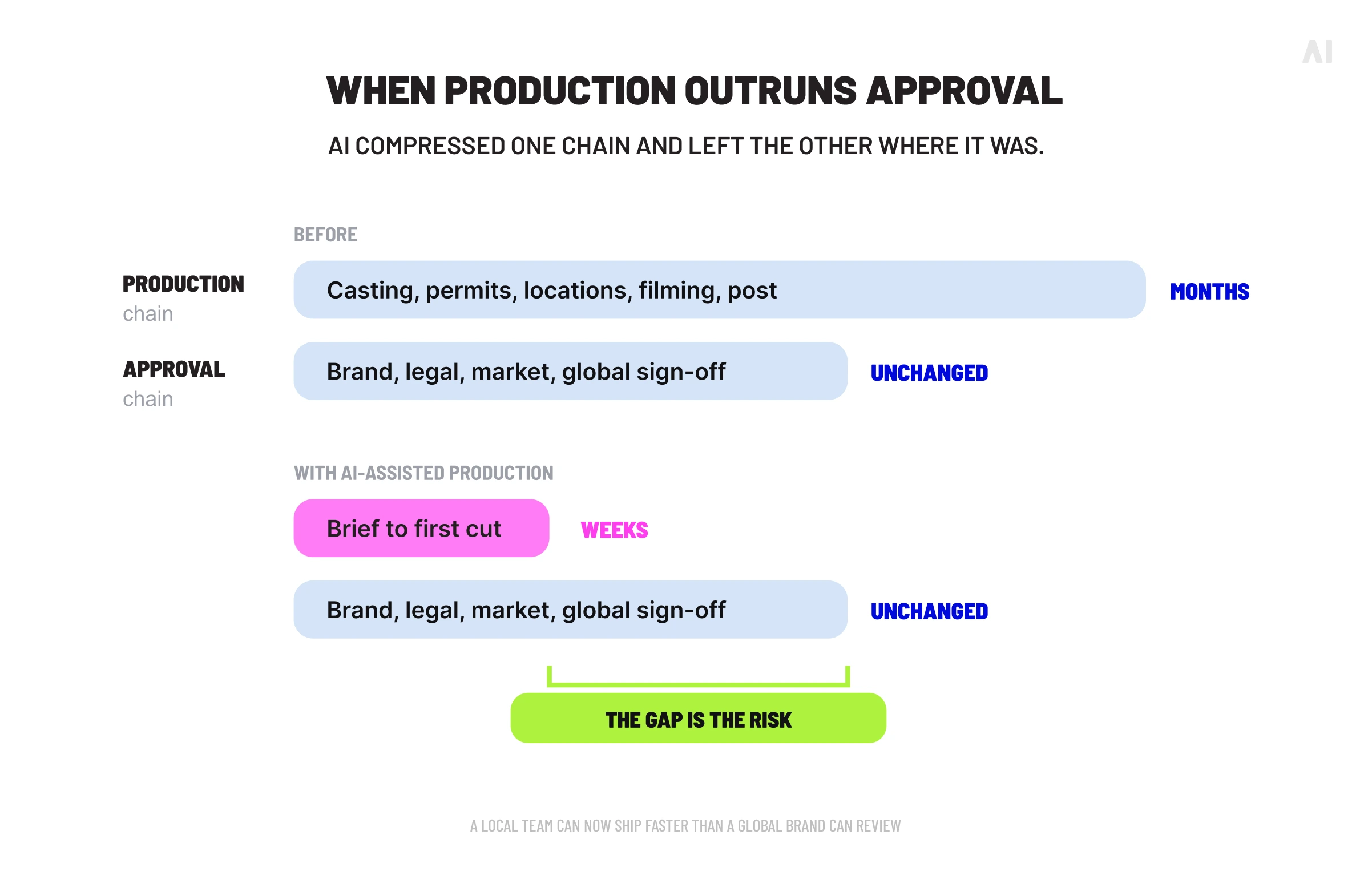
In March 2025, Fast Company covered Volvo's first fully AI-generated brand film, made by Dubai agency Lion Creative for the Saudi market, narrated in Arabic, and built without showing a car. The agency reported that AI cut production timelines from months to weeks. Days later, Jalopnik obtained a statement from Volvo describing the ad as a local initiative that fell outside Volvo Cars' global guidelines, and confirming it was being withdrawn. Nothing failed technically. The approval chain simply did not move at the speed of the production chain.
⚡ Speed changes what a brand can produce. It does not change what a brand can stand behind, and the distance between those two things is where most AI creative goes wrong.
AI ad creative vs. dynamic creative optimization
The two get conflated often enough to be worth separating.
- AI ad creative sits upstream, in production. It generates original material, produces variants, localizes, and versions. The output is a library of creative.
- Dynamic creative optimization happens at delivery. It assembles or selects creative components in real time using campaign data, business rules, and delivery logic, so different users see different combinations of the same modular assets.
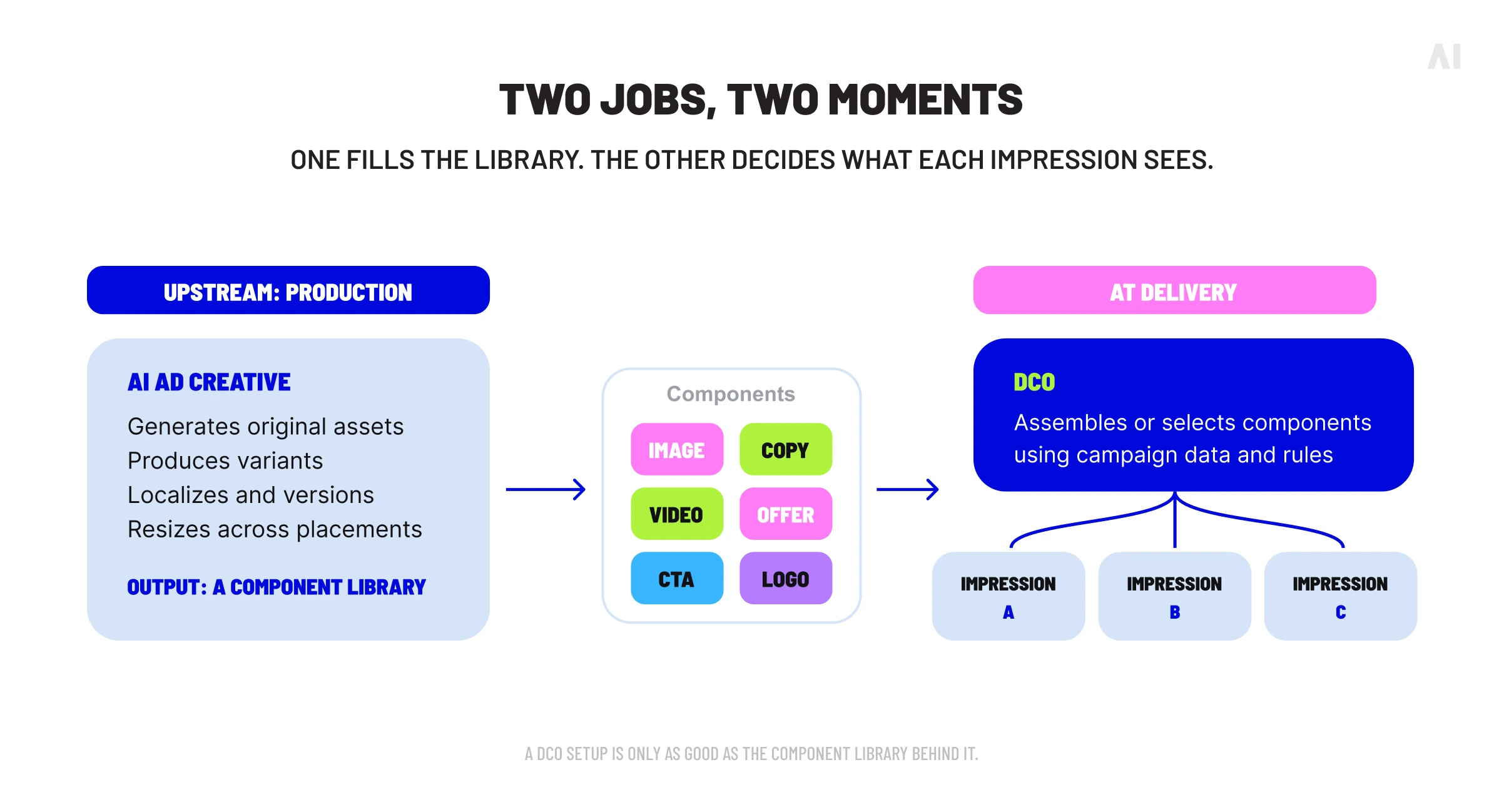
They compose neatly. AI creative production fills the component library faster and more cheaply than a studio can, and DCO decides which components a given impression receives. Neither replaces the other, and a DCO setup drawing on a thin component library will underperform however good the delivery logic is.
How to measure AI ad creative success
Production efficiency and advertising performance answer different questions, and running them on one scoreboard lets a genuine gain in one hide a loss in the other.
Asset volume belongs in neither column. Producing three hundred assets describes activity, not a result.
Buyers have started saying so. IAB's 2026 Digital Video Ad Spend Report found 96% of smaller buyers are not satisfied with their current level of generative AI use for creative ad production, which is a complaint about doing too little of it rather than too much. What holds them back is the instructive part: more than four in ten want better proof of performance, alongside easier integration with platforms and DSPs. The appetite is there. The evidence to justify it is what's missing.
The same causal caution applies here as at the testing stage. Performance signals should inform the next round of creative iteration, and they do that job well. Isolating which creative element produced a result is beyond them, and a measurement framework that assumes otherwise by default will send the next production cycle in a confidently wrong direction.
Risks and guardrails for AI generated ads
Most of what goes wrong is a review failure rather than a technology failure:
- Off-brand output that passes a casual look and fails a brand audit
- Factual errors in product claims, specifications, or pricing
- Unrealistic or artifact-laden imagery that undermines credibility
- Misleading impressions created by synthetic depictions of real products or situations
- Inconsistent quality across a large batch, where the first ten assets get scrutiny and the next ninety do not
- Intellectual property exposure around training data, likeness, and style
- Disclosure obligations that vary by platform and jurisdiction
- Audience reaction, now a measurable commercial risk rather than a reputational footnote
On that last point, advertisers are working from a flawed picture. IAB and Sonata Insights found 82% of executives believe those consumers feel very or somewhat positive about AI-generated advertising, against 45% of consumers who actually do. The gap widened from 32 points in 2024 to 37 points in 2026.
Disclosure narrows it, and remains under-used. The same research found 89% of advertisers using generative AI disclose at least sometimes, but fewer than half always do, a split essentially unchanged since 2024. Meanwhile 73% of Gen Z and Millennial consumers said knowing an ad was made with AI would either increase their purchase likelihood or make no difference to it. IAB's own reading is that disclosure carries more upside than downside with those audiences, which is a narrower claim than it first appears: the survey covers Gen Z and Millennial consumers, so treat it as evidence about who you are advertising to rather than a universal rule.
Platform policy is moving in the same direction. On 9 July 2026, Google introduced a "How this ad was made" panel in My Ad Center across Search, YouTube, and Discover. Ads built with Google's own generative AI tools are labeled automatically. Ads built with third-party tools depend on the advertiser using a new control to declare AI use, and TechCrunch reported that Google will not run its own check to confirm those declarations. Per Google's advertising policy documentation, the label setting rolled out through July across Google Ads, Display & Video 360, Campaign Manager 360, Merchant Center, and Ads Editor, and AI regulations in the European Union, India, and New York require disclosures or labels on certain AI-generated or edited assets.
Two things follow for anyone building a workflow.
- Treat legal and disclosure requirements as platform-specific and jurisdiction-specific, and verify current rules before making definitive claims in any market. Google's own documentation states plainly that using its AI label setting does not guarantee compliance with a given regulation, and advises seeking legal guidance.
- Then keep a creative-origin record for every asset, covering which tools touched it and who approved it, because that record is what makes accurate disclosure possible at all.
IAB's AI Transparency and Disclosure Framework is the standing industry reference for applying this consistently as rules continue to change.
One guardrail underpins the rest: no AI-generated asset is production-ready on generation. It is a draft until a person has verified it.
How AI Digital helps scale ad creative production
AI Creative Studio is AI Digital's answer to the production side of this problem. It pairs AI-powered production with human creative oversight, supporting brands and agency partners across creation, adaptation, localization, versioning, and iteration, from cinematic video and platform-native social content to interactive HTML5 and CTV formats.
Since launching in May 2026, the Studio has taken work that traditionally requires casting, permits, locations, filming, and post, an 8-to-12 week process, down to a first cut in approximately a week, at a fraction of the cost.
The human layer underneath that has been growing too. In July 2026, AI Digital acquired a Barcelona-based creative agency specifically to bring dedicated art direction and design capability in-house, deepening the human side of its AI plus Human Intelligence model. The reasoning was that rising production volumes should not cost brand consistency, strategic judgment, or visual quality. As chief strategy officer Mary Gabrielyan put it, most creative teams understand design, and AI Digital's advantage is that it also understands media: how an asset performs by placement, audience, and format, rather than only how it looks.
That is the boundary of the offer. AI Creative Studio is a creative production partner, not an autonomous ad generator, a media optimization platform, or a replacement for the workflow tools a client already runs. It makes and adapts the creative. Decisions about what to scale stay with the people running the campaign.
Conclusion on generative AI advertising: Scale creative output without losing creative control
The teams doing this well are not the ones producing the most. They are the ones running five things at once:
- clear creative direction before anything is generated,
- controlled variation around ideas that have been approved,
- reliable performance feedback rather than confident guesses about causation,
- genuine human review before anything goes live, and
- honest measurement that keeps production efficiency and campaign performance in separate columns.
Generative AI removed the production constraint that governed how advertising teams worked for decades. What replaced it is a judgment constraint, and that one does not respond to more compute.
If you are working out how to scale creative production without losing control of the creative, get in touch.