
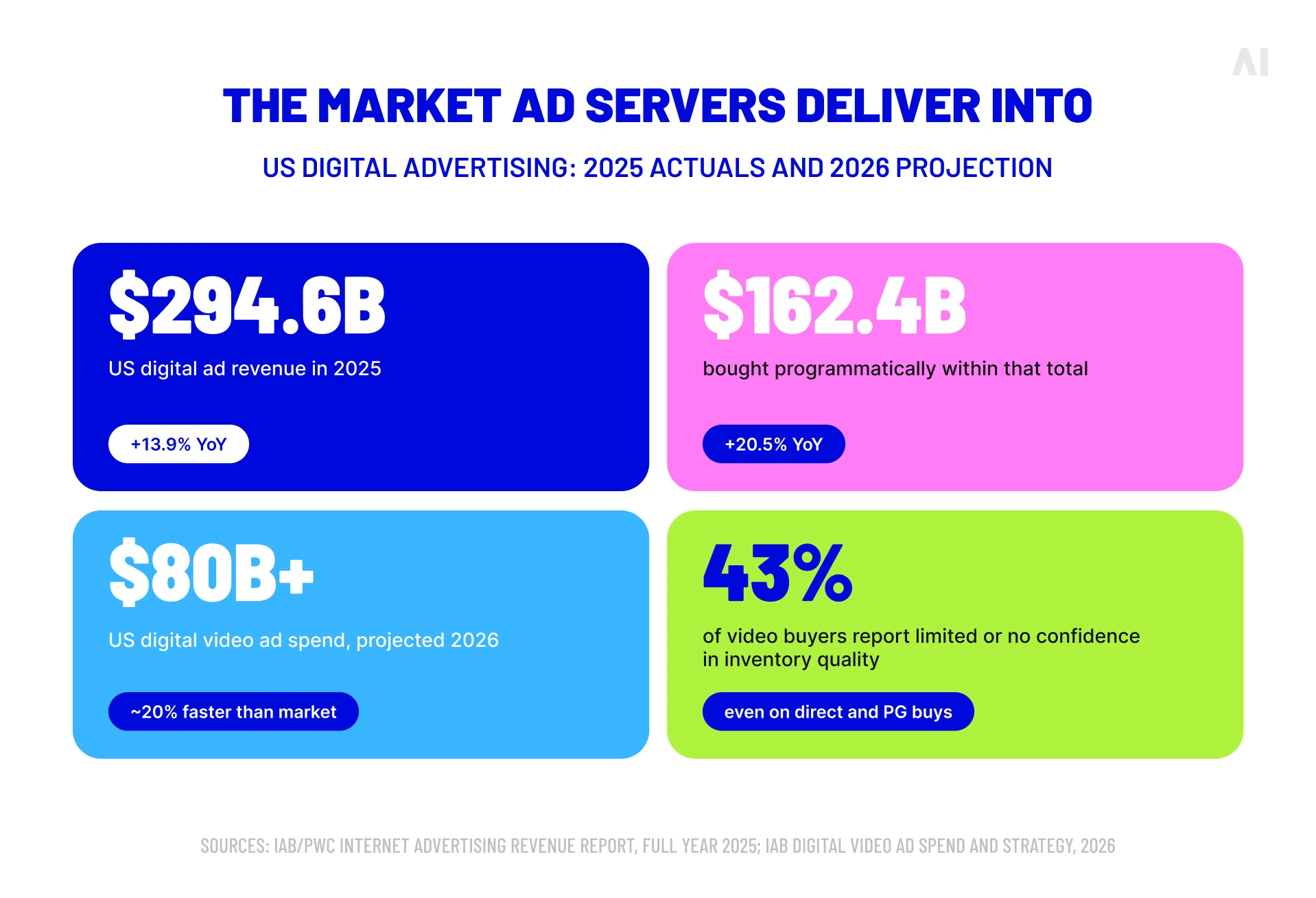
Programmatic buying gets the attention. Ad serving does the work. An ad server is the technology that decides which creative reaches a given placement, delivers it, and records what happened next, and it has been doing that job since the mid-1990s. Three decades later the US digital advertising market reached $294.6 billion in 2025, up 13.9% year over year, according to the IAB and PwC. Almost none of that spend reaches an audience without passing through ad serving technology at some point.
TL;DR: ad server
- An ad server manages, selects, delivers, and tracks digital advertising. Ad serving is the process; the ad server is the system that performs it.
- Publisher-side ad servers decide which campaign fills an available placement. Advertiser-side ad servers deliver the creative and record delivery independently. Both can take part in the same impression.
- First-party and third-party describe the ad server's relationship to the publisher or the advertiser. The terms have nothing to do with cookies or data types.
- Hosted and self-hosted describe who runs the infrastructure. Open source and proprietary describe how the software is licensed. The two distinctions are separate.
- Ad servers do not buy media and do not run auctions. DSPs, SSPs, and exchanges handle the transaction; the ad server handles delivery and the record of it.
- Every ad server tracks impressions and clicks. Beyond that, capabilities vary by platform, tags, and integrations.
Confusion sets in because so many platforms now overlap. DSPs serve creatives. SSPs report impressions. Ad servers target audiences. The categories blur at the feature level while staying distinct at the decision level.
This article covers what an ad server is, how ad serving works, the main types of ad servers and how they differ, where the ad server sits relative to platforms used to buy and sell media, what ad serving actually measures, and when advertisers or publishers need dedicated ad serving technology rather than the tools already built into their buying platform.
What is an ad server?
An ad server is technology used to manage, select, deliver, and track digital advertising. It holds the creative assets, applies the rules that govern where and when those assets can appear, responds to ad requests with an eligible ad, and logs the result.
The ad server is a system. Ad serving is what it does: deliver an eligible creative to an advertising placement, millions of times a second across the open web, apps, streaming, and digital out-of-home.
Two groups operate ad servers, for different reasons.
- Publishers and media owners use them to control which campaigns fill their inventory, honor guaranteed commitments, and produce billing records they can defend.
- Advertisers and their agencies use them to centralize creative across multiple buying platforms and to hold a single independent count of delivery. Those two roles produce two different kinds of ad server, covered below.
Within the wider ad tech stack, the ad server occupies the delivery and control layer, downstream of planning and buying and upstream of most analysis.
⚡ An ad server does not decide what an impression is worth. It decides what happens once someone has already decided.
How does an ad server work?
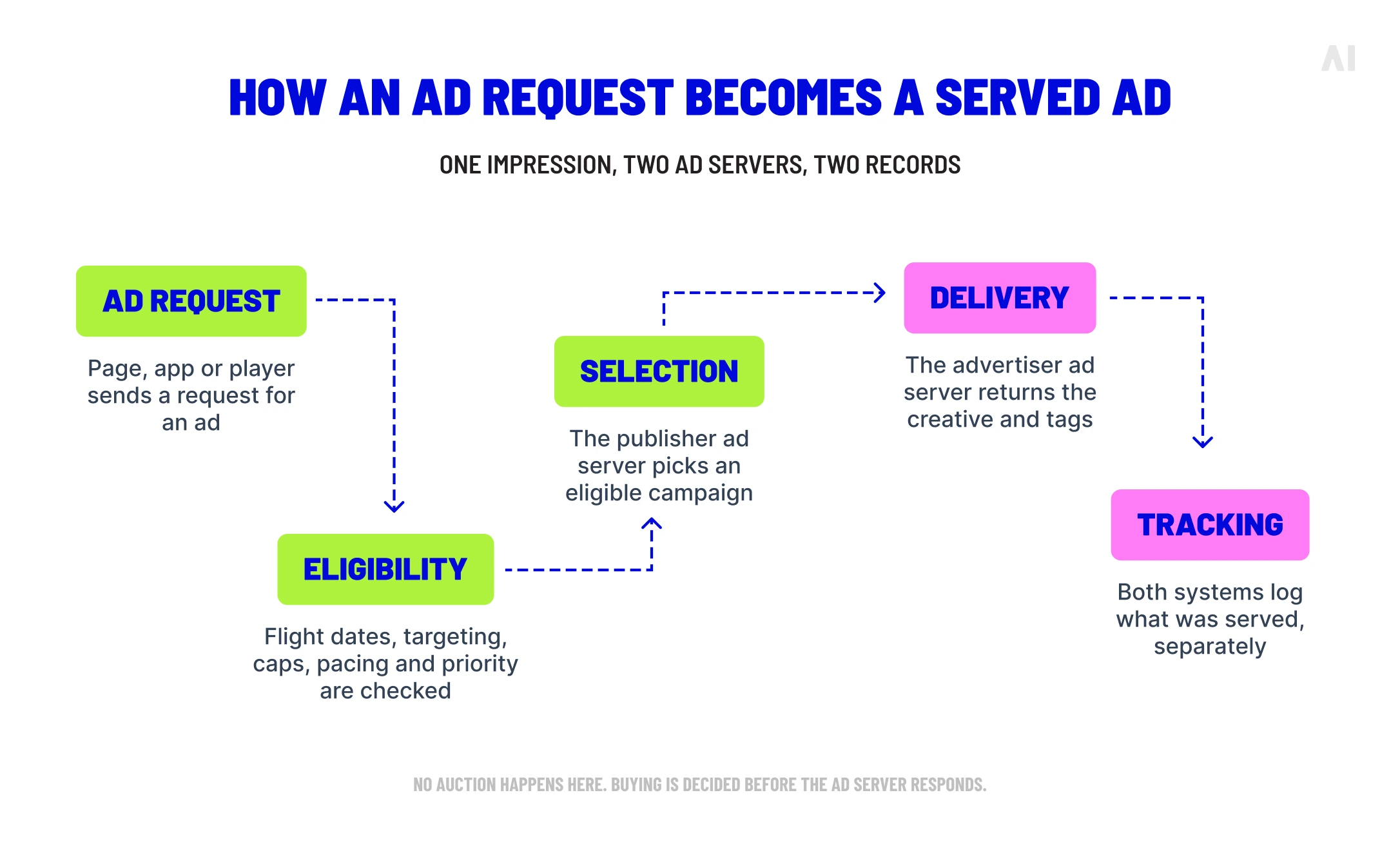
Ad serving begins with a request, not a bid. A page loads, an app opens, or a streaming ad break starts. The environment sends an ad request describing the opportunity: placement, format, device, and whatever contextual or consent signals are available.
On the publisher side, the ad server evaluates which campaigns are eligible for that request. Eligibility depends on flight dates, targeting rules, frequency caps, pacing, and business priority, since a guaranteed sponsorship usually outranks everything else booked against the same placement. The ad server selects one and responds.
On the advertiser side, the response often points somewhere else. If the winning campaign uses a third-party ad tag, the publisher's ad server returns that tag rather than the creative itself, and the advertiser's ad server then delivers the actual asset and fires its own tracking.
So one impression can leave two records. The publisher's ad server logs what it selected; the advertiser's ad server logs what it delivered. Neither is wrong, and the two counts rarely match exactly.
Neither step is an auction. Auctions decide who buys the impression and at what price, and they finish before the ad server does its job. Where programmatic demand is involved, the ad server passes the opportunity out to the market, receives a winner, and returns to what it does: rendering and recording.
Video and connected TV work slightly differently. Rather than returning an image or an HTML5 unit, the ad server responds with a VAST tag, an XML file telling the video player which media file to play and which events to report back. VAST is maintained by IAB Tech Lab, and the current core version is 4.3, with a separate addendum covering connected TV.
US digital video ad spend is projected to pass $80 billion in 2026, growing nearly 20% faster than the total ad market, so support for these formats has stopped being optional on either side.
Types of ad servers
Ad servers get classified in more than one way, and the classifications are not interchangeable. One describes the ad server's role in the advertising relationship. The other describes how the technology is deployed. A single platform sits somewhere on both.
First-party vs third-party ad servers
The dividing line here is whose campaign the ad server works for.
- A first-party ad server is operated by the publisher or media owner. It manages inventory, decides which campaign fills each placement, enforces the publisher's own rules on pricing and adjacency, and produces the delivery record used for invoicing advertisers. Its reporting reflects what the publisher served across its own properties.
- A third-party ad server is operated by the advertiser or agency. It hosts and delivers creative across many publishers and buying platforms, applies rules such as creative rotation and cross-publisher frequency, and produces an independent count of delivery. Its reporting reflects one advertiser's campaign wherever it ran.
First-party and third-party here describe the ad server's relationship to the publisher or advertiser, nothing more. They say nothing about whether the system uses first-party or third-party cookies, and a third-party ad server does not become a first-party ad server by moving to first-party data.
Hosted vs self-hosted ad servers
Deployment is a question of who owns the infrastructure.
- A hosted ad server runs on the vendor's infrastructure and reaches the customer as a service. The vendor handles uptime, scaling, patching, and security of the platform itself. Setup is faster, capacity absorbs traffic spikes without intervention, and customization stays within whatever the platform exposes.
- A self-hosted ad server runs on infrastructure the operator controls. That brings deeper customization, direct access to log-level data, and full ownership of where the data sits, along with responsibility for servers, scaling, database performance, and every security update. Ad serving is latency-sensitive and effectively always on, so that responsibility is not trivial.
Open source and proprietary form a separate distinction about licensing rather than deployment. Some self-hosted platforms are open source; others are licensed products. Revive Adserver shows why the two pairs are not synonyms: it is open source software under the GNU General Public License, available as a free self-hosted download, and also sold as a paid hosted edition. Same software, either deployment model.
⚡ Deployment answers who runs the servers. Licensing answers who can change the code. Confusing the two produces vendor shortlists that make no sense.
Where ad servers fit in the programmatic ecosystem
The ad server is not the marketplace. It sits beside the platforms that buy and sell media.
DSPs buy on behalf of advertisers, bidding impression by impression across many supply sources. SSPs package and sell publisher inventory into those markets. Ad exchanges run the auctions where the two sides meet. Programmatic advertising on this model now accounts for $162.4 billion of US ad revenue, up 20.5% in 2025 and growing faster than the market overall.
Ad servers touch every one of those transactions without taking part in them. They render what the auction awarded, enforce the rules the auction knows nothing about, and record the outcome.
💡 For a fuller treatment of the buy-side comparison, see ad server vs DSP. For the full route an impression travels from budget to screen, the digital advertising supply chain explainer covers it end to end.
What do ad servers track and measure?
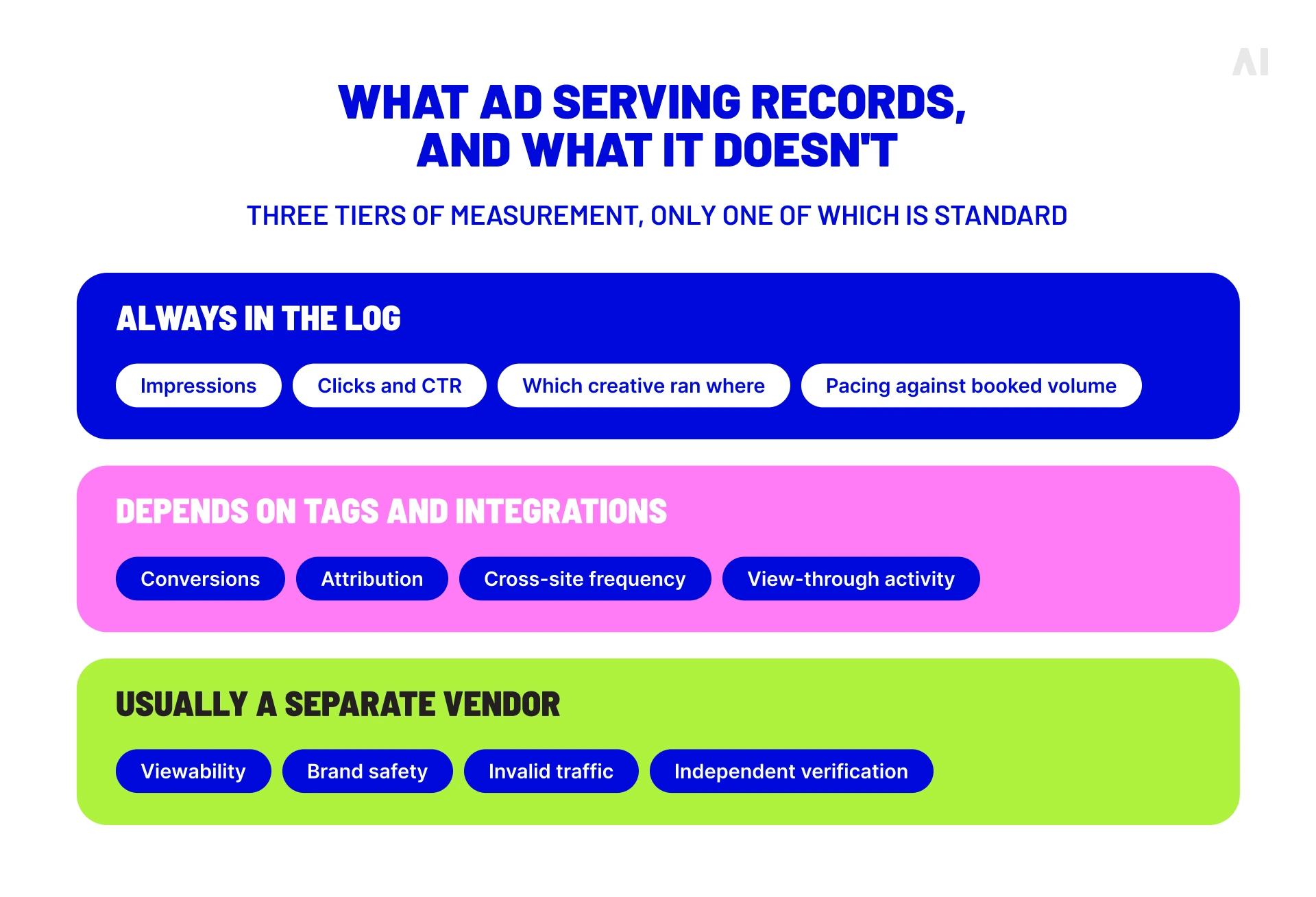
Ad serving produces the raw record of delivery. Every ad server captures the basics:
- Impressions, meaning ads delivered and rendered
- Clicks and click-through rate
- Creative delivery, including which version ran where
- Campaign activity by placement, publisher, and flight
- Pacing against booked or budgeted volume
- Frequency, where the environment supports the identifiers required to measure it
Everything past that list varies.
- Conversions depend on tags placed on the advertiser's own site and on an attribution setup that survives current browser restrictions.
- Viewability and verification usually depend on a third-party measurement vendor rather than the ad server itself.
- Attribution depends on integrations and a definition of success agreed in advance.
None of these should be assumed as standard features of every ad serving platform, and buyers get caught out when they are.
Timing complicates it further. Revised industry guidelines from the MRC, IAB Tech Lab, and MMA moved valid impression counting to a count-on-begin-to-render minimum, later in the ad serving process than earlier standards allowed. Systems that count at different moments in the same ad call will report different totals, by design.
Common ad serving challenges
Most ad serving problems are operational rather than technological, and they surface in reporting before anyone notices them in delivery.
- Tag errors. A truncated tag, a missing cache-buster macro, or an unencoded click macro breaks tracking while the ad appears to run normally.
- Creative mismatches. Dimensions, file weight, or format specs that clear internal review but fail the publisher's, leaving placements unfilled.
- Tracking discrepancies. Publisher and advertiser ad servers counting at different points in the same ad call, which is expected rather than exceptional.
- Latency. Every redirect in the chain adds milliseconds. Enough of them and the creative loses the race against the user scrolling past.
- Inconsistent counts across platforms. DSP, ad server, and verification vendor totals that never quite reconcile because each measures something slightly different.
- Unsupported formats. Interactive, high-impact, and newer CTV units that one system renders and another rejects.
None of these is fatal in isolation. Together they explain most of the reconciliation work that consumes ad operations teams at the end of every month.
Examples of ad server platforms
Publisher-side and advertiser-side tools stay genuinely distinct products, even inside one company's portfolio. And ad serving keeps specializing, with retail media pulling the category toward API-first infrastructure built for owned inventory rather than the open web.
When do you need an ad server?
Dedicated ad serving technology becomes useful once delivery has to be controlled and proven, not simply achieved.
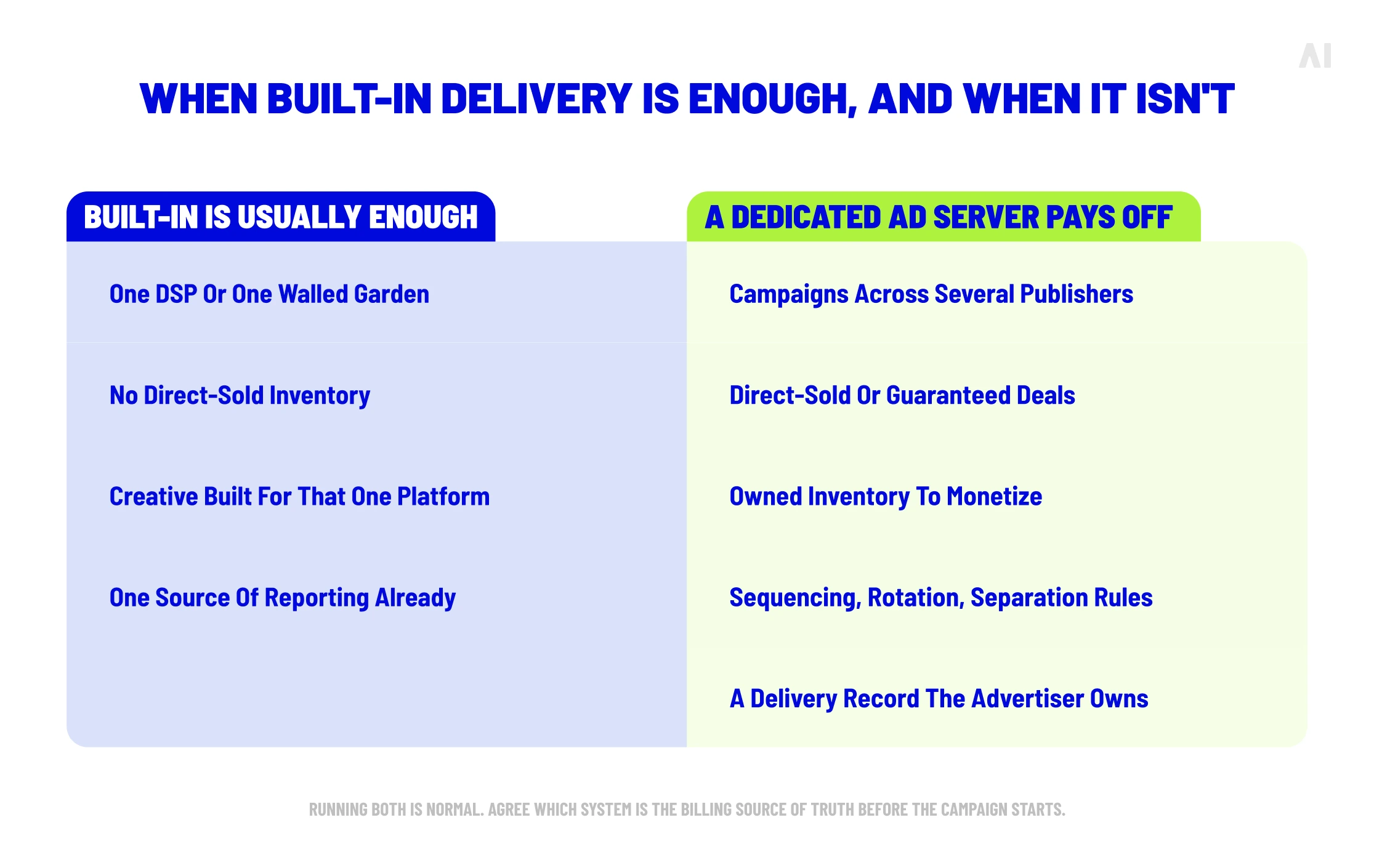
- Multi-publisher campaigns. Running the same creative across several publishers and platforms, and needing one independent count of what ran.
- Direct-sold inventory. Any media owner selling placements against guaranteed commitments needs delivery logic and records that hold up in a billing dispute.
- Complex creative rules. Sequencing, rotation, competitive separation, or approval workflows that a buying platform will not enforce.
- Owned inventory of any kind. Retailers, marketplaces, and app publishers monetizing their own placements.
- Independent reconciliation. Where reported delivery needs to be verifiable against something other than the seller's own numbers, a growing concern given that 43% of video buyers report limited or no confidence in inventory quality even for direct and programmatic guaranteed buys.
Plenty of advertisers need none of this. If a campaign runs inside a single DSP or a single walled garden, buys no direct inventory, and uses creative built for that one platform, the built-in delivery and reporting is usually sufficient. Adding an ad server layer would introduce reconciliation work without improving a single decision. Scale and contractual weight decide it. Campaigns spanning many environments, or carrying guarantees someone will be invoiced against, need a delivery record the advertiser owns.
⚡ A second system is only worth running when it answers a question the first one cannot.
How AI Digital fits into the ad serving ecosystem
AI Digital works in adjacent parts of the ecosystem rather than replacing ad serving infrastructure. Neither of the solutions below is an ad server.
- Smart Supply operates on the supply side, using AI-driven supply path optimization to build outcome-based deals against campaign KPIs, favor direct paths over recycled bid streams, and filter low-quality inventory, all independently of which DSP a buyer uses.
- Elevate works across the buying layer, connecting research, planning, optimization, reporting, and cross-platform intelligence across 12 or more DSPs. It does not bid, serve ads, or assemble creative. It makes sense of what happens across platforms once media is running.
Where an ad server holds the record of what was delivered, both of these sit on either side of that record, in the decisions about what to buy and what the buying achieved.
Final thoughts
An ad server is a delivery, control, and tracking layer. It is not the marketplace where media is bought, and treating it as one leads to some of the more expensive misunderstandings in ad tech: mismatched expectations about what a platform can measure, reconciliation disputes with no agreed source of truth, and infrastructure bought for problems it was never designed to solve.
Understanding that boundary makes the rest of the stack legible. Once it is clear which system owns delivery truth, which owns buying truth, and which owns verification, most reporting arguments resolve themselves.
If you want to pressure-test where those responsibilities sit across your own campaigns, get in touch with the AI Digital team.

.webp)