Podcast advertising platforms for modern media buying


Podcast advertising platforms offer host endorsements, targeted audio spots and negotiated network packages. Those purchases can involve different inventory, production responsibilities and reporting, even through the same provider.
The audience warrants a considered approach. According to The Infinite Dial 2026 from Edison Research at SSRS, 58% of Americans age 12 and older consumed a podcast in the past month, including listening or watching. This guide compares established buying options, explains their practical differences and provides a framework for matching a provider to your campaign.
TL;DR: Podcast advertising platforms for modern media buying
- Providers combine different roles. Networks represent inventory, marketplaces connect buyers with shows and platforms supply campaign tools. One company can perform all three functions.
- Buying routes affect the campaign. Self-service tools, managed relationships, direct sponsorships and programmatic access offer different levels of support and control.
- Creative and delivery are separate decisions. Who reads an ad does not determine whether it is permanently embedded or dynamically inserted.
- Pricing depends on the purchase. Entry budgets, sponsorship terms, production costs and measurement requirements vary by product.
- Reporting needs interpretation. Downloads, ad delivery, attributed conversions and incremental campaign effects answer different questions.
- Campaign fit guides selection. The comparison covers options for initial tests, broader reach and more advanced audience activation, alongside AI Digital's approach to coordinating media buying.
The profiles explain these distinctions; budget details appear in the pricing section.
What is a podcast advertising platform?
A podcast advertising platform is a system or service that helps advertisers access podcast inventory, arrange placements, manage campaigns and evaluate results. The term can describe software, a commercial service or a combination of both.
For advertisers exploring podcast advertising, the useful question is what the provider lets you buy and control. A hosting subscription or consumer listening app does not automatically include an advertiser-facing buying product.
Platforms vs. networks vs. marketplaces
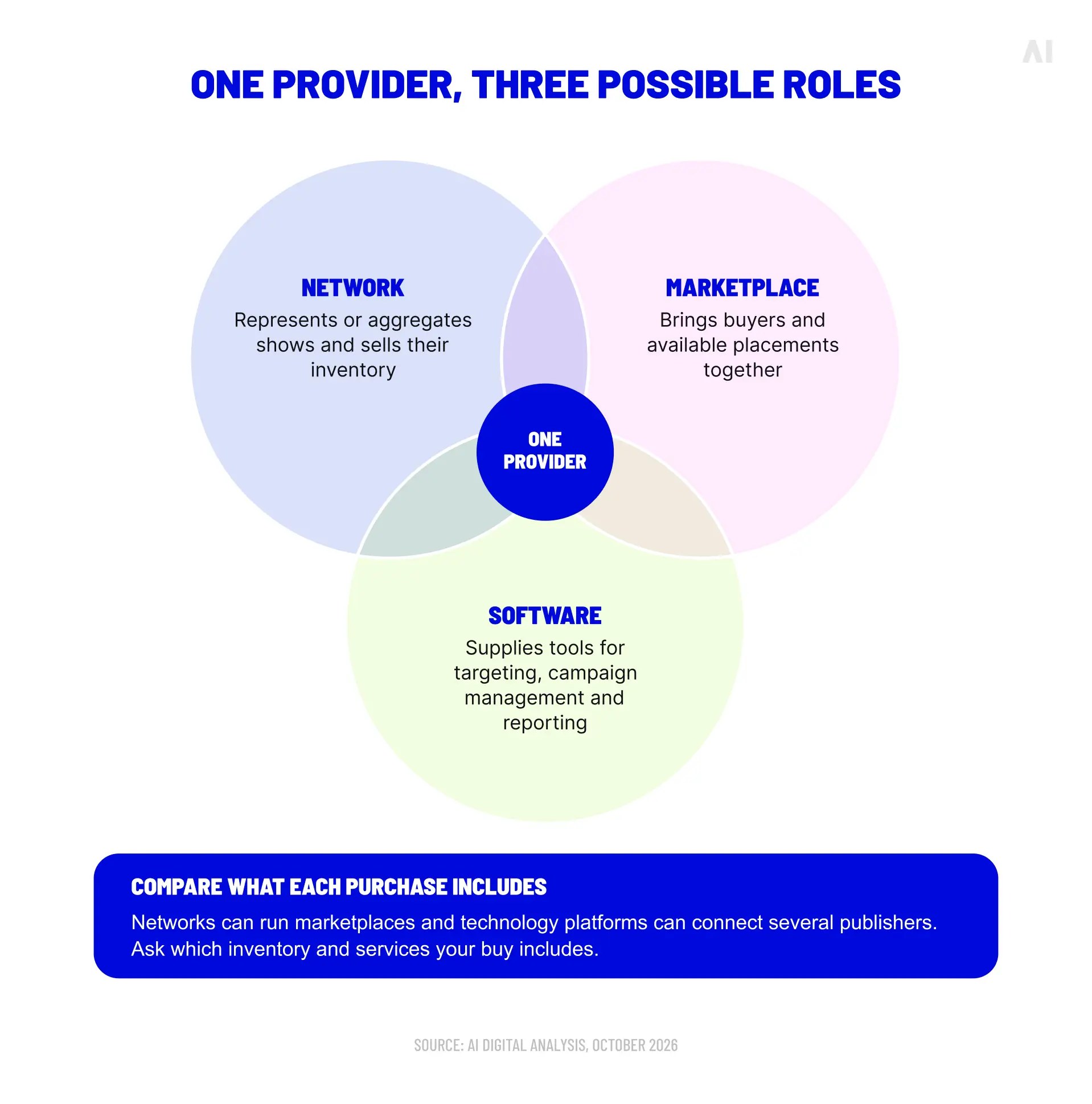
A podcast advertising network represents or aggregates shows whose inventory advertisers can purchase. A podcast advertising marketplace brings buyers and available placements together. Podcast advertising software supplies tools for functions such as targeting, campaign management or reporting.
These roles overlap. Networks can operate marketplaces; technology platforms can connect several publishers. Compare podcast media buying platforms by the inventory and services included in the purchase.
Self-serve, managed, and programmatic buying
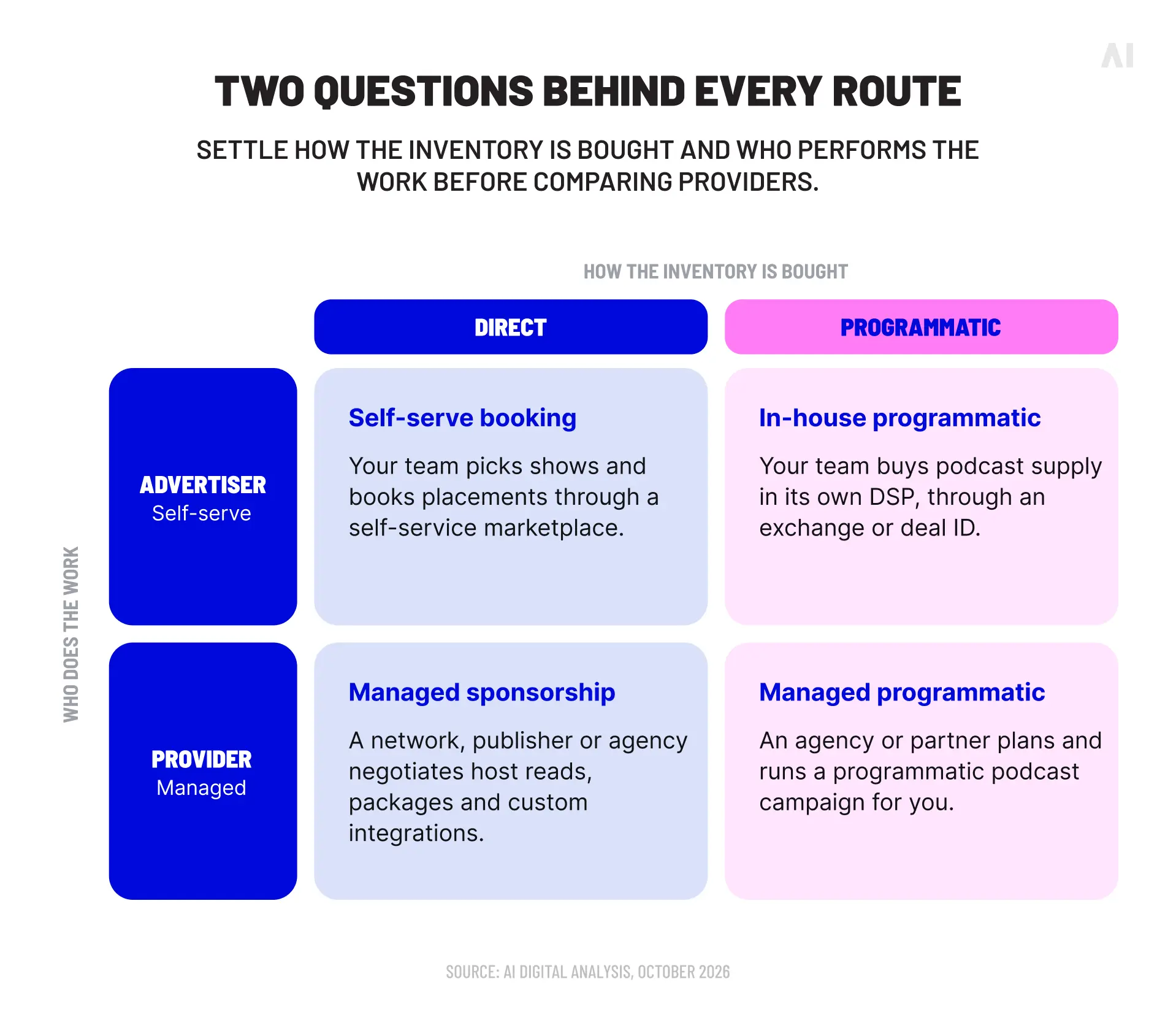
Self-serve describes a workflow the advertiser operates. Managed service assigns more planning or execution to a provider. A direct sponsorship involves a negotiated relationship around a show, host or package, while programmatic buying uses advertising technology to transact on available inventory.
These choices can overlap: an agency can manage a programmatic campaign, and a self-service marketplace can facilitate sponsorships. Establish both how the inventory is bought and who performs the work.
Best podcast advertising platforms and networks in 2027
The following selection compares advertiser-relevant offerings using official provider documentation reviewed in October 2026. It is an editorial comparison, not a hands-on test or performance ranking. Suggested use cases reflect the documented buying options; availability and terms depend on the selected product and market.
Spotify
Spotify offers several routes into podcast inventory. Its current podcast advertising page identifies Ads Manager, direct insertion orders and Spotify Ad Exchange, with custom host-read sponsorships arranged through a representative.
Inventory scope deserves attention. The Spotify Audience Network covers participating podcasts heard on and off Spotify. A show's availability in the listening app does not establish who sells its advertising, and inventory sold through Spotify need not be Spotify-owned.
For programmatic buyers, the exchange offering connects podcast inventory with DSP workflows. Spotify also documents audience targeting, creative tools and measurement integrations, although the available controls and reporting depend on the buying route. Confirm delivery behavior and any clickable elements for the listening environments included.
Spotify is worth evaluating when your team wants a choice between self-directed activation, negotiated sponsorship and DSP access.
💡 Our Spotify ads guide covers the broader advertising offering; podcast-specific budget requirements should be checked separately.
Acast
Acast combines creator relationships with audience-based buying. Its advertiser offering includes self-service campaigns, managed support, direct and programmatic access, spanning sponsorships, produced advertising and custom audio or video content.
Its campaign budget guidance describes dynamically inserted prerecorded ads, with targeting used to match campaigns to suitable inventory. For host-read sponsorships, show fit and creative collaboration become more central to the purchase. Distribution across listening environments depends on the inventory and campaign arrangement.
Acast's audience tools cover demographic, behavioral and contextual signals, with first-party data options where supported. Its attribution guidance explains pixel setup for visits and conversion events, while third-party tracking eligibility varies by market.
The offering suits consideration when a plan combines sponsorship with targeted advertising. Confirm which targeting and measurement controls apply to each component. Its public entry-budget information also requires qualification, as detailed below.
SiriusXM Media and AudioGo
SiriusXM Media provides a broader buying ecosystem than AudioGo alone. Its buying routes include direct insertion orders, programmatic activation and an online advertising platform. The podcast offering describes show-specific placements, host and announcer reads, category targeting and transcription-based contextual options.
AudioGo's podcast product centers on audience-based network buying, with controls including geography, audience characteristics, topics and ad position. It directs advertisers seeking specific-show or host-read opportunities to SiriusXM Media. Buying an audience through AudioGo therefore should not be treated as reserving a particular host endorsement.
Measurement also differs by route. AudioGo offers campaign reporting and site-visit attribution; its pixel documentation should be checked before assuming purchase tracking. SiriusXM Media separately describes brand-lift, attribution and sales measurement options, subject to campaign arrangements.
For a first audience test, AudioGo offers an accessible workflow. More customized sponsorships or coordinated audio plans call for a conversation about the broader SiriusXM offering.
Libsyn Ads
Libsyn Ads emphasizes support with planning and execution. Its advertiser service includes campaign proposals, show selection, fully managed buying, host reads and dynamically delivered advertising. The provider describes audience, category and geographic criteria that can inform campaign planning.
Reporting includes episode information, download counts and timestamped transcribed air checks. Those air checks can help establish where the message appeared; they should be evaluated separately from lead or conversion measurement. Agree on the reporting needed for your objective before booking.
Libsyn's terms distinguish its marketplace from its full-service offering. Advertisers should establish which workflow they will use and who handles show approval, creative coordination and delivery issues.
This is a relevant option for teams seeking help assembling a podcast plan, particularly around host-read placements. Request current inventory, targeting availability, delivery terms and minimum spend in the proposal rather than assuming that every marketplace placement includes the same support.
Podbean
Podbean has an advertiser-facing marketplace alongside its hosting business. Its campaign setup guide describes selecting location, device and category parameters, choosing placements, setting a budget and schedule, and picking podcasts from the matching options. Advertisers can upload audio or use its AI ad-creation tools.
The advertiser offering separately lists host-read opportunities and programmatic buying through DSPs. These should be treated as distinct arrangements rather than assumed features of every self-service campaign. Its advertiser terms describe CPM billing against verified downloads containing the served ads unless otherwise agreed.
For reporting, Podbean provides impression and visit-tracking tools and documents supported third-party tags, including specialist podcast measurement providers.
Podbean is worth considering for a self-directed test where selecting shows is important. Review the available inventory and tracking setup first, and distinguish the advertising budget from any hosting or publisher-side service charges.
Audioboom
Audioboom makes a useful distinction between managed creator partnerships and marketplace buying. Its advertiser page describes the Premium Network as offering live reads, host endorsements, show selection, dedicated account management and attribution support.
Showcase is its advertising marketplace, with a self-service portal, dynamic ad insertion and targeting by genre, location, keywords and audience demographics. That creates a different buying experience from commissioning an endorsement around a chosen host.
Consider how much depends on the creator relationship. A tailored message may require account support and a show agreement; an audience campaign may prioritize targeting and delivery adjustments.
Before selecting either route, request the current campaign minimum, creative requirements and reporting deliverables. Audioboom's public advertiser page does not provide a universal rate card, and its description of partner measurement technology should not be read as certification of every metric available to advertisers.
iHeartPodcasts
iHeartPodcasts is relevant to advertisers considering podcast investment within a wider audio plan. Alongside its sales-assisted advertiser route, iHeart describes programmatic access across podcasts and other audio inventory through DSP-based deals.
Its broader audience offering includes demographic, geographic, behavioral, contextual and first-party signals. Buyers should establish which capabilities apply to the selected podcast inventory rather than transferring every capability from the wider audio business to an individual sponsorship.
iHeart's podcast measurement guidance discusses host-read campaigns, response indicators, reach and frequency, and brand studies. The proposal should specify the creative, insertion method, measurement partners and reporting included.
The strongest reason to consider this route is the opportunity to coordinate podcast activity with other audio investments. Ask how the plan handles audience overlap, campaign reporting and distinct channel objectives. Podcast-specific pricing and minimum requirements need a quote.
PodcastOne
PodcastOne's publicly documented offering is sales-led. Its current company overview describes a team arranging advertising placements and custom integrations, supported by audio/video production, distribution and audience insights.
For advertisers, the starting point is a brief around the desired show, audience and brand relationship. Request a proposal specifying available sponsorship or host-read opportunities, creative approval, placement, campaign timing and any dynamically inserted delivery. These details should be established for the booking rather than assumed from the network name.
The company has announced a Listener.com partnership covering analytics, inventory and performance information. That announcement alone does not establish the advertiser reports or attribution tools included in a campaign.
PodcastOne belongs on the shortlist when a negotiated show relationship or custom integration is the priority. Ask for reporting examples, targeting detail and commercial terms, since its public materials do not provide a complete self-service feature list or standard campaign minimum.
How to compare podcast advertising platforms
Compare podcast ad platforms against the same brief. A dashboard, a familiar host and a large catalog each answer different needs.
Inventory and audience access
Start with the shows and audiences you can actually book. Check category depth, geography, exclusive versus non-exclusive representation, show-level versus network access and the seller's rights to the inventory.
Distribution needs its own question. An ad may accompany a podcast across listening apps, but the exact coverage depends on publisher relationships, insertion, app behavior and deal terms. Ask which environments are included and whether they appear in reporting.
Avoid ranking podcast ad networks by unlike scale claims. Downloads, unique consumers, available shows and cross-channel impressions describe different things.
⚡ The useful inventory question is how much of a catalog matches your campaign and can actually be booked.
Targeting and data capabilities
Evaluate the signals behind the targeting options. Show selection and category context describe content; demographic or interest segments describe an audience using a particular data methodology.
Ask where geography, episode context, behavioral segments and advertiser-owned data are supported. Establish how audiences are built, which inventory can use them and what targeting does to available reach and cost.
A detailed menu does not guarantee person-level identification across podcast environments. The buying route and available signals determine the precision you can reasonably expect.
Ad formats, creative options, and delivery methods
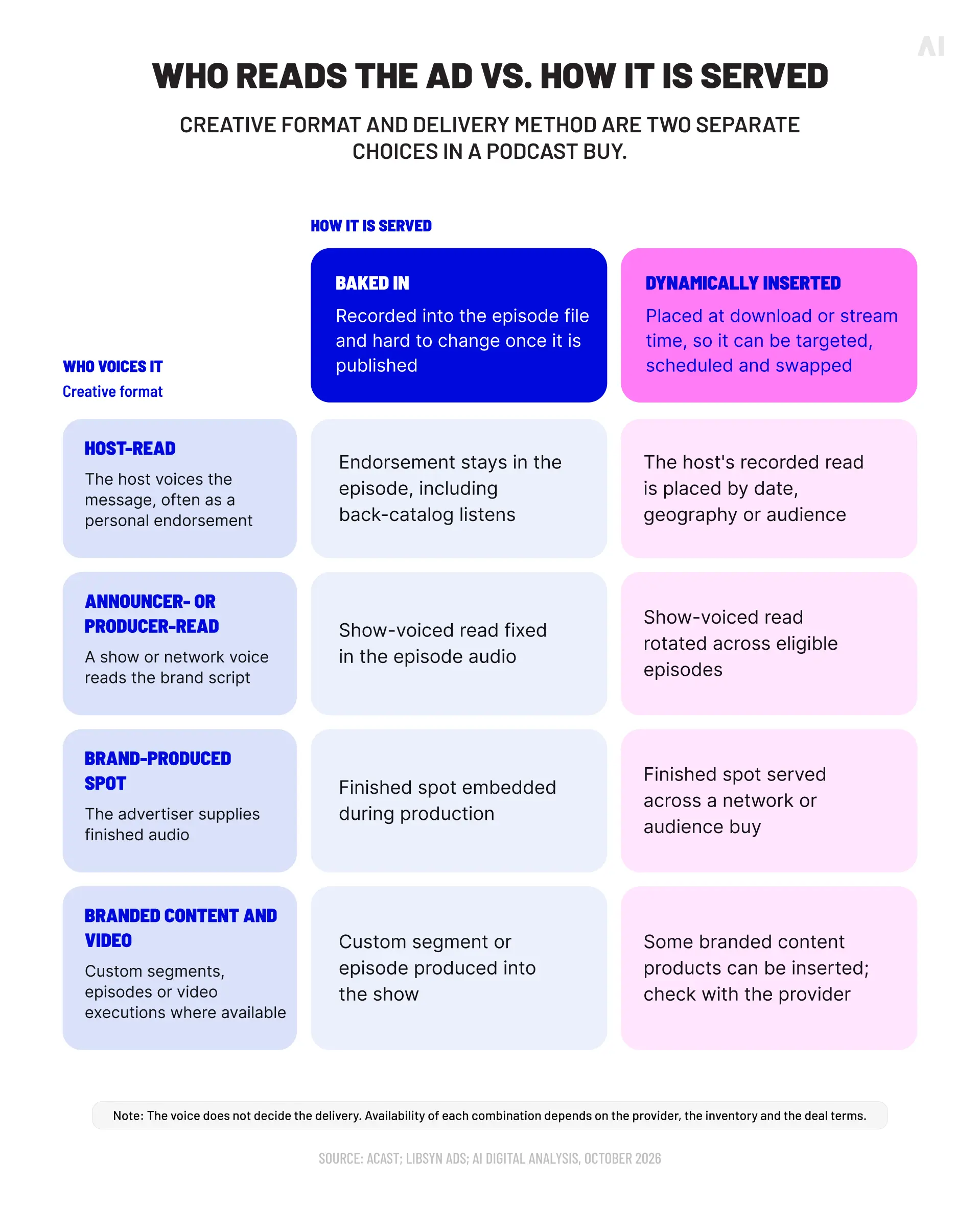
Compare creative and delivery separately. Creative options can include host-read sponsorships, announcer- or producer-read ads, brand-produced spots, branded content and video executions where available.
Delivery describes whether the message is baked into the episode or dynamically inserted. A host-read recording can be delivered dynamically; an announcer's voice does not establish how the ad is served.
For time-sensitive campaigns, check creative replacement, older-episode eligibility and end dates. For video, establish the viewing inventory and assets included.
Measurement and reporting
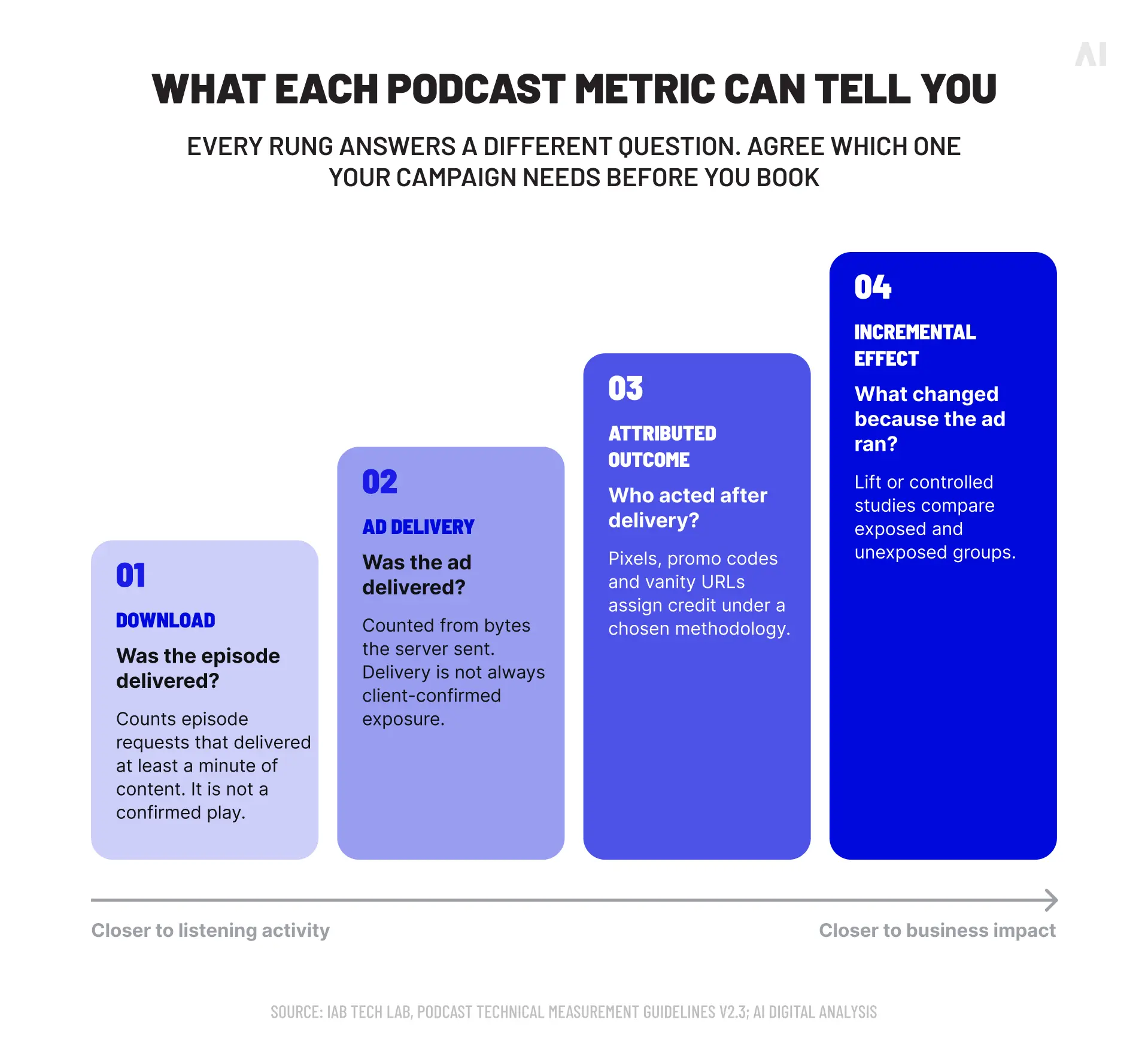
Separate content consumption, ad delivery and business outcomes. IAB Tech Lab's final Podcast Measurement Guidelines version 2.3 explain why a download is not confirmed playback and server-measured delivery is not necessarily client-confirmed exposure.
Request reporting on placements, delivery, geography and reach/frequency where supported. Then establish how visits, conversions, promo codes or vanity URLs will be measured. A platform integration may require implementation or a separate study agreement.
Attribution assigns credit under a methodology; incrementality asks what happened because the campaign ran. They are different assessments. Similarly, verify the entity, service, metrics and version covered by an IAB certification claim rather than assuming it validates all reporting.
How podcast advertising pricing and minimum spend differ
Podcast advertising costs depend on inventory, creative, targeting and service. A negotiated show sponsorship and a produced spot bought across an audience network can have very different economics.
Commercial structures include CPM buying, fixed-price placements and sponsorship packages. A campaign budget sets spending limits; it does not necessarily include production, bespoke research or agency support. Compare proposals on the same basis, including placement, duration, deliverables and makegood terms.
Public information reviewed in October 2026. “Contact vendor” means no universal current figure was established in the reviewed materials, rather than an absence of minimum spend.
An entry budget establishes access. A useful test budget must also support your learning objective, audience and measurement plan.
Self-serve or managed service: Which buying model fits the campaign?
Choose the service model around the work your team can perform. Self-service can provide direct control, but someone still owns audience selection, creative, tracking, pacing and interpretation. Managed buying can provide planning and coordination, with responsibilities defined in the agreement.
A hybrid arrangement can also work: internal buyers manage routine audience campaigns while a partner coordinates a sponsorship. Compare the actual division of labor, including who resolves delivery problems.
⚡ Campaign support earns its place when it solves a task your team cannot efficiently handle alone.
When programmatic podcast buying makes sense
Programmatic access is useful when podcast activity needs to fit existing audience activation, campaign management and reporting workflows. A buyer already using a DSP may prefer to evaluate podcast supply alongside other media, subject to the inventory and data available through that route.
It does not automatically include every show sponsorship, targeting feature or measurement option. Establish supply transparency, fees and reporting before treating centralized buying as a complete solution.
💡 Our guide to programmatic audio advertising explains the broader approach.
How to choose a podcast advertising platform for your use case
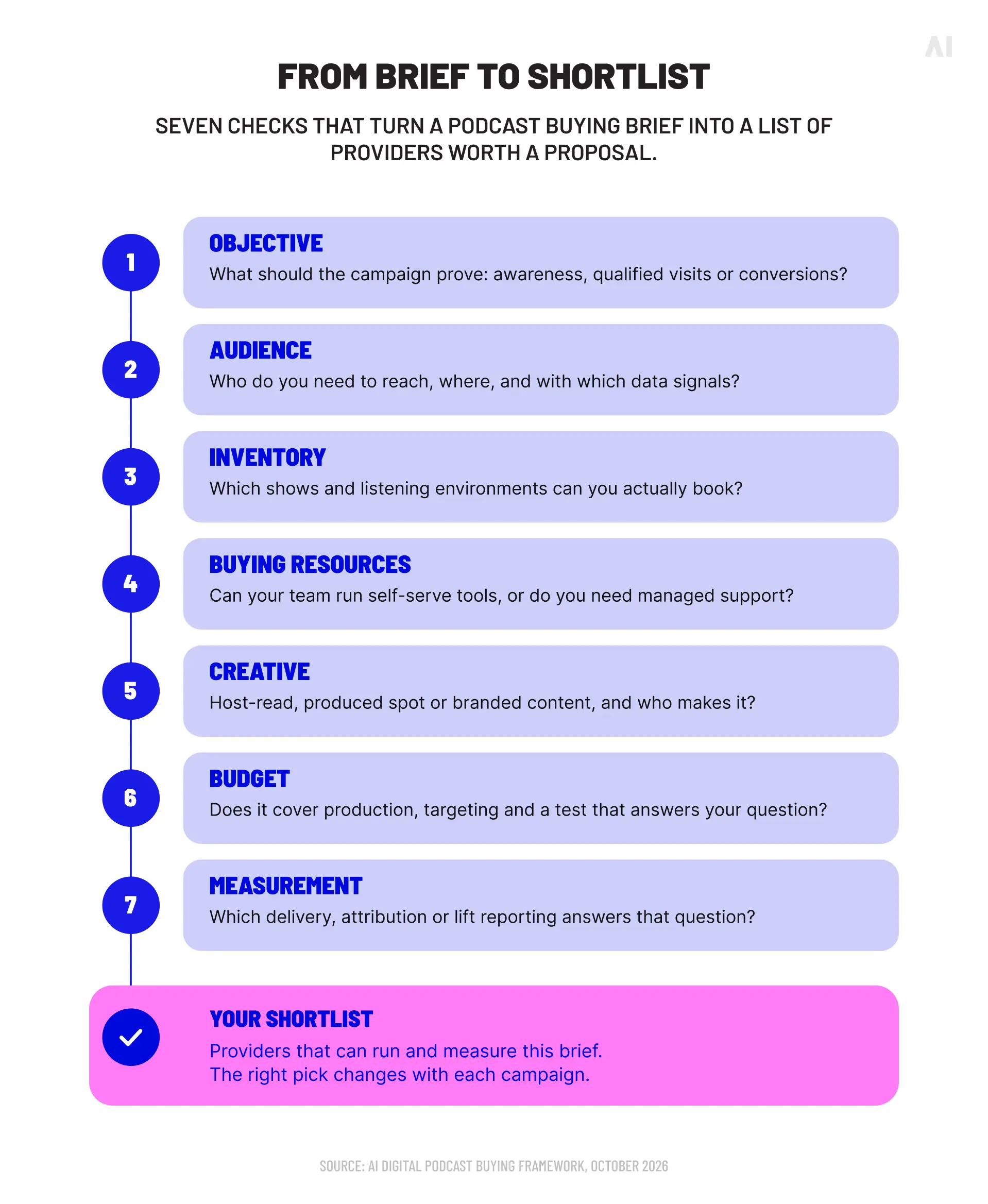
Begin with a short buying brief: objective, audience, budget, required inventory, creative resources and measurement expectations. Then assess providers against those requirements. The best podcast advertising platforms for a particular team are the ones that can support its intended campaign and operating model.
For a first podcast advertising test
Prioritize clear setup, manageable entry requirements and a measurement plan you can implement. Choose a test question, such as whether a relevant show category generates qualified visits or a sponsorship improves awareness.
Keep enough flexibility to learn without changing every variable at once. Check creative support, review timelines and reporting access before launch. A small minimum is useful only when the resulting campaign can answer the question you set.
For broader audience reach
Assess geographic coverage, category breadth, eligible listening environments and the ability to expand beyond individual shows. Request an explanation of audience overlap and available frequency controls before combining several networks.
Coordinate the role of podcasts with other digital audio advertising. More supply can broaden opportunity, but the plan still needs a clear audience and appropriate creative. Total catalog size should not replace a forecast for the inventory you intend to buy.
For more advanced targeting and measurement
Work backward from the required data and outcomes. Confirm first-party audience eligibility, contextual controls, supported measurement partners and the reporting available at show or placement level.
Review sample outputs and implementation requirements before committing budget. If the objective requires an incrementality study, determine its feasibility separately from ordinary attribution. Include privacy and data-use requirements in the evaluation, especially when connecting campaign exposure with customer information.
How AI Digital approaches podcast and audio media buying
AI Digital helps advertisers build podcast and audio campaigns around clear business goals, bringing supply evaluation, buying strategy and measurement planning together. From assessing available inventory to selecting suitable buying routes, the focus is on putting your budget behind opportunities that fit your audience and objectives.
Smart Supply supports that approach through direct partnerships with premium SSPs, custom Deal IDs built around campaign KPIs, traffic-quality filtering and in-flight adjustments. Visibility into placements, traffic sources and pricing gives advertisers greater control over where spending goes, while a DSP- and SSP-agnostic approach preserves buying flexibility. Podcast inventory and access are confirmed for each proposed campaign.
The Open Garden Framework extends that flexibility across buying technology, supply and data partners. Your campaign requirements guide the selection, helping you build a media plan without committing your entire strategy to one provider.
As podcast investment grows, AI Digital brings the strategic oversight and execution support needed to coordinate different buying routes, define their contribution and assess results. Talk with the team about building a podcast and audio plan around your next campaign.
Choose the buying setup, not just the biggest platform
Choose a podcast ad platform by the purchase it enables: relevant inventory, an appropriate creative model, workable campaign control and reporting that answers your questions. Service requirements and commercial terms deserve the same attention as audience reach.
As investment grows, using several providers may be sensible. The priority is a coordinated plan with clear responsibilities and distinct roles for each purchase.
Talk with AI Digital to put podcast and audio advertising to work for your brand, with a buying strategy built around your audience, budget and growth goals.