Best CTV ad platforms in 2027: Features, pricing, and use cases


CTV advertising platforms can look remarkably similar in a sales presentation. Premium streaming inventory, automated optimization and measurable outcomes appear across the category. Underneath those promises sit different buying systems, commercial arrangements and definitions of success.
An agency coordinating television with display and audio needs different controls from a growth team testing its first streaming campaign. A brand extending a linear TV plan has another set of requirements again.
This guide compares advertiser-facing platforms by inventory, targeting, measurement, pricing and service model. It excludes publisher monetization tools and supply-side platforms. With IAB forecasting US CTV advertising growth of 11% in 2026, selecting the buying environment deserves the same scrutiny as selecting the media itself.
TL;DR: CTV ad platforms at a glance
- Platform scope: The comparison covers omnichannel DSPs, performance TV tools and convergent television platforms, with overlapping capabilities.
- Product differences: The profiles examine inventory access, audience data, optimization, reporting and the support available to buyers.
- Measurement: Household attribution, modeled lift and experimental studies answer different questions about campaign results.
- Commercial models: The pricing section separates media costs, technology charges, service fees and campaign commitments.
- Selection and activation: The use-case framework and checklist connect platform capabilities to practical buying needs, followed by AI Digital’s role across platforms.
❗ “Best for” describes editorial fit. It does not establish a winner across every campaign objective. The profiles and pricing table below link to the supporting documentation.
What types of CTV advertising platforms are we comparing?
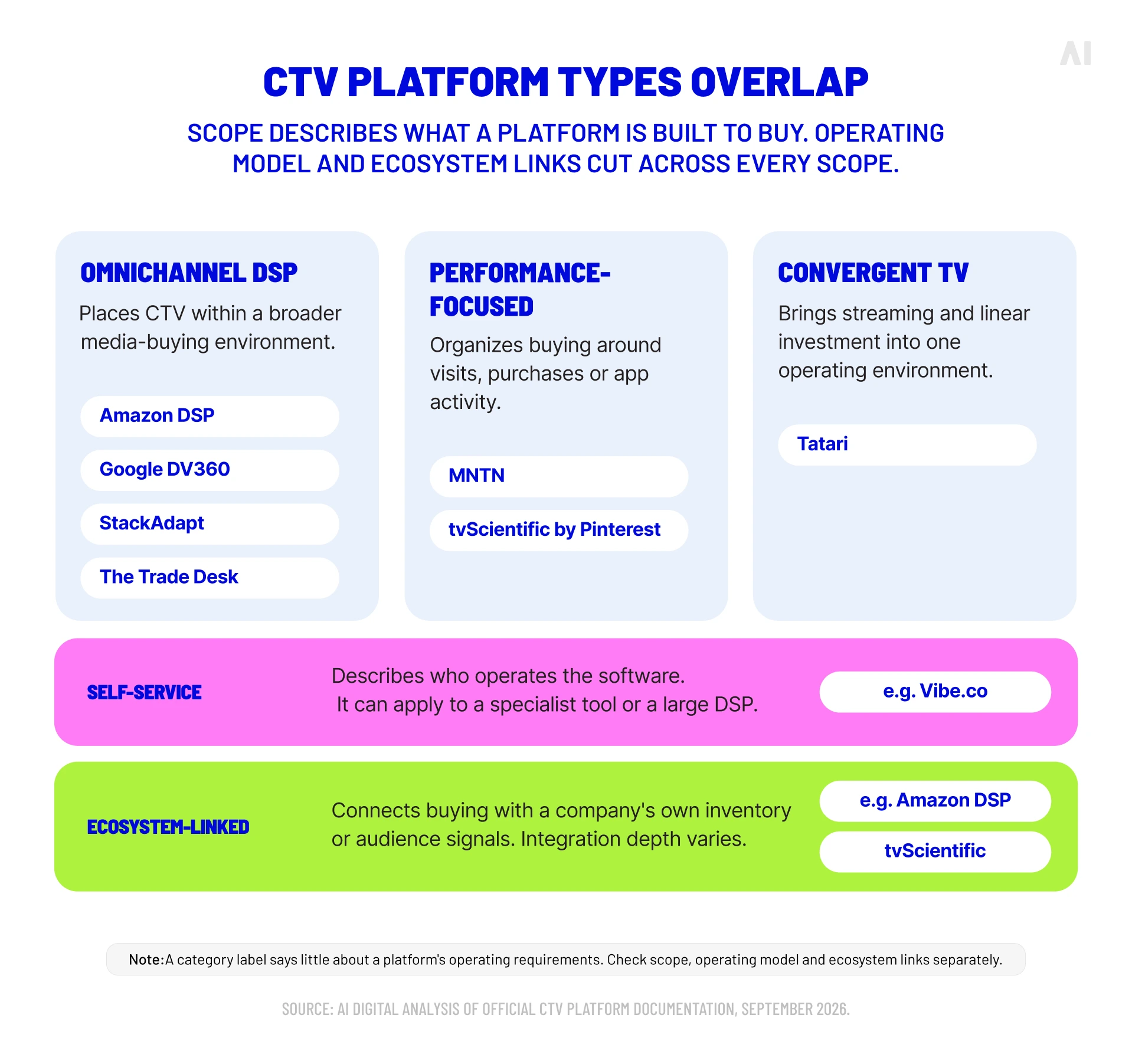
Connected TV advertising platforms differ in scope as well as interface.
- An omnichannel demand-side platform places CTV within a broader media-buying environment. Amazon DSP, Display & Video 360, StackAdapt and The Trade Desk belong in this group.
- Performance-focused platforms organize buying around actions such as visits, purchases or app activity. MNTN and tvScientific emphasize this workflow.
- Convergent TV platforms, including Tatari, bring streaming and linear investment into a shared operating environment.
Other labels describe a different dimension.
- Self-service concerns who operates the software; it can apply to a specialist tool or a large DSP.
💡 Our self-serve advertising platform guide examines that choice separately.
- Ecosystem-linked platforms connect buying with a company’s inventory or audience signals, although the depth of integration varies.
These categories overlap. Calling a product “CTV advertising software” tells you little about its actual operating requirements.
How we evaluated the best CTV ad platforms
This CTV platform comparison is an editorial assessment of official product pages, help documentation and company announcements, checked in September 2026. It is not based on hands-on testing or a standardized performance trial.
We assessed inventory access, audience activation, measurement, reporting transparency, buying controls, service options and disclosed commercial terms. Usability judgments concern the documented workflow and responsibilities, rather than an independently tested interface.
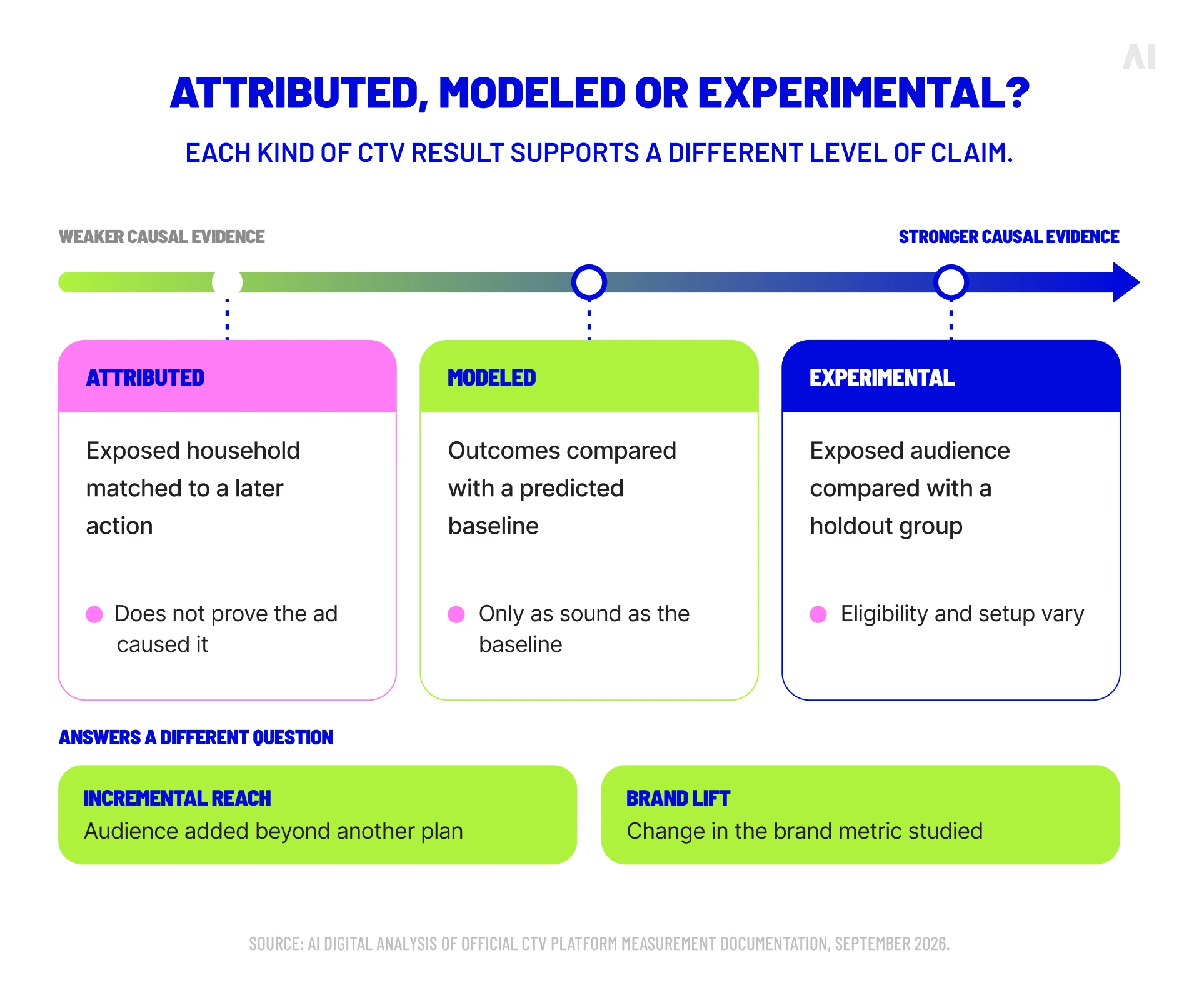
Measurement received particular scrutiny.
- Attribution connects an exposure with a later action under matching and timing rules.
- Incremental reach counts additional audience beyond another plan.
- Conversion-lift studies and predictive-baseline models estimate advertising’s additional effect through different methods.
- A brand-lift result concerns the brand measure studied, not necessarily sales.
The practical test is how these capabilities support your CTV media-buying process, from planning and creative approval to optimization and reporting.
⚡A platform earns its place in the media plan through the decisions it helps the buyer make.
8 CTV ad platforms to consider in 2027
The following platforms appear alphabetically. Each profile connects documented capabilities with an advertiser use case and identifies the qualifications that deserve attention during evaluation.
Amazon DSP
Best for: Advertisers combining CTV with commerce-informed, cross-channel buying.
Platform type: Omnichannel DSP.
Amazon DSP buys across Amazon properties and third-party supply, using Amazon, advertiser and third-party audiences. Its streaming opportunities include Prime Video and supply accessed through Amazon Publisher Direct and exchanges. Brands do not have to sell on Amazon to use it.
That combination is its principal strength: television can sit within a broader plan informed by shopping and streaming signals. Buyers still need to distinguish TV-screen placements from streaming video delivered on other devices.
Measurement: Amazon Marketing Cloud supports custom analysis of campaign signals and advertiser inputs in a clean-room environment. Outputs are aggregated, rather than unrestricted person-level exports. Eligible advertisers can also use Omnichannel Metrics for on- and off-Amazon sales reporting. Eligibility and methodology vary by solution.
Buying and access: Self-service and managed arrangements support auction and deal-based buying. Public campaign guidance exists, but terms depend on the route.
Trade-off: A rich ecosystem does not make every audience, publisher or measurement product available to every account. Establish which combinations support the proposed campaign before choosing the package.
Google Display & Video 360
Best for: Teams coordinating CTV, YouTube and broader programmatic activity.
Platform type: Omnichannel DSP.
Display & Video 360’s CTV documentation distinguishes dedicated CTV buying from YouTube & partners workflows. Buyers can use automated optimization and custom bidding within supported configurations. Targeting options depend on inventory and line-item type.
Its appeal is operational continuity for teams already using Google Marketing Platform. However, a shared platform does not produce identical controls across every source of video supply.
Measurement: Google documents app-level identifiers, reach planning and Floodlight-based cross-device conversion reporting. Its CTV reporting guide also names limitations: Netflix inventory is not fully supported for the described cross-device conversion reporting, and App Attribution Partner measurement is unavailable in that workflow.
Buying and access: Auctions, private deals and programmatic-guaranteed arrangements sit within a contract-based platform. Advertisers should establish who will operate the account and what implementation support the commercial arrangement includes.
Trade-off: DV360 offers broad buying and reporting capabilities, but requires configuration expertise. Inventory availability and measurement coverage must be checked separately, especially when the campaign depends on a particular publisher or conversion integration.
MNTN
Best for: Performance teams seeking automated CTV activation and website-outcome reporting.
Platform type: Performance CTV.
MNTN combines audience selection, automated bidding and streaming-network access with creative tools, including uploaded video and QuickFrame AI generation. Its documented workflow suits marketers who want to manage television through campaign goals and performance reporting.
Measurement: Verified Visits connects completed TV exposure with a subsequent household website visit using cross-device matching. The documentation also covers Multi-Touch ad pathways and optional last-touch reporting based on referral parameters. Default visit windows are seven days for retargeting and fourteen days for prospecting, with customization available. These are visit windows, not automatically the same as subsequent conversion windows.
MNTN also describes independent measurement integrations spanning incrementality, marketing mix modeling and other methods. Native attribution and external evaluation should be discussed separately.
Buying and access: Self-service activation uses a publicly explained pricing model, with automated media buying and creative support within the workflow.
Trade-off: The integrated setup can reduce operational work, but attributed revenue still depends on matching, credit and timing rules. Ask how reported conversions will be reconciled with search, social and the advertiser’s own analytics.
StackAdapt
Best for: Agencies and marketing teams coordinating CTV with other programmatic channels.
Platform type: Omnichannel programmatic platform.
StackAdapt’s CTV offering combines streaming inventory with audience targeting, live-event planning and cross-device reporting. Documented capabilities include pod bidding to limit repeated ads within a commercial break, creative transcoding for supported publishers and forecasting of incremental reach beyond linear television.
Those features address practical buying problems: preparing creative for different destinations, selecting timely inventory and controlling exposure. They complement the ability to activate first-party audiences within a broader channel plan.
Measurement: Its cross-channel attribution solution links impression exposure and activity across channels with conversions. This can help teams assess journeys alongside Google Analytics, but attributed contribution should not be presented as experimental lift.
Buying and access: Plans and packages offer self-service, managed and hybrid arrangements. Support depends on region, investment and program complexity; the reviewed plans do not publish monetary thresholds.
Trade-off: Service flexibility is a strength, provided the scope is clear. Confirm which planning, analytics and account-management services belong to the proposed package, particularly if the team expects substantial help with activation or interpretation.
Tatari
Best for: Advertisers managing streaming alongside linear television.
Platform type: Convergent TV.
Tatari spans streaming, linear TV and online video, with self-service software and optional strategic support. It describes direct and programmatic buying, making it relevant when television investment extends beyond a standalone CTV test.
Measurement: Tatari’s methodology documentation distinguishes household/device-graph view-through attribution, IP-based digital view-through attribution and an Incremental Lift model. The latter compares observed outcomes with a predictive baseline and does not require a live holdout.
That distinction helps buyers understand what a reported result represents. Modeled lift depends on the quality of the estimated baseline; it should not be described as a randomized experiment. Linear response analysis introduces its own baseline assumptions. Tatari also describes partner-supported holdout experiments, which provide a separate route for validation.
Buying and access: Tatari describes self-service, semi-managed and managed engagements in its platform overview. Commercial terms need confirmation because public descriptions of entry budgets are not fully consistent.
Trade-off: Its broad TV remit is attractive for coordinated investment, but the buyer needs a clear allocation and measurement plan. Establish how reporting reconciles different methods across streaming and linear before treating the combined dashboard as a single comparable result.
The Trade Desk
Best for: Experienced teams seeking operational control across programmatic channels.
Platform type: Independent omnichannel DSP.
The Trade Desk’s CTV offering supports first- and third-party audience activation, premium inventory relationships and frequency management across supported networks, channels and devices. Linear audience data can also inform reach-extension planning where available.
Its strength lies in coordinating television with the buyer’s wider data and media strategy. Frequency controls still depend on the supported identity and buying environment; they do not impose a universal limit across unrelated platforms.
Measurement: The measurement framework includes conversion-data onboarding, exposure feeds and integrations with independent measurement providers. Its updated conversion-lift setup uses a holdout approach, but the documented streamlined workflow is in closed beta for users with conversion lift enabled.
Buying and access: Programmatic auctions and deals operate under negotiated terms. Reviewed official documentation does not establish a universal fee or spending minimum.
Trade-off: The platform’s flexibility rewards a team with buying, data and measurement expertise. That is a suitability judgment, rather than a claim that smaller advertisers cannot access the platform through an agency or other partner.
tvScientific by Pinterest
Best for: Advertisers prioritizing acquisition outcomes and intent-based audiences.
Platform type: Performance TV.
Pinterest’s launch announcement confirms that Pinterest audiences are available through tvScientific by Pinterest for CTV. That is a documented capability; the broader cross-screen vision described in the announcement should not be assumed complete.
The platform combines automated optimization with CRM, geographic, behavioral and lookalike targeting. Its inventory page includes streaming and linear categories, so describing it as exclusively streaming would be inaccurate. Creative Advisor adds scoring and recommendations for creative evaluation.
Measurement: Its attribution documentation describes household cross-device matching and outcome reporting. Separate measurement partners support additional evaluation. Buyers should establish the exact lift methodology rather than infer experimental design from an “incremental” label.
Buying and access: CPM and outcome-based arrangements are advertised. Guaranteed Outcomes is available to qualified advertisers, with eligibility confirmed during onboarding. Service scope and commercial conditions need to be agreed for the chosen program.
Trade-off: Performance-oriented buying and Pinterest signals create a distinctive proposition, but outcome definitions, qualification requirements and independent validation still need scrutiny.
Vibe.co (Walmart Connect)
Best for: SMB and mid-market teams seeking accessible CTV campaign setup.
Platform type: Self-service CTV.
Walmart completed its acquisition of Vibe.co in August 2026, expanding Walmart Connect’s streaming advertising business. The announcement supports the ownership description, but does not establish universal availability of Walmart shopper-data integrations in Vibe accounts.
Vibe combines streaming campaign management with automated optimization. Its audience controls include geography, demographics, interests, customer lists and frequency settings, giving smaller teams ways to define a test without assembling an extensive buying operation.
Measurement: The current web-attribution help article describes IP matching between TV exposure and subsequent website activity on the same network. For eligible performance campaign goals, its documented default attribution window is thirty days. A household match does not identify the individual who converted or prove the ad caused the action. App measurement integrations require separate interpretation.
Buying and access: Self-service, impression-based buying has publicly documented pricing guidance. Confirm onboarding and creative-support arrangements for the account.
Trade-off: Accessible setup is useful for testing, but the team still needs suitable creative, reliable conversion tracking and a budget capable of producing a useful result.
How CTV platform pricing actually works
CTV platform pricing combines the cost of inventory with the cost of buying and evaluating it. A quoted CPM may include some services while another quote lists them separately. Compare the full campaign scope before deciding which is cheaper.
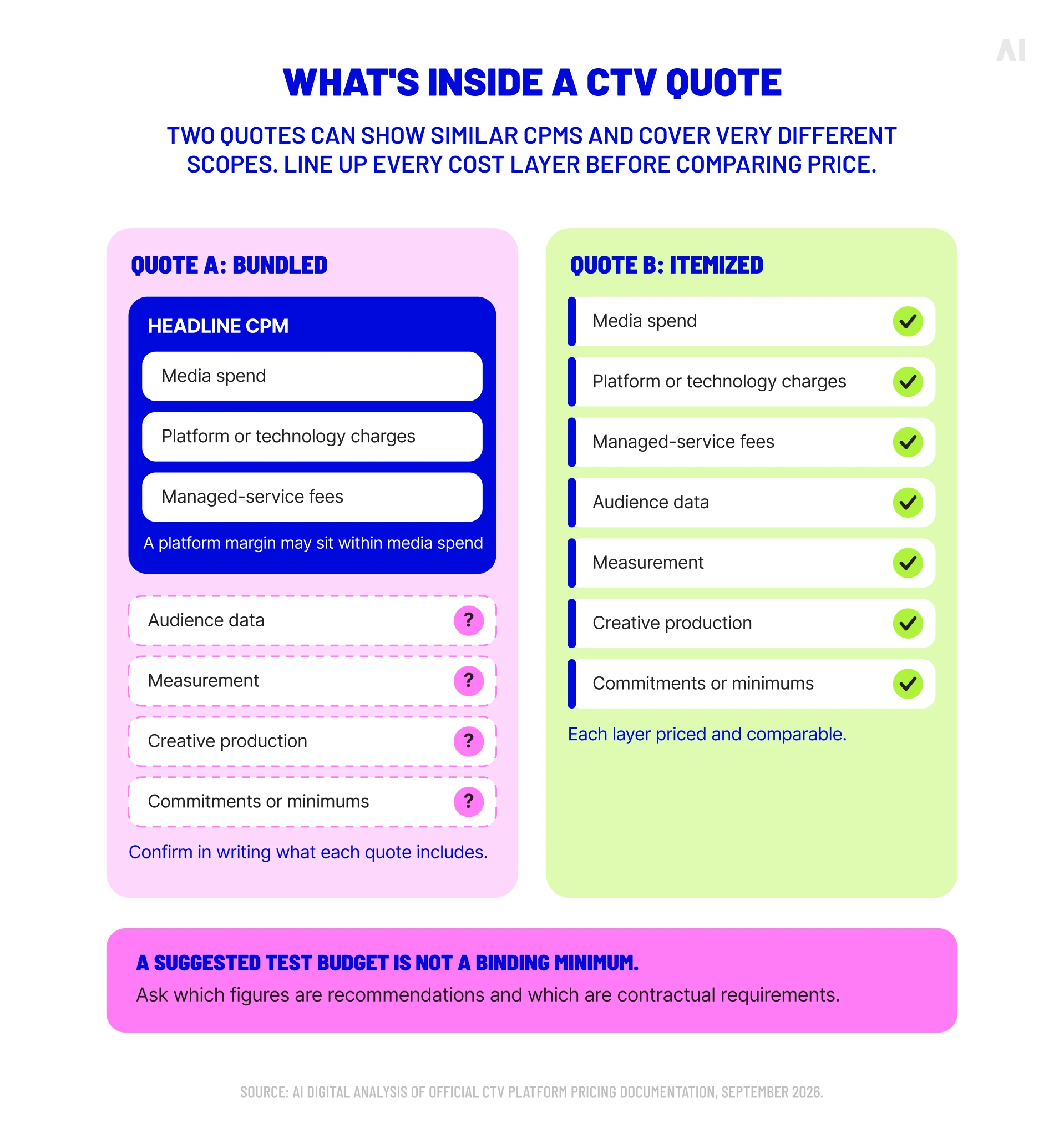
Separate media spend, platform or technology charges, managed-service fees, audience data, measurement, creative production and contractual commitments. A suggested test budget also differs from a binding minimum.
❗ All monetary figures are in US dollars. Public disclosures describe commercial terms, not independently measured market averages. Missing figures do not establish that a platform is expensive, and a low entry threshold does not establish an adequate experiment budget.
Which CTV platform is best for your use case?
The best connected TV advertising platforms for a shortlist are those that resolve the buyer’s most important operational constraint. Use the following framework to organize demonstrations and proposals.
Enterprise omnichannel programmatic buying
Prioritize control over audiences, supply, frequency and reporting. Amazon DSP, DV360, The Trade Desk and StackAdapt deserve consideration, but the existing technology stack and team capacity should narrow the list. Have each provider demonstrate a realistic workflow using the advertiser’s own data requirements.
Performance-focused CTV campaigns
MNTN, tvScientific and Vibe offer relevant workflows for acquisition-oriented teams. Compare the outcome being optimized and the evidence behind reported results. A platform can improve attributed cost per acquisition while broader business performance remains uncertain. Plan validation alongside the CTV measurement framework, rather than adding it after delivery.
Convergent linear and streaming TV
Tatari is a natural candidate when the budget already spans television formats. tvScientific also merits discussion for relevant linear inventory and service scope. Ask how the plan allocates spending and reconciles response data; buying both formats does not, by itself, establish unified measurement.
Lower-barrier CTV testing
Vibe and MNTN warrant evaluation for teams seeking a manageable launch. Tatari’s eligible self-service routes may also fit. Examine creative readiness, tracking implementation and the time needed to collect useful evidence. A small commitment is helpful only if the test can answer something specific.
Commerce and audience-data use cases
Amazon DSP offers a clear route to Amazon signals, while tvScientific brings Pinterest audiences into consideration. Vibe’s ownership makes its integration roadmap relevant, but buyers should verify current account capabilities. Evaluate the audience’s relevance to the purchase decision and the available measurement, rather than selecting by ecosystem name alone.
What to verify before choosing a CTV platform
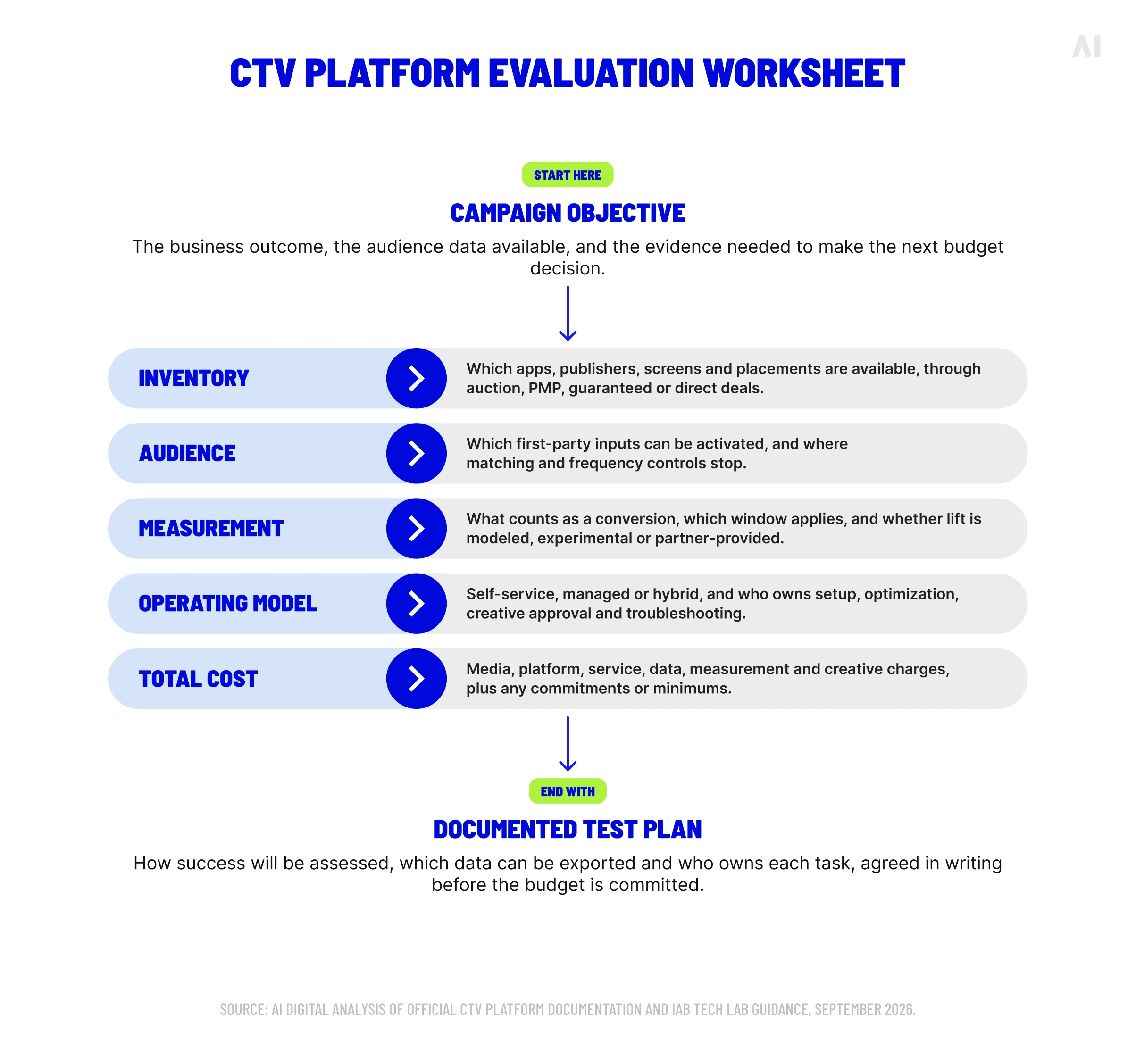
A useful CTV advertising platform comparison ends with a campaign-specific proposal. Ask shortlisted providers to document the following:
- Inventory and access: Which apps, publishers, screens and placements are available through auction, PMP, guaranteed or direct arrangements?
- Supply relationships: Which publishers, exchanges, SSPs and intermediaries participate, and what does each contribute?
- Quality and transparency: How are authorized sellers, invalid traffic and brand suitability checked? Which app and publisher details appear in reports?
- Data and frequency: Can the platform activate your first-party inputs, and where do matching or frequency controls stop?
- Measurement: What counts as a conversion, which window applies and how is duplicate credit handled? Is lift modeled, experimental or partner-provided?
- Reporting access: Which campaign, placement or log-level data can be exported, and under what restrictions?
- Delivery responsibilities: Who handles optimization, support, creative approval and troubleshooting? What fees and commitments apply?
The IAB Tech Lab CTV guide and sellers.json documentation explain mechanisms for checking authorized sellers and supply-chain participants. These support scrutiny; a shorter route alone does not guarantee better inventory or outcomes.
How AI Digital helps brands work across CTV platforms
AI Digital supports platform selection and campaign execution as a DSP-agnostic programmatic partner. Its role begins with the business objective, available audience data and evidence the advertiser needs to make its next budget decision.
Its programmatic capabilities cover activation across buying platforms, PMPs, premium publishers and curated marketplaces, alongside supply-quality checks, hands-on optimization and granular reporting where available. Measurement options can include website actions, conversions, footfall and brand studies, depending on the campaign setup.
The Open Garden Framework supports flexibility across technology and supply partners. Smart Supply adds an outcome-led approach to supply selection and ongoing decisions, using campaign KPIs to guide the inventory strategy. Its SSP relationships should be evaluated for the access and value they provide in the specific campaign.
Creative readiness belongs in that process too. AI Creative Studio supports video production and adaptation when the media plan requires additional assets or versions.
⚡ The buying platform is one part of the operating model; execution connects it to the advertiser’s goal.
Choose the CTV platform that fits the way you buy media
The best CTV advertising platforms serve different teams well. Start with the campaign objective, then compare inventory, measurement, operational demands and full commercial terms. Require the proposal to explain how success will be assessed before committing the budget.
For help selecting a CTV media buying platform and putting the plan into practice, talk to AI Digital about CTV activation.