Spotify Ads: Formats, Costs, and How to Run Campaigns That Drive Real Outcomes

.webp)
In 2026, Spotify advertising has evolved into a cornerstone of programmatic audio marketing, offering digital marketers, advertisers, and media planners a powerful way to engage highly targeted audiences. With over 713 million active users and 281 million Premium subscribers, Spotify provides unparalleled access to listeners through music, podcasts, and digital audio ads that deliver both reach and context.
Ads on Spotify from Spotify podcast ads and Spotify video ads to Spotify sponsored sessions and Spotify radio advertising—allow brands to connect with audiences across devices, including smart speakers, smartphones, and desktops. Using tools like Spotify Ads Manager and Spotify Ad Studio, marketers can run Spotify ads with precision, control ad frequency, optimize Spotify ad campaigns, and measure performance through AI-driven analytics.
For advertisers looking to maximize ROI, understanding Spotify ad pricing, Spotify CPM rates, and the cost of advertising on Spotify is crucial. Platforms like Smart Supply ensure premium inventory access, while Elevate leverages AI to personalize creative at scale, making it possible to integrate Spotify advertising campaigns into broader programmatic and omnichannel strategies. Whether you’re learning how to run Spotify ads, exploring audio ad formats, or seeking inspiration from the best Spotify ads, Spotify offers a flexible, measurable, and immersive environment to amplify your brand’s presence in 2026.
What are Spotify ads?
Spotify ads are a form of digital audio advertising designed to reach listeners on Spotify’s free tier, where users experience the platform with ads interspersed between songs, during podcasts, and while browsing the app. Spotify offers multiple ad formats, including audio ads, video ads, and display ads, each crafted to engage audiences in contextually relevant moments.
One of the platform’s key strengths is its use of first-party listener data. Advertisers can target users based on genres, moods, playlists, devices, and listening behaviors, ensuring each ad feels personalized and resonates with the audience. This level of precision makes Spotify advertising especially effective for both brand awareness and performance-driven campaigns.
Brands can purchase Spotify ads directly through Spotify Ad Studio, which caters to small and medium-sized businesses, or via programmatic platforms, allowing larger advertisers to scale campaigns efficiently. Both approaches provide measurable results, from engagement metrics to conversion tracking, making it easier to optimize campaigns in real time.
⚡️For marketers looking to understand the broader landscape of automated audio advertising, check out our article: What is Programmatic Audio and How Does it Work?
Examples of Spotify ads
Examples of Spotify ads reveal how brands use Spotify’s different formats to capture attention in the right moments. Each format is designed to blend naturally into the listening experience while using Spotify’s first-party data to match the message to the user’s mood, context, and device.
These examples illustrate how advertisers can shape campaigns that feel native to the platform and deliver measurable results across music, podcasts, mobile, and smart speakers.
{{Spotify-Ads-Formats-Costs-and-How-to-Run-Campaigns-1=""/tables}}
💡Key Notes
- All formats leverage first-party Spotify data for personalized, contextually relevant ads.
- Campaigns can be run via Spotify Ad Studio or programmatic platforms, providing measurable ROI and flexible budgeting.
- Combining multiple ad formats in a Spotify advertising campaign can improve engagement and reach across music, podcasts, and browsing experiences.
Why Marketers Choose Spotify in 2026
Marketers choose Spotify advertising in 2026 because it blends emotional engagement, massive scale, and precision targeting in a way few platforms can match. With hundreds of millions of listeners streaming Spotify with ads, the opportunity to connect through immersive digital audio ads, Spotify podcast ads, and Spotify video ads has never been stronger. Research shows that combining audio and video formats on Spotify can generate a 90% lift in ad recall and 2.2× higher brand awareness, proving how deeply users respond to ads on Spotify during moments of focused listening. These emotional, high-attention environments turn each audio ad or music advertisement into a brand experience rather than background noise.
This emotional impact is amplified by Spotify’s scale. With a large portion of listeners on the ad-supported tier, brands can run ads on Spotify across music, podcasts, smart speakers, and mobile. Spotify’s first-party data unlocks precise targeting — based on moods, playlists, genres, moments of the day, and device behavior — helping marketers build smarter Spotify ad campaigns with the right Spotify ad frequency and message timing. For advertisers integrating audio into broader media plans, Spotify becomes an anchor for programmatic advertising, allowing teams to sync campaigns across channels and measure performance clearly.
Performance is another reason why brands choose to advertise on Spotify. Spotify reports completion rates above 90% for many audio campaigns, with podcast listeners converting at higher-than-average rates thanks to trust in hosts and the intimacy of spoken-word content.
💡Spotify’s data shows mobile app conversions growing 200% year-on-year, reinforcing that Spotify ads can move more than awareness — they can drive actions.
With access to tools like Spotify Ads Manager and Spotify Ad Studio, both small businesses and enterprise teams can launch campaigns, optimize Spotify CPM rates, control budgets, and analyze results in real time.
⚡️For a deeper look at how Spotify fits into modern programmatic ecosystems, and to understand the broader shifts shaping audio, streaming, and omnichannel media, explore our insights on the emerging media trends transforming 2025.
Key advantages of Spotify advertising
Spotify advertising offers a combination of reach, emotional impact, and data-driven precision that makes it one of the strongest channels in the digital audio landscape. As listeners spend more time with streaming audio across mobile, desktop, and smart speakers, brands using Spotify ads gain access to highly engaged moments where attention is naturally higher. With flexible buying options, measurable performance, and deep first-party insights powering every placement, advertisers can build campaigns that scale across audiences while staying contextually relevant. These strengths make ads on Spotify a valuable addition to any modern programmatic or omnichannel strategy.
Expansive and diverse reach
When you advertise on Spotify, you tap into a platform with massive scope and cross-device consistency. With over 626 million monthly active users globally, and more than 393 million of them on the ad-supported tier, the reach is both broad and scalable. Whether you’re running a local campaign or a full-funnel global push, Spotify ads give you access to listeners on mobile, desktop, smart speakers and gaming consoles—making it a key destination for digital audio ads in your omnichannel mix.
High engagement and brand recall
Ads on Spotify benefit from what the platform calls the “attention economy” — listeners are actively engaged, often in lean-back or lean-in mode, which boosts emotional resonance. For example, multi-format campaigns on Spotify achieved up to a 90% increase in ad recall and a 2.2× lift in brand awareness compared to single-format benchmarks. With brand-lift measurement tools like Spotify Brand Lift, advertisers routinely see +10 points in ad recall, +5 in brand awareness and +4 in message association. These metrics show how Spotify advertising can move beyond just impressions to create real mind-share, making it powerful for both branding and performance objectives.
Data-powered targeting and contextual precision
One of the major strengths of Spotify advertising campaigns is the combination of first-party listener insights and contextual delivery. On Spotify, you can target by demographics, interests, listening behaviours, genre affinity, device type and context (e.g., commuting, studying, working out). Because Spotify knows when and where people listen, you get hyper-relevant placements — for example audio in screenless mode when users are on the move, or video when they are actively browsing. That means your spotify ad campaign isn’t just reaching someone — it’s reaching them in the right moment, with the right format, at the right time.
Seamless integration with programmatic buying ecosystems
For media planners and advertisers, being able to run Spotify ads via programmatic platforms or self-serve tools like Spotify Ad Studio makes a big difference. It offers flexible budget control, standardised frequency management, and measurable performance across channels.
The buying process integrates with broader DSPs and audio supply paths, Spotify advertising can be part of a unified programmatic audio strategy — aligning with other channels like CTV, mobile audio, display and podcast advertising. This makes Spotify ads not just a standalone tactic, but an integrated piece of your omnichannel plan.
Spotify ad formats explained
Spotify offers a diverse set of ad formats that help brands reach listeners through Spotify ads across music, podcasts, and browsing environments. The platform gives advertisers the flexibility to match creative formats with audience behavior and context. These formats work seamlessly across devices and integrate directly into programmatic audio advertising, making it easy to run ads on Spotify with measurable results, flexible budgets, and clear Spotify ad pricing benchmarks.
Audio ads
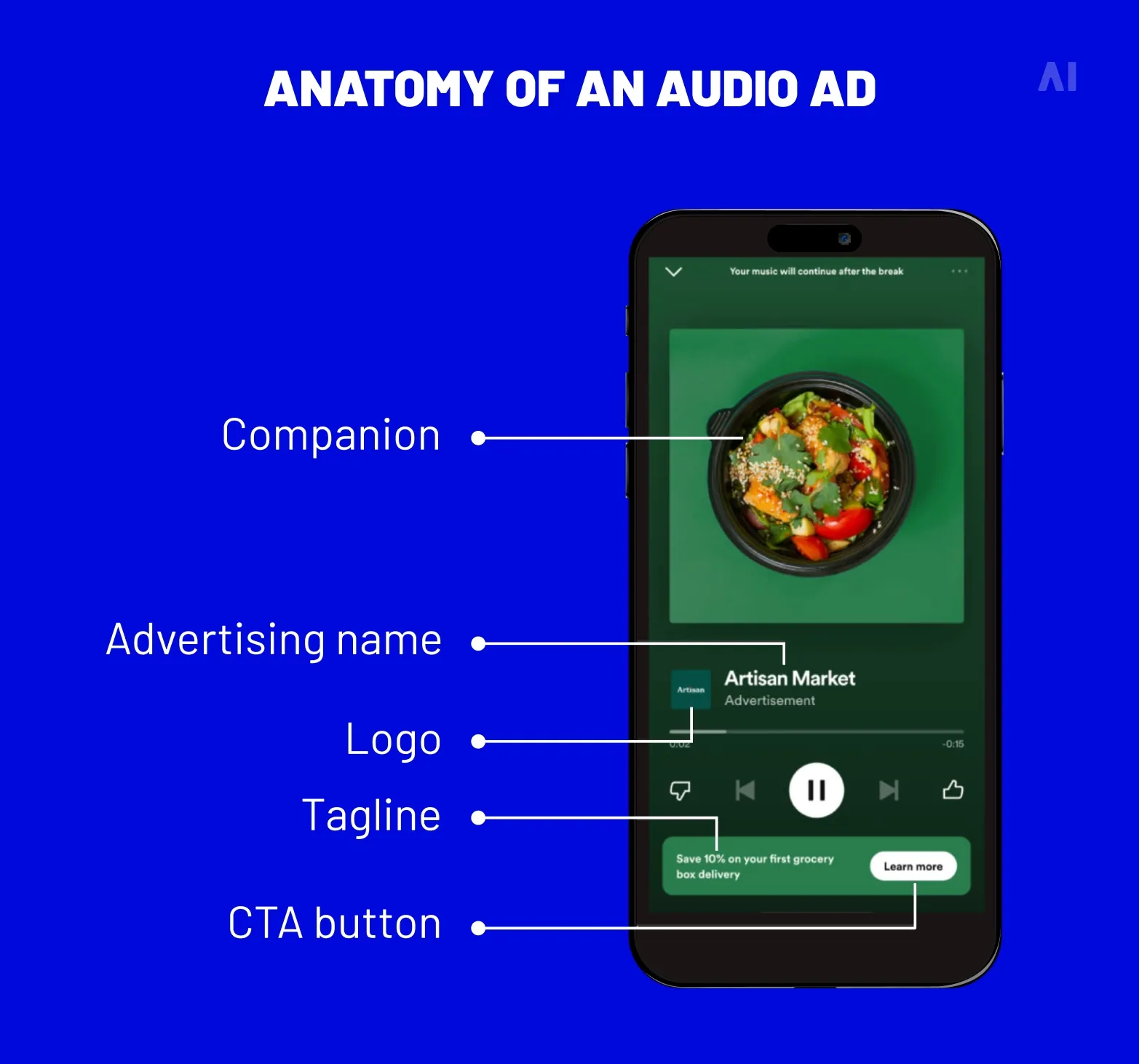
These are the classic digital audio spots—typically 15-30 seconds—served between songs or during podcast breaks on Spotify’s free tier. They are designed to reach listeners in screenless or low-attention modes (e.g., commuting, working out).
Best for: Building awareness, delivering a brand message via voice and sound, targeting mood or playlist contexts.
💡Audio ads can optionally include a “Canvas” visual element for mobile/desktop that loops while the ad plays, enhancing impact.
Video ads (mobile, desktop, and connected devices)
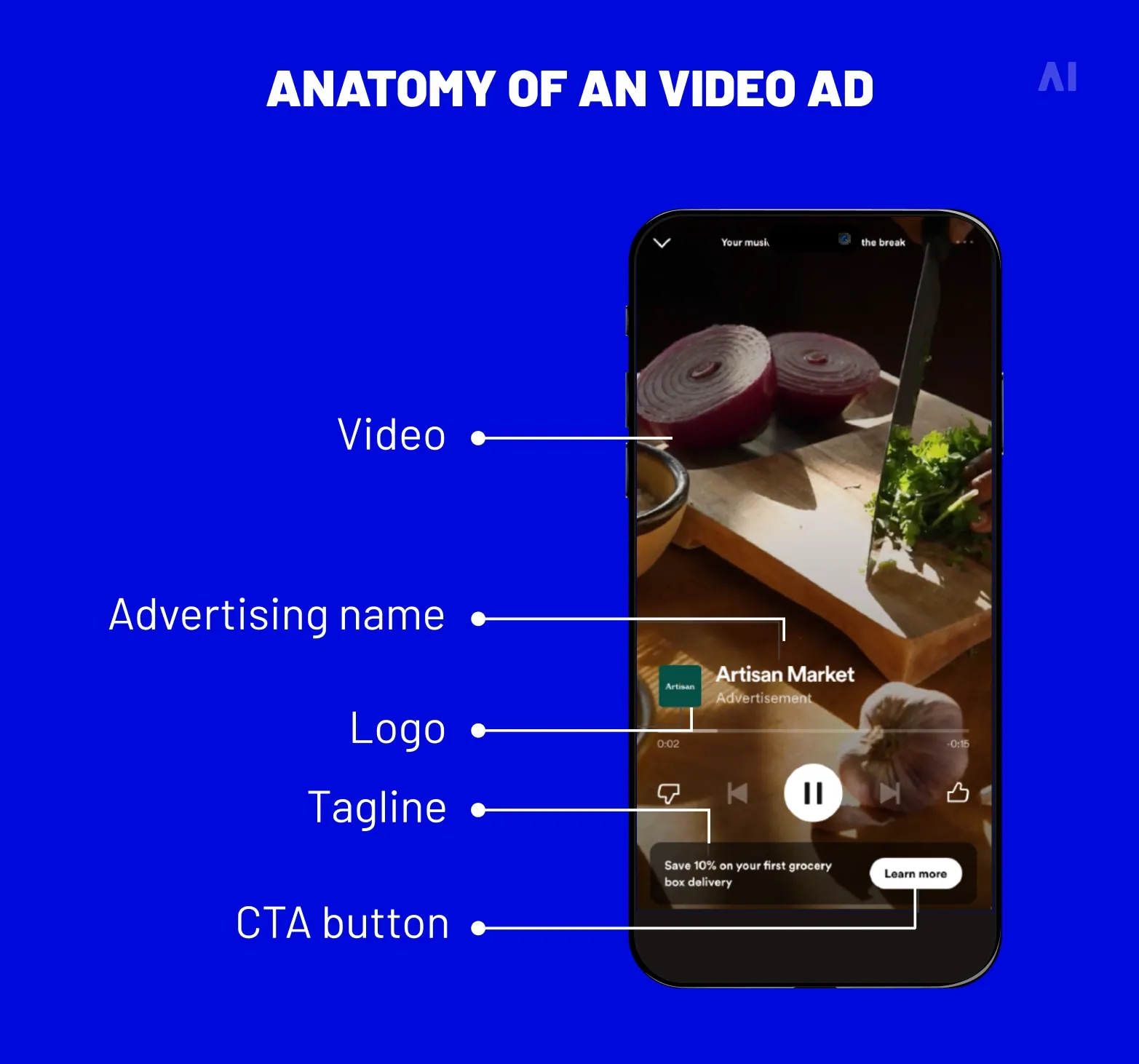
Full-screen video formats served when the user is actively engaged with the app. These include “Video Takeover” formats and opt-in video experiences. Video-Takeover requires companion display ad, click-through URL, and meets specific file/format requirements.
💡But to maximize efficiency and scale across many placements — especially across mobile, desktop and connected devices — programmatic video advertising is key.
⚡️For more detail on video in programmatic setups, see our guide on programmatic video advertising.
Overlay ads
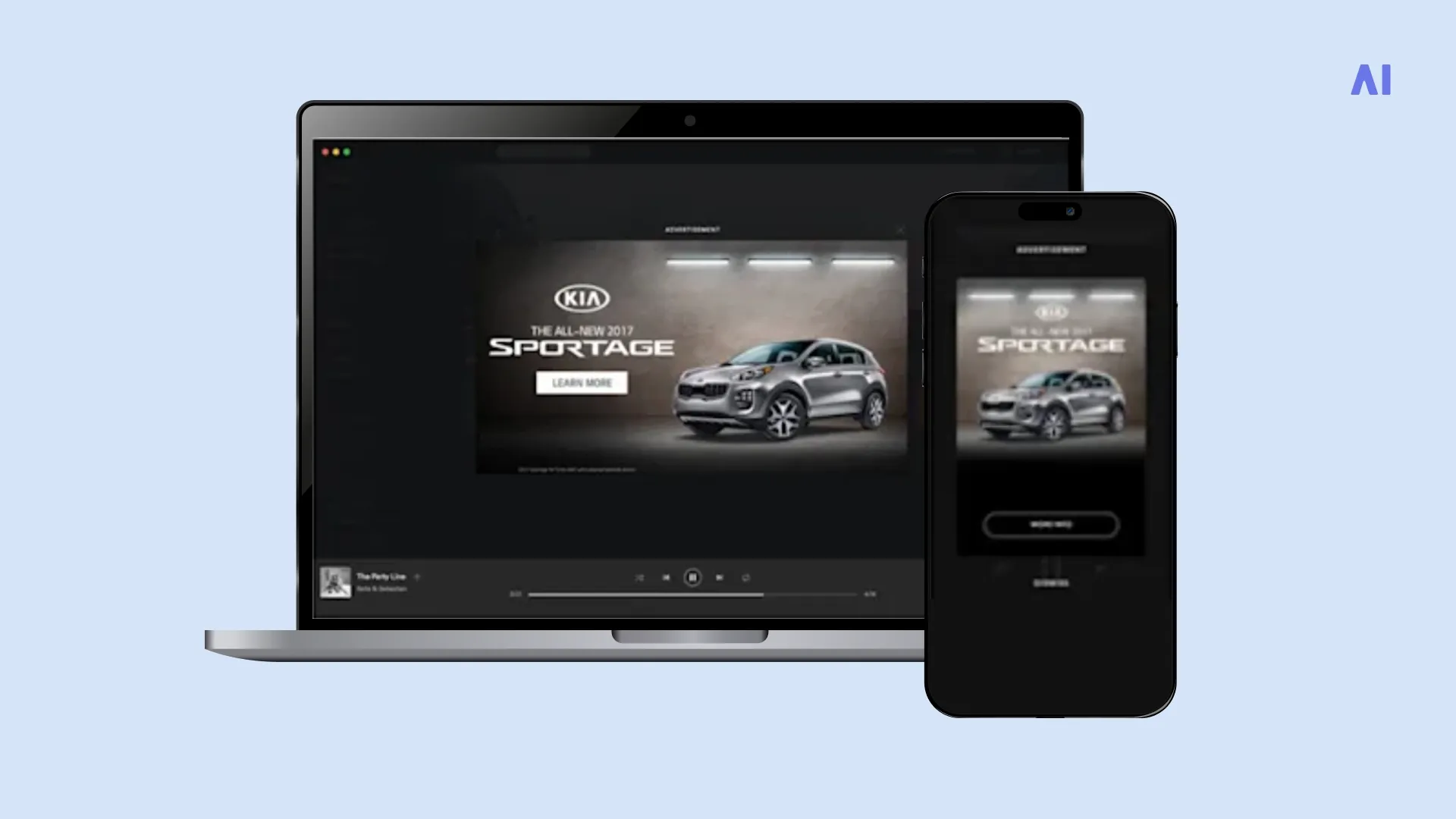
Visual display ads (e.g., banners or large overlays) that appear when a user returns to the Spotify app after a session. These clickable displays offer a visual anchor complementing audio/video campaigns.
💡Note that File specs (e.g., 800 × 435 px desktop) are important for creative readiness.
Best for: Driving traffic or conversions (e.g., “Visit site” or “Download app”), especially after sound-driven exposure.
Homepage takeover (desktop)
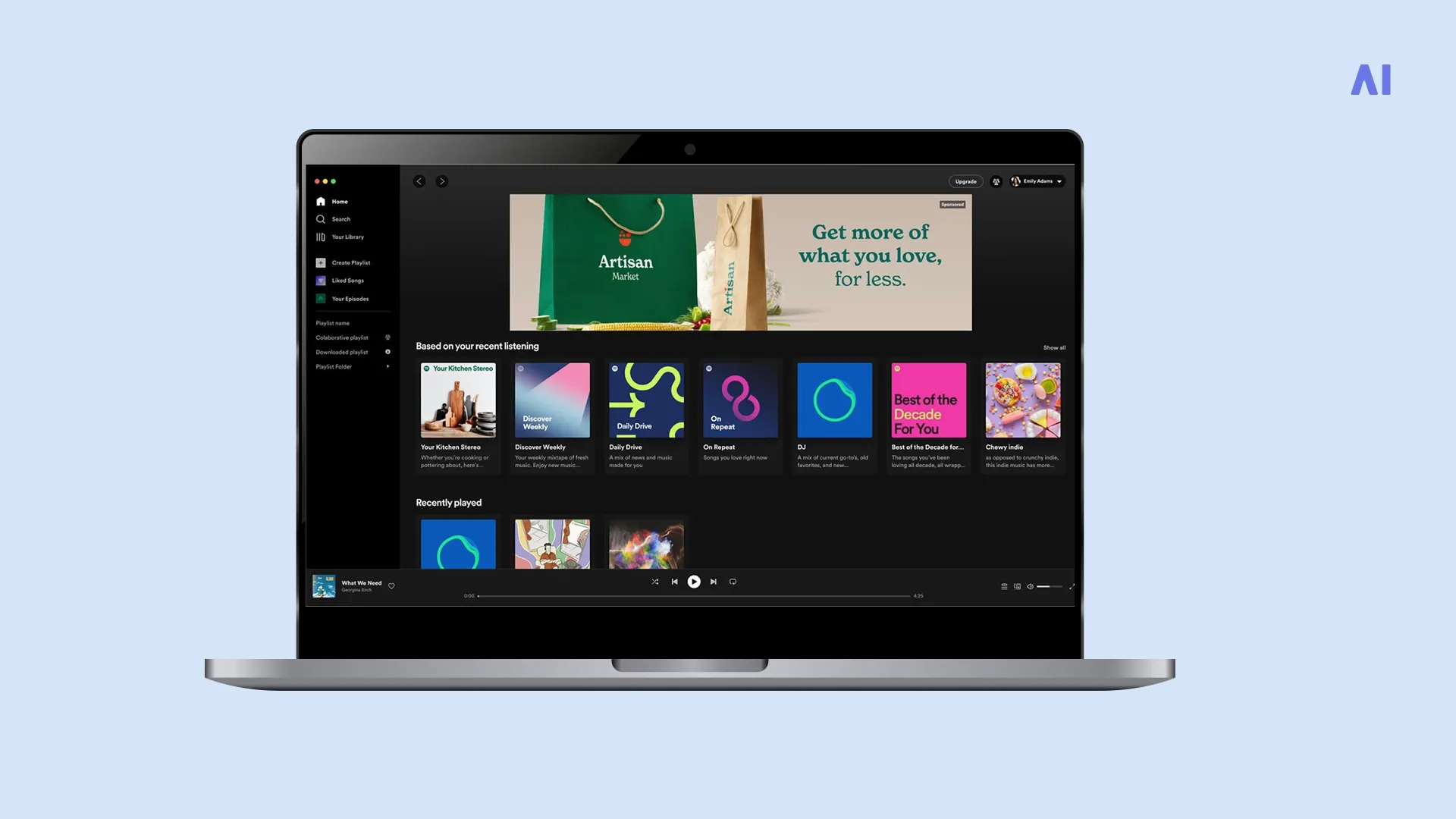
A branded takeover of the Spotify homepage on desktop for a set period (commonly 24 hours). High-impact, high-visibility display format. Because of its scale, this format is often higher cost and used for awareness vs. direct response.
Best for: Big-brand launches, event promotions, or when you want mass reach in one splash.
Sponsored playlists
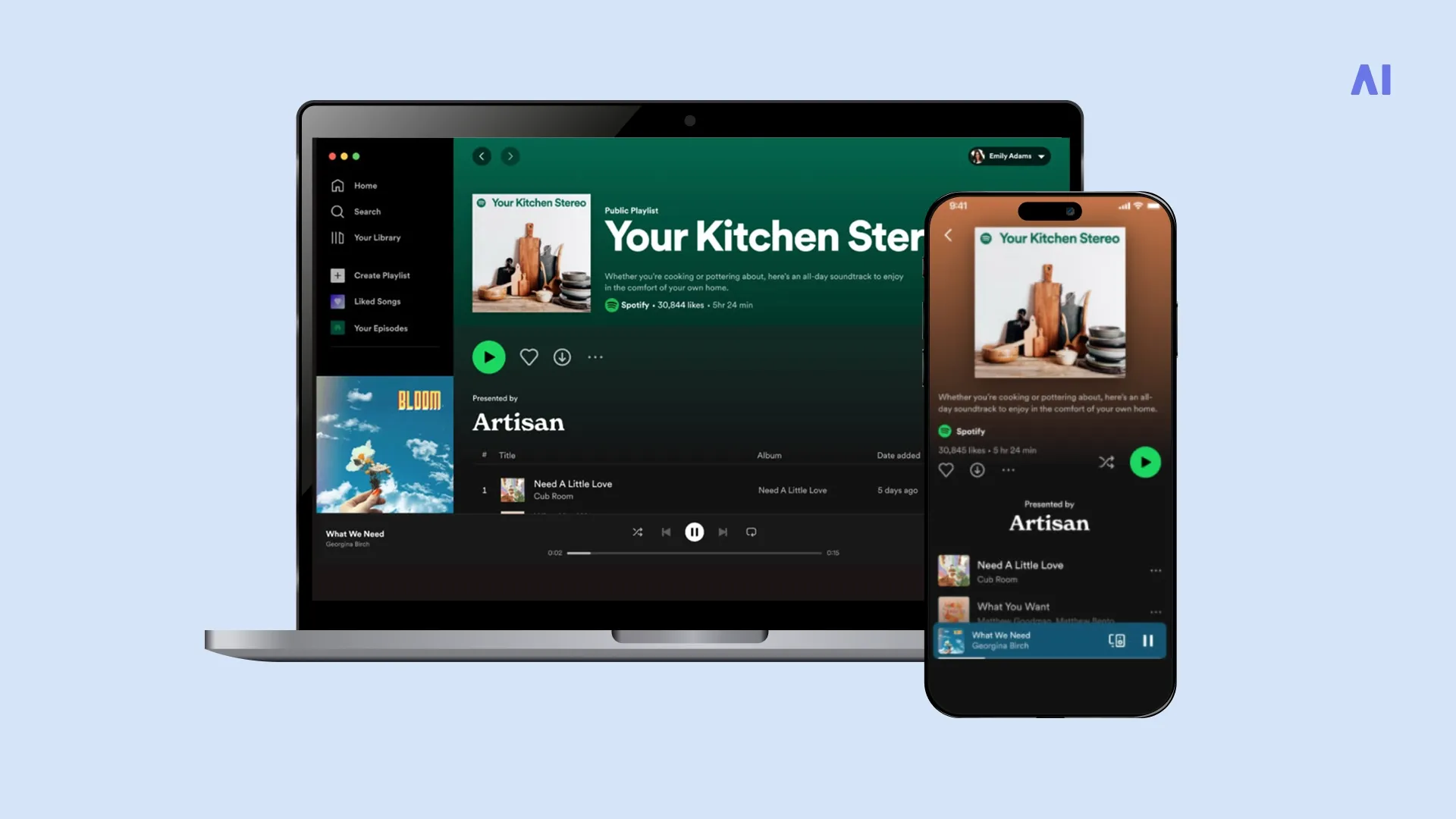
Brand-sponsored placement in themed playlists, aligned with mood or activity (e.g., “Chill Vibes”, “Workout Hits”). May include audio/video spots plus branding of playlist cover.
💡Very strong for brand positioning, less direct for conversion unless paired with CTA overlays or follow-me ads.
Best for: Mood-based targeting (e.g., aligning a brand with relaxing, studying, gaming or exercise settings) and higher-contextual relevance.
Podcast ads
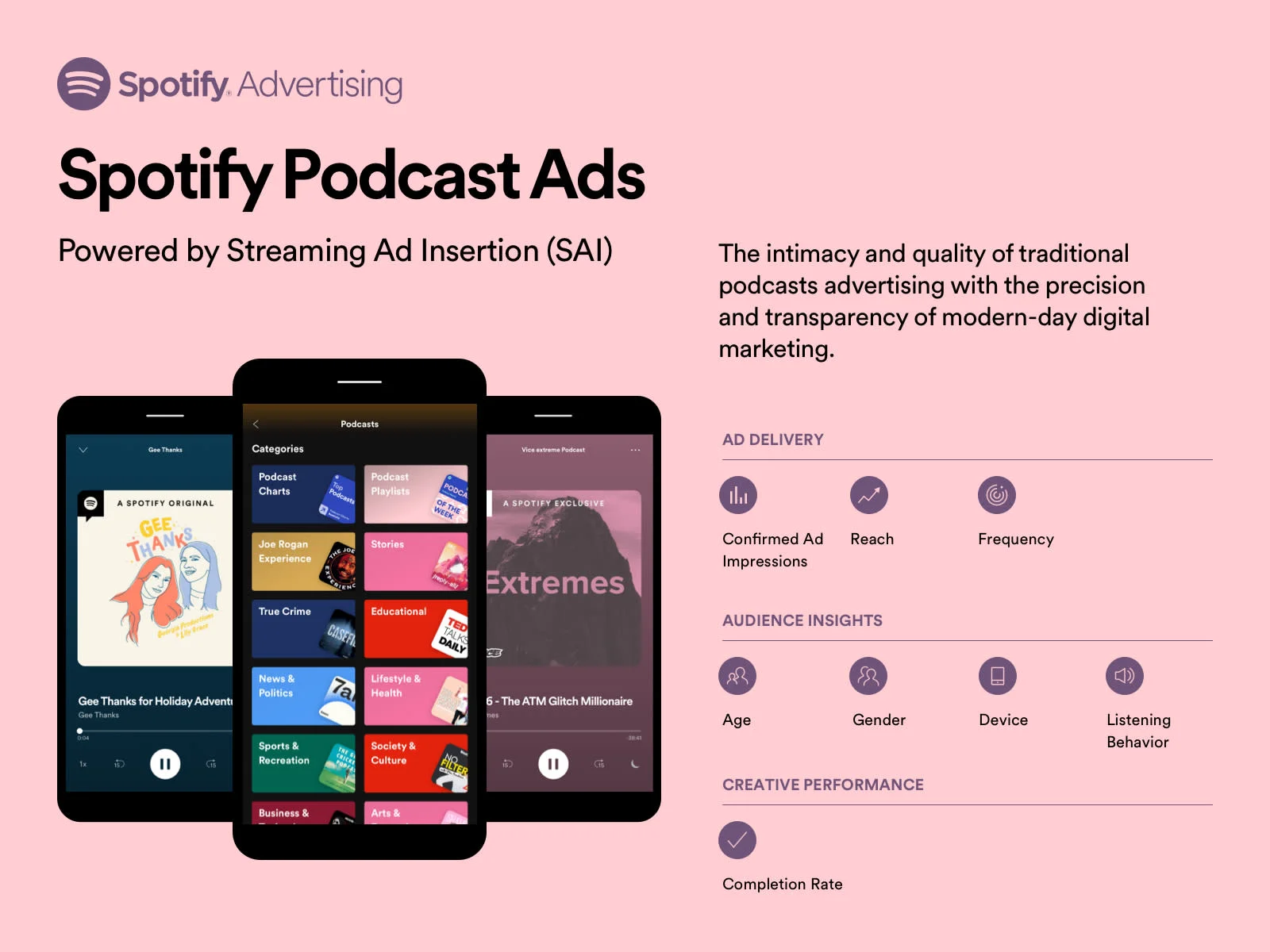
Ads inserted into podcasts on Spotify — pre-roll, mid-roll or post-roll. These operate in the spoken-word audio environment, often with higher listener engagement and longer attention spans.
💡The skip-rate is typically low because podcast listeners are already engaged; strong for both awareness and consideration phases.
Best for: Messaging with more depth, storytelling, credibility alignment (via host-read spots), or when targeting niche audiences within podcasts.
Spotify ad costs and pricing models
Understanding how Spotify ads are priced is essential for advertisers building efficient, performance-driven audio strategies. Unlike traditional radio or fixed-rate media, Spotify advertising uses dynamic pricing models—mostly CPM-based (cost per thousand impressions)—that adjust based on audience targeting, ad format, geography, and the buying path you choose, whether through Spotify Ad Studio, Spotify Ads Manager, or a programmatic DSP.
Spotify’s flexible structure allows both small businesses and enterprise brands to advertise on Spotify with transparent pricing, scalable budgets, and measurable outcomes across audio, video, and podcast inventory. This is also where AI Digital’s programmatic advertising capabilities elevate performance even further. By connecting Spotify inventory into a unified programmatic ecosystem, AI Digital optimizes bidding, audience segmentation, and cross-channel frequency to ensure every impression delivers maximum value. Smart Supply automatically identifies the most efficient placements, reduces wasted spend, and enhances targeting precision—so advertisers pay competitive CPMs while reaching higher-quality listeners.
💡In practice, this means brands don't simply buy Spotify ads; they activate a smarter, data-driven Spotify advertising campaign that performs better across the entire audio landscape.
How Spotify ad targeting works
Spotify uses an impression-based model across most formats, meaning you pay only when your audio ad, Spotify video ad, display unit, or Spotify podcast ad is actually delivered. Costs are influenced by:
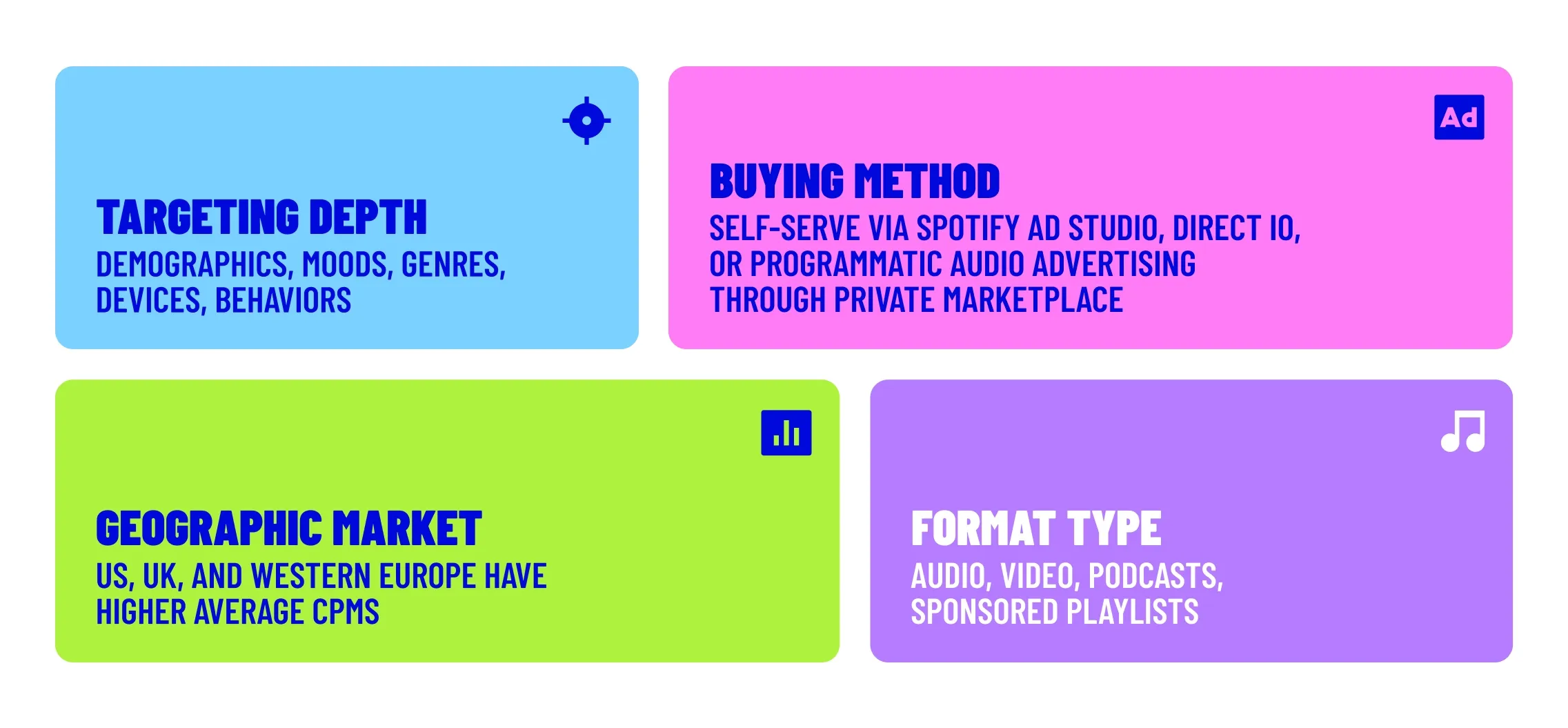
💡Spotify emphasizes flexibility: you can run ads on Spotify starting from small self-serve budgets, or scale through programmatic deals for broader Spotify advertising campaigns.
⚡️AI Digital’s Smart Supply is designed to optimize Spotify ad campaigns by improving cost efficiency across supply paths. It works by:
- Securing premium, brand-safe audio inventory—including Spotify—at competitive rates
- Reducing wasted impressions through algorithmic bidding and real-time decisioning
- Lowering effective CPMs by automatically shifting spend toward the most efficient placements
- Integrating Spotify data with omnichannel measurement for true performance benchmarking
This helps advertisers get more value out of every impression, whether the goal is reach, frequency management, or performance optimization.
How to run Spotify ads step-by-step
Running Spotify ads is a straightforward process once you understand the structure inside Spotify Ad Studio and how it connects to broader programmatic workflows. Here’s a practical, beginner-friendly guide that also scales for advanced advertisers using DSPs and AI-driven optimization.
1. Create a Spotify Ad Studio account
Start by setting up your account in Spotify Ad Studio, the platform’s self-serve tool for creating and managing ads on Spotify. This is where you’ll access audience targeting, budgeting tools, and creative uploads. For enterprise-level programmatic buying, you can also onboard Spotify inventory through your DSP, integrating it into your larger programmatic audio advertising strategy.
2. Add basic campaign details
Name your Spotify advertising campaign, select your objective (reach, impressions, consideration), and choose where your ads will appear—music, podcasts, video placements, or multi-format delivery. These details help Spotify’s system structure your campaign and recommend best practices based on your goals.
3. Define and target your audience
Spotify’s powerful first-party data lets you target people based on demographics, location, interests, music genres, playlist categories, moods, behaviors, device type, and even specific moments of the day.
You can also use custom audiences or programmatic segments when buying through a DSP. This step is crucial for controlling Spotify ad frequency, improving personalization, and keeping spend efficient.
4. Set your budget, bid, and schedule
Choose your daily or lifetime budget, define your bid strategy, and schedule your campaign. If buying programmatically, your bidding may involve real-time auctions—RTB (Real-Time Bidding)—which determine when and where your Spotify ads appear based on your bid, targeting, and the value of each impression.
RTB plays a crucial role in Spotify’s programmatic ecosystem because every impression is not equal: listeners have different moods, contexts, devices, and engagement levels at any given moment. Real-time bidding allows advertisers to compete only for the impressions that matter most. For example, you can bid higher for users listening on smart speakers during long sessions or lower for broad-reach placements during passive listening. RTB continuously analyzes supply, demand, and listener behavior, ensuring your campaign pays the right price for each moment—rather than relying on fixed rates that ignore audience quality.
💡In practice, RTB helps advertisers maximize efficiency by preventing overspending, improving targeting accuracy, and optimizing delivery across the entire Spotify advertising campaign. It’s especially valuable when you want to control Spotify ad frequency, avoid waste, or scale budgets dynamically based on performance.
5. Create and upload сreatives
creative. Spotify Ad Studio supports audio uploads or lets you generate high-quality voiceover ads directly in the platform.
Ensure your creative aligns with mood or playlist context, and consider using variations for testing. For video ads, make sure the specs match the platform requirements across mobile, desktop, and connected devices.
6. Measure and optimize performance
Once your campaign goes live, monitor key metrics such as impressions, reach, completion rate, click-through rate, and engagement. These benchmarks show how well your Spotify ads are delivering against your goals—but true optimization happens when analytics, machine learning, and programmatic tools work together.
⚡️This is where AI Digital adds significant value. By integrating Spotify’s first-party reporting with cross-channel programmatic data, AI Digital helps you understand not just what performed well, but why. Our Smart Supply system automatically analyzes patterns in listener behavior, device usage, time-of-day responsiveness, and playlist context, then reallocates budget toward higher-performing placements. This means your Spotify advertising campaign continuously improves in real time—without the manual guesswork.
AI Digital also supports advanced KPIs that go beyond basic platform metrics. These include:
- Effective CPM (eCPM) to measure true cost efficiency
- Frequency distribution to prevent oversaturation
- Lift metrics such as ad recall and brand awareness (if Brand Lift studies are activated)
- Attribution insights, connecting Spotify engagements to downstream actions
- Audience quality scores, measuring the value of each impression relative to your goals
- Cross-channel impact, showing how Spotify influences performance on search, display, or social
With these insights, you can refine segments, test new creative angles, adjust Spotify ad frequency, or shift spend across audio, video, and podcast formats.
⚡️A deeper breakdown of optimization metrics will be available in our guide: 15 Essential Digital Marketing KPIs to Track (and Improve) in 2026.
Best practices for Spotify advertising
To get the most out of Spotify ads, brands need more than strong targeting—they need thoughtful creative, data-driven optimization, and consistent testing. Spotify is a uniquely emotional and high-attention environment, so even small improvements in creative or placement can dramatically impact performance. For marketers building a full Spotify advertising campaign, here are the practices that consistently deliver stronger results.
- Lean into context. Spotify’s first-party data allows you to match your audio ads, Spotify video ads, or podcast ads to moments—studying, working, commuting, exercising. Ads tailored to mood or activity consistently show higher completion rates and engagement.
- Use clear, concise messaging. Audio is powerful, but listeners process information quickly. Use a single focus point, emphasize your CTA early, and make sure your brand name appears in the first few seconds.
- Set—and control—your Spotify ad frequency. Frequency impacts both recall and fatigue. Monitoring and adjusting frequency across devices helps avoid oversaturation while keeping your message memorable.
- Test creative variations. Change tone, voiceover style, music beds, or CTAs and measure performance differences. Spotify is ideal for rapid A/B testing.
- Integrate with a broader performance marketing strategy. When Spotify is part of an omnichannel system—search, social, CTV, display—your performance improves. AI Digital’s measurement stack ties Spotify events to macro-level KPIs, helping you optimize your entire funnel.
Challenges and how to overcome them
While Spotify advertising is powerful, advertisers can still face strategic or operational challenges. With AI-driven tools and thoughtful planning, these limitations can become opportunities.
Creative limitations (audio-only format)
Audio-only ads can feel restrictive for brands used to visual storytelling.
But there’s an advantage: listeners are more focused, and emotional resonance is stronger. Using dynamic scripts, music cues, and contextual targeting can turn audio into one of the most memorable touchpoints in a campaign. AI Digital’s Elevate can also generate multiple voice variations or AI-personalized audio versions for different audiences—removing creative bottlenecks entirely.
Budget scalability for small advertisers
While advertising on Spotify cost structures are flexible, small businesses may struggle with scale or efficient bidding. AI Digital’s Smart Supply helps reduce wasted spend by automatically optimizing bids, finding lower-cost impressions, and improving CPM efficiency—making it easier for smaller advertisers to run ads on Spotify without overshooting budgets.
Measuring true ROI and attribution
Attribution is one of the biggest challenges in digital audio. Spotify provides strong platform analytics, but measuring full customer impact requires deeper integration. AI Digital connects Spotify impression data with cross-channel analytics, incrementality testing, and attribution models—helping marketers quantify lift, understand contribution across channels, and tie Spotify ads to business outcomes.
Privacy and consent management
As privacy regulations evolve, advertisers must navigate consent, cookie deprecation, and the shift toward first-party data. Spotify’s logged-in environment already supports privacy-friendly targeting, but AI Digital goes further; using privacy-compliant identity solutions, consent frameworks, and clean-room integrations to maintain measurement accuracy without compromising user trust.
⚡️For more detail on how AI is transforming privacy-safe targeting, attribution, and personalization, explore our guide on AI in Digital Marketing.
Conclusion: integrating Spotify into your omnichannel strategy
Spotify has earned its place in every modern media mix because it brings together two things marketers rarely get in the same channel: deep emotional engagement and data-driven precision. Listeners stream with intent—working, commuting, studying, relaxing—and Spotify’s first-party data allows advertisers to match messages to these moments with remarkable accuracy. When combined with flexible pricing models and measurable outcomes, Spotify ads become a reliable engine for both brand lift and performance.
The real power emerges when Spotify is integrated into an omnichannel plan. Pairing audio ads, Spotify video ads, and podcast ads with display, social, and especially CTV creates a unified brand story that follows the user across screens and devices. For advertisers moving toward a connected media ecosystem, aligning Spotify with channels like Connected TV strengthens mid-funnel engagement and multiplies conversion pathways.
⚡️To explore how CTV fits alongside Spotify, see our guide on Connected TV Advertising
AI Digital helps brands take this even further. Smart Supply ensures your spend flows through the most efficient and premium audio inventory, while Elevate allows dynamic, AI-driven personalization across every Spotify format. Together, they turn Spotify from a standalone channel into a strategic, programmatic component of your full media framework—optimized, scalable, and measurable.
Here are a few practical takeaways for marketers ready to integrate Spotify into their broader strategies:
- Use Spotify as your emotional anchor. Audiences are more attentive in audio environments, making Spotify ideal for brand storytelling and sonic branding.
- Let data guide your placements. Lean on genre, mood, device, and behavior targeting to deliver the right message in the right moment.
- Connect Spotify to your cross-channel measurement. When audio, display, video, and CTV are measured together, you can optimize spend holistically.
- Apply programmatic intelligence. Smart Supply and Elevate help refine bidding, personalize creatives, and scale results with far more efficiency than manual optimization.
Integrating Spotify into your omnichannel strategy is a shift toward a smarter, more cohesive advertising ecosystem where every impression works harder and every message lands with greater impact.