Programmatic podcast advertising in modern media ecosystems


Programmatic podcast advertising gives media teams a way to buy across participating shows and publishers through automated technology. In Edison Research at SSRS’s 2026 study, 58% of Americans age 12+ had listened to or watched a podcast in the previous month. Reaching that audience means working across different platforms and buying arrangements, each offering access to part of it.
This guide follows podcast inventory from publisher to campaign, examining transactions, insertion, targeting, reporting and the trade-offs against direct sponsorships.
TL;DR: Podcast programmatic advertising
- Programmatic automates podcast media buying and activation. Supported routes include auctions, private deals and guaranteed arrangements.
- Buying and delivery are separate decisions. Programmatic does not automatically mean dynamic ad insertion, real-time bidding or an open auction.
- Inventory access and control vary. A buyer may access selected shows, network inventory or curated packages, with different reporting and exclusion options.
- Targeting uses several kinds of signals. Content, audience profiles and supported identity data can inform selection without identifying an individual listener.
- Measurement answers different questions. Downloads, ad delivery, estimated reach, attributed conversions and incremental impact should be assessed separately.
- Direct sponsorships retain a role. Programmatic can simplify broader activation, while bespoke host collaborations may require a negotiated relationship.
What is programmatic podcast advertising?
Programmatic podcast advertising is the automated buying, selling and activation of podcast ad inventory through connected advertising technology. It sits within programmatic audio advertising, which also covers environments such as streaming music and digital radio.
Depending on the supplier and integration, advertisers can buy through auctions, private marketplaces, preferred deals or programmatic guaranteed arrangements. Automation can follow a negotiated agreement, so the presence of a sales team does not make a transaction non-programmatic. Acast's programmatic offering, for example, includes both private marketplace and guaranteed buying.
How programmatic differs from direct podcast sponsorships
Programmatic usually organizes buying around eligible impressions and campaign criteria. Direct sponsorship often starts with a chosen show, its audience and the host's creative involvement. Both can contribute to a broader podcast advertising strategy.
These are common planning differences, not rigid boundaries. Acast documents directly purchased ads and sponsorships using dynamic insertion, alongside baked-in reads. Voice, buying route and insertion method should each be specified in the media plan.
Podcast ad buying and delivery
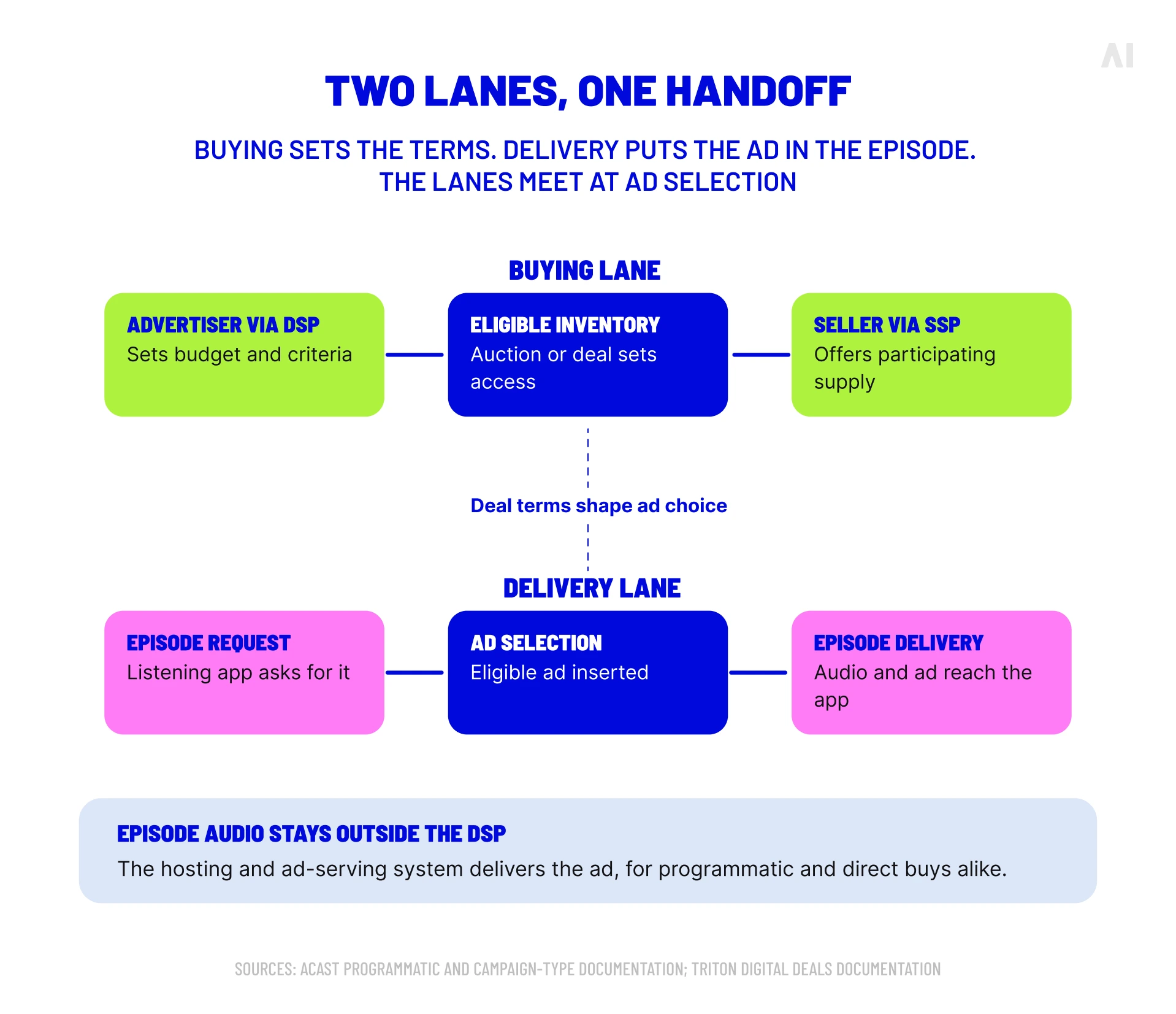
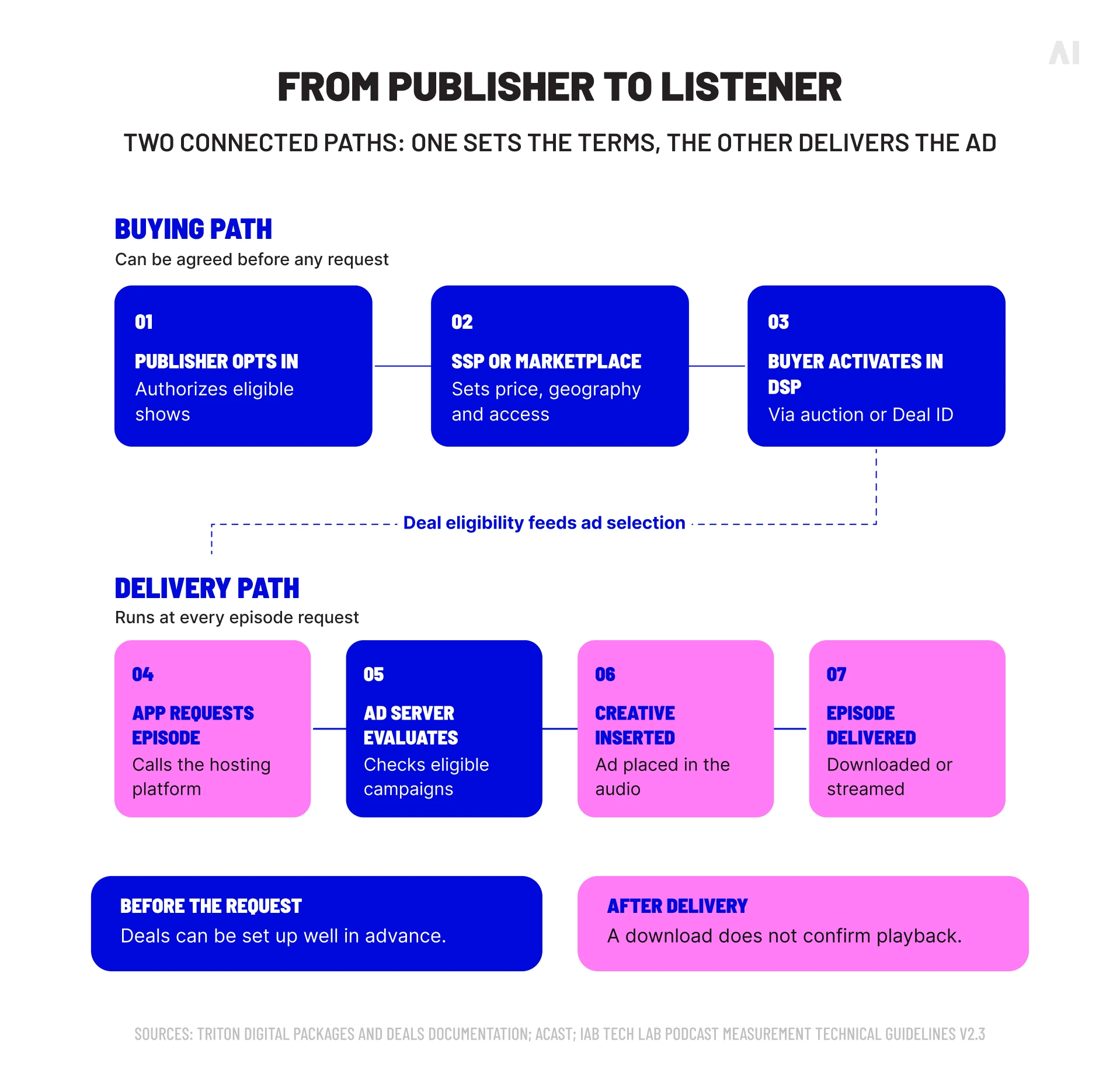
The buying path determines which advertiser can access an opportunity and under what terms. The delivery path gets the selected creative into the episode experience. Connected technology coordinates those tasks, but the episode does not pass through the buyer's DSP.
Where programmatic podcast inventory comes from
Supply can originate with publishers, networks, hosting or monetization platforms and authorized inventory representatives. A show's appearance in a listening app does not establish who sells its advertising, which is why comparing podcast advertising platforms requires checking each provider's inventory access and commercial arrangements.
Triton's package documentation illustrates the commercial layer: publishers opt into network packages and authorize eligible inventory to be made available through deals. They can limit which podcasts participate. Access therefore depends on permissions, integrations, geographic eligibility and commercial arrangements.
How the programmatic transaction works
The buyer sets campaign requirements, while the seller defines eligible inventory and commercial conditions. The supported transaction then determines how demand is selected:
- Open auction: eligible buyers compete through real-time bidding.
- Private marketplace auction: access is restricted to participating buyers.
- Preferred deal: a buyer receives agreed access or priority under the platform's rules.
- Programmatic guaranteed: buyer and seller agree to a reserved inventory commitment fulfilled through an automated workflow.
Triton documents these transaction types, including its own priority rules. Pricing and reservation mechanics should be confirmed for the actual route. A Deal ID identifies a buying arrangement; its existence alone does not promise guaranteed volume or exclusive inventory.
Where dynamic ad insertion fits
Dynamic ad insertion, or DAI, selects and inserts eligible creative separately from the original recording. Depending on the implementation, selection can occur at the episode request, download or playback stage.
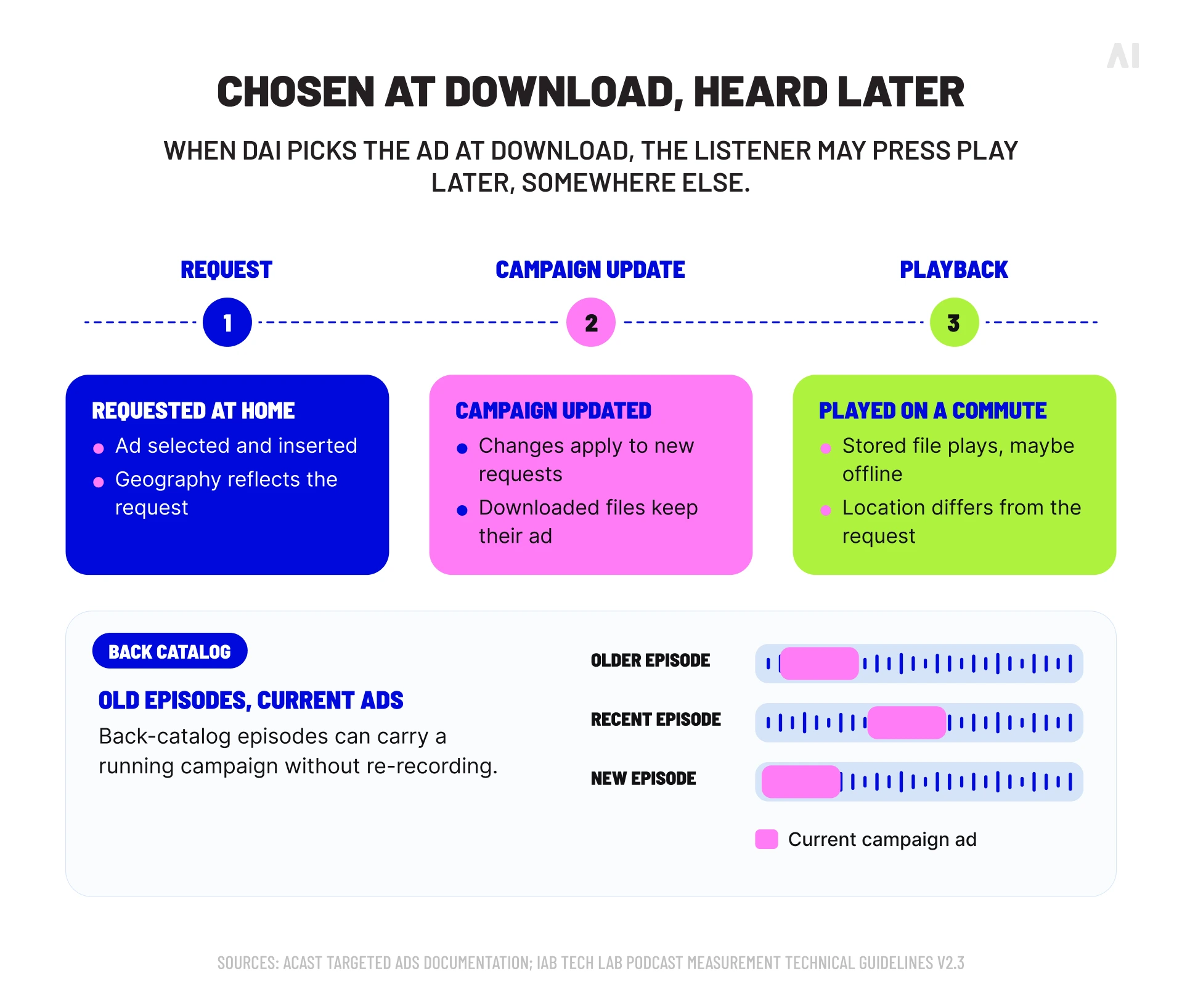
Acast describes ad selection before an episode is downloaded or streamed, including eligible back-catalog episodes. This allows a current campaign to run within older content without re-recording the episode.
Timing needs care. An episode downloaded at home may be played later on a commute. Download-time signals therefore describe the request context, and changing a campaign does not rewrite an existing offline file. DAI also serves direct campaigns, so its presence does not establish how the placement was bought.
⚡ The buying agreement sets the commercial terms; the insertion system handles delivery.
Available programmatic podcast inventory
Programmatic podcast inventory can be offered by show, network, audience profile or content criteria. Private and curated packages add commercial and selection rules to those options.
These categories overlap. A private package could contain selected business shows and use contextual filters. Publisher package controls demonstrate how inventory can be narrowed before it reaches demand.
Custom integrations and exclusive sponsorship opportunities may require separate negotiation. A programmatic connection to a network should not be treated as access to its entire commercial offering.
Podcast targeting methods and signals
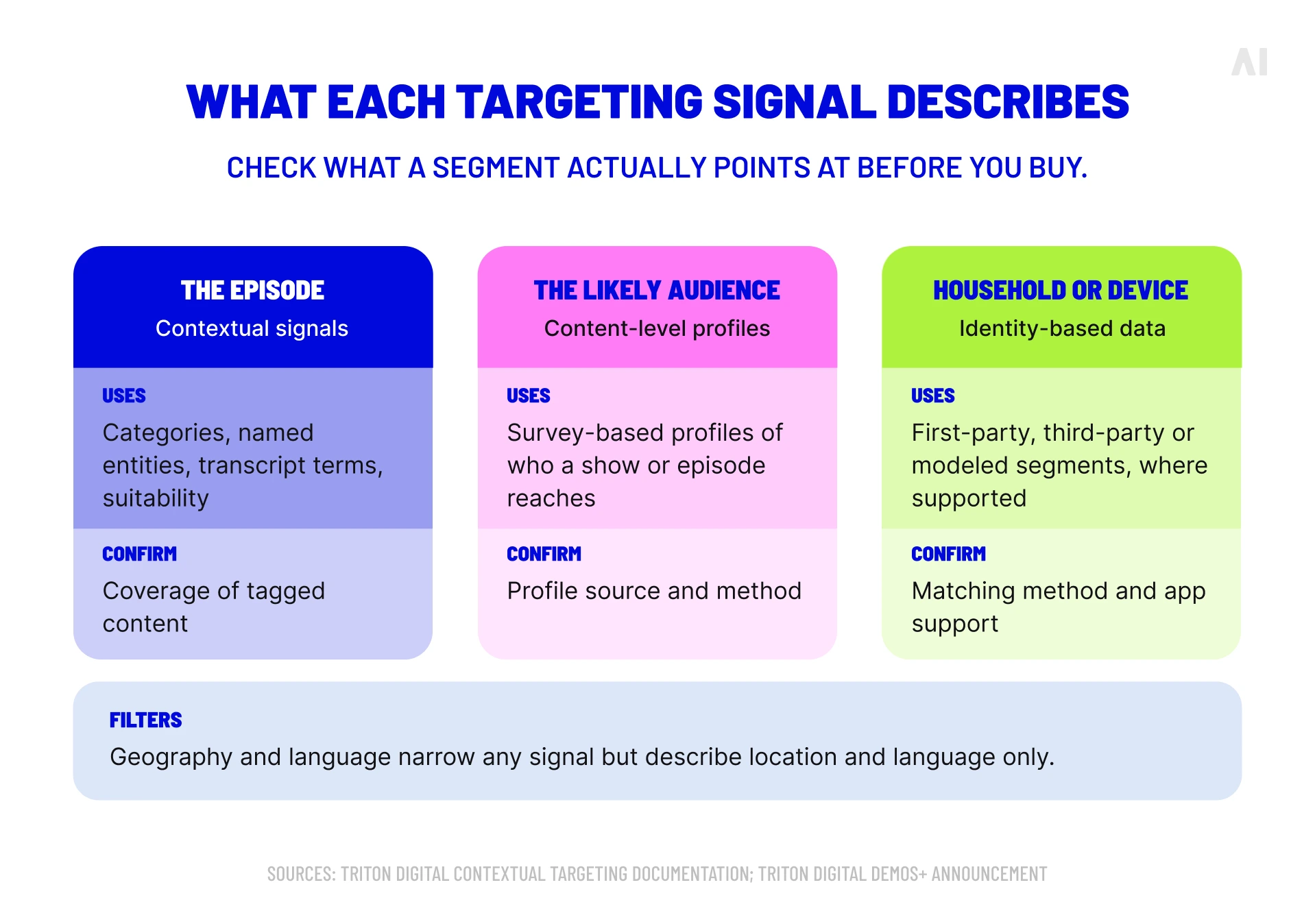
Targeting depends on the supply source, available data and activation route. A useful planning question is what each signal actually describes: the episode, the likely audience or a supported household or device identifier.
Context, show and genre signals
Contextual selection can range from choosing a show category to identifying topics within individual episodes. Geography and language can further narrow eligibility, although geography describes location rather than subject matter.
Triton's contextual targeting documentation explains episode-level analysis using categories, named entities, transcript terms and suitability information. It requires enabled integrations and tagged content.
For example, a business category could contain entrepreneurship interviews, investment commentary and employment advice. An advertiser seeking discussions about starting a company may benefit from episode-level selection, provided the supplier offers sufficient coverage.
Audience and data-driven targeting
Audience activation may use demographic, behavioral, interest, first-party, third-party or modeled segments where supported. Before buying, establish how those segments are built and applied.
One approach selects content associated with a desired audience. Triton's Demos+ demographic targeting uses survey-based profiles to classify shows and episodes by their likely consumers. The signal attaches to content rather than an identified listener.
Other routes can use supported identity or data connections. SiriusXM Media describes first-party data and audience targeting within its programmatic audio offering, but the applicable options must be confirmed for podcast supply. A feature available in one streaming environment cannot be assumed across every listening app.
Podcast ad placement controls
Control can be substantial, but it depends on the supplier, integration and agreement. Acast, for instance, advertises show-level visibility; buyers should establish equivalent reporting expectations with each partner.
Before activation, confirm:
- Which publishers and shows are visible before and after delivery.
- Which inclusion lists, exclusions and contextual filters are supported.
- How geography and brand-suitability requirements are enforced.
- What the Deal ID includes and how changes are communicated.
- Whether reports identify shows, episodes or only aggregated packages.
There is also a difference between setting a suitability rule and verifying delivery against it. SiriusXM Media describes pre-bid controls and episodic suitability reporting through supported partnerships. Ask which capabilities apply to the proposed campaign, including any added cost.
How programmatic podcast advertising is measured
Measurement should separate content delivery, ad delivery, audience estimates and business outcomes. Those layers draw on different evidence and answer different questions.
The current final IAB Tech Lab Podcast Measurement Technical Guidelines are version 2.3, released in September 2026. The accompanying release explanation emphasizes that a download does not establish confirmed playback. Provider certification also has a defined version and metric scope, which should be checked in the compliance register.
The delivery distinctions follow IAB's metric definitions. Outcome reporting requires additional attribution or lift methodology.
Delivery, reach and frequency
Campaign reports can include impressions, spend, pacing and placement data. The underlying impression definition should be clear before results are compared. Spotify Ad Analytics distinguishes download-based measurement for non-Spotify media from confirmed ad impressions for Spotify media.
Reach and frequency introduce another calculation. IAB describes audience estimation using IP addresses and user agents within a defined period, with limitations from changing or shared addresses. Ask how the buying system deduplicates delivery and where its frequency controls operate. A reported frequency should not automatically be interpreted as a precise count of exposures for each person across every app.
Conversion and attribution signals
Advertisers can assess site visits, leads, purchases, promo-code use and vanity-URL responses, alongside brand studies and third-party attribution.
Spotify's attribution documentation describes combining impression information with website events collected through its pixel. Podscribe explains household-IP matching, device-graph support and modeling, as well as comparisons with promo codes and surveys.
These methods help connect exposure records with outcomes. Estimating what happened because of advertising requires a further comparison. Podscribe's incrementality documentation describes control-based approaches, bias adjustments and uncertainty ranges. Campaign reporting should keep those estimates distinct from attributed totals.
⚡ Attribution assigns credit under a model. Incrementality estimates the additional effect of advertising.
Programmatic buying: strengths and limitations
Programmatic's advantages are clearest when the campaign benefits from coordinated activation across eligible supply. Its limitations become more apparent when the proposition depends on a particular host or bespoke integration.
Scale, automation and optimization
Centralized buying can reduce the operational work of managing separate publisher activations. Teams can use compatible supply connections to apply campaign criteria, monitor pacing and adjust their approach.
AdsWizz describes programmatic podcast buying through DSPs and marketplaces, with targeting and creative adjustments. For a media team, the practical benefit is a more repeatable workflow for testing eligible supply and messages.
Optimization still needs a meaningful signal. A low-cost placement may provide inexpensive delivery while contributing little to the campaign objective. Evaluate cost alongside placement quality and the agreed outcome measures.
What advertisers may lose compared with direct deals
Standardized buying can leave less room for a host's personal experience, a custom editorial segment or a broader creator partnership. Acast's sponsorship and branded-content formats illustrate the collaboration that such work can require.
Private and guaranteed arrangements can preserve negotiated access and greater control. They do not automatically include bespoke production, endorsements or exclusivity. Those elements need to appear in the agreement, regardless of how the media is activated.
When programmatic podcast buying fits
Programmatic is worth considering when a campaign needs broader audience activation, multiple publishers, centralized operations or a repeatable testing framework. It can support a wider digital audio advertising plan, including activity considered alongside Spotify advertising.
Consider a regional retailer testing messages across relevant podcasts. Geographic eligibility, creative consistency and comparable reporting could make programmatic useful. A specialist brand seeking a detailed host demonstration may instead prioritize direct collaboration.
A combined plan can assign each route a specific job: sponsorship for the chosen partnership, programmatic for additional eligible reach. Define how overlap and outcomes will be assessed before adding the results together.
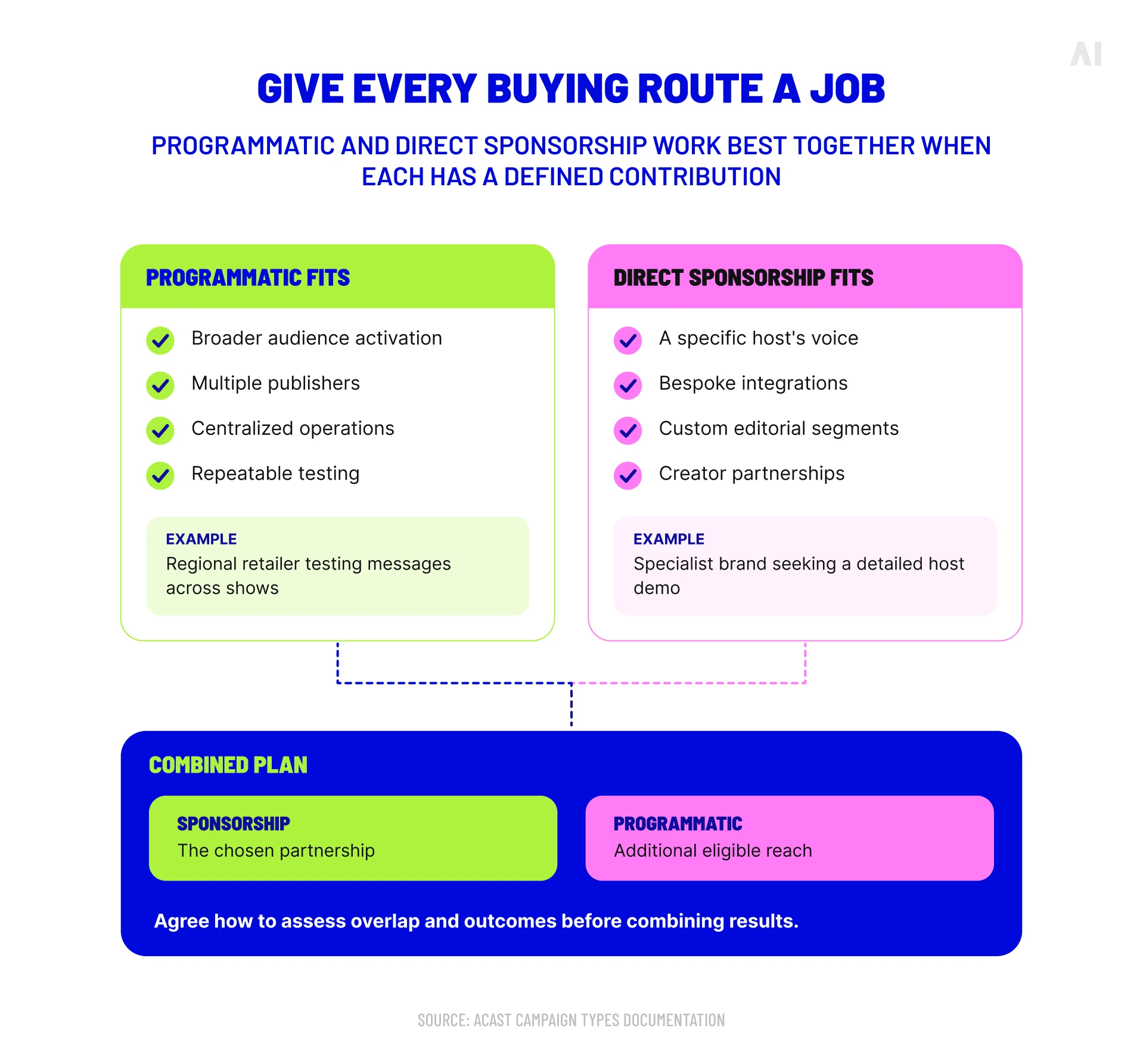
⚡ A media plan works better when every buying route has a defined contribution.
AI Digital's approach to podcast buying
AI Digital's broader buying approach connects campaign objectives with supply selection, technology and ongoing optimization. For podcast planning, the starting questions are practical: which inventory is available, how it can be purchased and what the reporting will establish.
Smart Supply brings direct premium-SSP partnerships, custom Deal IDs built around campaign KPIs, traffic-quality filtering and in-flight adjustments. Its stated approach includes visibility into placements, traffic sources and pricing, without allegiance to a single DSP or SSP. Podcast availability and capabilities should be confirmed for the proposed campaign.
The Open Garden Framework supports vendor-neutral coordination across buying technology, supply and data partners. That gives advertisers a useful basis for evaluating podcast opportunities within a wider media strategy, with campaign requirements guiding the choice of partners.
Programmatic complements direct podcast buying
Programmatic adds ways to access podcast inventory and coordinate campaigns. Its value depends on understanding the purchase: the supply included, transaction terms, delivery method, targeting signals and evidence available afterward. Direct sponsorships and managed relationships remain useful where the campaign requires them.
Talk with AI Digital to build podcast and audio buying into a media strategy designed around your campaign goals.