Ad copy optimization: How to create and test dozens of versions with AI


Ad copy optimization begins with a question about the customer. Would a clearer benefit attract more qualified prospects? Does the offer need stronger evidence? Could the call to action better explain what happens next?
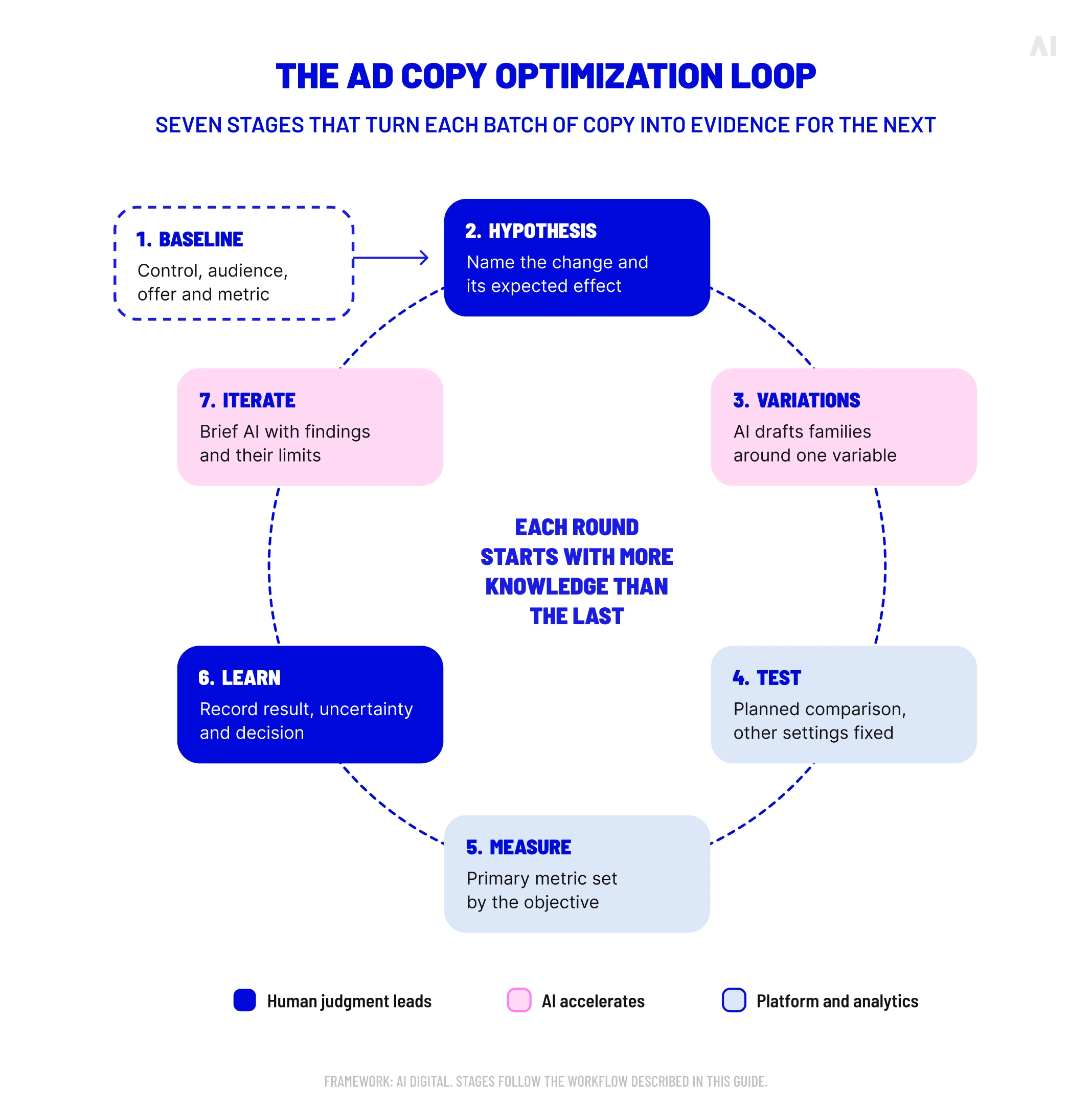
AI makes those questions easier to explore in writing. Teams still need to choose versions that test a clear idea, compare their performance fairly and use the findings to guide the next revision. A useful workflow connects each batch of copy to a specific learning objective, so the next round starts with more knowledge than the last.
TL;DR: Ad copy optimization with AI
- Optimization is an ongoing process. Copy changes connect audience needs and campaign objectives to measurable hypotheses.
- AI expands the pool of ideas. Controlled prompts generate alternatives around benefits, proof points and CTAs, with human review before launch.
- Generation and testing operate at different scales. Teams can create dozens of candidates while testing a manageable shortlist in stages.
- The delivery method affects interpretation. Responsive-ad asset reports provide useful signals, but do not isolate each asset's contribution.
- Business objectives determine success. Clicks help explain response; acquisition campaigns also need conversion quality, cost and value measures.
- Findings feed the next round: baseline → hypothesis → variations → test → measure → learn → iterate.
What is ad copy optimization?
Ad copy optimization is the ongoing improvement of paid-ad messaging using campaign objectives, audience response and test results. It covers what the ad promises, how it supports that promise and the action it invites people to take.
Optimization is more than rewriting copy
A smoother sentence may improve readability, but performance testing needs a clearer proposition. Replacing a general benefit with a specific use case, for example, could help relevant buyers recognize themselves in the ad.
Consider a hypothetical project-management software campaign seeking qualified demo requests. Its current headline, “Manage projects in one place,” communicates breadth. Testing “See overdue work at a glance” asks if a concrete operational problem produces a better response from the intended audience.
How AI scales copy variations
AI can help teams explore more ways to express an approved proposition. In IAB and Sonata Insights' 2026 US study, 83% of surveyed advertising executives said their companies had deployed AI in the creative process. That finding describes adoption across creative work, rather than proving that generated copy performs better.
From a few variations to dozens of testable ideas
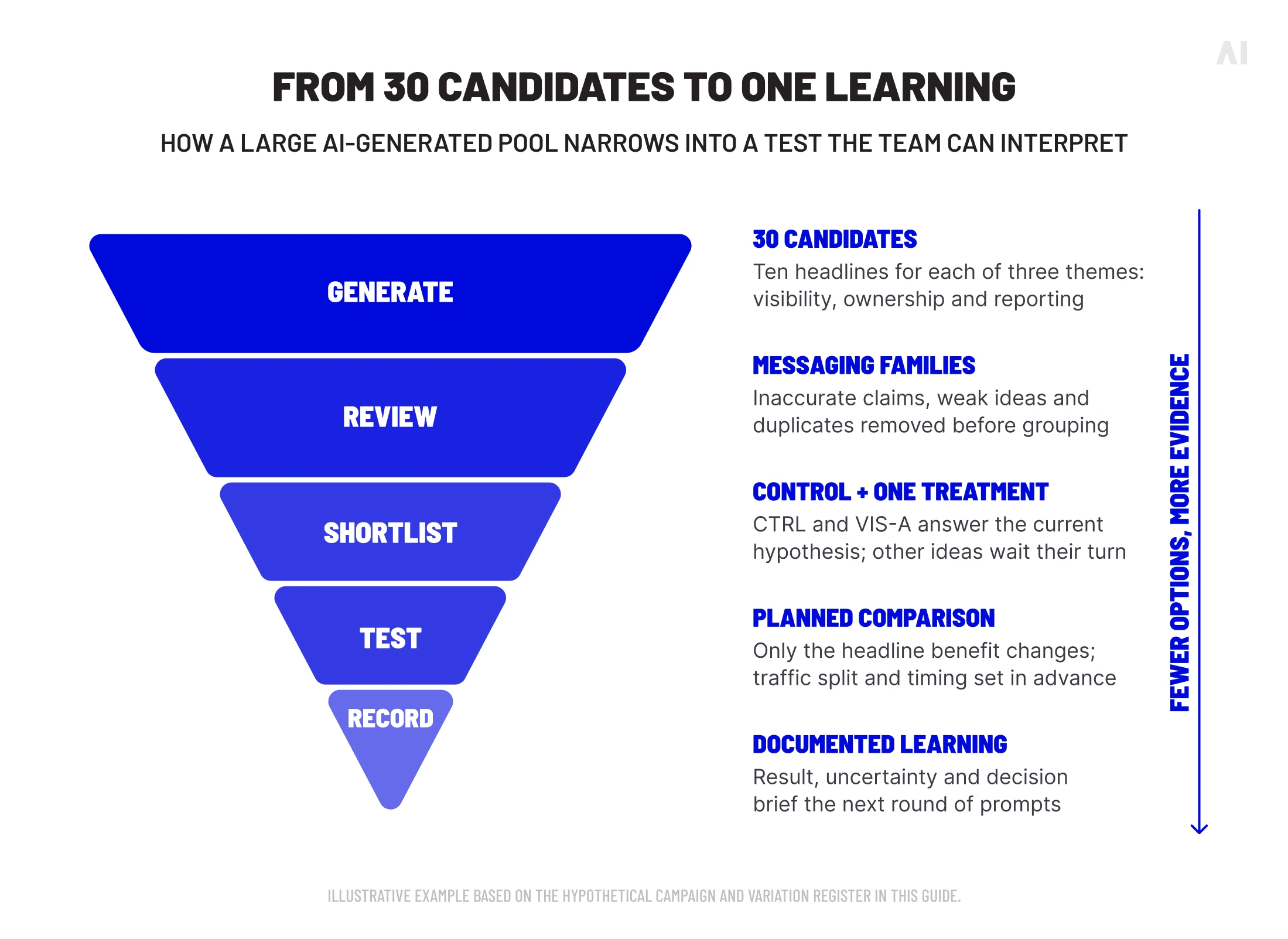
For the software campaign, a team could request ten candidates for each of three themes: project visibility, task ownership and reporting. That creates thirty options for review, not a requirement to launch every version.
AI in performance marketing gives writers more alternatives to compare, reject and develop before media spend begins.
Why more variations do not automatically mean better optimization
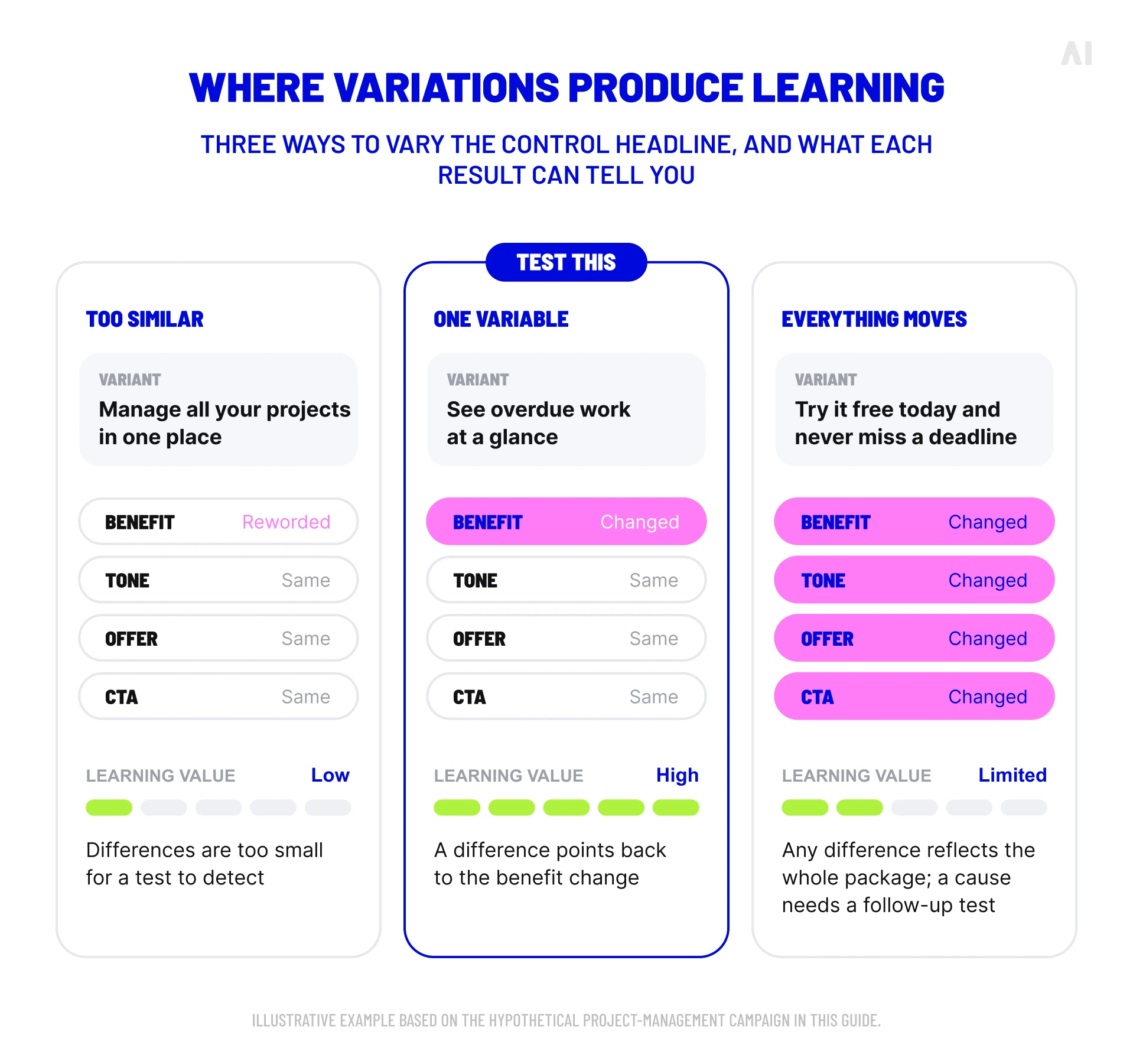
Near-identical rewrites add little learning value. Unrelated messages create a different problem: if each changes the benefit, tone, offer and CTA, interpreting any difference becomes difficult.
Available traffic also has to support the comparisons. Generating another candidate is inexpensive; collecting persuasive evidence about its performance may take considerably more budget and time.
⚡ The capacity to generate copy can grow faster than the capacity to learn from it.
Set a baseline and hypothesis
Before generating alternatives, record the current messaging, intended audience and result the campaign needs to achieve. These become the boundaries of the creative brief.
Establish the baseline and success metric
For the hypothetical software campaign, record:
- Control: the existing headline and supporting copy.
- Audience: operations managers at the intended company size.
- Offer: a product demonstration, with no change to its terms.
- Destination: the current demo landing page.
- Primary metric: cost per qualified demo request, using an agreed qualification definition.
- Supporting measures: request volume, qualification rate and click-through rate.
Check that the necessary tracking and CRM data are available. Historical performance helps plan the test, but a comparison with last month's results alone cannot isolate copy from seasonal or delivery changes.
Turn creative questions into testable hypotheses
A useful hypothesis names the change, its expected effect and the reason for expecting it. Google's experiment guidance recommends tying hypotheses to business goals and choosing success metrics before testing begins.
Prioritize the question with the strongest customer evidence and greatest potential commercial value.
Generate ad copy variations with AI
Generate families of alternatives around a defined variable. Supply the facts and constraints that distinguish the product before asking for persuasive language.
Headlines, value propositions and CTAs
Useful dimensions include the opening hook, benefit, proof point, offer framing and requested action. Urgency belongs in the brief only when a real deadline or availability constraint supports it.
A reusable prompt might read:
Create headline candidates for a paid-ad campaign.
Product: [approved product description and facts]
Audience: [role, need and relevant context]
Objective: qualified product-demo requests
Control headline: Manage projects in one place
Hypothesis: emphasizing overdue-task visibility will improve
qualified response compared with a general organization benefit.
Change only: the headline's benefit emphasis
Keep fixed: audience, offer, supporting copy and CTA
Format: [placement and verified character limit]
Voice: clear, specific and restrained
Do not invent statistics, customer endorsements, guarantees,
features, discounts or deadlines.
Return distinct candidates with a short explanation of each angle.
Flag missing information instead of filling it in.
Platform tools can also generate text. For example, Google's Performance Max generation workflow uses website content, a product or service summary and advertiser prompts to produce headlines and descriptions. Review the inputs as carefully as the output.
Audience, tone and message angles
The same capability may answer different customer concerns. An operations manager might value visibility across projects; a team lead might care more about knowing who owns the next task.
Create those audience-specific families deliberately. If the audience changes alongside the message, the result describes that combination. It cannot establish that one headline is universally stronger.
For tone experiments, accompany instructions such as “more direct” with approved brand examples.
Protect brand voice and factual accuracy
Review AI ad copy against approved facts before shortlisting. Confirm offer terms, required qualifications, character limits and compatibility with the destination page.
Google warns that generated assets can contain inaccuracies and still require review. Generation does not guarantee advertising-policy approval. Apply the same discipline when AI-written copy enters programmatic advertising workflows.
Organize variations for meaningful tests
Give every candidate an identifier and a hypothesis before it enters a live campaign. A shared register prevents approved copy, rejected drafts and active treatments from becoming mixed together.
These examples assume the product supports the stated capabilities. Add complete copy, platform IDs, dates and results during testing.
A staged process keeps the workload practical:
- Review the candidate pool. Remove inaccurate claims, weak ideas and duplicates.
- Select meaningful alternatives. Prioritize differences that answer the current hypothesis.
- Run the planned comparison. Retain other candidates for later rounds.
- Confirm promising findings. Follow exploratory signals with an appropriate controlled test.
Selecting the strongest-looking result from many comparisons can exaggerate confidence. Treat broad exploration as a way to identify promising directions, with conclusions matched to the experiment's design.
How to test AI-generated ad copy
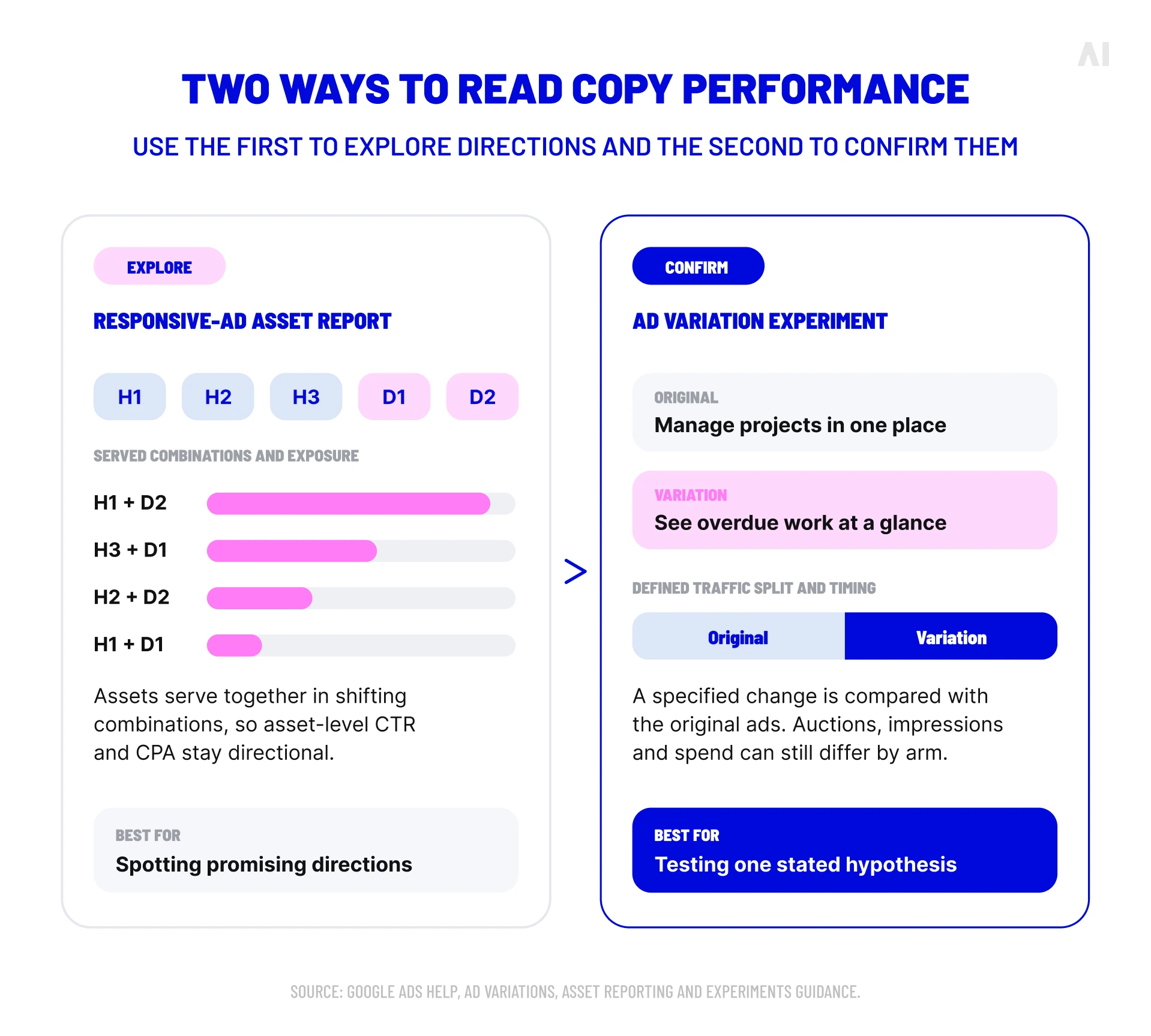
Choose the testing method around the platform, format and question. For search campaigns, Google Ads' ad variations provide a route for comparing specified messaging changes with original ads, with defined traffic allocation and timing.
Ordinary responsive-ad delivery works differently. Assets can appear in different combinations and receive different exposure. Google's current asset-reporting guidance explicitly treats asset-level CTR, CPA and related ratios as directional because assets serve together. Fuller reporting does not make those figures a clean headline-by-headline A/B test.
Even within a native experiment, a traffic split need not produce identical delivery. Google explains that auction eligibility, impressions and spend are different. Assess results using the experiment's intended comparison, rather than assuming equal impression counts are guaranteed.
Limit the variables you change at once
Document the treatment and the settings intended to remain consistent, including targeting, bids, offer, landing page and other creative assets. Record any automated text generation or enhancements that could alter what people see.
If the team wants to compare complete messaging approaches, it can change several elements deliberately. The resulting conclusion concerns the whole approach. Isolating a particular CTA or benefit requires a more focused follow-up.
Give the test enough data before drawing conclusions
Plan around traffic, conversion frequency, normal variability and the smallest improvement worth acting on. Microsoft's pre-experiment guidance connects the traffic needed to an experiment's ability to detect the anticipated effect.
Allow for conversion and qualification delays. A demo request arriving today may take time to become a qualified lead.
Monitoring remains necessary to catch broken tracking or delivery problems. However, repeatedly checking and stopping when a favorite version moves ahead can undermine the evaluation. Microsoft's guidance on running experiments explains that early checks and multiple hypotheses require appropriate statistical handling.
Use the planned evaluation method and the platform's uncertainty reporting. Inconclusive is a valid result. It means the available evidence does not justify a confident performance claim.
Metrics for ad copy optimization
Choose a primary metric that reflects the campaign objective, then use supporting measures to explain the result. A message can attract attention while bringing the wrong people to the site.
CTR and engagement signals
Click-through rate describes clicks relative to impressions. It can help assess whether messaging attracts a response within a comparable placement and audience.
It does not show what happens afterward. In the software example, a broad productivity promise might attract casual interest, while a specific operational benefit could produce fewer clicks and more suitable demo requests.
Conversion rate, CPA and business outcomes
Conversion rate tracks completion of a defined action relative to the relevant interactions or visits. State the denominator consistently. Average CPA expresses cost per conversion, so its usefulness depends on what the campaign counts as a conversion.
Choose measures the team can track reliably. For a broader view of digital marketing ROI, include production and other marketing costs; advertising revenue divided by media spend alone does not establish profitability.
⚡ A click becomes more useful evidence when you can connect it to what the customer does next.
Turn test results into better copy
Write a short learning record before requesting another batch. Include the hypothesis, treatment, audience, dates, primary result, uncertainty and practical decision. Record negative and inconclusive findings alongside improvements.
Look for message patterns, not just a single winner
Suppose the software campaign's overdue-task message performs well in the planned comparison. The next prompt can preserve that direction while exploring clearer phrasing or a different supporting proof point.
Be precise about the evidence. If several changes accompanied the headline, the result does not prove the benefit alone caused the improvement. Recurring patterns can inform the next hypothesis, followed by a focused test when isolating the cause is important.
Give AI the findings and their limits. Ask it to propose follow-up candidates, rather than invent an explanation for why customers responded.
Apply learnings across audiences and formats carefully
A promising search message may be worth exploring in social or display. Adapt it to the placement and audience, then validate it there.
Dynamic creative optimization provides a related approach to assembling and delivering creative components. Keep records of the original test context so an encouraging result does not become an unsupported rule for every channel.
Where AI copy needs human review
Human review should assess the strategy behind the message as well as the wording. Someone with product and customer knowledge needs to decide if the proposition is distinctive, credible and relevant to the buyer's situation.
Reviewers should also challenge stereotypes in audience framing, implied guarantees and sensitive claims. A sentence may be factually defensible yet create the wrong expectation when paired with an image or landing page.
Creative judgment also governs what happens after testing. A marginal improvement may offer little commercial value once production costs or lead quality are considered. A model-generated explanation of the result cannot substitute for evidence about customer behavior.
⚡ An explanation generated after the test is still an explanation to investigate.
AI Digital's approach to creative production
AI Creative Studio combines AI-native production workflows with human creative expertise to help teams build, adapt and iterate campaign assets. Its capabilities include cross-platform versioning, format adaptation, resizing, asset downcuts and creative tagging, alongside production across video, social, audio, static and interactive formats.
Within an ad copy optimization program, that production capacity can support the work surrounding a validated messaging direction: preparing assets for placements, developing adaptations and keeping creative iteration connected to media requirements.
Campaign hypotheses, live experiments and performance measurement remain part of the wider workflow, using the appropriate media-platform and analytics infrastructure.
AI accelerates learning, not creative judgment
An effective optimization cycle leaves the team with both usable creative and a clearer basis for the next decision. AI can reduce the manual effort involved in developing alternatives. The lasting benefit comes from carrying evidence forward: which messages deserve another test, which claims need stronger support and which directions have stopped earning their place.
Talk with AI Digital about scaling creative production and adaptation to support your next campaign and its next round of testing.