
Measuring return has become harder for reasons that compound. Privacy changes have thinned the signal marketers once relied on, as consent requirements, browser restrictions and the decline of third-party identifiers leave a growing share of activity unobserved. Journeys now spread across search, social, retail media, connected TV and the open web, so a single purchase carries the fingerprints of channels that never speak to one another. And the platforms selling the media grade their own homework, reporting through models built to reflect well on themselves.
Pressure on marketing leaders to prove their return climbed 21% between 2023 and 2025, with pressure from the CFO rising 52% over the same period. Boards want evidence that spend produces revenue, in terms finance recognizes. For marketers who already understand the mechanics of ROI in digital marketing, the task now is measurement rigorous enough to survive that scrutiny.
👉 Our companion guide on digital marketing measurement across channels examines why single-model attribution no longer suffices.
The digital marketing ROI formula (and where it breaks down)
At its simplest, digital marketing ROI is the revenue a campaign generates minus its cost, divided by that cost, expressed as a percentage or a ratio. Spend $100,000, earn $500,000 in attributable revenue, and the return is 400%, or 4:1. But anyone can do the arithmetic. The challenge—and it is a genuine one—is getting the inputs right.
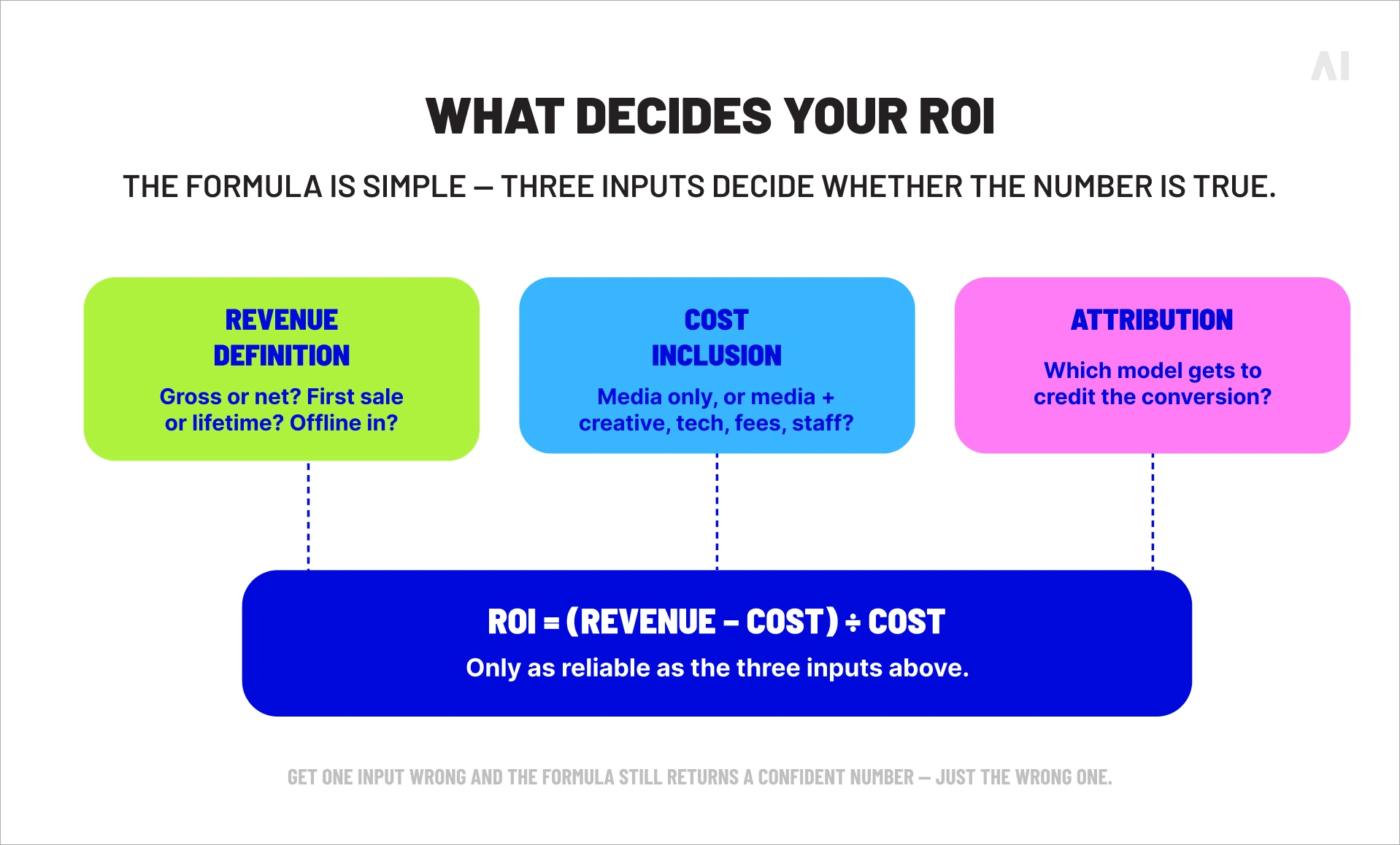
Three decisions determine whether the result means anything:
- how revenue is defined (gross or net, first purchase or lifetime, offline included or not),
- which costs are counted (media only, or media plus creative, technology, agency fees and staff time), and
- how conversions are attributed, since the revenue you assign to a campaign depends entirely on the model doing the assigning.
Get any one wrong and the formula still produces a confident number; it is simply the wrong one. A dependable answer to how to calculate ROI in digital marketing rests less on the equation than on the discipline behind those three inputs. A fuller walk-through with worked examples is coming in a dedicated guide to how to calculate marketing ROI.
ROI vs ROAS
Return on ad spend and return on investment are often used interchangeably, but they answer different questions, and confusing them leads to expensive decisions.
- ROAS divides revenue by advertising spend alone—a campaign-level efficiency gauge for comparing creatives, adjusting bids and placing the next media dollar.
- ROI divides profit by total cost, including creative production, technology, agency fees and staff, which is why finance and the executive team care about it: it reflects whether marketing is contributing to the business rather than simply moving revenue through a channel.
The distinction becomes concrete at the margins. A paid social campaign can post a 4:1 ROAS and still lose money once a large creative budget, a stack of martech licenses and a share of team salaries load in—its true ROI turning negative while the ROAS dashboard stays green. Teams that optimize to ROAS but report ROI to the board, without reconciling the two, end up defending decisions the underlying economics do not support.
👉 The interplay between margin and ad spend is developed further in our piece on profit on ad spend.
What counts as marketing revenue
Before ROI can be trusted, the revenue figure feeding it has to be honest—and in practice it inflates in three predictable ways.
- The first is platform self-attribution: Google and Meta each claim the conversions they can see under their own rules, so a single sale appears in two dashboards at once and the revenue you sum across platforms exceeds what the business recorded.
- The second is the view-through window, which credits a conversion when a user was merely served an impression, sometimes days earlier—sweeping in buyers who would have converted regardless.
- The third is the revenue that never enters the measurement stack at all, from phone orders to in-store purchases to deals closed by a rep, which leaves online-only channels looking better or worse than they are.
⚡ Accurate revenue attribution is the first prerequisite for meaningful marketing ROI measurement; everything downstream inherits its errors.
Why digital marketing ROI is hard to measure
If the formula is simple, why is a dependable answer so elusive? Four obstacles account for most of the difficulty enterprise marketers face in 2026, and they reinforce one another.
- Signal loss is the first. Consent frameworks, operating-system privacy controls and the erosion of third-party identifiers have removed much of the user-level data attribution once ran on, leaving measurement to work with partial observation and modeling.
- Platform attribution conflicts are the second. Each walled garden reports through its own logic—its own lookback windows, conversion definitions and view of what counts—and because those views overlap, the same outcome gets claimed more than once with no neutral referee to resolve the dispute. Aggregate the reports and the totals stop reconciling with reality.
- Long and complex journeys are the third. A single purchase may draw on display for awareness, search for intent, social for consideration and connected TV for reach, spread over weeks. Crediting that outcome fairly across channels never built to be compared is a genuine analytical problem, not a tooling gap.
- Organizational data silos are the fourth, and the most self-inflicted. Media data sits in one system, CRM data in another, finance in a third, with manual or absent joins between them—so each team measures its own slice and the enterprise never sees the whole. That is a problem that is organizational before it is technical.
👉 Reconstructing those interactions is the subject of guides to customer journey analytics and to cross-channel marketing measurement.
⚡ A return on investment is a figure your measurement choices produce, and different choices produce different figures.
Key metrics for ROI measurement
Headline ROI tells you whether a program paid off, not why or whether the return will hold. A small set of metrics does that diagnostic work—each correcting for something a single ROI figure conceals—turning ROI from a scorecard into a decision tool that informs where budget should move, which customers are worth acquiring, and how much of the reported return is real.
👉 Our guide to display advertising KPIs covers the channel-level indicators beneath them.
CAC and LTV ratio
Customer acquisition cost is the complete price of winning a paying customer—not the media alone, but media plus creative, sales effort, tooling and team time. Measured properly, it usually exceeds the cost-per-acquisition a platform reports, because the platform sees only its own slice of the spend.
Set against acquisition cost, customer lifetime value gives the ratio executives read as the real signal of marketing health. An LTV:CAC of around 3:1 is a widely used rule of thumb for sustainable growth, though the right threshold varies with business model, gross margin and payback tolerance, so it works as a guide rather than a law. The ratio also guards against a failure that pure ROI optimization invites: chase the cheapest conversions and a campaign can post a strong short-term return while filling the base with low-value, quick-to-churn customers, so the economics that looked healthy at acquisition decay within a year.
ROI vs profitability
A positive ROI can sit on top of an unprofitable business, and marketers who stop at the campaign number miss the distance between the two. ROI, as marketing usually calculates it, measures return against marketing cost; profitability measures what the company keeps after every cost—the goods themselves, fulfillment and shipping, returns and refunds, payment processing, overhead and support.
A campaign returning 5:1 on paid media can still lose money on a thin-margin product with a high return rate, which is why finance evaluates marketing ROI alongside contribution margin. A channel driving high revenue on low-margin products may deserve less budget than one driving modest revenue on high-margin ones, whatever the ROI on paper. Reading return and profitability together keeps optimization pointed at profit rather than at revenue that merely resembles it.
Incremental revenue
Attributed revenue answers a question of credit: of the sales that happened, which touchpoints were involved? Incremental revenue answers a harder and more useful one: how many of those sales would not have happened without the marketing? That gap separates correlation from cause, and it is where most reported ROI overstates itself.
Attribution, by design, distributes credit across the customers it can see, including the substantial share who would have converted anyway—the loyal buyer already heading to the checkout, caught by a retargeting ad on the way. Counting that sale as marketing-driven inflates the return.
Incrementality strips it out by comparing exposed audiences against held-back control groups, isolating the lift the spend actually caused, and it consistently reveals attributed ROI running ahead of true ROI—the gap widest in lower-funnel channels that harvest existing demand rather than create it.
👉 The experimental methods behind it are covered in our guide to incrementality testing in marketing.
The point to carry forward is that a channel's real contribution and its attributed contribution are rarely the same number.
Digital marketing ROI benchmarks by channel
Channel-level ROI benchmarks are the most requested and the least trustworthy numbers in the field. They circulate widely—email returning some multiple of spend, search outperforming social—but almost all originate with the platforms and vendors that benefit from the comparison, and few survive contact with independent measurement.
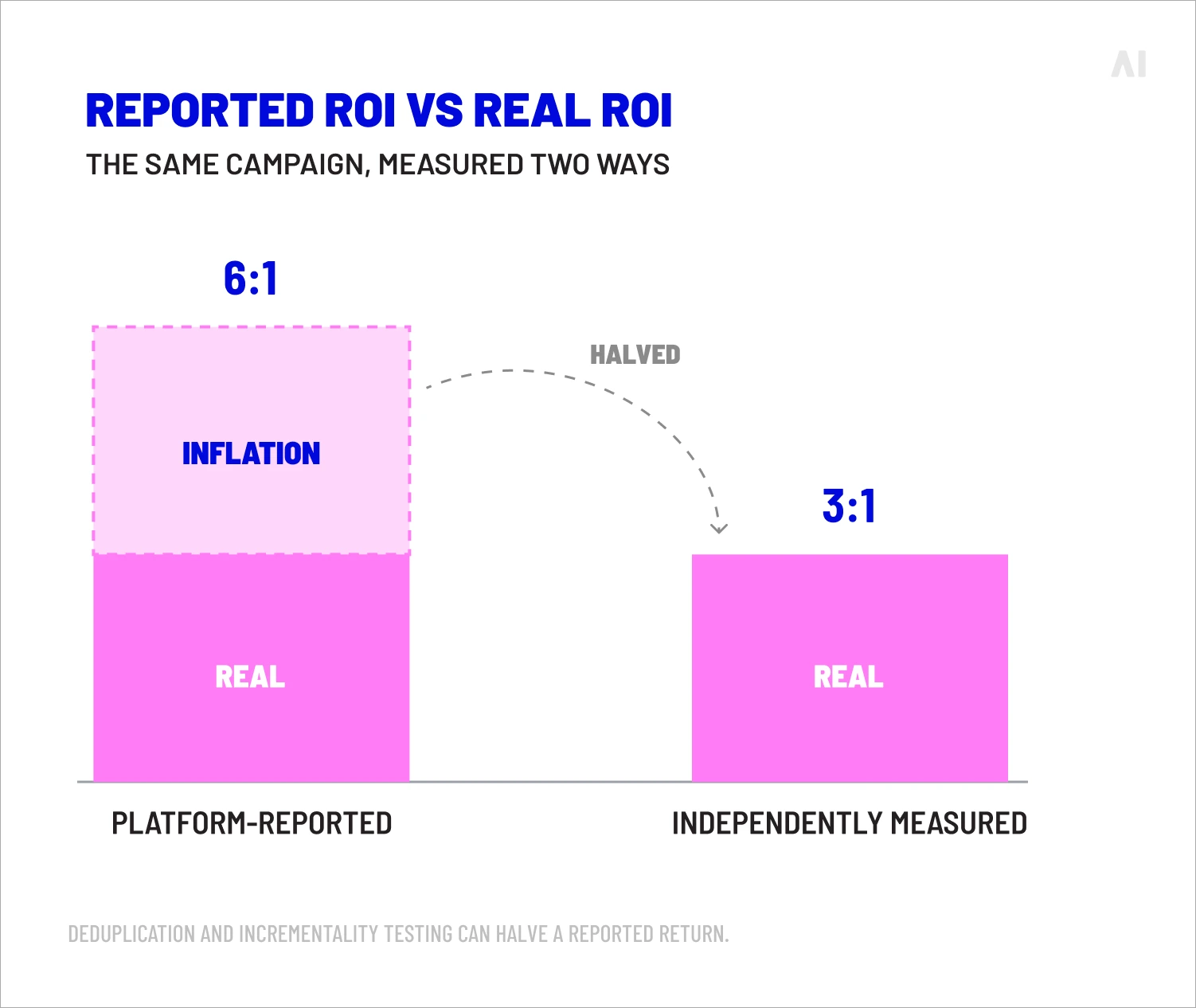
Performance varies enormously by industry, business model and, above all, by how the return was measured. A 5:1 ROI is often cited as a marker of a healthy program, but the convention means little without knowing whether the figure is platform-reported or independently verified. The same campaign can show a 6:1 return in a platform dashboard and a 3:1 return under deduplicated, incrementality-adjusted measurement, and only the second is an online marketing ROI worth managing against.
👉 For why platform-reported figures skew high in the first place, and what advertisers can do about it, see our look at alternatives to the walled garden.
How business models should measure ROI
There is no single correct way to measure marketing ROI, because there is no single kind of business. A model's sales cycle, revenue structure and the point at which money arrives all change which metrics carry the signal. An ecommerce brand banking revenue at checkout, a SaaS company earning it over years of subscription, and a lead-generation business that hands prospects to a sales team are measuring three different things, and one template across them produces confident nonsense.
E-commerce
For ecommerce brands, revenue arrives at the moment of purchase, which makes ROI look deceptively easy to read. The trap is measuring only the first sale: optimize purely for acquisition ROI and you chase one-time buyers while undervaluing the repeat purchasing where ecommerce economics live.
The metrics that deserve attention are:
- average order value
- customer lifetime value
- repeat-purchase rate
- contribution margin
- revenue
- ROAS
Each tells a different part of the story. A rising AOV improves return without extra acquisition spend. A healthy repeat-purchase rate turns an expensive first sale into a profitable relationship. And reading acquisition and retention together stops a cheap, discount-driven campaign from making performance look better than it really is.
B2B SaaS
SaaS turns the ecommerce problem inside out. Revenue does not arrive at conversion. It builds over the life of a subscription, which means immediate sign-ups are a poor measure of ROI.
A trial can be worth very little—or a great deal—depending on whether it renews for three years. Short-window measurement cannot see that.
For SaaS, the metrics that matter are:
- pipeline contribution
- customer acquisition cost
- LTV ratio
- payback period
- recurring revenue
Payback period is often the sharpest single indicator. It shows how long recurring revenue takes to recover acquisition cost, tying marketing spend to cash the business can actually plan around.
Attribution also has to stretch across long, multi-stakeholder journeys. That is why SaaS marketers lean on models built for extended sales cycles rather than last-touch reporting.
👉 Our guide to the best attribution models for B2B and long sales cycles takes that further.
Lead generation businesses
Lead-generation businesses have a measurement gap ecommerce and SaaS do not. The revenue-defining event usually happens off the website and outside the ad platform, when a sales team closes a deal weeks later. That makes lead volume a risky metric to optimize against. A campaign can generate a flood of cheap leads that look efficient in-platform but never become revenue.
For lead generation, the metrics that matter are:
- qualified leads
- closed revenue
- lead-to-sale conversion rate
- cost per qualified lead
- cost per closed deal
These connect marketing activity to money, not just to form fills.
But the connection depends on the right infrastructure:
- CRM integration, so each lead’s outcome flows back to the campaign that produced it
- offline conversion tracking, so closed deals are credited to their source
Without that loop, ROI measurement stops at the lead. The business ends up optimizing for the wrong half of the funnel.
How attribution shapes the ROI number you see
By this point it’s clear that the ROI a marketer reports is a product of how conversions are credited rather than a fixed quantity. Change the attribution model and the same campaign, spend and sales produce a different return—a property to be understood rather than a flaw to be engineered away, since each approach answers a different question and supports a different decision.
The sections below set out the main approaches—platform-bound attribution, marketing mix modeling and incrementality testing—and what each is good for.
👉 A guide to marketing attribution models compares their types and limitations in full.
The walled garden problem
The clearest illustration of attribution changing the number is the walled garden. Google, Meta, Amazon and their peers each measure and report the conversions they touched, using attribution rules of their own making. Because advertisers run several at once, and each claims a generous share of any journey it was part of, the same conversion is credited in multiple places—and summing the platform reports can yield a combined return that exceeds what the business actually earned, a mathematical impossibility that appears in dashboards every day.
The consequence for ROI is systematic inflation that pushes budget toward whichever platform reports most flatteringly rather than whichever contributes most. The correction is an independent measurement layer that sits above the platforms, deduplicates their overlapping claims and grades performance on consistent terms. Trusting platform dashboards alone is the equivalent of letting each supplier audit its own invoice.
👉 The structural reasons closed ecosystems behave this way are set out in our primer on the open garden framework and our work on marketing effectiveness measurement challenges.
Attribution vs marketing mix modeling
Attribution and marketing mix modeling are frequently posed as rivals, when in practice they operate at different altitudes.
- Attribution works from user-level data, reading individual journeys to credit touchpoints; it is granular, fast and well suited to tactical decisions—which creative to keep, which keyword to fund, where the next increment of budget performs hardest. Its blind spots are the channels it cannot track and the causation it cannot prove.
- Marketing mix modeling works from aggregate, historical data, using statistics to estimate how each channel—digital and offline, paid and unpaid—contributes to business outcomes over time. It sees the whole board, including television, print and the base demand attribution ignores, and it suits strategic questions of allocation rather than day-to-day optimization. Its cost is cadence: models refresh in weeks or months, not hours, and need years of consistent data to earn trust.
The productive relationship is a division of labor—attribution runs the operational layer, MMM the strategic one—and treating them as competitors forfeits what each does best.
👉 Our guide compares the two alongside incrementality: marketing measurement vs attribution vs MMM.
Incrementality testing
Incrementality testing is the method that checks the others' work. Where attribution assigns credit and MMM estimates contribution, incrementality asks the causal question directly: run the campaign against a comparable group deliberately left unexposed, and the difference in outcomes is the lift the spend caused. Nothing else validates ROI so cleanly.
Its role in a measurement program is confirmation. Attribution can report that paid search delivered a strong return; only an incrementality test can confirm whether that return reflects demand the channel created or demand it merely intercepted.
Used as a periodic check on attribution-based ROI, it keeps the day-to-day numbers honest and stops a well-optimized dashboard from drifting away from business reality.
👉 Our explainer covers what incrementality testing involves in practice; within this guide, it is the validation layer that separates a return that looks real from one that is.
⚡ The dashboard number and the deduplicated number are rarely the same, and only one of them is worth setting a budget by.
Create a reliable marketing ROI framework
Understanding why ROI misleads is the easy part. Building a measurement program that produces a number worth acting on is the work, and it is more attainable than it sounds when approached in order.
What follows is a practical sequence for enterprise marketers and marketing-operations teams—three moves that turn ROI measurement from a reporting exercise into a decision system, each depending on the one before it.
👉 For the wider system this sits within, see our guides to building a scalable marketing measurement framework and to defining a marketing measurement strategy across channels.
1. Define business goals and revenue metrics
Meaningful ROI starts before any data is collected, with a clear statement of what the business is trying to achieve and how revenue will be counted. A program aimed at new-customer acquisition should not be judged by the same revenue metric as one defending an existing base, and a long sales cycle needs a definition that reaches past the first transaction.
The practical task is to agree, up front and across teams, on the objectives that define success and the revenue metrics that represent them—gross versus net, new versus total, immediate versus lifetime.
Aligned to those outcomes rather than to channel vanity metrics, the resulting ROI is both more accurate and more actionable.
2. Build a reliable measurement foundation
A reliable ROI number rests on a data foundation most organizations have to build deliberately. Four components carry the weight:
- First-party data, collected with consent, replaces the third-party signal that privacy changes have removed.
- Server-side tracking recovers conversions that browser restrictions and blockers would otherwise drop.
- CRM integration connects marketing touchpoints to what customers do afterward, closing the loop between spend and revenue.
- A single source of truth—one governed data layer the whole organization measures from—ensures marketing, finance and analytics read the same numbers rather than arguing three versions of them.
These are not glamorous investments, and they compete for budget against tools that show results faster. But cross-channel measurement is only as trustworthy as the data beneath it: the strongest analytical layer built on fragmented inputs produces fragmented answers. The foundation is where accuracy is won or lost.
3. Align metrics with business outcomes
The final step connects marketing measurement to the language of the business by aligning marketing and finance around a shared set of KPIs.
Left to themselves, the two functions measure in different currencies—marketing in impressions, clicks and ROAS, finance in margin, payback and contribution—and the translation losses between them are where marketing's case for investment usually breaks down. When profitability, payback period, CAC, LTV, ROAS, attribution and revenue contribution are defined once and shared, budgeting becomes an evidence-based decision both sides can read.
The prize is better investment: a CMO who can express marketing's return in the terms finance already uses can defend and expand the budget on the merits.
👉 Our guide to digital marketing KPIs details the measures that populate such a framework.
How to improve ROI digital marketing
Measurement earns its keep only when it changes what a marketer does. Once ROI is measured honestly, the question becomes how to improve it—and the answer is rarely the generic advice to target better or spend smarter.
Real improvement comes from a handful of levers enterprise teams control, each raising return through a different mechanism:
- converting more of the traffic already paid for,
- producing creative that works harder,
- keeping customers longer,
- moving budget toward genuine contribution,
- cutting supply-chain waste, and
- applying AI without surrendering visibility.
This is the practical core of how to improve ROI in digital marketing.
Improve landing page conversion rates
The fastest way to raise ROI is often to spend nothing more on media and instead convert more of the traffic already arriving. Every point of conversion-rate improvement multiplies the return on spend already committed, which makes the landing page one of the highest-leverage surfaces in the program.
The work is mundane and reliably effective:
- sharpening the match between ad message and page promise,
- removing friction from forms and checkouts,
- clarifying the single action the page wants a visitor to take, and
- testing changes rather than guessing at them.
Small compounding gains—a clearer headline, a shorter form, a faster load—accumulate into materially better economics with no additional acquisition spend.
Improve creative performance
Creative is the variable most likely to move performance and the one most often left static. The difference between an average execution and a strong one shows up directly in engagement, conversion rate and the return a campaign posts, and unlike audience or bid adjustments, creative improvement compounds across every channel it runs on.
The more effective pattern is continuous creative testing: producing enough variation to learn what resonates, reading the results, and feeding them back into the next round.
The constraint has always been production capacity—testing at volume demands more assets than most teams can make—and AI-assisted production changes that arithmetic, generating and adapting assets fast enough to keep a genuine testing program supplied.
This is where AI Digital's AI Creative Studio fits. It pairs AI-powered production tools with a hands-on creative team to build original creative from scratch—across video, audio, display, social and rich media—and to scale existing campaigns across formats and sizes at speed. For a marketer, the benefit is measured in outcomes: more creative variations tested, higher engagement, better conversion, and a stronger return from the same media investment. Creative stops being the fixed input in the ROI equation and becomes a lever.
Improve customer retention
Acquisition dominates marketing attention, but retention often delivers the higher return, because keeping a customer costs a fraction of winning one and the revenue compounds. A program that pours budget into the top of the funnel while customers leak out of the bottom is refilling a bucket rather than growing one, and its ROI suffers even when acquisition looks efficient.
The levers are familiar and underused:
- encouraging repeat purchases,
- lifting customer lifetime value through relevant follow-up,
- building loyalty that reduces price sensitivity, and
- sustaining post-purchase engagement so the first sale becomes the first of many.
Each raises ROI by extracting more value from customers already acquired, which tends to reveal that the cheapest growth available is the growth a brand already paid for and is failing to keep.
Reallocate budget based on incrementality
The most reliable way to raise real ROI without raising spend is to move budget from channels that report well to channels that perform well—and those are not always the same.
- Attribution tends to reward the lower-funnel activity that harvests existing demand, so budgets drift toward it, while the upper-funnel work that creates demand looks weaker on attributed numbers and gets starved.
- Incrementality testing exposes the mismatch.
Consider a brand running a large paid-search program with a strong attributed return; a test reveals that roughly 60% of those conversions would have happened without the ads—the channel is intercepting demand, not generating it. Moving 20% of that budget into connected TV and upper-funnel programmatic, at unchanged total spend, buys incremental outcomes rather than credit for inevitable ones, and net-new customer acquisition rises. Bain & Company has documented experimentation of this kind lifting ROI by 20% or more for major advertisers.
👉 Our guide to media mix optimization covers how to run this reallocation systematically.
Reduce media waste
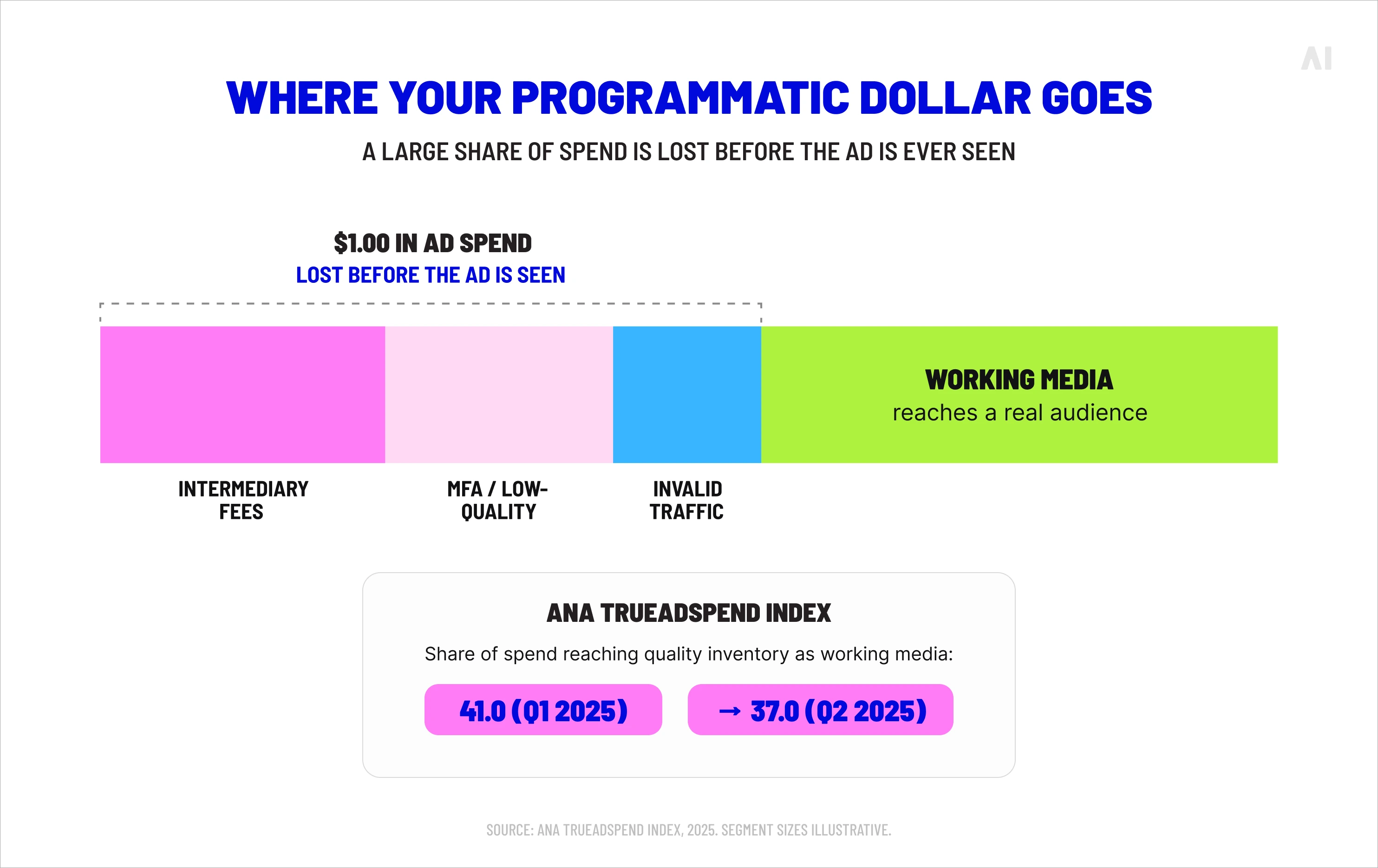
A large share of programmatic ROI is lost before an ad is ever seen. Budgets leak into made-for-advertising sites built to attract spend rather than audiences, domain spoofing and invalid traffic, and layers of intermediary fees between buyer and publisher—none of it a visible line item, all of it lowering the return.
The scale of the leakage is documented: the ANA's TrueAdSpend Index, which tracks the portion of programmatic spend reaching quality inventory as working media, fell from 41.0 in the first quarter of 2025 to 37.0 in the second—a signal the problem is worsening rather than resolving.
Recovering that lost return is a matter of supply selection and optimization: choosing the paths a bid travels, favoring direct publisher relationships, and eliminating the redundant hops and low-quality inventory that inflate cost without improving outcomes.
AI Digital's Smart Supply approach concentrates spend on transparent, quality supply, so more of every dollar reaches a real audience.
👉 Our guides to programmatic advertising and media planning and buying go deeper on the mechanics.
⚡ The return on a campaign is decided partly in the supply chain, where spend is lost before the audience is ever reached.
Leverage AI for campaign optimization
AI has opened a real efficiency frontier in campaign optimization—smart bidding that adjusts in real time, creative testing at a scale humans cannot match, audience modeling that finds patterns a planner would miss.
Used well, it lifts ROI by squeezing waste and delay out of processes that were manual and slow. The caution is about visibility. Much AI optimization runs as a black box that improves the metric it is pointed at—often platform-reported ROAS—while obscuring whether real business impact moved with it, pulling reported and real performance apart from each other.
The way to capture the efficiency without inheriting the blindness is to pair AI optimization with independent measurement, so the gains are validated against business outcomes rather than platform self-report.
👉 Our comparison of AI marketing platforms and the traditional martech stack and our piece on AI in programmatic advertising develop the point.
How AI Digital helps measure ROI accurately
Everything to this point argues for the same conclusion: accurate marketing ROI depends on measurement the platforms do not control, media the supply chain does not erode, and a data layer the whole organization can trust.
AI Digital is built around that conclusion, combining independent measurement, marketing intelligence and transparent media buying so marketers can see genuine return rather than platform-reported return—and act on it.
The effect is less wasted spend, sharper budget allocation, and more confident decisions across every channel, set against the closed alternative in our analysis of walled gardens versus the open internet.
Get a clear ROI view with Elevate
The obstacle to accurate ROI is usually not a shortage of data but a surplus of disconnected data—every platform reporting its own version, none reconciling.
Elevate, AI Digital's marketing intelligence platform, addresses that by bringing performance data from across channels into a single, independent measurement layer. It does not bid, serve ads or optimize creative; its role is marketing intelligence and measurement, which is precisely why it can grade every channel on neutral terms rather than accepting each platform's account of itself. The practical result is a unified view of return that platform dashboards cannot provide: overlapping claims deduplicated, reporting discrepancies resolved into one number, and an ROI the business can act on and defend—so optimization and budget decisions rest on evidence rather than on whichever platform argued its case most persuasively.
Improve media efficiency with Smart Supply
Where Elevate sharpens what marketers can see, Smart Supply improves what they buy. Working within AI Digital's Open Garden framework, it raises campaign efficiency by increasing transparency into the media supply chain and reducing the low-quality inventory that drains return. Supply path optimization is the mechanism: by selecting and optimizing the routes a bid travels—favoring direct, transparent paths and filtering out made-for-advertising inventory, redundant intermediaries and invalid traffic—Smart Supply concentrates spend where it reaches genuine audiences on quality inventory, lifting the return on every dollar without increasing spend. Combined with the intelligence and independent measurement Elevate provides, it closes the loop between seeing return accurately and improving it deliberately.
👉 The framework behind this approach is set out in our guide to the open garden framework, and the tool itself in our Smart Supply overview.
From reported ROI to real ROI: a smarter measurement standard
The argument of this guide reduces to a single idea: digital marketing ROI is less a single number than the output of a chain of decisions—how revenue is defined, how conversions are attributed, how clean the media is, and whose measurement you trust. Change any link and the return changes with it. Marketers who struggle tend to treat the platform dashboard figure as fact; those who pull ahead treat it as a claim to be verified.
Moving from reported ROI to real ROI means adopting independent, deduplicated measurement, validating attributed return against incrementality, and refusing to let the sellers of media be the sole scorers of it. It is more demanding than accepting the dashboard, and it separates optimizing an illusion from growing a business. As accountability from boards and finance intensifies, measurement rigor stops being a technical nicety and becomes a competitive advantage: the organizations that can prove their return will win the budgets, and the argument, over those that can only report one.
If you want to measure and improve your marketing ROI on those terms, get in touch with AI Digital.
👉 Our guide to creating a data-driven marketing strategy explains the next step.